
1 PERSONALITY DO CONTINUED Chapter 16 2 Borderline
1 PERSONALITY D/O, CONTINUED Chapter 16
2 Borderline Personality d/o • Cutting may relieve tension • Relationships stormy – love & hate – demanding – fall in love quickly & then disappointed w that person > feel hurt > rage • Black & white thinking • boundaries • Hurt themselves as message to others
3 Borderline Personality d/o • Sense of self damaged – change minds, majors, careers, partners, friends, sexuality – few work • Dissociative flavor – another person in there • 2% pop • Mostly F • Mellow w age – less suicidal
4 Borderline • Males – aggressive, antisocial flavor • Theories • Comes from Freud – on the border • Psychoanalytic > unloving parents – chaotic or violent backgrounds – some were phys or sex abused - insecure about self – lonely – fear rejection • Biological – underactive prefrontal cortex + overactive amygdala – lower serotonin levels (5 -HTT gene) – linked to aggression

5 Borderline • b/c of biology > miss/misread internal & external cues • Biosocial theory – child has internal issues > then environment shapes them – learning aspect • - how child is treated by others • - who teaches him/her ? • - cultures in change > society might fail these children • TX • Talk therapy might help – certain type of clinician – boundaries – psychoanalysis not helpful – analyst too quiet – hate interpretations (judgments)
6 Borderline • TX • Newer relational therapy better • > maladaptive beh • > sense of self • > est relationships • Linehan’s Dialectical Behavior Therapy (DBT) helpful • > CBT + Client-centered therapy > goal social skills • Multidrug therapy – antidepressants + antianxiety + antipsychotics
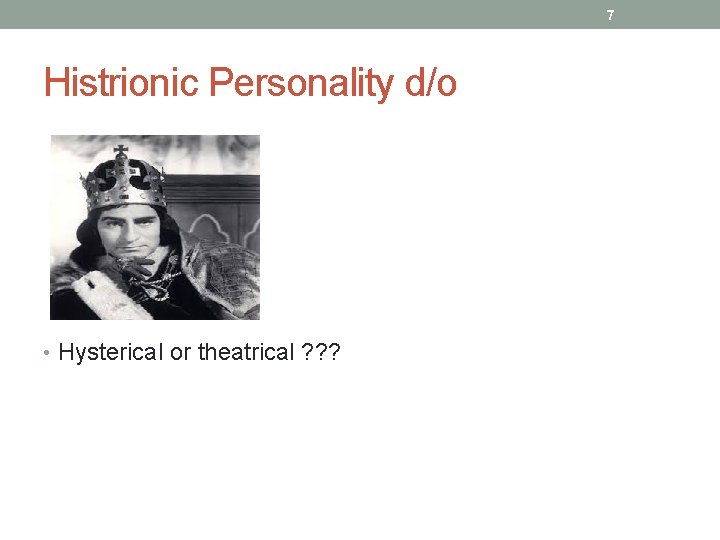
7 Histrionic Personality d/o • Hysterical or theatrical ? ? ?
8 Histrionic • Perform • Exaggerate • Grand behavior • Impressive • Change persona to impress you > must be praised • Shallow • Vain • Inconsiderate • charming
9 Histrionic • Flirt or seduce • Might act ill for attn • Attractive • Shallow relationships that they overestimate • Often drawn to abusers • Overly associated w/ women – “hysteria” • 2% pop • F=M
10 Theories • Psychodynamic – roots in hysteria – unloving parents – child has to act extreme for attn/love – follow that as adults – fear loss/rejection • Cognitive – too self-centered – no pay attn to environment – too fearful of being inadequate – lack social skills – want others to control, care for and direct them • Sociocultural – societies that encourage immaturity – tolerate dependence – or America & Hispanic > more sexualized – lead to more histrionic
11 Treating Histrionic P d/o • More likely than pts w/ other personality disorders to go for help • Issue: pt will focus on impressing the clinician rather than on therapy Psychologist – watch boundaries – ignore flirting, pretentiousness, etc – stay professional Talk therapy – group – encourage insight – psychodynamic helps > childhood & need for approval Meds – no help
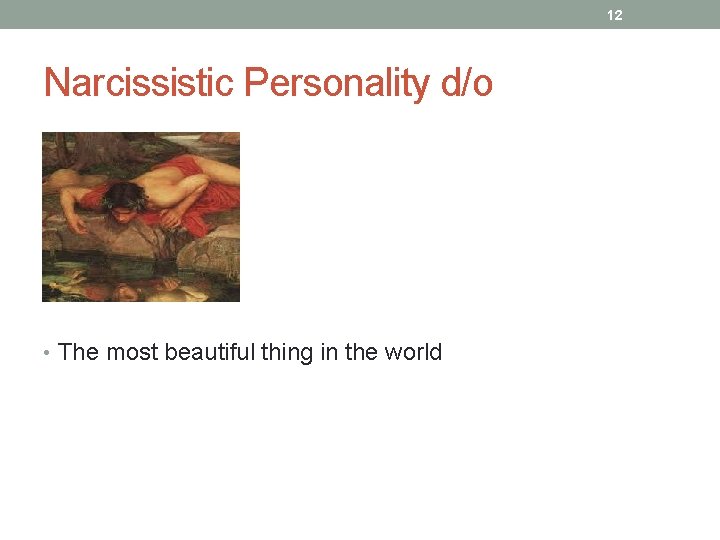
12 Narcissistic Personality d/o • The most beautiful thing in the world
13 Narcissistic • No empathy • Pleased w/ themselves • They think they are great, important, powerful • Deserve admiration for their looks, style, minds, greatness • Seem rude & arrogant to others • Know how to make a good impression > they are not nice, don’t care, jealous (but think others are jealous of them) • Some lash out at others if criticized – others turn to stone • similar to teenagers > they usually grow out of it
14 Narcissistic • Some depressive sx • 1% • Majority male • Theories • Psychodynamic – rich literature on this – cold, rejecting parents – child compensates by demanding attn – mistrust world • Object relations > convincing themselves that they are important and independent • Consider world cut off from them
15 Narcissistic • Theories – psychodynamic > children often had early loss, some abused • Cognitive-behavioral theory – opposite of above – parents too indulgent - spoiled for doing little • Sociocultural – narcissistic societies – esp US – produce these people [Getz questions this] • TX – may show up b/c of depression, comorbid condition – pts do not see narcissism as problem – no insight
16 TX • - will not accept criticism, feedback • Hard to work with > experts at manipulation • Psychodynamic therapy > cut through defenses • CBT – be less self-centered – focus on another person, consider others’ feelings, opinions – teach them • Mixed results
17 Cluster C • Anxious, afraid, withdrawn – appear like depressed or anxious people – but different • Avoidant Personality d/o • Uncomfortable in social encounters – worry about rejection – timid, shy > even w/ loved ones – similar to social anxiety d/o • Social anxiety d/o > situation • Avoidant personality d/o > issues w relationship • Many young people shy > outgrow • 1 -2% pop
18 Avoidant Personality d/o • Theory – recognize similarity to anxiety – may be comorbid • No overarching theory • Psychodynamic – parents shamed the child – toilet- training – punished in front of others – child feels inadequate • Cognitive – criticized as children – see world as judgmental – assume all negative – ignore/mistrust praise
19 Avoidant Personality d/o • Behavioral – never learned good social skills • TX – pt may be mistrustful of clinician – build trust • Psychodynamic – return to childhood > find conflicts • CBT – change negative thinking – help pt build confidence in own judgments & abilities • Group helpful • Meds help anxiety sx
20 Dependent Personality d/o • Fear being separated – demand care, encouragement – they have relationships – fear talking the lead – clingy – won’t take initiative in forming relationships – dislike themselves – may find & stay w/ abusers • Suicidality – go to Ers for depression (hopelessness) & anxiety sx • Theories • Psychodynamic – Freudian oral stage fixation – can’t trust • Object Relations (offshoot) – poor attachment & mistrust
21 Dependent Personality d/o • - some say too much parenting – overprotected • Behaviorist – overprotecting parents mold this – reinforce clingy behavior > that’s love – or parents dependent & model this – never learns independence • TX – depends on psychologist – might use family/couples therapy • Psychodynamic – therapist encourages transference – pt will want doc to lead him/her > doc interprets & gives back autonomy
22 Dependent Personality d/o • CBT – encourage pt to take control over own life – therapist challenges mistaken ideas about incompetence & behaviorist aspect > assertiveness training • Group good
23 Obsessive-Compulsive Personality d/o • Focus on perfection, being right, order, inflexibility – worry about doing the job correctly, rather than doing it • Unsatisfied w selves & life • Morally rigid • Little pleasure • Relationships shallow, neglected • 1 -2% pop • Mostly males; often White, well-off • Often comorbid with other conditions • Not always OCD
24 O-C Personality d/o • Theory • Psychodynamic – richest theory – Freud said anal regressive – fixated b/c of poor toilet-training – hold in stool & feelings – many collect things • Cognitive – misread themselves & world • TX • Usually come for help b/c other problems • Pts responsive to all major therapies • Psychodynamic – bring out unconscious conflicts – be accepting
25 O-C Personality d/o • CBT – less focus on perfectionism – give up black & white (dichotomous) thinking • Meds – SSRIs – for depression
26 Multicultural Aspects of Personality d/o • Unknown area • Minorities dealing w social issues • Why Latinos in US more likely to be dx w/ borderline personality d/o ? • Expressed emotionality OK ? ?
- Slides: 26