
1 PART B The Human Body Maintaining Life
1 PART B The Human Body: Maintaining Life Power. Point® Lecture Slide Presentation by Jerry L. Cook, Sam Houston University ESSENTIALS OF HUMAN ANATOMY & PHYSIOLOGY EIGHTH EDITION ELAINE N. MARIEB Copyright © 2006 Pearson Education, Inc. , publishing as Benjamin Cummings
Necessary Life Functions § Maintain Boundaries § Movement § Locomotion § Movement of substances § Responsiveness § Ability to sense changes and react § Digestion § Break-down and delivery of nutrients Copyright © 2006 Pearson Education, Inc. , publishing as Benjamin Cummings
Necessary Life Functions § 14. Metabolism – all chemical reactions within the body § Production of energy § Making body structures Copyright © 2006 Pearson Education, Inc. , publishing as Benjamin Cummings
Necessary Life Functions § Excretion § Elimination of waste from metabolic reactions § Reproduction § Production of future generation § Growth § Increasing of cell size and number Copyright © 2006 Pearson Education, Inc. , publishing as Benjamin Cummings
Survival Needs § Nutrients § Chemicals for energy and cell building § Includes carbohydrates, proteins, lipids, vitamins, and minerals § Oxygen § Required for chemical reactions Copyright © 2006 Pearson Education, Inc. , publishing as Benjamin Cummings
Survival Needs § Water § 60– 80% of body weight § Provides for metabolic reaction § Stable body temperature § Atmospheric pressure must be appropriate Copyright © 2006 Pearson Education, Inc. , publishing as Benjamin Cummings
Homeostasis § 15. Homeostasis - Maintenance of a stable internal environment = a dynamic state of equilibrium § Homeostasis must be maintained for normal body functioning and to sustain life § Homeostatic imbalance – a disturbance in homeostasis resulting in disease Copyright © 2006 Pearson Education, Inc. , publishing as Benjamin Cummings
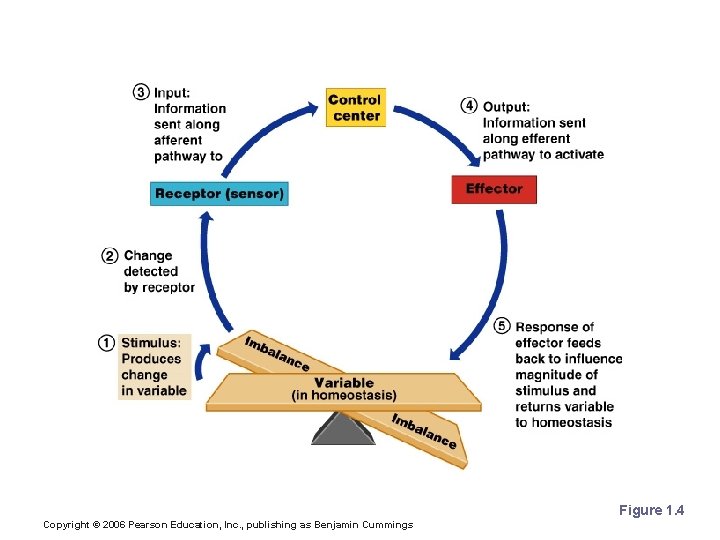
Overview of Homeostasis Figure 1. 4 Copyright © 2006 Pearson Education, Inc. , publishing as Benjamin Cummings
Maintaining Homeostasis § The body communicates through neural and hormonal control systems § Receptor § Responds to changes in the environment (stimuli) § Sends information to control center Copyright © 2006 Pearson Education, Inc. , publishing as Benjamin Cummings
Maintaining Homeostasis § Control center § Determines set point § Analyzes information § Determines appropriate response § Effector § Provides a means for response to the stimulus Copyright © 2006 Pearson Education, Inc. , publishing as Benjamin Cummings
Feedback Mechanisms § Negative feedback § Includes most homeostatic control mechanisms § Shuts off the original stimulus, or reduces its intensity § Works like a household thermostat Copyright © 2006 Pearson Education, Inc. , publishing as Benjamin Cummings
Feedback Mechanisms § Positive feedback § Increases the original stimulus to push the variable farther § In the body this only occurs in blood clotting and birth of a baby Copyright © 2006 Pearson Education, Inc. , publishing as Benjamin Cummings
- Slides: 12