
1 Overview of types of financial activities Traditionally


- Slides: 30
1 Overview of types of financial activities Traditionally, financial activity is divided into: • Banking • Capital Markets • Insurance
2 Banking • Banking is the oldest intermediation function performed in a developed economy • Banking involves intermediation in the collection of savings which are then invested in credit or, generally speaking, financial intermediation • A bank assume the risk of its investment. It commits itself to repay the money borrowed from depositors or investors independently of the return of its assets
3 Banking • Banking functions • To intermediate funds from savers to the economic system • Liquidity transformation: banks lend against expiry dates which do not necessarily match those of its own borrowing (e. g. the bank may demand deposits to provide long term mortgage loans) • Screening and monitoring risks: a bank assesses the merits of the firm which receives credit
4 Banking • Banks may acquire funds: • in the form of deposits. The 2 basic types being on • “demand deposits”: consists of funds held in an account from which deposited funds can be withdrawn at any time from the depository institution, such as a checking or savings account, accessible by a teller, ATM or online banking. • “time deposits”: is an interest-bearing bank deposit account that has a specified date of maturity, such as a saving account • issuing securities in financial markets, such as bonds • in the interbank market
5 Banking The funds raised from the savers can be employed • in short, medium, long-term lending: • Invested in shares, or others financial instruments, and assuming the risk associated with: • Stakes can be acquired for mere investment purpose (typical activity for a merchant bank) • Stakes can be acquired as a stable holding with an active involvement in the management of the firm business • Stakes can be acquired as venture capitalist and private equity funds for the purposes of setting up and supporting new enterprises in the earlier stages of their development or to help restructure an existing business in trouble
6 Banking • EU definition of a “credit institution”: An undertaking whose business is to receive deposits or others repayable funds from the public and to grant credits for its own accounts
7 Banking • It is essential to take account of the diversity of credit institutions in the Community • Notwithstanding the existence of a definition of “credit institution” in the EC directives, each country has a legal definition of banks, that can be only partial coincident with the European one (see Italian, French and English laws) • Different legal definitions depends on different banking models
8 Banking • Banking models • “Universal bank” is a bank that offers both banking and stock broking services to its clients (the banking model of EC directives) • “Specialised bank” (e. g. specialization between commercial banks and investment banks in the U. S. A. or the specialization between short-term banks and long-term banks in Italy in the past) • “House bank” is a bank that holds stable stakes in non financial firms (e. g. German banks)
9 Banking In the last decades of the previous century, new developments took place in the financial system which altered its structure and size significantly: • Financial innovation • Globalization • New approach of public intervention (prudential supervision, deregulation, privatisations)
10 Banking �Developments of banking business and financial innovation: 1. Payment services: a very traditional activity that has been developed by the banks into new products, such as e. g. EFT, POS payments, electronic money 2. Issue of warranties: guarantees granted by banks on behalf of their clients or in their favour (such as back up facilities)
11 Banking 3. Assisting and advising commercial and industrial firms in financial operations (such as mergers and acquisitions, leverage buyout, takeover bids): banks providing these services can act in the role of originator, arranger, advisor, lead-manager, book runner) 4. Services provided by individual banks and syndicates in the placement of shares, bonds and other financial instruments: selling syndicate; underwriting syndicate; purchasing syndicate
12 Banking 5. Securitisation: a traditional securitization scheme involves the legal and economic transfer of assets to a special-purpose vehicle that issues commercial paper that are claims against the assets transferred. a) Different classes of commercial paper (junior, mezzanine, senior) are normally issued, and each class has a different priority claim on the cash flows originating from the underlying pool of assets. b) Synthetic securitisation: a securitisation where the transfer of risk is achieved by the use of credit derivatives or guarantees, and the pool of exposures is not removed from the balance sheet of the originator credit institution
13 Banking Securitisation has changed the banking model from: • “originate to hold” : banks extend loans to firms and households and hold them in their balance sheets until they mature or are paid off to • “originate to distribute”: to transform banks illiquid assets into marketable securities and provide an additional source of funding to expand lending
14 Capital markets • Capital markets includes a wide array of agents and activities that provides: • Organization • and • Proper functioning of markets for the trading of financial instruments (debt and equity)
15 Capital markets • Capital markets are organized stock exchanges where companies finance their investments raising funds directly from the investing public or indirectly through institutional investors • The risk of the investment remains with the investor, since the intermediary that manages and invests financial resources does not assume any risk of the investment (contrary to e. g. bank deposit)
16 Capital markets • The importance of capital markets in financial systems varied from one country to another: • Market driven: securities markets share center stage with banks in terms of getting household savings to firms, exerting corporate control, and easing risk management (such as UK and the United States) • Bank oriented systems: banks play a leading role in mobilizing savings, allocating capital, overseeing the investment decisions of corporate managers (such as Germany and Japan).
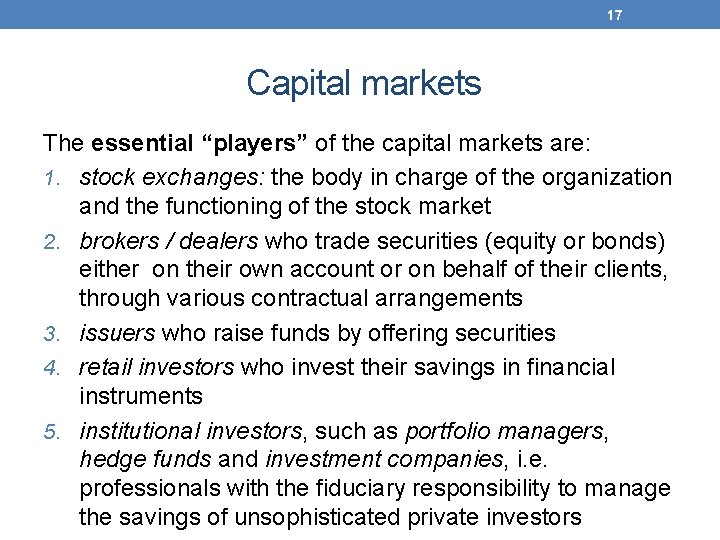
17 Capital markets The essential “players” of the capital markets are: 1. stock exchanges: the body in charge of the organization and the functioning of the stock market 2. brokers / dealers who trade securities (equity or bonds) either on their own account or on behalf of their clients, through various contractual arrangements 3. issuers who raise funds by offering securities 4. retail investors who invest their savings in financial instruments 5. institutional investors, such as portfolio managers, hedge funds and investment companies, i. e. professionals with the fiduciary responsibility to manage the savings of unsophisticated private investors
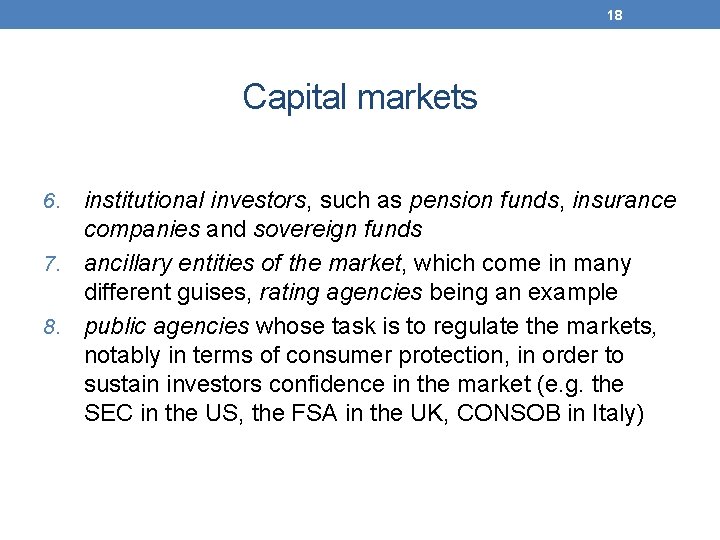
18 Capital markets institutional investors, such as pension funds, insurance companies and sovereign funds 7. ancillary entities of the market, which come in many different guises, rating agencies being an example 8. public agencies whose task is to regulate the markets, notably in terms of consumer protection, in order to sustain investors confidence in the market (e. g. the SEC in the US, the FSA in the UK, CONSOB in Italy) 6.
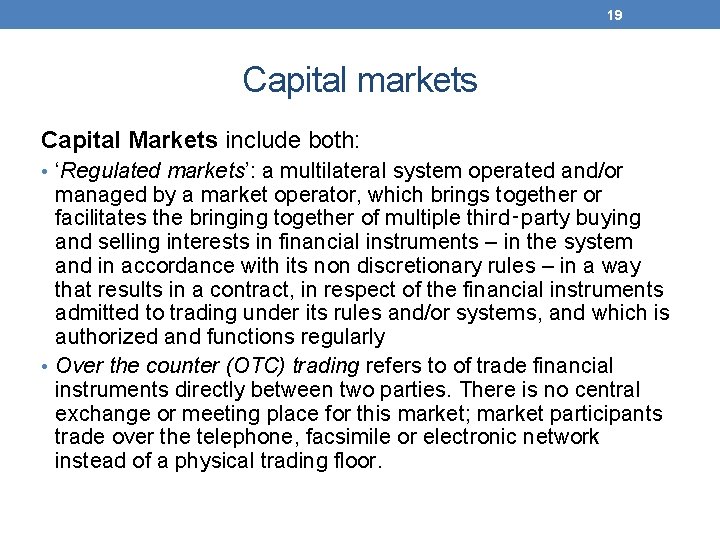
19 Capital markets Capital Markets include both: • ‘Regulated markets’: a multilateral system operated and/or managed by a market operator, which brings together or facilitates the bringing together of multiple third‑party buying and selling interests in financial instruments – in the system and in accordance with its non discretionary rules – in a way that results in a contract, in respect of the financial instruments admitted to trading under its rules and/or systems, and which is authorized and functions regularly • Over the counter (OTC) trading refers to of trade financial instruments directly between two parties. There is no central exchange or meeting place for this market; market participants trade over the telephone, facsimile or electronic network instead of a physical trading floor.
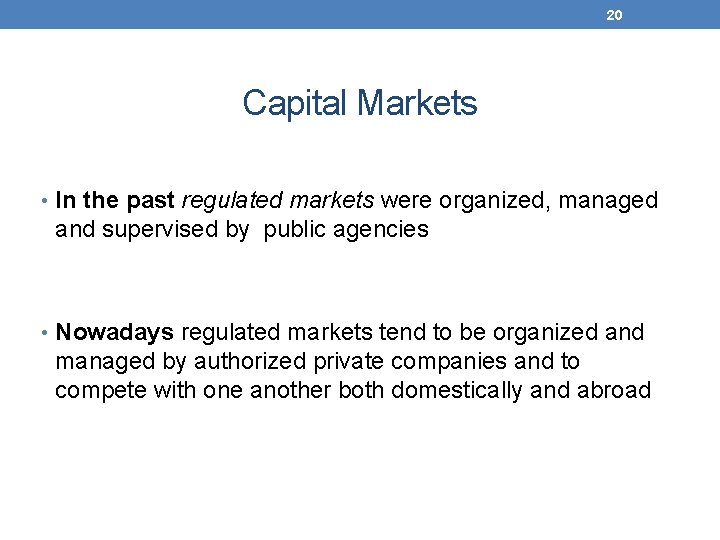
20 Capital Markets • In the past regulated markets were organized, managed and supervised by public agencies • Nowadays regulated markets tend to be organized and managed by authorized private companies and to compete with one another both domestically and abroad
21 Capital Markets • In accordance with the Mifid directive (dir. 2004/39/EC) the term ‘system’ encompasses all those markets that are composed of a set of rules and a trading platform as well as those that only work on the basis of a set of rules. The definitions should exclude bilateral systems where an investment firm enters into every trade on own account and not as a riskless counterparty interposed between the buyer and seller. • ‘Multilateral trading facility (MTF)’ means a multilateral system, operated by an investment firm or a market operator, which brings together multiple third‑party buying and selling interests in financial instruments – in the system and in accordance with non‑discretionary rules – in a way that results in a contract in accordance with the provisions
22 Capital Markets • The Mi. FID Directive creates an obligation to safeguard market integrity to report transactions and to keep records • In particular, it establishes a pre-trade transparency obligation. This requires "internalisers" (i. e. firms dealing on own account - by executing client orders outside regulated markets or multilateral trading facilities ) to disclose the prices at which they will be willing to buy from and/or sell to their clients.
23 Capital Markets • Trading on a stock exchange is normally done through qualified intermediaries who meet the eligibility standards set by the market operator. They will act either as: • brokers act as agents and therefore buy and sell securities on behalf of their clients from whom they obtain a commission Or • dealer / traders trade on their own account, with their profit being the difference between the price paid and the price received for the security concerned • Or • market makers persons who do not provide any investment services or activities other than dealing on own account , outside a regulated market or an MTF on an organized, on frequent and systematic basis by providing a system accessible to third parties in order to engage in dealings with them
24 Capital Markets • It is extremely rare for a small investor to choose financial securities without advice. Normally he will rely on professional advice which can be offered at various degrees of involvement. • A relatively simple involvement is that of an advice on the selection of the security to buy or sell (such as e. g. stocks or bonds), or of the market where to execute the financial investment (such as e. g. domestic or foreign, cash market or futures market, etc. ). • A more sophisticated form of assistance is offered where the investor requests the professional to manage his savings in an individual portfolio: the professional proceeds to make investments and manage them in accordance with the procedures and criteria agreed upon in the management contract concluded with the client-investor.
25 Capital Markets • Savings from a pool of small savers will be normally managed in one of two forms: investment companies or pension funds. • Investment Companies come in two forms: • Open-end mutual funds collect financial resources in small denomination shares, mostly from individuals, and invest these resources in stocks and bonds issued by business firms or public authorities on behalf of their clients. The small investors who underwrite the mutual fund’s units bear the investment risk. They can at any time sell back their units to the fund. or • Closed-end funds are not committed to redeem the shares before the expiration of the contract, and therefore entails higher risk for the investor in terms of how the investment company’s portfolio may be invested by the managers. Indeed, the investor can exit before the expiry date only if a secondary market in the shares concerned has developed.
26 Capital Markets • Pension funds provide capital to the investor when he reaches a specified age, which coincides with retirement. • Their structure differs according to the nature of the promoter, i. e. whether it is a company, a labor union, a public authority, etc. • They benefit from certain tax advantages which are meant to stimulate this form of saving.
27 Capital Markets • Rating is the assessment of, on the one hand, the risk of default on debt securities issued by businesses or government, and, on the other hand, the evaluation of the financial position of an issuer. • This activity is the domain of specialized agencies, such as Moody’s, Standard & Poors, Fitch, IBCA. • These agencies base themselves on financial reporting provided by the issuer and evaluated in accordance with qualitative and quantitative criteria. • These agencies are not required to ascertain the truthfulness of the documents provided or of the information gathered. • Financial analysts evaluate the overall creditworthiness of the issuer and assume full responsibility for their professional appraisal.
28 Insurance • An Insurance firm is a company that assume the risk of uncertain event which could affect the person insured, considering that the frequency and hence the likelihood of such events can be calculated on the basis of statistics. The insured person pays a premium. • The firm will accumulate the premiums received and to the extent that aggregate amounts will not need to be paid out immediately, it will therefore have a reserve fund on the basis of which he will make his own investments. • Any insurer therefore will have two flows of income, a direct one in terms of premiums paid by clients, and an indirect one in terms of income from investments.
29 Insurance • There are 2 classes of insurance that, generally, must to be managed by different companies: • Life insurance comprises, in particular, assurance on survival to a stipulated age only, assurance on death only, assurance on survival to a stipulated age or on earlier death, life assurance with return of premiums, marriage assurance, birth assurance. • Indemnity (or causality) insurance insures against accidents, not necessarily tied to any specific property (e. g. accident, sickness, fire and natural forces, motor vehicle liability, credit default…).
30 Insurance • Insurance companies are deemed financial intermediaries only in so far as they invest premiums, paid to them by their customers, in the financial markets; • Insurance is a type of financial intermediation in so far as insurance firms invest their reserves in securities • The Insurers role on the financial markets has been enhanced considerably by recent developments which allows these firms to invest their reserves not only in real estate and government bonds (as was the case formerly), but also in securities issued by private parties: • see the case of AIG in the U. S. A. The largest insurance company in the world has had to be bailed out because of its entanglement with the entire financial sector, inter alia through credit default swaps activities.