
1 Overview of Governance Structures for a Regional
- Slides: 9
1 Overview of Governance Structures for a Regional Solid Waste Management System WORKING GROUP MEETING – 12/6/19
GOVERNANCE OVERVIEW – Available Governance Structures (1) Independent Special District (2) Dependent Special District (3) Interlocal Agreement (“ILA”)-based Structure 2
GOVERNANCE OVERVIEW – 3 Independent Special District Governing Rules: Governed by a collective body that is not subject to the control of a single county or municipality. Characteristics: q Members appointed as provided by applicable law q Independent control over budget and millage rates q Significant state oversight (e. g. , annual reporting; audits) q Possesses only the powers granted by the Legislature
GOVERNANCE OVERVIEW – 4 Independent Special District (contd. ) Taxing Authority: The Legislature may authorize levying of property taxes (any millage is not subject to millage cap of any other local government) and non-ad valorem assessments. Creation: Only by the Legislature (typically via special act). q Steps/Requirements: • Charter (special act or general law) setting forth certain information as required by Section 189. 031(3), Florida Statutes (e. g. , nature of independent status; purpose; powers/duties; amendment procedures; election procedures) • If by special act, advance published notice of intent to seek enactment or effectiveness subject to referendum
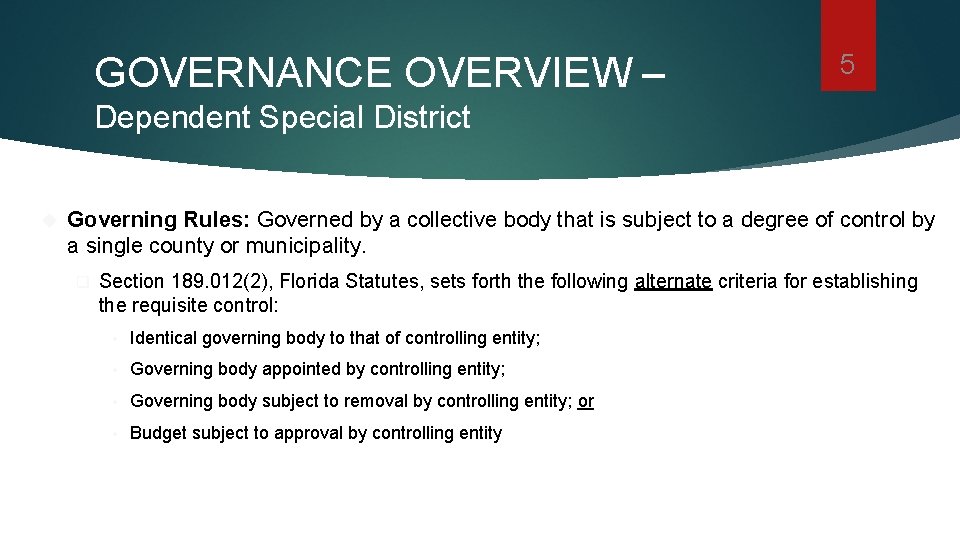
GOVERNANCE OVERVIEW – 5 Dependent Special District Governing Rules: Governed by a collective body that is subject to a degree of control by a single county or municipality. q Section 189. 012(2), Florida Statutes, sets forth the following alternate criteria for establishing the requisite control: • Identical governing body to that of controlling entity; • Governing body appointed by controlling entity; • Governing body subject to removal by controlling entity; or • Budget subject to approval by controlling entity
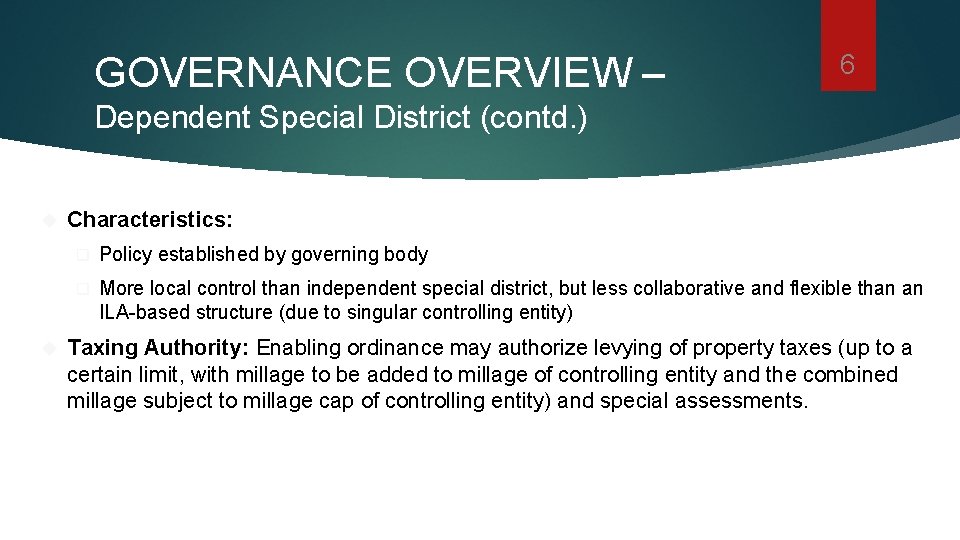
GOVERNANCE OVERVIEW – 6 Dependent Special District (contd. ) Characteristics: q Policy established by governing body q More local control than independent special district, but less collaborative and flexible than an ILA-based structure (due to singular controlling entity) Taxing Authority: Enabling ordinance may authorize levying of property taxes (up to a certain limit, with millage to be added to millage of controlling entity and the combined millage subject to millage cap of controlling entity) and special assessments.
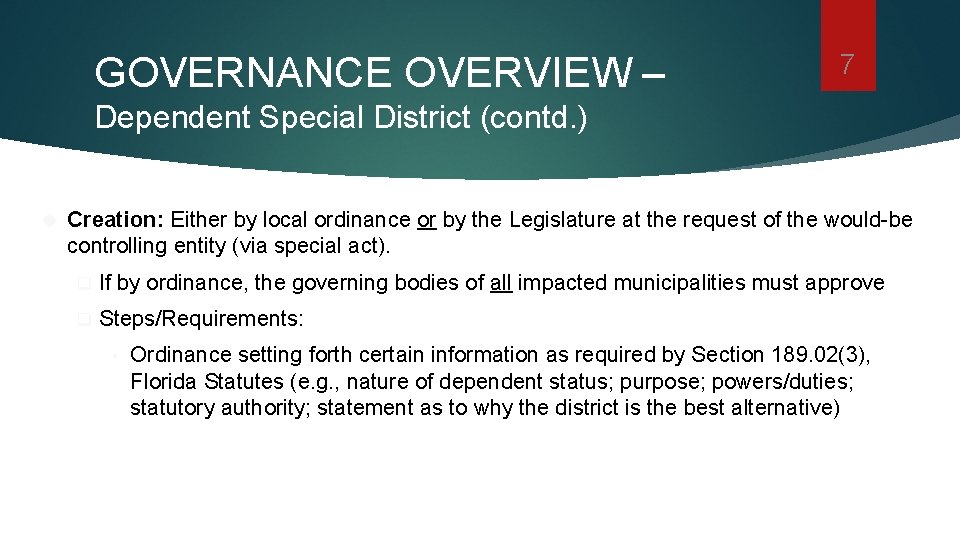
GOVERNANCE OVERVIEW – 7 Dependent Special District (contd. ) Creation: Either by local ordinance or by the Legislature at the request of the would-be controlling entity (via special act). q If by ordinance, the governing bodies of all impacted municipalities must approve q Steps/Requirements: • Ordinance setting forth certain information as required by Section 189. 02(3), Florida Statutes (e. g. , nature of dependent status; purpose; powers/duties; statutory authority; statement as to why the district is the best alternative)
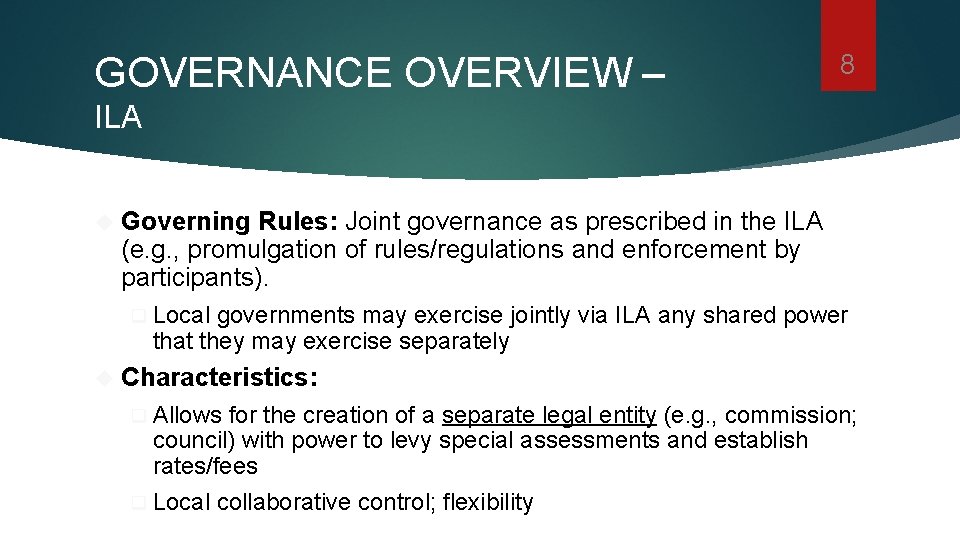
GOVERNANCE OVERVIEW – 8 ILA Governing Rules: Joint governance as prescribed in the ILA (e. g. , promulgation of rules/regulations and enforcement by participants). q Local governments may exercise jointly via ILA any shared power that they may exercise separately Characteristics: q Allows for the creation of a separate legal entity (e. g. , commission; council) with power to levy special assessments and establish rates/fees q Local collaborative control; flexibility
GOVERNANCE OVERVIEW – ILA (contd. ) Taxing Authority: Any created legal entity has no taxing authority. Creation: By contract (the ILA). 9