
1 Overview of Africas Development and Opportunities for
- Slides: 68
1 Overview of Africa’s Development and Opportunities for Foreign Direct Investment Mwangi S. Kimenyi Senior Fellow and Director Africa Growth Initiative The Brookings Institution Washington, D. C.
2 Outline • Introduction: Africa and its People • Trends—Population, Democratization • Regional Integration • Recent Economic Growth Performance • Business Climate • Foreign Direct Investment In Africa
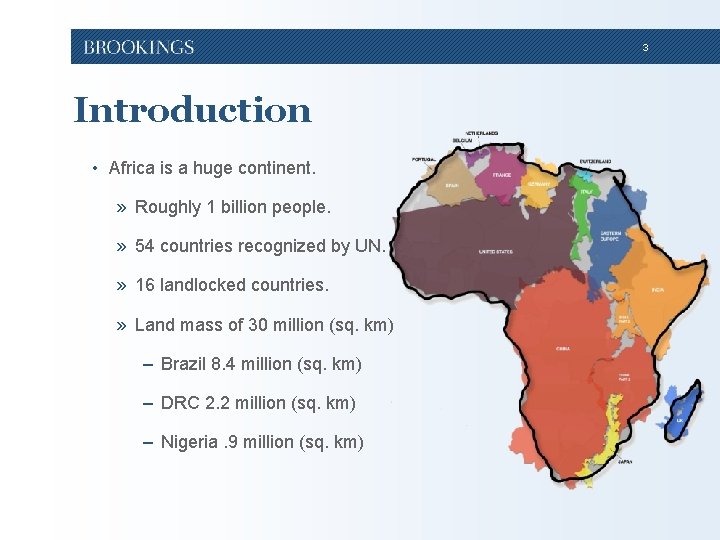
3 Introduction • Africa is a huge continent. » Roughly 1 billion people. » 54 countries recognized by UN. » 16 landlocked countries. » Land mass of 30 million (sq. km) – Brazil 8. 4 million (sq. km) – DRC 2. 2 million (sq. km) – Nigeria. 9 million (sq. km)
4 Introduction • Thousands of ethnic groups. • These ethnic groups have more than 10 million people » Hausa, Yoruba, Oromo, Igbo, Akan, Amhara, Somali, Ijaw, Kongo, Fula, Shona, Zulu • Many of these ethnic groups have their own language (or dialect of a language) and culture • There an estimated 2, 000 languages spoken in Africa, in six major linguistic families
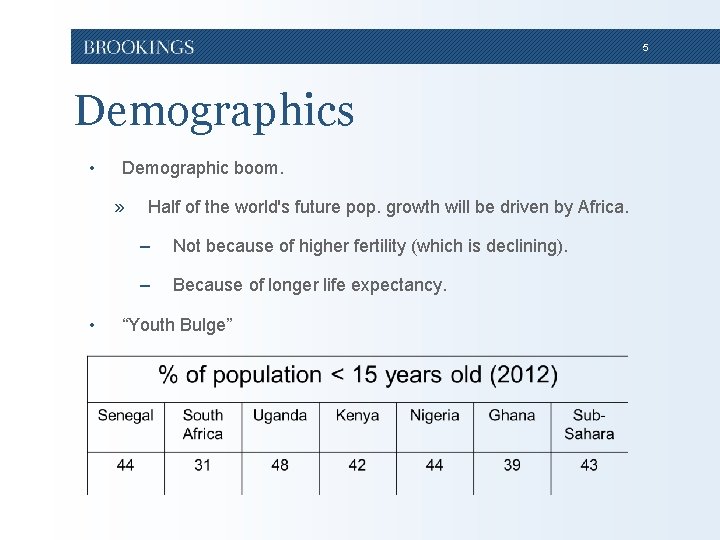
5 Demographics • Demographic boom. » • Half of the world's future pop. growth will be driven by Africa. – Not because of higher fertility (which is declining). – Because of longer life expectancy. “Youth Bulge”
6 Demographics • • Potential positive: “demographic dividend” » Africa's adult population was 460 million in 2010. » It is expected to be 800 million by 2030. » Children and elderly (dependents) will be relatively few. Potential negatives: » Lack of jobs » Radicalization of youth, political instability » Crime
7 Middle class consumerism • • Burgeoning middle class, ready consumers » Currently, there are 85 million households that make more than $5, 000 per year » By 2020, there will be 128 million households Commercial hubs on the rise » • In 2020, the household spending of Alexandria, Cairo, Cape Town, Johannesburg and Lagos will total 25 billion dollars Urbanization (associated with economic growth) on the rise » Today, 40% of Africans live in cities. By 2030, this will increase to more than 50%
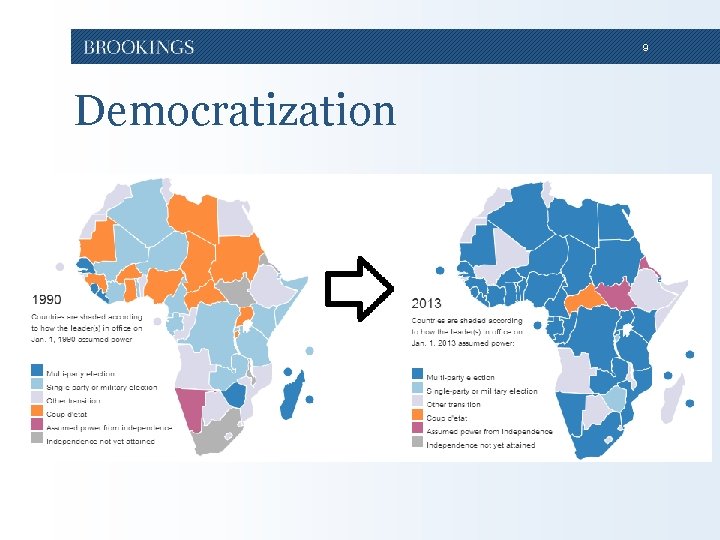
8 Democratization • Africa has “democratized” to some extent, especially in the 90’s » In 1989, there 3 democracies; in 2008, there were 23 • “Democracy has become the norm rather than the exception” • Practice of elections has become entrenched » In 2013, there are elections to be scheduled in 22 countries Negatives (long-standing leaders, non-competitive political systems) » Zimbabwe » Equatorial Guinea » Gambia
9 Democratization
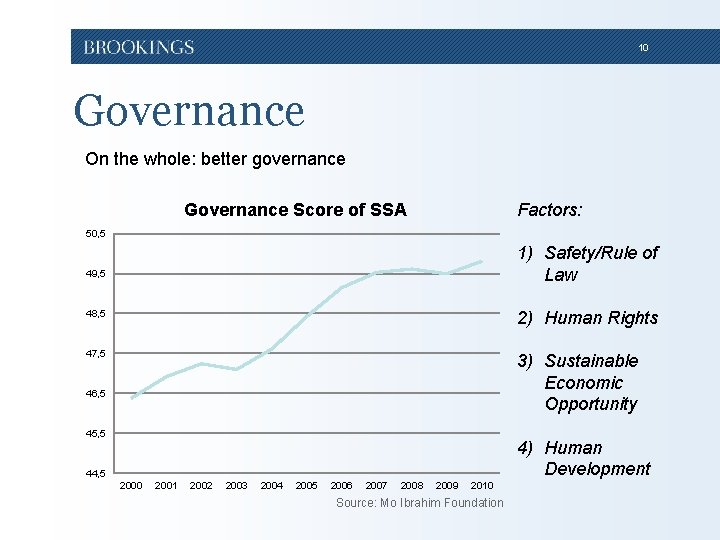
10 Governance On the whole: better governance Governance Score of SSA Factors: 50, 5 1) Safety/Rule of Law 49, 5 48, 5 2) Human Rights 47, 5 3) Sustainable Economic Opportunity 46, 5 45, 5 4) Human Development 44, 5 2000 2001 2002 2003 2004 2005 2006 2007 2008 2009 2010 Source: Mo Ibrahim Foundation
11 Decline in Violence and Conflict • • According to Uppsala Armed Conflict Data Program: » African civil wars in late 2000 s are half as common compared to mid-1990 s » Mass killings are on the decline » Current wars are more likely to be fought on state periphery Problem areas: Mali, CAR, DRC, Sudan Terrorist threats of Al Shabaab, Boko Haram
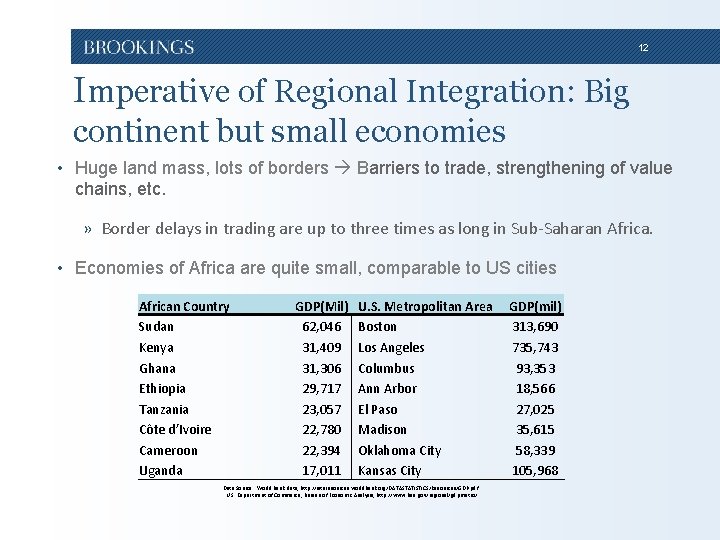
12 Imperative of Regional Integration: Big continent but small economies • Huge land mass, lots of borders Barriers to trade, strengthening of value chains, etc. » Border delays in trading are up to three times as long in Sub-Saharan Africa. • Economies of Africa are quite small, comparable to US cities African Country Sudan Kenya Ghana Ethiopia Tanzania Côte d’Ivoire Cameroon Uganda GDP(Mil) 62, 046 31, 409 31, 306 29, 717 23, 057 22, 780 22, 394 17, 011 U. S. Metropolitan Area Boston Los Angeles Columbus Ann Arbor El Paso Madison Oklahoma City Kansas City Data Source: World Bank data, http: //siteresources. worldbank. org/DATASTATISTICS/Resources/GDP. pdf U. S. Department of Commerce, Bureau of Economic Analysis, http: //www. bea. gov/regional/gdpmetro/ GDP(mil) 313, 690 735, 743 93, 353 18, 566 27, 025 35, 615 58, 339 105, 968
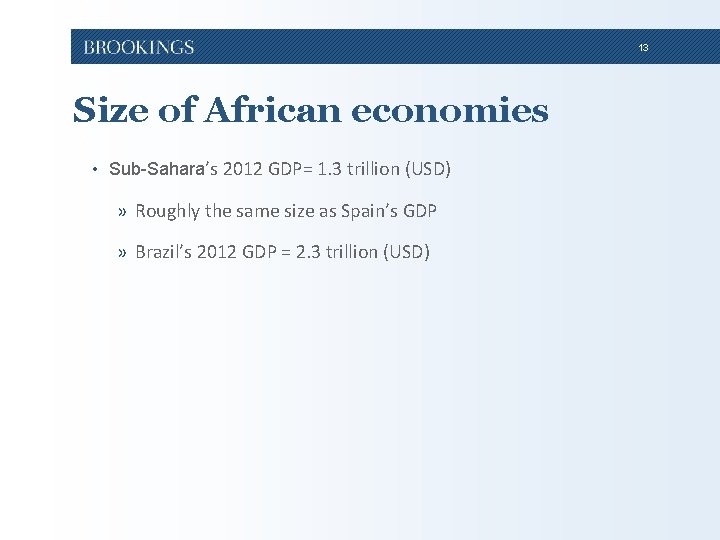
13 Size of African economies • Sub-Sahara’s 2012 GDP= 1. 3 trillion (USD) » Roughly the same size as Spain’s GDP » Brazil’s 2012 GDP = 2. 3 trillion (USD)
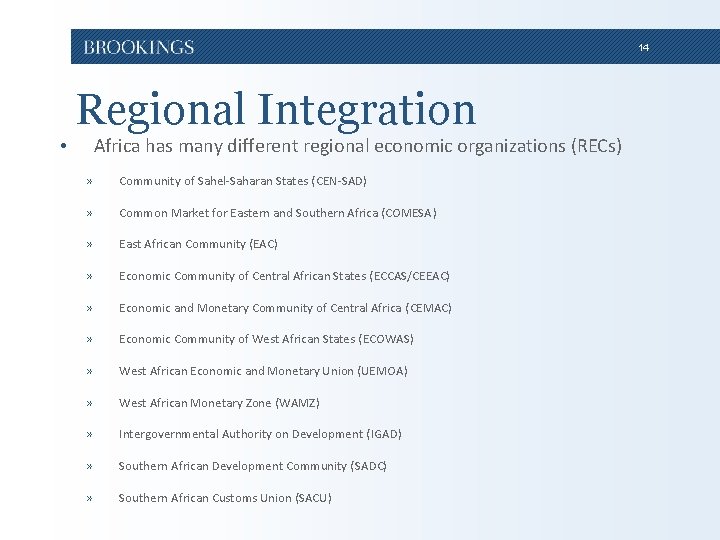
14 • Regional Integration Africa has many different regional economic organizations (RECs) » Community of Sahel-Saharan States (CEN-SAD) » Common Market for Eastern and Southern Africa (COMESA) » East African Community (EAC) » Economic Community of Central African States (ECCAS/CEEAC) » Economic and Monetary Community of Central Africa (CEMAC) » Economic Community of West African States (ECOWAS) » West African Economic and Monetary Union (UEMOA) » West African Monetary Zone (WAMZ) » Intergovernmental Authority on Development (IGAD) » Southern African Development Community (SADC) » Southern African Customs Union (SACU)
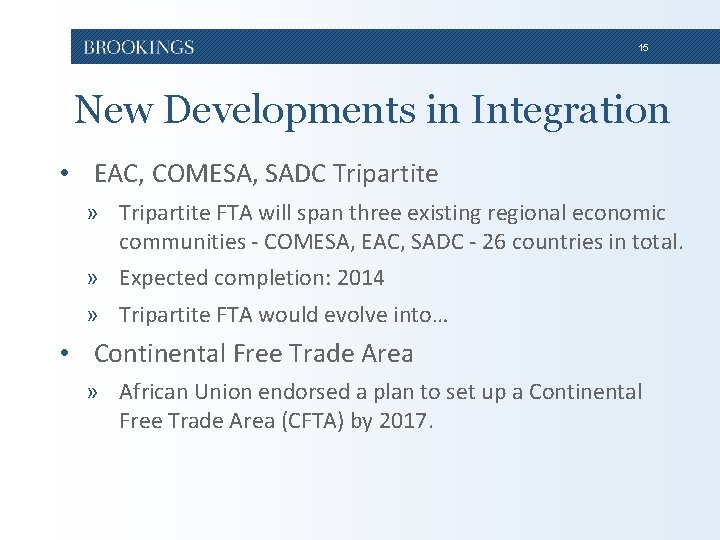
15 New Developments in Integration • EAC, COMESA, SADC Tripartite » Tripartite FTA will span three existing regional economic communities - COMESA, EAC, SADC - 26 countries in total. » Expected completion: 2014 » Tripartite FTA would evolve into… • Continental Free Trade Area » African Union endorsed a plan to set up a Continental Free Trade Area (CFTA) by 2017.
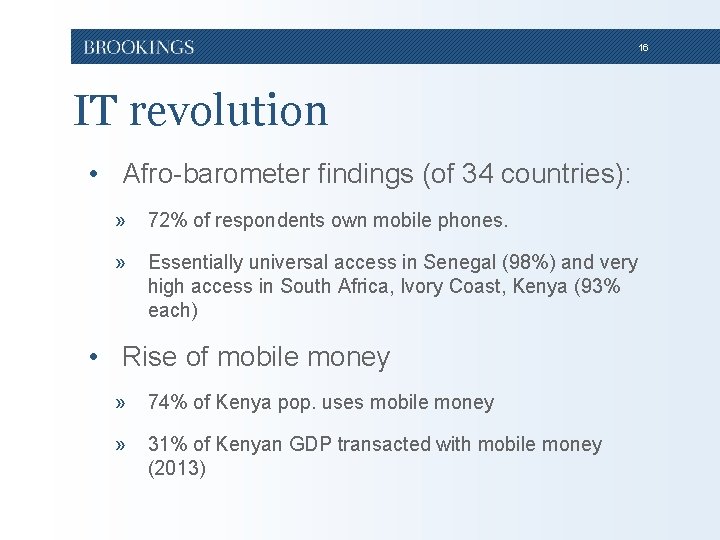
16 IT revolution • Afro-barometer findings (of 34 countries): » 72% of respondents own mobile phones. » Essentially universal access in Senegal (98%) and very high access in South Africa, Ivory Coast, Kenya (93% each) • Rise of mobile money » 74% of Kenya pop. uses mobile money » 31% of Kenyan GDP transacted with mobile money (2013)
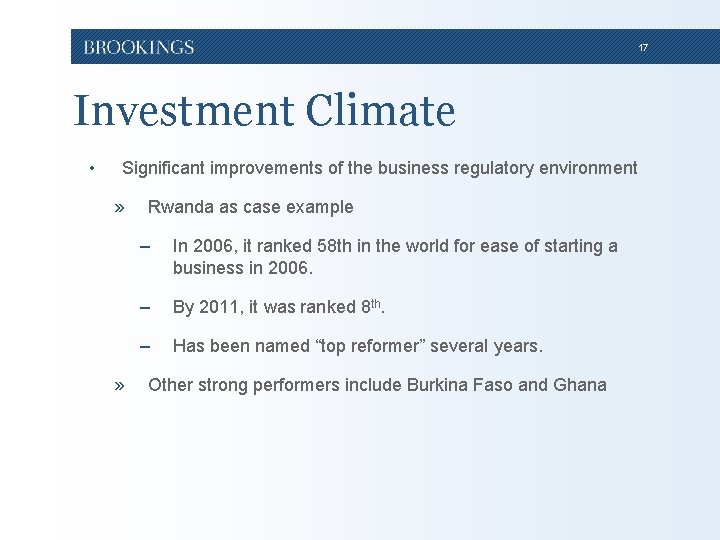
17 Investment Climate • Significant improvements of the business regulatory environment » » Rwanda as case example – In 2006, it ranked 58 th in the world for ease of starting a business in 2006. – By 2011, it was ranked 8 th. – Has been named “top reformer” several years. Other strong performers include Burkina Faso and Ghana
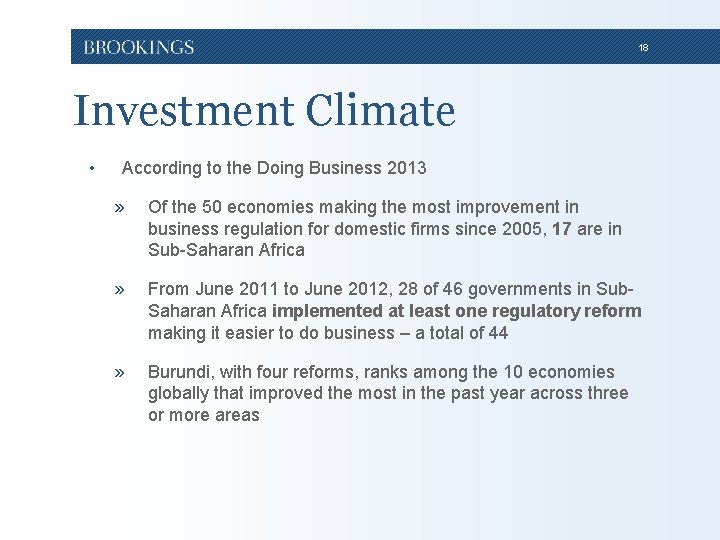
18 Investment Climate • According to the Doing Business 2013 » Of the 50 economies making the most improvement in business regulation for domestic firms since 2005, 17 are in Sub-Saharan Africa » From June 2011 to June 2012, 28 of 46 governments in Sub. Saharan Africa implemented at least one regulatory reform making it easier to do business – a total of 44 » Burundi, with four reforms, ranks among the 10 economies globally that improved the most in the past year across three or more areas
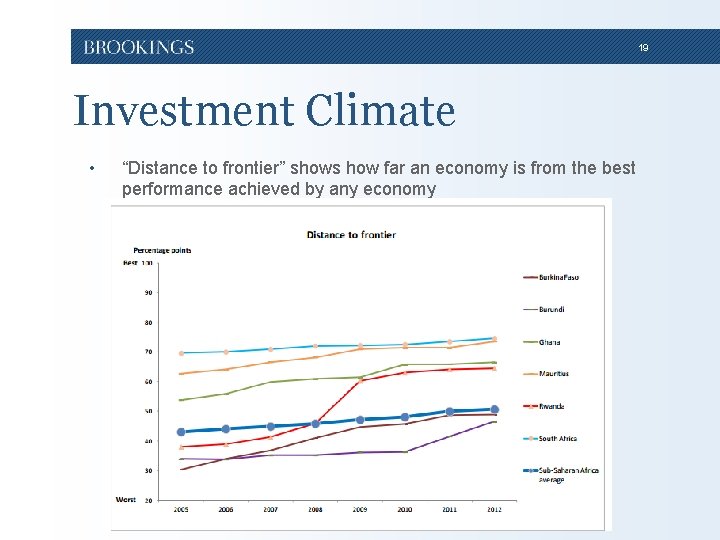
19 Investment Climate • “Distance to frontier” shows how far an economy is from the best performance achieved by any economy
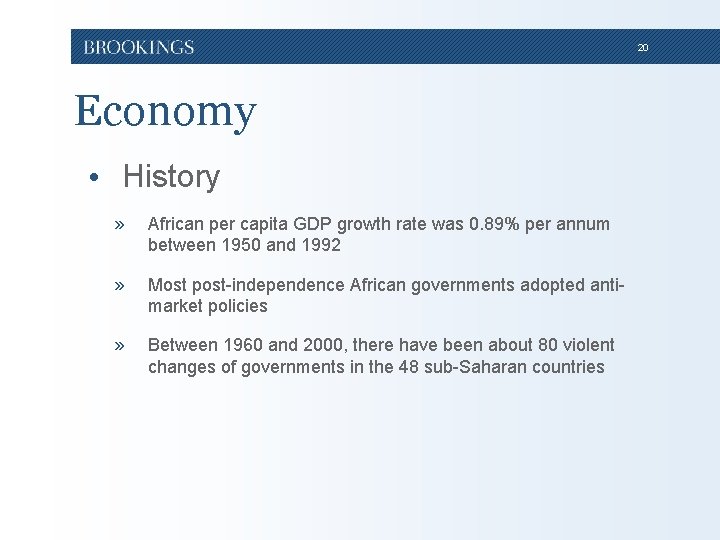
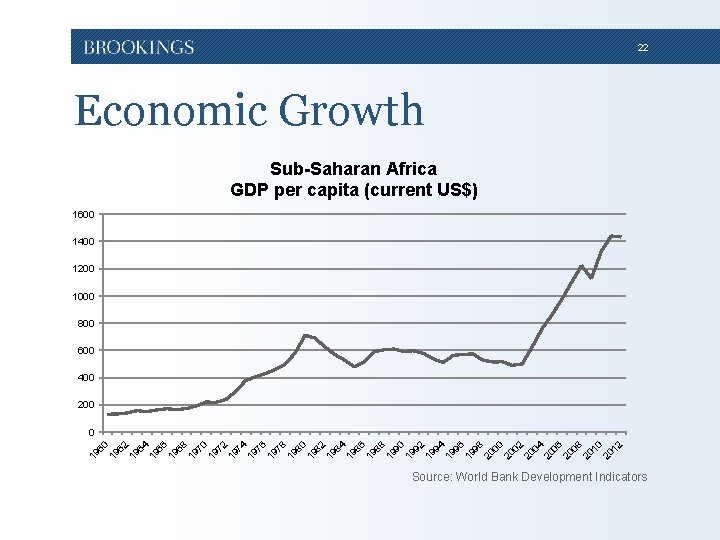
20 Economy • History » African per capita GDP growth rate was 0. 89% per annum between 1950 and 1992 » Most post-independence African governments adopted antimarket policies » Between 1960 and 2000, there have been about 80 violent changes of governments in the 48 sub-Saharan countries
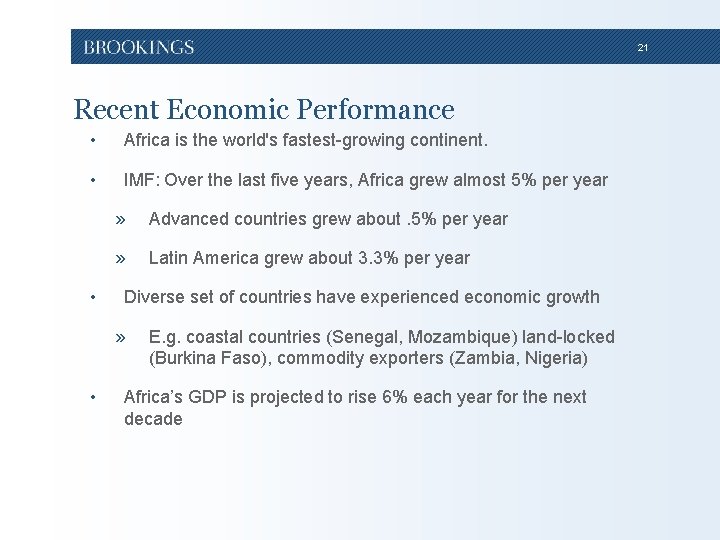
21 Recent Economic Performance • Africa is the world's fastest-growing continent. • IMF: Over the last five years, Africa grew almost 5% per year • » Advanced countries grew about. 5% per year » Latin America grew about 3. 3% per year Diverse set of countries have experienced economic growth » • E. g. coastal countries (Senegal, Mozambique) land-locked (Burkina Faso), commodity exporters (Zambia, Nigeria) Africa’s GDP is projected to rise 6% each year for the next decade
22 Economic Growth Sub-Saharan Africa GDP per capita (current US$) 1600 1400 1200 1000 800 600 400 200 19 62 19 64 19 66 19 68 19 70 19 72 19 74 19 76 19 78 19 80 19 82 19 84 19 86 19 88 19 90 19 92 19 94 19 96 19 98 20 00 20 02 20 04 20 06 20 08 20 10 20 12 0 Source: World Bank Development Indicators
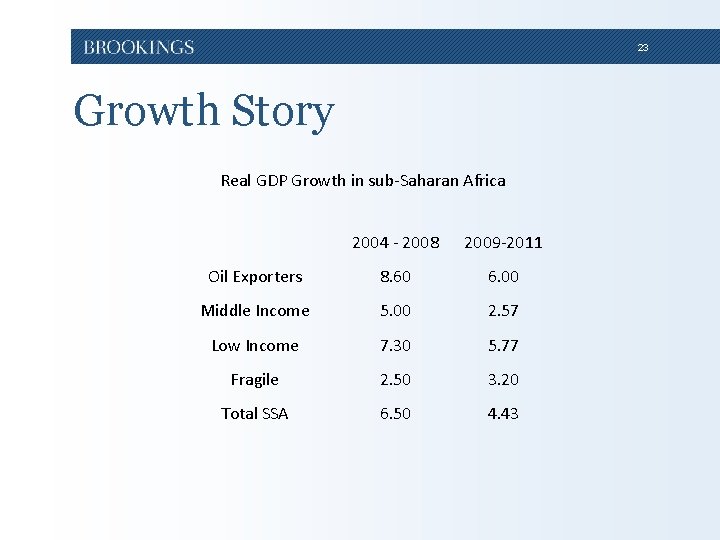
23 Growth Story Real GDP Growth in sub-Saharan Africa 2004 - 2008 2009 -2011 Oil Exporters 8. 60 6. 00 Middle Income 5. 00 2. 57 Low Income 7. 30 5. 77 Fragile 2. 50 3. 20 Total SSA 6. 50 4. 43
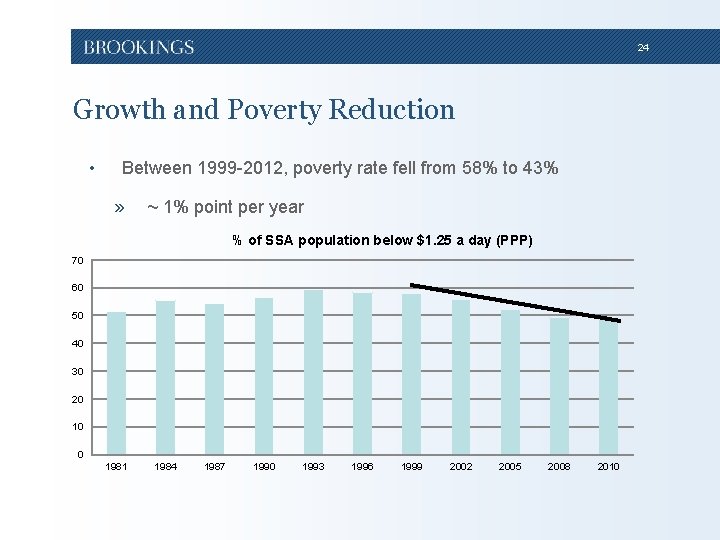
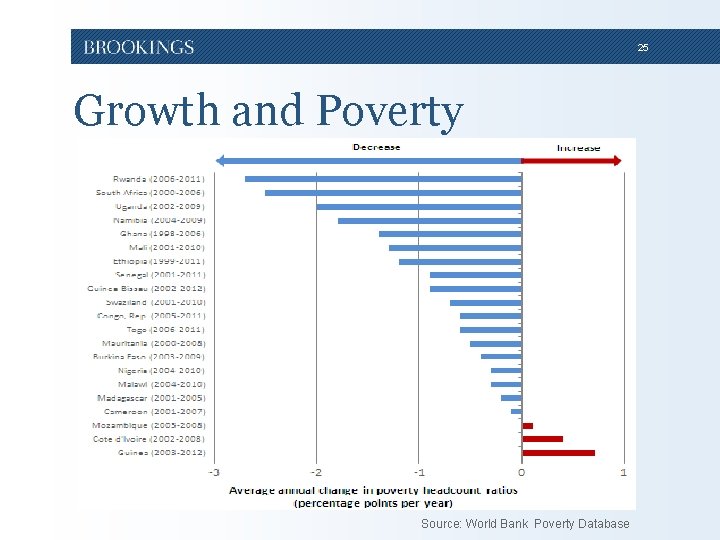
24 Growth and Poverty Reduction • Between 1999 -2012, poverty rate fell from 58% to 43% » ~ 1% point per year % of SSA population below $1. 25 a day (PPP) 70 60 50 40 30 20 10 0 1981 1984 1987 1990 1993 1996 1999 2002 2005 2008 2010
25 Growth and Poverty Source: World Bank Poverty Database
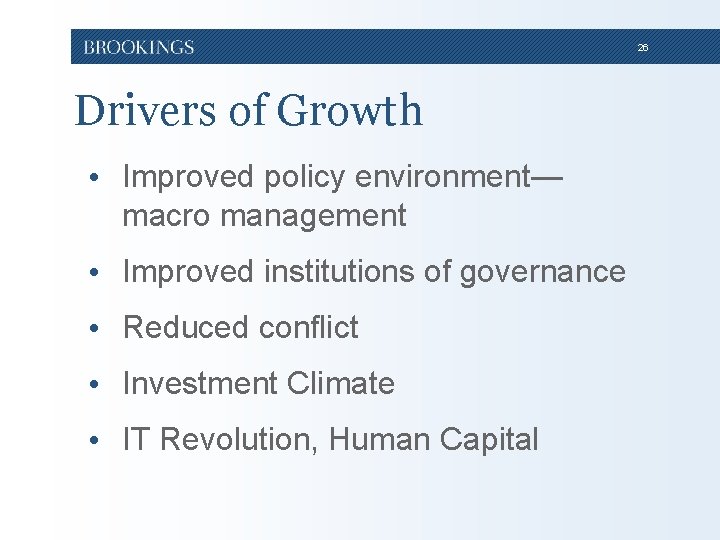
26 Drivers of Growth • Improved policy environment— macro management • Improved institutions of governance • Reduced conflict • Investment Climate • IT Revolution, Human Capital
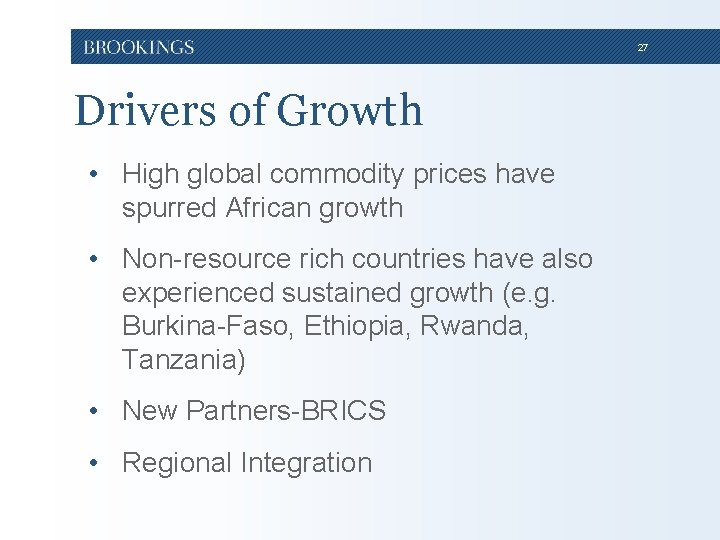
27 Drivers of Growth • High global commodity prices have spurred African growth • Non-resource rich countries have also experienced sustained growth (e. g. Burkina-Faso, Ethiopia, Rwanda, Tanzania) • New Partners-BRICS • Regional Integration
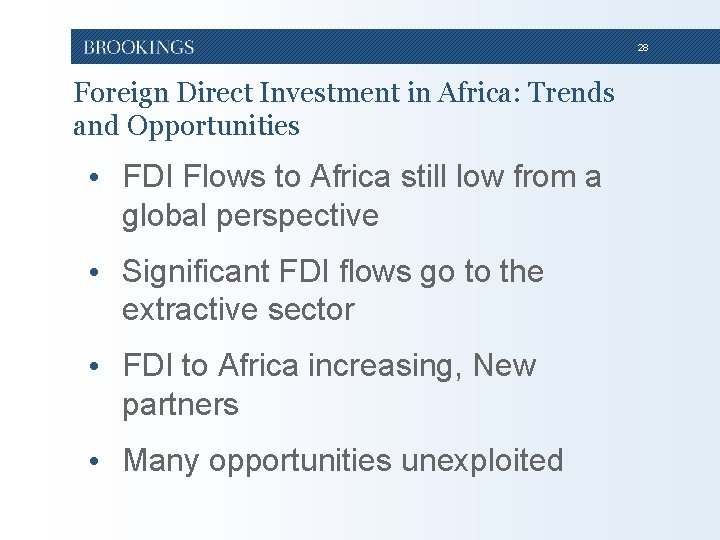
28 Foreign Direct Investment in Africa: Trends and Opportunities • FDI Flows to Africa still low from a global perspective • Significant FDI flows go to the extractive sector • FDI to Africa increasing, New partners • Many opportunities unexploited
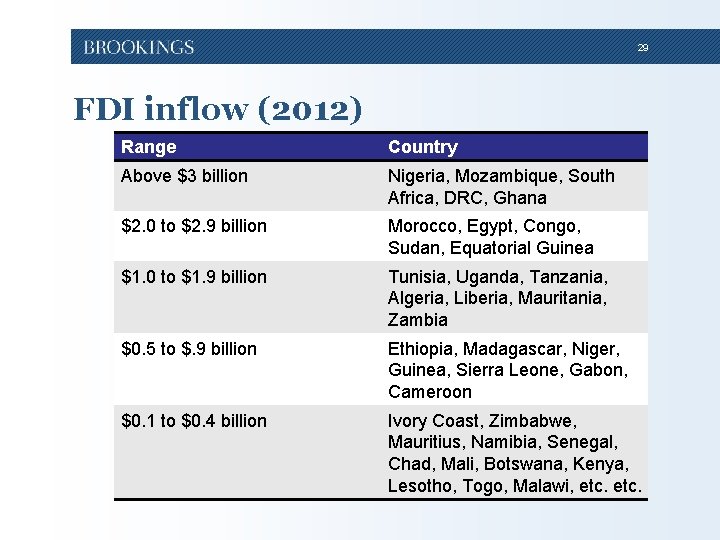
29 FDI inflow (2012) Range Country Above $3 billion Nigeria, Mozambique, South Africa, DRC, Ghana $2. 0 to $2. 9 billion Morocco, Egypt, Congo, Sudan, Equatorial Guinea $1. 0 to $1. 9 billion Tunisia, Uganda, Tanzania, Algeria, Liberia, Mauritania, Zambia $0. 5 to $. 9 billion Ethiopia, Madagascar, Niger, Guinea, Sierra Leone, Gabon, Cameroon $0. 1 to $0. 4 billion Ivory Coast, Zimbabwe, Mauritius, Namibia, Senegal, Chad, Mali, Botswana, Kenya, Lesotho, Togo, Malawi, etc.
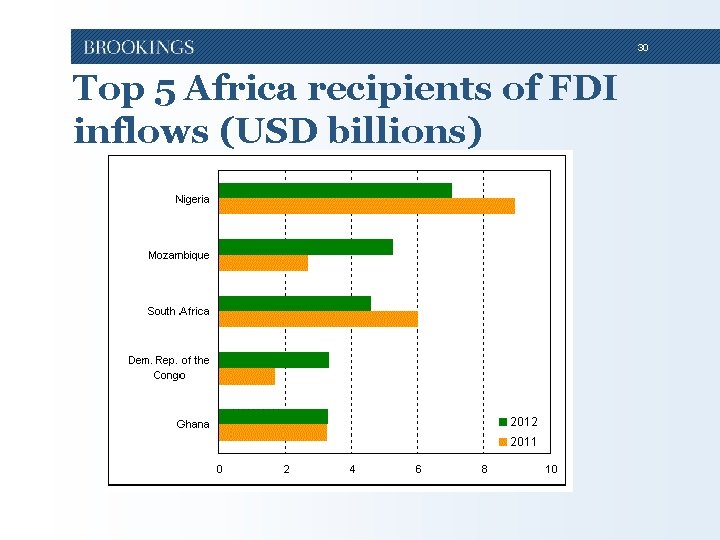
30 Top 5 Africa recipients of FDI inflows (USD billions)
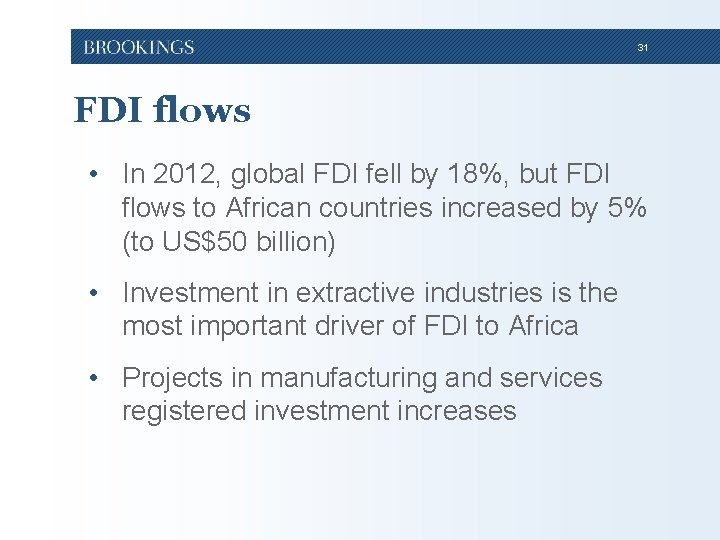
31 FDI flows • In 2012, global FDI fell by 18%, but FDI flows to African countries increased by 5% (to US$50 billion) • Investment in extractive industries is the most important driver of FDI to Africa • Projects in manufacturing and services registered investment increases
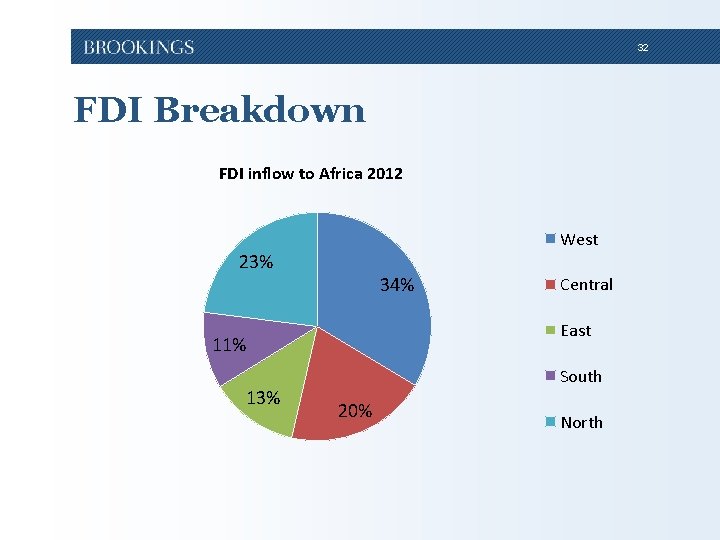
32 FDI Breakdown FDI inflow to Africa 2012 West 23% 34% East 11% 13% Central South 20% North
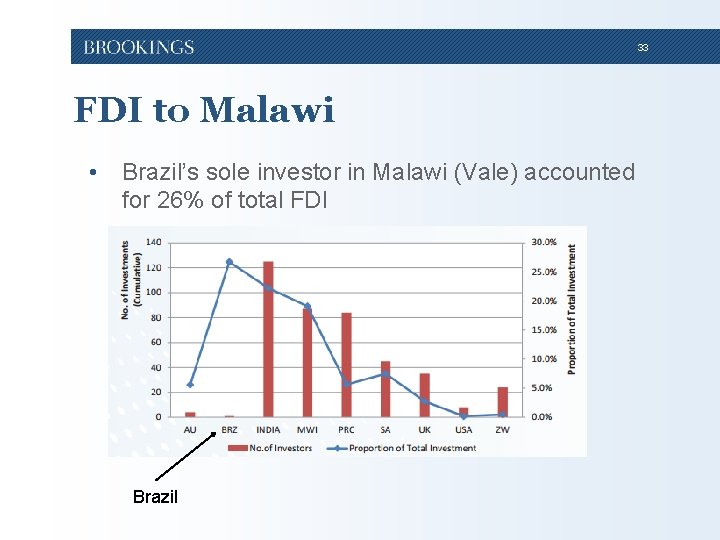
33 FDI to Malawi • Brazil’s sole investor in Malawi (Vale) accounted for 26% of total FDI Brazil
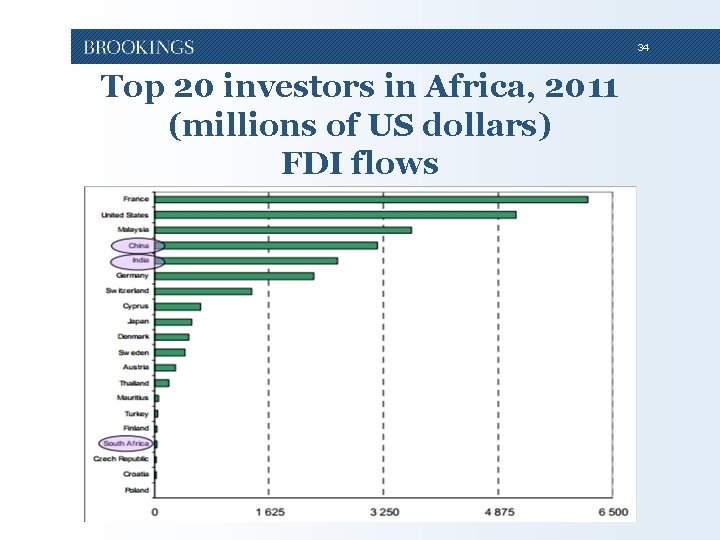
34 Top 20 investors in Africa, 2011 (millions of US dollars) FDI flows
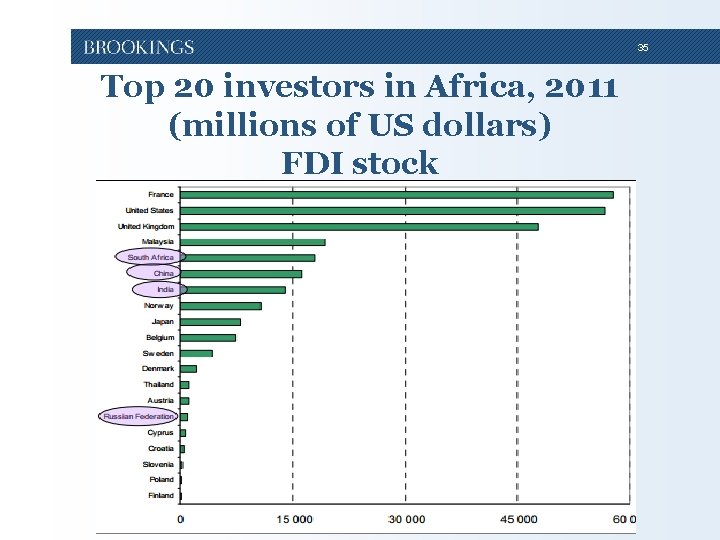
35 Top 20 investors in Africa, 2011 (millions of US dollars) FDI stock
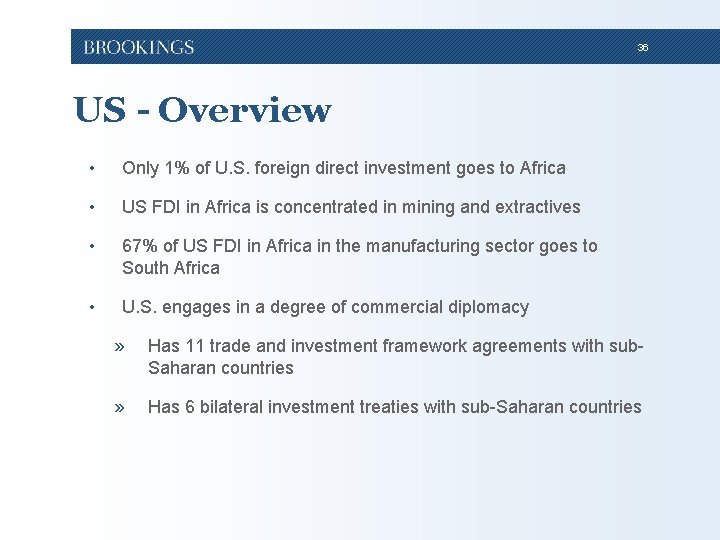
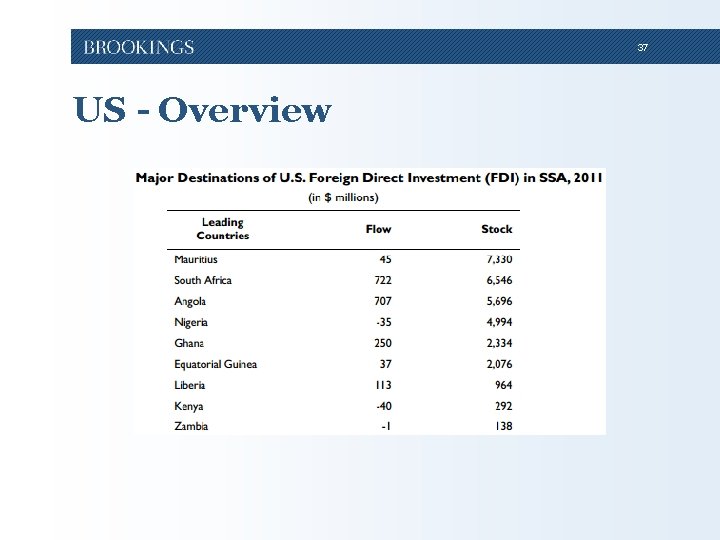
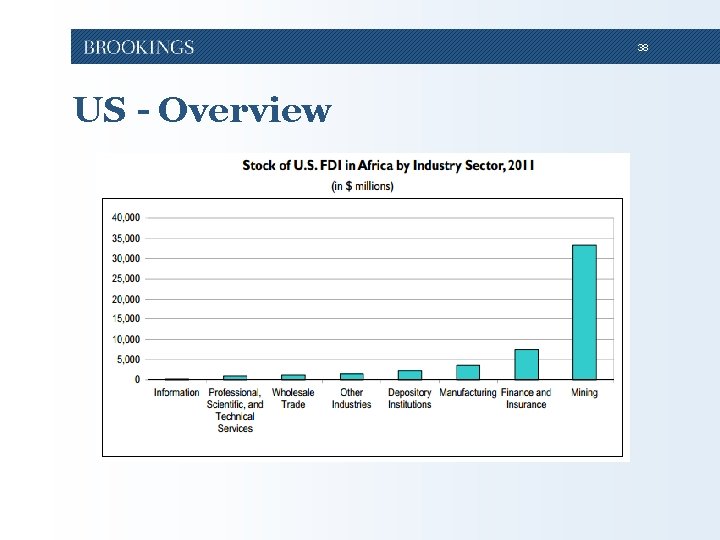
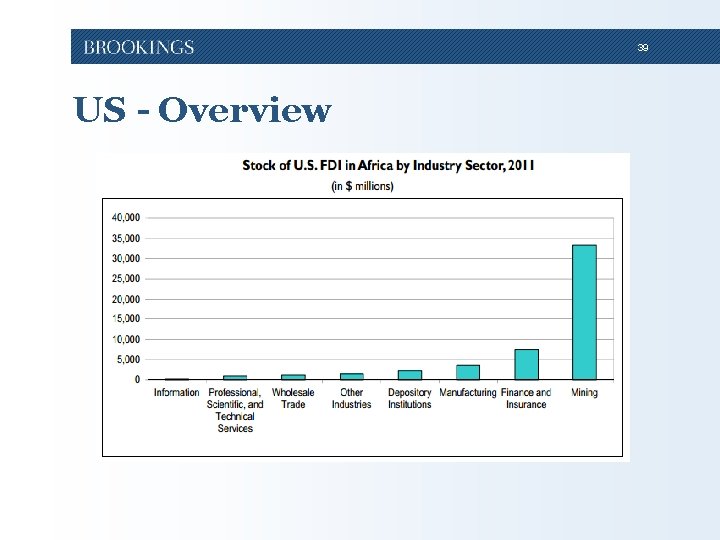
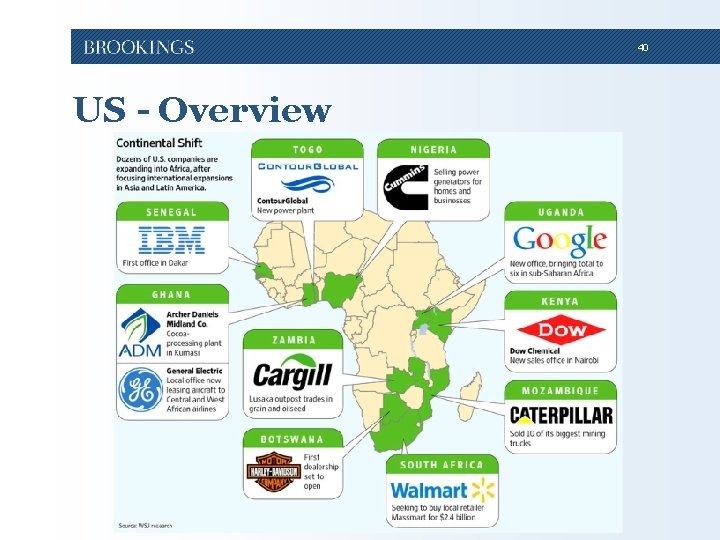
36 US - Overview • Only 1% of U. S. foreign direct investment goes to Africa • US FDI in Africa is concentrated in mining and extractives • 67% of US FDI in Africa in the manufacturing sector goes to South Africa • U. S. engages in a degree of commercial diplomacy » Has 11 trade and investment framework agreements with sub. Saharan countries » Has 6 bilateral investment treaties with sub-Saharan countries
37 US - Overview
38 US - Overview
39 US - Overview
40 US - Overview
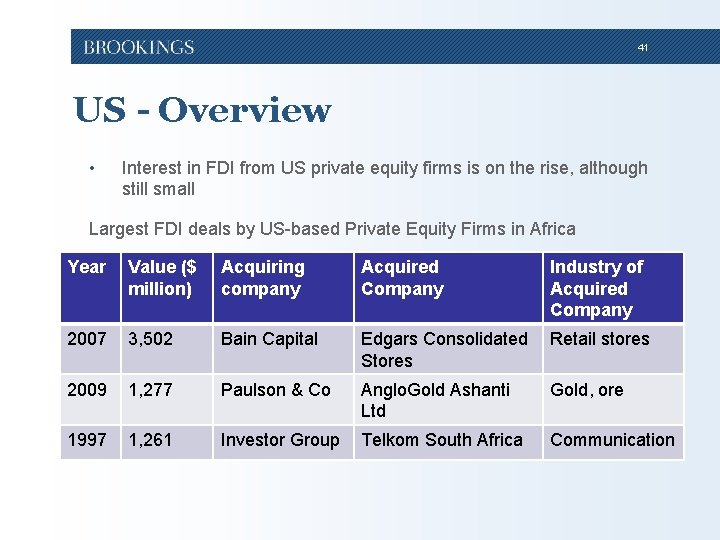
41 US - Overview • Interest in FDI from US private equity firms is on the rise, although still small Largest FDI deals by US-based Private Equity Firms in Africa Year Value ($ million) Acquiring company Acquired Company Industry of Acquired Company 2007 3, 502 Bain Capital Edgars Consolidated Stores Retail stores 2009 1, 277 Paulson & Co Anglo. Gold Ashanti Ltd Gold, ore 1997 1, 261 Investor Group Telkom South Africa Communication
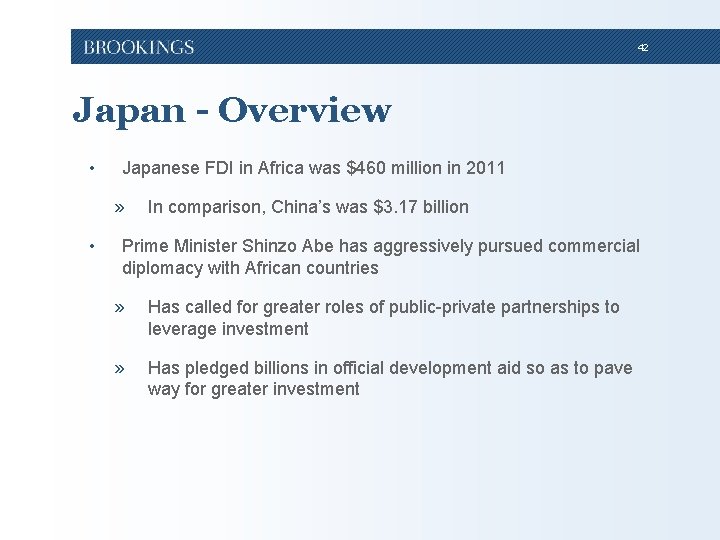
42 Japan - Overview • Japanese FDI in Africa was $460 million in 2011 » • In comparison, China’s was $3. 17 billion Prime Minister Shinzo Abe has aggressively pursued commercial diplomacy with African countries » Has called for greater roles of public-private partnerships to leverage investment » Has pledged billions in official development aid so as to pave way for greater investment
43 Japan - Overview • Japanese FDI in Africa was $460 million in 2011 » • In comparison, China’s was $3. 17 billion Prime Minister Shinzo Abe has aggressively pursued commercial diplomacy with African countries » Has called for greater roles of public-private partnerships to leverage investment » Has pledged billions in official development aid so as to pave way for greater investment
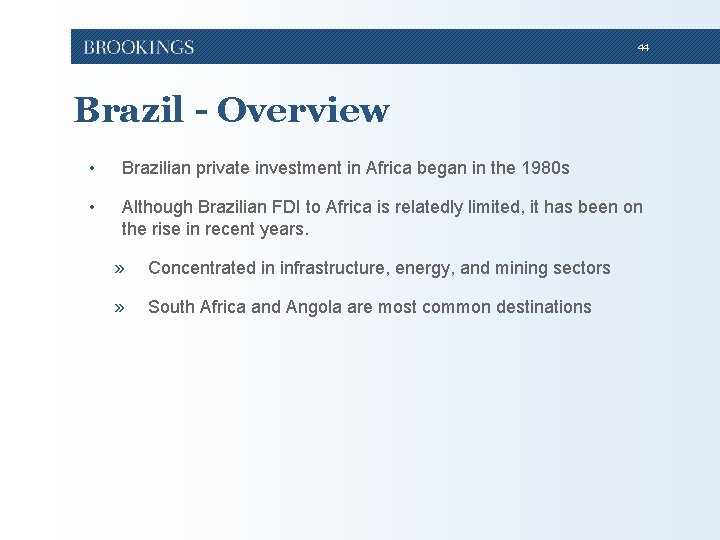
44 Brazil - Overview • Brazilian private investment in Africa began in the 1980 s • Although Brazilian FDI to Africa is relatedly limited, it has been on the rise in recent years. » Concentrated in infrastructure, energy, and mining sectors » South Africa and Angola are most common destinations
45 Brazil - Public institutions • Brazilian Development Bank (BNDES) plays an important role in the promotion of FDI » Emphasizes commercial and infrastructure-related investment » Offers incentives and disbursements to companies in Sub. Saharan Africa – • E. g. Has helped businesses in the African ethanol industry in Angola, Ghana and Mozambique Brazilian Caixa Econômica Federal (Caixa) has supported the development of housing projects in Angola and Mozambique
46 Brazil - Public institutions • Brazilian Development Bank (BNDES) plays an important role in the promotion of FDI » Emphasizes commercial and infrastructure-related investment » Offers incentives and disbursements to companies in Sub. Saharan Africa – • E. g. Has helped businesses in the African ethanol industry in Angola, Ghana and Mozambique Brazilian Caixa Econômica Federal (Caixa) has supported the development of housing projects in Angola and Mozambique
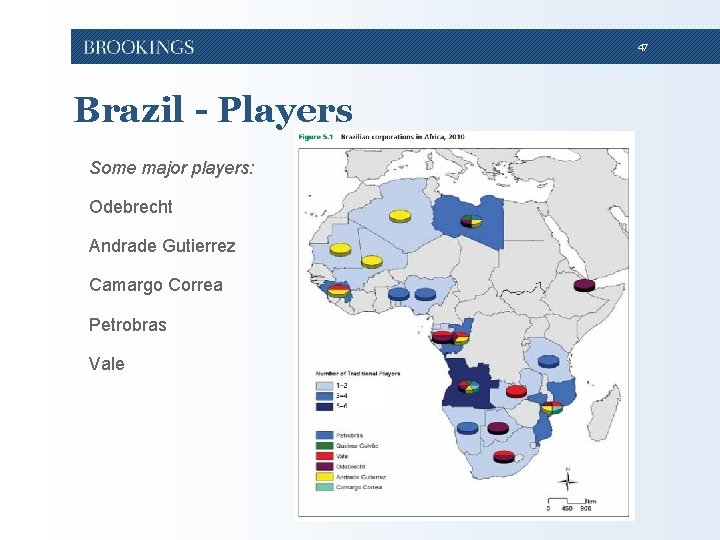
47 Brazil - Players Some major players: Odebrecht Andrade Gutierrez Camargo Correa Petrobras Vale
48 Brazil - Odebrecht • Construction company with most number of projects in Africa (2011 WB Publication) » Present in South Africa, Angola, Botswana, DRC, Djibouti, Gabon, Liberia, Libya, Mozambique » Partners with governments, other foreign companies, other Brazilian contractors in Africa » Engages in projects relating to oil and gas exploration, infrastructure, construction of residential condominiums, urban planning, diamond mines, and food distribution.
49 Brazil - Odebrecht • Undertaken numerous business activities in a variety of contexts » Construction of the Capanda dam in Angola » Building the Letsibogo dam in Botswana » Drilling for oil in the DRC » Providing oil-well services in Gabon » Constructing container and fuel terminals in Djibouti » Constructing a coal mine at Moatize, Mozambique (with Vale) and settlements for families displaced by the mine
50 Brazil - Camargo Correa • Construction company » Opened offices in Angola in 2006 » Hired as the contractor for projects including urban planning and building housing, roads, and power lines » Involved in constructing the Mphanda Nkuwa hydroelectric project on the River Zambezi in Mozambique. » Part of a consortium which is building a coal mine at Moatize, Mozambique. » One of the company’s largest projects involved a consortium of foreign and local companies producing cement
51 Brazil - Petrobras » Energy sector – Invested in Angola’s oil and gas sector as of 1979 – Since 2008, has taken a more assertive posture than historically. – Prospects for and extracts oil, especially in deep waters, with operations in Angola, Libya, Nigeria, and Tanzania. – Recently acquired a 50 percent stake in a 7, 400 square kilometer block off the Benin coast to search for light crude – Acquired a 50 percent stake in a block for exploration in deep waters in Namibia
52 Brazil - Andrade Gutierrez • Construction company » Has projects in Angola, Algeria, Cameroon, the DRC, Guinea, Equatorial Guinea, Libya, Mali, Mauritania, and Mozambique. » Done business in Africa since 1984 » Activities include building roads and housing, and urban planning
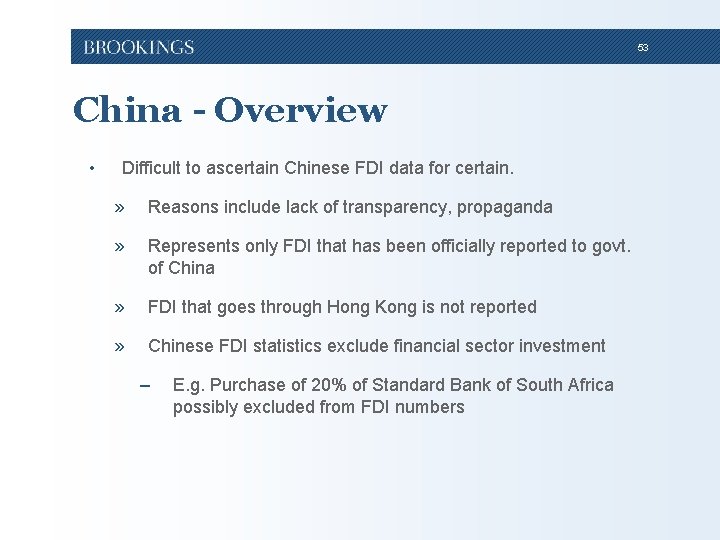
53 China - Overview • Difficult to ascertain Chinese FDI data for certain. » Reasons include lack of transparency, propaganda » Represents only FDI that has been officially reported to govt. of China » FDI that goes through Hong Kong is not reported » Chinese FDI statistics exclude financial sector investment – E. g. Purchase of 20% of Standard Bank of South Africa possibly excluded from FDI numbers
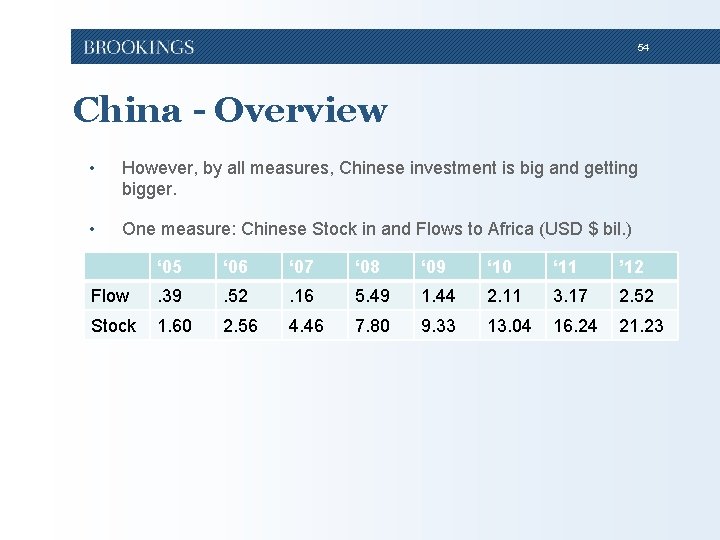
54 China - Overview • However, by all measures, Chinese investment is big and getting bigger. • One measure: Chinese Stock in and Flows to Africa (USD $ bil. ) ‘ 05 ‘ 06 ‘ 07 ‘ 08 ‘ 09 ‘ 10 ‘ 11 ’ 12 Flow . 39 . 52 . 16 5. 49 1. 44 2. 11 3. 17 2. 52 Stock 1. 60 2. 56 4. 46 7. 80 9. 33 13. 04 16. 24 21. 23
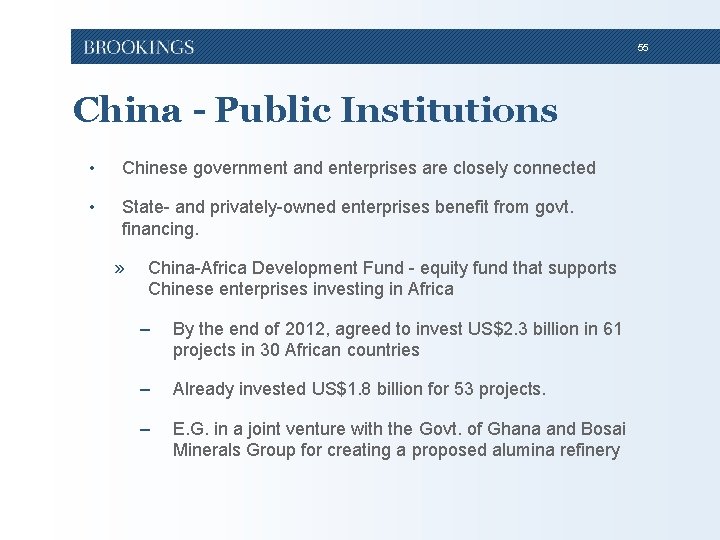
55 China - Public Institutions • Chinese government and enterprises are closely connected • State- and privately-owned enterprises benefit from govt. financing. » China-Africa Development Fund - equity fund that supports Chinese enterprises investing in Africa – By the end of 2012, agreed to invest US$2. 3 billion in 61 projects in 30 African countries – Already invested US$1. 8 billion for 53 projects. – E. G. in a joint venture with the Govt. of Ghana and Bosai Minerals Group for creating a proposed alumina refinery
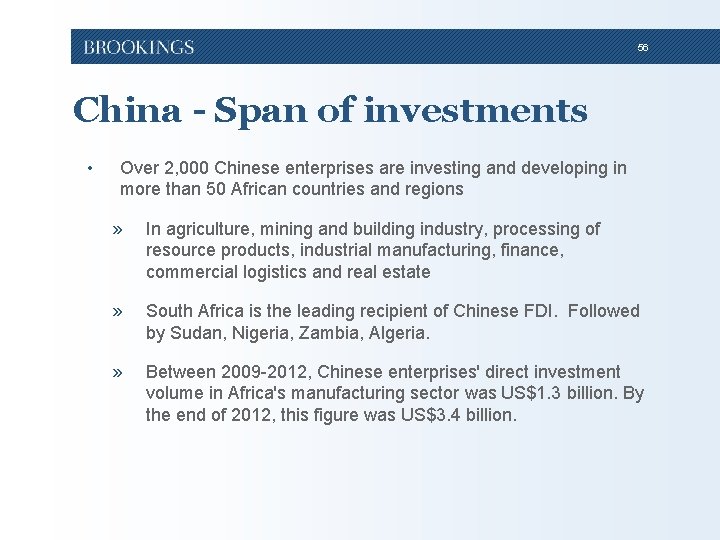
56 China - Span of investments • Over 2, 000 Chinese enterprises are investing and developing in more than 50 African countries and regions » In agriculture, mining and building industry, processing of resource products, industrial manufacturing, finance, commercial logistics and real estate » South Africa is the leading recipient of Chinese FDI. Followed by Sudan, Nigeria, Zambia, Algeria. » Between 2009 -2012, Chinese enterprises' direct investment volume in Africa's manufacturing sector was US$1. 3 billion. By the end of 2012, this figure was US$3. 4 billion.
57 China - Span of investments • Malawi’s President Joyce Banda went to China in June to sign two contracts: » A $600 mil USD contract with China Gezhouba Group Company for a 1, 000 mw thermal power plant for southern Malawi » Contract for the upgrading and construction of new power transmission lines with Tebian Electric Apparatus for central Malawi
58 China - Public Institutions • Chinese undertakes heavy-handed form of commercial diplomacy » By the end of 2012, China had signed bilateral investment treaties (BIT) with 32 African countries, and established joint economic commission mechanisms with 45 African countries. » Had agreements with at least 10 African countries to help investors avoid the issue of “double taxation” » In 2012, had an estimated 50 commercial attachés and associated staff in 48 African countries » Holds discussions, such as Forum on China-Africa Cooperation (FOCAC, with African governments regularly
59 India • India’s total FDI stock in Africa was ~US$14 billion in 2012 • India has a diversified portfolio that includes textiles, small- and medium-sized enterprises, social services (health, education) etc. • Indian FDI in Africa has traditionally been concentrated in Mauritius. » Why? Mauritius has offshore financial facilities and favorable tax conditions.
60 India • Indian FDI in Africa has also invested in Côte d’Ivoire, Senegal, Sudan, etc. • In 2010, the Indian company Bharti Airtel purchased the African telephone network Zain for $10 billion (USD)
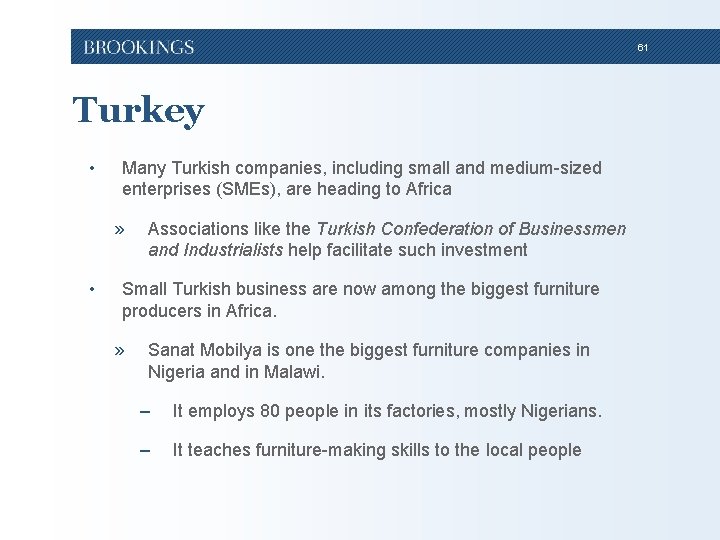
61 Turkey • Many Turkish companies, including small and medium-sized enterprises (SMEs), are heading to Africa » • Associations like the Turkish Confederation of Businessmen and Industrialists help facilitate such investment Small Turkish business are now among the biggest furniture producers in Africa. » Sanat Mobilya is one the biggest furniture companies in Nigeria and in Malawi. – It employs 80 people in its factories, mostly Nigerians. – It teaches furniture-making skills to the local people
62 Turkey • Members of the Rwanda Active Businessmen Association representing the agro-processing, textile, food, steel and furniture industries will visit Istanbul, Turkey in March » To boost trade and investment between Turkey and Rwanda » To share and learn from each other’s experiences on how to improve production processes
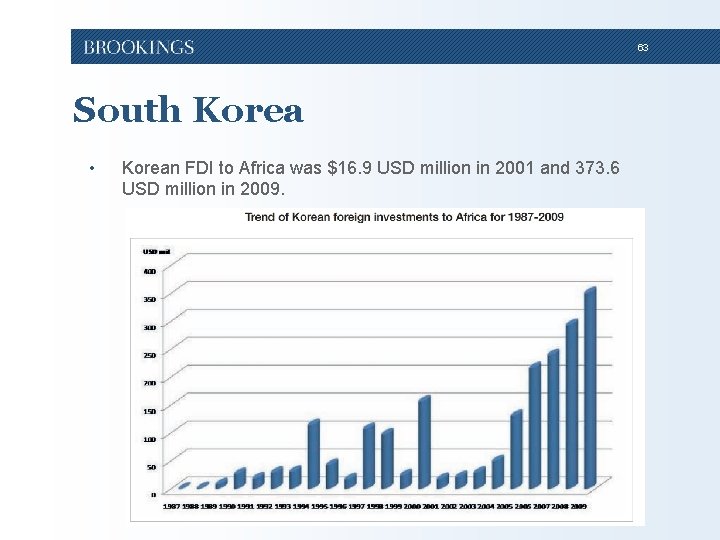
63 South Korea • Korean FDI to Africa was $16. 9 USD million in 2001 and 373. 6 USD million in 2009.
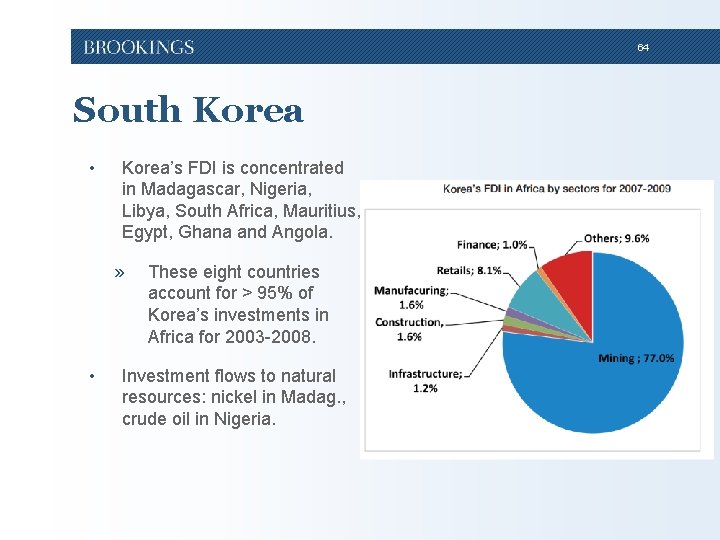
64 South Korea • Korea’s FDI is concentrated in Madagascar, Nigeria, Libya, South Africa, Mauritius, Egypt, Ghana and Angola. » • These eight countries account for > 95% of Korea’s investments in Africa for 2003 -2008. Investment flows to natural resources: nickel in Madag. , crude oil in Nigeria.
65 Iran • • Diplomacy » Iranian Foreign Minister: “The President of the Islamic Republic of Iran attaches great importance to improving all-out relations with Africa” » Iran Vice President: Iran will build a hospital, a power plant and a major water project in Mombasa, Kenya. Iran has diversified areas of international interest, in part because of Western sanctions » Has agreed to share technology with Nigeria to produce electricity. » Iranian car manufacturer, Khodro, opened a factory in Senegal
66 Emerging Africa: Opportunities for Mutually Beneficial Engagement • There are still many constraints for doing business in Africa but there has also been major improvements • Growth prospect for Africa look good and the youthful population presents a great opportunity • For many countries, governance and improvements in investment climate unlikely to be reversed • There is a new scramble for Africa particularly by emerging economies • Brazil has a comparative advantage on account of a smaller cultural divide
67 Emerging Africa: Opportunities for Mutually Beneficial Engagement • Africa presents many opportunities for Brazilian investors specifically in: - Natural resource sectors—Extraction, value addition, manufactures - Closing Africa’s infrastructure deficit-construction - Agricultural transformation • Exploit the youth bulge/raise productivity • Partnership with local private sector and even governments
68 Strategic positioning • Brazilian investors should think long term • Provision of job opportunities is the priority for African (China has a bad record in this area) • Capacity building is key for durable partnerships • Focus on the development of communities— health, education-broad corporate social responsibility • There are challenges but opportunities are greater