
1 Overview and Methodology Overarching Question to what




- Slides: 19
1
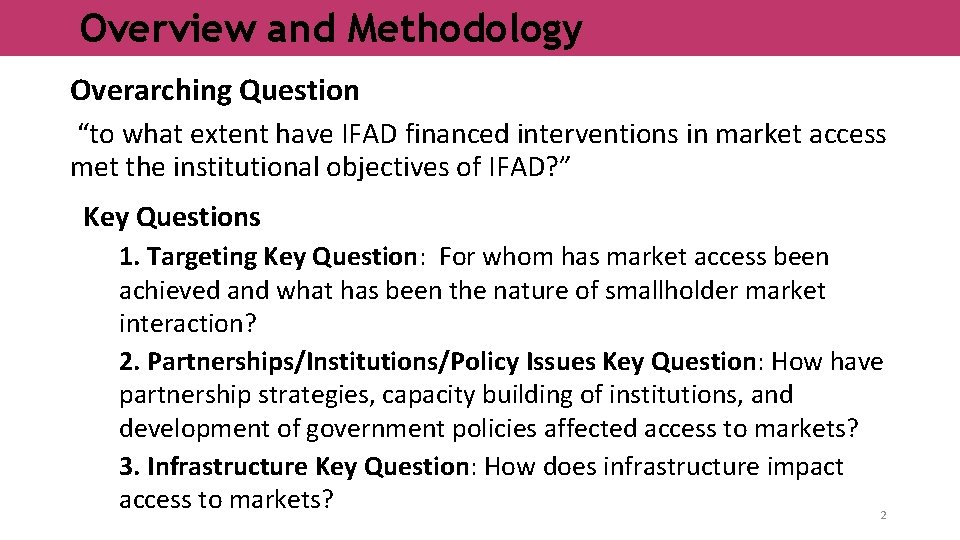
Overview and Methodology Overarching Question “to what extent have IFAD financed interventions in market access met the institutional objectives of IFAD? ” Key Questions 1. Targeting Key Question: For whom has market access been achieved and what has been the nature of smallholder market interaction? 2. Partnerships/Institutions/Policy Issues Key Question: How have partnership strategies, capacity building of institutions, and development of government policies affected access to markets? 3. Infrastructure Key Question: How does infrastructure impact access to markets? 2
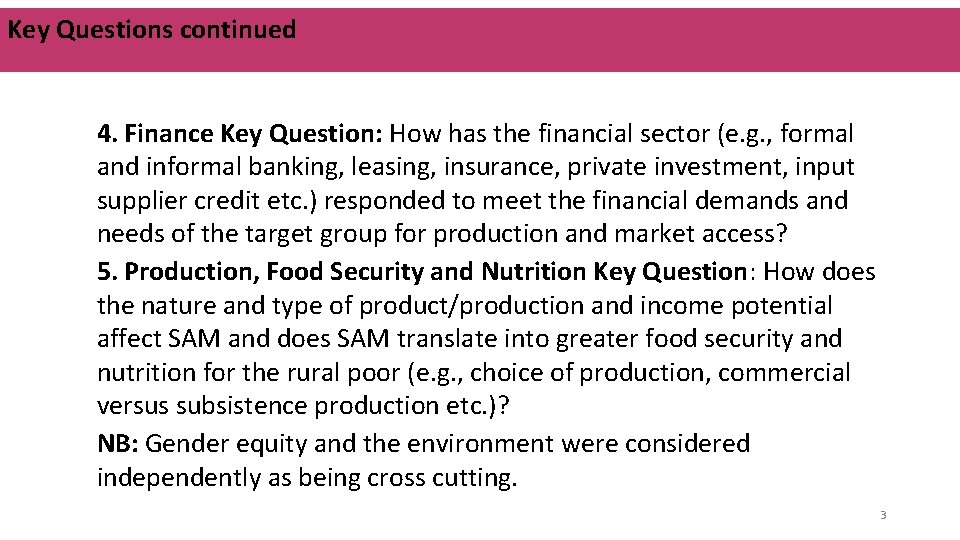
Key Questions continued 4. Finance Key Question: How has the financial sector (e. g. , formal and informal banking, leasing, insurance, private investment, input supplier credit etc. ) responded to meet the financial demands and needs of the target group for production and market access? 5. Production, Food Security and Nutrition Key Question: How does the nature and type of product/production and income potential affect SAM and does SAM translate into greater food security and nutrition for the rural poor (e. g. , choice of production, commercial versus subsistence production etc. )? NB: Gender equity and the environment were considered independently as being cross cutting. 3
Methodology 1. Review SAM literature 2. Sample Selection • 150 evaluations scanned for SAM components • 45 assessed for substantive SAM activities • 39 selected for in depth analysis 3. Smallholder & Market Functionality Analysis • Assessed by Key Questions, Importance to Smallholders & Market Functionality as measured by impact & relevance respectively. Programme Sample Selection Method 1. Stated specific SAM objectives. 2. Number of SAM activities. 3. Relative size of SAM budget. 4. Degree to which SAM was judged integral to programme outcome/impact success. Impact is average of Household Income & Assets, Household Social Capital & Food Security/Nutrition and relevance is a proxy for an intervention being relevant to market functioning. 4
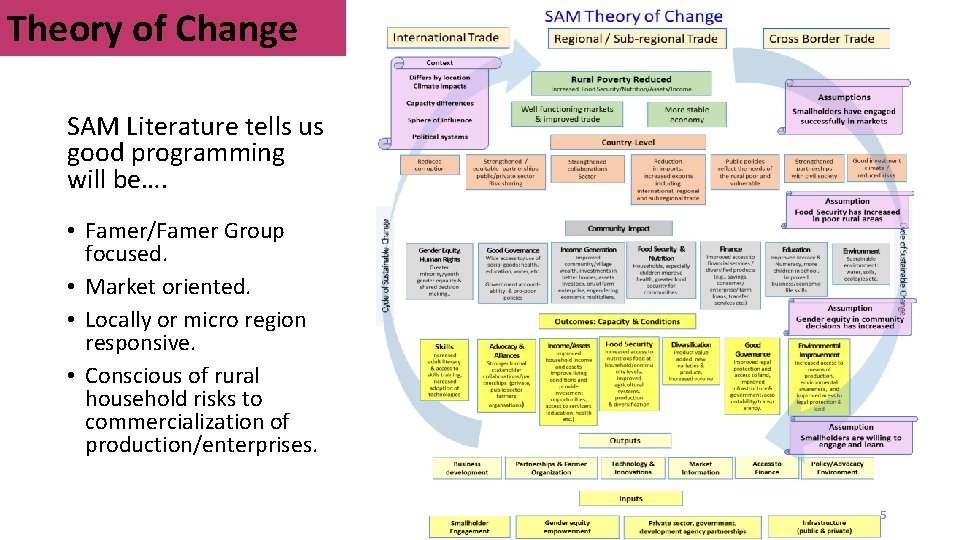
Theory of Change SAM Literature tells us good programming will be…. • Famer/Famer Group focused. • Market oriented. • Locally or micro region responsive. • Conscious of rural household risks to commercialization of production/enterprises. 5
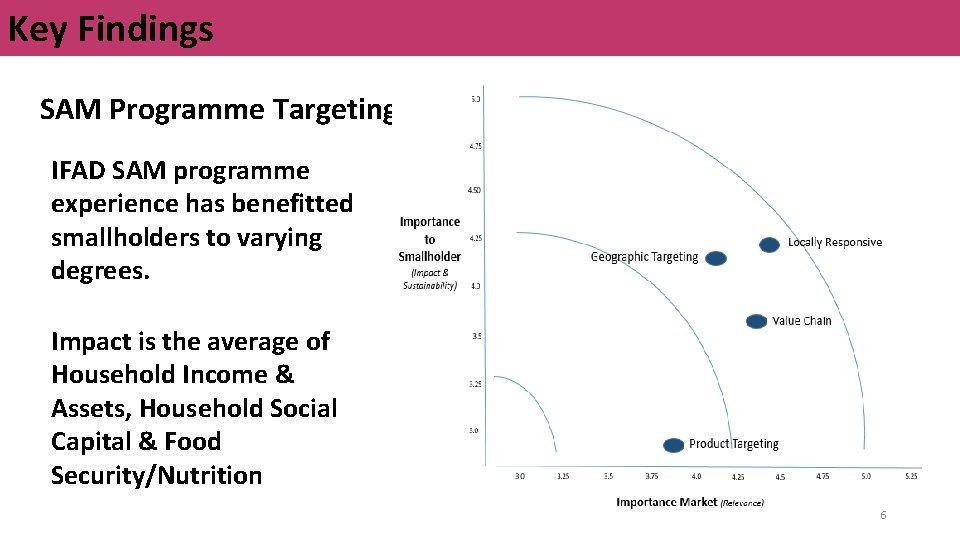
Key Findings SAM Programme Targeting IFAD SAM programme experience has benefitted smallholders to varying degrees. Impact is the average of Household Income & Assets, Household Social Capital & Food Security/Nutrition 6
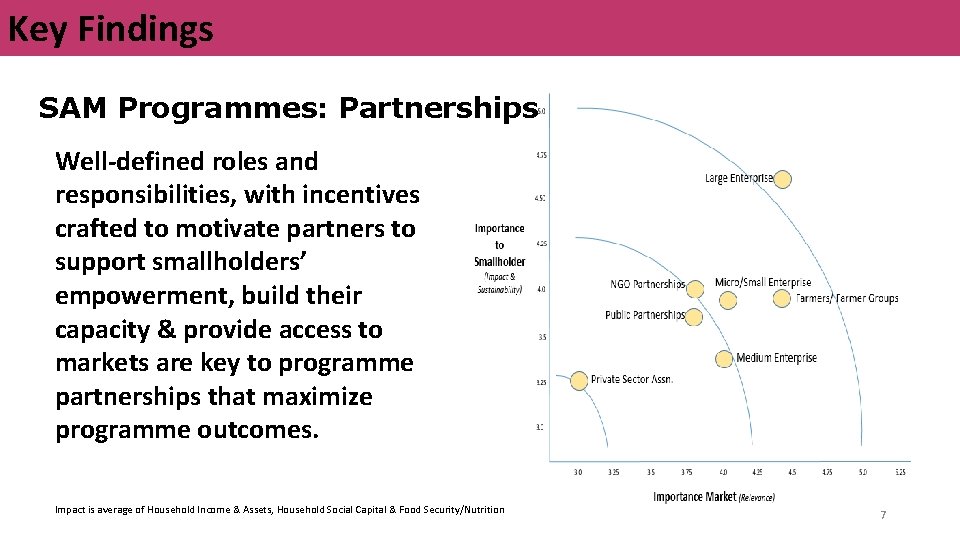
Key Findings SAM Programmes: Partnerships Well-defined roles and responsibilities, with incentives crafted to motivate partners to support smallholders’ empowerment, build their capacity & provide access to markets are key to programme partnerships that maximize programme outcomes. Impact is average of Household Income & Assets, Household Social Capital & Food Security/Nutrition 7
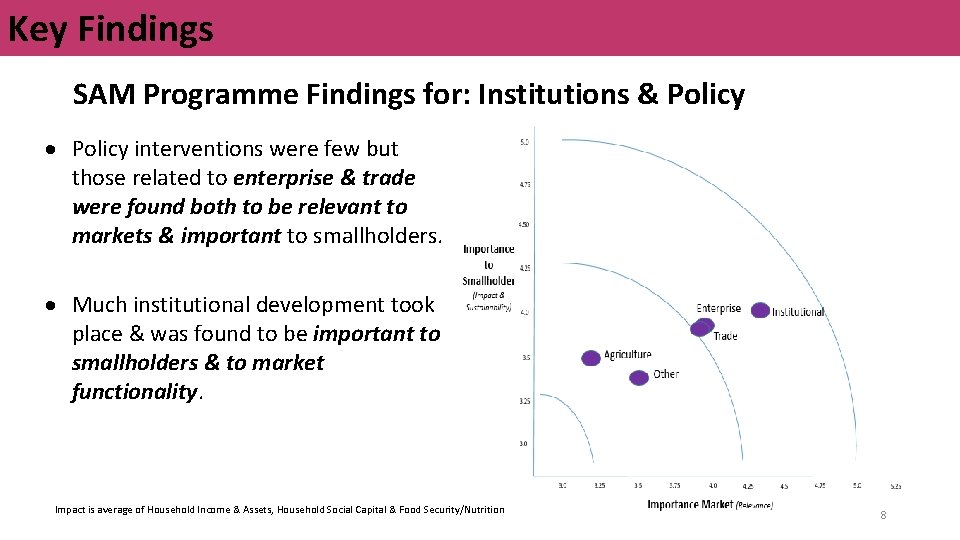
Key Findings SAM Programme Findings for: Institutions & Policy interventions were few but those related to enterprise & trade were found both to be relevant to markets & important to smallholders. Much institutional development took place & was found to be important to smallholders & to market functionality. Impact is average of Household Income & Assets, Household Social Capital & Food Security/Nutrition 8
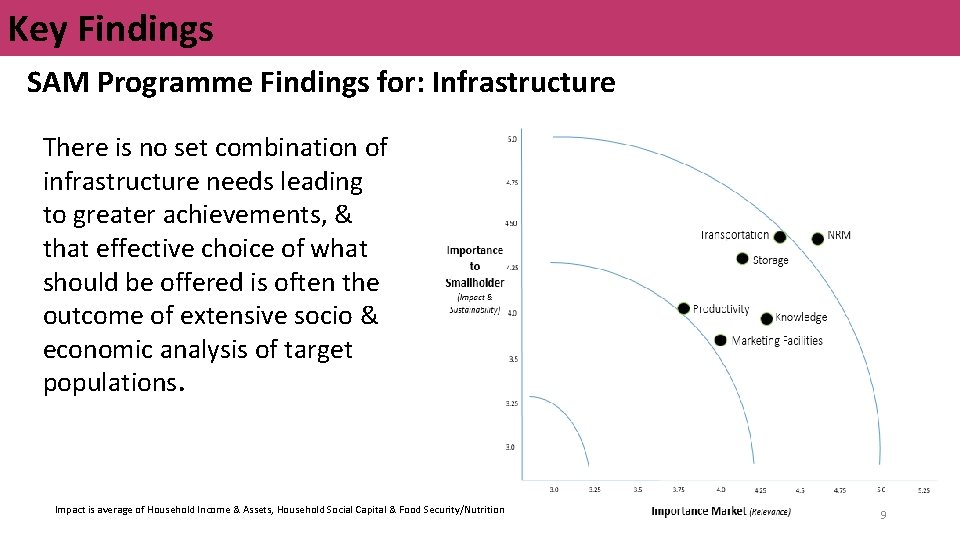
Key Findings SAM Programme Findings for: Infrastructure There is no set combination of infrastructure needs leading to greater achievements, & that effective choice of what should be offered is often the outcome of extensive socio & economic analysis of target populations. Impact is average of Household Income & Assets, Household Social Capital & Food Security/Nutrition 9
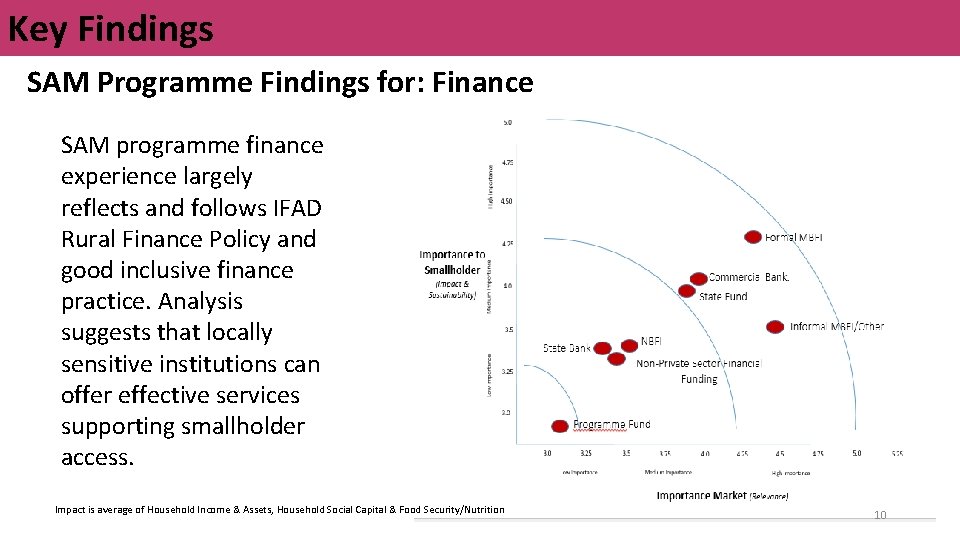
Key Findings SAM Programme Findings for: Finance SAM programme finance experience largely reflects and follows IFAD Rural Finance Policy and good inclusive finance practice. Analysis suggests that locally sensitive institutions can offer effective services supporting smallholder access. Impact is average of Household Income & Assets, Household Social Capital & Food Security/Nutrition 10
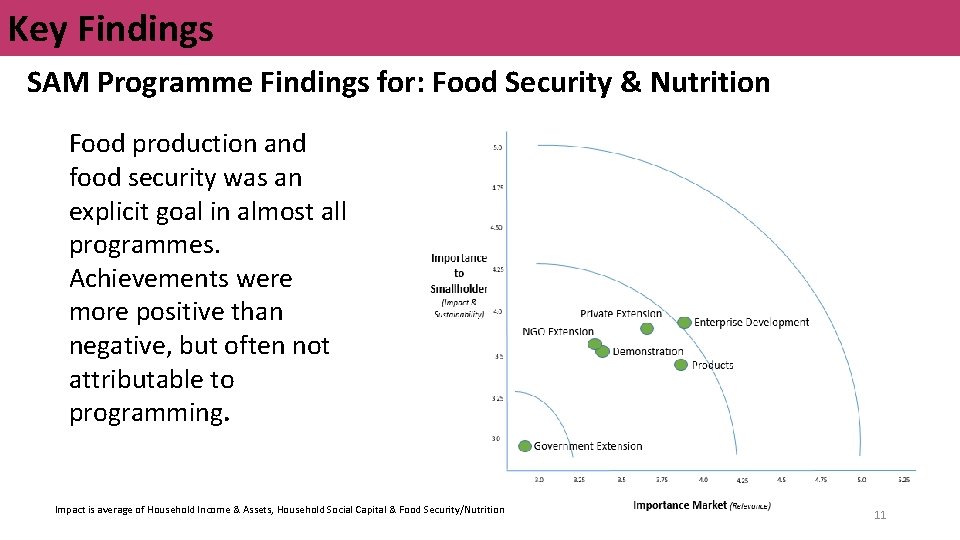
Key Findings SAM Programme Findings for: Food Security & Nutrition Food production and food security was an explicit goal in almost all programmes. Achievements were more positive than negative, but often not attributable to programming. Impact is average of Household Income & Assets, Household Social Capital & Food Security/Nutrition SAM Production (Food & Nutrition) 11
Key Findings Gender & Environment (including Climate Change) Gender Equity Expanding market access to women offers a promising opportunity to increase household productivity for commercial purposes and poverty reduction. Women’s market participation has been mixed but was often positive despite inequalities which require targeted, well sequenced capacity development and empowerment support. SAM programmes had gender goals but frequently did not specify outcomes or outputs to support desired outcomes. Natural Resource Management NRM outcomes were seldom found as specific programme activities, but where there were specified NRM outputs notable positive access to markets was often achieved. 12
Key Findings Emerging SAM Themes 5. 0 Locally Sensitive Targeting of Programme Activities 4. 75 Large Enterprise 4. 50 Transportation Importance to 4. 25 Smallholder Storage Relevant Infrastructure pri se NGO Private Extension Trade NGO Extension Public Demonstration Agriculture State Bank Processing NBFI Products Other Policy 3. 5 Geographic Targeting Commercial Bank DA e I ledg now Farmers/Groups K Institutional Dev Micro/Small Ent. Value Chain Marketing Facilities ter Productivity 4. 0 3. 25 Informal MBFI Locally Responsive En (Impact & Sustainability) Formal MBFI Market Oriented Activities NRM Other Infrastructure Medium Enterprise Targeting Private Sector Assn. Partnerships Infrastructure Financial 3. 0 Impact is average of Household Income & Assets, Household Social Capital & Food Security/Nutrition Production Government Fund Government Extension Programme Fund 3. 0 3. 25 Institutions & Policy Product Targeting 3. 5 3. 75 4. 0 4. 25 Importance Market (Relevance) 4. 5 4. 75 5. 0 5. 25 13
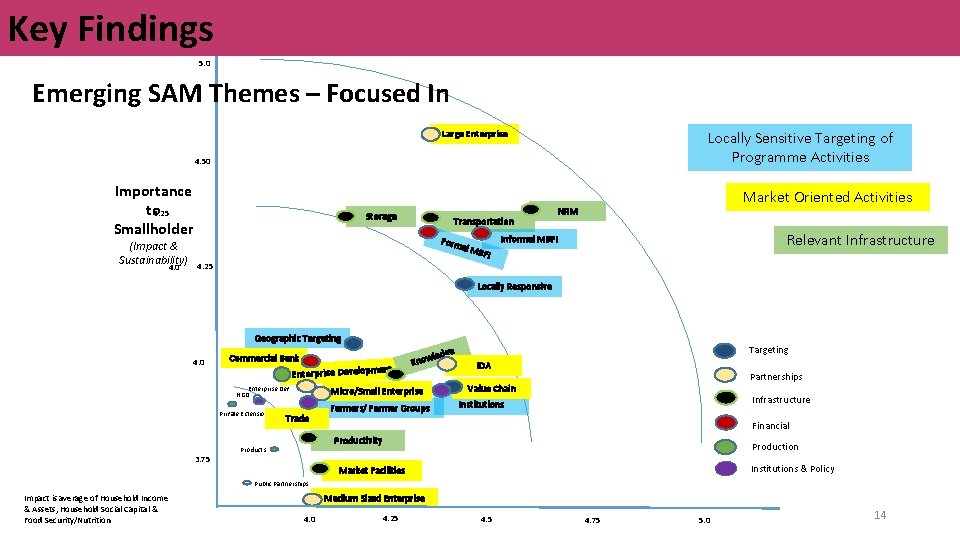
Key Findings 5. 0 Emerging SAM Themes – Focused In Large Enterprise Locally Sensitive Targeting of Programme Activities 4. 50 Importance to 4. 25 Smallholder (Impact & Sustainability) 4. 0 Storage Transportation Form al M BFI Market Oriented Activities NRM Relevant Infrastructure Informal MBFI 4. 25 Locally Responsive Geographic Targeting 4. 0 ledge Commercial Bank Enterprise Developme Enterprise Dev NGO Private Extension 3. 75 nt Know Micro/Small Enterprise Trade Farmers/ Farmer Groups Targeting IDA Partnerships Value Chain Infrastructure Institutions Financial Productivity Products Production Institutions & Policy Market Facilities Public Partnerships Impact is average of Household Income & Assets, Household Social Capital & Food Security/Nutrition Medium Sized Enterprise 4. 0 4. 25 4. 75 5. 0 14
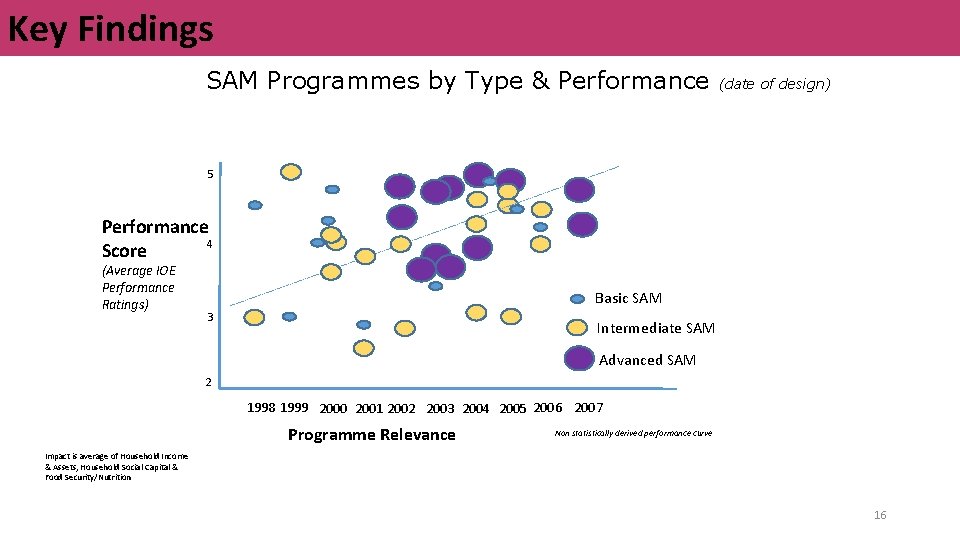
Key Findings SAM Programmes by Type & Performance (date of design) 5 Performance 4 Score (Average IOE Performance Ratings) Basic SAM 3 Intermediate SAM Advanced SAM 2 1998 1999 2000 2001 2002 2003 2004 2005 2006 2007 Programme Relevance Non statistically derived performance curve Impact is average of Household Income & Assets, Household Social Capital & Food Security/Nutrition 16
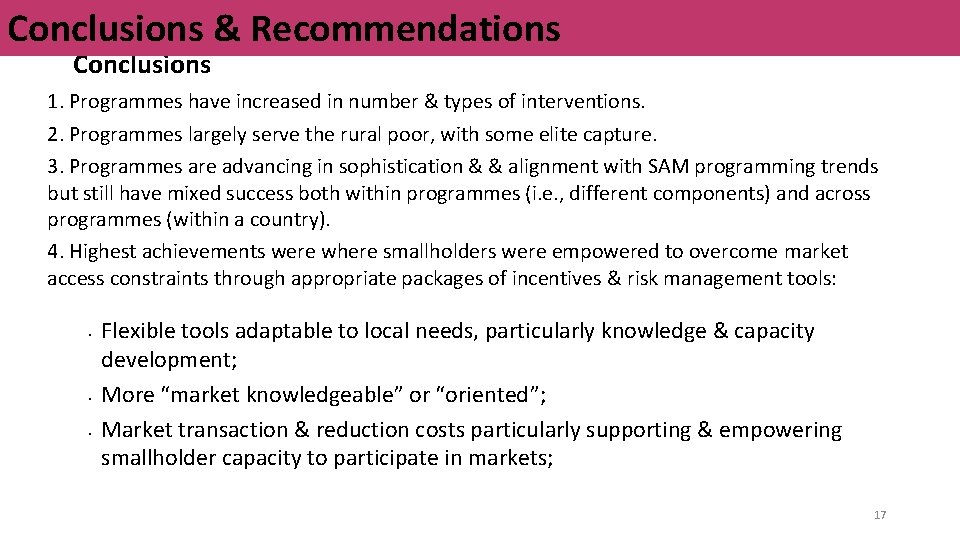
Conclusions & Recommendations Conclusions 1. Programmes have increased in number & types of interventions. 2. Programmes largely serve the rural poor, with some elite capture. 3. Programmes are advancing in sophistication & & alignment with SAM programming trends but still have mixed success both within programmes (i. e. , different components) and across programmes (within a country). 4. Highest achievements were where smallholders were empowered to overcome market access constraints through appropriate packages of incentives & risk management tools: • • • Flexible tools adaptable to local needs, particularly knowledge & capacity development; More “market knowledgeable” or “oriented”; Market transaction & reduction costs particularly supporting & empowering smallholder capacity to participate in markets; 17
Conclusions & Recommendations Conclusions continued 5. Women & natural resource management offer potential high performance achievements. 6. Transparent, smallholder accountable institutions and policies. 7. Well sequenced, flexible, locally responsive implementation & partners balancing public goods and respect for market demand. 8. Programmes have been supported/guided by IFAD’s strategic frameworks & policy developments. 18
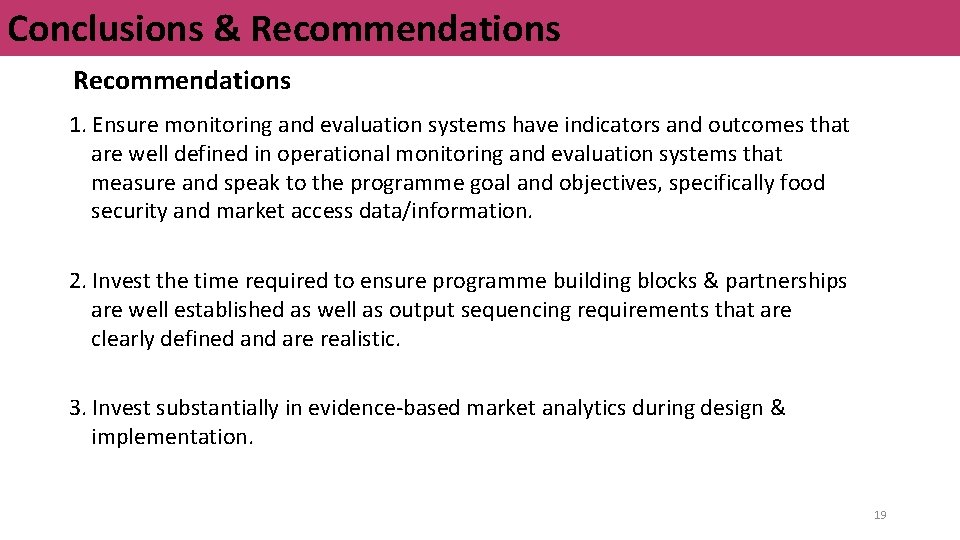
Conclusions & Recommendations 1. Ensure monitoring and evaluation systems have indicators and outcomes that are well defined in operational monitoring and evaluation systems that measure and speak to the programme goal and objectives, specifically food security and market access data/information. 2. Invest the time required to ensure programme building blocks & partnerships are well established as well as output sequencing requirements that are clearly defined and are realistic. 3. Invest substantially in evidence-based market analytics during design & implementation. 19
Conclusions & Recommendations continued 4. Identify and provide output activities for gender, minority & environmental considerations in all programmes (through appropriate targeting and implementation strategies). 5. Consider programme designs with greater flexibility, to respond quickly as they arise during programme implementation. 6. IFAD consider new products for flexible funding instruments with the means to adapt to market opportunities 20