
1 Open Tank Level Measurement Level measurement in

- Slides: 7
1
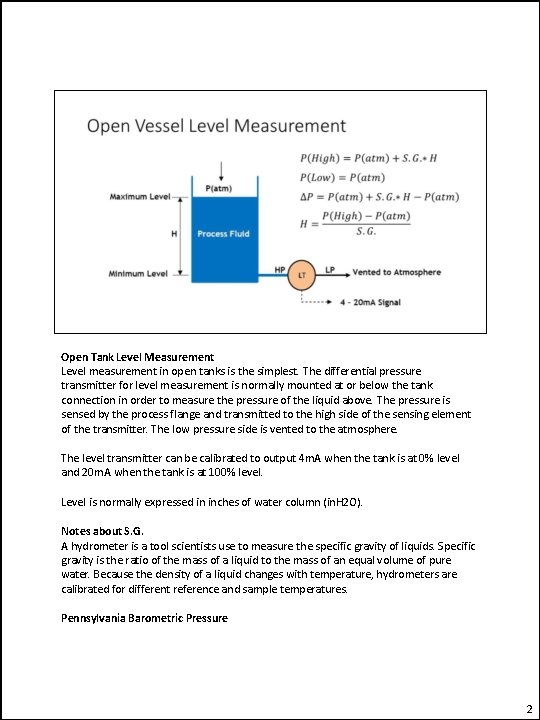
Open Tank Level Measurement Level measurement in open tanks is the simplest. The differential pressure transmitter for level measurement is normally mounted at or below the tank connection in order to measure the pressure of the liquid above. The pressure is sensed by the process flange and transmitted to the high side of the sensing element of the transmitter. The low pressure side is vented to the atmosphere. The level transmitter can be calibrated to output 4 m. A when the tank is at 0% level and 20 m. A when the tank is at 100% level. Level is normally expressed in inches of water column (in. H 2 O). Notes about S. G. A hydrometer is a tool scientists use to measure the specific gravity of liquids. Specific gravity is the ratio of the mass of a liquid to the mass of an equal volume of pure water. Because the density of a liquid changes with temperature, hydrometers are calibrated for different reference and sample temperatures. Pennsylvania Barometric Pressure 2
State Low: 30. 08 Hg State High: 30. 17 Hg State Average: 30. 12 Hg State range: 0. 09 Hg 2
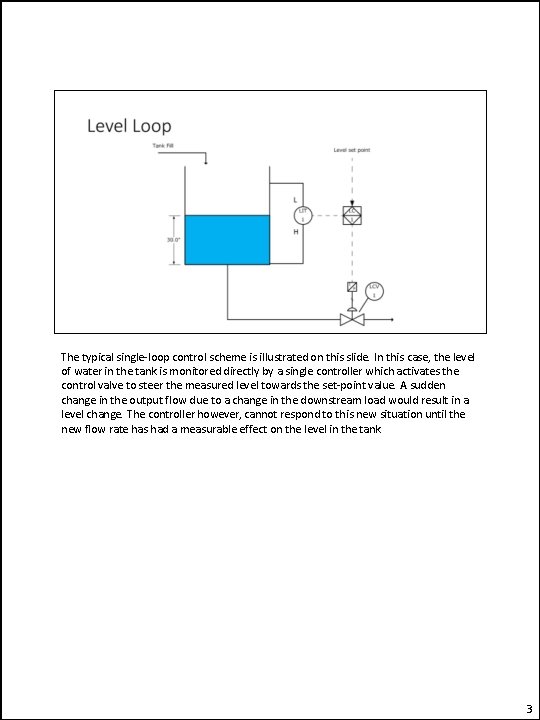
The typical single-loop control scheme is illustrated on this slide. In this case, the level of water in the tank is monitored directly by a single controller which activates the control valve to steer the measured level towards the set-point value. A sudden change in the output flow due to a change in the downstream load would result in a level change. The controller however, cannot respond to this new situation until the new flow rate has had a measurable effect on the level in the tank. 3
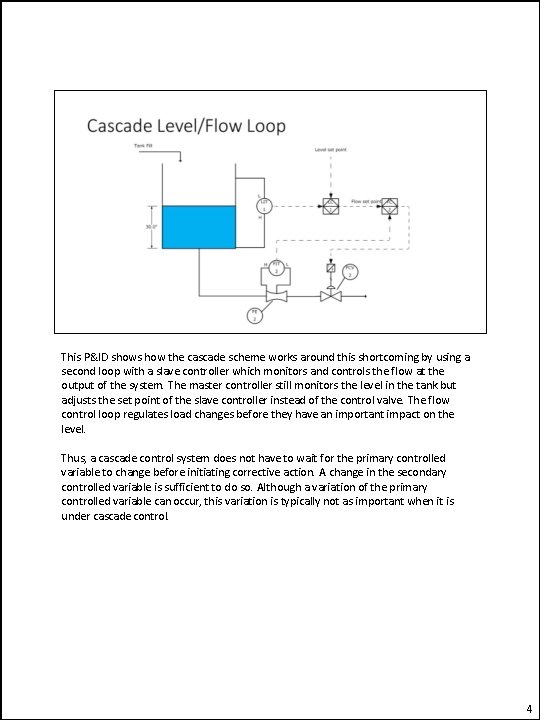
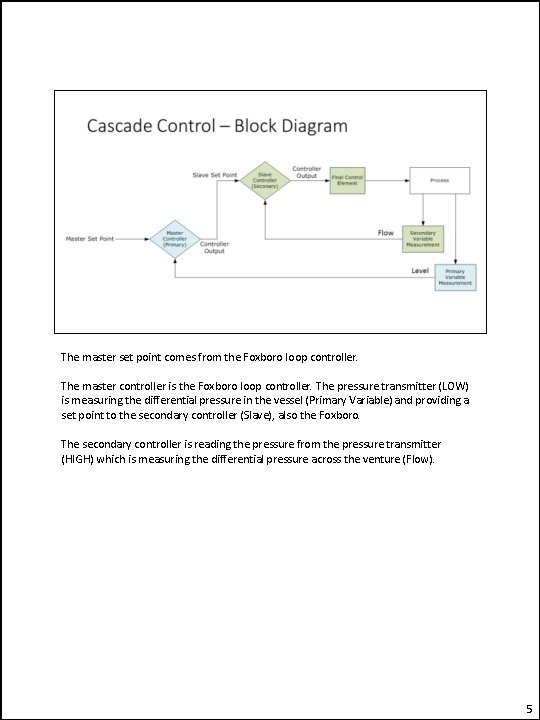
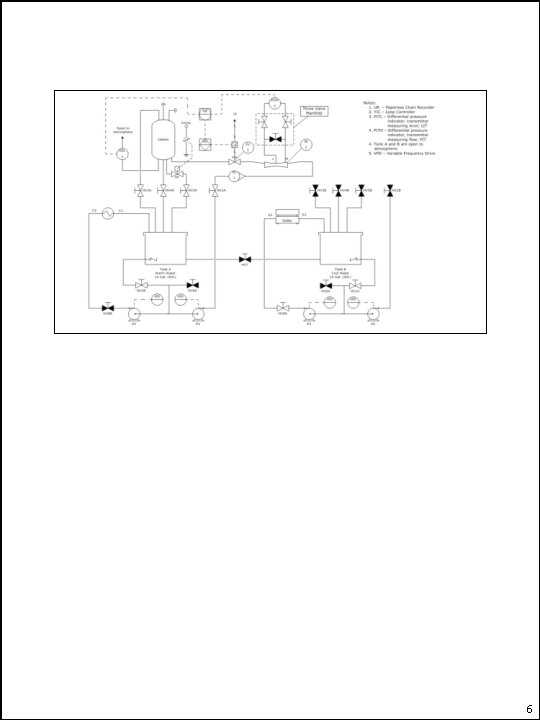
This P&ID shows how the cascade scheme works around this shortcoming by using a second loop with a slave controller which monitors and controls the flow at the output of the system. The master controller still monitors the level in the tank but adjusts the set point of the slave controller instead of the control valve. The flow control loop regulates load changes before they have an important impact on the level. Thus, a cascade control system does not have to wait for the primary controlled variable to change before initiating corrective action. A change in the secondary controlled variable is sufficient to do so. Although a variation of the primary controlled variable can occur, this variation is typically not as important when it is under cascade control. 4
The master set point comes from the Foxboro loop controller. The master controller is the Foxboro loop controller. The pressure transmitter (LOW) is measuring the differential pressure in the vessel (Primary Variable) and providing a set point to the secondary controller (Slave), also the Foxboro. The secondary controller is reading the pressure from the pressure transmitter (HIGH) which is measuring the differential pressure across the venture (Flow). 5
6