
1 Open Energy System Models challenges and barriers
1 Open Energy System Models: challenges and barriers EMP-E 2018 - PARALLEL SESSION 2 A: OPEN ENERGY SYSTEM MODELS Sylvain Quoilin - Smart Thermal Energy Systems
Thermo-physical fluid properties: Cool. Prop REFPROP: • Historical, reference software for thermophysical properties for: • 151 pure and pseudo-pure fluids • Unlimited mixtures • Written in Fortran • Non-free 2 Cool. Prop: • Open-source thermophysical properties for: • 125 pure and pseudo-pure fluids • 35 mixtures • 57 incompressible pure fluids • 47 incompressible mixtures • Written in C++ • MIT license Sylvain Quoilin - Smart Thermal Energy Systems
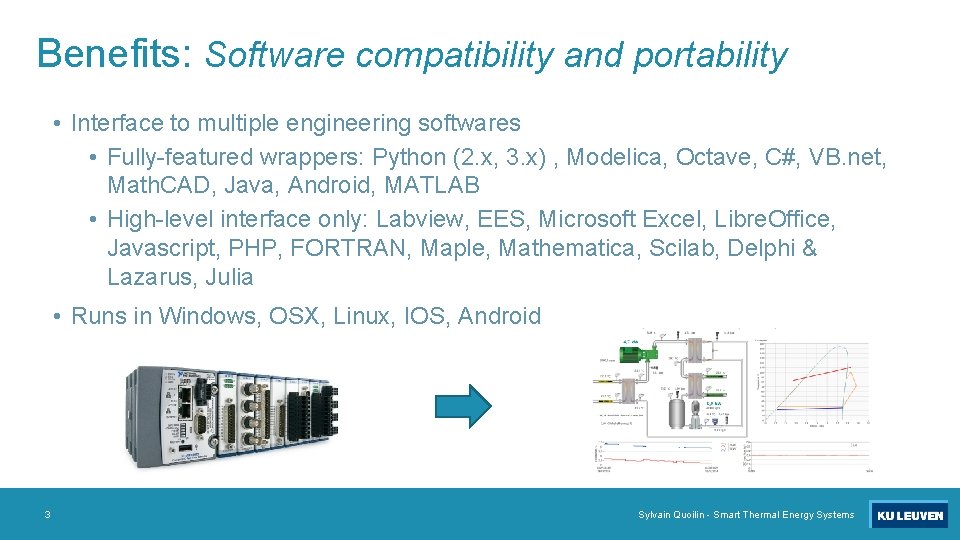
Benefits: Software compatibility and portability • Interface to multiple engineering softwares • Fully-featured wrappers: Python (2. x, 3. x) , Modelica, Octave, C#, VB. net, Math. CAD, Java, Android, MATLAB • High-level interface only: Labview, EES, Microsoft Excel, Libre. Office, Javascript, PHP, FORTRAN, Maple, Mathematica, Scilab, Delphi & Lazarus, Julia • Runs in Windows, OSX, Linux, IOS, Android 3 Sylvain Quoilin - Smart Thermal Energy Systems
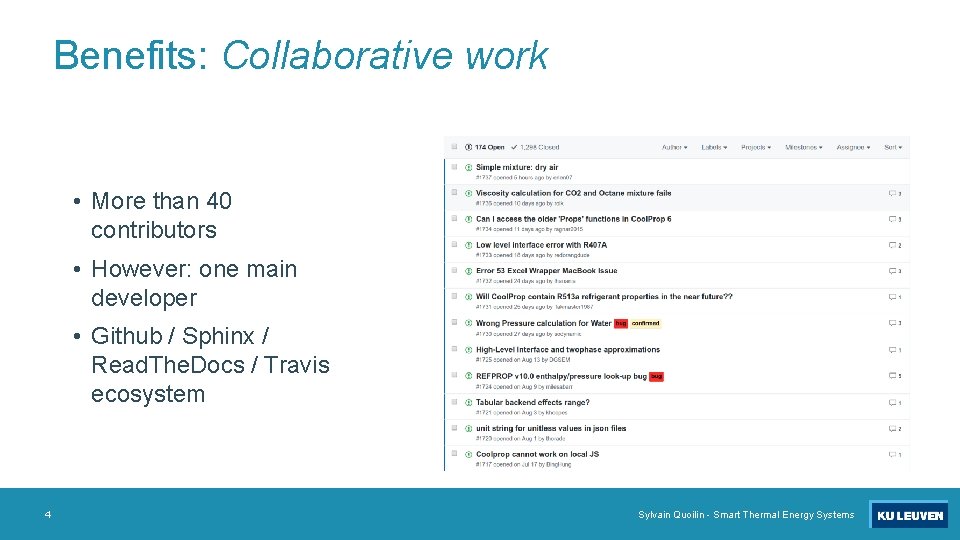
Benefits: Collaborative work • More than 40 contributors • However: one main developer • Github / Sphinx / Read. The. Docs / Travis ecosystem 4 Sylvain Quoilin - Smart Thermal Energy Systems
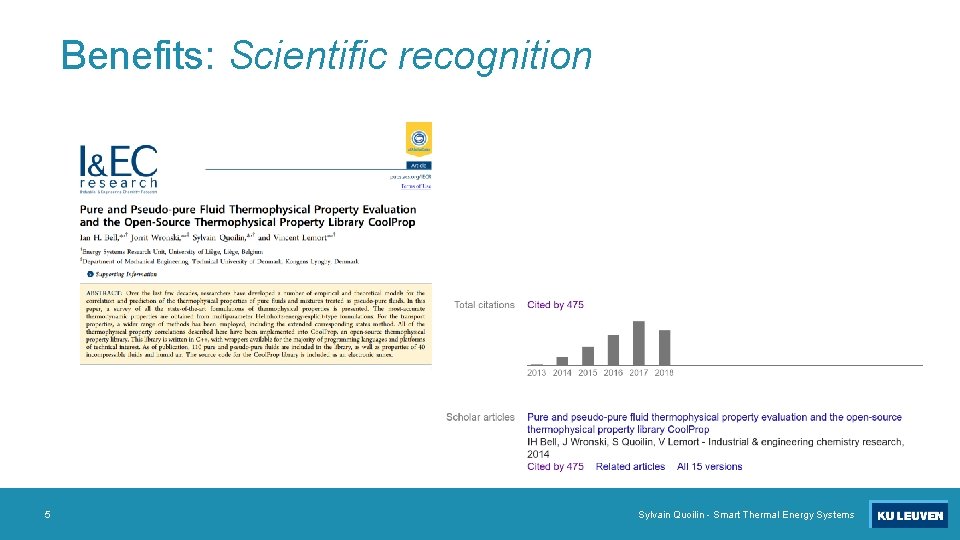
Benefits: Scientific recognition 5 Sylvain Quoilin - Smart Thermal Energy Systems

Benefits: Free access for everyone Examples: • Teaching thermodynamics in developing countries • Private companies 6 Sylvain Quoilin - Smart Thermal Energy Systems
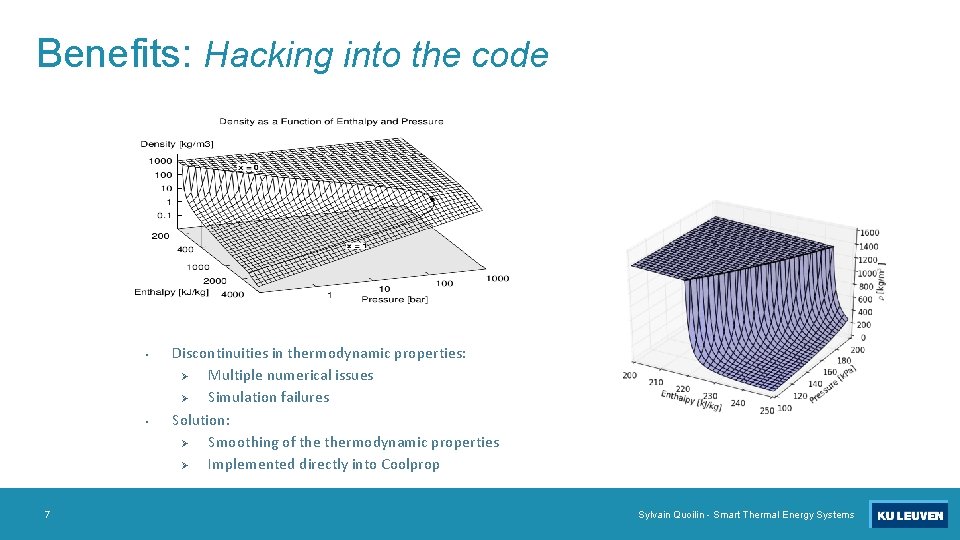
Benefits: Hacking into the code • • 7 Discontinuities in thermodynamic properties: Ø Multiple numerical issues Ø Simulation failures Solution: Ø Smoothing of thermodynamic properties Ø Implemented directly into Coolprop Sylvain Quoilin - Smart Thermal Energy Systems

Open-source power system models The Dispa-SET model - Current challenges 8 Sylvain Quoilin - Smart Thermal Energy Systems
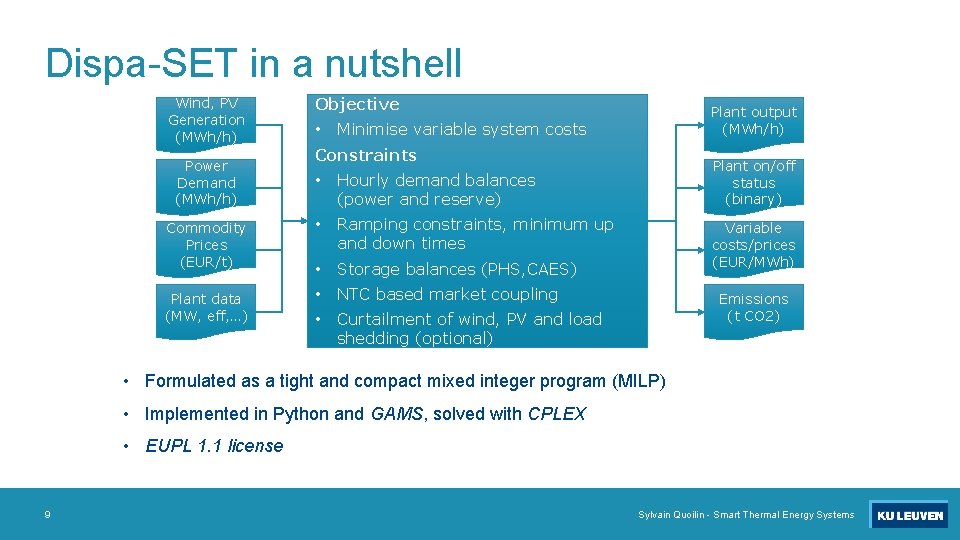
Dispa-SET in a nutshell Wind, PV Generation (MWh/h) Power Demand (MWh/h) Objective • Plant output (MWh/h) Minimise variable system costs Constraints • Hourly demand balances (power and reserve) Commodity Prices (EUR/t) • Ramping constraints, minimum up and down times • Storage balances (PHS, CAES) Plant data (MW, eff, …) • NTC based market coupling • Curtailment of wind, PV and load shedding (optional) Plant on/off status (binary) Variable costs/prices (EUR/MWh) Emissions (t CO 2) • Formulated as a tight and compact mixed integer program (MILP) • Implemented in Python and GAMS, solved with CPLEX • EUPL 1. 1 license 9 Sylvain Quoilin - Smart Thermal Energy Systems
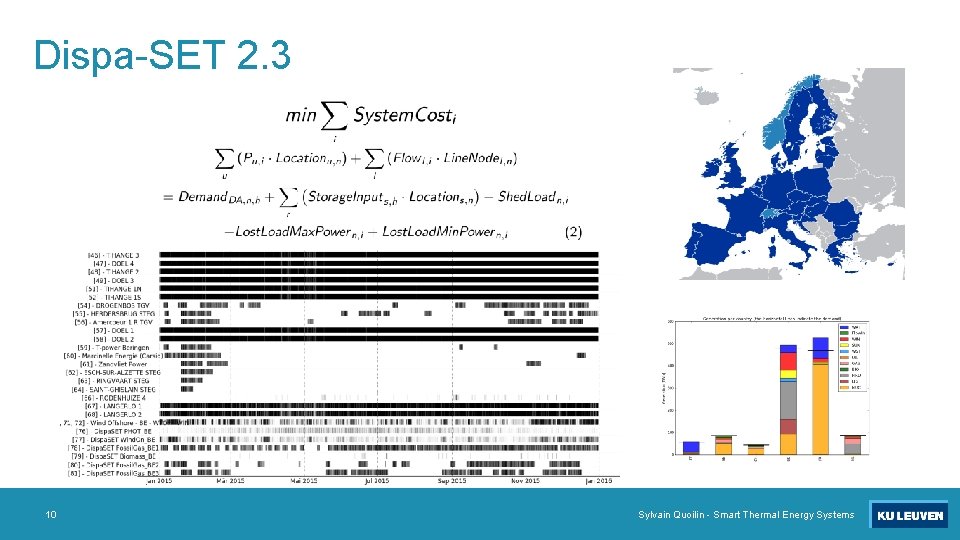
Dispa-SET 2. 3 10 Sylvain Quoilin - Smart Thermal Energy Systems

Challenges in open power system models • Data! • The Entso-E transparency platform is a precious resource, but the data is not under an open license • Some data derived from closed databases (e. g. Platts) cannot be released • Good solvers are not open! • Cplex, Gurobi, Xpress, … • Some solver interfaces (e. g. Pyomo) are not as efficient as their non-free counterparts (e. g. GAMS) • Multiple tools available: • Py. PSA, Oemof, Balmorel, EMMA, Calliope, Dispa-SET, etc. • Possibility to converge? • Julia/Jump as common solver is currently discussed within the openmod initiative 11 Sylvain Quoilin - Smart Thermal Energy Systems
Conclusions 12 Sylvain Quoilin - Smart Thermal Energy Systems
Why energy models and data should be open • Quality of science: peer review, reproducibility, traceability • More effective collaboration between science and policy • Transparent social debate • Collaborative burden sharing (=> increased productivity) • Research funded by public money should be public 13 Sylvain Quoilin - Smart Thermal Energy Systems
Why energy models and data are not open • Ethical and security concerns (particularly for data) • E. g. Information in household consumption data • Unwanted exposure • Reluctance to share data was shown to be associated with weaker evidence • Political sensitivities • Time-consuming: documenting the code, providing a documentation • Institutional and personal inertia From the H 2020 website: “the European Commission is now moving decisively from Open Access into the broader picture of Open Science” 14 Sylvain Quoilin - Smart Thermal Energy Systems
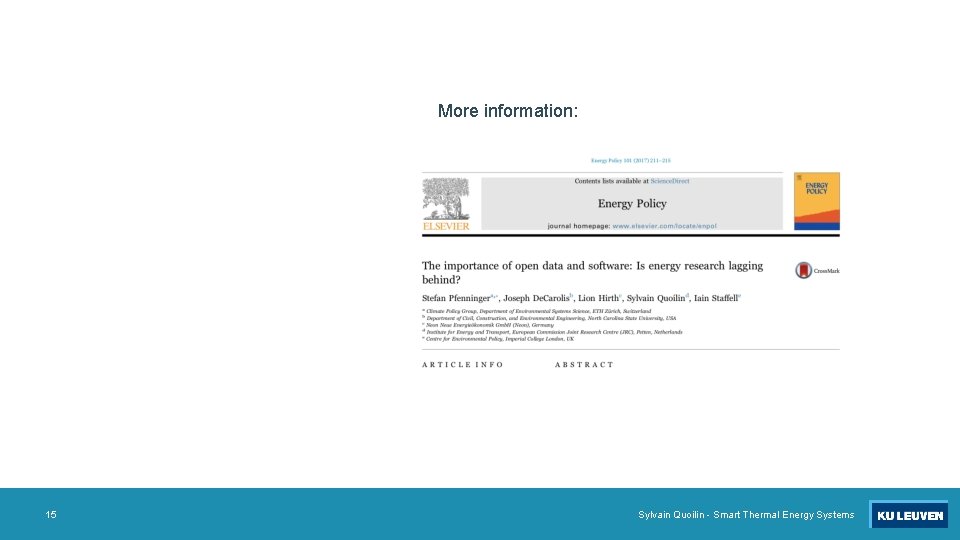
More information: 15 Sylvain Quoilin - Smart Thermal Energy Systems
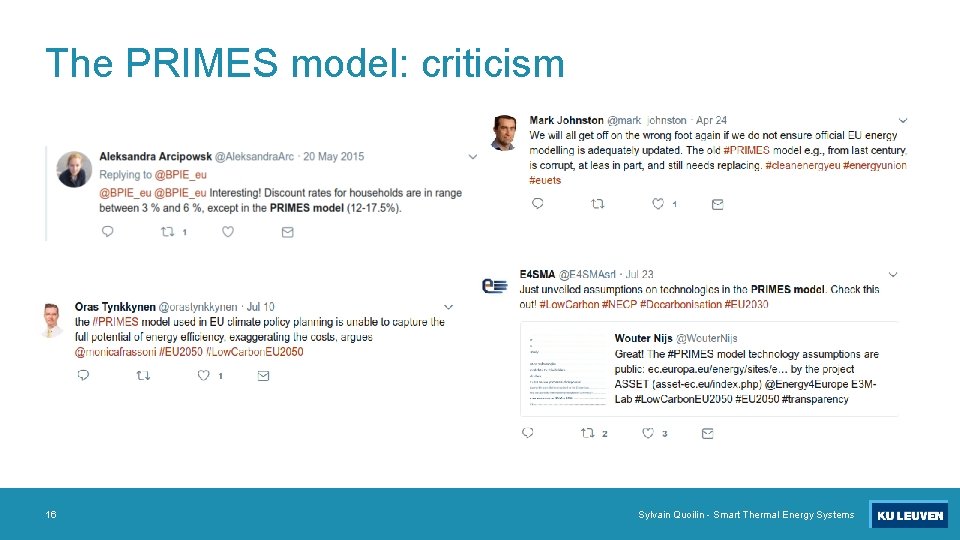
The PRIMES model: criticism 16 Sylvain Quoilin - Smart Thermal Energy Systems
- Slides: 16