
1 Offshoring Strategy Framework Strategy Evaluation Efficiency Evaluation
- Slides: 50
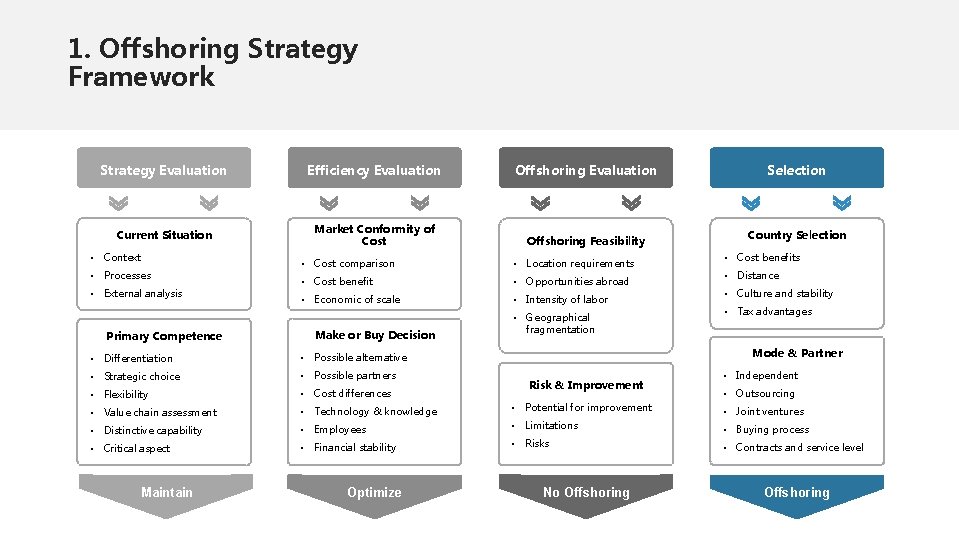
1. Offshoring Strategy Framework Strategy Evaluation Efficiency Evaluation Offshoring Evaluation Current Situation Market Conformity of Cost Offshoring Feasibility • Context • Processes • External analysis Primary Competence • Cost comparison • Location requirements • Cost benefit • Opportunities abroad • Economic of scale • Intensity of labor Make or Buy Decision • Differentiation • Possible alternative • Strategic choice • Possible partners • Flexibility • Cost differences • Value chain assessment • Geographical fragmentation Selection Country Selection • Cost benefits • Distance • Culture and stability • Tax advantages Mode & Partner Risk & Improvement • Independent • Outsourcing • Technology & knowledge • Potential for improvement • Joint ventures • Distinctive capability • Employees • Limitations • Buying process • Critical aspect • Financial stability • Risks • Contracts and service level Maintain Optimize No Offshoring
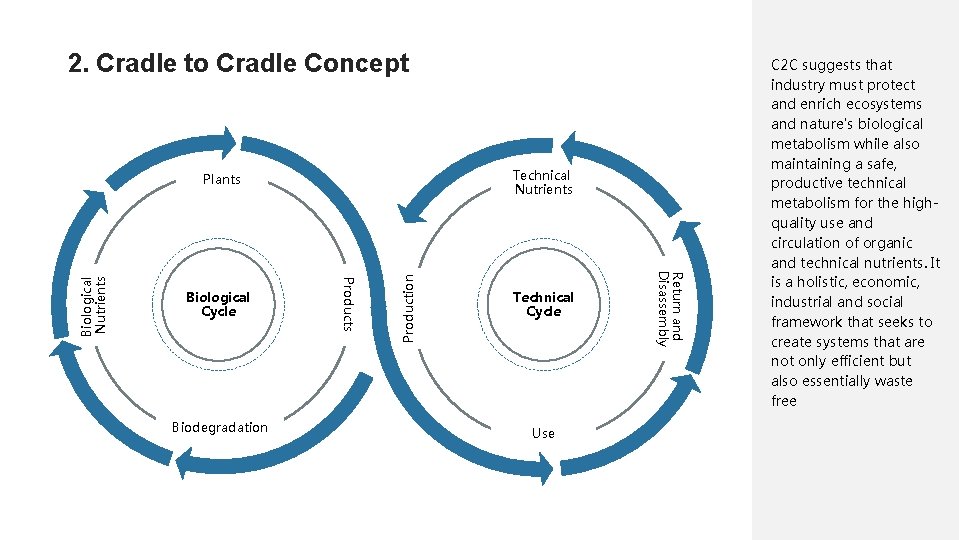
2. Cradle to Cradle Concept Technical Nutrients Biodegradation Production Technical Cycle Use Return and Disassembly Biological Cycle Products Biological Nutrients Plants C 2 C suggests that industry must protect and enrich ecosystems and nature's biological metabolism while also maintaining a safe, productive technical metabolism for the highquality use and circulation of organic and technical nutrients. It is a holistic, economic, industrial and social framework that seeks to create systems that are not only efficient but also essentially waste free
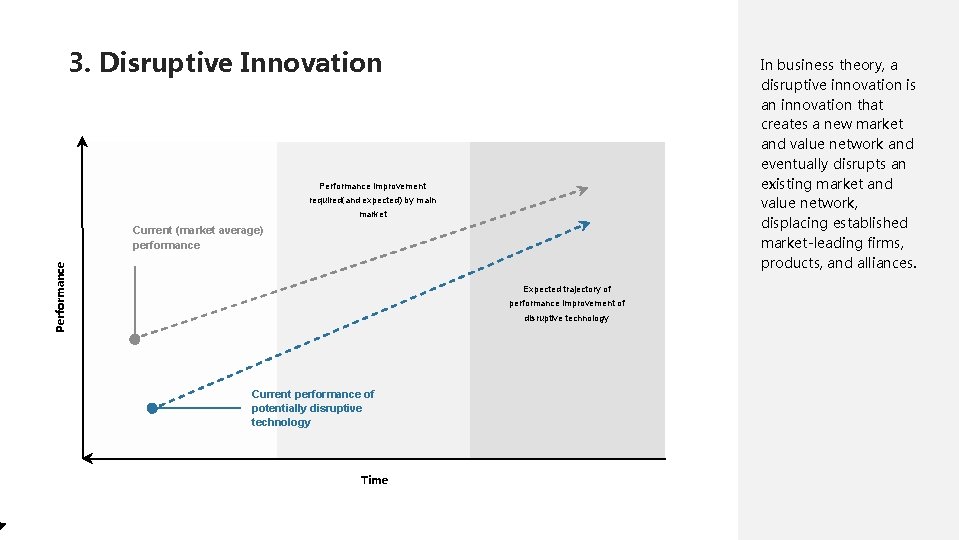
3. Disruptive Innovation In business theory, a disruptive innovation is an innovation that creates a new market and value network and eventually disrupts an existing market and value network, displacing established market-leading firms, products, and alliances. Performance improvement required(and expected) by main market Performance Current (market average) performance Expected trajectory of performance improvement of disruptive technology Current performance of potentially disruptive technology Time
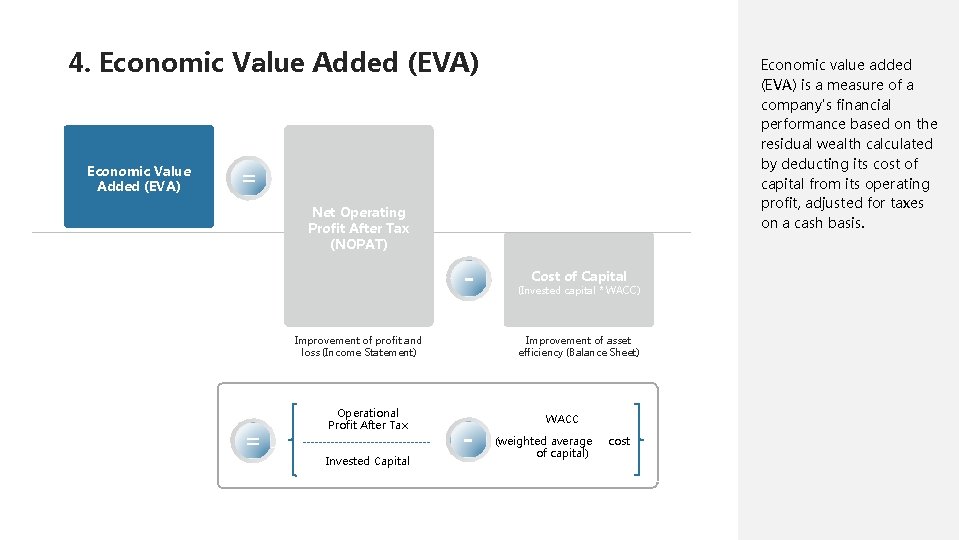
4. Economic Value Added (EVA) Economic value added (EVA) is a measure of a company's financial performance based on the residual wealth calculated by deducting its cost of capital from its operating profit, adjusted for taxes on a cash basis. = Net Operating Profit After Tax (NOPAT) - Improvement of asset efficiency (Balance Sheet) Improvement of profit and loss (Income Statement) = Operational Profit After Tax Invested Capital Cost of Capital (Invested capital * WACC) - WACC (weighted average of capital) cost
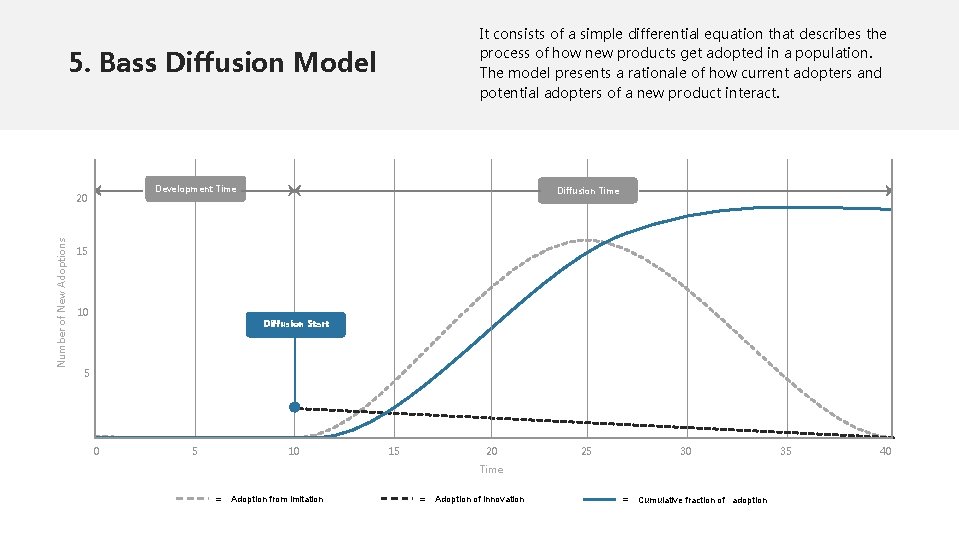
It consists of a simple differential equation that describes the process of how new products get adopted in a population. The model presents a rationale of how current adopters and potential adopters of a new product interact. 5. Bass Diffusion Model Development Time Number of New Adoptions 20 Diffusion Time 15 10 Diffusion Start 5 0 5 10 15 20 25 30 Time = Adoption from imitation = Adoption of innovation = Cumulative fraction of adoption 35 40
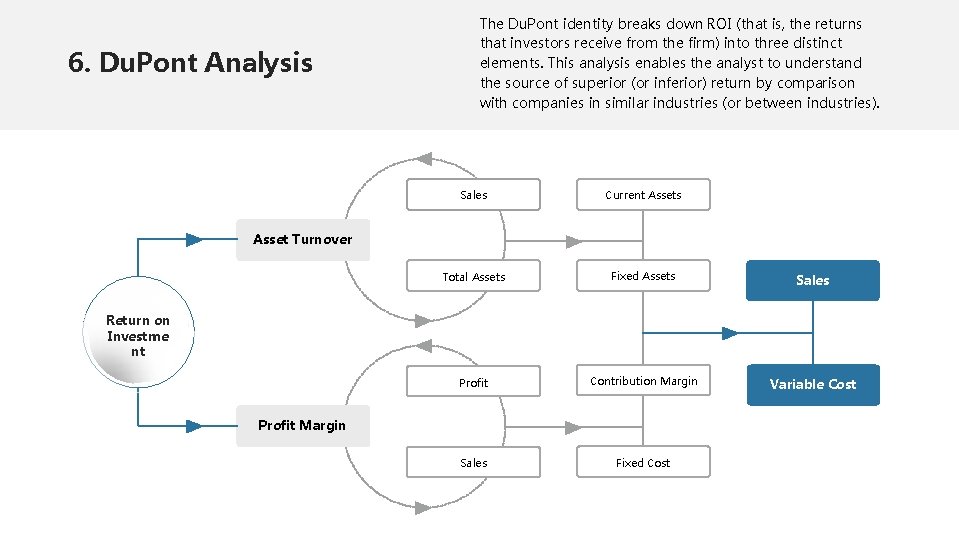
6. Du. Pont Analysis The Du. Pont identity breaks down ROI (that is, the returns that investors receive from the firm) into three distinct elements. This analysis enables the analyst to understand the source of superior (or inferior) return by comparison with companies in similar industries (or between industries). Sales Current Assets Total Assets Fixed Assets Sales Profit Contribution Margin Variable Cost Sales Fixed Cost Asset Turnover Return on Investme nt Profit Margin
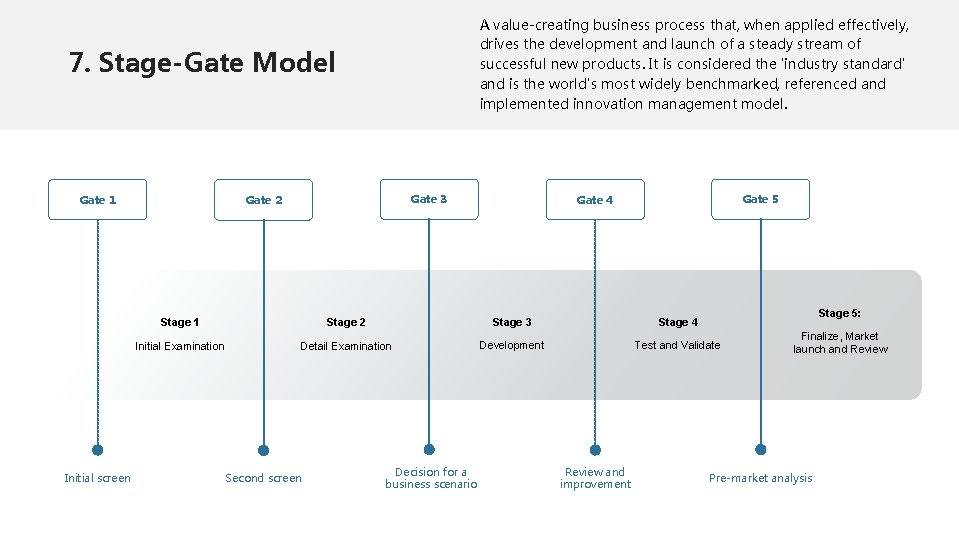
A value-creating business process that, when applied effectively, drives the development and launch of a steady stream of successful new products. It is considered the 'industry standard' and is the world's most widely benchmarked, referenced and implemented innovation management model. 7. Stage-Gate Model Gate 1 Initial screen Gate 3 Gate 2 Gate 5 Gate 4 Stage 5: Stage 1 Stage 2 Stage 3 Stage 4 Initial Examination Detail Examination Development Test and Validate Second screen Decision for a business scenario Review and improvement Finalize, Market launch and Review Pre-market analysis
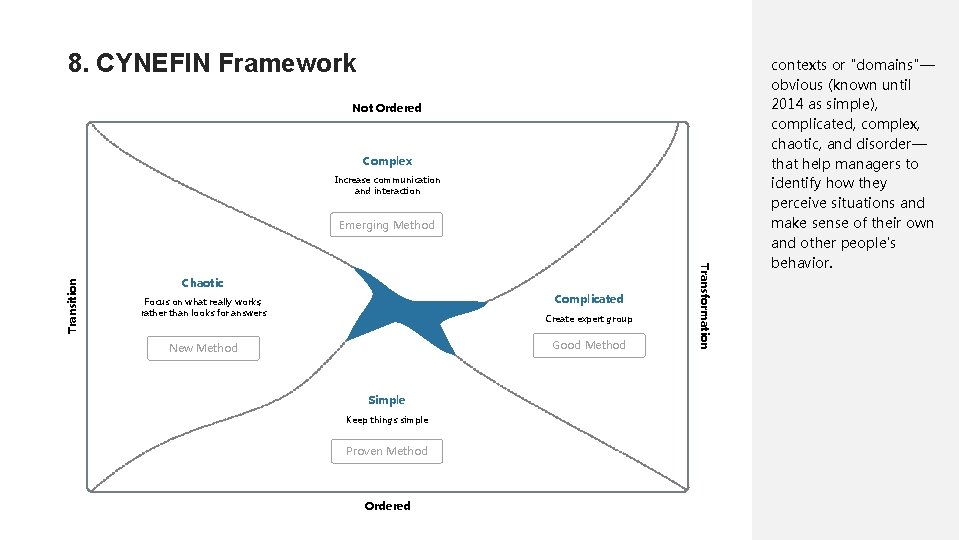
8. CYNEFIN Framework Not Ordered Complex Increase communication and interaction Chaotic Complicated Focus on what really works, rather than looks for answers Create expert group Good Method New Method Simple Keep things simple Proven Method Ordered Transformation Transition Emerging Method contexts or "domains"— obvious (known until 2014 as simple), complicated, complex, chaotic, and disorder— that help managers to identify how they perceive situations and make sense of their own and other people's behavior.
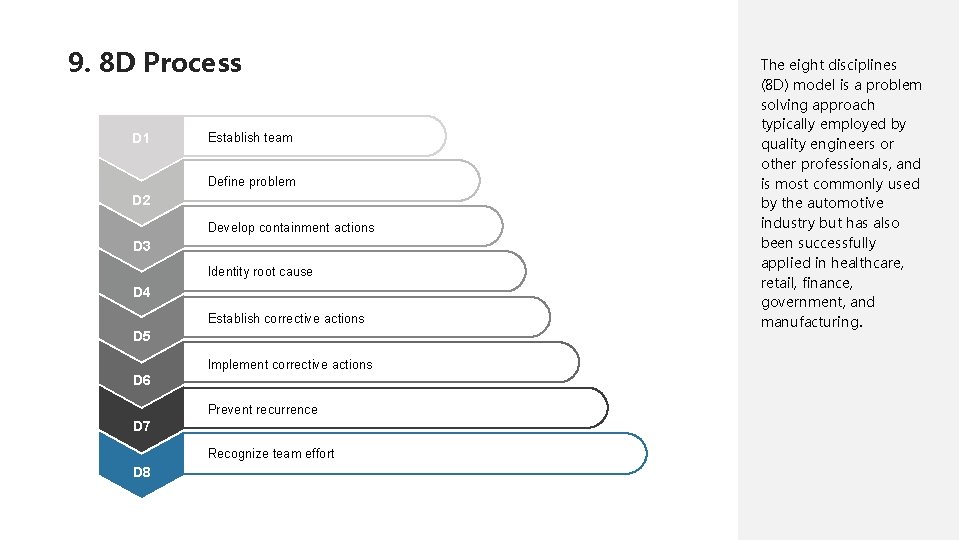
9. 8 D Process D 1 Establish team Define problem D 2 Develop containment actions D 3 Identity root cause D 4 Establish corrective actions D 5 Implement corrective actions D 6 Prevent recurrence D 7 Recognize team effort D 8 The eight disciplines (8 D) model is a problem solving approach typically employed by quality engineers or other professionals, and is most commonly used by the automotive industry but has also been successfully applied in healthcare, retail, finance, government, and manufacturing.
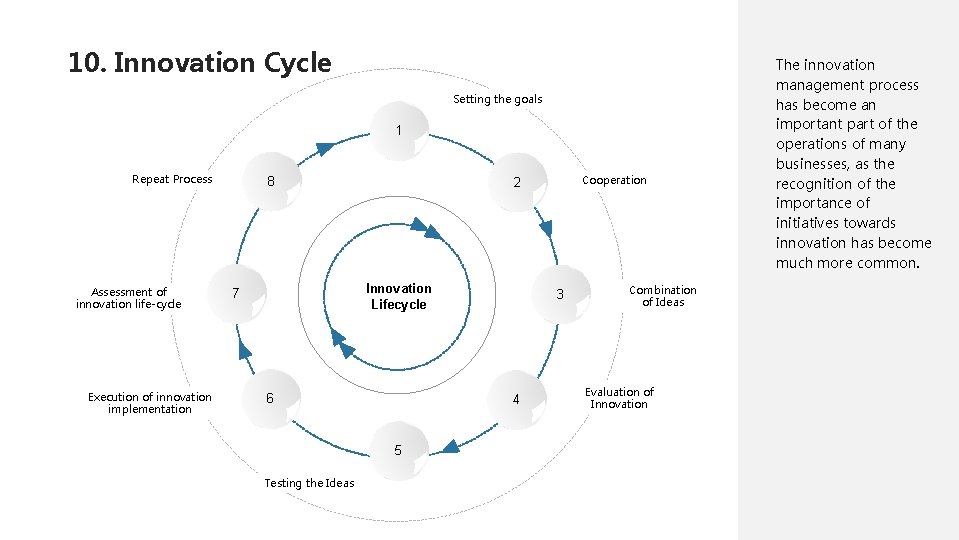
10. Innovation Cycle Setting the goals 1 Repeat Process Assessment of innovation life-cycle Execution of innovation implementation 8 Innovation Lifecycle 7 6 3 4 5 Testing the Ideas Cooperation 2 Combination of Ideas Evaluation of Innovation The innovation management process has become an important part of the operations of many businesses, as the recognition of the importance of initiatives towards innovation has become much more common.
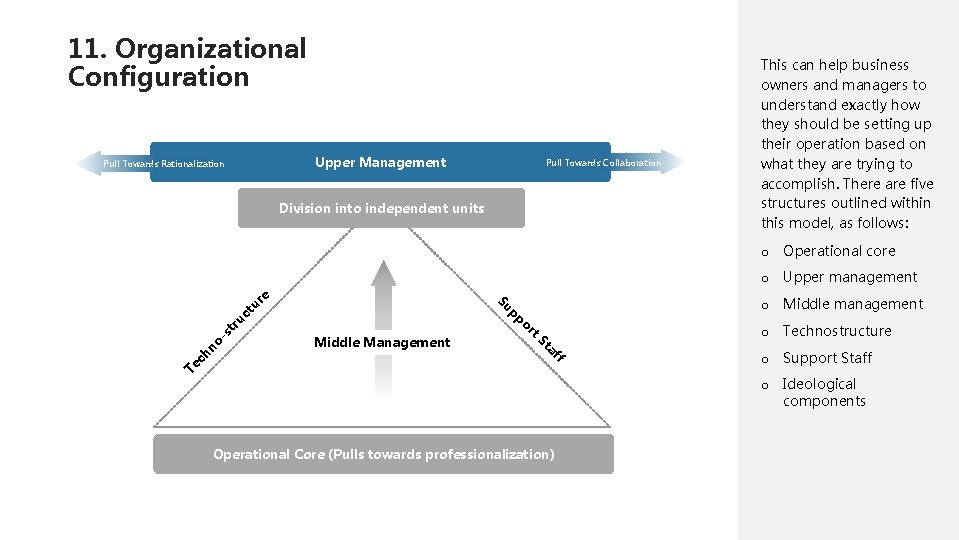
11. Organizational Configuration Upper Management Pull Towards Rationalization Pull Towards Collaboration Division into independent units This can help business owners and managers to understand exactly how they should be setting up their operation based on what they are trying to accomplish. There are five structures outlined within this model, as follows: o Operational core o Upper management re Su u ct ru t -s c Te h no Middle Management pp or o Middle management t. S ta f o Technostructure f o Support Staff o Ideological components Operational Core (Pulls towards professionalization)
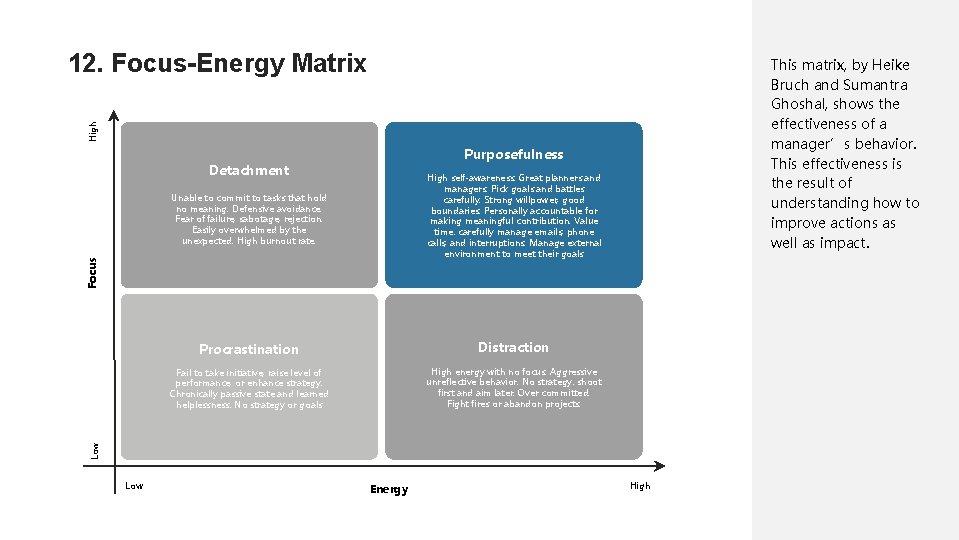
12. Focus-Energy Matrix High This matrix, by Heike Bruch and Sumantra Ghoshal, shows the effectiveness of a manager’s behavior. This effectiveness is the result of understanding how to improve actions as well as impact. Purposefulness Detachment Procrastination Distraction Fail to take initiative, raise level of performance, or enhance strategy. Chronically passive state and learned helplessness. No strategy or goals High energy with no focus. Aggressive unreflective behavior. No strategy: shoot first and aim later. Over committed. Fight fires or abandon projects. Low Focus Unable to commit to tasks that hold no meaning. Defensive avoidance. Fear of failure, sabotage, rejection. Easily overwhelmed by the unexpected. High burnout rate. High self-awareness. Great planners and managers. Pick goals and battles carefully. Strong willpower, good boundaries. Personally accountable for making meaningful contribution. Value time: carefully manage emails, phone calls, and interruptions. Manage external environment to meet their goals Low Energy High
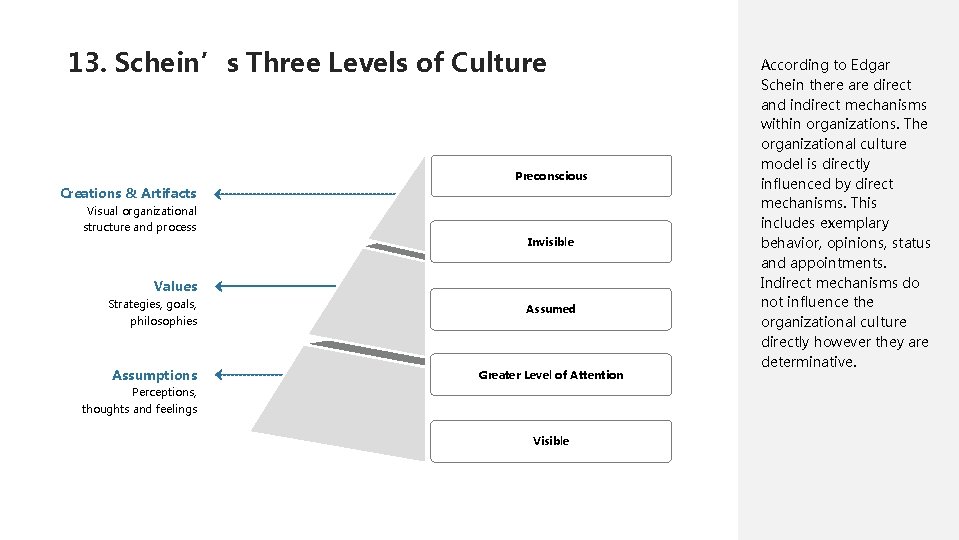
13. Schein’s Three Levels of Culture Preconscious Creations & Artifacts Visual organizational structure and process Invisible Values Strategies, goals, philosophies Assumptions Assumed Greater Level of Attention Perceptions, thoughts and feelings Visible According to Edgar Schein there are direct and indirect mechanisms within organizations. The organizational culture model is directly influenced by direct mechanisms. This includes exemplary behavior, opinions, status and appointments. Indirect mechanisms do not influence the organizational culture directly however they are determinative.
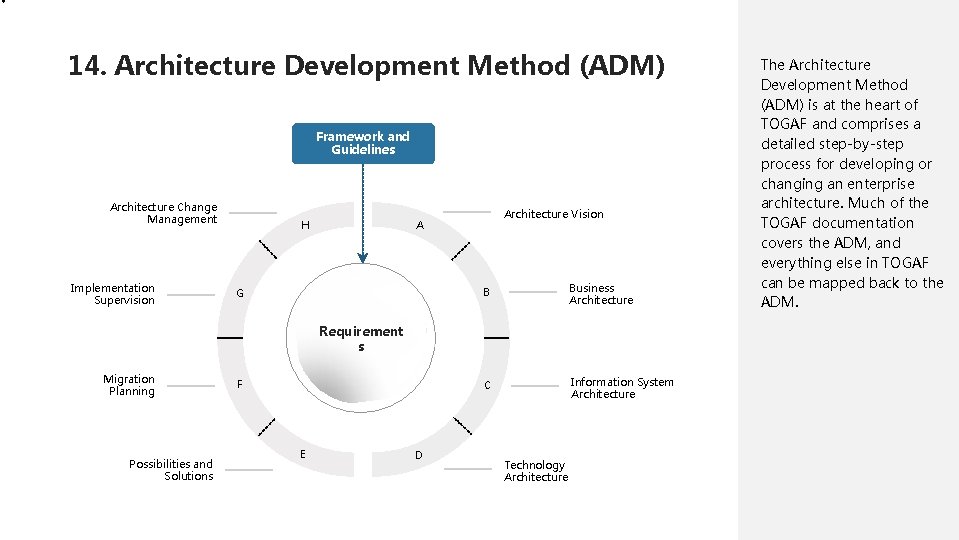
14. Architecture Development Method (ADM) Framework and Guidelines Architecture Change Management Implementation Supervision Architecture Vision A H G B Business Architecture C Information System Architecture Requirement s Migration Planning Possibilities and Solutions F E D Technology Architecture The Architecture Development Method (ADM) is at the heart of TOGAF and comprises a detailed step-by-step process for developing or changing an enterprise architecture. Much of the TOGAF documentation covers the ADM, and everything else in TOGAF can be mapped back to the ADM.
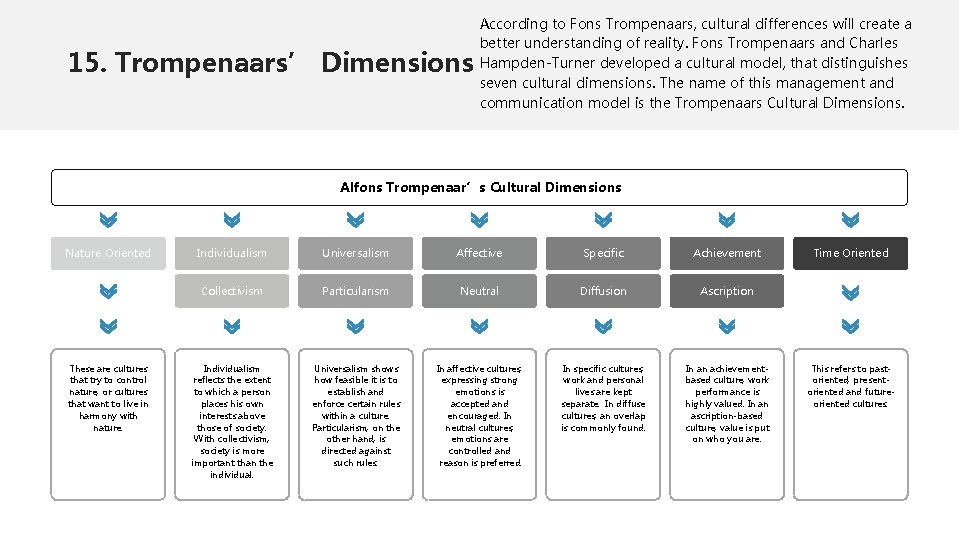
15. Trompenaars’ Dimensions According to Fons Trompenaars, cultural differences will create a better understanding of reality. Fons Trompenaars and Charles Hampden-Turner developed a cultural model, that distinguishes seven cultural dimensions. The name of this management and communication model is the Trompenaars Cultural Dimensions. Alfons Trompenaar’s Cultural Dimensions Nature Oriented These are cultures that try to control nature, or cultures that want to live in harmony with nature. Individualism Universalism Affective Specific Achievement Collectivism Particularism Neutral Diffusion Ascription Individualism reflects the extent to which a person places his own interests above those of society. With collectivism, society is more important than the individual. Universalism shows how feasible it is to establish and enforce certain rules within a culture. Particularism, on the other hand, is directed against such rules. In affective cultures, expressing strong emotions is accepted and encouraged. In neutral cultures, emotions are controlled and reason is preferred. In specific cultures, work and personal lives are kept separate. In diffuse cultures, an overlap is commonly found. In an achievementbased culture, work performance is highly valued. In an ascription-based culture, value is put on who you are. Time Oriented This refers to pastoriented, presentoriented and futureoriented cultures.
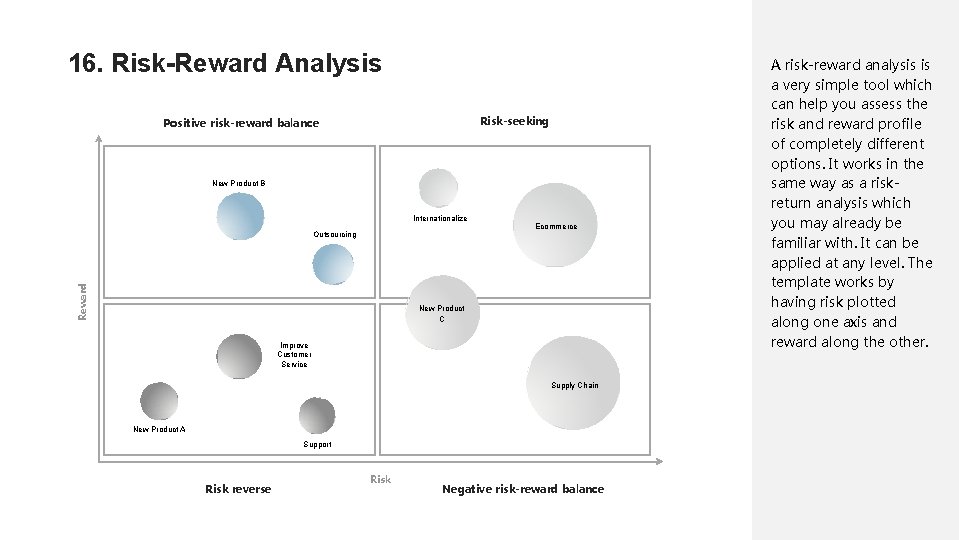
16. Risk-Reward Analysis Risk-seeking Positive risk-reward balance New Product B Internationalize Reward Outsourcing Ecommerce New Product C Improve Customer Service Supply Chain New Product A Support Risk reverse Risk Negative risk-reward balance A risk-reward analysis is a very simple tool which can help you assess the risk and reward profile of completely different options. It works in the same way as a riskreturn analysis which you may already be familiar with. It can be applied at any level. The template works by having risk plotted along one axis and reward along the other.
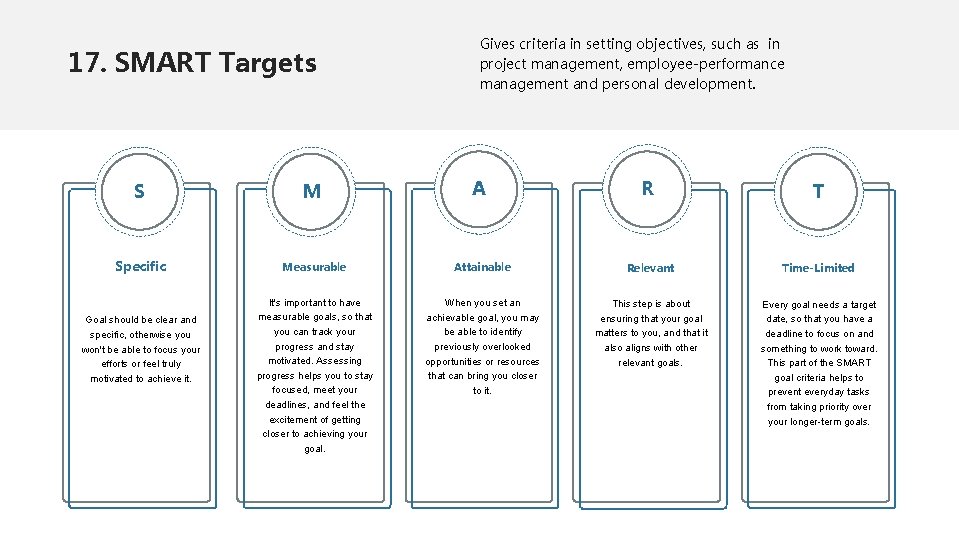
17. SMART Targets S Specific Goal should be clear and specific, otherwise you won't be able to focus your efforts or feel truly motivated to achieve it. M Gives criteria in setting objectives, such as in project management, employee-performance management and personal development. A R T Measurable Attainable Relevant Time-Limited It's important to have measurable goals, so that you can track your progress and stay motivated. Assessing progress helps you to stay focused, meet your deadlines, and feel the excitement of getting closer to achieving your goal. When you set an achievable goal, you may be able to identify previously overlooked opportunities or resources that can bring you closer to it. This step is about ensuring that your goal matters to you, and that it also aligns with other relevant goals. Every goal needs a target date, so that you have a deadline to focus on and something to work toward. This part of the SMART goal criteria helps to prevent everyday tasks from taking priority over your longer-term goals.
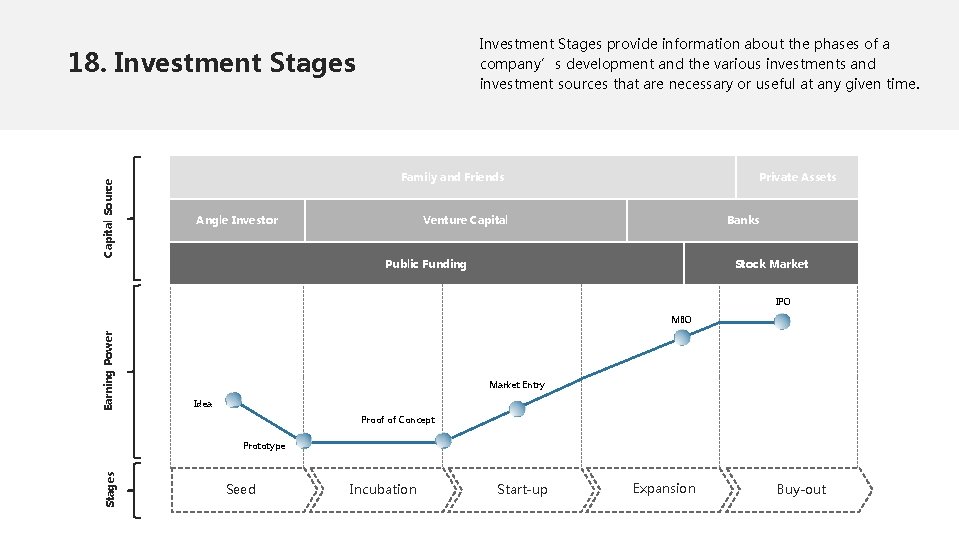
Investment Stages provide information about the phases of a company’s development and the various investments and investment sources that are necessary or useful at any given time. Capital Source 18. Investment Stages Family and Friends Angle Investor Private Assets Venture Capital Banks Public Funding Stock Market IPO Earning Power MBO Market Entry Idea Proof of Concept Stages Prototype Seed Incubation Start-up Expansion Buy-out
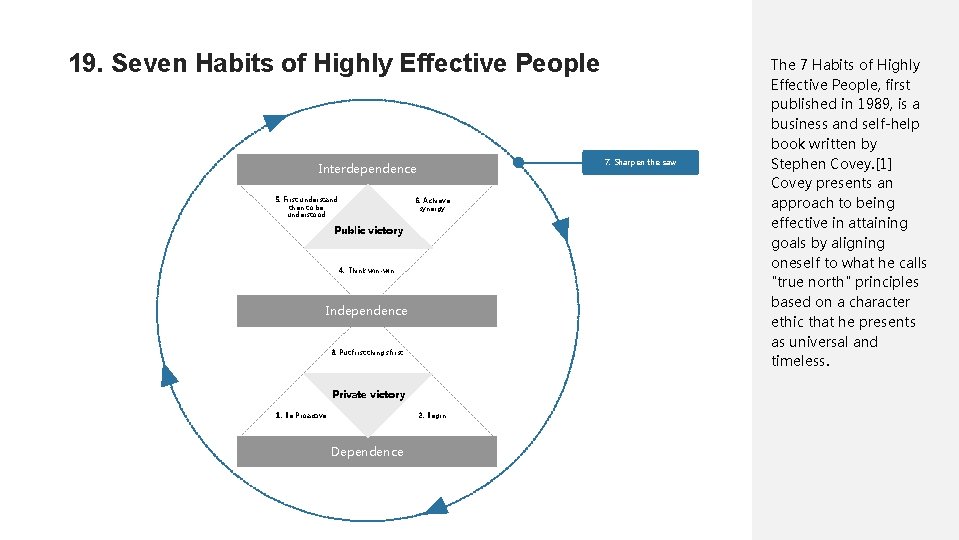
19. Seven Habits of Highly Effective People 7. Sharpen the saw Interdependence 5. First understand then to be understood 6. Achieve synergy Public victory 4. Think win-win Independence 3. Put first things first Private victory 1. Be Proactive 2. Begin Dependence The 7 Habits of Highly Effective People, first published in 1989, is a business and self-help book written by Stephen Covey. [1] Covey presents an approach to being effective in attaining goals by aligning oneself to what he calls "true north" principles based on a character ethic that he presents as universal and timeless.
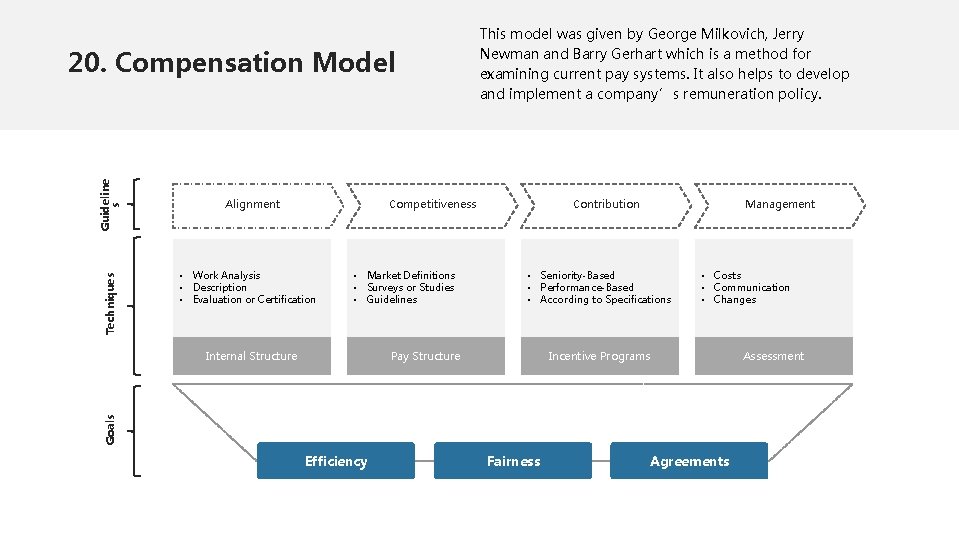
Techniques Guideline s 20. Compensation Model This model was given by George Milkovich, Jerry Newman and Barry Gerhart which is a method for examining current pay systems. It also helps to develop and implement a company’s remuneration policy. Contribution Competitiveness Alignment • Work Analysis • Description • Evaluation or Certification • Market Definitions • Surveys or Studies • Guidelines • Seniority-Based • Performance-Based • According to Specifications Pay Structure • Costs • Communication • Changes Incentive Programs Goals Internal Structure Management Efficiency Fairness Agreements Assessment
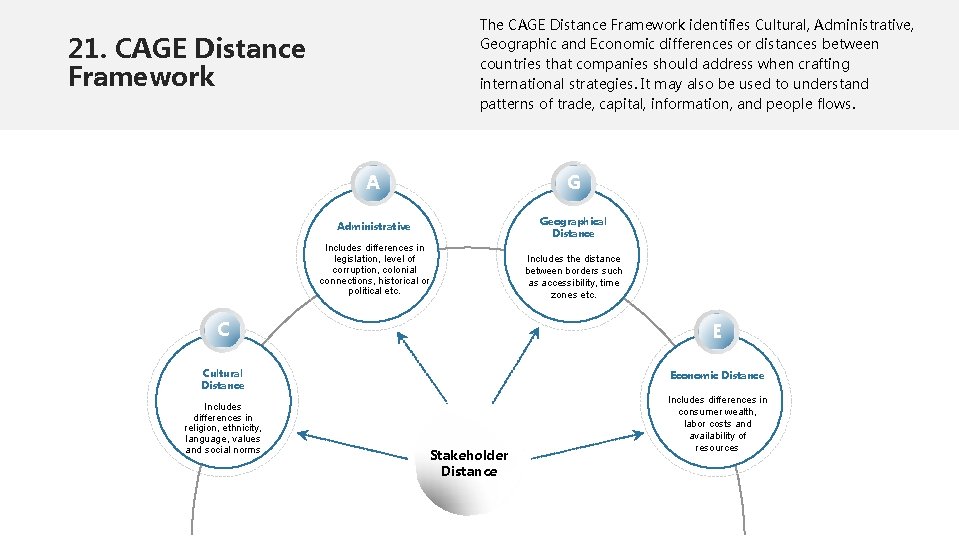
The CAGE Distance Framework identifies Cultural, Administrative, Geographic and Economic differences or distances between countries that companies should address when crafting international strategies. It may also be used to understand patterns of trade, capital, information, and people flows. 21. CAGE Distance Framework A G Administrative Geographical Distance Includes differences in legislation, level of corruption, colonial connections, historical or political etc. Includes the distance between borders such as accessibility, time zones etc. C E Cultural Distance Economic Distance Includes differences in religion, ethnicity, language, values and social norms Includes differences in consumer wealth, labor costs and availability of resources Stakeholder Distance
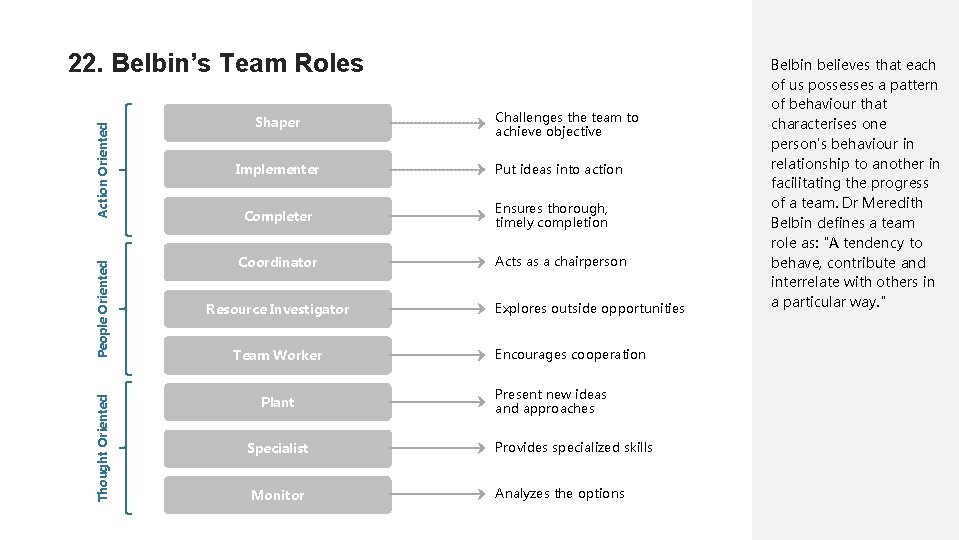
Thought Oriented People Oriented Action Oriented 22. Belbin’s Team Roles Shaper Implementer Completer Coordinator Resource Investigator Team Worker Plant Specialist Monitor Challenges the team to achieve objective Put ideas into action Ensures thorough, timely completion Acts as a chairperson Explores outside opportunities Encourages cooperation Present new ideas and approaches Provides specialized skills Analyzes the options Belbin believes that each of us possesses a pattern of behaviour that characterises one person's behaviour in relationship to another in facilitating the progress of a team. Dr Meredith Belbin defines a team role as: "A tendency to behave, contribute and interrelate with others in a particular way. "
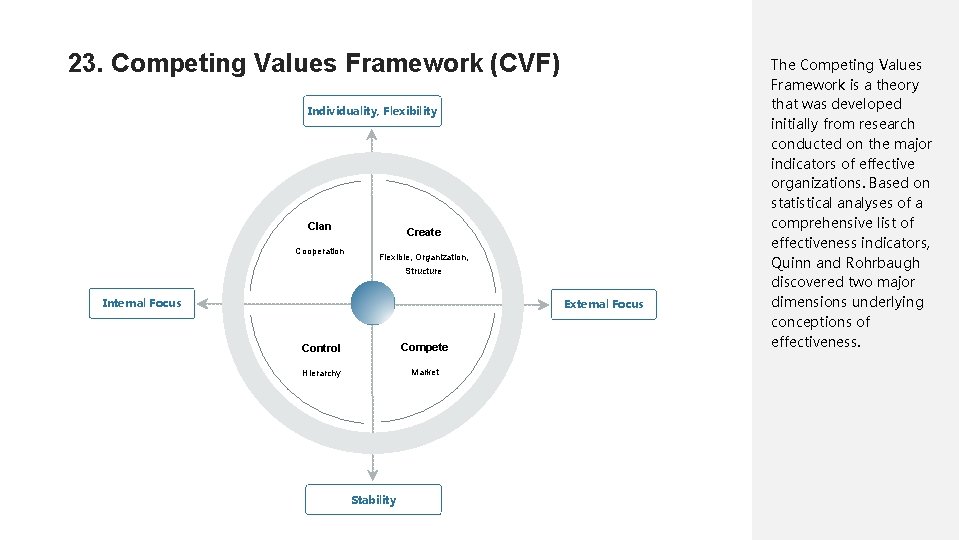
23. Competing Values Framework (CVF) Individuality, Flexibility Clan Cooperation Create Flexible, Organization, Structure Internal Focus External Focus Control Compete Hierarchy Market Stability The Competing Values Framework is a theory that was developed initially from research conducted on the major indicators of effective organizations. Based on statistical analyses of a comprehensive list of effectiveness indicators, Quinn and Rohrbaugh discovered two major dimensions underlying conceptions of effectiveness.
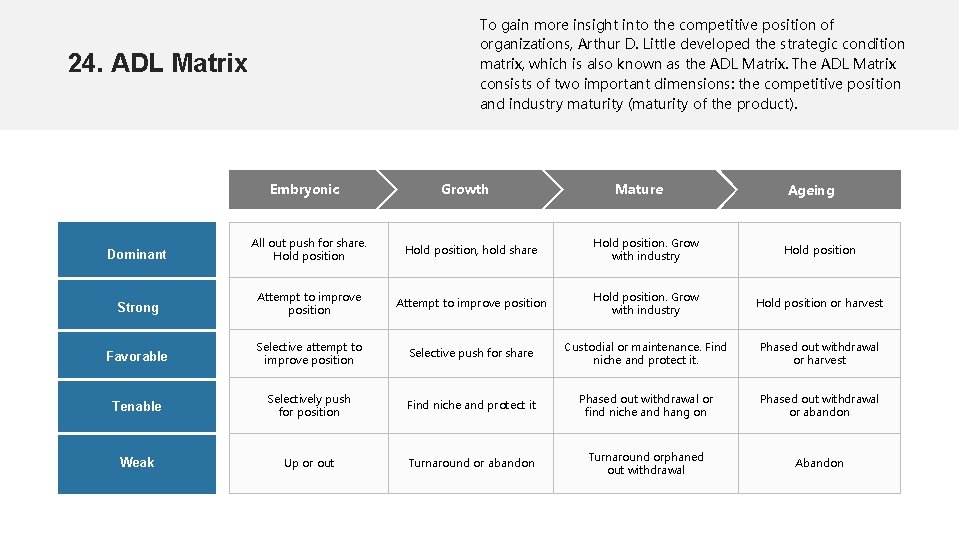
To gain more insight into the competitive position of organizations, Arthur D. Little developed the strategic condition matrix, which is also known as the ADL Matrix. The ADL Matrix consists of two important dimensions: the competitive position and industry maturity (maturity of the product). 24. ADL Matrix Embryonic Growth Mature Ageing Dominant All out push for share. Hold position, hold share Hold position. Grow with industry Hold position Strong Attempt to improve position Hold position. Grow with industry Hold position or harvest Favorable Selective attempt to improve position Selective push for share Custodial or maintenance. Find niche and protect it. Phased out withdrawal or harvest Tenable Selectively push for position Find niche and protect it Phased out withdrawal or find niche and hang on Phased out withdrawal or abandon Weak Up or out Turnaround or abandon Turnaround orphaned out withdrawal Abandon
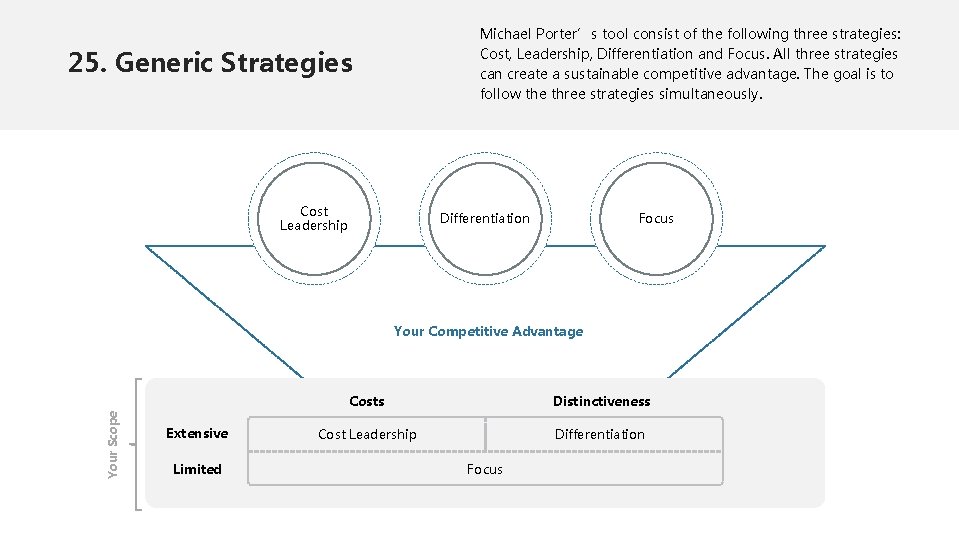
Michael Porter’s tool consist of the following three strategies: Cost, Leadership, Differentiation and Focus. All three strategies can create a sustainable competitive advantage. The goal is to follow the three strategies simultaneously. 25. Generic Strategies Cost Leadership Differentiation Focus Your Scope Your Competitive Advantage Extensive Limited Costs Distinctiveness Cost Leadership Differentiation Focus
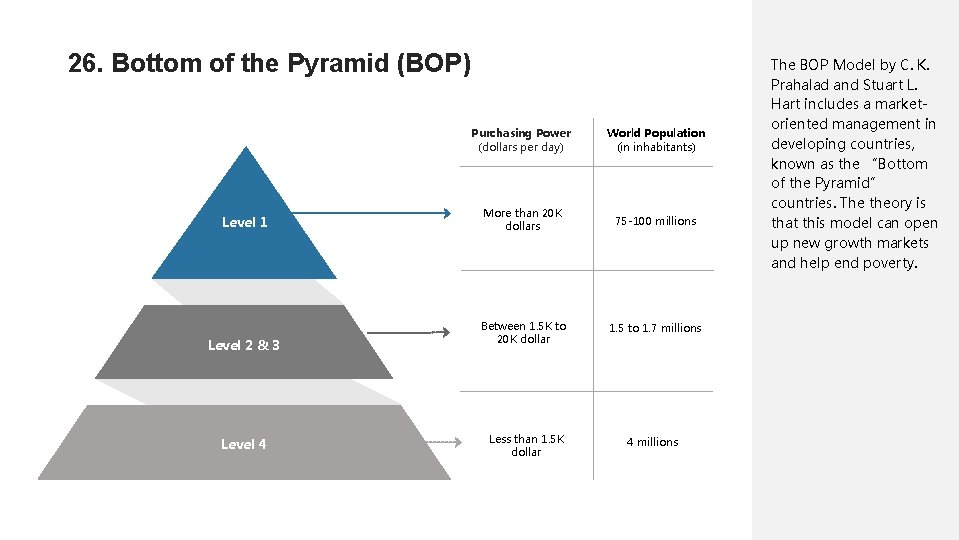
26. Bottom of the Pyramid (BOP) Level 1 Level 2 & 3 Level 4 Purchasing Power (dollars per day) World Population (in inhabitants) More than 20 K dollars 75 -100 millions Between 1. 5 K to 20 K dollar 1. 5 to 1. 7 millions Less than 1. 5 K dollar 4 millions The BOP Model by C. K. Prahalad and Stuart L. Hart includes a marketoriented management in developing countries, known as the “Bottom of the Pyramid” countries. The theory is that this model can open up new growth markets and help end poverty.
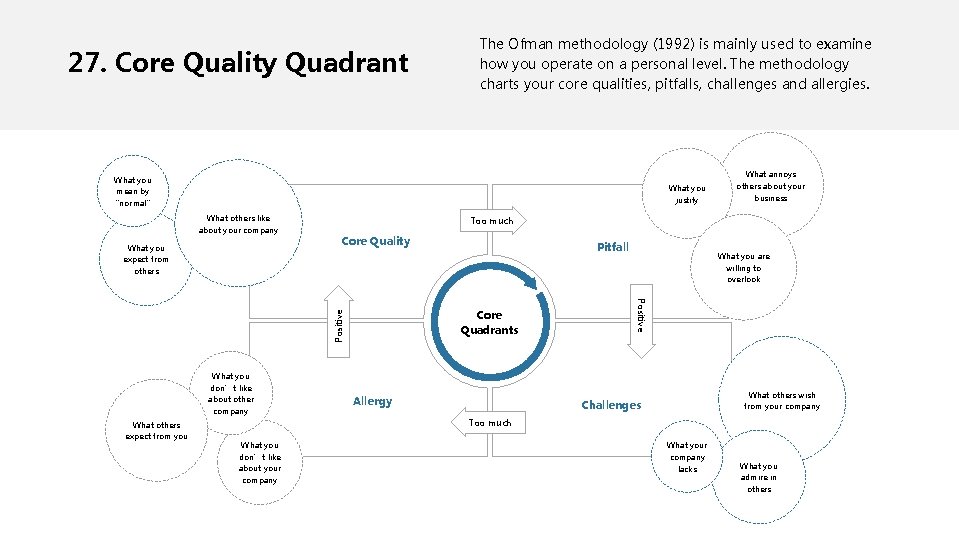
27. Core Quality Quadrant The Ofman methodology (1992) is mainly used to examine how you operate on a personal level. The methodology charts your core qualities, pitfalls, challenges and allergies. What you mean by “normal” What you justify What others like about your company Too much Core Quality What others expect from you Allergy What you are willing to overlook Positive x What you don’t like about other company Pitfall Core Quadrants Positive What you expect from others What annoys others about your business What others wish from your company Challenges Too much What you don’t like about your company What your company lacks What you admire in others
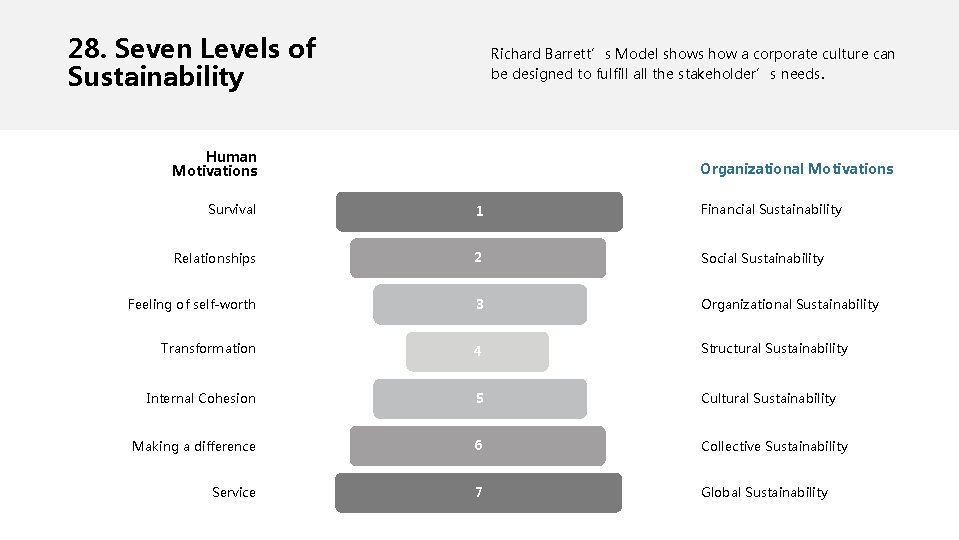
28. Seven Levels of Sustainability Richard Barrett’s Model shows how a corporate culture can be designed to fulfill all the stakeholder’s needs. Human Motivations Organizational Motivations Survival 1 Financial Sustainability Relationships 2 Social Sustainability Feeling of self-worth 3 Organizational Sustainability Transformation 4 Structural Sustainability Internal Cohesion 5 Cultural Sustainability Making a difference 6 Collective Sustainability Service 7 Global Sustainability
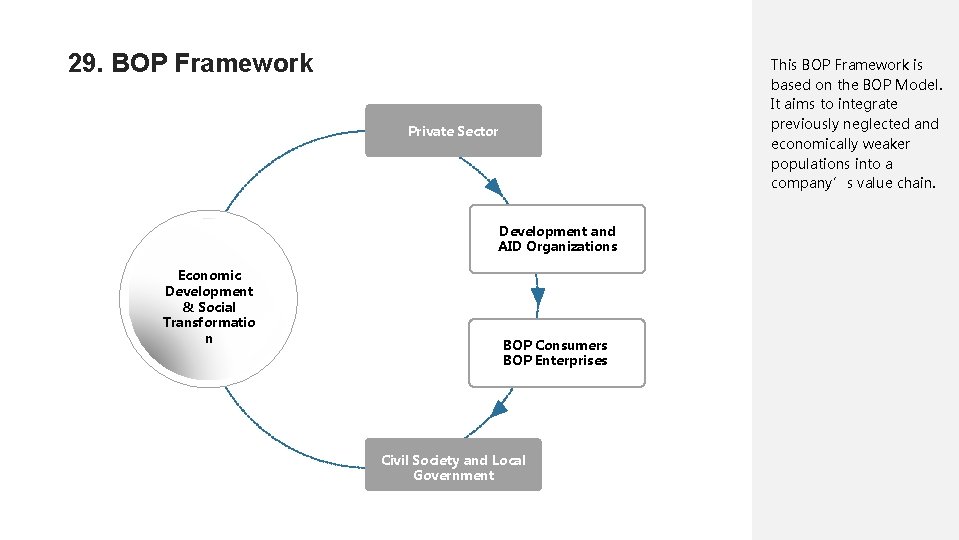
29. BOP Framework This BOP Framework is based on the BOP Model. It aims to integrate previously neglected and economically weaker populations into a company’s value chain. Private Sector Development and AID Organizations Economic Development & Social Transformatio n BOP Consumers BOP Enterprises Civil Society and Local Government
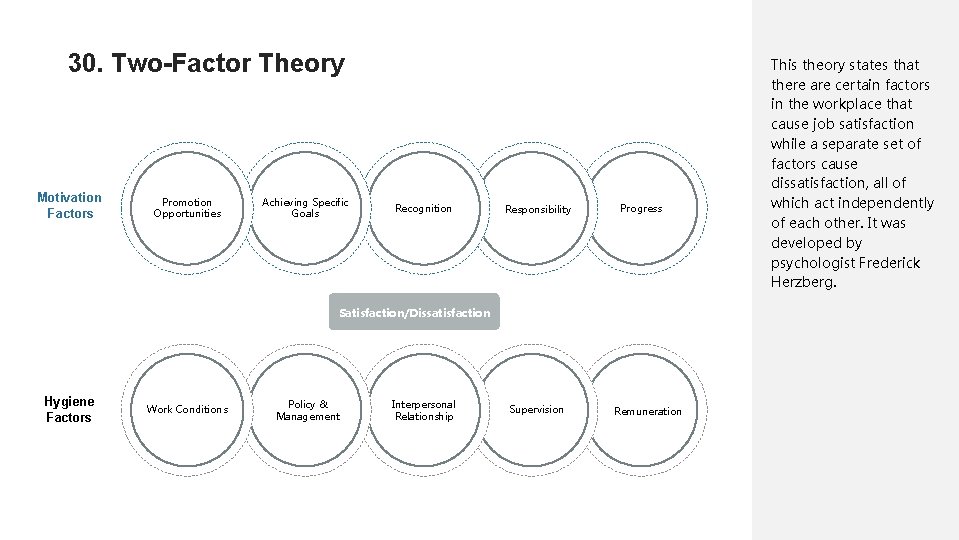
30. Two-Factor Theory Motivation Factors Promotion Opportunities Achieving Specific Goals Recognition Responsibility Progress Satisfaction/Dissatisfaction Hygiene Factors Work Conditions Policy & Management Interpersonal Relationship Supervision Remuneration This theory states that there are certain factors in the workplace that cause job satisfaction while a separate set of factors cause dissatisfaction, all of which act independently of each other. It was developed by psychologist Frederick Herzberg.
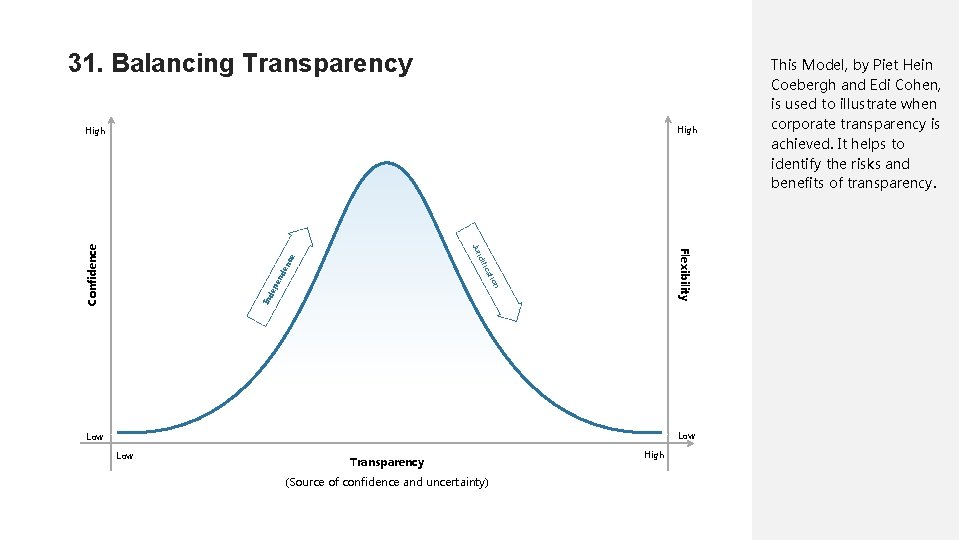
31. Balancing Transparency High Ind ep on en ati de ific nc e rid Flexibility Ju Confidence High Low Low Transparency (Source of confidence and uncertainty) High This Model, by Piet Hein Coebergh and Edi Cohen, is used to illustrate when corporate transparency is achieved. It helps to identify the risks and benefits of transparency.
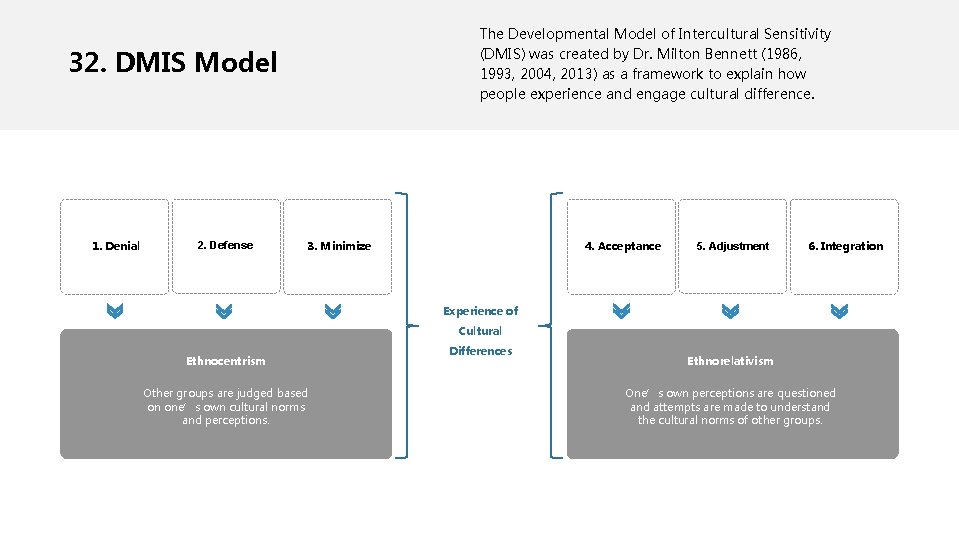
The Developmental Model of Intercultural Sensitivity (DMIS) was created by Dr. Milton Bennett (1986, 1993, 2004, 2013) as a framework to explain how people experience and engage cultural difference. 32. DMIS Model 1. Denial 2. Defense 3. Minimize 4. Acceptance 5. Adjustment 6. Integration Experience of Cultural Ethnocentrism Other groups are judged based on one’s own cultural norms and perceptions. Differences Ethnorelativism One’s own perceptions are questioned and attempts are made to understand the cultural norms of other groups.
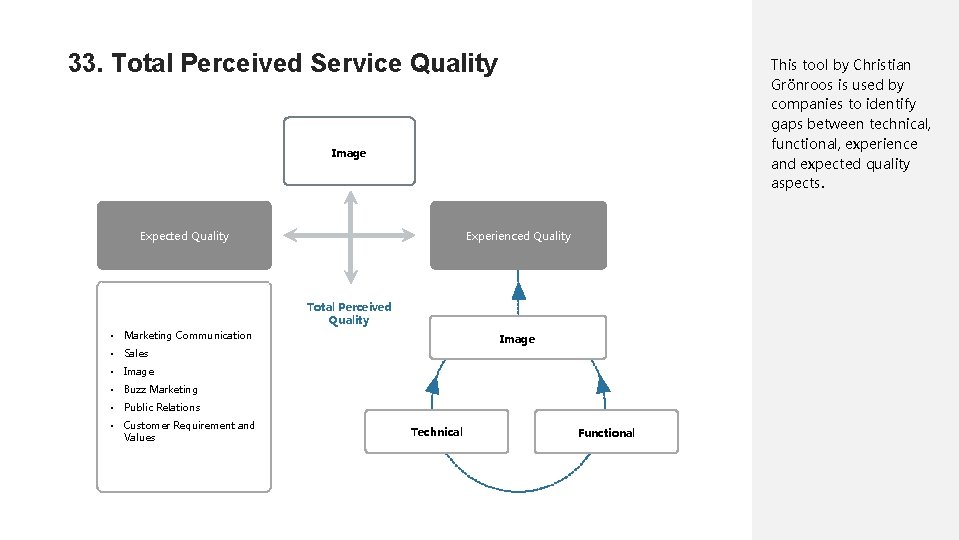
33. Total Perceived Service Quality This tool by Christian Grönroos is used by companies to identify gaps between technical, functional, experience and expected quality aspects. Image Experienced Quality Expected Quality Total Perceived Quality • Marketing Communication Image • Sales • Image • Buzz Marketing • Public Relations • Customer Requirement and Values Technical Functional
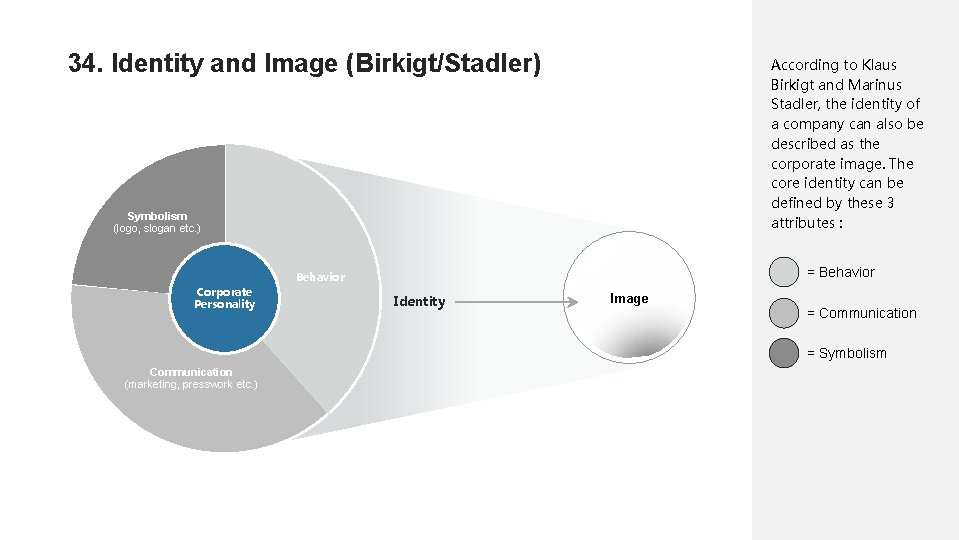
34. Identity and Image (Birkigt/Stadler) According to Klaus Birkigt and Marinus Stadler, the identity of a company can also be described as the corporate image. The core identity can be defined by these 3 attributes : Symbolism (logo, slogan etc. ) = Behavior Corporate Personality Identity Image = Communication = Symbolism Communication (marketing, presswork etc. )
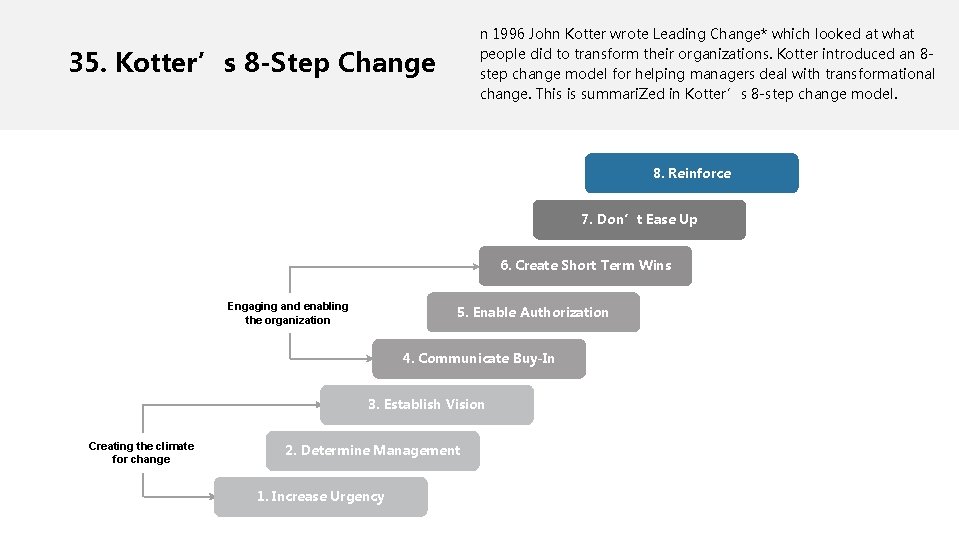
n 1996 John Kotter wrote Leading Change* which looked at what people did to transform their organizations. Kotter introduced an 8 step change model for helping managers deal with transformational change. This is summari. Zed in Kotter’s 8 -step change model. 35. Kotter’s 8 -Step Change 8. Reinforce 7. Don’t Ease Up 6. Create Short Term Wins Engaging and enabling the organization 5. Enable Authorization 4. Communicate Buy-In 3. Establish Vision Creating the climate for change 2. Determine Management 1. Increase Urgency
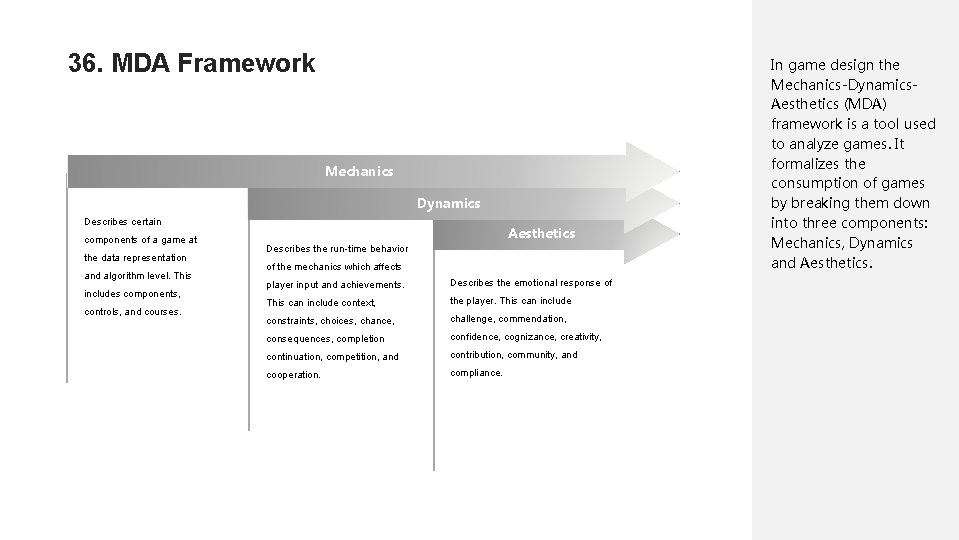
36. MDA Framework Mechanics Dynamics Describes certain components of a game at the data representation and algorithm level. This includes components, controls, and courses. Aesthetics Describes the run-time behavior of the mechanics which affects player input and achievements. Describes the emotional response of This can include context, the player. This can include constraints, choices, chance, challenge, commendation, consequences, completion confidence, cognizance, creativity, continuation, competition, and contribution, community, and cooperation. compliance. In game design the Mechanics-Dynamics. Aesthetics (MDA) framework is a tool used to analyze games. It formalizes the consumption of games by breaking them down into three components: Mechanics, Dynamics and Aesthetics.
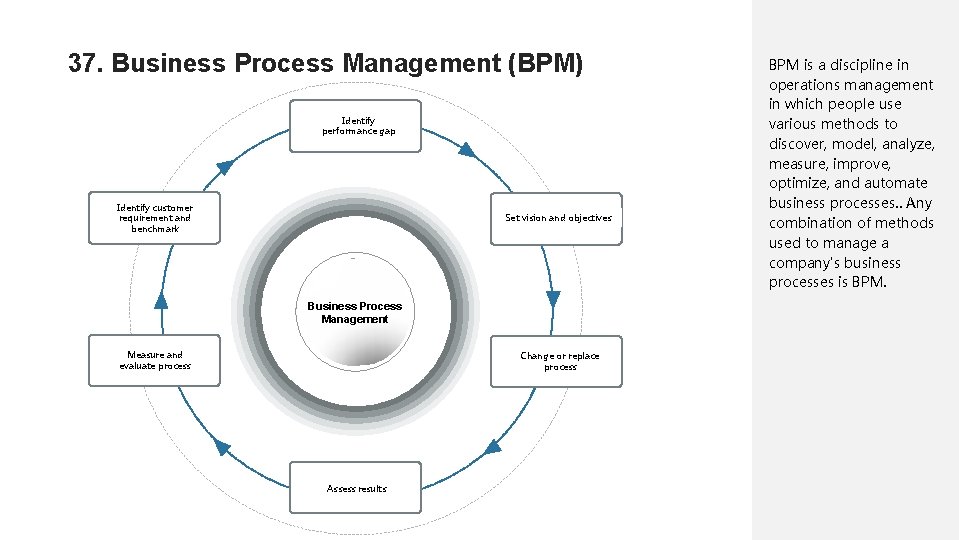
37. Business Process Management (BPM) Identify performance gap Identify customer requirement and benchmark Set vision and objectives Business Process Management Measure and evaluate process Change or replace process Assess results BPM is a discipline in operations management in which people use various methods to discover, model, analyze, measure, improve, optimize, and automate business processes. . Any combination of methods used to manage a company's business processes is BPM.
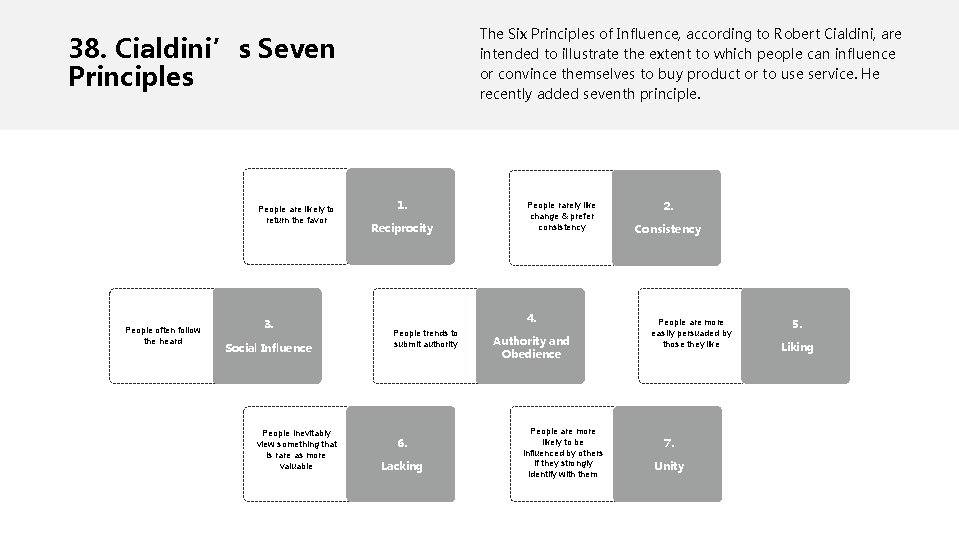
The Six Principles of Influence, according to Robert Cialdini, are intended to illustrate the extent to which people can influence or convince themselves to buy product or to use service. He recently added seventh principle. 38. Cialdini’s Seven Principles People are likely to return the favor People often follow the heard 3. Social Influence People inevitably view something that is rare as more valuable 1. Reciprocity People rarely like change & prefer consistency 4. People trends to submit authority 6. Lacking Authority and Obedience People are more likely to be influenced by others if they strongly identify with them 2. Consistency People are more easily persuaded by those they like 7. Unity 5. Liking
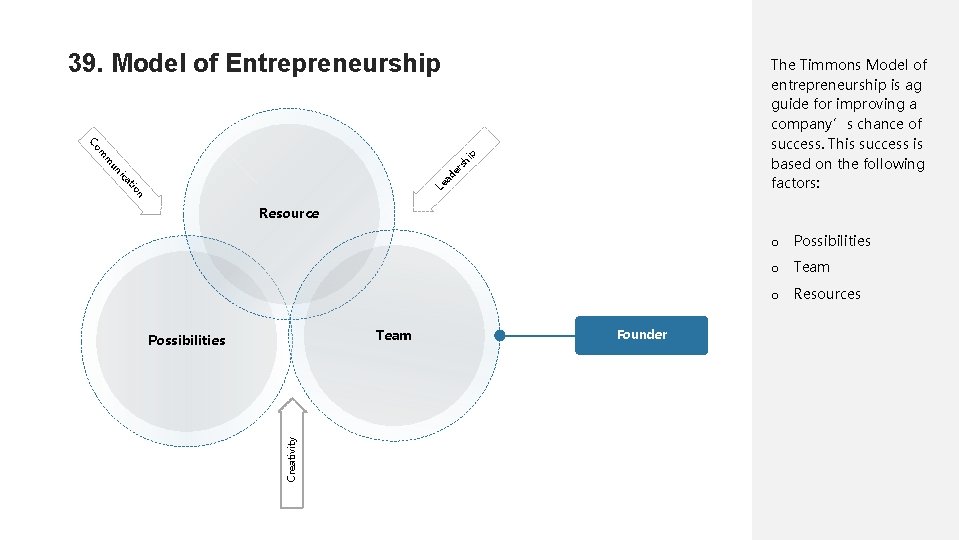
39. Model of Entrepreneurship Co The Timmons Model of entrepreneurship is ag guide for improving a company’s chance of success. This success is based on the following factors: p m m hi a ic un ad n tio Le s er Resource o Possibilities o Team o Resources Team Creativity Possibilities Founder
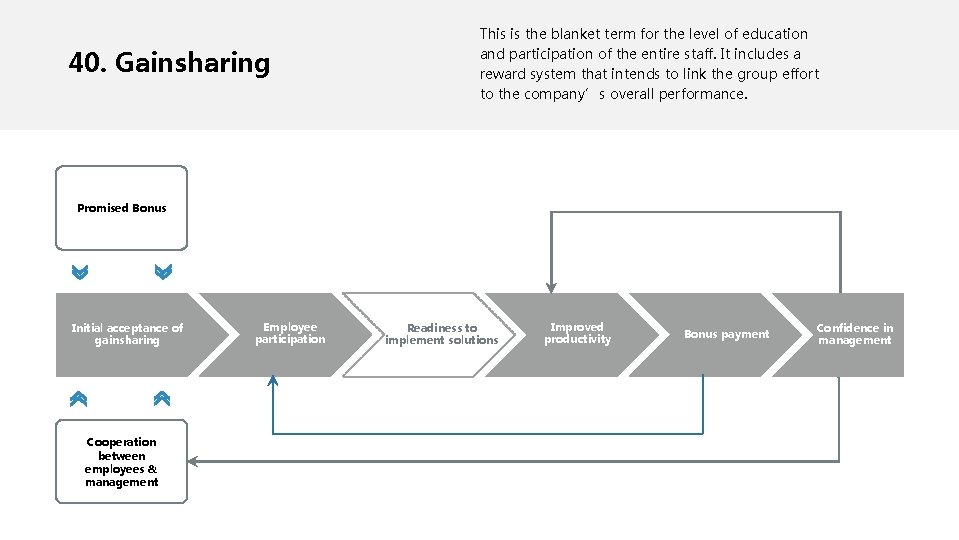
40. Gainsharing This is the blanket term for the level of education and participation of the entire staff. It includes a reward system that intends to link the group effort to the company’s overall performance. Promised Bonus Initial acceptance of gainsharing Cooperation between employees & management Employee participation Readiness to implement solutions Improved productivity Bonus payment Confidence in management
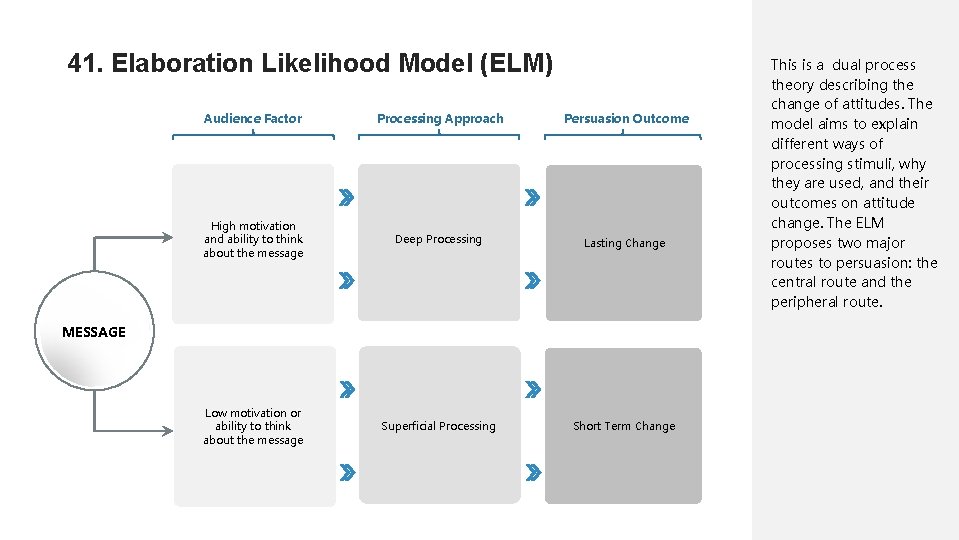
41. Elaboration Likelihood Model (ELM) Audience Factor Processing Approach Persuasion Outcome High motivation and ability to think about the message Deep Processing Lasting Change Low motivation or ability to think about the message Superficial Processing Short Term Change MESSAGE This is a dual process theory describing the change of attitudes. The model aims to explain different ways of processing stimuli, why they are used, and their outcomes on attitude change. The ELM proposes two major routes to persuasion: the central route and the peripheral route.
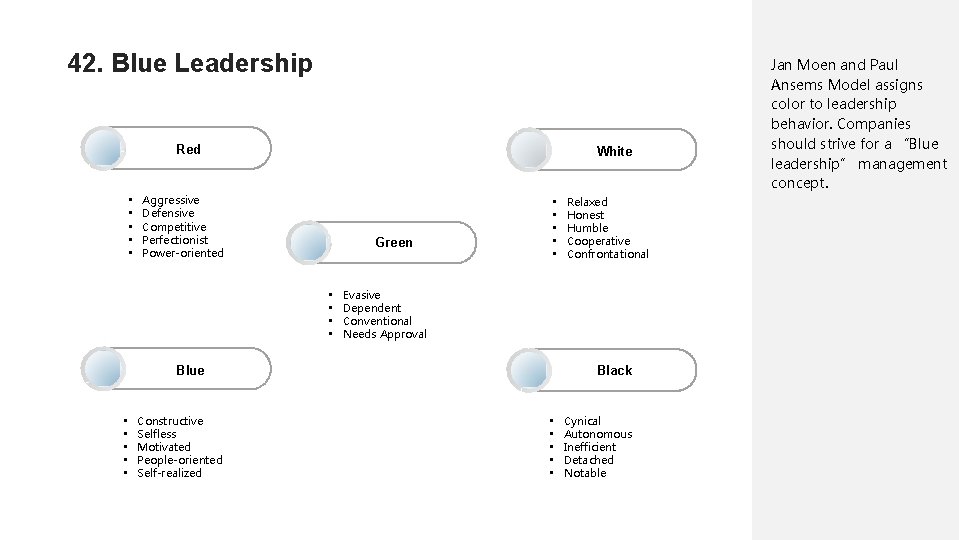
42. Blue Leadership Red • • • White Aggressive Defensive Competitive Perfectionist Power-oriented Green • • • Evasive Dependent Conventional Needs Approval Black Blue • • • Constructive Selfless Motivated People-oriented Self-realized Relaxed Honest Humble Cooperative Confrontational • • • Cynical Autonomous Inefficient Detached Notable Jan Moen and Paul Ansems Model assigns color to leadership behavior. Companies should strive for a “Blue leadership” management concept.
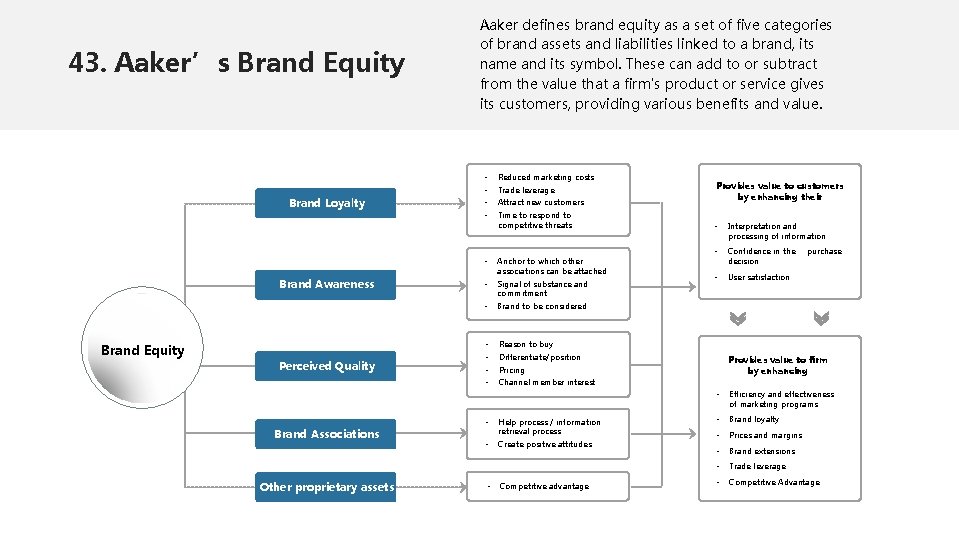
43. Aaker’s Brand Equity Brand Loyalty Brand Awareness Brand Equity Perceived Quality Brand Associations Other proprietary assets Aaker defines brand equity as a set of five categories of brand assets and liabilities linked to a brand, its name and its symbol. These can add to or subtract from the value that a firm's product or service gives its customers, providing various benefits and value. • • Reduced marketing costs Trade leverage Attract new customers Time to respond to competitive threats • Anchor to which other associations can be attached • Signal of substance and commitment • Brand to be considered • • Reason to buy • Interpretation and processing of information • Confidence in the decision • User satisfaction Differentiate/position purchase Provides value to firm by enhancing Pricing Channel member interest • Help process / information retrieval process • Create positive attitudes • Provides value to customers by enhancing their Competitive advantage • Efficiency and effectiveness of marketing programs • Brand loyalty • Prices and margins • Brand extensions • Trade leverage • Competitive Advantage
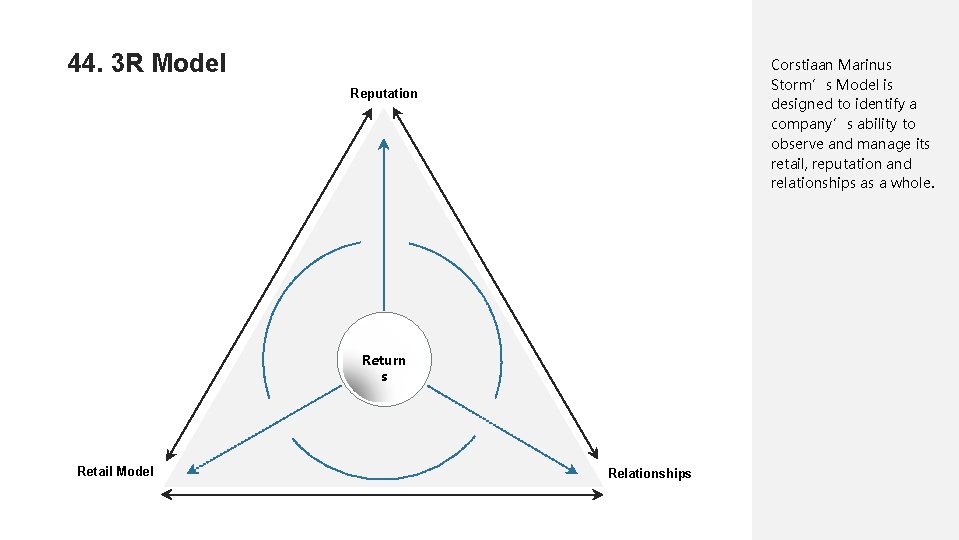
44. 3 R Model Corstiaan Marinus Storm’s Model is designed to identify a company’s ability to observe and manage its retail, reputation and relationships as a whole. Reputation Return s Retail Model Relationships
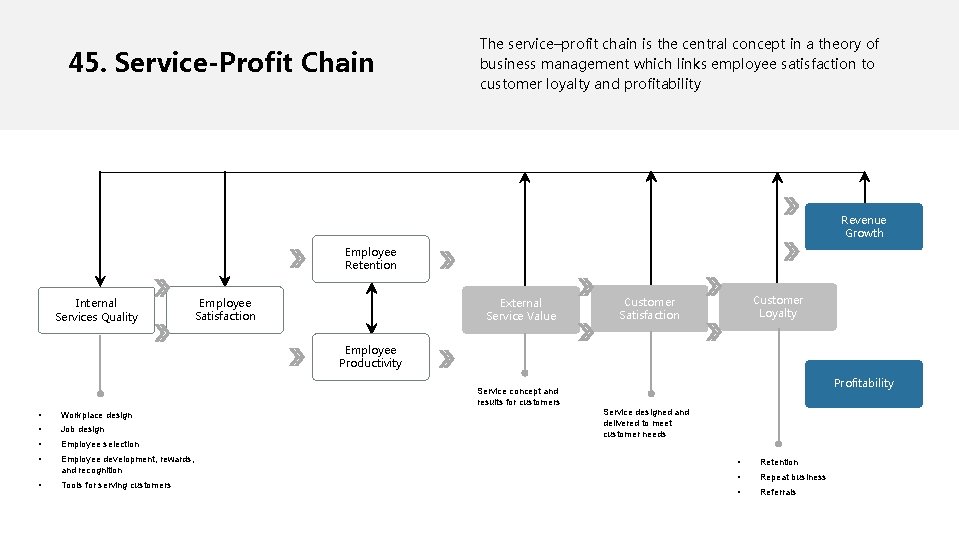
45. Service-Profit Chain The service–profit chain is the central concept in a theory of business management which links employee satisfaction to customer loyalty and profitability Revenue Growth Employee Retention Internal Services Quality External Service Value Employee Satisfaction Customer Loyalty Customer Satisfaction Employee Productivity Profitability Service concept and results for customers • Workplace design • Job design • Employee selection • Employee development, rewards, and recognition • Tools for serving customers Service designed and delivered to meet customer needs • Retention • Repeat business • Referrals
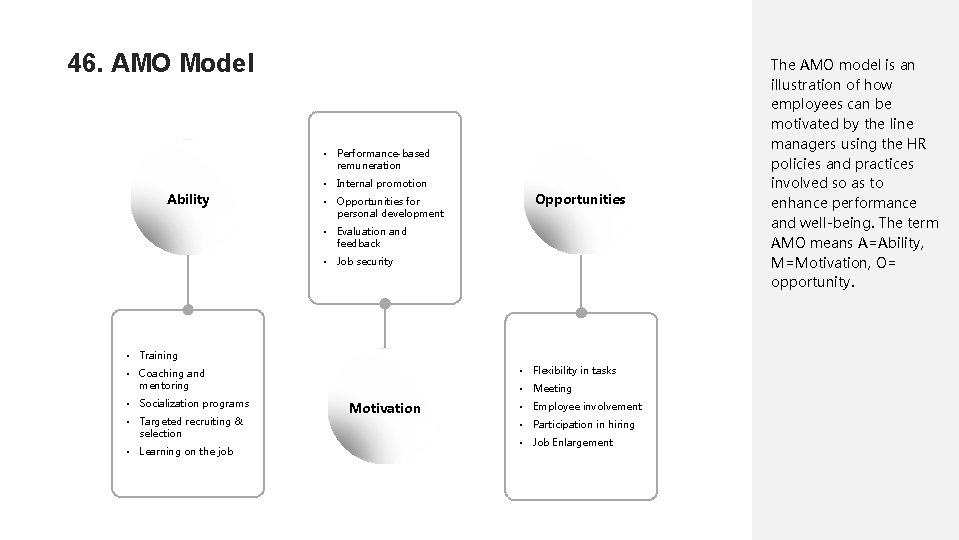
46. AMO Model • Performance-based remuneration • Internal promotion Ability • Opportunities for personal development Opportunities • Evaluation and feedback • Job security • Training • Flexibility in tasks • Coaching and mentoring • Socialization programs • Targeted recruiting & selection • Learning on the job • Meeting Motivation • Employee involvement • Participation in hiring • Job Enlargement The AMO model is an illustration of how employees can be motivated by the line managers using the HR policies and practices involved so as to enhance performance and well-being. The term AMO means A=Ability, M=Motivation, O= opportunity.
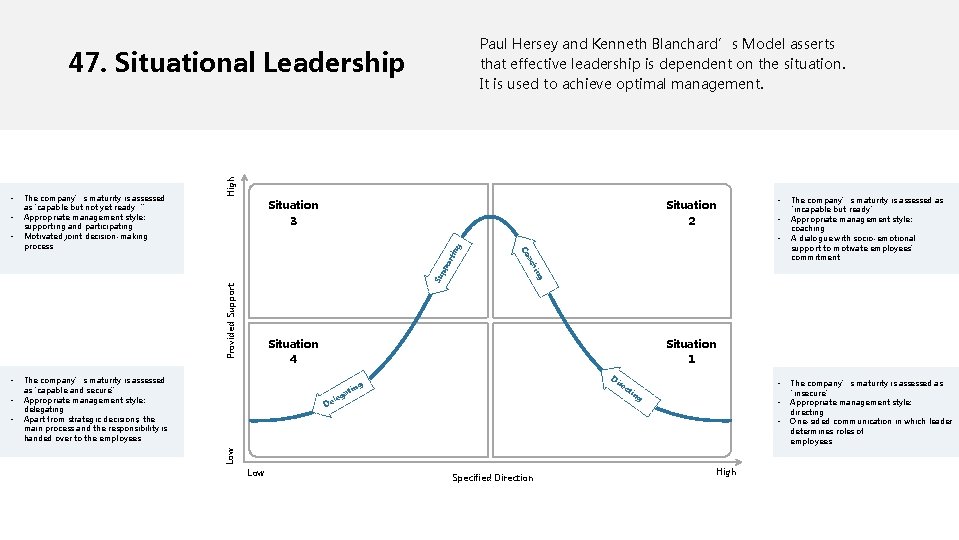
Paul Hersey and Kenneth Blanchard’s Model asserts that effective leadership is dependent on the situation. It is used to achieve optimal management. • Su pp Provided Support g Situation 4 The company’s maturity is assessed as "capable and secure” Appropriate management style: delegating Apart from strategic decisions, the main process and the responsibility is handed over to the employees Situation 1 Di re c g tin ga le De • tin g • Low The company’s maturity is assessed as "incapable but ready" Appropriate management style: coaching A dialogue with socio-emotional support to motivate employees’ commitment hin • ac • • Co • • Situation 2 or • Situation 3 g • The company’s maturity is assessed as "capable but not yet ready“ Appropriate management style: supporting and participating Motivated joint decision-making process tin • High 47. Situational Leadership Specified Direction High The company’s maturity is assessed as "insecure" Appropriate management style: directing One-sided communication in which leader determines roles of employees
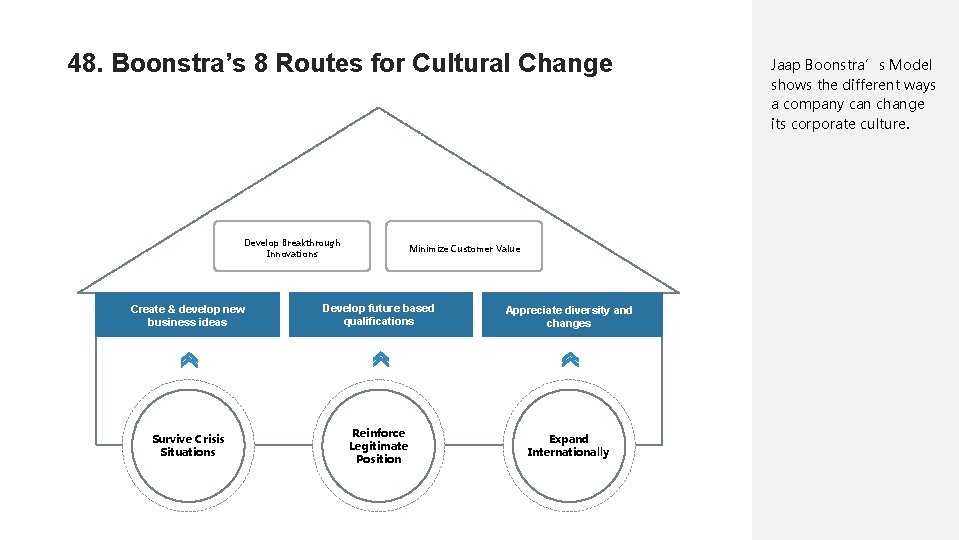
48. Boonstra’s 8 Routes for Cultural Change Develop Breakthrough Innovations Minimize Customer Value Create & develop new business ideas Develop future based qualifications Appreciate diversity and changes Survive Crisis Situations Reinforce Legitimate Position Expand Internationally Jaap Boonstra’s Model shows the different ways a company can change its corporate culture.
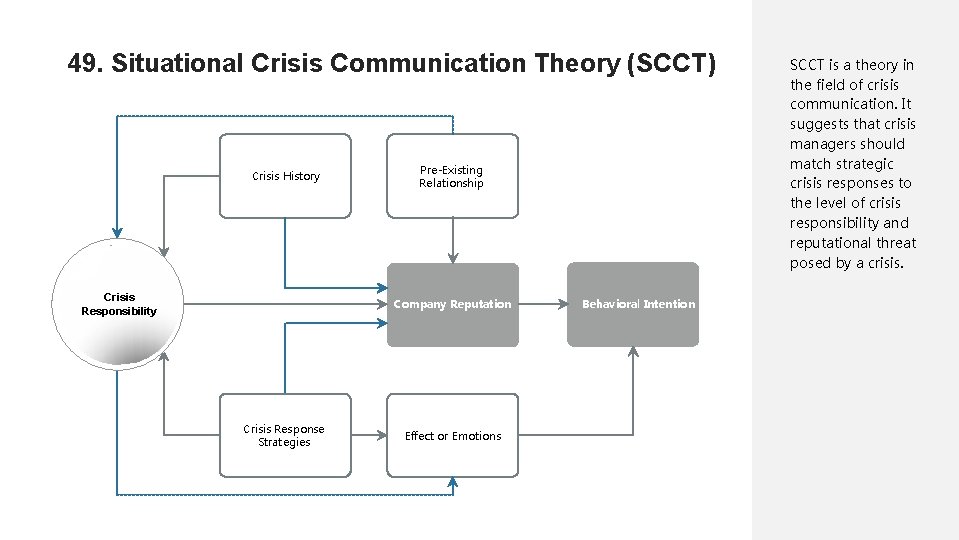
49. Situational Crisis Communication Theory (SCCT) Crisis History Crisis Responsibility Pre-Existing Relationship Company Reputation Crisis Response Strategies Effect or Emotions Behavioral Intention SCCT is a theory in the field of crisis communication. It suggests that crisis managers should match strategic crisis responses to the level of crisis responsibility and reputational threat posed by a crisis.
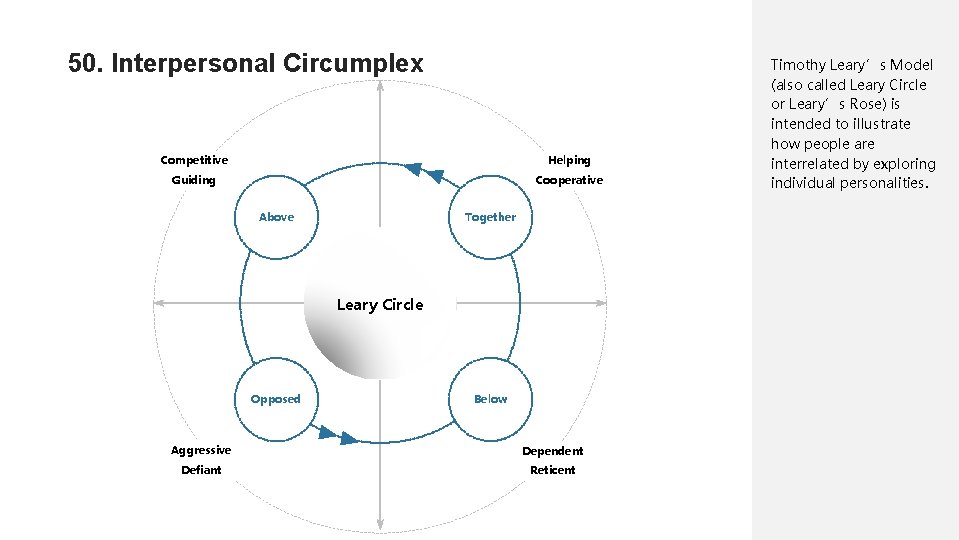
50. Interpersonal Circumplex Competitive Helping Guiding Cooperative Above Together Leary Circle Opposed Below Aggressive Dependent Defiant Reticent Timothy Leary’s Model (also called Leary Circle or Leary’s Rose) is intended to illustrate how people are interrelated by exploring individual personalities.