
1 of 48 Boardworks Ltd 2007 2 of
1 of 48 © Boardworks Ltd 2007
2 of 48 © Boardworks Ltd 2007
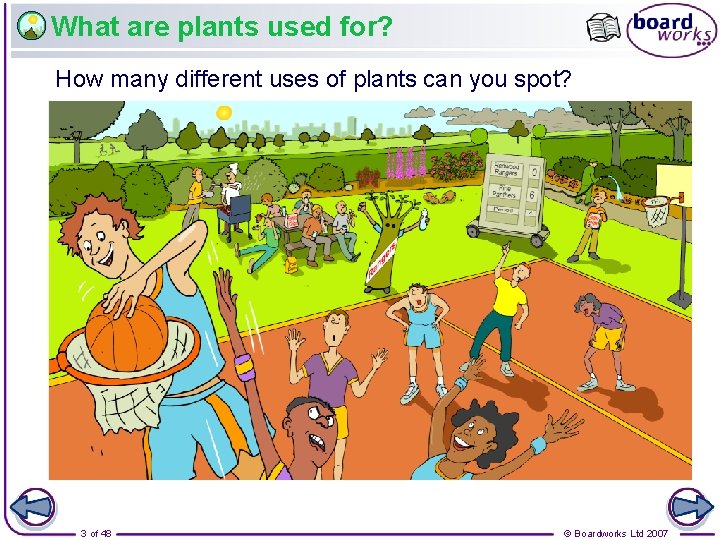
What are plants used for? How many different uses of plants can you spot? 3 of 48 © Boardworks Ltd 2007
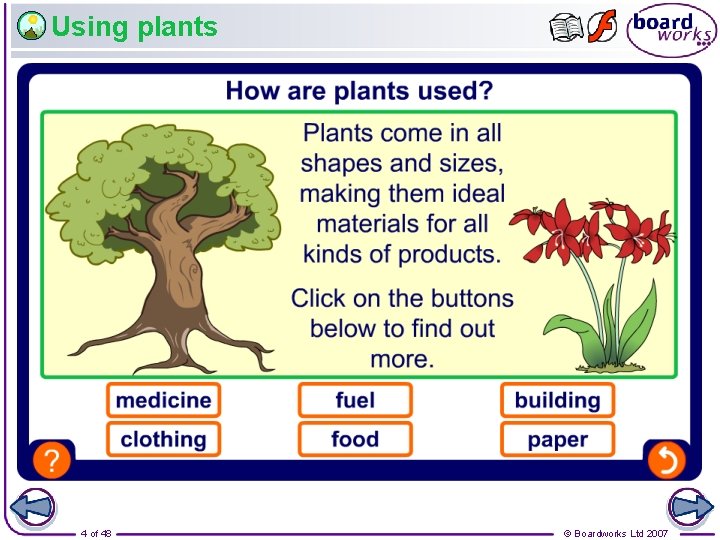
Using plants 4 of 48 © Boardworks Ltd 2007
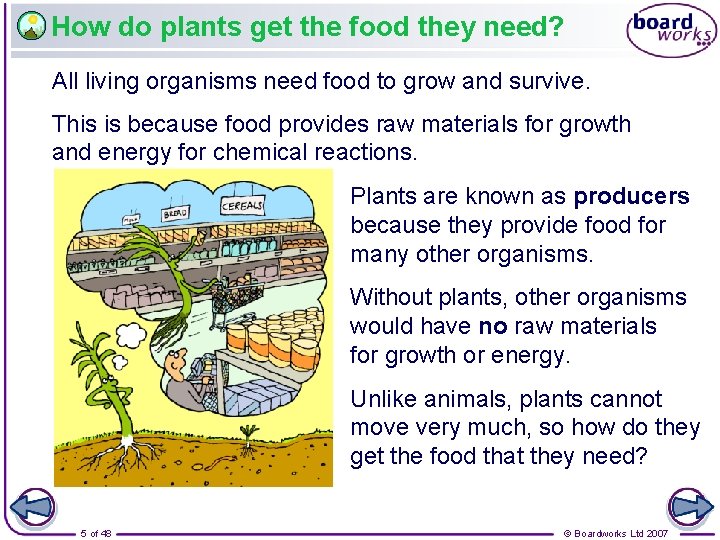
How do plants get the food they need? All living organisms need food to grow and survive. This is because food provides raw materials for growth and energy for chemical reactions. Plants are known as producers because they provide food for many other organisms. Without plants, other organisms would have no raw materials for growth or energy. Unlike animals, plants cannot move very much, so how do they get the food that they need? 5 of 48 © Boardworks Ltd 2007
Do plants eat soil? It used to be thought that plants got their food from the soil. This was proved to be untrue by measuring the mass of the soil in a plant pot before and after growth. The soil did not decrease in mass, even though plant mass increased. Later experiments showed that plants actually make their own food! Plants are the only living organisms that can do this. This means that all other organisms rely on plants. What is the name of the process by which plants make food? 6 of 48 © Boardworks Ltd 2007
7 of 48 © Boardworks Ltd 2007
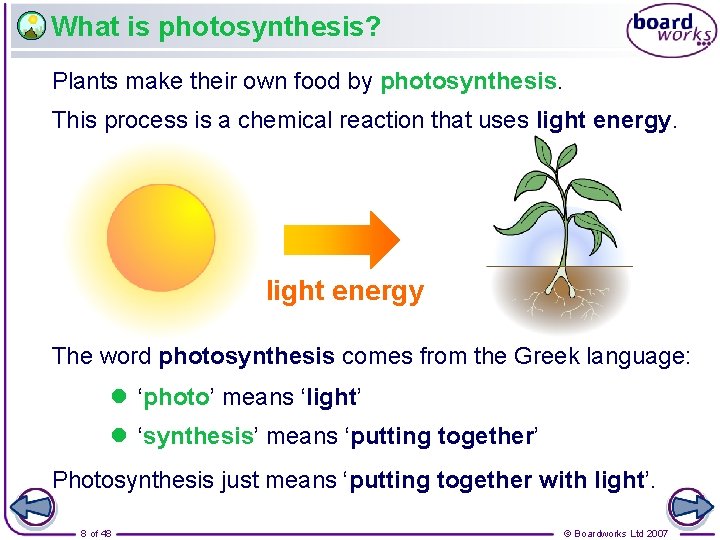
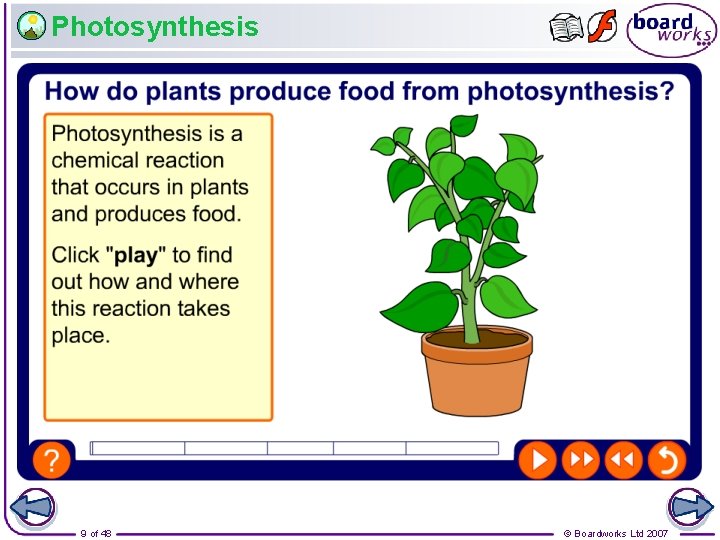
What is photosynthesis? Plants make their own food by photosynthesis. This process is a chemical reaction that uses light energy The word photosynthesis comes from the Greek language: l ‘photo’ means ‘light’ l ‘synthesis’ means ‘putting together’ Photosynthesis just means ‘putting together with light’. 8 of 48 © Boardworks Ltd 2007
Photosynthesis 9 of 48 © Boardworks Ltd 2007
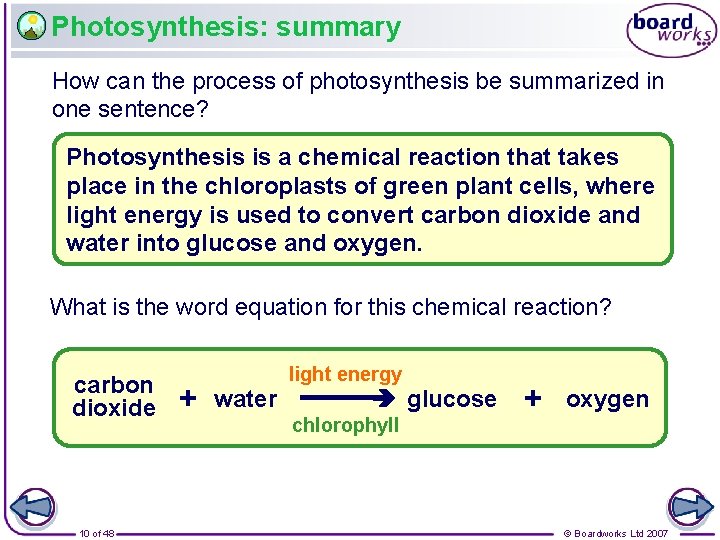
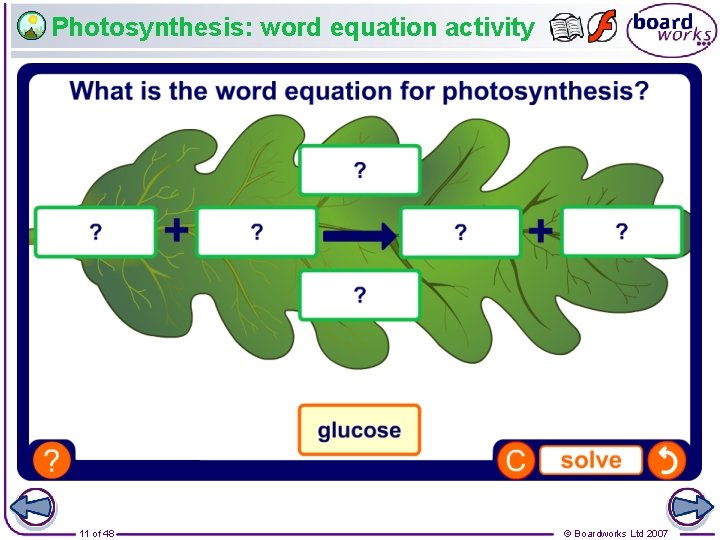
Photosynthesis: summary How can the process of photosynthesis be summarized in one sentence? Photosynthesis is a chemical reaction that takes place in the chloroplasts of green plant cells, where light energy is used to convert carbon dioxide and water into glucose and oxygen. What is the word equation for this chemical reaction? carbon dioxide 10 of 48 + water light energy glucose chlorophyll + oxygen © Boardworks Ltd 2007
Photosynthesis: word equation activity 11 of 48 © Boardworks Ltd 2007

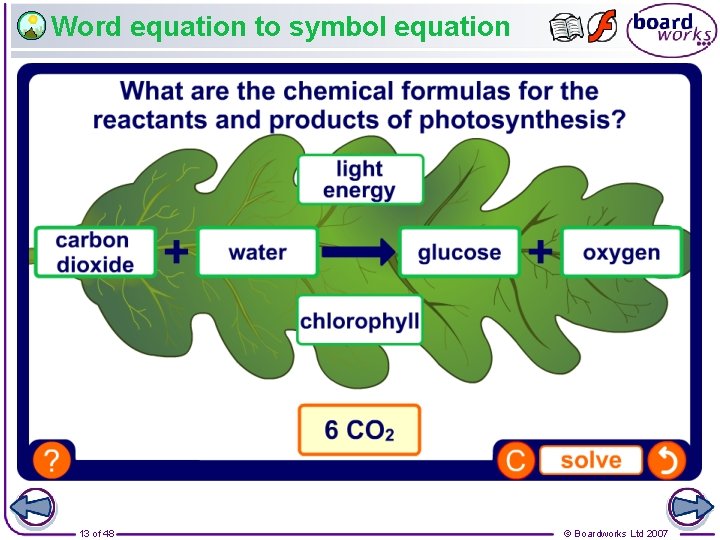
What is the symbol equation for photosynthesis? The reaction of photosynthesis can be represented by the following equation: carbon dioxide + water light energy glucose chlorophyll + oxygen What is the symbol equation for this reaction? 6 CO 2 + 6 H 2 O light energy chlorophyll C 6 H 12 O 2 + 6 O 2 Is this a balanced symbol equation? How would you balance the equation? 12 of 48 © Boardworks Ltd 2007
Word equation to symbol equation 13 of 48 © Boardworks Ltd 2007
Photosynthesis equation quiz 14 of 48 © Boardworks Ltd 2007
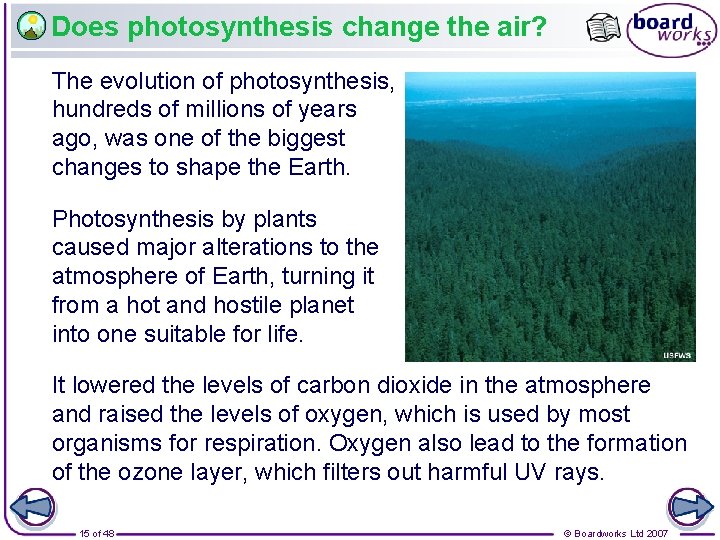
Does photosynthesis change the air? The evolution of photosynthesis, hundreds of millions of years ago, was one of the biggest changes to shape the Earth. Photosynthesis by plants caused major alterations to the atmosphere of Earth, turning it from a hot and hostile planet into one suitable for life. It lowered the levels of carbon dioxide in the atmosphere and raised the levels of oxygen, which is used by most organisms for respiration. Oxygen also lead to the formation of the ozone layer, which filters out harmful UV rays. 15 of 48 © Boardworks Ltd 2007
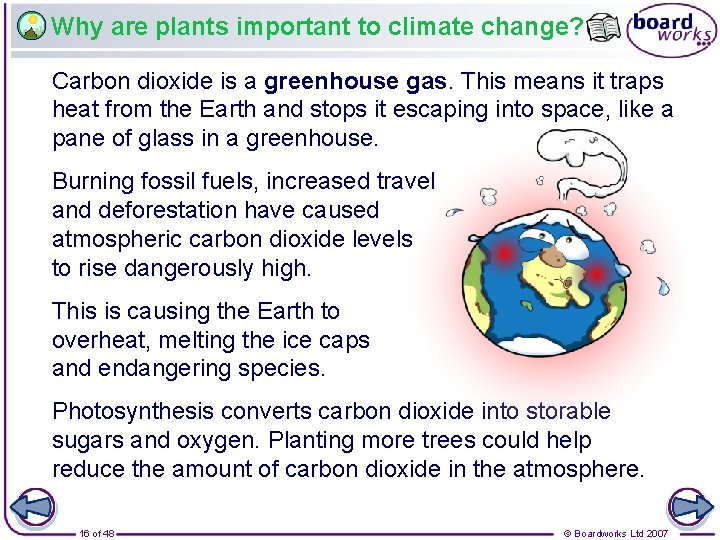
Why are plants important to climate change? Carbon dioxide is a greenhouse gas. This means it traps heat from the Earth and stops it escaping into space, like a pane of glass in a greenhouse. Burning fossil fuels, increased travel and deforestation have caused atmospheric carbon dioxide levels to rise dangerously high. This is causing the Earth to overheat, melting the ice caps and endangering species. Photosynthesis converts carbon dioxide into storable sugars and oxygen. Planting more trees could help reduce the amount of carbon dioxide in the atmosphere. 16 of 48 © Boardworks Ltd 2007
17 of 48 © Boardworks Ltd 2007
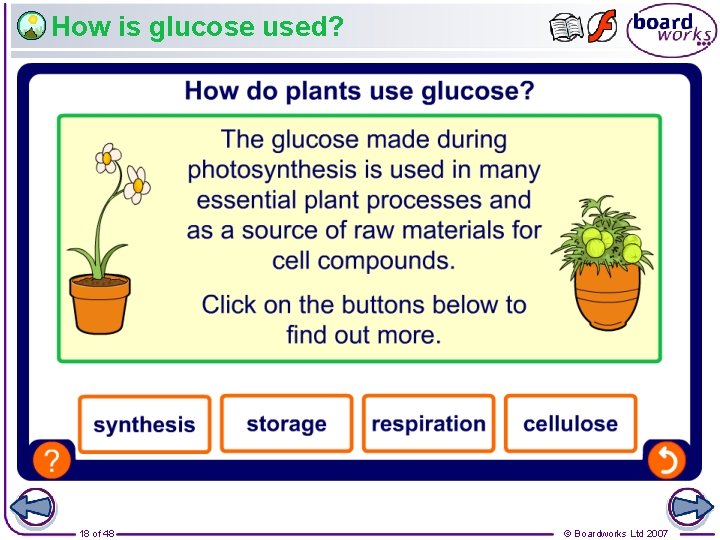
How is glucose used? 18 of 48 © Boardworks Ltd 2007
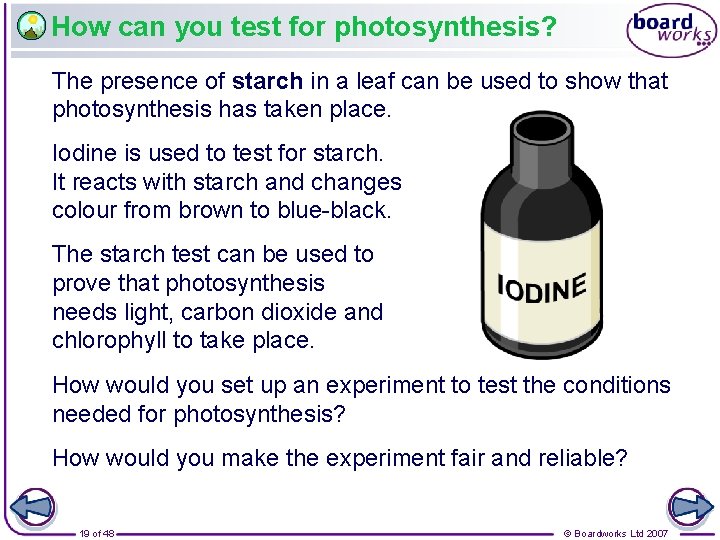
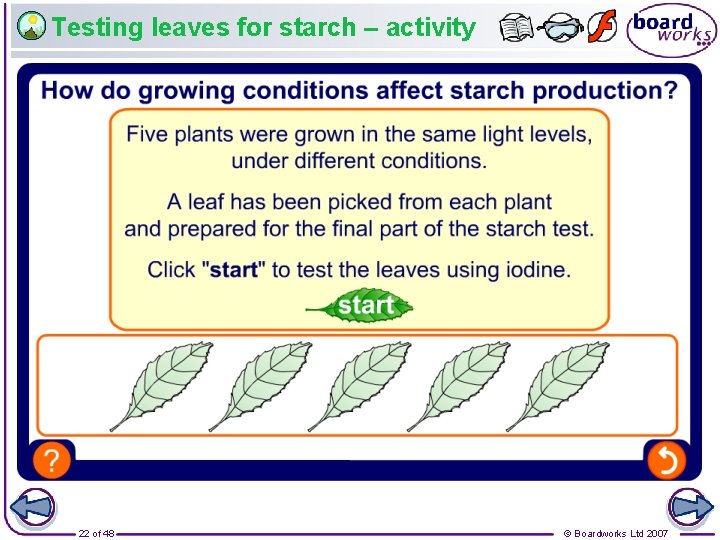
How can you test for photosynthesis? The presence of starch in a leaf can be used to show that photosynthesis has taken place. Iodine is used to test for starch. It reacts with starch and changes colour from brown to blue-black. The starch test can be used to prove that photosynthesis needs light, carbon dioxide and chlorophyll to take place. How would you set up an experiment to test the conditions needed for photosynthesis? How would you make the experiment fair and reliable? 19 of 48 © Boardworks Ltd 2007
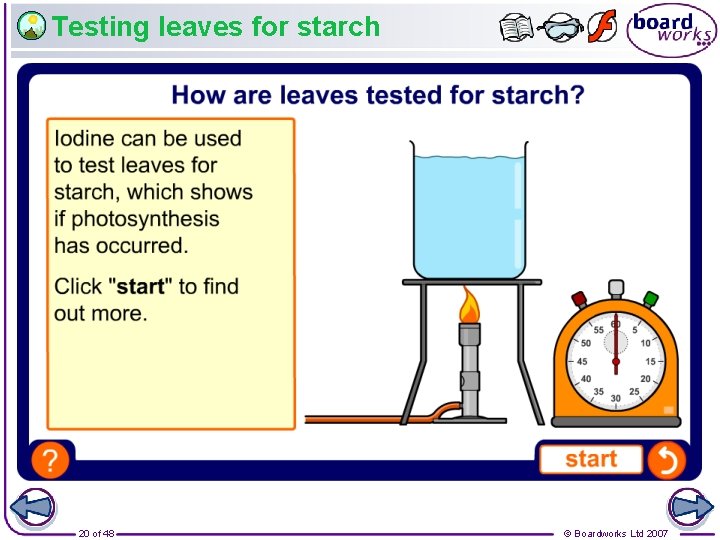
Testing leaves for starch 20 of 48 © Boardworks Ltd 2007
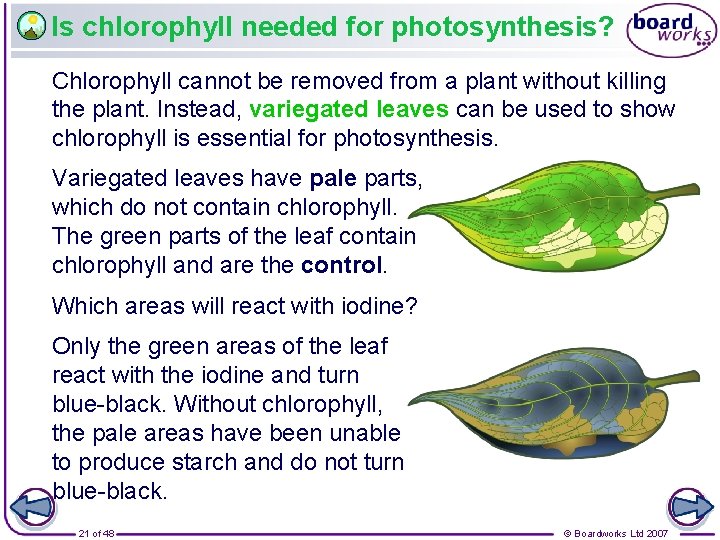
Is chlorophyll needed for photosynthesis? Chlorophyll cannot be removed from a plant without killing the plant. Instead, variegated leaves can be used to show chlorophyll is essential for photosynthesis. Variegated leaves have pale parts, which do not contain chlorophyll. The green parts of the leaf contain chlorophyll and are the control. Which areas will react with iodine? Only the green areas of the leaf react with the iodine and turn blue-black. Without chlorophyll, the pale areas have been unable to produce starch and do not turn blue-black. 21 of 48 © Boardworks Ltd 2007
Testing leaves for starch – activity 22 of 48 © Boardworks Ltd 2007
23 of 48 © Boardworks Ltd 2007
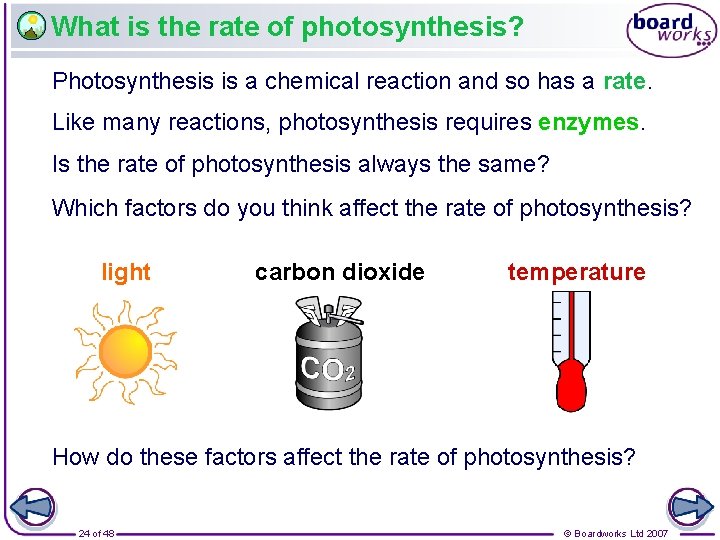
What is the rate of photosynthesis? Photosynthesis is a chemical reaction and so has a rate. Like many reactions, photosynthesis requires enzymes. Is the rate of photosynthesis always the same? Which factors do you think affect the rate of photosynthesis? light carbon dioxide temperature How do these factors affect the rate of photosynthesis? 24 of 48 © Boardworks Ltd 2007
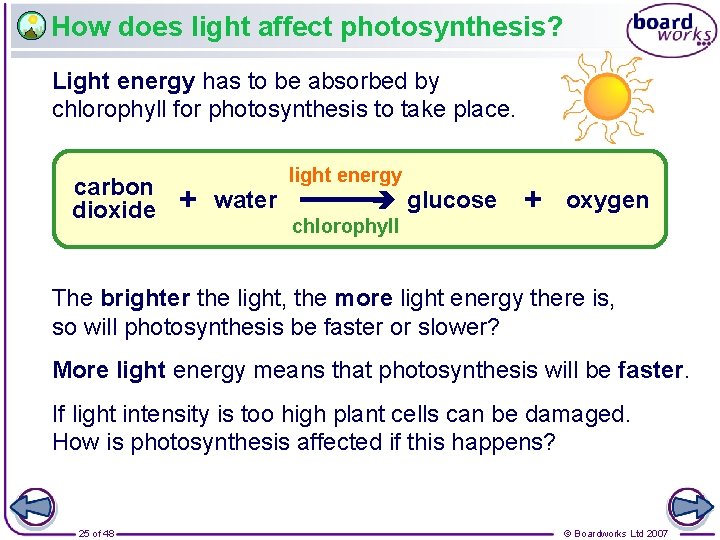
How does light affect photosynthesis? Light energy has to be absorbed by chlorophyll for photosynthesis to take place. carbon dioxide + water light energy glucose chlorophyll + oxygen The brighter the light, the more light energy there is, so will photosynthesis be faster or slower? More light energy means that photosynthesis will be faster. If light intensity is too high plant cells can be damaged. How is photosynthesis affected if this happens? 25 of 48 © Boardworks Ltd 2007
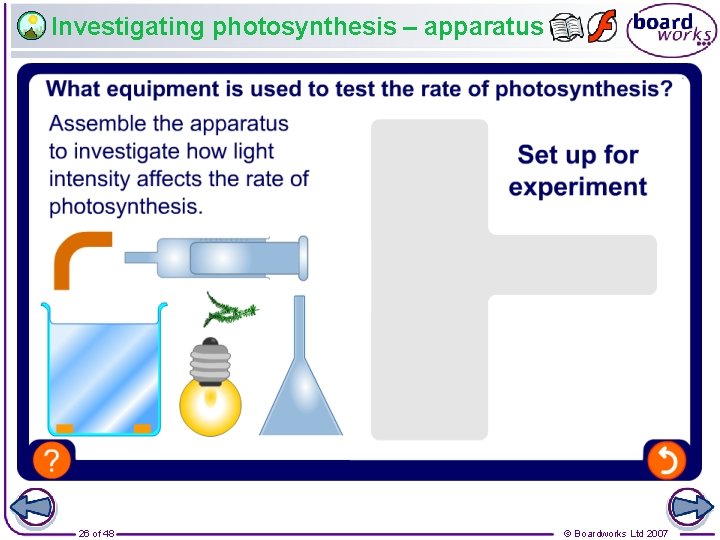
Investigating photosynthesis – apparatus 26 of 48 © Boardworks Ltd 2007
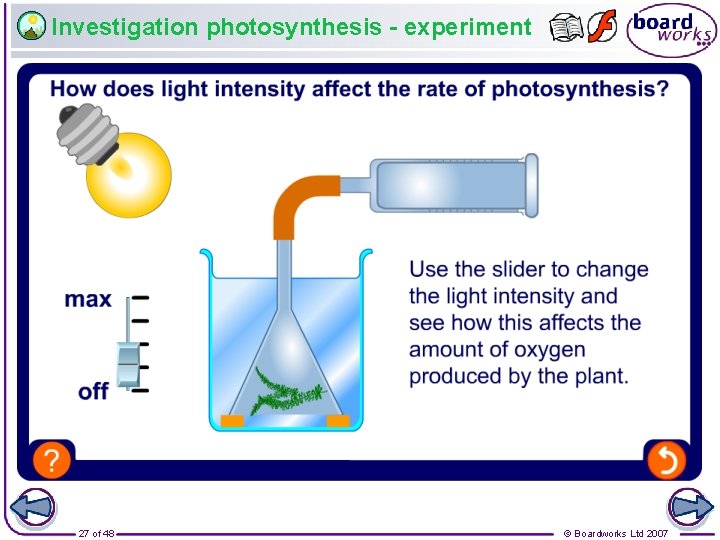
Investigation photosynthesis - experiment 27 of 48 © Boardworks Ltd 2007
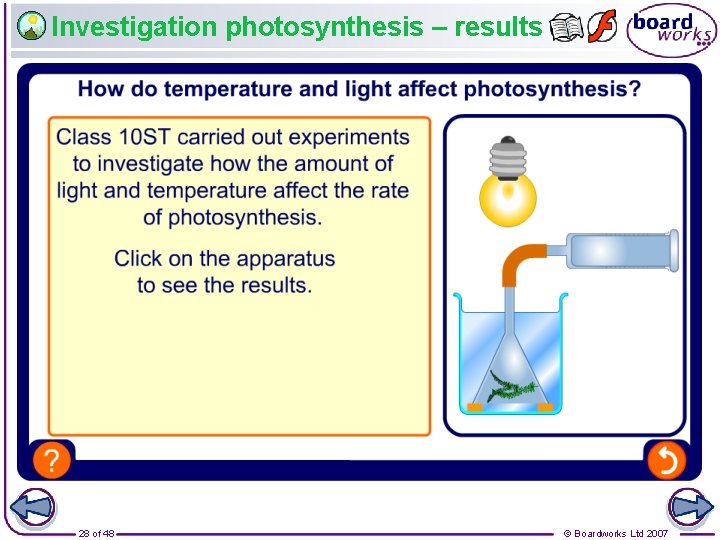
Investigation photosynthesis – results 28 of 48 © Boardworks Ltd 2007
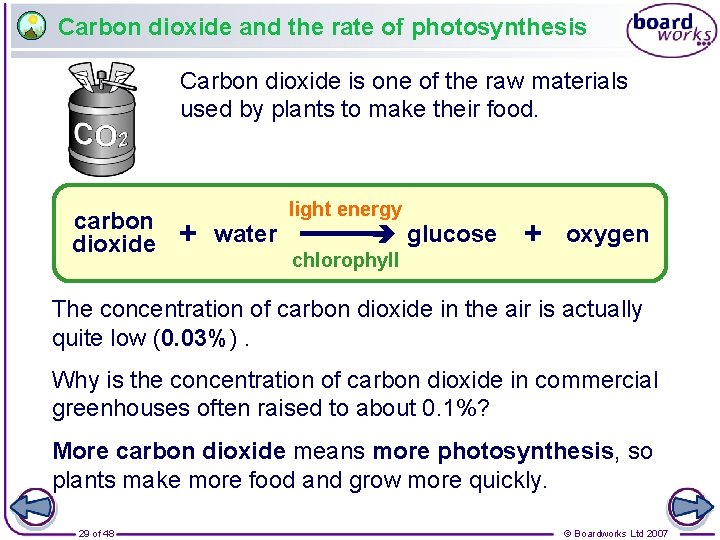
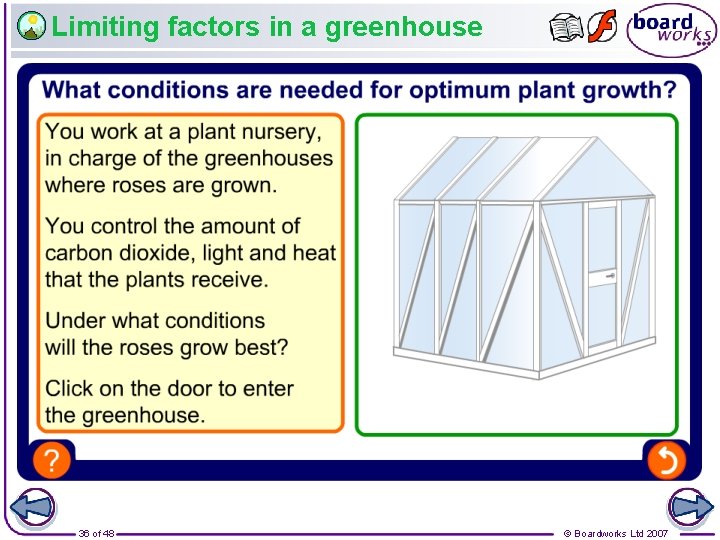
Carbon dioxide and the rate of photosynthesis Carbon dioxide is one of the raw materials used by plants to make their food. carbon dioxide + water light energy glucose chlorophyll + oxygen The concentration of carbon dioxide in the air is actually quite low (0. 03%). Why is the concentration of carbon dioxide in commercial greenhouses often raised to about 0. 1%? More carbon dioxide means more photosynthesis, so plants make more food and grow more quickly. 29 of 48 © Boardworks Ltd 2007
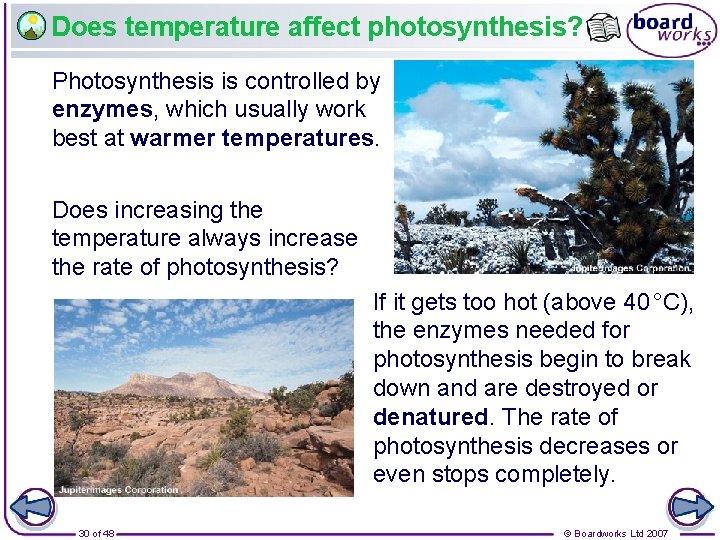
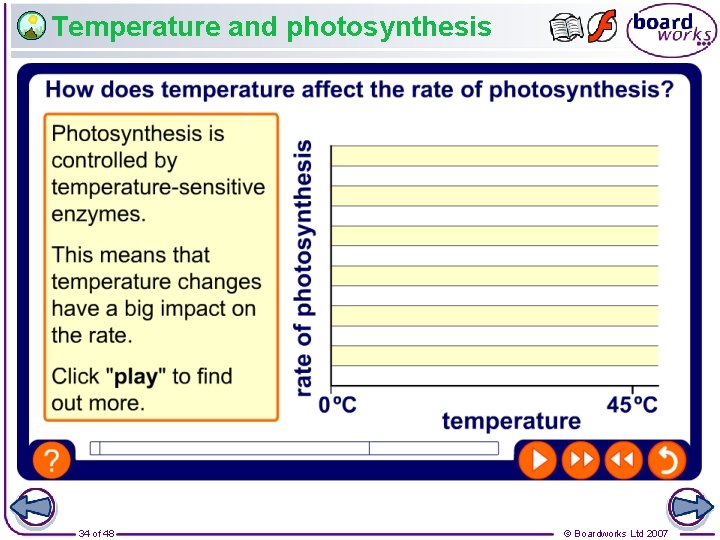
Does temperature affect photosynthesis? Photosynthesis is controlled by enzymes, which usually work best at warmer temperatures. Does increasing the temperature always increase the rate of photosynthesis? If it gets too hot (above 40 °C), the enzymes needed for photosynthesis begin to break down and are destroyed or denatured. The rate of photosynthesis decreases or even stops completely. 30 of 48 © Boardworks Ltd 2007
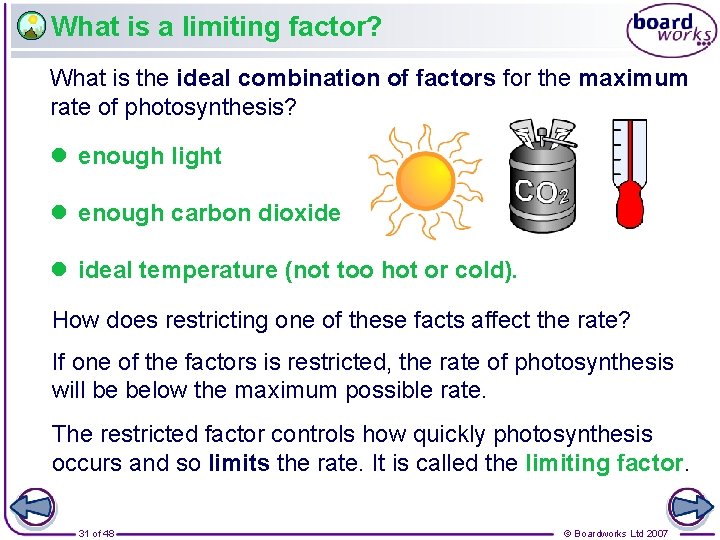
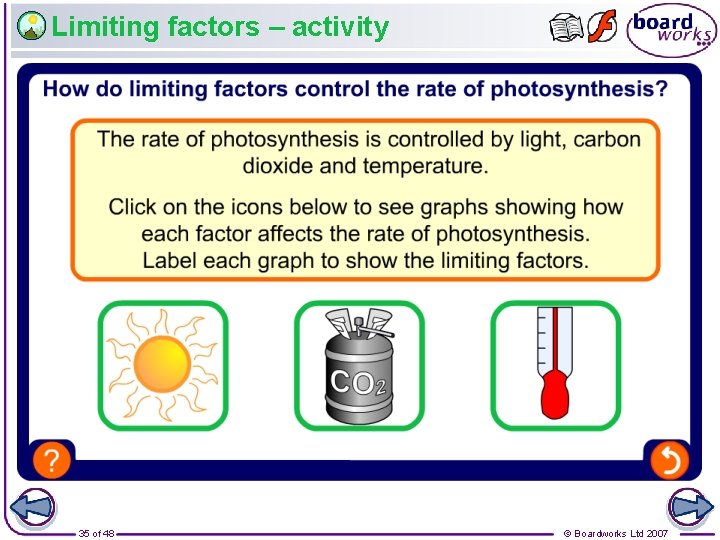
What is a limiting factor? What is the ideal combination of factors for the maximum rate of photosynthesis? l enough light l enough carbon dioxide l ideal temperature (not too hot or cold). How does restricting one of these facts affect the rate? If one of the factors is restricted, the rate of photosynthesis will be below the maximum possible rate. The restricted factor controls how quickly photosynthesis occurs and so limits the rate. It is called the limiting factor. 31 of 48 © Boardworks Ltd 2007
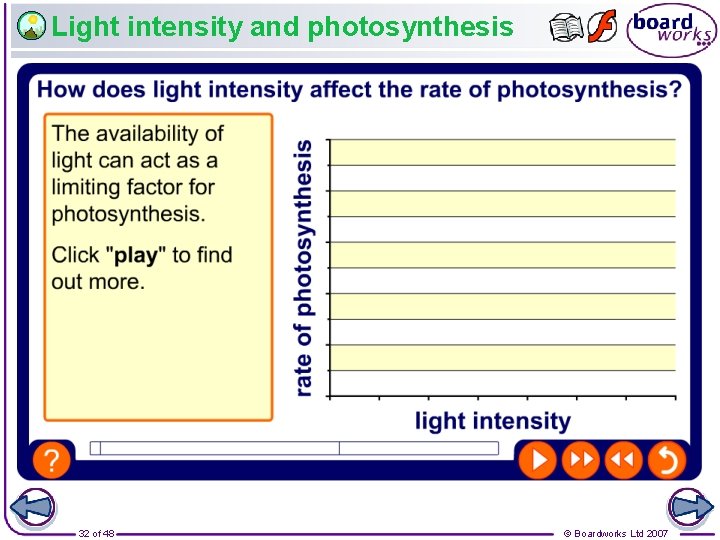
Light intensity and photosynthesis 32 of 48 © Boardworks Ltd 2007
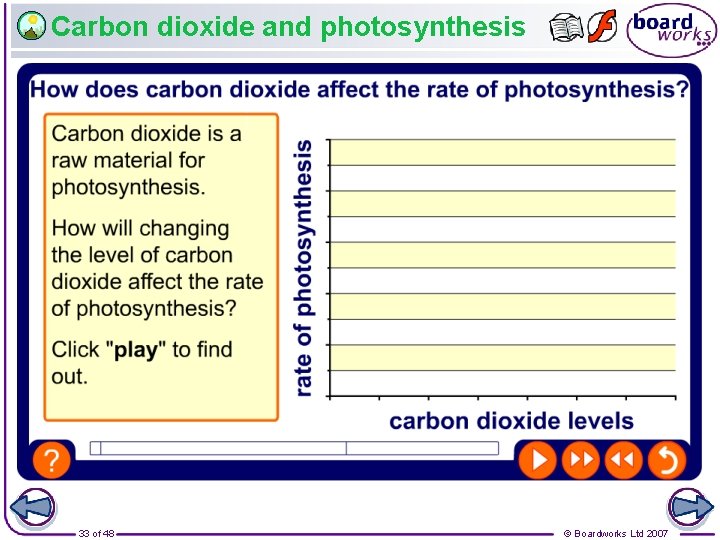
Carbon dioxide and photosynthesis 33 of 48 © Boardworks Ltd 2007
Temperature and photosynthesis 34 of 48 © Boardworks Ltd 2007
Limiting factors – activity 35 of 48 © Boardworks Ltd 2007
Limiting factors in a greenhouse 36 of 48 © Boardworks Ltd 2007
37 of 48 © Boardworks Ltd 2007
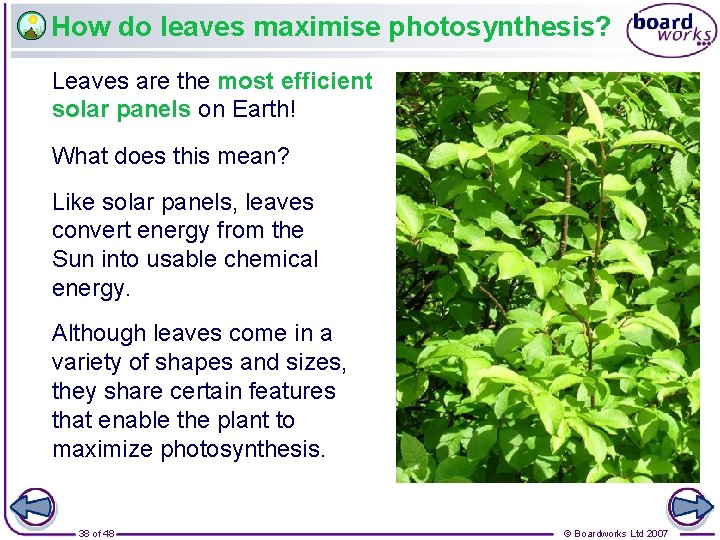
How do leaves maximise photosynthesis? Leaves are the most efficient solar panels on Earth! What does this mean? Like solar panels, leaves convert energy from the Sun into usable chemical energy. Although leaves come in a variety of shapes and sizes, they share certain features that enable the plant to maximize photosynthesis. 38 of 48 © Boardworks Ltd 2007
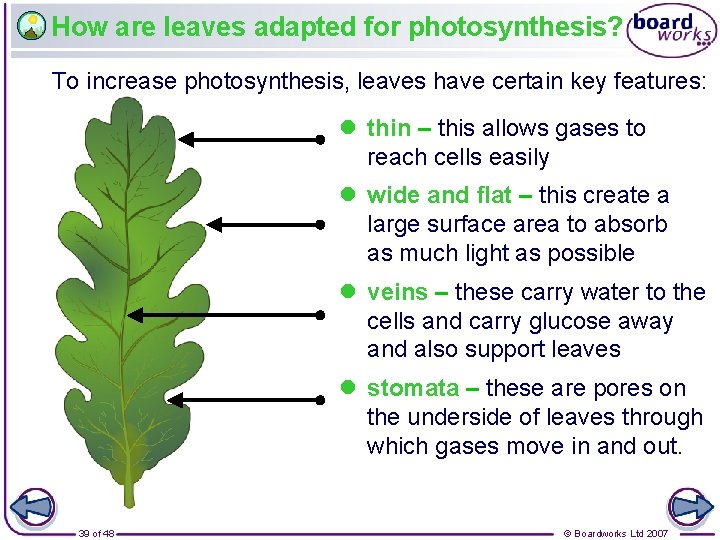
How are leaves adapted for photosynthesis? To increase photosynthesis, leaves have certain key features: l thin – this allows gases to reach cells easily l wide and flat – this create a large surface area to absorb as much light as possible l veins – these carry water to the cells and carry glucose away and also support leaves l stomata – these are pores on the underside of leaves through which gases move in and out. 39 of 48 © Boardworks Ltd 2007
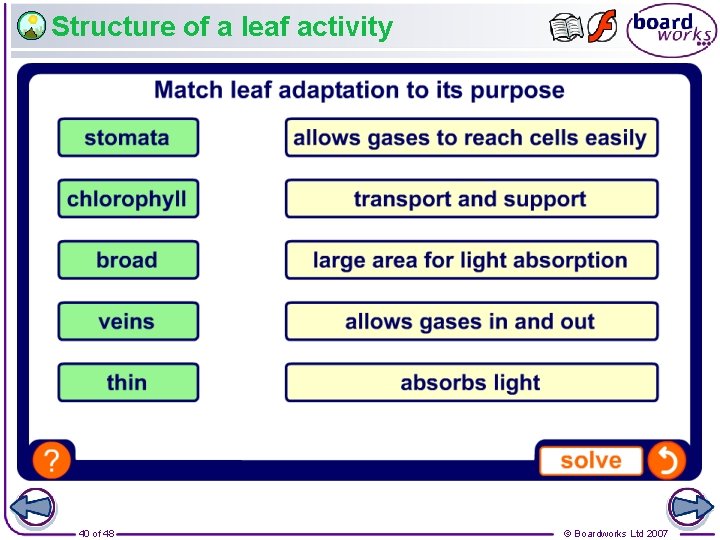
Structure of a leaf activity 40 of 48 © Boardworks Ltd 2007
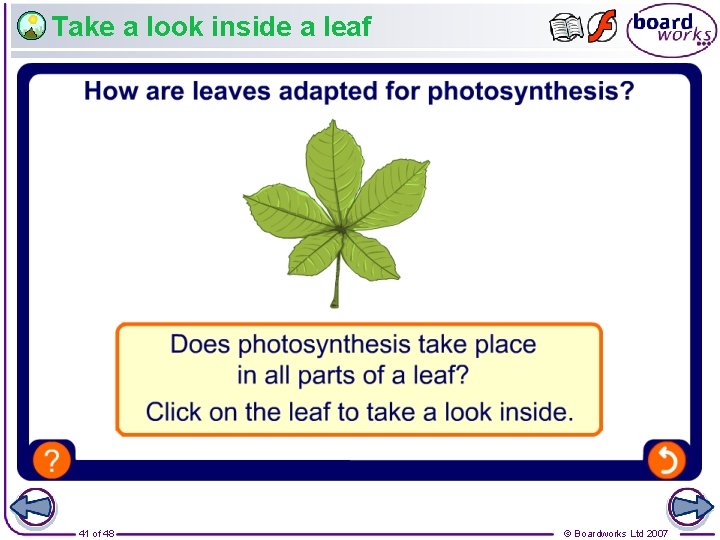
Take a look inside a leaf 41 of 48 © Boardworks Ltd 2007
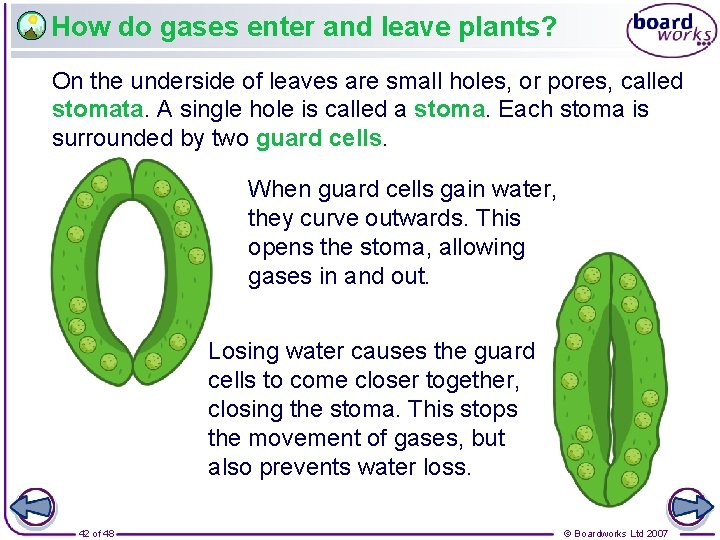
How do gases enter and leave plants? On the underside of leaves are small holes, or pores, called stomata. A single hole is called a stoma. Each stoma is surrounded by two guard cells. When guard cells gain water, they curve outwards. This opens the stoma, allowing gases in and out. Losing water causes the guard cells to come closer together, closing the stoma. This stops the movement of gases, but also prevents water loss. 42 of 48 © Boardworks Ltd 2007
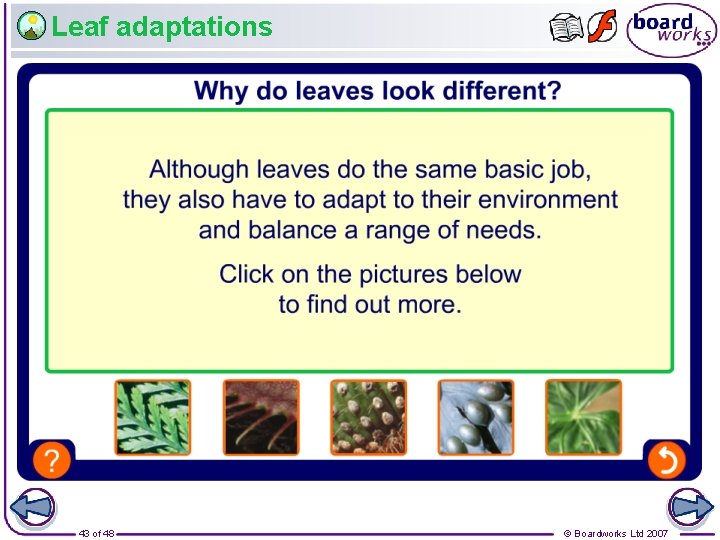
Leaf adaptations 43 of 48 © Boardworks Ltd 2007
44 of 48 © Boardworks Ltd 2007
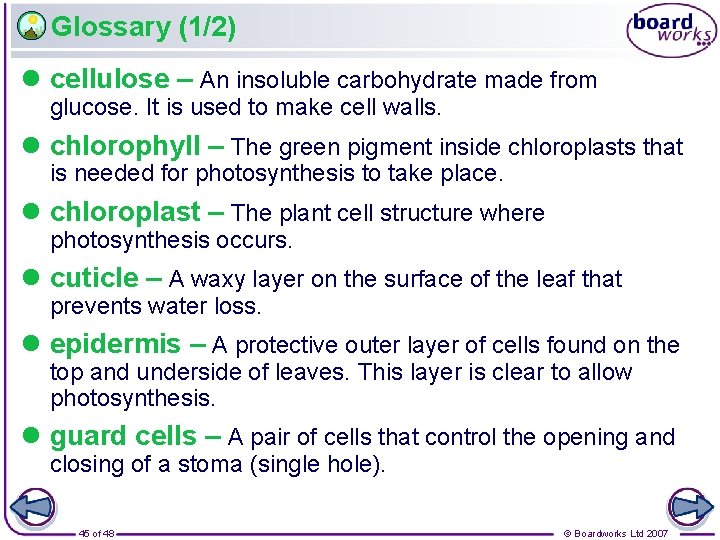
Glossary (1/2) l cellulose – An insoluble carbohydrate made from glucose. It is used to make cell walls. l chlorophyll – The green pigment inside chloroplasts that is needed for photosynthesis to take place. l chloroplast – The plant cell structure where photosynthesis occurs. l cuticle – A waxy layer on the surface of the leaf that prevents water loss. l epidermis – A protective outer layer of cells found on the top and underside of leaves. This layer is clear to allow photosynthesis. l guard cells – A pair of cells that control the opening and closing of a stoma (single hole). 45 of 48 © Boardworks Ltd 2007
Glossary (2/2) l palisade – A layer of cells in the leaves, which contain lots of chloroplasts. It is the main site of photosynthesis. l photosynthesis – The process by which plants use carbon dioxide and water to make glucose and oxygen in the presence of light and chlorophyll. l spongy layer – A layer of cells that contains large spaces between cells. This allows the diffusion of gases between the stomata and palisade layer. l stoma (singular) – A single hole on the lower surface of the leaf that allows gases in and out. l stomata (plural) – Small holes in the lower surface of leaves that allow gases in and out. l variegated – A leaf containing areas without chlorophyll. 46 of 48 © Boardworks Ltd 2007
Anagrams 47 of 48 © Boardworks Ltd 2007
Multiple choice quiz 48 of 48 © Boardworks Ltd 2007
- Slides: 48