
1 of 29 Boardworks Ltd 2009 2 of
1 of 29 © Boardworks Ltd 2009

2 of 29 © Boardworks Ltd 2009
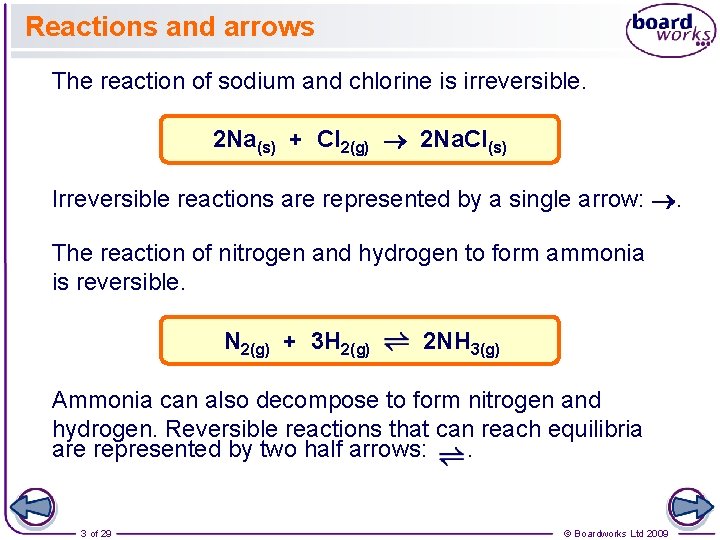
Reactions and arrows The reaction of sodium and chlorine is irreversible. 2 Na(s) + Cl 2(g) ® 2 Na. Cl(s) Irreversible reactions are represented by a single arrow: ®. The reaction of nitrogen and hydrogen to form ammonia is reversible. N 2(g) + 3 H 2(g) 2 NH 3(g) Ammonia can also decompose to form nitrogen and hydrogen. Reversible reactions that can reach equilibria are represented by two half arrows: . 3 of 29 © Boardworks Ltd 2009
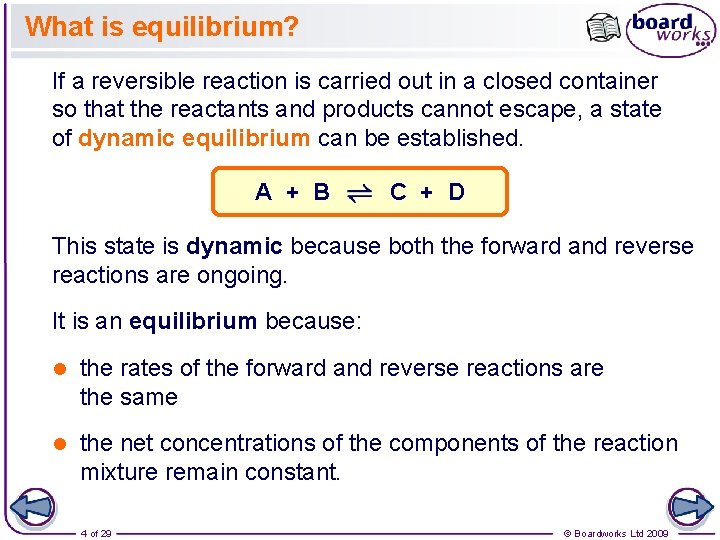
What is equilibrium? If a reversible reaction is carried out in a closed container so that the reactants and products cannot escape, a state of dynamic equilibrium can be established. A + B C + D This state is dynamic because both the forward and reverse reactions are ongoing. It is an equilibrium because: l the rates of the forward and reverse reactions are the same l the net concentrations of the components of the reaction mixture remain constant. 4 of 29 © Boardworks Ltd 2009

Dynamic equilibrium This graph illustrates the dynamic nature of equilibrium. It shows that both the forward and back reactions are taking place: they both have non-zero rate. When their rates are equal, equilibrium is reached. forward reaction: 2 SO 2(g) + O 2(g) ® 2 SO 3(g) rates are equal at equilibrium reverse reaction: 2 SO 3(g) ® 2 SO 2(g) + O 2(g) time 5 of 29 © Boardworks Ltd 2009
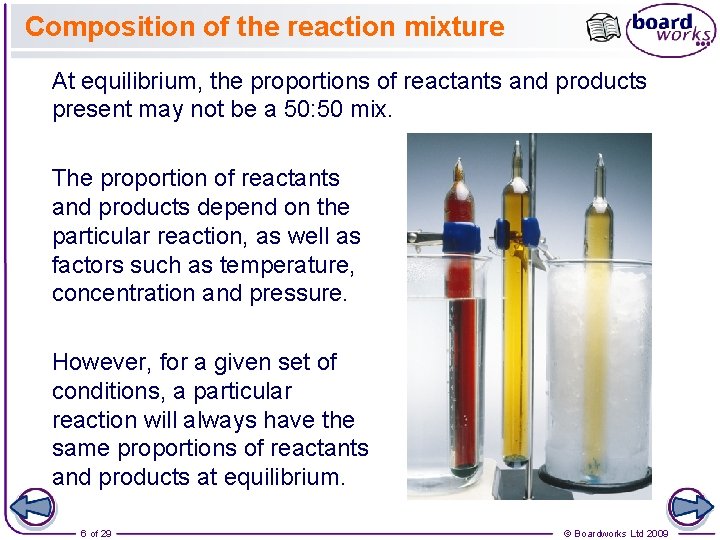
Composition of the reaction mixture At equilibrium, the proportions of reactants and products present may not be a 50: 50 mix. The proportion of reactants and products depend on the particular reaction, as well as factors such as temperature, concentration and pressure. However, for a given set of conditions, a particular reaction will always have the same proportions of reactants and products at equilibrium. 6 of 29 © Boardworks Ltd 2009

Dynamic equilibrium: summary 7 of 29 © Boardworks Ltd 2009
8 of 29 © Boardworks Ltd 2009
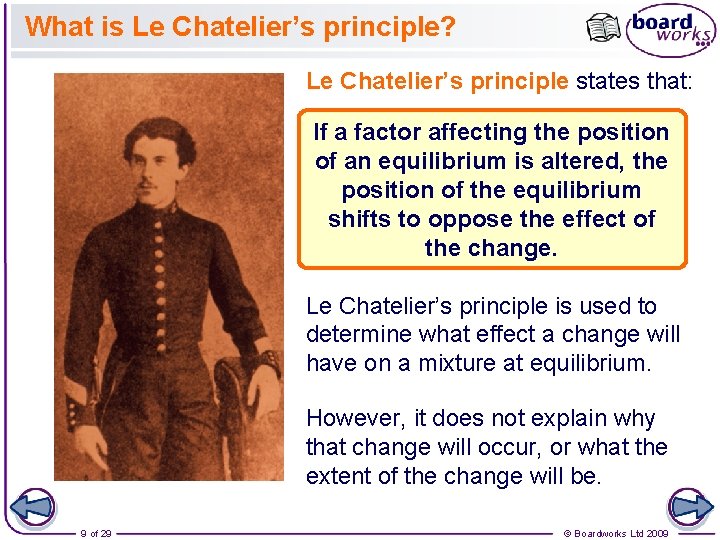
What is Le Chatelier’s principle? Le Chatelier’s principle states that: If a factor affecting the position of an equilibrium is altered, the position of the equilibrium shifts to oppose the effect of the change. Le Chatelier’s principle is used to determine what effect a change will have on a mixture at equilibrium. However, it does not explain why that change will occur, or what the extent of the change will be. 9 of 29 © Boardworks Ltd 2009
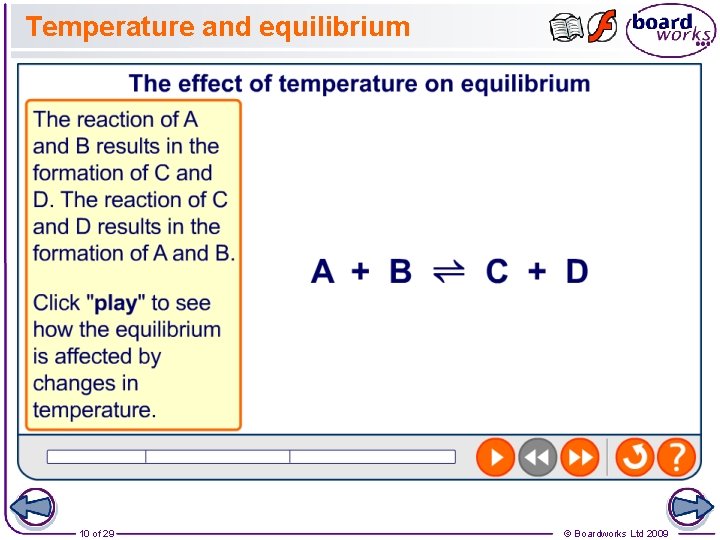
Temperature and equilibrium 10 of 29 © Boardworks Ltd 2009
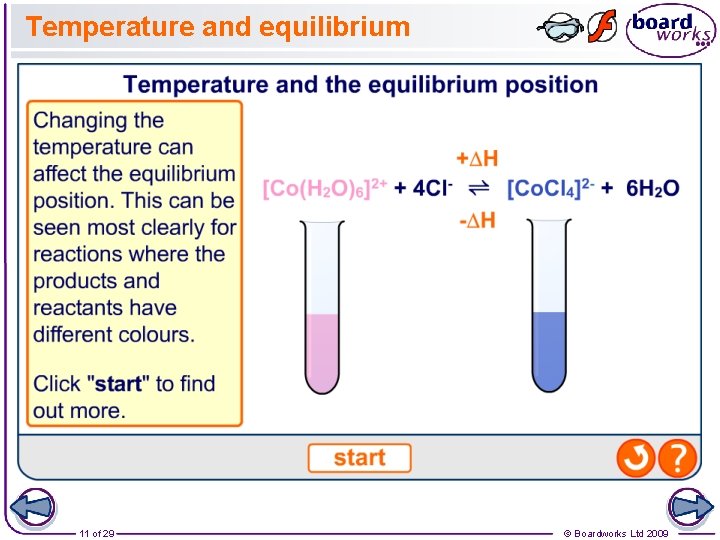
Temperature and equilibrium 11 of 29 © Boardworks Ltd 2009
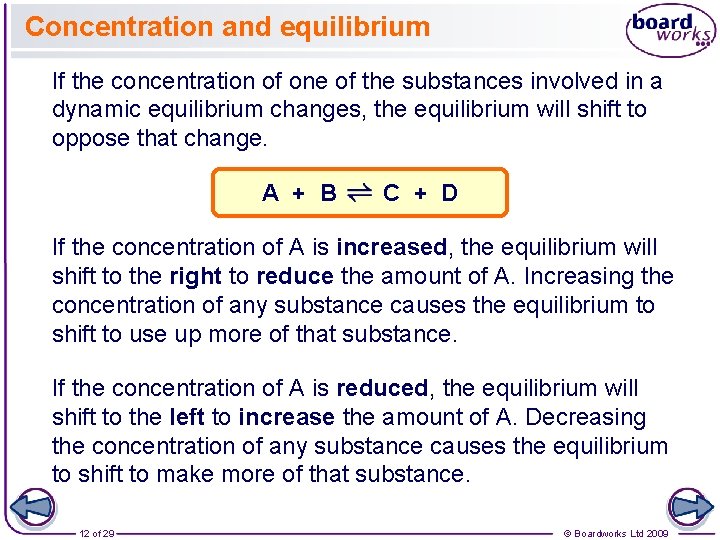
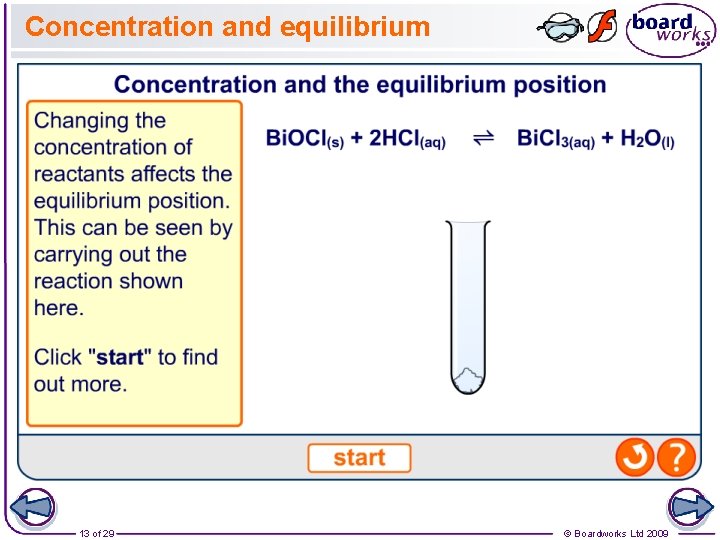
Concentration and equilibrium If the concentration of one of the substances involved in a dynamic equilibrium changes, the equilibrium will shift to oppose that change. A + B C + D If the concentration of A is increased, the equilibrium will shift to the right to reduce the amount of A. Increasing the concentration of any substance causes the equilibrium to shift to use up more of that substance. If the concentration of A is reduced, the equilibrium will shift to the left to increase the amount of A. Decreasing the concentration of any substance causes the equilibrium to shift to make more of that substance. 12 of 29 © Boardworks Ltd 2009
Concentration and equilibrium 13 of 29 © Boardworks Ltd 2009
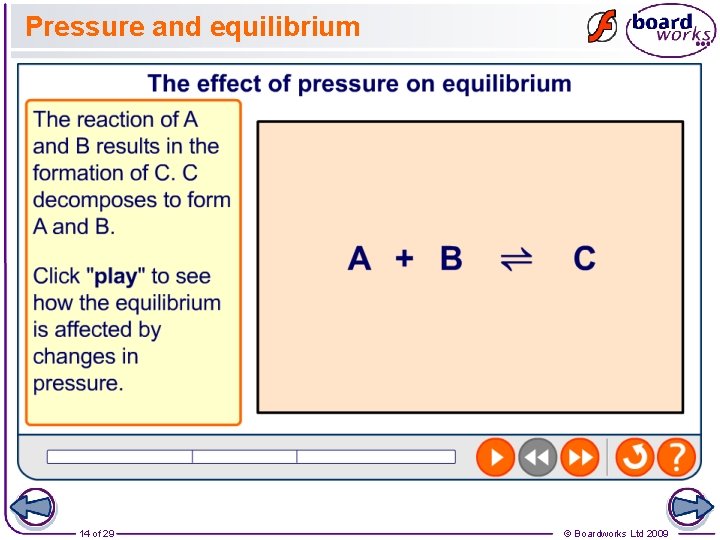
Pressure and equilibrium 14 of 29 © Boardworks Ltd 2009
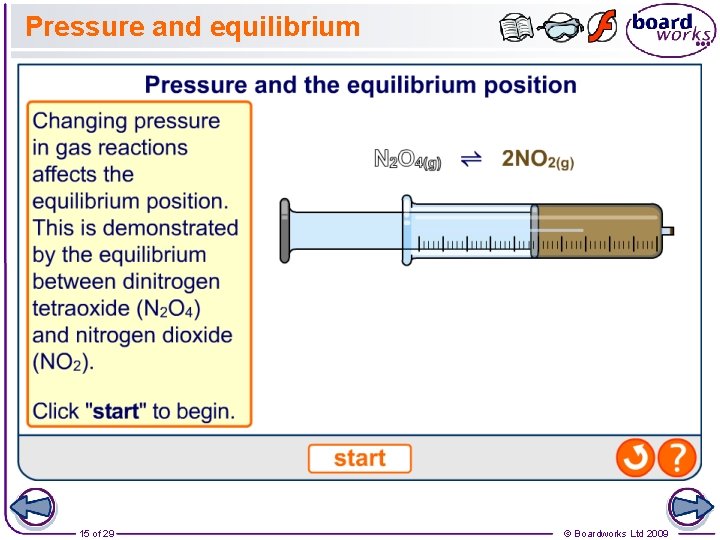
Pressure and equilibrium 15 of 29 © Boardworks Ltd 2009
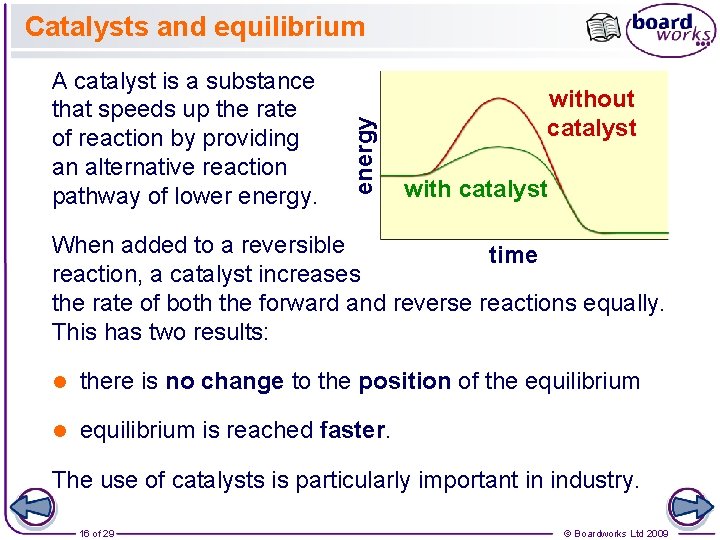
A catalyst is a substance that speeds up the rate of reaction by providing an alternative reaction pathway of lower energy Catalysts and equilibrium without catalyst with catalyst When added to a reversible time reaction, a catalyst increases the rate of both the forward and reverse reactions equally. This has two results: l there is no change to the position of the equilibrium l equilibrium is reached faster. The use of catalysts is particularly important in industry. 16 of 29 © Boardworks Ltd 2009
Le Chatelier’s principle: summary 17 of 29 © Boardworks Ltd 2009
18 of 29 © Boardworks Ltd 2009
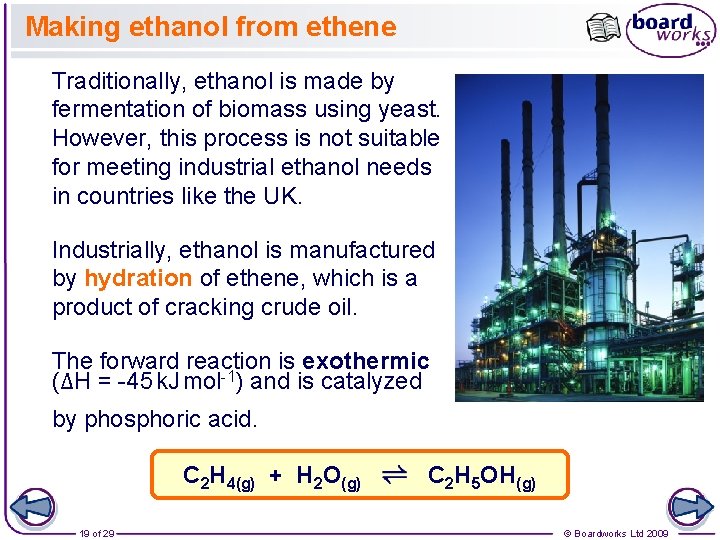
Making ethanol from ethene Traditionally, ethanol is made by fermentation of biomass using yeast. However, this process is not suitable for meeting industrial ethanol needs in countries like the UK. Industrially, ethanol is manufactured by hydration of ethene, which is a product of cracking crude oil. The forward reaction is exothermic (∆H = -45 k. J mol-1) and is catalyzed by phosphoric acid. C 2 H 4(g) + H 2 O(g) 19 of 29 C 2 H 5 OH(g) © Boardworks Ltd 2009
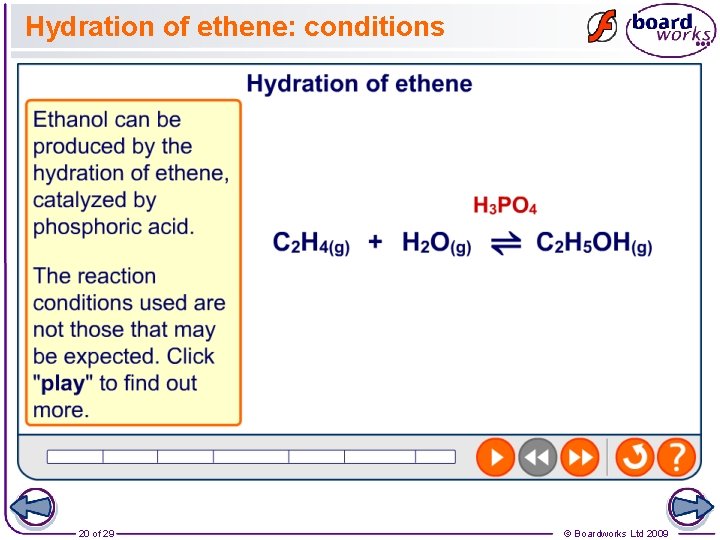
Hydration of ethene: conditions 20 of 29 © Boardworks Ltd 2009
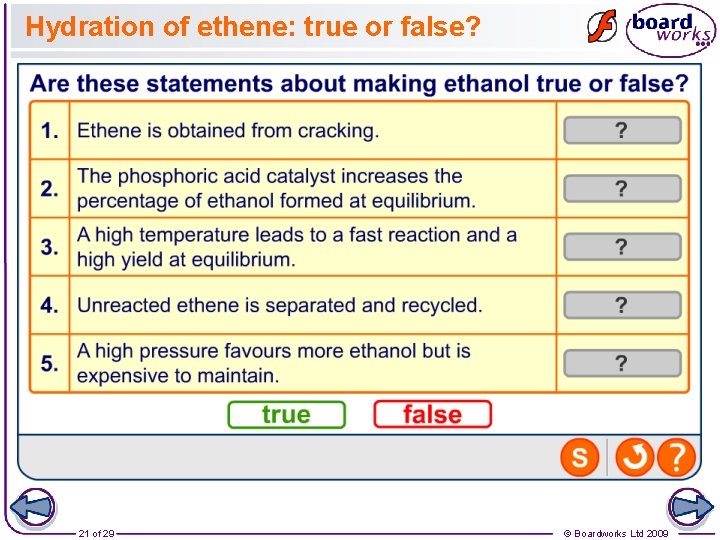
Hydration of ethene: true or false? 21 of 29 © Boardworks Ltd 2009
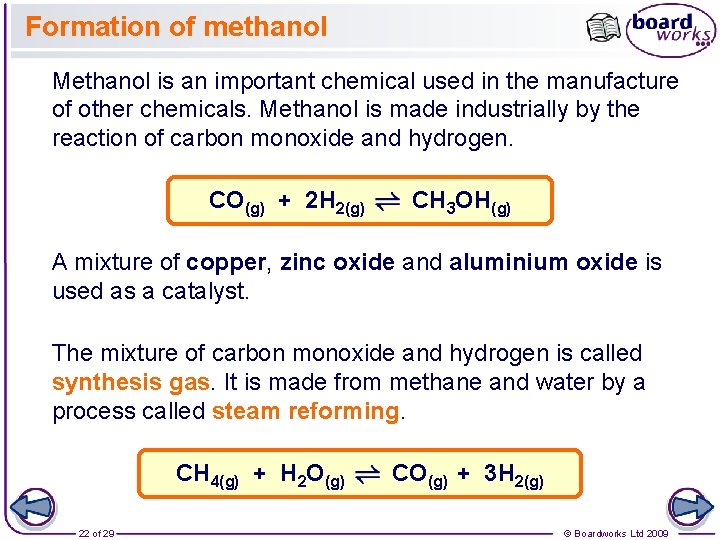
Formation of methanol Methanol is an important chemical used in the manufacture of other chemicals. Methanol is made industrially by the reaction of carbon monoxide and hydrogen. CO(g) + 2 H 2(g) CH 3 OH(g) A mixture of copper, zinc oxide and aluminium oxide is used as a catalyst. The mixture of carbon monoxide and hydrogen is called synthesis gas. It is made from methane and water by a process called steam reforming. CH 4(g) + H 2 O(g) 22 of 29 CO(g) + 3 H 2(g) © Boardworks Ltd 2009
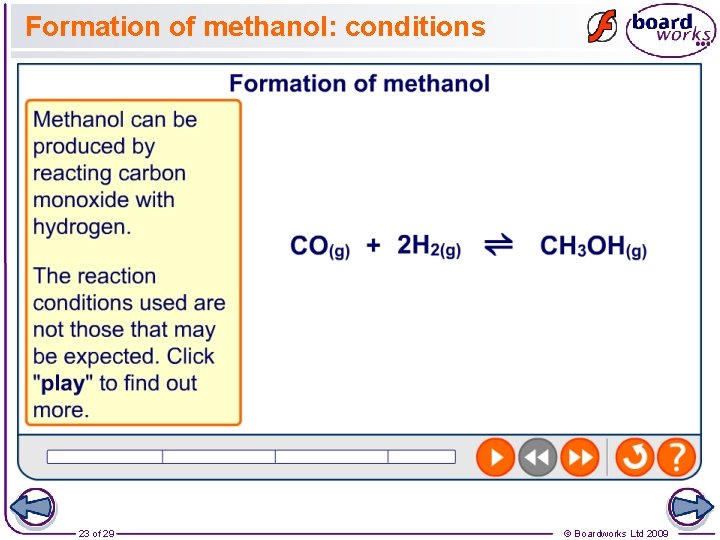
Formation of methanol: conditions 23 of 29 © Boardworks Ltd 2009
Carbon neutral activities in industry Ethanol and methanol can be used as liquid fuels; for example, for specially-adapted motor cars. Methanol produced from carbon monoxide and hydrogen can be a carbon neutral fuel. A carbon neutral activity is one that has no net annual carbon (greenhouse gas) emissions to the atmosphere. Greenhouse gas emissions are a major cause of global warming. Aiming for carbon neutral status is one way in which industries can try to reduce their impact on the environment. 24 of 29 © Boardworks Ltd 2009
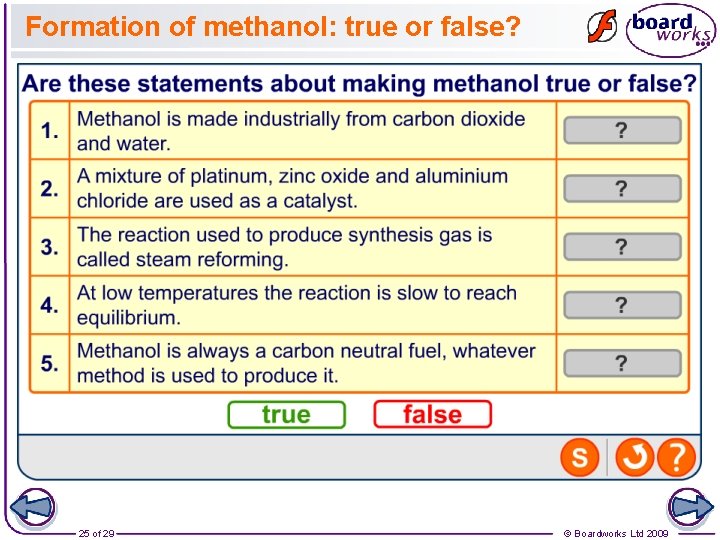
Formation of methanol: true or false? 25 of 29 © Boardworks Ltd 2009
26 of 29 © Boardworks Ltd 2009
Glossary 27 of 29 © Boardworks Ltd 2009
What’s the keyword? 28 of 29 © Boardworks Ltd 2009
Multiple-choice quiz 29 of 29 © Boardworks Ltd 2009
- Slides: 29