
1 of 28 Boardworks Ltd 2008 2 of
1 of 28 © Boardworks Ltd 2008
2 of 28 © Boardworks Ltd 2008
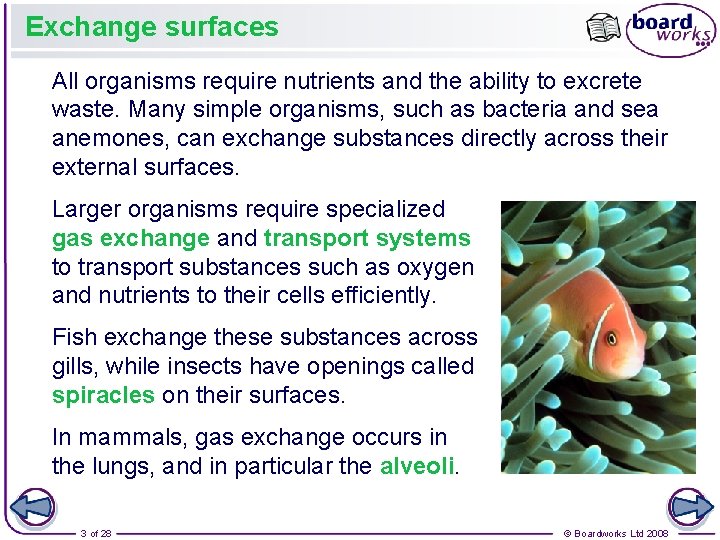
Exchange surfaces All organisms require nutrients and the ability to excrete waste. Many simple organisms, such as bacteria and sea anemones, can exchange substances directly across their external surfaces. Larger organisms require specialized gas exchange and transport systems to transport substances such as oxygen and nutrients to their cells efficiently. Fish exchange these substances across gills, while insects have openings called spiracles on their surfaces. In mammals, gas exchange occurs in the lungs, and in particular the alveoli. 3 of 28 Crop photo © Boardworks Ltd 2008
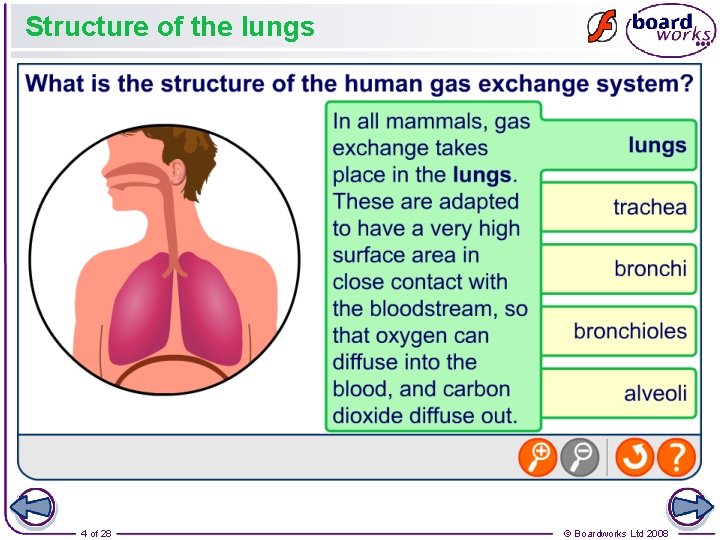
Structure of the lungs 4 of 28 © Boardworks Ltd 2008
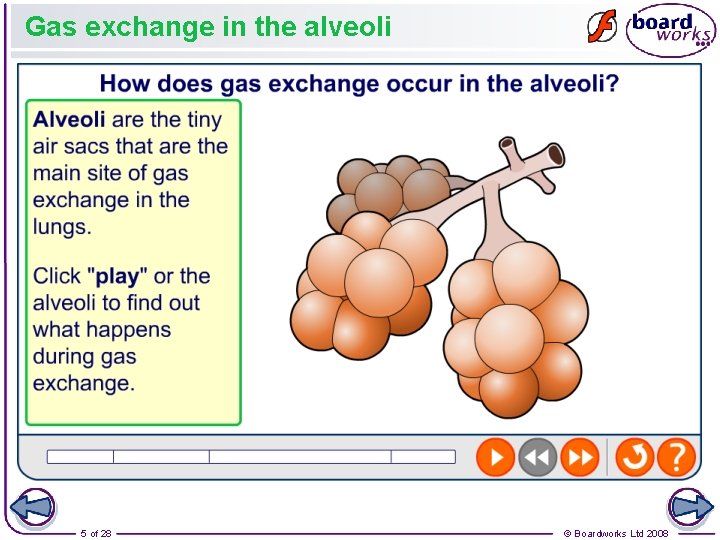
Gas exchange in the alveoli 5 of 28 © Boardworks Ltd 2008
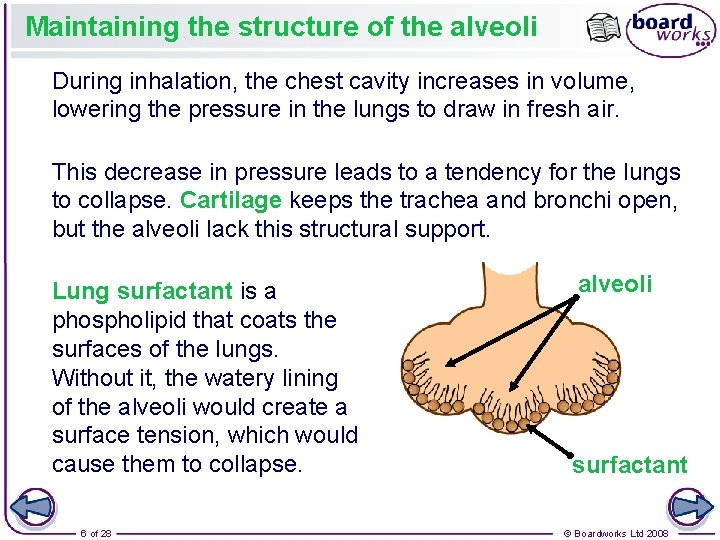
Maintaining the structure of the alveoli During inhalation, the chest cavity increases in volume, lowering the pressure in the lungs to draw in fresh air. This decrease in pressure leads to a tendency for the lungs to collapse. Cartilage keeps the trachea and bronchi open, but the alveoli lack this structural support. Lung surfactant is a phospholipid that coats the surfaces of the lungs. Without it, the watery lining of the alveoli would create a surface tension, which would cause them to collapse. 6 of 28 alveoli surfactant © Boardworks Ltd 2008
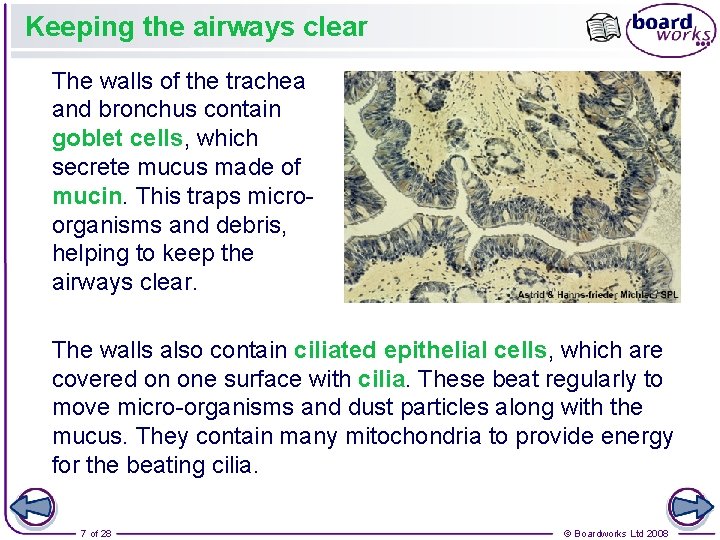
Keeping the airways clear The walls of the trachea and bronchus contain goblet cells, which secrete mucus made of mucin. This traps microorganisms and debris, helping to keep the airways clear. The walls also contain ciliated epithelial cells, which are covered on one surface with cilia. These beat regularly to move micro-organisms and dust particles along with the mucus. They contain many mitochondria to provide energy for the beating cilia. 7 of 28 © Boardworks Ltd 2008
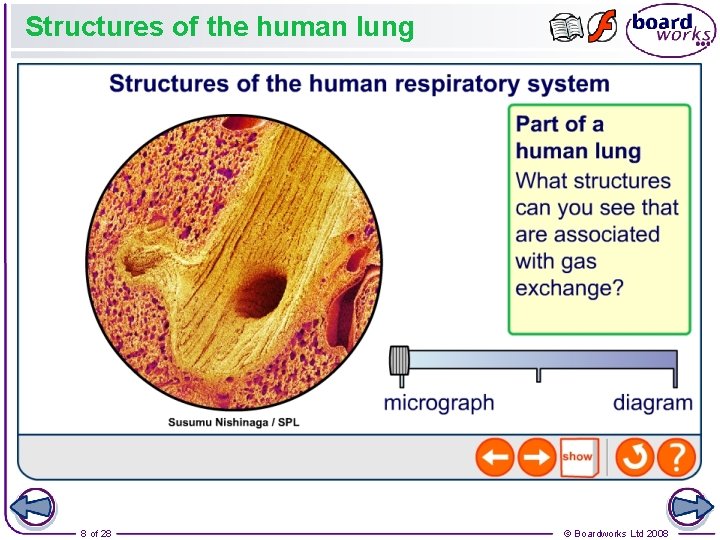
Structures of the human lung 8 of 28 © Boardworks Ltd 2008
9 of 28 © Boardworks Ltd 2008
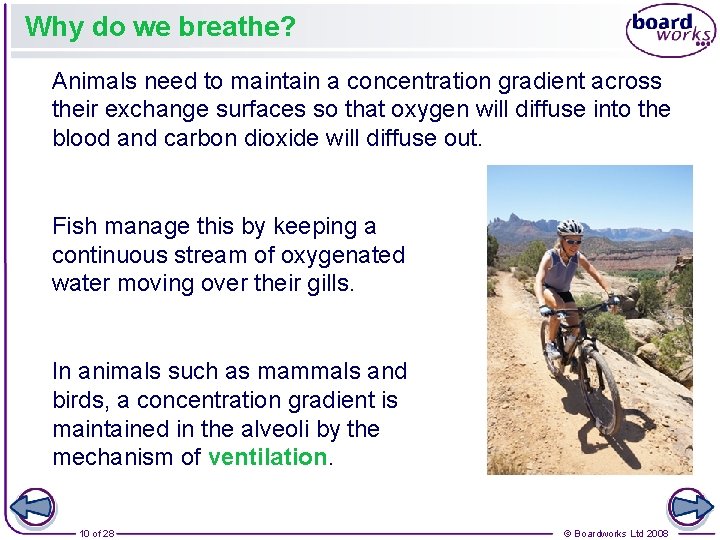
Why do we breathe? Animals need to maintain a concentration gradient across their exchange surfaces so that oxygen will diffuse into the blood and carbon dioxide will diffuse out. Fish manage this by keeping a continuous stream of oxygenated water moving over their gills. In animals such as mammals and birds, a concentration gradient is maintained in the alveoli by the mechanism of ventilation. 10 of 28 © Boardworks Ltd 2008
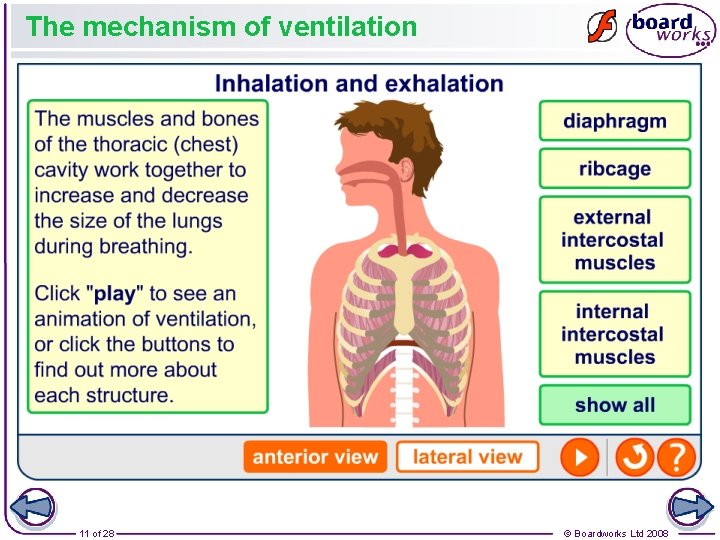
The mechanism of ventilation 11 of 28 © Boardworks Ltd 2008
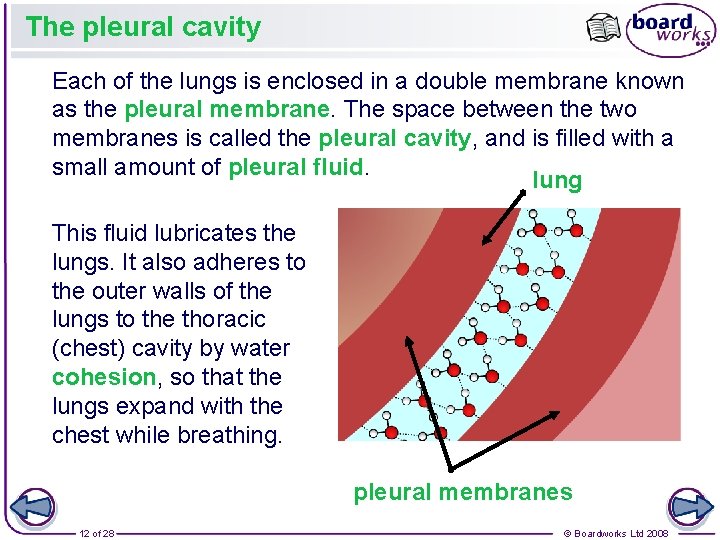
The pleural cavity Each of the lungs is enclosed in a double membrane known as the pleural membrane. The space between the two membranes is called the pleural cavity, and is filled with a small amount of pleural fluid. lung This fluid lubricates the lungs. It also adheres to the outer walls of the lungs to the thoracic (chest) cavity by water cohesion, so that the lungs expand with the chest while breathing. pleural membranes 12 of 28 © Boardworks Ltd 2008
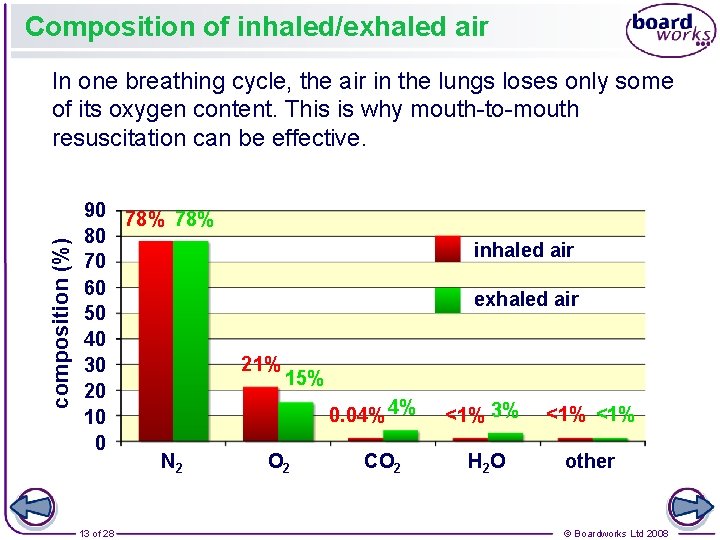
Composition of inhaled/exhaled air composition (%) In one breathing cycle, the air in the lungs loses only some of its oxygen content. This is why mouth-to-mouth resuscitation can be effective. 90 78% 80 70 60 50 40 30 20 10 0 N 2 13 of 28 inhaled air exhaled air 21% 15% 0. 04% 4% O 2 CO 2 <1% 3% <1% H 2 O other © Boardworks Ltd 2008
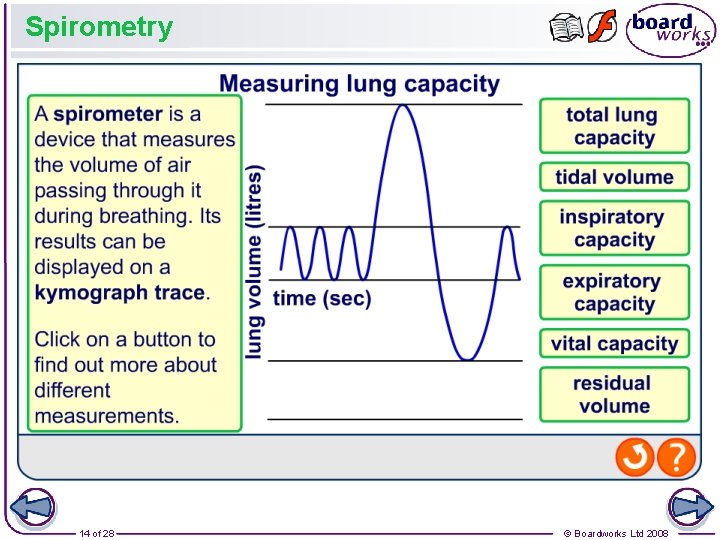
Spirometry 14 of 28 © Boardworks Ltd 2008
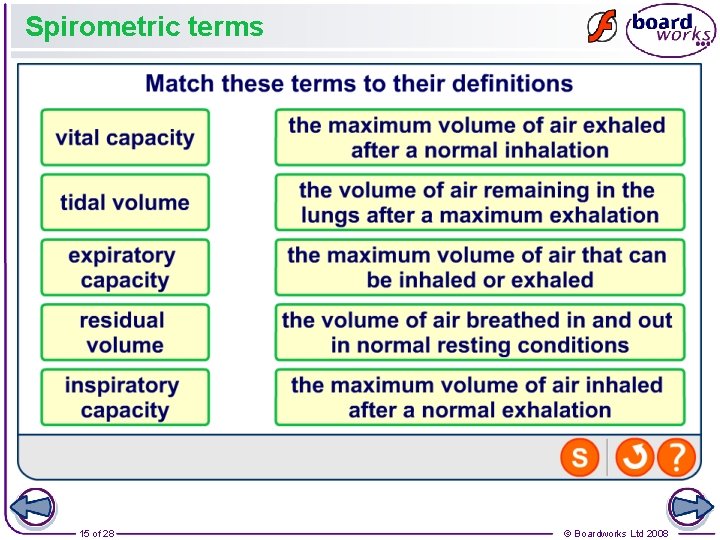
Spirometric terms 15 of 28 © Boardworks Ltd 2008
16 of 28 © Boardworks Ltd 2008
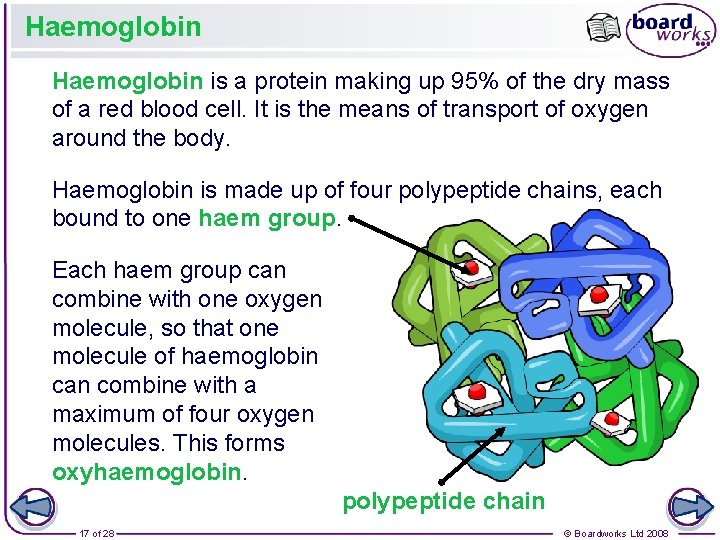
Haemoglobin is a protein making up 95% of the dry mass of a red blood cell. It is the means of transport of oxygen around the body. Haemoglobin is made up of four polypeptide chains, each bound to one haem group. Each haem group can combine with one oxygen molecule, so that one molecule of haemoglobin can combine with a maximum of four oxygen molecules. This forms oxyhaemoglobin. polypeptide chain 17 of 28 © Boardworks Ltd 2008
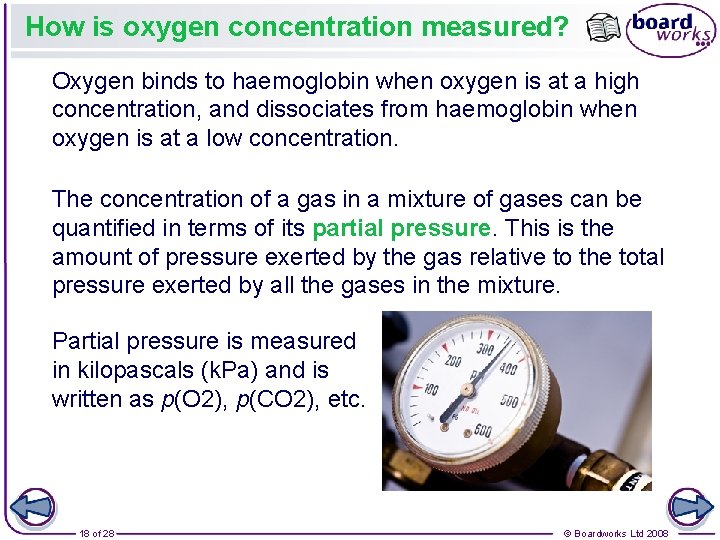
How is oxygen concentration measured? Oxygen binds to haemoglobin when oxygen is at a high concentration, and dissociates from haemoglobin when oxygen is at a low concentration. The concentration of a gas in a mixture of gases can be quantified in terms of its partial pressure. This is the amount of pressure exerted by the gas relative to the total pressure exerted by all the gases in the mixture. Partial pressure is measured in kilopascals (k. Pa) and is written as p(O 2), p(CO 2), etc. 18 of 28 © Boardworks Ltd 2008
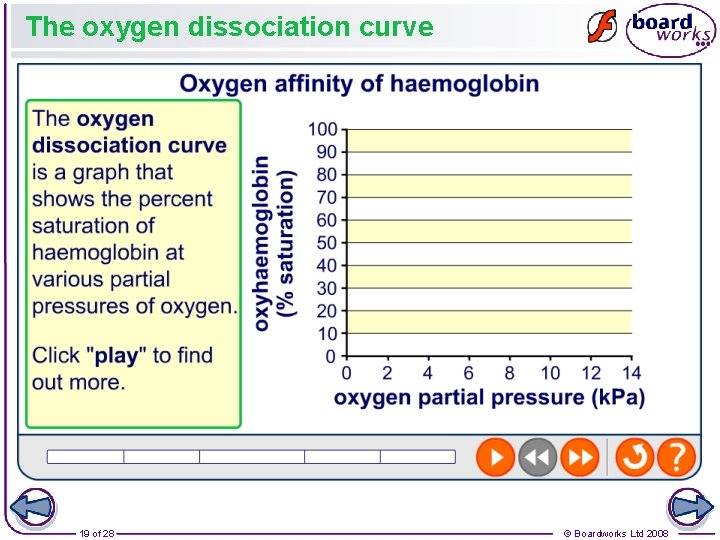
The oxygen dissociation curve 19 of 28 © Boardworks Ltd 2008
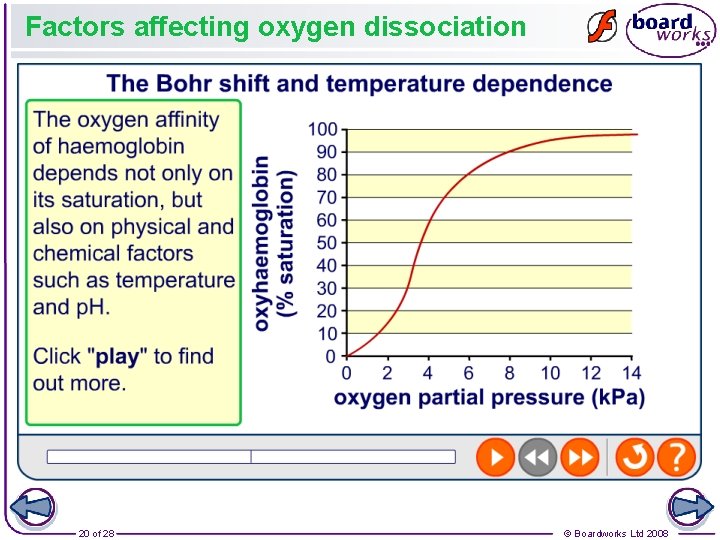
Factors affecting oxygen dissociation 20 of 28 © Boardworks Ltd 2008
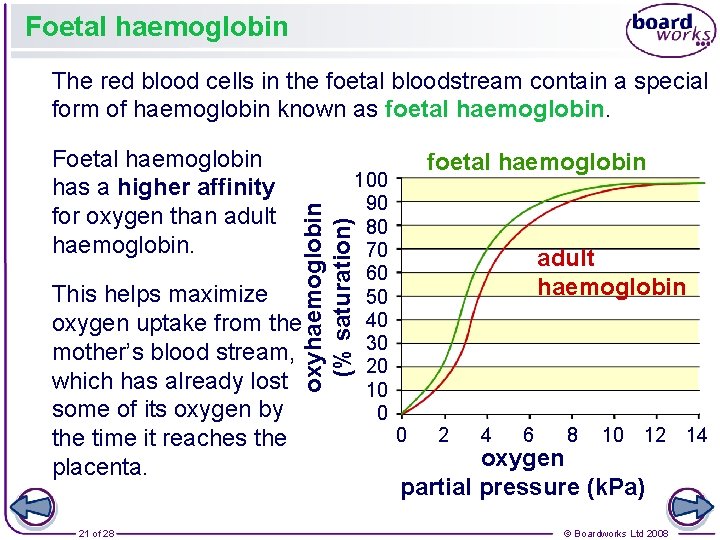
Foetal haemoglobin The red blood cells in the foetal bloodstream contain a special form of haemoglobin known as foetal haemoglobin. This helps maximize oxygen uptake from the mother’s blood stream, which has already lost some of its oxygen by the time it reaches the placenta. 21 of 28 100 90 80 70 60 50 40 30 20 10 0 foetal haemoglobin oxyhaemoglobin (% saturation) Foetal haemoglobin has a higher affinity for oxygen than adult haemoglobin 0 2 4 6 8 10 12 14 oxygen partial pressure (k. Pa) © Boardworks Ltd 2008
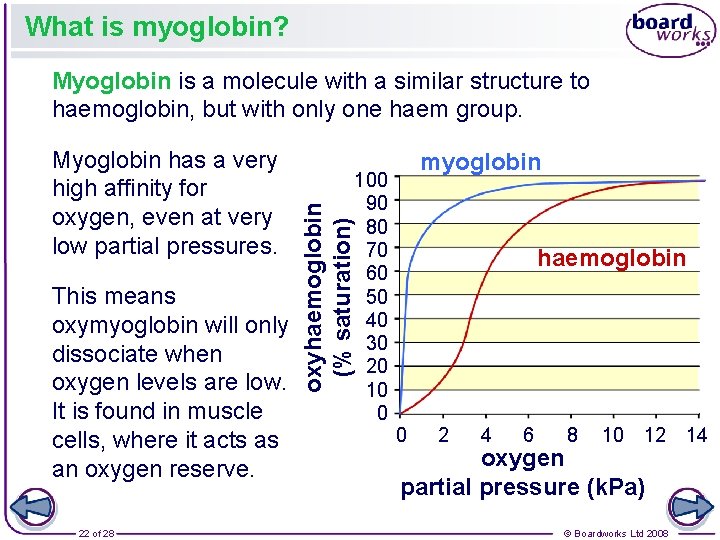
What is myoglobin? Myoglobin is a molecule with a similar structure to haemoglobin, but with only one haem group. This means oxymyoglobin will only dissociate when oxygen levels are low. It is found in muscle cells, where it acts as an oxygen reserve. 22 of 28 100 90 80 70 60 50 40 30 20 10 0 myoglobin oxyhaemoglobin (% saturation) Myoglobin has a very high affinity for oxygen, even at very low partial pressures. haemoglobin 0 2 4 6 8 10 12 14 oxygen partial pressure (k. Pa) © Boardworks Ltd 2008
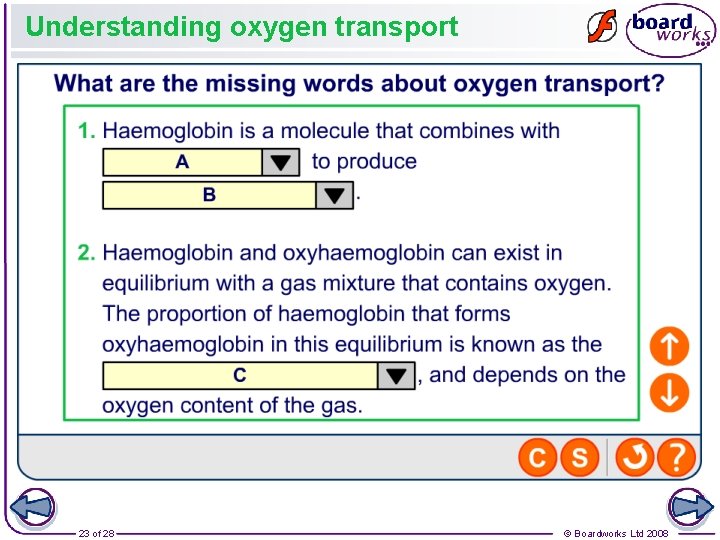
Understanding oxygen transport 23 of 28 © Boardworks Ltd 2008
24 of 28 © Boardworks Ltd 2008
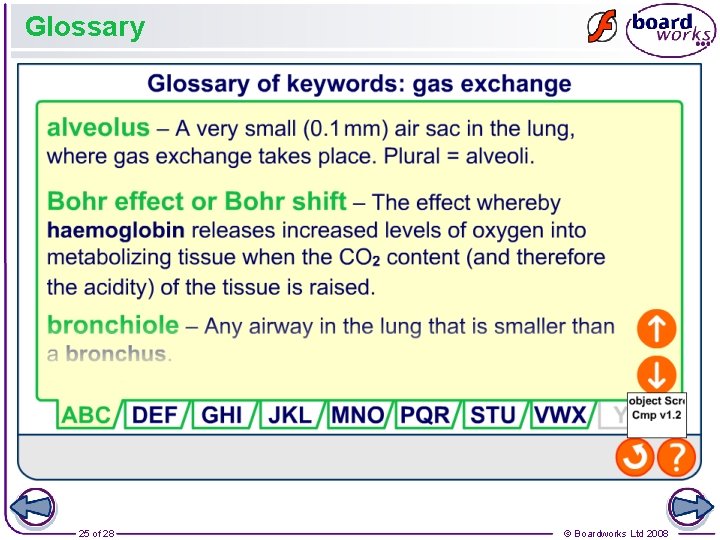
Glossary 25 of 28 © Boardworks Ltd 2008

What’s the keyword? 26 of 28 © Boardworks Ltd 2008
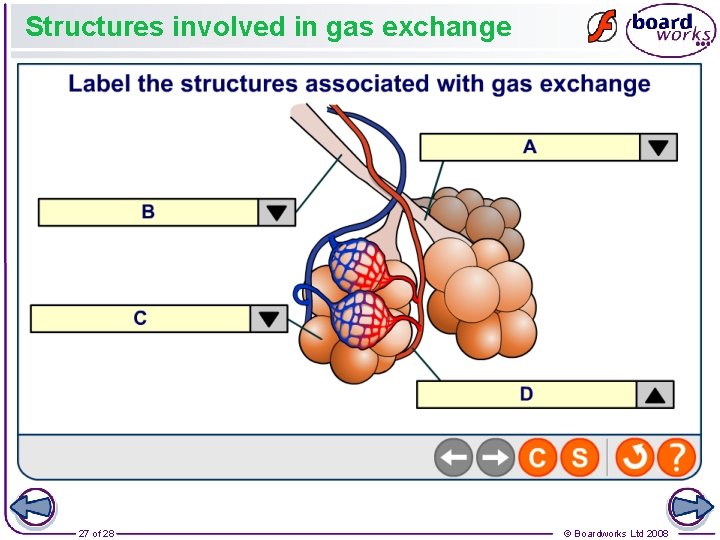
Structures involved in gas exchange 27 of 28 © Boardworks Ltd 2008
Multiple-choice quiz 28 of 28 © Boardworks Ltd 2008
- Slides: 28