
1 of 12 Boardworks Ltd 2009 How do
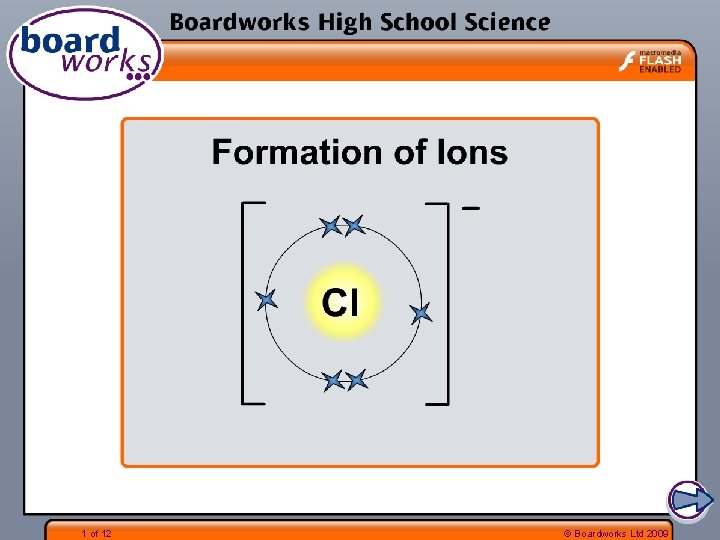
1 of 12 © Boardworks Ltd 2009
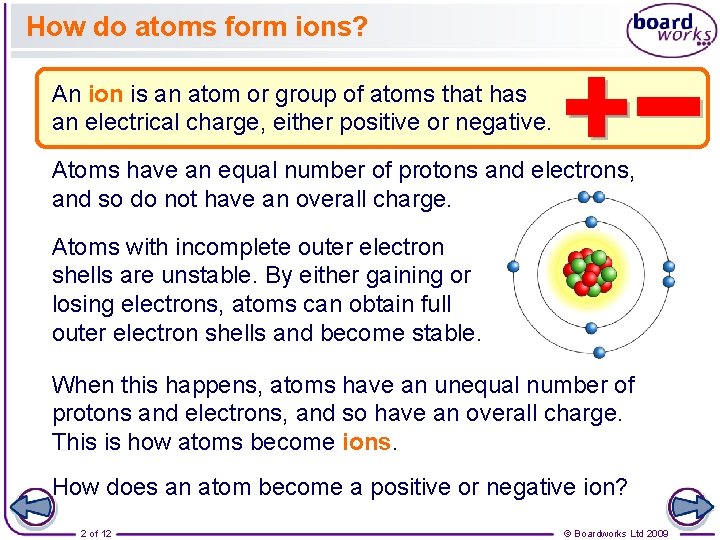
How do atoms form ions? An ion is an atom or group of atoms that has an electrical charge, either positive or negative. Atoms have an equal number of protons and electrons, and so do not have an overall charge. Atoms with incomplete outer electron shells are unstable. By either gaining or losing electrons, atoms can obtain full outer electron shells and become stable. When this happens, atoms have an unequal number of protons and electrons, and so have an overall charge. This is how atoms become ions. How does an atom become a positive or negative ion? 2 of 12 © Boardworks Ltd 2009
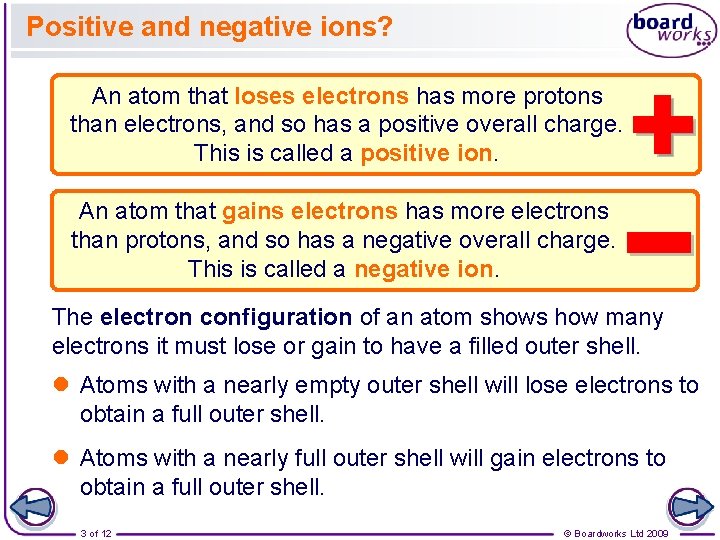
Positive and negative ions? An atom that loses electrons has more protons than electrons, and so has a positive overall charge. This is called a positive ion. An atom that gains electrons has more electrons than protons, and so has a negative overall charge. This is called a negative ion. The electron configuration of an atom shows how many electrons it must lose or gain to have a filled outer shell. l Atoms with a nearly empty outer shell will lose electrons to obtain a full outer shell. l Atoms with a nearly full outer shell will gain electrons to obtain a full outer shell. 3 of 12 © Boardworks Ltd 2009
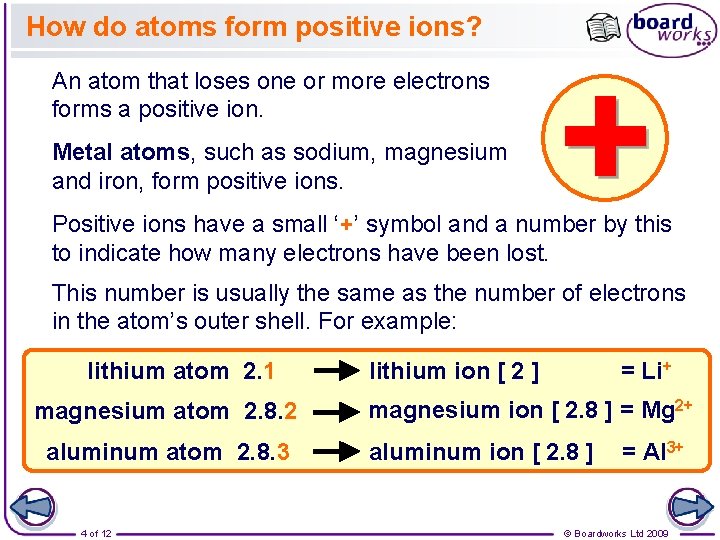
How do atoms form positive ions? An atom that loses one or more electrons forms a positive ion. Metal atoms, such as sodium, magnesium and iron, form positive ions. Positive ions have a small ‘+’ symbol and a number by this to indicate how many electrons have been lost. This number is usually the same as the number of electrons in the atom’s outer shell. For example: lithium atom 2. 1 magnesium atom 2. 8. 2 aluminum atom 2. 8. 3 4 of 12 lithium ion [ 2 ] = Li+ magnesium ion [ 2. 8 ] = Mg 2+ aluminum ion [ 2. 8 ] = Al 3+ © Boardworks Ltd 2009

How is a sodium ion formed? Sodium atom: 11 protons = +11 11 electrons = -11 Sodium ion: 11 protons = +11 10 electrons = -10 Total charge = 0 +1 + Na loses 1 electron 2. 8. 1 (partially full outer shell) 5 of 12 Na [2. 8] (full outer shell) © Boardworks Ltd 2009
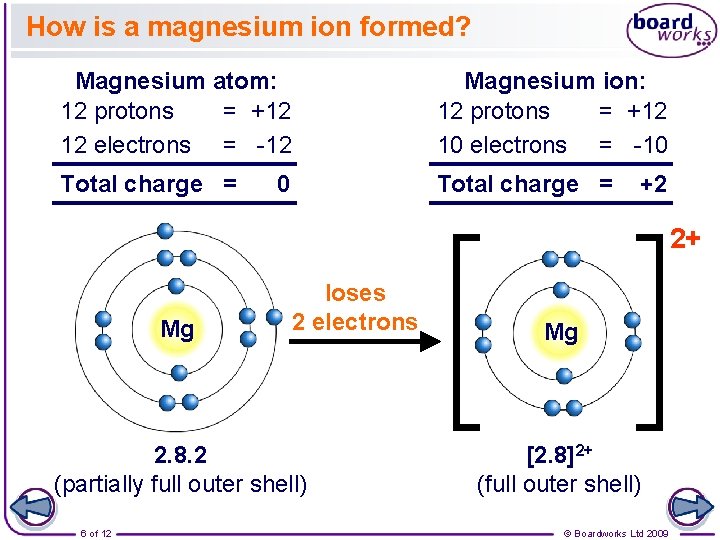
How is a magnesium ion formed? Magnesium atom: 12 protons = +12 12 electrons = -12 Magnesium ion: 12 protons = +12 10 electrons = -10 Total charge = 0 +2 2+ Mg loses 2 electrons 2. 8. 2 (partially full outer shell) 6 of 12 Mg [2. 8]2+ (full outer shell) © Boardworks Ltd 2009
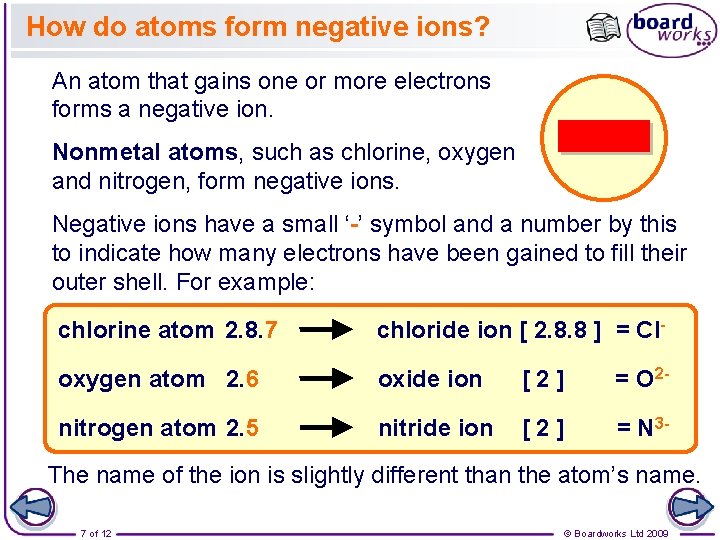
How do atoms form negative ions? An atom that gains one or more electrons forms a negative ion. Nonmetal atoms, such as chlorine, oxygen and nitrogen, form negative ions. Negative ions have a small ‘-’ symbol and a number by this to indicate how many electrons have been gained to fill their outer shell. For example: chlorine atom 2. 8. 7 chloride ion [ 2. 8. 8 ] = Cl- oxygen atom 2. 6 oxide ion [2] = O 2 - nitrogen atom 2. 5 nitride ion [2] = N 3 - The name of the ion is slightly different than the atom’s name. 7 of 12 © Boardworks Ltd 2009
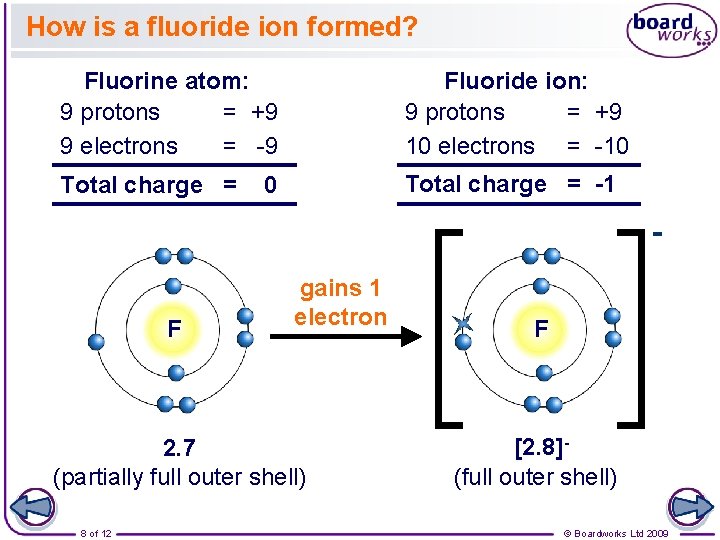
How is a fluoride ion formed? Fluorine atom: 9 protons = +9 9 electrons = -9 Fluoride ion: 9 protons = +9 10 electrons = -10 Total charge = -1 0 F gains 1 electron 2. 7 (partially full outer shell) 8 of 12 F [2. 8](full outer shell) © Boardworks Ltd 2009
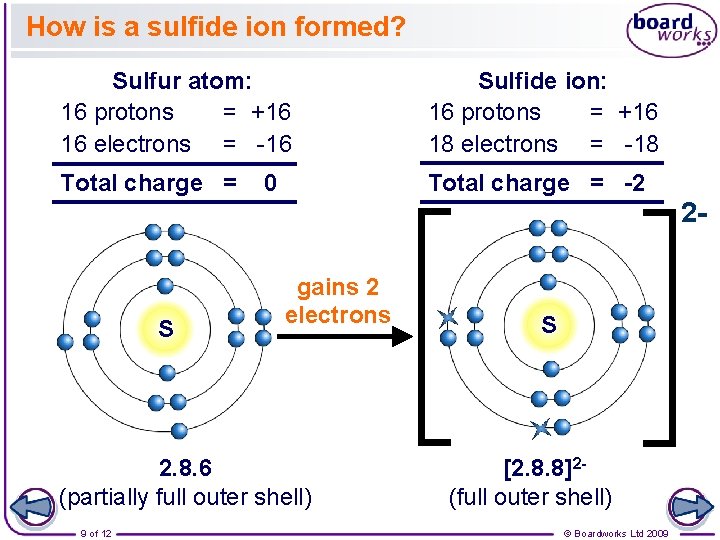
How is a sulfide ion formed? Sulfur atom: 16 protons = +16 16 electrons = -16 Sulfide ion: 16 protons = +16 18 electrons = -18 Total charge = -2 0 2 - S gains 2 electrons 2. 8. 6 (partially full outer shell) 9 of 12 S [2. 8. 8]2(full outer shell) © Boardworks Ltd 2009
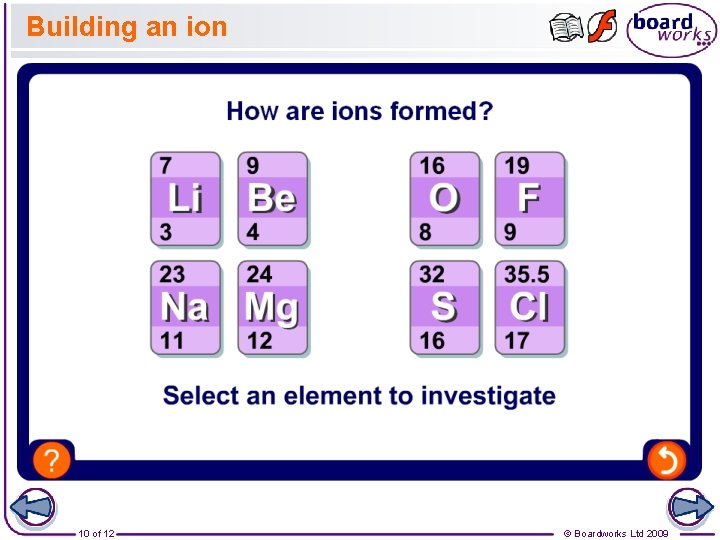
Building an ion 10 of 12 © Boardworks Ltd 2009
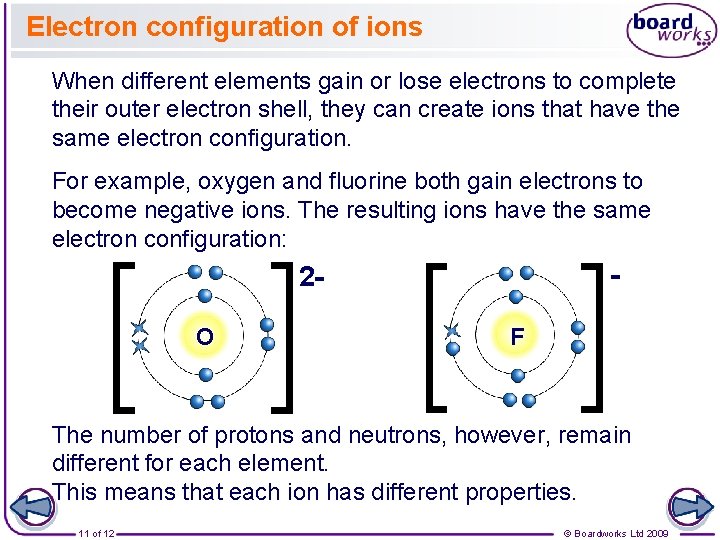
Electron configuration of ions When different elements gain or lose electrons to complete their outer electron shell, they can create ions that have the same electron configuration. For example, oxygen and fluorine both gain electrons to become negative ions. The resulting ions have the same electron configuration: - 2 O F The number of protons and neutrons, however, remain different for each element. This means that each ion has different properties. 11 of 12 © Boardworks Ltd 2009
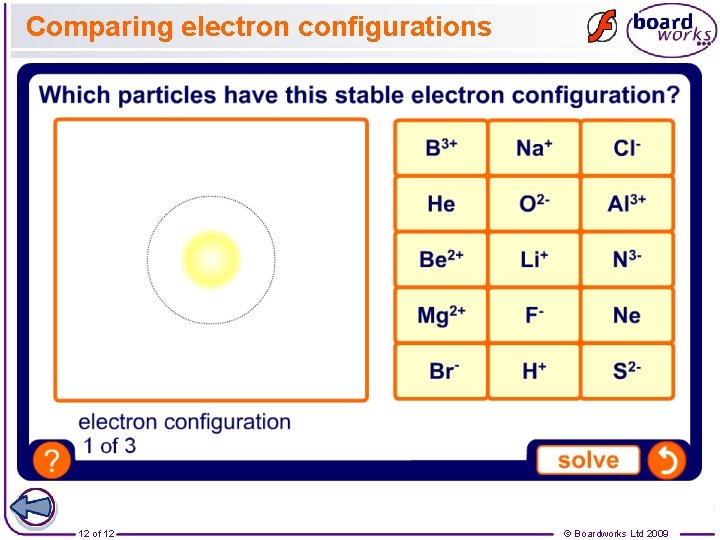
Comparing electron configurations 12 of 12 © Boardworks Ltd 2009
- Slides: 12