
1 Objectives To understand a suspects Miranda rights

1
Objectives • To understand a suspects Miranda rights. • To identify procedures for searching and transporting suspects. • To differentiate between custodial and non -custodial interview and interrogation. • To understand interview and interrogation techniques. 2
Main Menu • Custody • Transporting • Interview & Interrogation – Interview & Interrogation Tactics Video Segment – Interrogation Demonstration Video Segment 3

4
Custody • Is the state of being detained or held under guard – typically by the police • May include: – being formally arrested with restraints • for example, handcuffs – being secured in the cage of a patrol car – being confronted by officers with firearms – being kept in a police station and not being allowed to depart 5
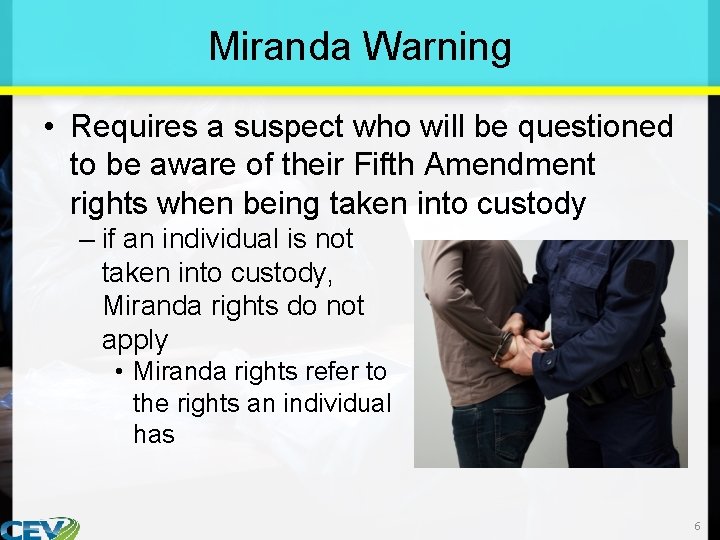
Miranda Warning • Requires a suspect who will be questioned to be aware of their Fifth Amendment rights when being taken into custody – if an individual is not taken into custody, Miranda rights do not apply • Miranda rights refer to the rights an individual has 6
The Fifth Amendment • Guarantees the right to a grand jury, forbids “double jeopardy” and protects against self-incrimination • Allows suspects to refuse to answer questions or to communicate information Double jeopardy: being prosecuted twice for the same offense Self-incrimination: proving oneself was involved in a crime or exposing oneself to a criminal prosecution 7
Miranda Warning • Consists of four statements which must be communicated to anyone being taken into police custody – You have the right to remain silent – Anything you say can and will be used against you in a court of law – You have the right to an attorney – If you cannot afford an attorney, one will be appointed for you The wording of the Miranda warning may vary from the statements above as long as they fully convey the message. 8
Miranda Warning • Is a result of the 1966 Supreme Court case Miranda v. Arizona – the U. S. Supreme Court declared all individuals under police custody must be advised of their constitutional rights in order to ensure they understand their Fifth Amendment rights 9

Miranda Warning • Must be spoken in a language clearly understandable by the suspect – many law enforcement agencies have a policy of asking suspects if they understand the rights just read to them and recording the suspect’s answer 10
Miranda Warning • Is equally applicable to juveniles • Allows juveniles to remain silent if their parent or guardian is not present while being taken into custody – law enforcement officers are required to state Miranda rights to a juvenile in a language the juvenile understands – a juvenile’s parents or guardian must also be advised of the juvenile’s rights immediately 11
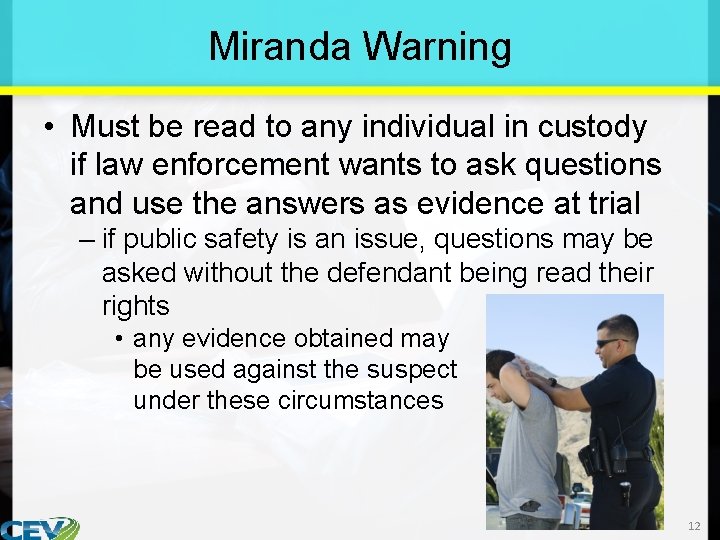
Miranda Warning • Must be read to any individual in custody if law enforcement wants to ask questions and use the answers as evidence at trial – if public safety is an issue, questions may be asked without the defendant being read their rights • any evidence obtained may be used against the suspect under these circumstances 12
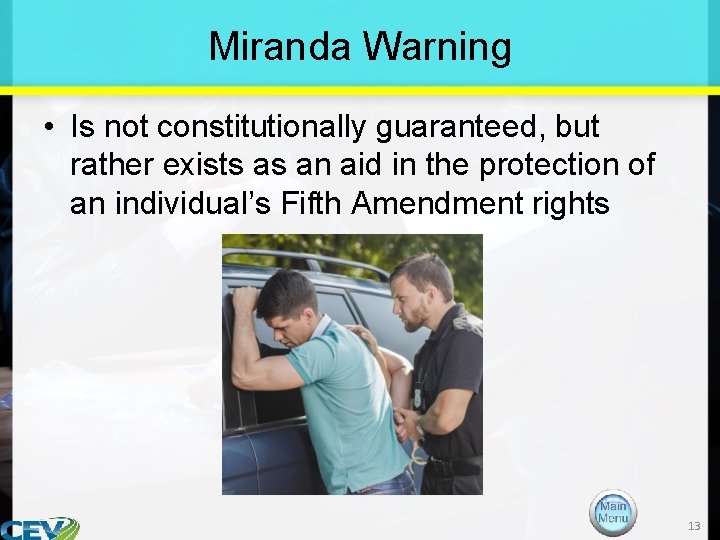
Miranda Warning • Is not constitutionally guaranteed, but rather exists as an aid in the protection of an individual’s Fifth Amendment rights 13

14
Prisoner Transporting • Is the movement of a prisoner to the appropriate facility by the arresting officer • May include the need for two officers – when possible, two officers will transport a prisoner who is incapacitated from intoxication or injury to prevent falls or additional injury – two officers are required to transport a prisoner on a stretcher • the second officer will ride in the rear to monitor the prisoner and to provide medical aid if necessary 15
Prisoner Transporting • Must follow the proper safety protocols • Involves the use of a Digital Video Recorder (DVR) – the camera will be turned to face the rear seat to record the prisoner’s actions for the entire transport • the transporting officer should be able to visually observe the prisoner at all times 16
Transport Guidelines • Include: – a maximum of two prisoners may be transported in a patrol car – juveniles can only be transported in patrol cars – no adult may be transported with a juvenile except a parent or other adult arrested in connection with the same offense – female prisoners may be transported with male prisoners only when they are arrested during the same incident 17
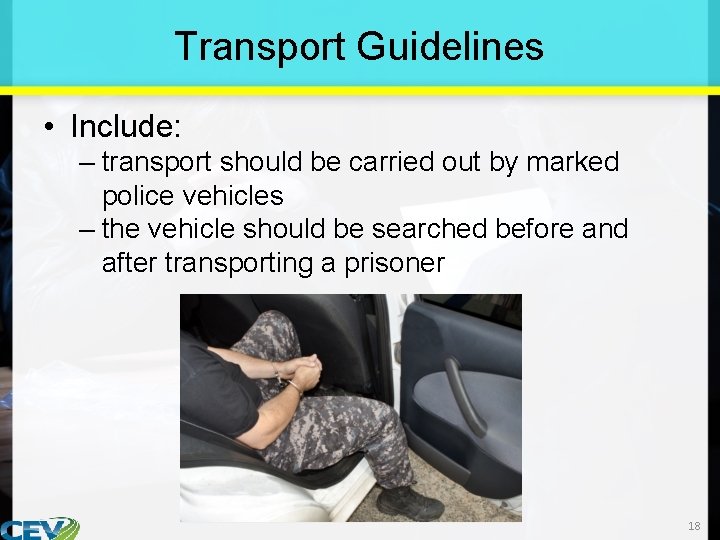
Transport Guidelines • Include: – transport should be carried out by marked police vehicles – the vehicle should be searched before and after transporting a prisoner 18
Transport Guidelines • Include: – the prisoner shall not communicate with anyone during the transport, other than the transporting officer – an officer of the same sex should be used if transport is lengthy – prisoners requiring wheelchairs, crutches or prosthetic appliances should be given special considerations when being transported 19
Prisoner Transporting • Should begin with a thorough search of the individual being transported – before the search begins, officers should ask the suspects if they have any concealed weapons – the search should be carried out by an officer of the same sex of the suspect, if possible – care should be taken to protect the dignity and self-respect of the individual being searched Any items seized during a search should be preserved as evidence. 20
Prisoner Search • Includes the following types: – general • reveal the contents of an suspect’s outer garments, general clothes or hand luggage without touching the individual or the luggage – clothing • remove the suspect’s hat, shoes, socks, bags or excess clothing and search each item • empty the suspect’s pockets • check seams, sleeves and inner lining of suspect’s clothing • remove inner soles of suspect’s shoes • turn the suspect’s socks inside out 21
Prisoner Search • Includes the following types: – personal • inspect the suspect’s hair, mouth and ears • search the seams on the collar of the suspect’s clothing • apply light pressure and pat over the suspect’s torso • sweep the fingers around the suspect’s waistline and underneath the suspect’s belt • ensure the suspect’s pockets are patted thoroughly • ensure the suspect’s pant cuffs are unrolled and patted 22
Prisoner Search • Includes the following types: – strip • if a strip search is required, the search must be conducted in a private area of the detention center or medical facility • the search must be conducted by a staff member of the same sex as the suspect • the suspect must be allowed to remain partially clothed at all times • the search must be carried out as quickly as possible 23
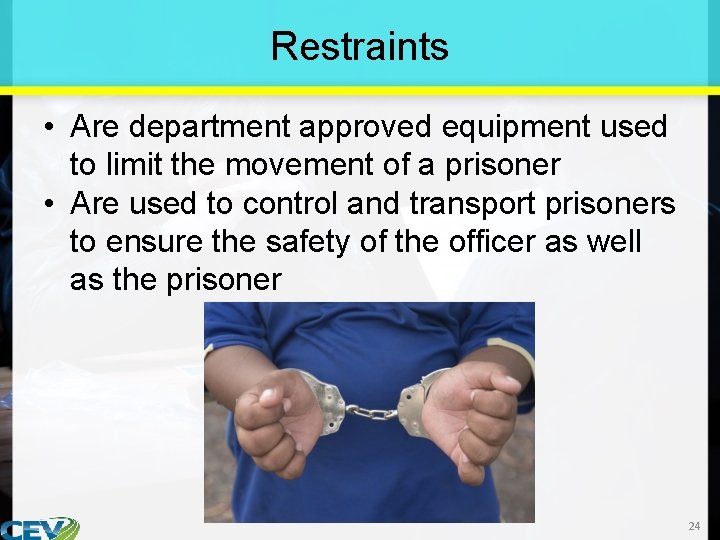
Restraints • Are department approved equipment used to limit the movement of a prisoner • Are used to control and transport prisoners to ensure the safety of the officer as well as the prisoner 24
Restraints • Are typically in the form of handcuffs – officers typically handcuff all prisoners with both hands behind their back and palms facing outward – officers may handcuff prisoners with their hands in front or utilize other appropriate restraining devices if the prisoner: • is pregnant • is handicapped • has injuries which could be aggravated by standard handcuffing procedures 25
Additional Restraints • May be used to secure prisoners who violently resists arrest, are a security hazard or who exhibits mental disorders which pose a threat to themselves, the officer or the public • Which may be used include: – cuffs with waist chains – leg restraints – leg straps – flex-cuffs – leg braces 26
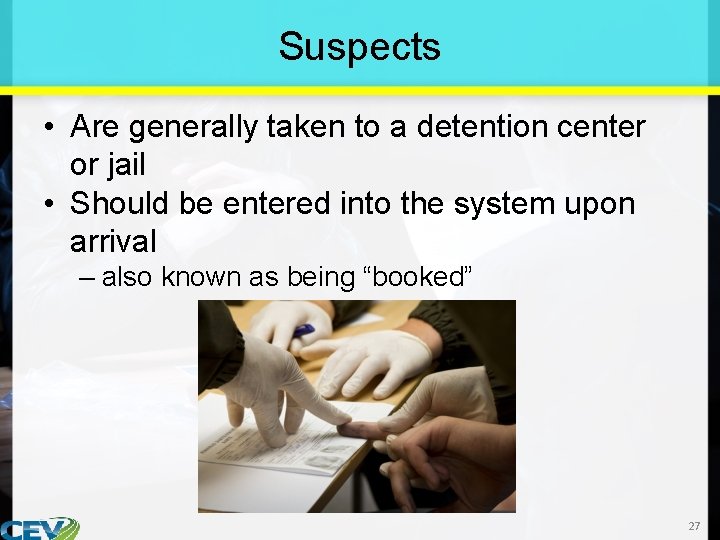
Suspects • Are generally taken to a detention center or jail • Should be entered into the system upon arrival – also known as being “booked” 27
Booking a Suspect • Includes: – recording pertinent information • an official records the suspect’s name, contact information, the details of the alleged crime and any other important information – confiscating clothing and personal property • the suspect surrenders all personal belongings and is provided a jail uniform – photographing • the suspect stands for a photo known as a “mug shot”, which typically indicates the suspects height 28
Booking a Suspect • Includes: – fingerprinting • an officer takes impressions of the suspect’s fingerprints, usually all 10 fingers – checking for warrants • an officer will conduct a search through the database for any outstanding warrants the suspect may have – incarcerating • the suspect is placed in a holding cell or other secure facility to await trial or the posting of bail 29

30
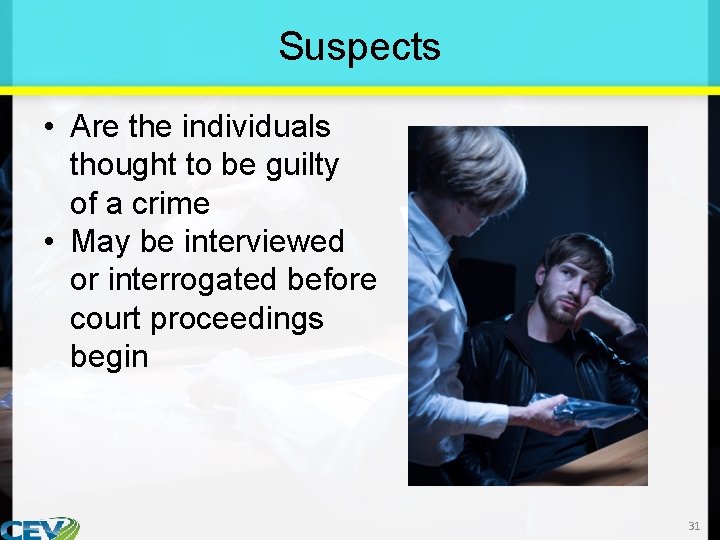
Suspects • Are the individuals thought to be guilty of a crime • May be interviewed or interrogated before court proceedings begin 31
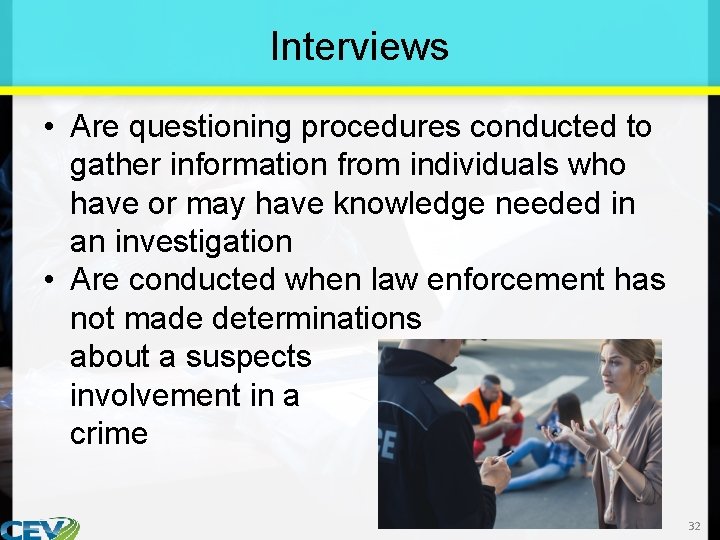
Interviews • Are questioning procedures conducted to gather information from individuals who have or may have knowledge needed in an investigation • Are conducted when law enforcement has not made determinations about a suspects involvement in a crime 32
Interviews • May be custodial or non-custodial – custodial interviews are obtained when an individual is in custody • Miranda rights must be read – non-custodial interviews are obtained when an individual is not in custody • Miranda rights do not have to be read • May lead to an interrogation 33
Interrogations • Are conducted by law enforcement officials in order to elicit an incriminating response – including a confession • Typically involve persuasion or pressure – for example, by attempting to convince an individual it would be in their best interest to confess to a crime or provide certain details 34
Interrogations • May be custodial or non-custodial – custodial interrogations are completed when a suspect connected to a crime is in custody • Miranda rights must be read – non-custodial interrogations are completed when a suspect is not in police custody • Miranda rights do not have to be read 35
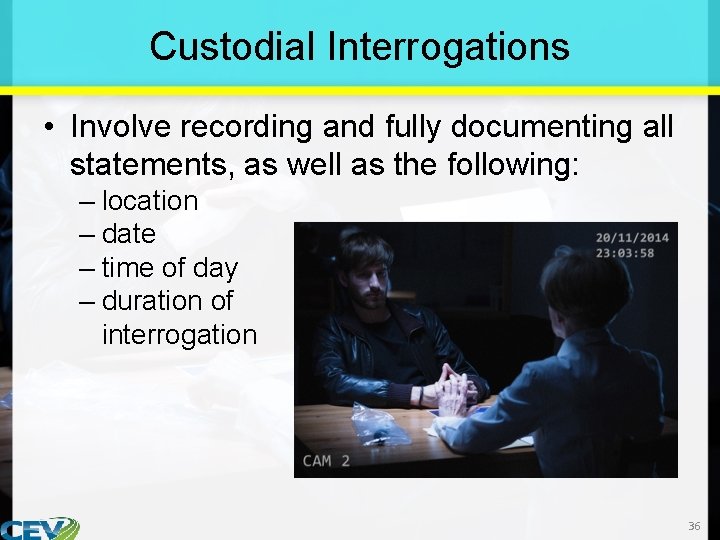
Custodial Interrogations • Involve recording and fully documenting all statements, as well as the following: – location – date – time of day – duration of interrogation 36
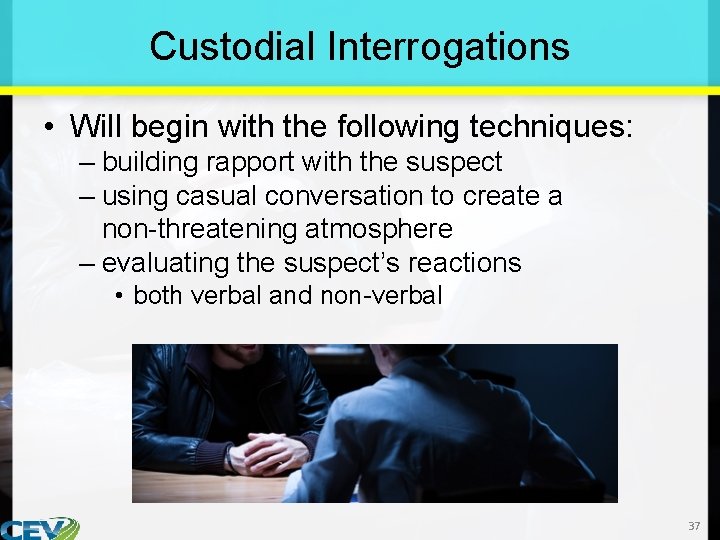
Custodial Interrogations • Will begin with the following techniques: – building rapport with the suspect – using casual conversation to create a non-threatening atmosphere – evaluating the suspect’s reactions • both verbal and non-verbal 37
Custodial Interrogations • Should include basic questions about the crime which require memory as well as questions which require thinking – in order to observe the suspect’s demeanor The physical layout of an interrogation room is designed to maximize a suspect’s discomfort and sense of powerlessness which intensifies the suspects “get me out of here” sensation throughout the interrogation. 38

Suspects • Are guaranteed the right to counsel – the right to talk to a lawyer before deciding whether to talk to police – the right to consult with a lawyer before being interrogated if the suspect decides to talk to the police – the right to answer police only through an attorney Suspects are guaranteed the right to counsel according to the Sixth Amendment. 39
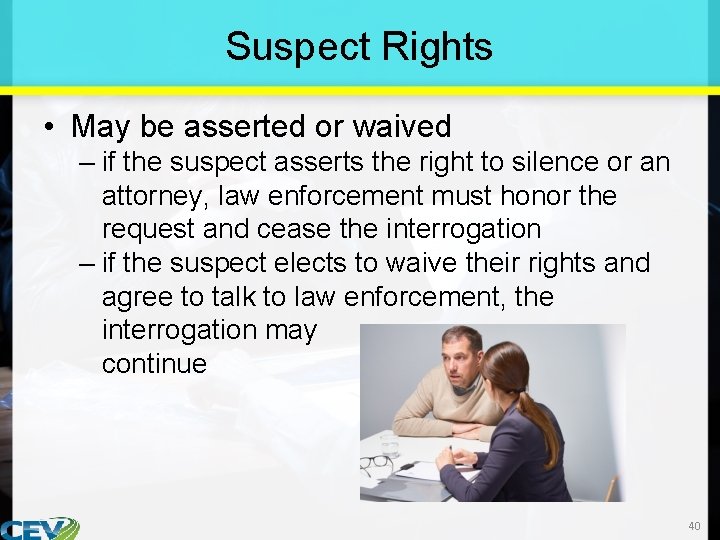
Suspect Rights • May be asserted or waived – if the suspect asserts the right to silence or an attorney, law enforcement must honor the request and cease the interrogation – if the suspect elects to waive their rights and agree to talk to law enforcement, the interrogation may continue 40

Suspect Statements • Which are made in response to interrogation in police custody will be admissible at trial – only if the prosecution can show the suspect was informed of the right to consult with an attorney and of the right against self-incrimination before and during interrogation 41
Failure to Provide Miranda Warning • Results in the suspects statement being inadmissible in court – what the individual in custody says cannot be used for evidence at trial • although confessions given before a suspect has been read their Miranda rights may find their confession entered as evidence in court Law enforcements attention to the rule of reading an individual their Miranda rights means less chance of a case being overturned in court due to poor procedure on their part. 42
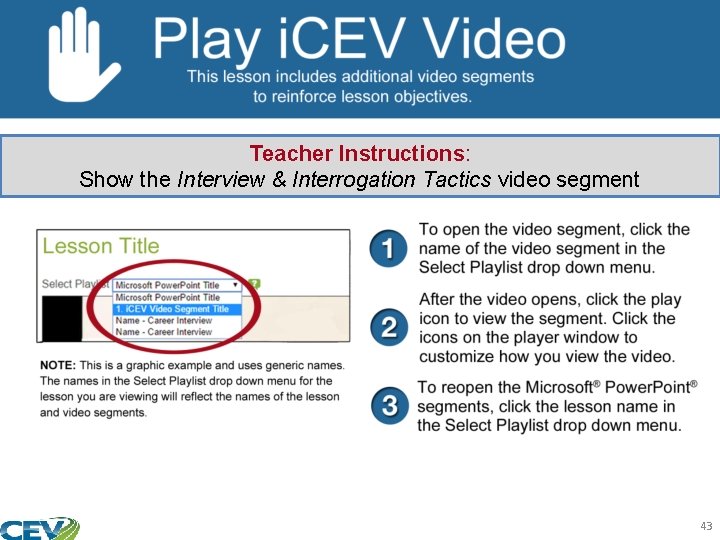
Teacher Instructions: Show the Interview & Interrogation Tactics video segment 43
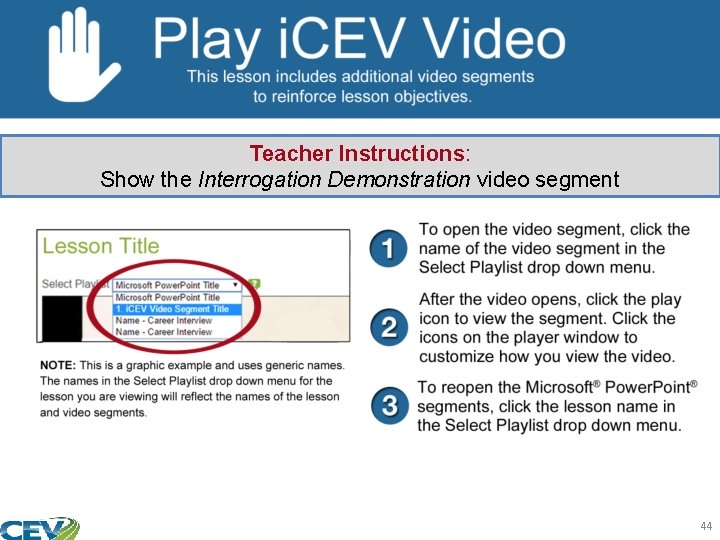
Teacher Instructions: Show the Interrogation Demonstration video segment 44
Resources • http: //www. mirandarights. org/ • http: //criminal. findlaw. com/criminal-rights/miranda-rights-and-the-fifth -amendment. html • http: //www. mirandawarning. org/whatareyourmirandarights. html • https: //www. correctionsone. com/products/vehicleequipment/prisoner-transport/articles/1843670 -Prisoner-transportsofficer-safety-liability-issues/ • http: //dag. un. org/bitstream/handle/11176/387389/Approaching%20 %26%20 Searching%20 Suspects. pdf? sequence=3&is. Allowed=y • http: //repository. law. umich. edu/cgi/viewcontent. cgi? article=1028&co ntext=book_chapters 45

Acknowledgements Brand Managers Stevi Huffaker Amy Hogan Graphics Editor Melody Rowell Video Post Production Mike Barley V. P. of Brand Management Clayton Franklin Quality Control Director Angela Dehls © MMXVII CEV Multimedia, Ltd. Executive Producer Gordon W. Davis, Ph. D. 46
- Slides: 46