
1 Objectives To recognize and classify various types
1
Objectives • To recognize and classify various types of evidence and how it is collected. • To define chain of custody and explain special circumstances when evidence is released, destroyed or deemed inadmissible in court. 2
Main Menu • Evidence Collection • Search & Seizure 3
4
Evidence • Is an object, substance or other type of proof used to indicate alleged facts of a case – often presented in a court of law • Is obtained by finding, collecting and preserving any matter which may help with the case • Is collected by the Crime Scene Investigation unit 5
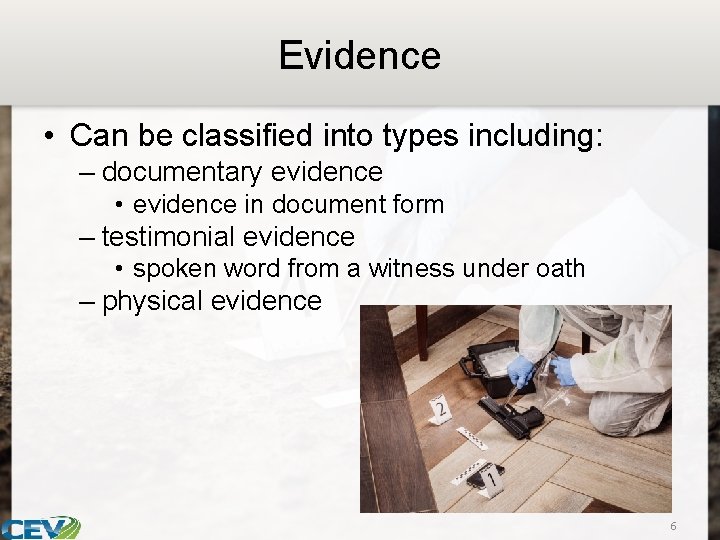
Evidence • Can be classified into types including: – documentary evidence • evidence in document form – testimonial evidence • spoken word from a witness under oath – physical evidence 6

Evidence Collection • Begins after law enforcement arrives at the crime scene • Is performed in the following manner: – secure the crime scene – initial walk-through • generate initial theories • look for potential evidence – document the scene by taking photos and drawing sketches – collect evidence by tagging, logging and packaging it 7

Common Evidence • Collected at a crime scene includes: – trace evidence – bodily fluids – hair – fibers – fingerprints – ballistic evidence – documents – impression evidence 8
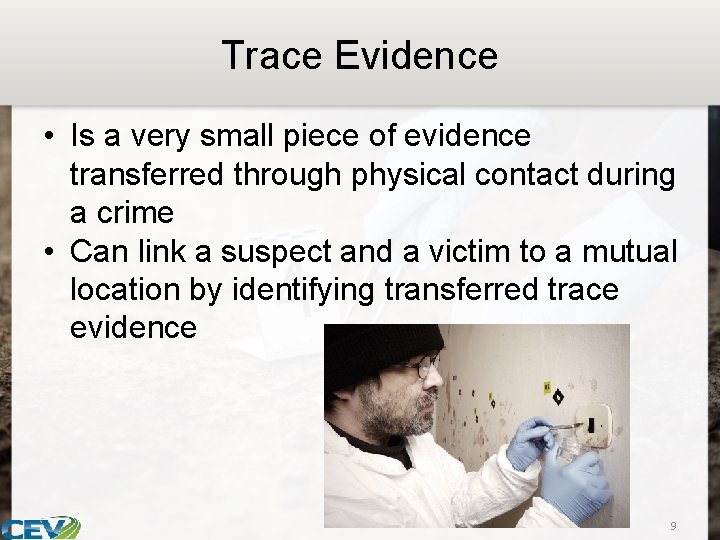
Trace Evidence • Is a very small piece of evidence transferred through physical contact during a crime • Can link a suspect and a victim to a mutual location by identifying transferred trace evidence 9
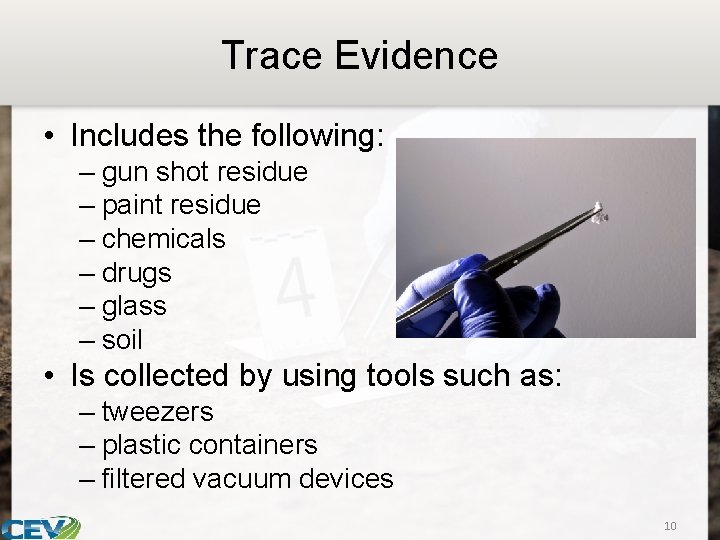
Trace Evidence • Includes the following: – gun shot residue – paint residue – chemicals – drugs – glass – soil • Is collected by using tools such as: – tweezers – plastic containers – filtered vacuum devices 10
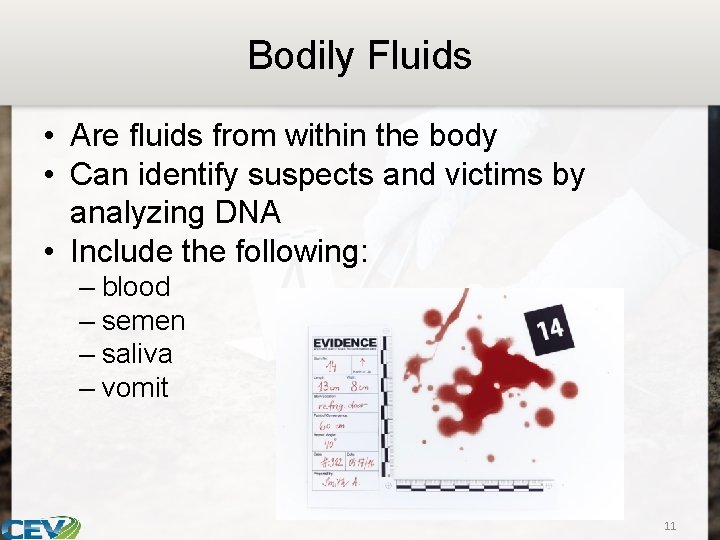
Bodily Fluids • Are fluids from within the body • Can identify suspects and victims by analyzing DNA • Include the following: – blood – semen – saliva – vomit 11
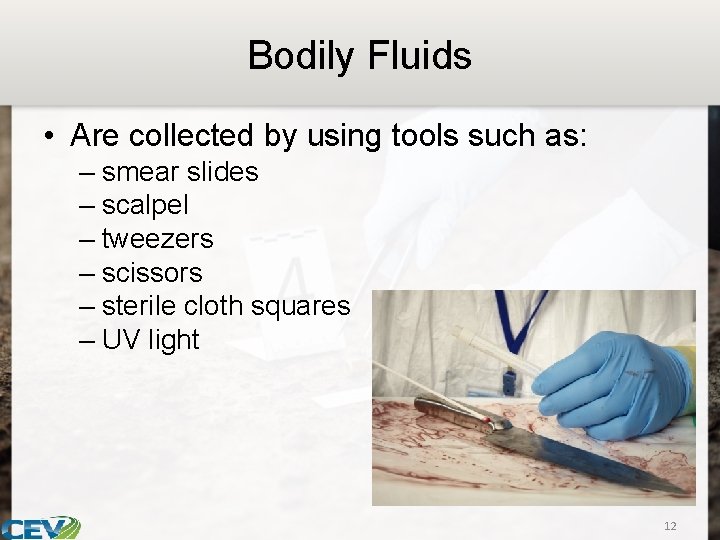
Bodily Fluids • Are collected by using tools such as: – smear slides – scalpel – tweezers – scissors – sterile cloth squares – UV light 12
Hair • Is analyzed by using a microscope • Can identify suspects by comparing hair found at the crime scene to a sample of the suspect’s hair • May come from: – humans • criminals • victims – animals 13
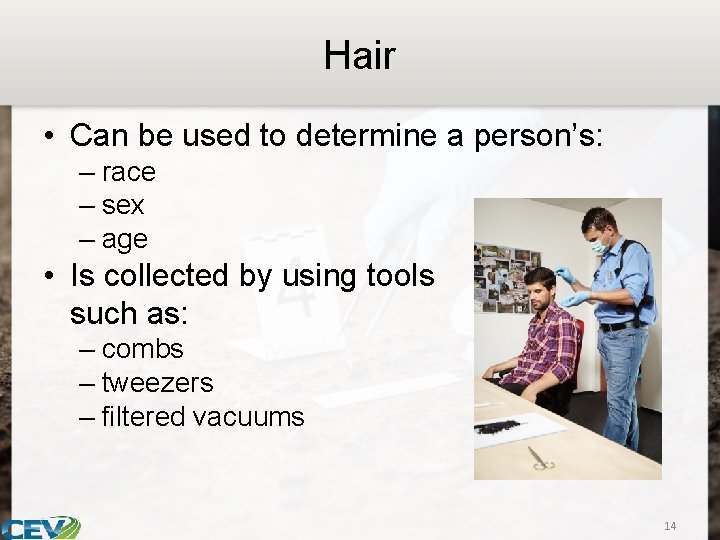
Hair • Can be used to determine a person’s: – race – sex – age • Is collected by using tools such as: – combs – tweezers – filtered vacuums 14
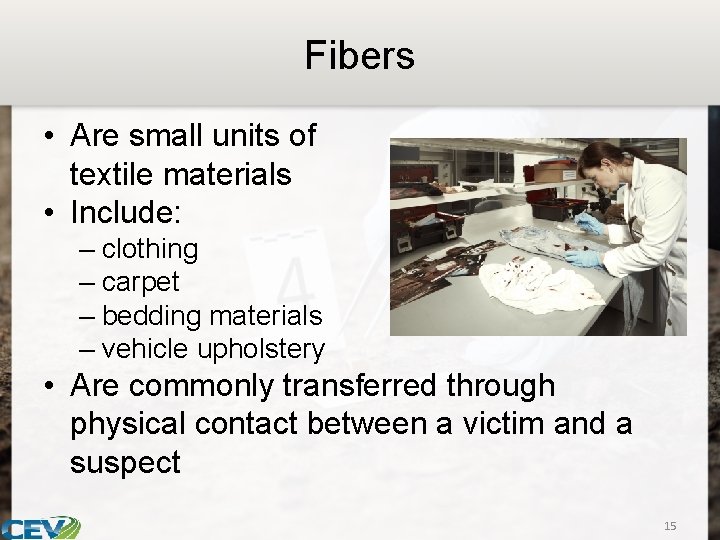
Fibers • Are small units of textile materials • Include: – clothing – carpet – bedding materials – vehicle upholstery • Are commonly transferred through physical contact between a victim and a suspect 15
Fibers • Are used by matching fibers found at the crime scene to their specific source, such as a suspect’s personal items • Are collected by using tools such as: – tweezers – knives – clippers – paper bindles – sealed containers • Are commonly overlooked by investigators because they are not easily seen 16
Fingerprints • Are impressions or marks made by a person’s fingertip which are used to identify a person • Are searched for in areas the perpetrator is likely to have touched • Are recovered by collecting objects found in the crime scene and processing them in the lab 17
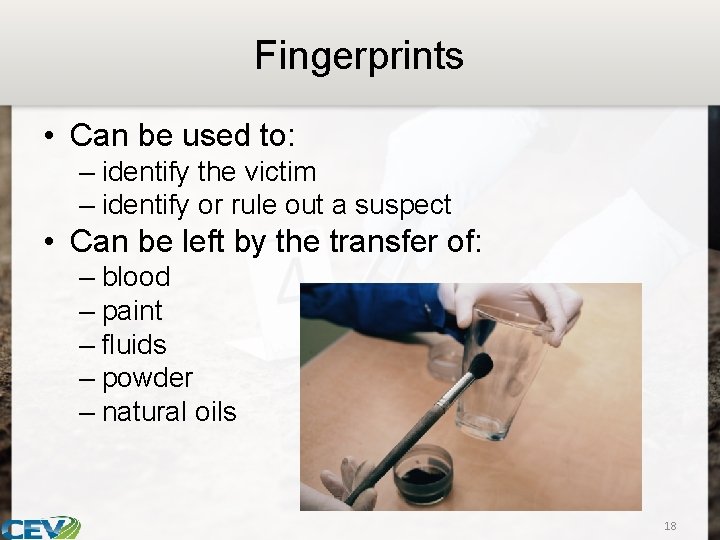
Fingerprints • Can be used to: – identify the victim – identify or rule out a suspect • Can be left by the transfer of: – blood – paint – fluids – powder – natural oils 18
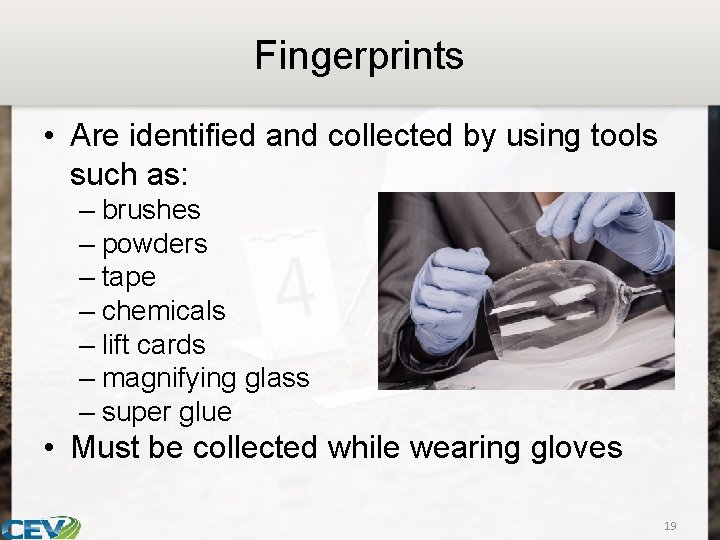
Fingerprints • Are identified and collected by using tools such as: – brushes – powders – tape – chemicals – lift cards – magnifying glass – super glue • Must be collected while wearing gloves 19
Ballistic Evidence • Includes: – guns – bullets – casings • Can be used to: – test firearms to determine bullet patterns – measure distance of gun to entrance wound – identify casing and tool mark impressions – collect gunshot residue – examine clothing with gunshot holes • Must be collected while wearing gloves • Must not be loaded when testing in the lab 20
Documents • Include: – diaries – planners – phone books – suicide notes • Are used to determine: – forgery – handwriting matches – type of machine used to produce the document • Are collected while wearing gloves 21
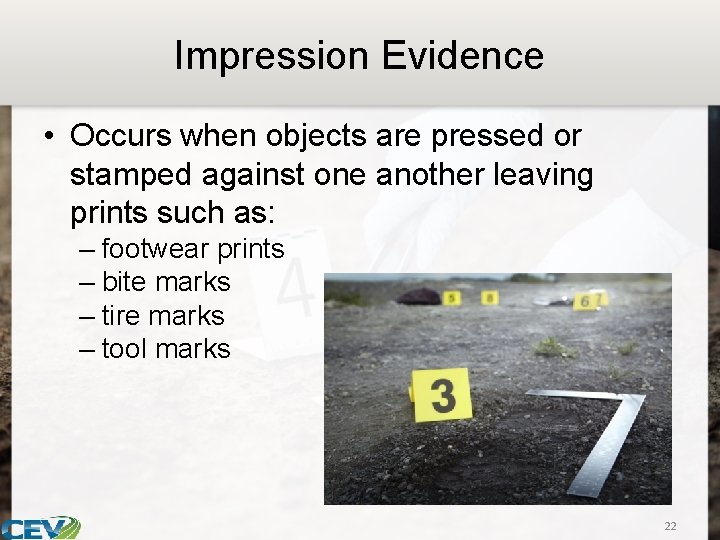
Impression Evidence • Occurs when objects are pressed or stamped against one another leaving prints such as: – footwear prints – bite marks – tire marks – tool marks 22
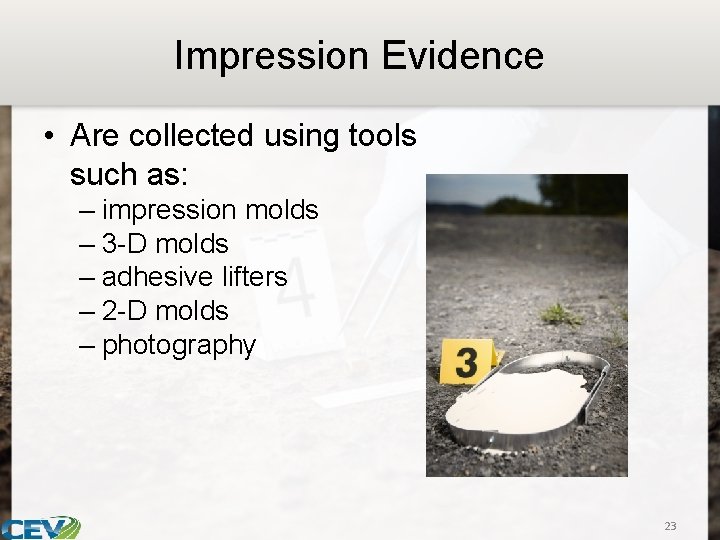
Impression Evidence • Are collected using tools such as: – impression molds – 3 -D molds – adhesive lifters – 2 -D molds – photography 23
Chain of Custody • Is the documentation of movement and location of physical evidence from the time it is obtained until it is presented in court • Includes the documentation of: – condition of the evidence when it is gathered – identification of every person who handles the evidence – duration of time the evidence has been in custody – storage and packaging of evidence – transfer of evidence 24
Chain of Custody • Requires evidence used in court to be free from: – improper storage • evidence should be stored correctly depending on the type of evidence to protect and maintain integrity – material alteration – illegal seizure – substitution • replacing lost or damaged evidence 25
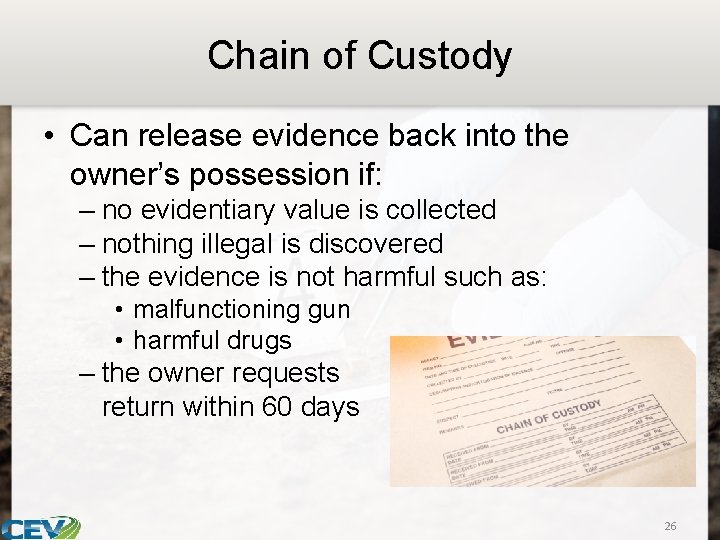
Chain of Custody • Can release evidence back into the owner’s possession if: – no evidentiary value is collected – nothing illegal is discovered – the evidence is not harmful such as: • malfunctioning gun • harmful drugs – the owner requests return within 60 days 26
Chain of Custody • Can result in evidence being declared inadmissible in court if broken – evidence is not properly handled or stored – evidence is not documented correctly – every person who handled the evidence is not documented • it cannot be proven in court the evidence is the same evidence found at the crime scene and not planted or been tampered with 27
28
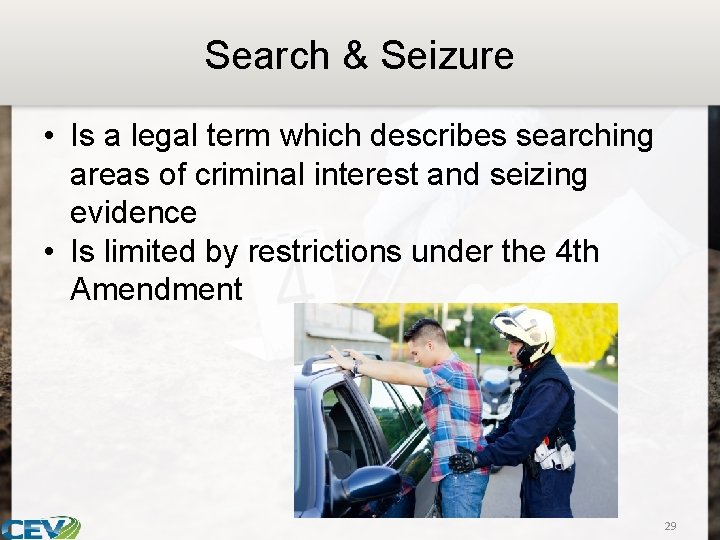
Search & Seizure • Is a legal term which describes searching areas of criminal interest and seizing evidence • Is limited by restrictions under the 4 th Amendment 29
The 4 th Amendment • Is defined as: – “the right of the people to be secure in their persons, houses, papers, and effects, against unreasonable searches and seizures, shall not be violated, and no warrants shall issue, but upon probable cause, supported by oath or affirmation, and particularly describing the place to be searched, and the persons or things to be seized” 30
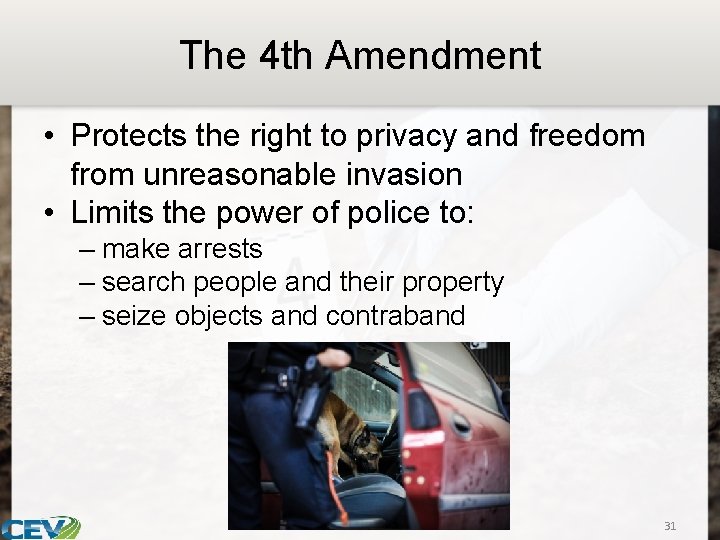
The 4 th Amendment • Protects the right to privacy and freedom from unreasonable invasion • Limits the power of police to: – make arrests – search people and their property – seize objects and contraband 31
Search & Seizure Law • Allows for search and seizure by police if a judge issues a warrant to search property or police have probable cause and evidence to believe a crime is being committed Probable Cause: Is reasonable grounds to believe a crime is being committed or has been committed. 32
Warrant • Is a document issued by a legal or government official authorizing the police to make an arrest, search premises or carry out some other action relating to the administration of justice • Must be supported by probable cause and offered by a sworn police officer • Must describe the person or place to be searched or seized 33
Warrants • Can be obtained by submitting an affidavit to a public officer who is authorized by law to administer oaths and affirmations – describes the place which would be searched, what items will be searched and reason for the search • Should be signed by a judge permitting law enforcement to search the area • Were established in Weeks v. U. S. 34
Weeks v. United States (1914) • Case facts: – Freemont Weeks was suspected of illegal gambling in the state of Missouri – law enforcement unlawfully searched Weeks’ home without a search warrant and seized documents – Weeks was convicted based on the seized evidence • Question: – does the 4 th amendment provide protections to private citizens against illegally obtained evidence being used in court? 35
Weeks v. United States (1914) • Result: – unlawfully seized objects were ruled inadmissible in court • Established limits on federal government’s use of evidence • Resulted in the court reversing Weeks conviction and creating the exclusionary rule 36
The Exclusionary Rule • Prevents the court from using evidence obtained from unreasonable search and seizure which violates the 4 th Amendment • Occurs when the court finds an illegal search occurred – any evidence seized as a result cannot be used as direct evidence against the defendant in a criminal prosecution • Was made applicable to the states in Mapp v. Ohio 37
Mapp v. Ohio (1961) • Case facts: – police received a tip about a person staying at Dollree Mapp’s apartment who was wanted for questioning in a recent bombing case – police forced their way into the home and searched without a warrant – they found pornographic materials violating Ohio law at the time – she was found guilty, but appealed • Question: – is evidence discovered during an illegal search admissible in court? 38
Mapp v. Ohio (1961) • Result: – verdict ruled Mapp’s 4 th Amendment rights were violated and evidence was deemed inadmissible in court • Held evidence could not be admitted in a criminal trial if it was obtained through an illegal search – based on the 4 th Amendment • Discourages police misconduct by preventing the government from using a violation of a suspect’s rights to obtain evidence 39
Good Faith Exception • States if the police conducting the search rely in “good faith” on an ultimately invalid warrant, the evidence collected can be used – allows evidence seized on the basis of a mistakenly issued search warrant admissible in court • Was established in the case of United States v. Leon 40
United States v. Leon (1984) • Case facts: – Alberto Leon was a suspected drug dealer and was under surveillance by police – a judge issued a search warrant for Leon’s home based on surveillance evidence and police recovered large quantities of illegal drugs in the search – Leon was indicted on drug charges, but a judge concluded the evidence presented was insufficient to grant a search warrant and so the evidence obtained under the warrant could not be used at trial 41
United States v. Leon (1984) • Question: – if police believe they are executing a legal search, is evidence obtained admissible in court? • Result: – Leon was convicted of drug trafficking, the U. S. Supreme Court found the evidence seized on the basis of an invalid search warrant was still admissible 42
Inevitable Discovery Exception • Allows illegally found evidence to still be admissible in court if the evidence would have been found eventually using legal means • Was introduced in Nix v. Williams 43
Nix v. Williams (1984) • Case facts: – Williams was suspected in the murder of a young girl whose remains could not be found – before being arrested, Williams’ lawyer asked police he not be questioned in transit, but through casual conversation, Williams revealed where the girl’s body was located, which ended an extensive search – Williams was convicted, but appealed, wanting to suppress evidence provided by statements made in transit 44
Nix v. Williams (1984) • Question: – should evidence be excluded from trial because it was improperly obtained, even if it is likely to be found through legal means eventually? 45
Nix v. Williams (1984) • Result: – the Supreme Court decided the exclusionary rule did not apply to this particular case, because the search would have resulted in the discovery of the evidence even if Williams never offered the statements to the authorities – under the inevitable discovery exception, evidence which would be discovered within a short period of time is permissible regardless of the method in which it was obtained 46
The Automobile Exception • Allows a vehicle to be searched without a warrant when the evidence or contraband may possibly be removed from the scene due to the mobility of a vehicle • Was introduced in Carroll v. United States 47
Carroll v. United States (1925) • Case facts: – Carroll was pulled over and when the officer searched the vehicle (without a warrant), he found alcohol – Carroll was arrested and convicted, but appealed stating he was searched without a warrant 48
Carroll v. United States (1925) • Question: – may an automobile be searched without a warrant? • Result: – the Court affirmed Carroll’s conviction, holding the officer had probable cause to search his vehicle, because automobiles can be hidden or moved out of the jurisdiction before a warrant can be procured • therefore requiring a warrant to search a vehicle may be impracticable 49
Search Warrants • Are required for police officers making arrests if they want to search and seize any possible evidence – police officers arresting a person at home can search the area within immediate reach of the person, however they cannot search the entire home without a search warrant – this was established in Chimel v. California 50
Chimel v. California (1969) • Case facts: – police officers came to Chimel’s home with a warrant for his arrest under suspicion of coin theft – Chimel refused consent for the officers to search his home, but the officers still searched the entire house and seized several items to be admitted as evidence at trial – Chimel was convicted, but appealed based on the warrantless search 51
Chimel v. California (1969) • Question: – is it constitutional for officers to search a home with only an arrest warrant? • Result: – the Supreme Court decided the search of a home is unreasonable under the Fourth Amendment without a warrant to search the entire property, and searches upon arrest should be limited to the area within the immediate control of the suspect 52
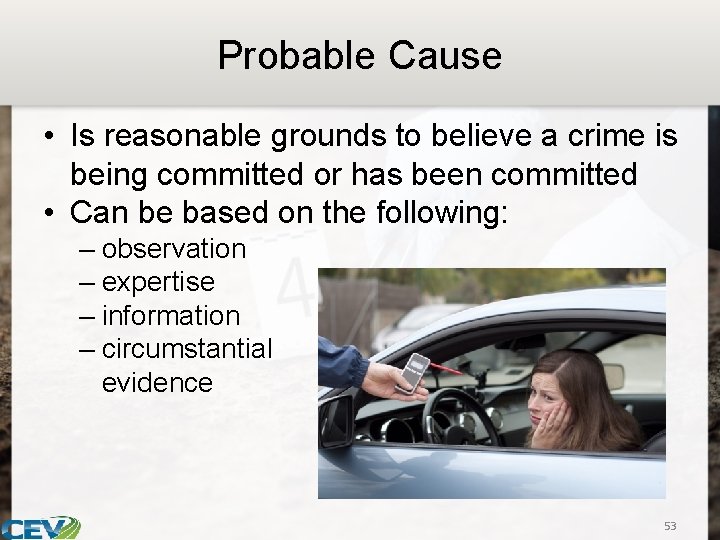
Probable Cause • Is reasonable grounds to believe a crime is being committed or has been committed • Can be based on the following: – observation – expertise – information – circumstantial evidence 53
Observation • Is the act of obtaining information through senses, such as sight, smell or hearing • Can include: – an officer seeing a suspicious person looking into a car window – an officer hearing a gunshot – an officer smelling drugs or alcohol in a person’s vehicle 54
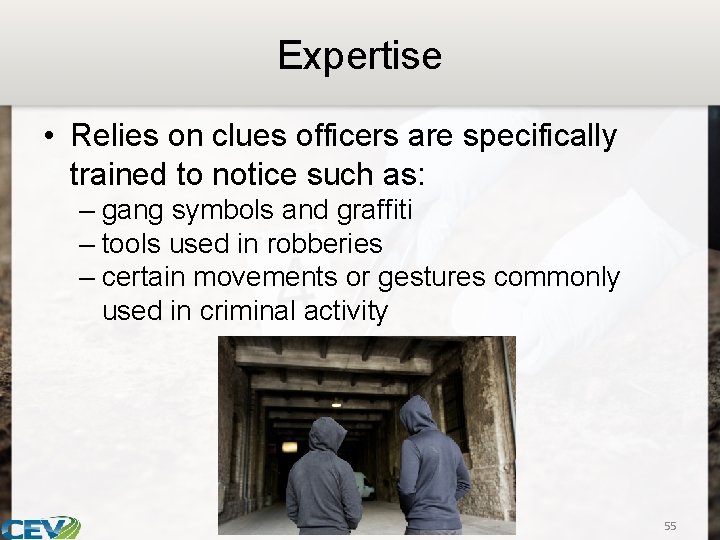
Expertise • Relies on clues officers are specifically trained to notice such as: – gang symbols and graffiti – tools used in robberies – certain movements or gestures commonly used in criminal activity 55
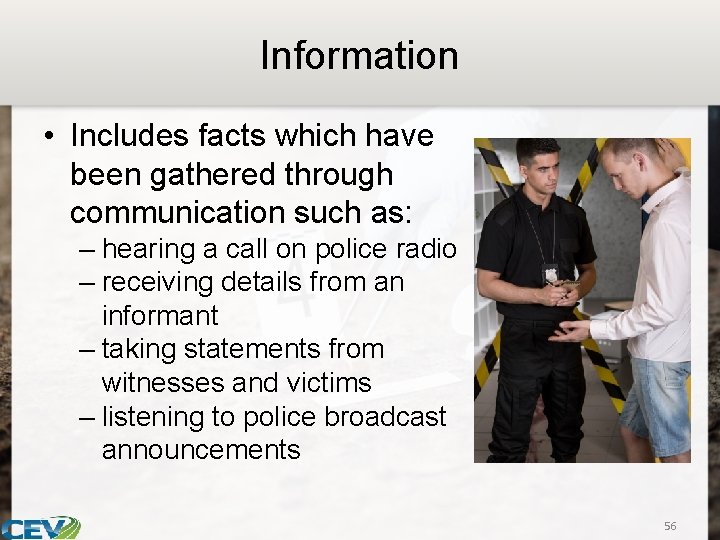
Information • Includes facts which have been gathered through communication such as: – hearing a call on police radio – receiving details from an informant – taking statements from witnesses and victims – listening to police broadcast announcements 56
Circumstantial Evidence • Is indirect information which implies a crime has occurred • Relates to a series of inferences leading to the conclusion of fact – a witness seeing a person shoot another is direct evidence – a witness hearing a gunshot but not actually seeing a person shoot another is circumstantial evidence 57
Probable Cause • Is required to perform a search, seizure or arrest – based on the 4 th Amendment • Was established in the Terry v. Ohio case 58
Terry v. Ohio (1967) • Case facts: – a Cleveland police officer was patrolling when he saw John Terry and Richard Chilton suspiciously observing a store, so he followed and approached them, identifying himself as an officer – the officer patted down Terry, found a pistol and, being unable to remove it, ordered the men into a store where he seized Terry’s revolver – Terry was charged with and convicted of carrying a concealed weapon, but appealed saying the search and seizure were unconstitutional 59
Terry v. Ohio (1967) • Question: – when is it constitutional for police to search a suspect • Result: – verdict ruled an officer may search a suspect to protect his or her own safety while investigating 60
Terry v. Ohio (1967) • Allows police officers to: – legally detain (stop) a person if the officer has a reasonable suspicion the person has committed, is committing or is about to commit a crime – complete a quick surface search of suspects’ outer clothing if they have reasonable suspicion the person stopped is armed • Established the Terry Stop 61
Terry Stop • Is the act in which law enforcement have the right to stop and frisk someone based upon reasonable suspicion • Allows police to detain a person and perform a limited search for weapons, without probable cause – which could potentially be used for criminal activity 62
Resources • https: //www. uwplatt. edu/files/urce/O'Connor. pdf • http: //criminal. findlaw. com/criminal-rights/the-fourth-amendment-and -the-exclusionary-rule. html • http: //law. harvard. edu/publications/evidenceiii/cases/frye. htm#N_1_ • http: //www. pbs. org/wgbh/pages/frontline/shows/case/revolution/data bases. html • http: //www. probablecause. org/whatisprobablecause. html • https: //www. nfstc. org/wp-content/files//Crime-Scene. Investigation. pdf • http: //www. forensictv. net/Downloads/forensic_science/forensic_scie nce_timeline_by_norah_rudin_and_keith_inman. pdf • http: //www. dailynews. com/general-news/20140608/oj-simpson-casetaught-police-what-not-to-do-at-a-crime-scene • https: //www. law. cornell. edu/supct/html/92 -102. ZO. html 63
Acknowledgements Production Coordinator Tylee Williams Sydney Buckley Assistant Brand Manager Whitney Orth Brand Manager Amy Hogan Graphic Designer Melody Rowell Quality Control Director Angela Dehls V. P. of Brand Management Clayton Franklin Executive Producer Gordon W. Davis, Ph. D. 64
- Slides: 64