
1 Objectives To obtain knowledge concerning the various
1
Objectives • To obtain knowledge concerning the various organizational structures associated with business. • To gain an understanding of each type of organizational structure. • To learn the advantages and disadvantages of various organizational structures. 2
Main Menu • Introduction to Organizational Structures • Organizational Details Affecting Structure • Ways to Divide Work • Basic Business Structures 3
Introduction to Organizational Structures 4
What is an Organization? • An organization is a systematic grouping of individuals brought together to accomplish a goal − examples include: • businesses and companies • school and club organizations • nonprofit or religious affiliations 5
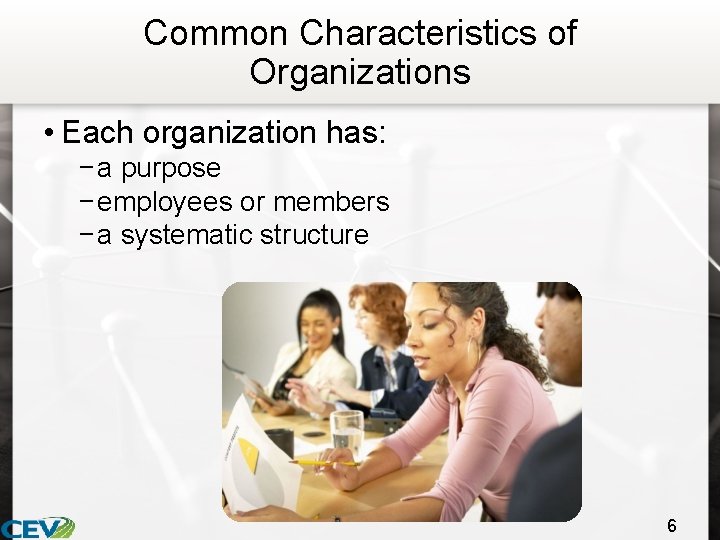
Common Characteristics of Organizations • Each organization has: − a purpose − employees or members − a systematic structure 6
Organization Purpose & Employees • The purpose of an organization is normally expressed in a goal or set of objectives for the organization to accomplish • An organization’s employees or members are the driving force in accomplishing a purpose; therefore good employee management and organizational structure is essential 7
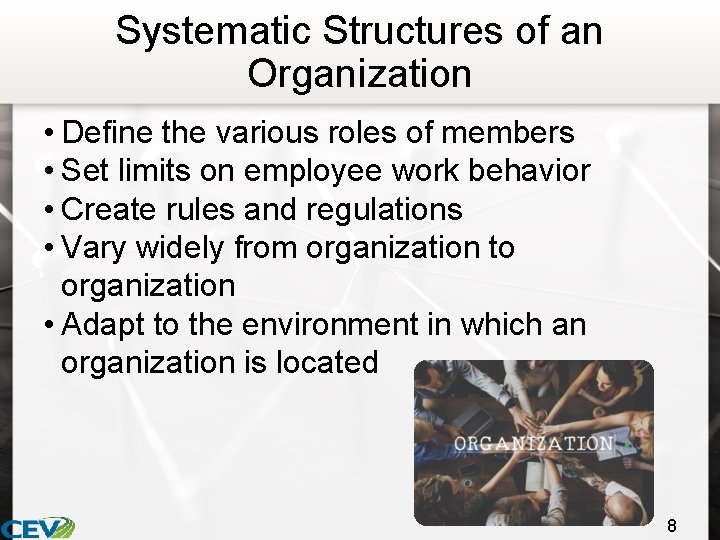
Systematic Structures of an Organization • Define the various roles of members • Set limits on employee work behavior • Create rules and regulations • Vary widely from organization to organization • Adapt to the environment in which an organization is located 8
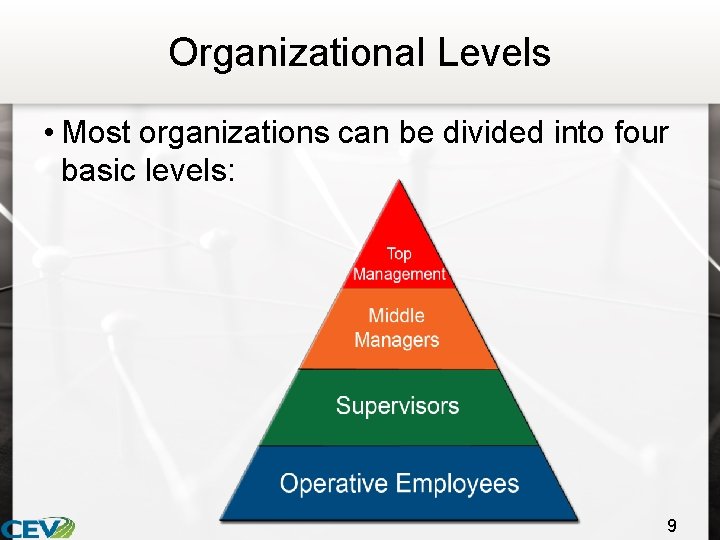
Organizational Levels • Most organizations can be divided into four basic levels: 9
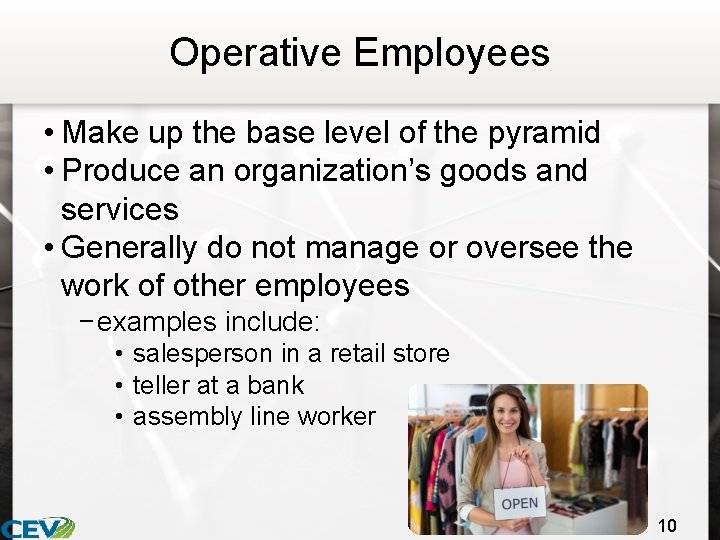
Operative Employees • Make up the base level of the pyramid • Produce an organization’s goods and services • Generally do not manage or oversee the work of other employees − examples include: • salesperson in a retail store • teller at a bank • assembly line worker 10
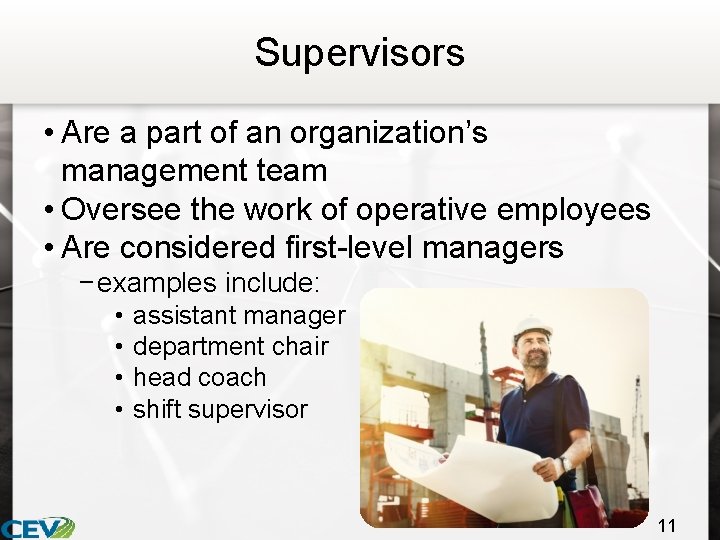
Supervisors • Are a part of an organization’s management team • Oversee the work of operative employees • Are considered first-level managers − examples include: • • assistant manager department chair head coach shift supervisor 11
Middle Managers • Are employees who manage other managers • Are responsible for establishing and achieving the goals of a specific department or region set by top management − examples include: • • director of marketing region manager high school principal vice president of a department 12
Top Management • Sets an organization’s goals and objectives • Develops methods for achieving goals and objectives • Is the head of the organization − examples include: • • chief executive officer president chairman of the board senior vice-president 13
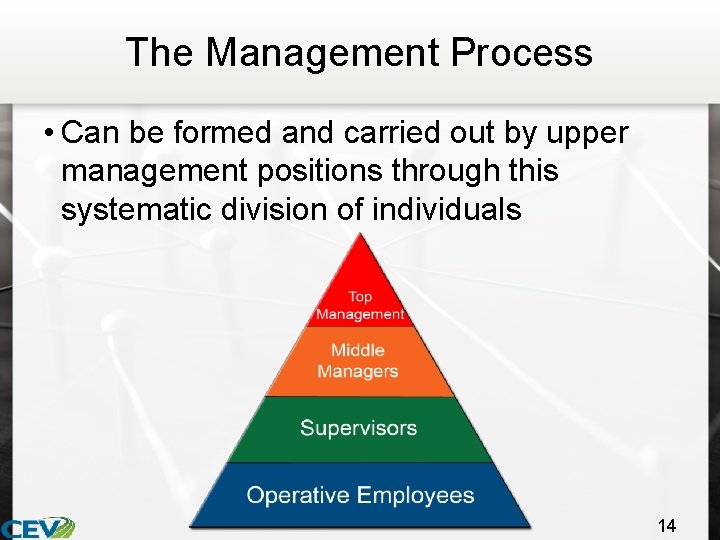
The Management Process • Can be formed and carried out by upper management positions through this systematic division of individuals 14
The Management Process • Refers to accomplishing goals and objectives effectively and efficiently • Involves using resources competently • Always has an end goal of achievement • Is accomplished through a specific organizational structure 15
Social Responsibilities of Mangers • Include: − protecting the welfare and interest of the community along with their own company − responding to the demands of society − reacting to changes in social demands 16
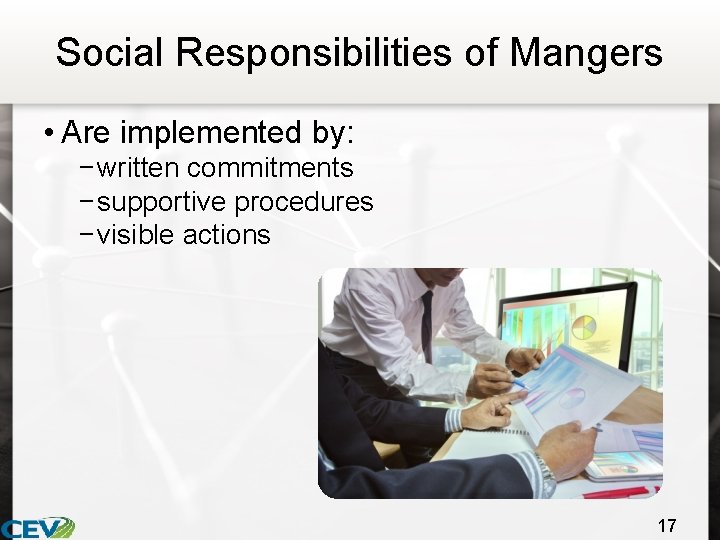
Social Responsibilities of Mangers • Are implemented by: − written commitments − supportive procedures − visible actions 17
Organizational Structures • Arrange and group jobs based on specific tasks in order to enhance efficiency • Increase the effectiveness of internal communication and reporting • Help with conflict management • Establish a chain of command • Can be formal or informal 18
Adaptive Organization • Are designed by: − communicating consistently − reinforcing the importance of innovation − collaborating effectively with employees, departments and groups − networking with outside organizations 19
Informal Structures • Are laid-back and undefined • Involve employees completing tasks which may not always fit their job description • Are normally found in smaller businesses with fewer employees • Allow for social interactions and preferences 20
Formal Structures • Are clearly defined and organized • Can be found in any business large or small • Can be charted or described visually • Include specific organizational details such as: − work specialization − span of control − chain of command − authority 21
Organizational Details Affecting Structure 22
Work Specialization • Occurs when a job is broken down into a number of steps which are each completed by a different individual − example of work specialization: • assembly line workers • Requires an individual to complete the same small task over and over again in order to contribute to a final project 23
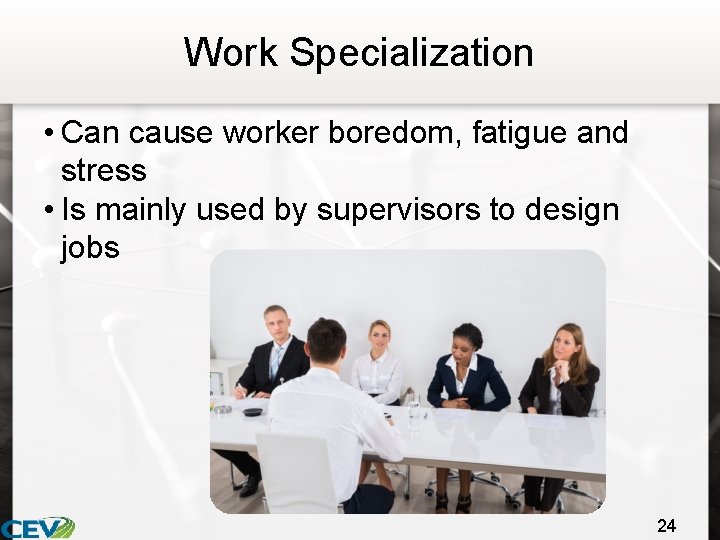
Work Specialization • Can cause worker boredom, fatigue and stress • Is mainly used by supervisors to design jobs 24
Span of Control • Is the number of employees a supervisor can direct • Varies from supervisor to supervisor • Is affected by the supervisor’s: − experience − skill level − level of training • Is directly related to: − the type of job being supervised − complexity of tasks − rules and regulations 25
Chain of Command • Is the principle in which an employee should have only one supervisor to whom he or she is responsible • Decreases conflicting demands and priorities • Allows easier allocation of tasks • Is a formal system of employee communication 26
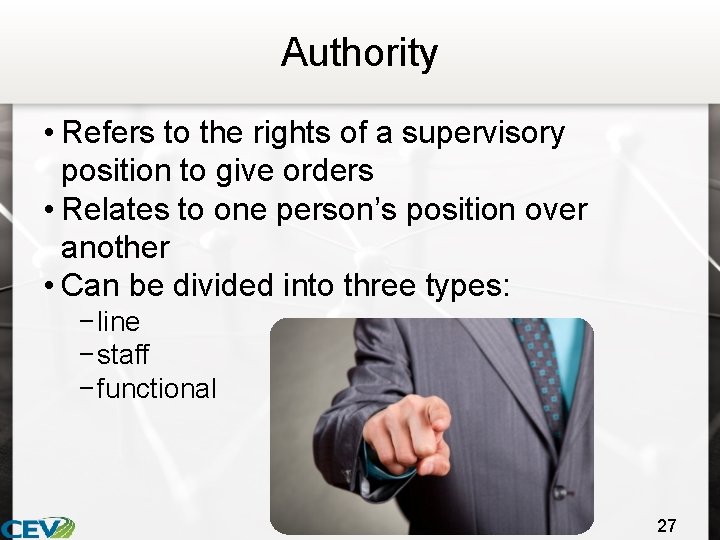
Authority • Refers to the rights of a supervisory position to give orders • Relates to one person’s position over another • Can be divided into three types: − line − staff − functional 27
Line Authority • Is the most straightforward form of authority • Gives the supervisor the right to direct the work of his or her employees without consulting others • Is also known as direct authority 28
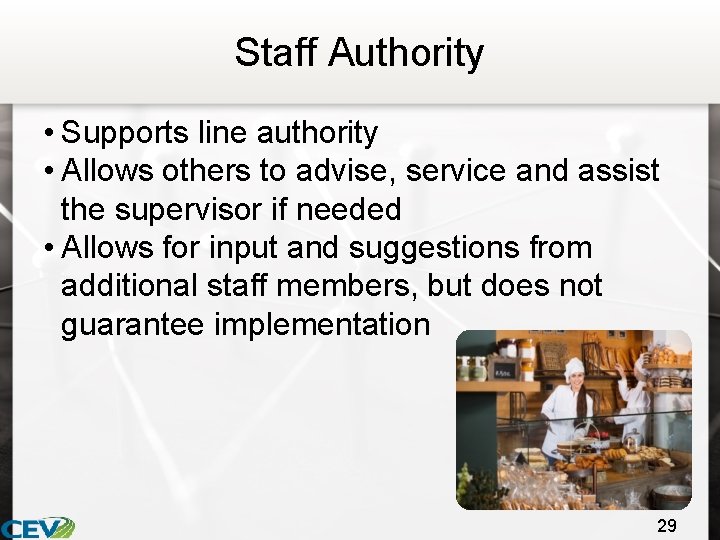
Staff Authority • Supports line authority • Allows others to advise, service and assist the supervisor if needed • Allows for input and suggestions from additional staff members, but does not guarantee implementation 29
Functional Authority • Signifies the rights over individuals outside of an individual’s specific division • Breaks the chain of command • Can create greater efficiency by allowing specialization of skills and improved coordination • Has a major problem with overlapping authority 30
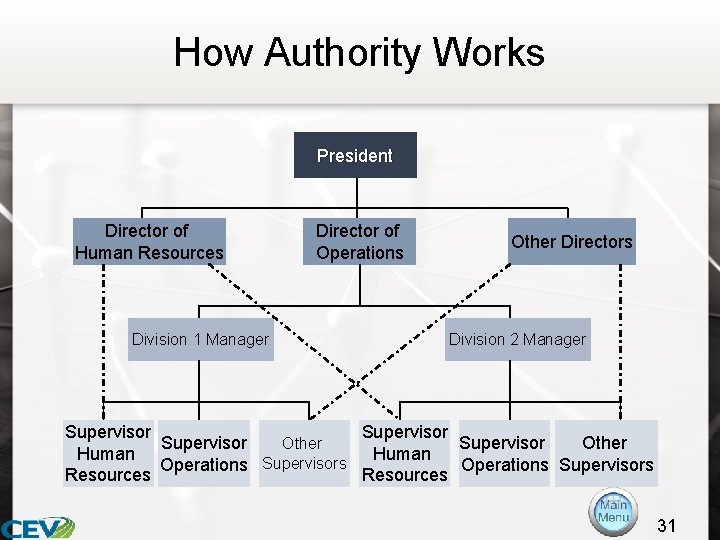
How Authority Works President Director of Human Resources Division 1 Manager Director of Operations Other Directors Division 2 Manager Supervisor Other Human Operations Supervisors Resources 31
Ways to Divide Work 32
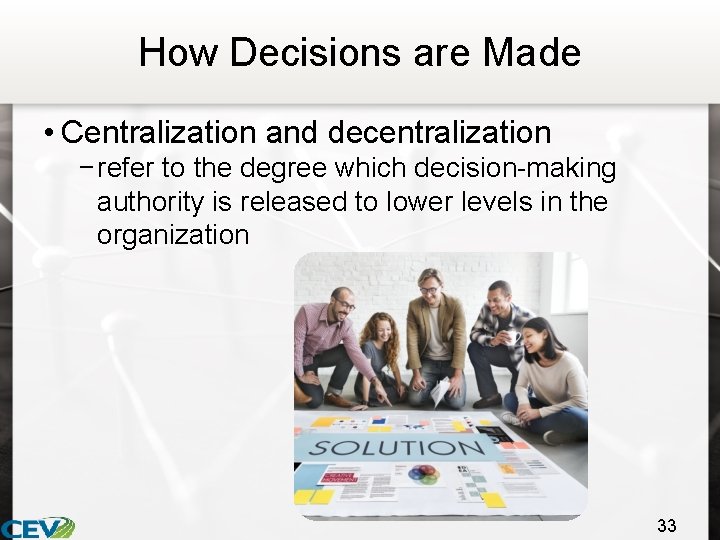
How Decisions are Made • Centralization and decentralization − refer to the degree which decision-making authority is released to lower levels in the organization 33
Centralization • Occurs when only a select few people at the top of an organization make decisions • Requires additional time and research in order to present to top management • Can result in uniformity of procedures • Is a top-down approach to making business decisions 34
Decentralization • Occurs when decisions are made by the individuals who are the closest to the problem • Is more conducive to making changes in a process 35
Departmentalization • Is the grouping of individuals into departments based on: − work functions − product or service − target market − geographic territory − process used to create products 36
Functional Departmentalization • Groups activities with similar functions by units or departments • Can be used in all types of organizations • Reflects the purpose of the company − examples include: • accounting department • marketing department • human resources department 37
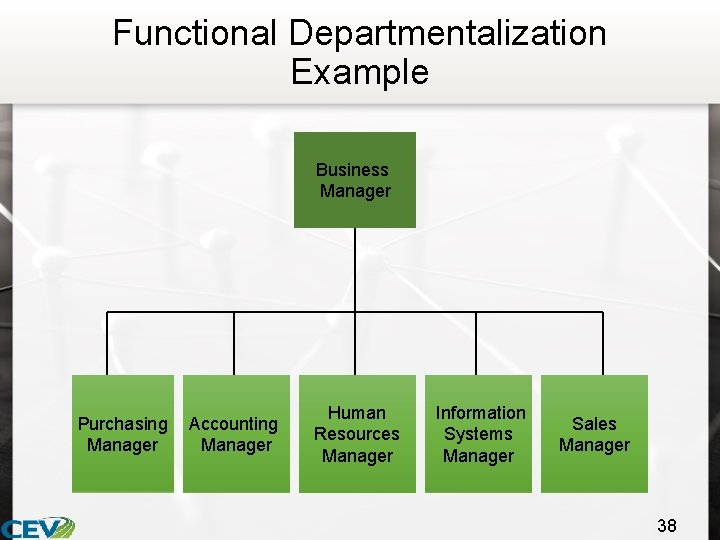
Functional Departmentalization Example Business Manager Purchasing Manager Accounting Manager Human Resources Manager Information Systems Manager Sales Manager 38
Product Departmentalization • Divides the organization by the products or services it produces and then subdivides each department by its function • Works well for companies with multiple product lines such as: − men’s wear − women’s wear − accessories 39
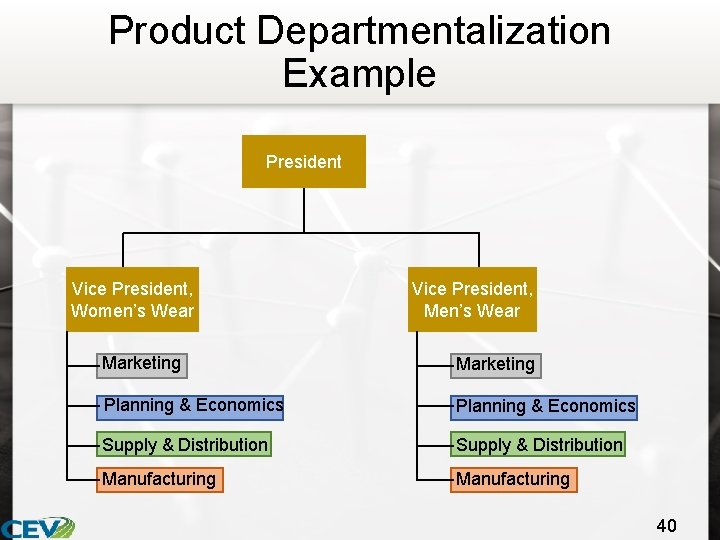
Product Departmentalization Example President Vice President, Women’s Wear Vice President, Men’s Wear Marketing Planning & Economics Supply & Distribution Manufacturing 40
Target Market Departmentalization • Groups activities around common customer categories • Uses the assumption customers in each department have a common set of problems and needs which can be met by having specialists for each • May be divided by: − retail customers − wholesale customers − government customers 41
Target Market Departmentalization Example Customer Service Government Accounts Military Accounts Corporate Accounts Business Accounts Nonprofit Accounts 42
Geographic Departmentalization • Divides activities into segments based on location • Is mainly used when an organization’s customers are spread over a large geographic area • May divide employees into regions such as: − midwest district − southern territory − north American sector 43
Geographic Departmentalization Example Vice President, Sales Representative, Eastern Region Sales Representative, Southern Region Sales Representative, Central Region Sales Representative, Western Region 44
Process Departmentalization • Group activities based on work or customer flow • Provides a basis for the homogeneous categorizing of activities • Groups workers into specific steps of a process such as: − finger printing − inmate processing − booking 45
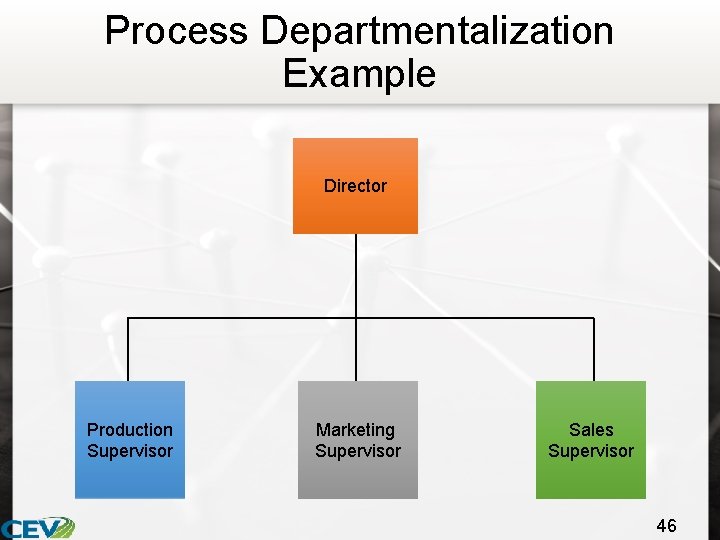
Process Departmentalization Example Director Production Supervisor Marketing Supervisor Sales Supervisor 46
Departmentalization • Enhances the manageability of an organization • Begins the framework for basic business structures • Should correspond to the goals and tasks of an organization 47
Basic Business Structures 48
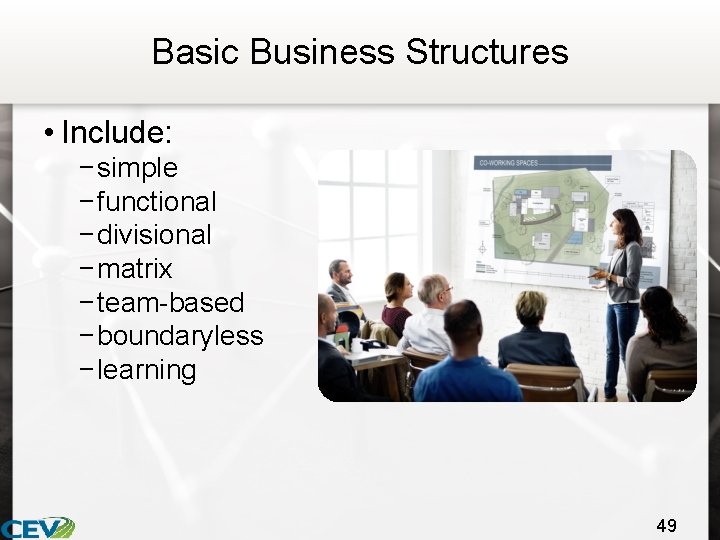
Basic Business Structures • Include: − simple − functional − divisional − matrix − team-based − boundaryless − learning 49
Simple Structure • Is a non-elaborate structure • Has little formalization • Has a centralized authority • Is a flat organization with only two or three levels • Is widely used in smaller businesses 50
Simple Structure • Advantages − fast − flexible − inexpensive − accountability is clear • Disadvantages − effective only in small organizations − has few policies and rules to guide operations − can have too much decision-making power at the top level 51
Functional Structure • Is an expansion of functional departmentalization • Groups employees with similar and related occupational specialties • Is used as a framework for an entire company 52
Functional Structure • Advantages − productivity and work specialization − job satisfaction − minimizes duplication • Disadvantages − loses sight of employee interests in pursuit of goals − individuals may become isolated and have little understanding of what people in other functions are doing 53
Divisional Structure • Is composed of self-contained units or divisions • Builds on product departmentalization • Creates divisions which are self-sufficient within given limits • Constructs divisions which are run by division managers or supervisors 54
Divisional Structure • Advantages − focuses on results − division managers have full responsibility for products and services − frees headquarter staff from being concerned with everyday activities • Disadvantages − duplication of activities and resources − can increase costs − can reduce efficiency 55
Matrix Organization • Combines the elements of functional and product-based departmentalization creating a dual chain of command • Employees have at least two bosses • Authority is shared between two supervisors • Involves regular communication 56
Matrix Organization • Advantage − can facilitate the coordination of multiple projects • Disadvantage − confusion associated with chain-of-command which can cause conflict 57
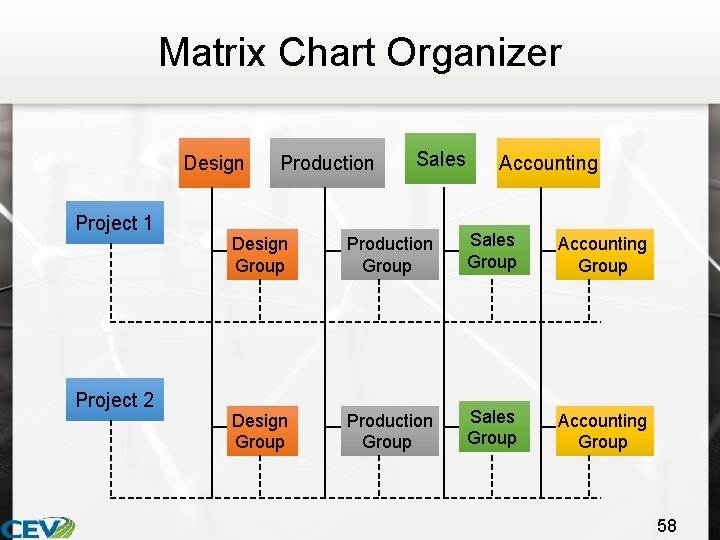
Matrix Chart Organizer Design Project 1 Project 2 Production Sales Accounting Design Group Production Group Sales Group Accounting Group 58
Team-based Structure • Consists entirely of work groups and teams which perform an organization’s work • Allows team members to have authority to make the decisions which will affect them • Has no chain-of-command 59
Team-based Structure • Advantages − allows organizations to listen to the customer − gives many different perspectives from various team members • Disadvantages − the chain of command is not defined which can cause conflict − authority is based within the team 60
Boundaryless Organization • Is not defined or limited by boundaries or categories imposed by a traditional structure • Blurs boundaries surrounding an organization by increasing its interdependence with its environment • Cuts across all aspects of an organization • Attempts to eliminate vertical, horizontal and inter-organizational barriers • Groups employees to accomplish one common task 61
Learning Organizations • Have developed a capacity to continuously adapt and change because members take an active role in identifying and resolving work-place issues − employees must collaborate on work activities throughout the organization and have a team oriented work ethic 62
Selecting a Structure • Consider the following: − size of the business or organization − business purpose − intended outcomes and productivity levels − worker skills and responsibilities 63
Organizations • Should: − be flexible − evaluate the structure of their organization − avoid frequent restructuring as it causes employee confusion and poor morale − communicate structural expectations to others • publish an organizational chart • provide employee training • conduct employee interviews 64
Resources • (n. d. ). Retrieved October 2, 2008, from U. S. Small Business Administration: www. sba. gov • (1999 - 2008). Retrieved October 3, 2008, from All. Business: http: //www. allbusiness. com/ • Guide to Organizational Charting. (n. d. ). Retrieved October 2, 2008, from Org. Chart. Net: http: //www. orgchart. net/ • Management. (2008). Retrieved October 2, 2008, from About. Com: www. management. about. com 65
Acknowledgements Assistant Brand Manager Megan O’Quinn Amy Hogan Graphic Designer Melody Rowell Brand Manager Megan O’Quinn V. P. of Brand Management Clayton Franklin CEV Multimedia, Ltd. © MMXVI Executive Producer Gordon W. Davis, Ph. D. 66
- Slides: 66