
1 Objectives To identify the role of ecommerce
1

Objectives • To identify the role of e-commerce in the business market. • To describe the advantages of e-tailing and e-commerce. • To identify the opposition and challenges of e-commerce. • To evaluate factors which contribute to successful online sales. 2
Main Menu • Introduction to E-Commerce • Uses of E-Commerce • Challenges & Success • Threats to E-Commerce • Elements, Considerations & Resources 3
Introduction to ECommerce 4
E- Commerce • Refers to distributing, buying, selling, marketing and servicing products over the Internet • Includes the exchange of goods and services online • Is often associated with e-tailing or ebusiness • Is known as doing business through an electronic marketplace According to some sources, E-Commerce started in 1994 when the first banner ad was placed on a website. The earliest product sold online was reportedly issued by Compuserve in 1992. 5

E-Tailing • Specifically refers to selling retail goods on the Internet • Functions similarly to a physical or brickand-mortar retail store • Often incorporates the use of e-tailware − software used to create online catalogs, ordering forms, credit checking and similar services for websites which sell goods and services to retail consumers A number of e-tailware products provide a complete range of support so a company which already has a website can easily add e-tailing capability to the site. 6
E-Business • Is the general or broad term used to describe online business − an e-business site is usually comprehensive and offers multiple services in addition to selling its products and services • for example, a site may feature the ability to track shipments or have threaded discussions While the term “e-business” is often used synonymously with e-commerce it is more of an umbrella term used for having a presence on the web. E-commerce usually refers to the order processing component of the Internet sites. 7
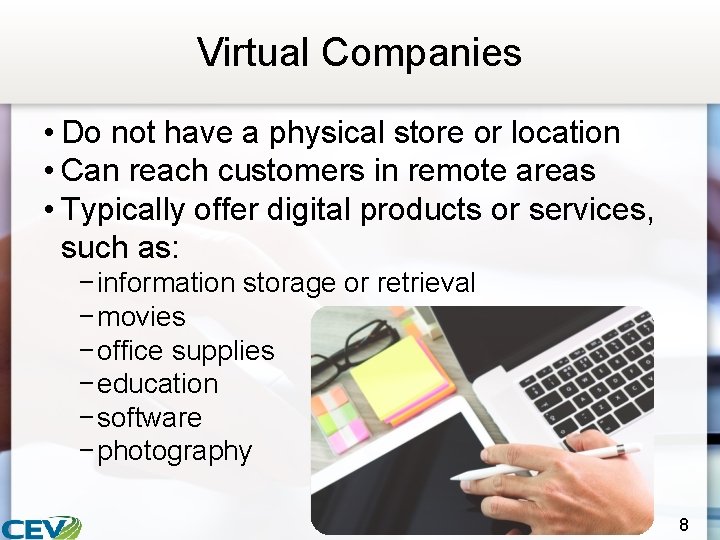
Virtual Companies • Do not have a physical store or location • Can reach customers in remote areas • Typically offer digital products or services, such as: − information storage or retrieval − movies − office supplies − education − software − photography 8
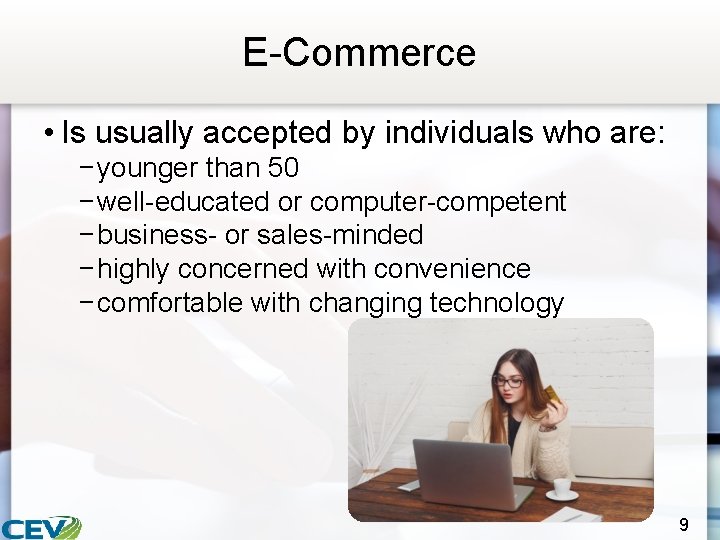
E-Commerce • Is usually accepted by individuals who are: − younger than 50 − well-educated or computer-competent − business- or sales-minded − highly concerned with convenience − comfortable with changing technology 9
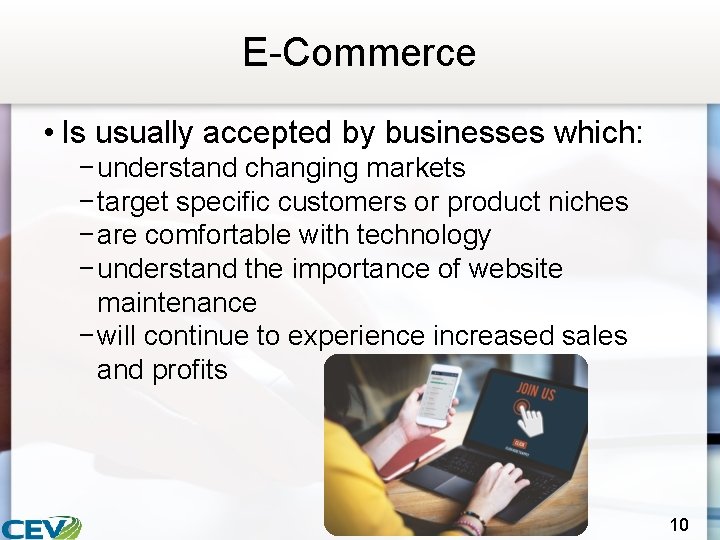
E-Commerce • Is usually accepted by businesses which: − understand changing markets − target specific customers or product niches − are comfortable with technology − understand the importance of website maintenance − will continue to experience increased sales and profits 10
Pioneers in Online Sales • Include: − e-Bay® • founded in 1995 with the online sale of a broken laser pointer for $14. 83 • has more than 100 million active users globally − Dell™ • launched website in 1994 with a single static web page • roughly half of profits are directly from website − Amazon® • launched website in 1994 selling only books • attracts about 615 million customers each year 11
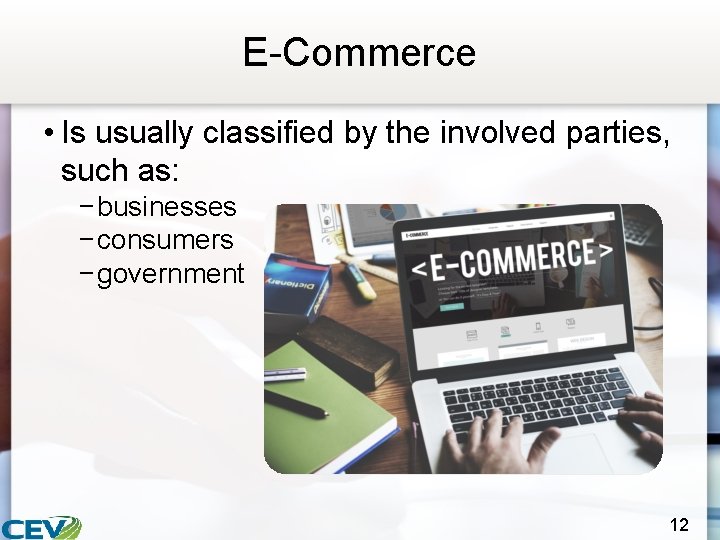
E-Commerce • Is usually classified by the involved parties, such as: − businesses − consumers − government 12
Business-to-Business (B 2 B) • Is used when a product or good is sold from one business to another • Is used when one firm acts as a wholesaler to another company • Consists of 5 million online servers • Is expected to grow at a rate of approximately 40 percent per year Business-to-business e-commerce includes a broad range of activities- ranging from the purchasing of stocks online to companies buying large shipments or parts from another company. There are three main goals for business-to-business efforts: increasing revenue, enhancing business relationships, reducing costs. 13
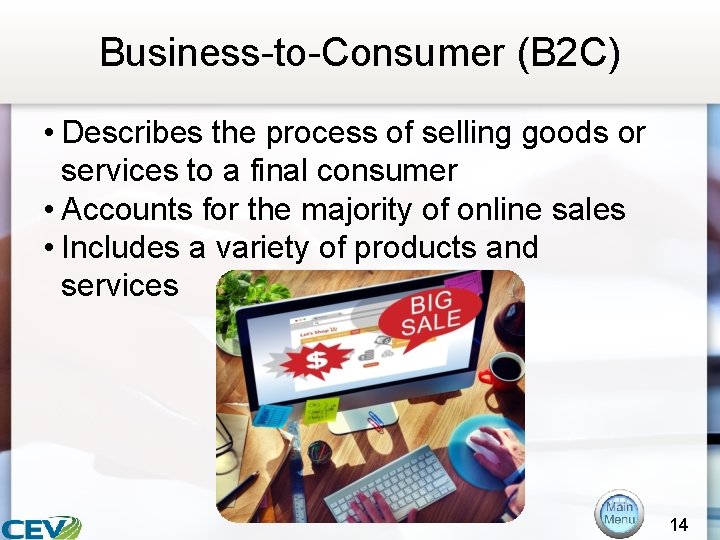
Business-to-Consumer (B 2 C) • Describes the process of selling goods or services to a final consumer • Accounts for the majority of online sales • Includes a variety of products and services 14
Uses of ECommerce 15
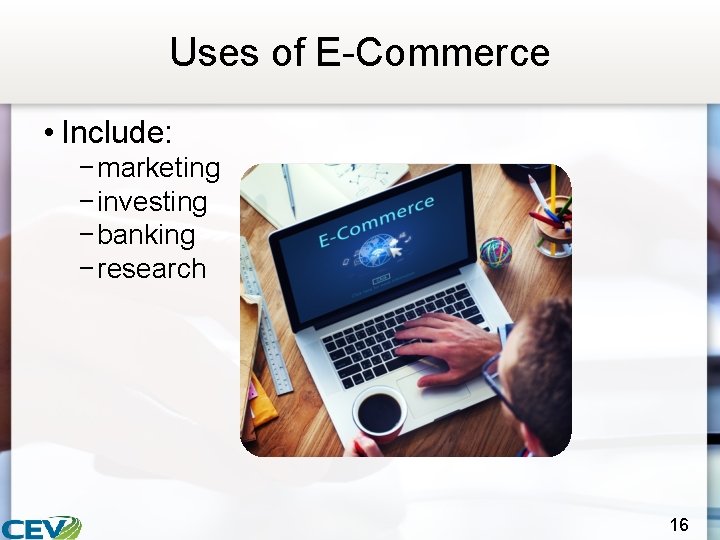
Uses of E-Commerce • Include: − marketing − investing − banking − research 16
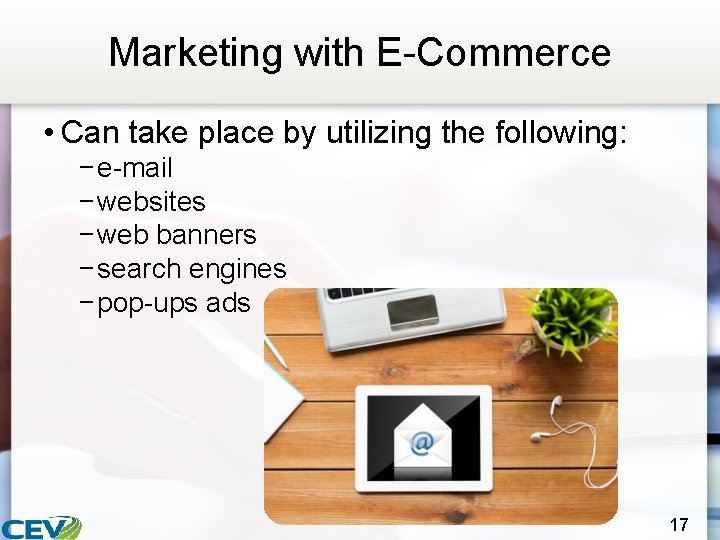
Marketing with E-Commerce • Can take place by utilizing the following: − e-mail − websites − web banners − search engines − pop-ups ads 17
Investing with E-Commerce • Takes place when someone does the following: − invests money in personal or profitable stocks − trades goods or services in place of spending money − pays a third party to sell or research products on your behalf − obtains additional investments or government resources 18
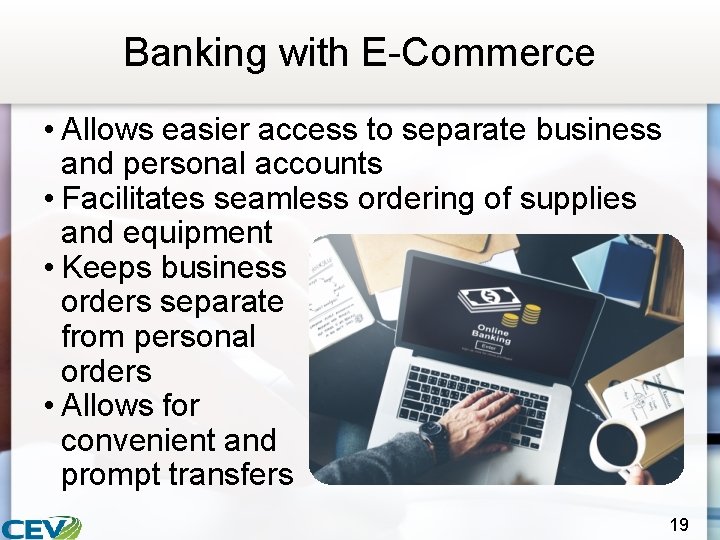
Banking with E-Commerce • Allows easier access to separate business and personal accounts • Facilitates seamless ordering of supplies and equipment • Keeps business orders separate from personal orders • Allows for convenient and prompt transfers 19
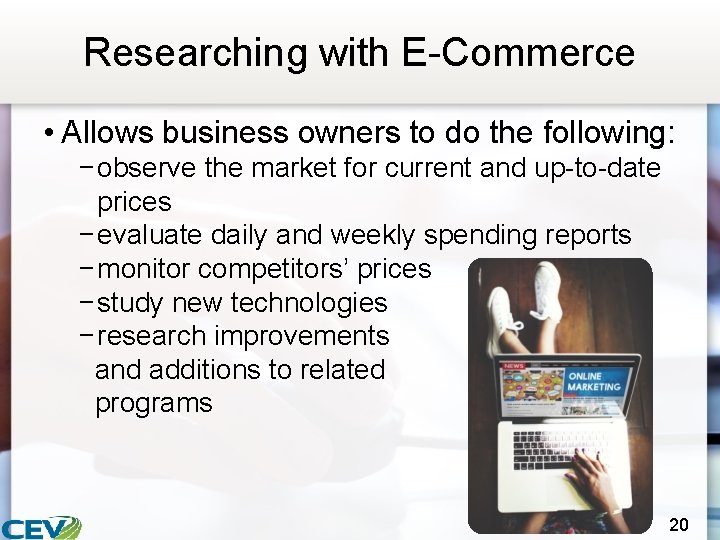
Researching with E-Commerce • Allows business owners to do the following: − observe the market for current and up-to-date prices − evaluate daily and weekly spending reports − monitor competitors’ prices − study new technologies − research improvements and additions to related programs 20
E-Commerce • Benefits companies including: − buyers who increase their business-tobusiness relationships and reduce costs − sellers who increase product offerings and improve convenience − cybermediaries who bring previously unknown buyers and sellers together − Internet solution providers who supply technology 21
Challenges & Success 22
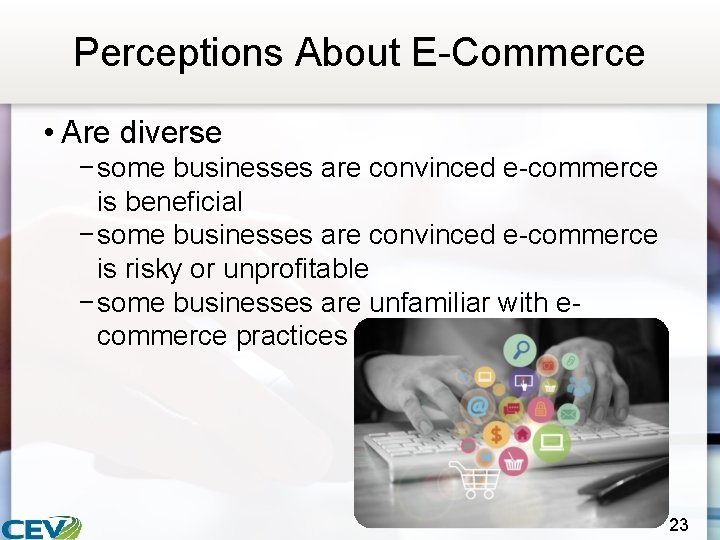
Perceptions About E-Commerce • Are diverse − some businesses are convinced e-commerce is beneficial − some businesses are convinced e-commerce is risky or unprofitable − some businesses are unfamiliar with ecommerce practices 23
Opposition to E-Commerce • Exists for consumers who are concerned with the following: − security • some will not use credit cards over the Internet due to concerns about theft and credit card fraud − social aspect of shopping • some people enjoy shopping with friends or leaving the house 24
Opposition to E-Commerce • Also exists due to the following: − lack of access to the Internet • roughly 98 percent of Americans have access, but only 34 percent of people worldwide have access − poorly designed websites • frustrate online shoppers and drive them away − difficulties making an exchange or return − lack of instant gratification • much of a consumer's reward for making a purchase lies in the gratification of using the product immediately, a reward not gained through shopping online 25
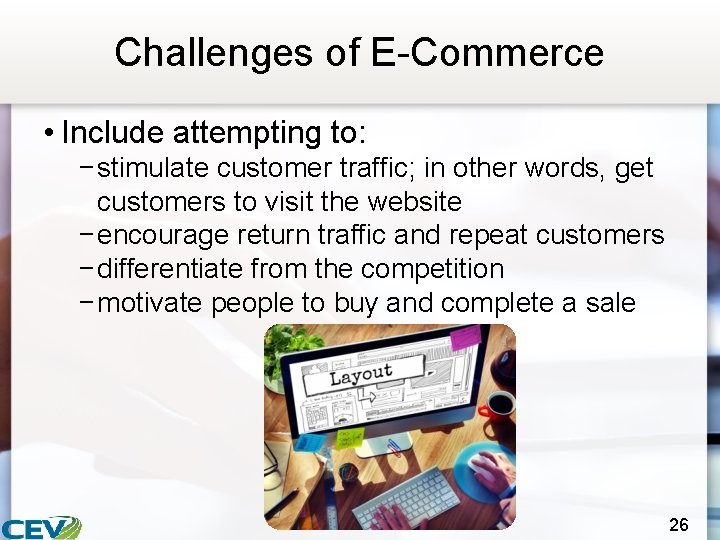
Challenges of E-Commerce • Include attempting to: − stimulate customer traffic; in other words, get customers to visit the website − encourage return traffic and repeat customers − differentiate from the competition − motivate people to buy and complete a sale 26
Advantages of E-Commerce • Include: − increases international sales − increases number of overall customers and allows access at any time − extends business beyond the limits of geographic proximity − allows for a large catalog of items unrestricted by space − allows for quick adjustment of prices to reflect changes in demand 27
Advantages of E-Commerce • Can, when utilized sufficiently, include: − increase computer literacy in the workforce − increase access to business-related information − allow for understanding of consumption habits and tracking of customer preferences in order to customize products and provide personalized levels of service − restructure supply chain − eliminate intermediaries and engages buyers directly − improve customer communication − increase productivity 28
Disadvantages of E-Commerce • Include: − not the best form of distribution for all products and companies − sites may require daily maintenance and attention − when a server crashes or is down for maintenance, business contact is lost − servers, firewalls, routers and Internet connections must all work simultaneously 29
Successful E-Commerce Products • Include: − computer products − books − music − financial services − entertainment − home electronics − embarrassing or personal products 30
Successful E-Commerce Products • Also include: − apparel − gifts and flowers − travel services − toys − tickets − specialty or customized goods − replacement parts Products such as spare parts for washing machines or hot water pumps are also good candidates for selling online. Retailers often need to order spare parts, since they do not always stock them at consumer outlets. In these cases, e-commerce businesses do not compete with retail stores, only with other ordering systems. 31
Poor E-Commerce Products • Include: − products with a smell, taste or touch component − products which require testing or sampling − products which require extensive fittings − perishable goods 32
Factors Affecting Success • In e-commerce include a business’s ability to: − provide a competent management team − participate in efficient post-sale services − maintain an organized business structure − provide technical support − create an effective web design 33
Factors Affecting Success • In e-commerce also include a business’s ability to: − plan and research − stay up-to-date with technological advances − accurately target and maintain customers − provide secured sites and safety software 34
Successful E-Businesses • Offer customers a rewarding experience by providing the following: − value or reasonably-priced products − service and performance − an easy and efficient buying process − customer incentives − personal attention − access to company information and policies − a sense of community (via discussion boards, loyalty programs, etc. ) 35
Benefits & Features • For customers which are unique to ecommerce include: − ability to easily create customized products and orders − easy comparison of sellers on the basis of price, quality, delivery and service − availability of product reviews, information and opinions of other buyers − ability to search for a specific product or service − opportunity to e-mail product information to others − ability to build an order over several days 36
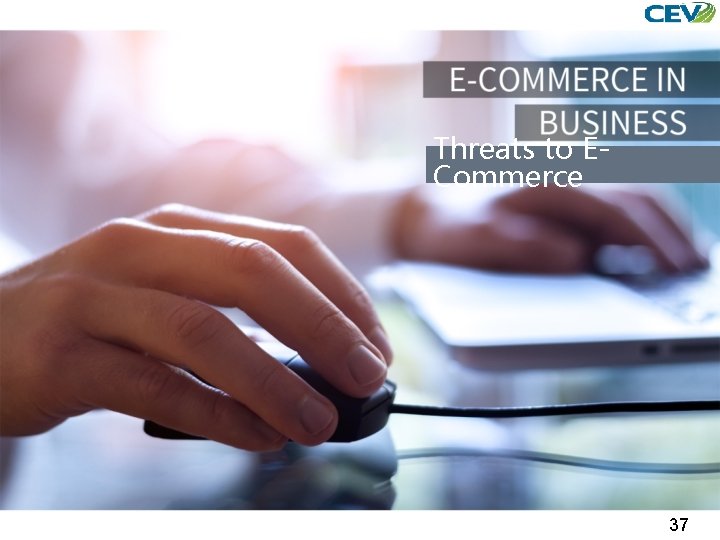
Threats to ECommerce 37
Threats to E-Commerce • Include identify theft − a process by which imposters obtain key personal information, such as: • social security numbers • credit card information • drivers license numbers − often responsible for the following: • credit card fraud • falsified purchases • inaccurate account spending 38
Identity Theft Protection • Can be increased by applying the following tips: − protect credit card information and only make purchases on secured sites − do not give credit card information over the phone unless you placed the call − do not reply to e-mails asking for account information 39
Identity Theft Protection • Can be increased by applying the following tips: − contact a company before providing them with personal information Employee misconduct is also a fear for some companies. Even when corporate services are legit, an individual employee may use their position to obtain illegal information. Employee screening and monitoring is an important aspect to preventing identity theft. 40
Threats to E-Commerce • Also include: − phishing • the act of sending a falsified e-mail or instant message which creates the appearance of a legitimate business to obtain account information 41
Threats to E-Commerce • Also include: − hackers • are those who attempt to break in to a computer system • are usually skilled programmers or engineers with proficient technical knowledge to understand the weak points of a company’s online security system Confidence in the transmission of sensitive financial and personal information is typically the highest set-back to online spending. The challenge of operating a secure website is very real. The number of companies which have been attacked by hackers has grown dramatically the past few years. The losses from security breaches, in terms of the time and effort expended and lost productivity, are mounting. 42
Security Policies • Must be created to secure an electronic commerce system Thoroughly planned security policies help minimize online break ins by communicating with and managing the users in an organization. Unfortunately, security policies are often treated as an after-thought. A security policy must address an organization’s specific risks. To understand risks, an appropriate player should perform a security audit which identifies vulnerabilities and rates both the severity of each threat and its likelihood of occurring. 43
Security Policies • Include documents which identify aspects, such as: − security goals − potential risks − authorized users − data access or denial − data protection 44
Firewalls • Are safety checkpoints for all incoming and outgoing data • Review messages to ensure data content is safe and acceptable to view • Can be hardware- or software-based • Are security barriers which protect against hackers or unwanted traffic Providing reliable and secured sites for consumers and site guests should be a primary goal for e-businesses. Most professional sites will have at least one type of firewall. Others companies, such as government entities, are protected by the highest level of online security possible. Firewalls do not always protect from viruses or hackers. 45
Encryption & SSL • Can be used to protect data − encryption • is the procedure in which information is converted into ciphertext to prevent specific individuals from encoding the data 46
Encryption & SSL • Can be used to protect data − SSL (secure sockets layer) protocol • uses cryptographic systems to encrypt data • creates a secured connection between a client and a server • is represented by an official seal or logo • must be renewed or updated every three years • verifies the validity of a company’s site and security measures SSL Certificates must be purchased from specific businesses. Most companies which purchase an SSL will display a security license at the bottom of their sites. The https (instead of http) in web addresses also indicates the presence of an SSL. 47
Elements, Considerations & Resources 48
Elements Required • To conduct successful e-commerce consist of the following: − a product − a place to sell the product (a website) − a way to get people to visit the website − a way to accept orders − a way to accept payment − a method of shipping − a process for accepting returns − a process to handle warranty claims if needed − a procedure for providing customer service • e-mail, online forms, FAQ page, etc. 49
Factors to Consider • When entering e-commerce include: − suppliers • must be able to handle logistics of inventory and shipping directly to customers − customer relations • is as, or more, important online because competition is only a click away − post-sales processes • such as returns and shipping can be the difference between a one-time customer and a loyal repeat customer 50
Additional Considerations • When making e-commerce decisions include incorporating programs for the following: − e-mail notification − gift-sending − affiliate advertising − special discounts − repeat buyers − seasonal or periodic sales An affiliate program is a form of online advertising which rewards the affiliates, or selfselected advertisers for driving traffic to the advertiser. Affiliate programs allow websites who provide links to a site to receive payments or advertising services in exchange for promoting the website. 51
E-Commerce Resources • Include: − Internet service providers − software − webmasters − web payment services 52
Internet Service Providers • Are companies which provide Internet access to individuals and companies • Usually charge a monthly fee for Internet use and services • Vary in terms of services and capabilities − wireless − satellite − dial-up − broadband 53
Software • Facilitates the buying and selling of goods online • Should maximize profit potential while minimizing effort required • Can feature the following: − shopping cart − statistics on web traffic − integrated inventory or accounting systems 54
Webmasters • Create and maintain websites • Can be internal or external resources/employees • Will use software and image editors to complete the following: − design the layout for the site − code and encode data as needed Providing an attractive website includes the tasteful use of color, graphics, animation, photographs, fonts and white-space. Company-oriented webmasters should update and revise site information daily, weekly or as often as needed. 55
Web Payment Services • Manage the transfer of funds from buyer to seller in e-commerce • Include: − Pay. Pal® − Amazon Payments. TM − Authorize. net® − Intuit® The major difference between these entities is the eligible fees and services. Credit cards are the most popular means of sending payments on the Internet, accounting for 90 percent of online purchases. Most online companies process credit card transactions through arrangements made with commercial banks or credit cards companies. 56
Pay. Pal® • Is an online payment service which allows individuals and businesses to transfer funds electronically • Uses encryption software to help individuals make financial transfers between computers • Is recognized as one of the world's primary methods of online payment 57
Pay. Pal® • Manages 110 million accounts in 190 markets and 25 currencies around the world • Works similarly to a checking account 58
Pay. Pal® • Can be used for the following online transactions: − to purchase goods and services − to make donations − to send cash to an individual or company 59
Implementation • Of an e-commerce site can occur in one of three general ways: − enterprise computing − virtual hosting services − simplified e-commerce 60
Enterprise Computing • Includes purchasing hardware and software • Requires professional staff or developers to create e-commerce website − on-site information technology directors or outsourced services The major aspect of enterprise computing is the fact you control, create and maintain everything yourself. Information can be quickly changed or updated. The disadvantage is in order to maintain an effective site, companies must employ workers with sufficient technical knowledge. 61
Enterprise Computing • Develops websites with benefits including: − immensely high traffic– millions of visitors each month − capabilities for immediate changes to design or content − an extensive database which stores and updates online catalogs and product offerings • customized forms, pricing tables and detailed processes • integrate e-commerce offerings with other business practices 62
Virtual Hosting Services • Provide similar flexibility compared to enterprise computing • Consist of a general vendor who sells and maintains equipment and software in standardized packages • Require the business to provide web designers and developers to create and maintain the site In virtual hosting, a designer creates and maintains a site through a different server in order to avoid initial costs. While the communication process is a little more complicated, changes can still be easily made since you are uploading and making changes on your own and simply sending the ideas to a host. 63
Simplified E-Commerce • Is the general practice of most small businesses entering e-commerce • Allows a vendor to provide a simplified system for creating an online store • Is the use of vendor software to generate all of the web pages for the business • Requires a monthly service charge A major disadvantage of simplified e-commerce is the lag time within the communication process. If changes are to be made they must first be communicated to the host. The host must then make the changes and submit the changes for approval. 64
E-Commerce • Is not right for every business • May work well for businesses which answer “yes” to the following questions: − do you sell products or services which can be easily sold online − do you participate in business-to-business sales − do you have sufficient resources to develop a website − would your potential customers benefit from ecommerce services − are your familiar with the advantages and downsides of basic e-commerce 65
Resources • Chaudhury, Abijit; Jean-Pierre Kuilboer (2002). • e-Business and e-Commerce Infrastructure. Mc. Graw-Hill. ISBN 0 -07 -247875 -6. • Nissanoff, Daniel (2006). Future. Shop: How the New Auction Culture Will Revolutionize the Way We Buy, Sell and Get the Things We Really Want, Hardcover, The Penguin Press, 246 pages. ISBN 1 -59420 -077 -7. • www. ebayinc. com/history • www. ecommerce-land. com/history_ecommerce • www. newmediatrendwatch. com/world-overview • www. verisign. com 66

Acknowledgements Production Coordinators Amy Baker Amy Hogan Graphic Designer Melody Rowell Brand Manager Megan O’Quinn V. P. of Brand Management Clayton Franklin CEV Multimedia, Ltd. © MMXVI Executive Producer Gordon W. Davis, Ph. D. 67
- Slides: 67