
1 Objectives To identify and analyze leadership styles
1

Objectives • To identify and analyze leadership styles. • To explore characteristics of a leader. • To examine verbal and nonverbal communication strategies. • To understand the purpose of groups and leadership’s role within them. 2
Main Menu • • Introduction to Leadership Styles Traits of a Leader Communication in Leadership in Groups 3
4
Leadership • Is the ability to influence others • Inspires and motivates others to be productive • Often has the aim of getting everyone in a group to work toward a common goal 5
Leadership Styles • Are the ways in which people utilize their leadership position • Can be used independently from one another or together • Are dependent on: – the personality of the leader – the personality of group members – the task to be accomplished 6
Kurt Lewin • Was a psychologist who studied leadership styles • Is considered a pioneer of social, organizational and applied psychology • Conducted a research project in 1939 to identify different styles of leadership and their effectiveness 7
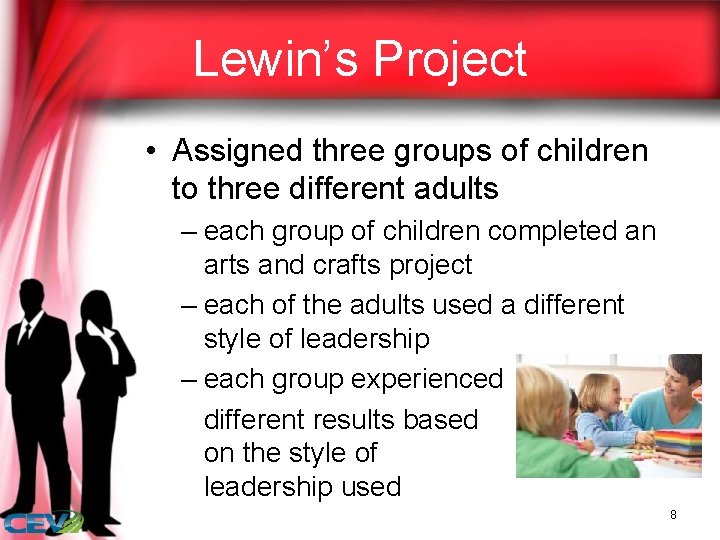
Lewin’s Project • Assigned three groups of children to three different adults – each group of children completed an arts and crafts project – each of the adults used a different style of leadership – each group experienced different results based on the style of leadership used 8
Lewin’s Leadership Styles • Consist of the following: – authoritarian – participative – laissez faire 9
Authoritarian Leadership • Requires full authority and control over the group • Makes all decisions and uses little or no input from others • Relies heavily on the use of policies, procedures and regulations • Is most effective for complex projects or when employees have low levels of training and skill 10
Authoritarian Leadership • Advantages include: – highly productive when leader is present – allows for quick decision-making • Disadvantages include: – one-way communication cause frustration or resentment among employees – employees can become dependent on the leader and loose their sense of initiative 11
Participative Leadership • Is also known as democratic leadership • Encourages group participation • Allows group members to feel involved in the process • Remains in control of the final decision • Has been found to be the most effective form of leadership 12
Participative Leadership • Advantages include: – creates a positive work environment – allows for creative thinking – reduces office tension and hostility – motivates employees to find the best solutions • Disadvantages include: – decision-making can take a long time – group pressures sometimes result in groupthink § when a group’s judgment is affected by its 13 members’ need to agree
Laissez Faire Leadership • Involves the leader offering little to no guidance and entrusting group members to make decisions – comes from the French term referring to deliberate avoidance of interference • Is also known as delegative leadership • Requires group members to: – be aware of tasks needing to be completed – act on their own to accomplish tasks 14
Laissez Faire Leadership • Advantages include: – group members have flexibility they need to be most successful – encourages critical thinking and self-motivation • Disadvantages include: – poorly defines roles within the group – can be unproductive if group members are not self-motivated and knowledgeable 15
Lewin’s Results • Found the authoritarian group: – was less creative than the other groups – was highly productive with the leader’s positive efforts – became less productive in the leader’s absence – developed discontent when the leader overexerted dominance 16
Lewin’s Results • Found the participative group: – was less productive than the authoritarian group – produced high-quality contributions from group members – members gained satisfaction from making their own decisions 17
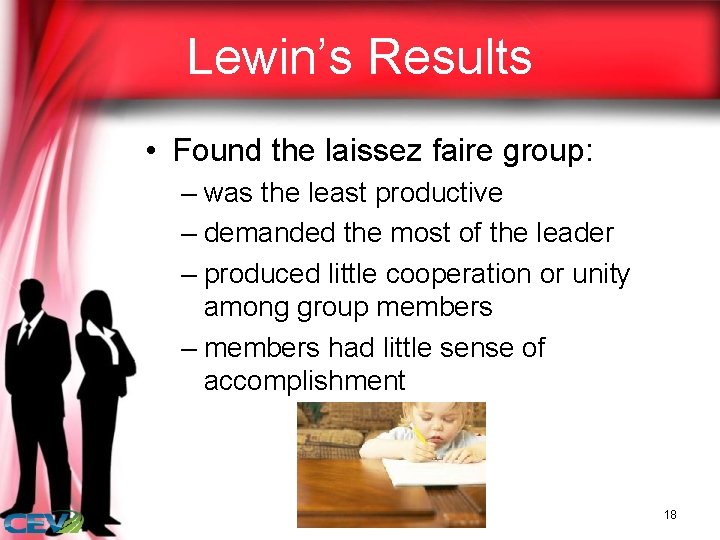
Lewin’s Results • Found the laissez faire group: – was the least productive – demanded the most of the leader – produced little cooperation or unity among group members – members had little sense of accomplishment 18
Abdicratic Leadership • Is a form of leadership not studied by Lewin • Occurs in group settings when no one is a leader – though there is no defined leader, someone is “in charge” or still responsible for the group’s actions • Requires group members complete tasks on their own 19
Abdicratic Leadership • Advantages include: – can help identify problems and problem workers in the short term – allows new leaders to emerge – allows the person in charge to focus on administrative tasks • Disadvantages include: – can result in confusion and a lack of organization 20
Assessment 21
Assessment 1. Leadership inspires and motivates others to be which of the following? A. B. C. D. Happy Kind Productive Self-sufficient 2. Leadership styles are NOT dependent on which of the following? A. B. C. D. The personalities of group members The task to be accomplished The personality of the leader The technology available 22
Assessment 3. Who was the psychologist who conducted a research project in 1939 to identify different styles of leadership and their effectiveness? A. B. C. D. Lewis Kurkin Lloyd Kirk Kurt Lewin Kolin Lewis 4. Which type of leadership relies heavily on the use of policies, procedures and regulations? A. B. C. D. Authoritarian Participative Democratic Laissez Faire 23
Assessment 5. Which type of leadership is also known as delegative leadership? A. B. C. D. Authoritarian Participative Democratic Laissez Faire 24

25
Personality Traits • Of a leader help determine which leadership style will be used • Of leaders have been studied extensively and commonly include: – fairness – vision – integrity – dedication – humility – openness – creativity – assertiveness – confidence – ability to generate trust and respect 26
Fairness • Involves treating all others equally and impartially – no one is shown favoritism or discriminated against • Requires listening to all the facts before making a decision or passing judgment • Helps to prevent: – jumping to conclusions – making mistakes based on misinformation 27
Vision • Is the ability to see the big picture or the object of the task • Requires the leader to know what the end result should be – allows the leader to effectively plan and delegate – lets the leader measure success based on how the outcome compares to the vision • Should be shared with group members – creates common goals 28
Integrity • Requires a leader be consistent concerning values, ethics and actions – honest and fair in all dealings – does not hide information from others – upholds moral principles • Shows group members the leader can be respected and trusted – lack of integrity can alienate others and negatively affect morale • In a leader sets an example for others to follow 29
Dedication • Involves the leader spending as much time and effort on a project as needed – may include long hours and hard work • Requires the leader to be one of the hardest workers in the group • Shows the leader is enthusiastic and committed to completing the project – inspires others to work hard to achieve success – emphasizes the importance of the project 30
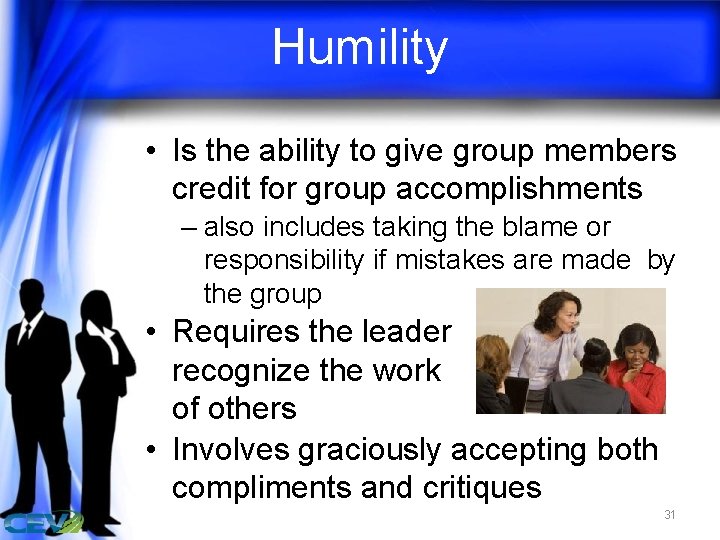
Humility • Is the ability to give group members credit for group accomplishments – also includes taking the blame or responsibility if mistakes are made by the group • Requires the leader recognize the work of others • Involves graciously accepting both compliments and critiques 31
Openness • Is the ability to listen to and consider others’ ideas and opinions • Requires recognition of different, and possibly better, ways of thinking or approaching a situation – can result in expanded perspectives • Can help build trust and communication between the leader and group members 32
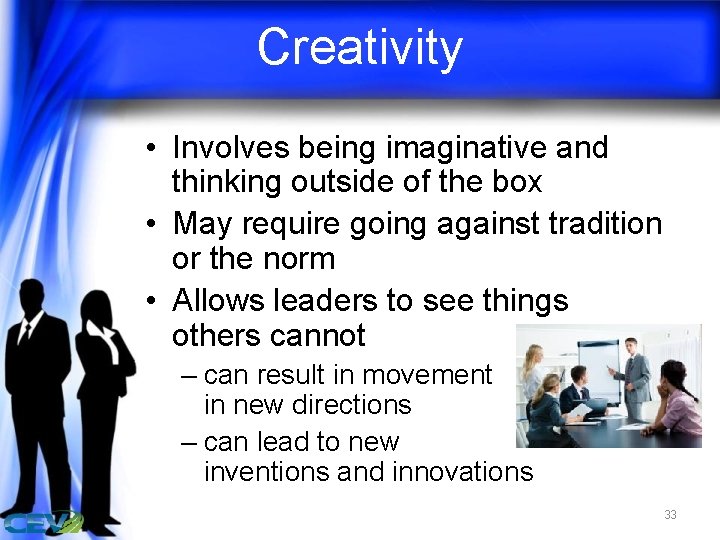
Creativity • Involves being imaginative and thinking outside of the box • May require going against tradition or the norm • Allows leaders to see things others cannot – can result in movement in new directions – can lead to new inventions and innovations 33
Assertiveness • Is the ability to clearly state expectations and enforce consequences • Aids in avoiding miscommunication • Allows the leader to keep everyone on task and moving in the proper direction • Should not be confused with rudeness or aggression 34
Confidence • Requires the leader know or feel he or she has the power and ability to succeed • Is perhaps the most important characteristic • Is required from leaders regarding both themselves and their goals – if a leader is not confident, others could find it difficult to follow due to feeling their task may not be a success 35
Ability to Gain Trust & Respect • Is a trait leaders must earn over time through a positive reputation and accomplishments – leaders with other traits are likely to earn trust and respect more quickly • Will also earn leaders commitment and loyalty from group members – this improves productivity and morale from group members 36
Assessment 37
Assessment 1. Which trait of a leader helps prevent jumping to conclusions and making mistakes based on misinformation? A. B. C. D. Creativity Fairness Confidence Dedication 2. Nathan is not consistent concerning values, ethics and actions. He can alienate others and negatively affects morale. Which of the following traits does he lack? A. B. C. D. Vision Assertiveness Humility Integrity 38
Assessment 3. Which of the following is the ability to give group members credit for group accomplishments and take the blame if mistakes are made by the group? A. B. C. D. Fairness Humility Creativity Confidence 39
Assessment 4. Which of the following accurately describes assertiveness? A. The ability to listen to and consider others’ ideas and opinions B. The practice of applying force or pressure C. The ability to clearly state expectations and enforce consequences D. The practice of using repetition and closely monitoring all actions 40
Assessment 5. Which of the following will earn leaders commitment and loyalty from group members? A. The ability to be understanding and kind B. The ability to give appreciation and compensation C. The ability to gain trust and respect D. The ability to complete a large amount of work 41
42
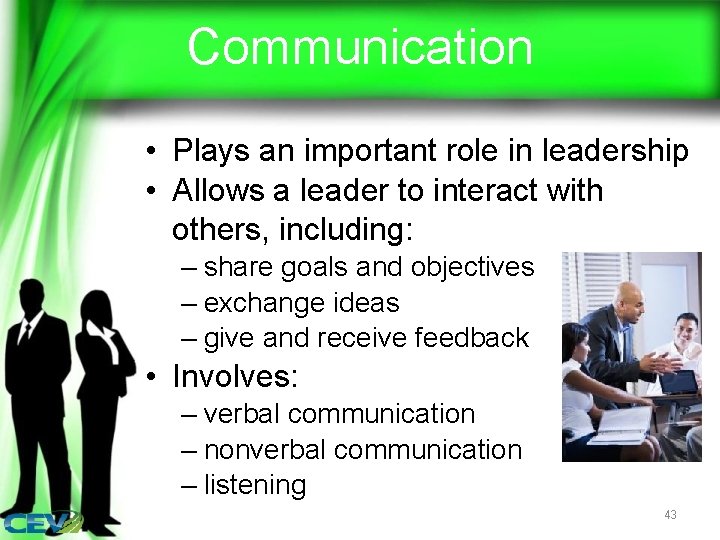
Communication • Plays an important role in leadership • Allows a leader to interact with others, including: – share goals and objectives – exchange ideas – give and receive feedback • Involves: – verbal communication – nonverbal communication – listening 43
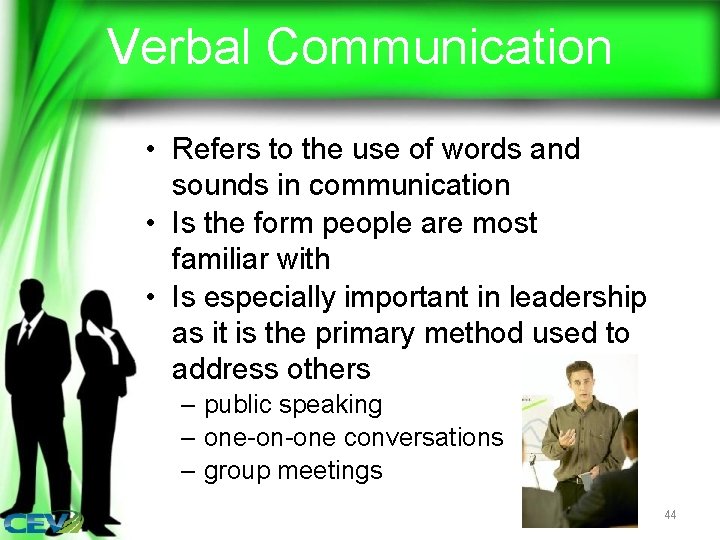
Verbal Communication • Refers to the use of words and sounds in communication • Is the form people are most familiar with • Is especially important in leadership as it is the primary method used to address others – public speaking – one-on-one conversations – group meetings 44
Verbal Communication • Is most effective when the leader is: – clear § leaders run the risk of having to take time to explain the information again if not clear – concise § too much information may result in group members becoming confused, misinformed or overwhelmed – confident § leaders with shaky voices who repeatedly correct themselves may have a hard time inspiring others to work hard 45
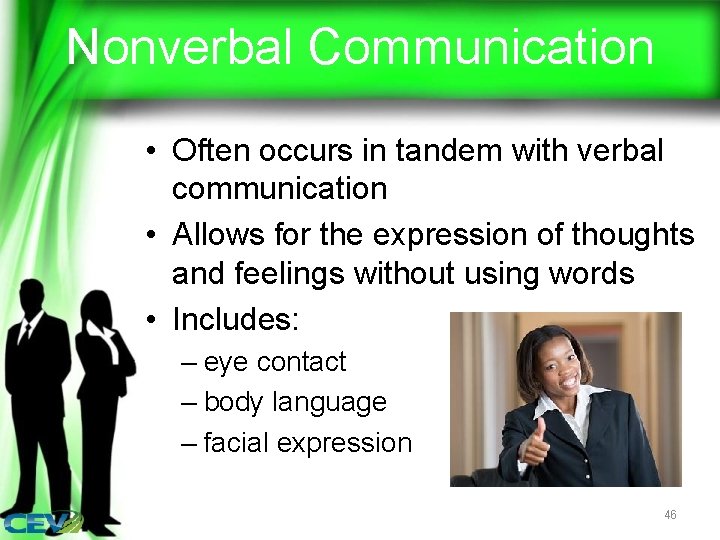
Nonverbal Communication • Often occurs in tandem with verbal communication • Allows for the expression of thoughts and feelings without using words • Includes: – eye contact – body language – facial expression 46
Eye Contact • Should be maintained whenever speaking to someone – when addressing a group, make eye contact with various members to make everyone feel included • Portrays speakers’ confidence in themselves and their messages • Aids in keeping listeners engaged and focused on what is being said 47
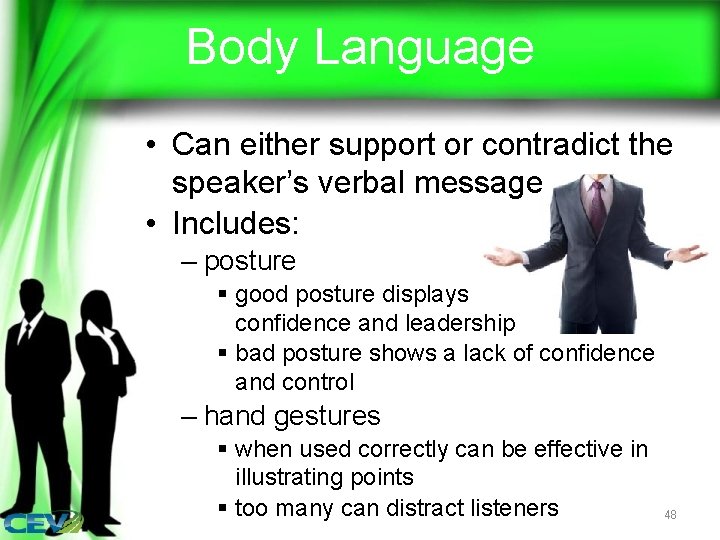
Body Language • Can either support or contradict the speaker’s verbal message • Includes: – posture § good posture displays confidence and leadership § bad posture shows a lack of confidence and control – hand gestures § when used correctly can be effective in illustrating points § too many can distract listeners 48
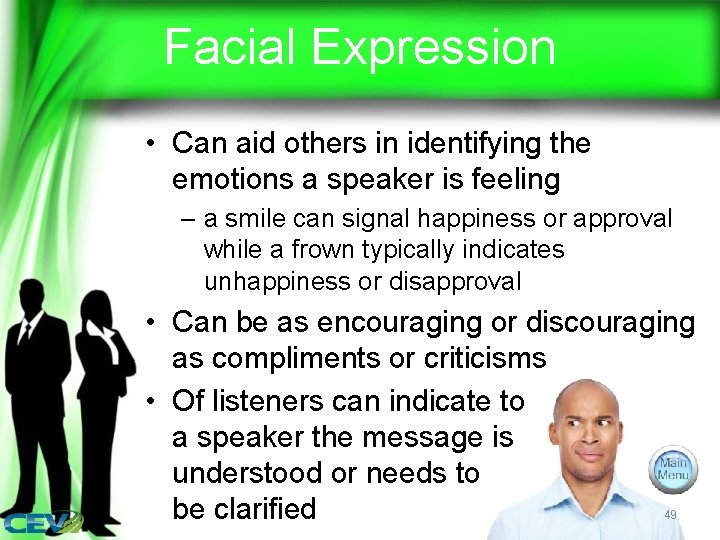
Facial Expression • Can aid others in identifying the emotions a speaker is feeling – a smile can signal happiness or approval while a frown typically indicates unhappiness or disapproval • Can be as encouraging or discouraging as compliments or criticisms • Of listeners can indicate to a speaker the message is understood or needs to be clarified 49
Assessment 50
Assessment 1. Which type of communication is especially important in leadership as it is the primary method used to address others? A. B. C. D. Verbal communication Written communication Nonverbal communication Digital communication 51
Assessment 2. To prevent too much information resulting in group members becoming confused, misinformed or overwhelmed, verbal communication should be which of the following? A. B. C. D. Clear Coherent Confident Concise 52
Assessment 3. Which of the following is true of nonverbal communication? A. It includes e-mail and texting B. It is most effective when it occurs without verbal communication C. It allows for expression of thoughts without using words D. It is not an effective type of communication 4. Which of the following portrays speakers’ confidence and aids in keeping listeners engaged and focused on what is being said? A. B. C. D. Compliments Facial expression Specific instructions Eye contact 53
Assessment 5. Posture and hand gestures are included in which type of communication? A. B. C. D. Facial expression Body language Verbal communication Digital communication 54
55
Groups • Allow for and encourage different ideas to be discussed by members – results in expanded perspectives, new ideas, building on concepts and many other benefits • Can allow large tasks to be broken into smaller parts – results in the task becoming more manageable and allows for it to be completed in a more timely manner 56
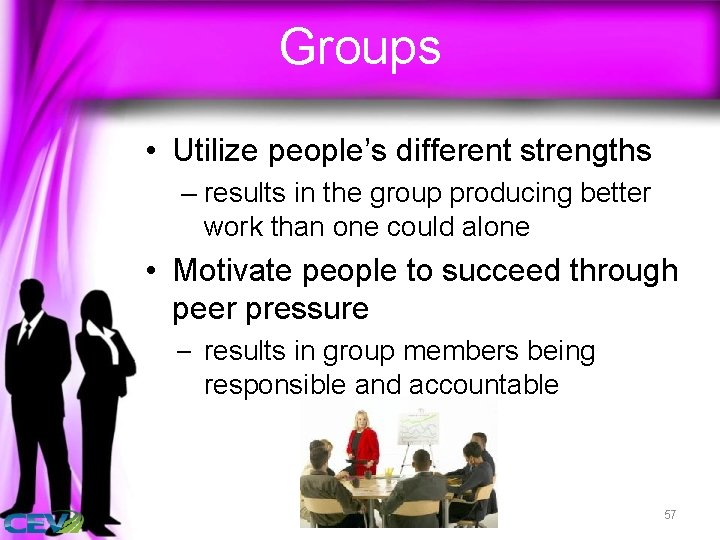
Groups • Utilize people’s different strengths – results in the group producing better work than one could alone • Motivate people to succeed through peer pressure – results in group members being responsible and accountable 57
Types of Groups • Include: – formal groups – informal groups 58
Formal Groups • Are formed with the purpose of achieving organizational goals • Include: – command groups – task groups – affinity groups 59
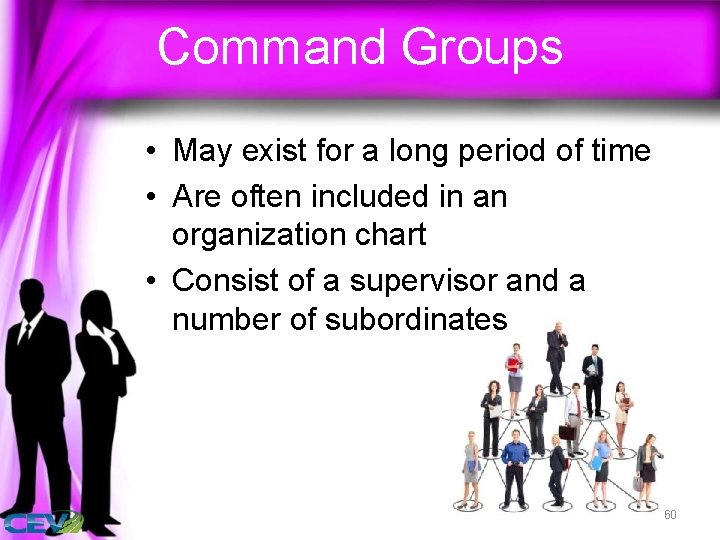
Command Groups • May exist for a long period of time • Are often included in an organization chart • Consist of a supervisor and a number of subordinates 60
Task Groups • Exist for a relatively short period of time • Are established to accomplish a specific project • Could possibly include members who have not worked together before 61
Affinity Groups • Are collections of employees which share responsibility and duties • May consist of members from the same level in the organization • Usually exist longer than task groups 62
Informal Groups • Are developed naturally based on shared interests and values of group members • May take the form of: – friendship groups – interest groups 63
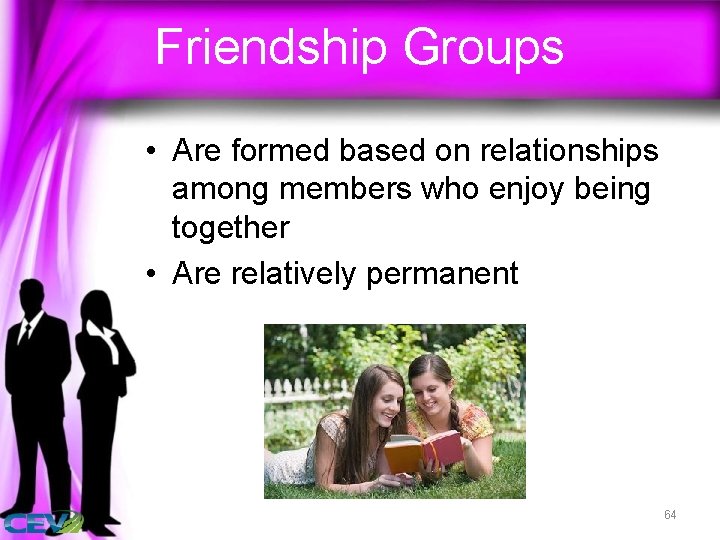
Friendship Groups • Are formed based on relationships among members who enjoy being together • Are relatively permanent 64
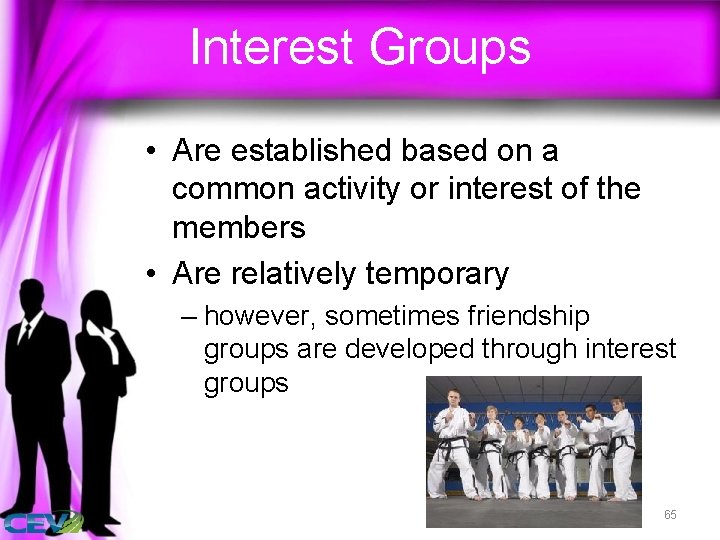
Interest Groups • Are established based on a common activity or interest of the members • Are relatively temporary – however, sometimes friendship groups are developed through interest groups 65
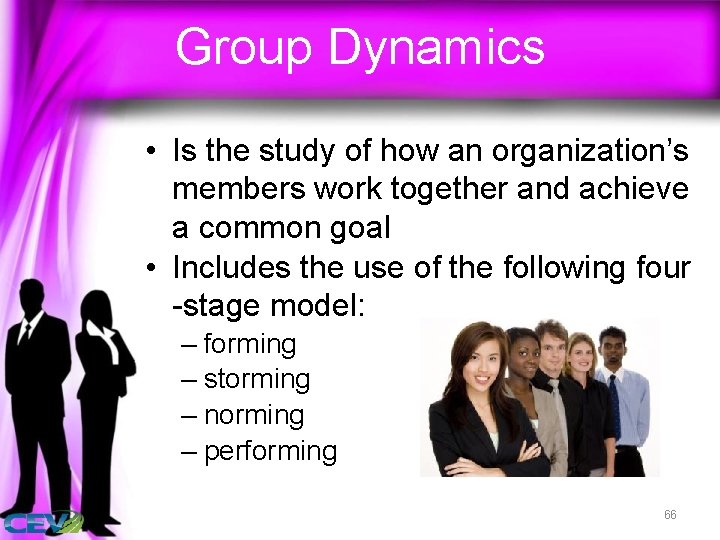
Group Dynamics • Is the study of how an organization’s members work together and achieve a common goal • Includes the use of the following four -stage model: – forming – storming – norming – performing 66
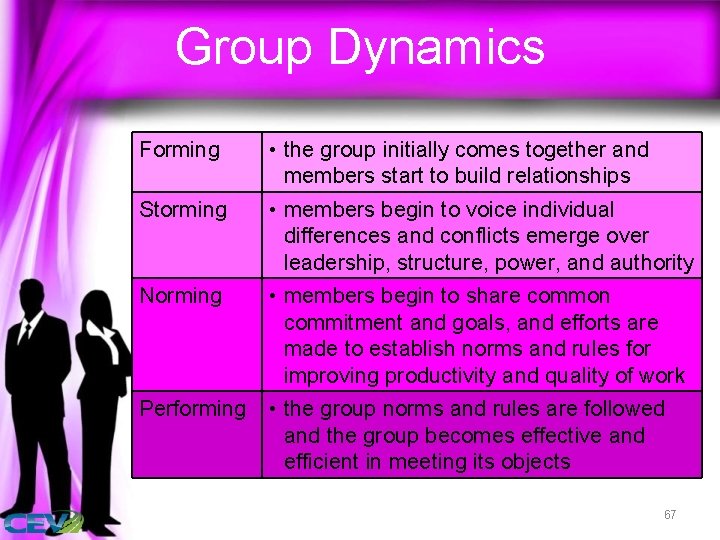
Group Dynamics Forming Storming Norming Performing • the group initially comes together and members start to build relationships • members begin to voice individual differences and conflicts emerge over leadership, structure, power, and authority • members begin to share common commitment and goals, and efforts are made to establish norms and rules for improving productivity and quality of work • the group norms and rules are followed and the group becomes effective and efficient in meeting its objects 67
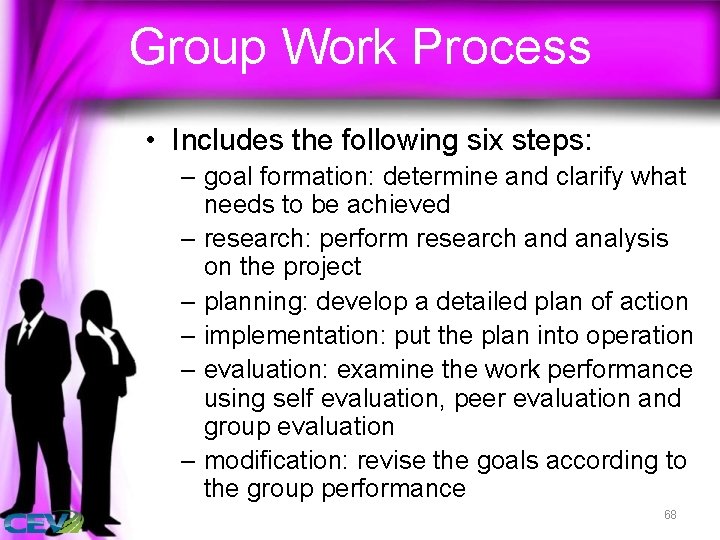
Group Work Process • Includes the following six steps: – goal formation: determine and clarify what needs to be achieved – research: perform research and analysis on the project – planning: develop a detailed plan of action – implementation: put the plan into operation – evaluation: examine the work performance using self evaluation, peer evaluation and group evaluation – modification: revise the goals according to the group performance 68
Group Leadership • Involves one person directing the group work process and dealing with group dynamics • Can be difficult with different personality types in one group – good leaders are able to identify these different personalities and use them to the group’s advantage • Utilizes leadership styles – in conjunction with one another or separately depending on the situation 69
Group Leadership • Involves the following: – ensuring everyone is working toward the same goal by clearly stating the goals and objectives – prioritizing what is important and must be accomplished – identifying the strengths and weaknesses of group members – delegating tasks to members according to their strengths 70
Analyzing Group Effectiveness • Can occur during a task or after it is completed – productivity levels can be measured as the task is being completed – when the task is over, compare the result to the vision • Is important to let the leader know where strengths and weaknesses are • Provides the leader knowledge of what improvements can be made 71
Evaluation of Group Work • Is essential for: – reviewing the team’s performance – improving the team’s productivity 72
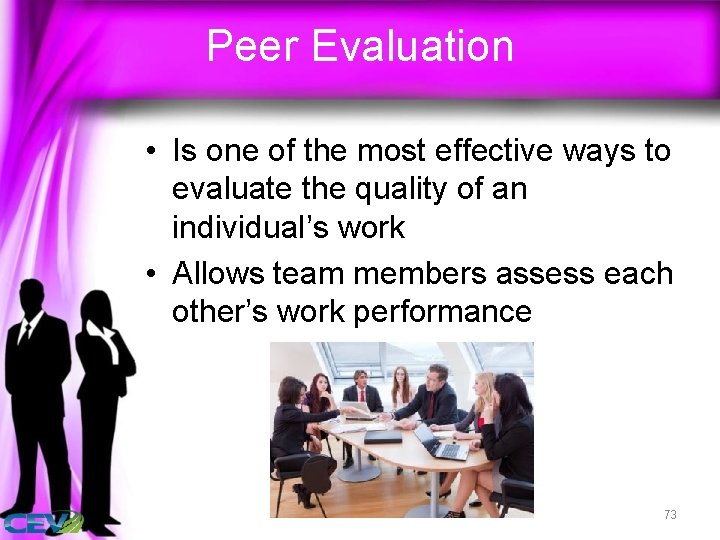
Peer Evaluation • Is one of the most effective ways to evaluate the quality of an individual’s work • Allows team members assess each other’s work performance 73

Peer Evaluation • Rules and format should be announced before beginning • Should include feedback for improvement 74
Assessment 75
Assessment 1. Which of the following is NOT a type of formal group as discussed in the segment? A. B. C. D. Affinity group Command group Interest group Task group 2. Collections of employees which share responsibility and duties are known as which of the following? A. B. C. D. Affinity groups Task groups Informal groups Interest groups 76
Assessment 3. Which of the following is the term for the study of how an organization’s members work together to achieve a common goal? A. B. C. D. Group interest Group discovery Group process Group dynamics 4. How many steps are included in the group work process? A. B. C. D. Four Five Six Seven 77
Assessment 5. According to the segment, which of the following is true of peer evaluation? A. It is not an effective way to evaluate the quality of an individual’s work B. It should not include rules or format requirements C. It creates conflict and division among team members D. It should include feedback for improvement 78
Assessment 79
Assessment 1. Which of the following is NOT a leadership style identified by Kurt Lewin? A. B. C. D. Authoritarian Participative Abdicratic Laissez faire 2. Which personality trait was discussed as being perhaps the most important trait for a leader? A. B. C. D. Vision Fairness Integrity Confidence 80
Assessment 3. Amber has to give a presentation to her class tomorrow. Since she will be using verbal communication to explain her project, it is important for her speech to be all the following except: A. B. C. D. Clear Coherent Confident Concise 81
Assessment 4. Analyzing group effectiveness allows the leader to: A. B. C. D. Identify strengths Measure productivity levels Compare the results to the vision All of the above 5. Which of the following is NOT a form of nonverbal communication? A. B. C. D. Eye contact Texting Facial expression Body language 82
Assessment 6. Which group of children did Lewin find to be least creative? A. B. C. D. Authoritarian Participative Abdicratic Laissez faire 7. The purpose of groups is to: A. B. C. D. Break large tasks into smaller parts Allow different ideas to be discussed Expand group members’ perspectives All of the above 83
Assessment 8. Blake recently started a new job. His boss, Hailey, tells him the tasks which need to be done but gives him no instructions on how to do them. Blake has to get these jobs done before he can go home and must figure out how to do them on his own. Which style of leadership is Hailey practicing? A. B. C. D. Authoritarian Participative Abdicratic Laissez faire 84
Assessment 9. Which of the following is NOT one of the purposes of groups? A. B. C. D. Motivate the group to work harder Take advantage of people’s different strengths Shift workload to other people in the group Break the task into manageable parts 10. Which of the following group types is established by the organization to accomplish a specific project? A. B. C. D. Task group Interest group Command group Affinity group 85
Sources • • • "Kurt Lewin's Leadership Styles. " Business Management | Business Models. Web. 08 July 2010. <http: //www. businessmate. org/Article. php? Artikel. Id=31>. "Leadership Traits. " Small Business Notes. Web. 08 July 2010. <http: //www. smallbusinessnotes. com/operating/leadership. h tml>. Griffin, R. & Moorhead, G. (2010). Organizational behavior: Managing people and organizations (9 th ed. ). Mason, OH: Cengage Learning. "Group Leadership. " Web. 08 July 2010. <http: //www. abacon. com/commstudies/groups/leader. html>. Lee, J. A. (1980). The gold and the garbage in management theories and prescriptions. Athens, OH: Ohio University Press. Lewin, K. , Lippitt, R. , & White, R. K. (1939). Patterns of aggressive behavior in experimentally created social climates. Journal of Social Psychology, 10, 271 -279. O'Hair, Dan, Robert A. Stewart, and Hannah Rubenstein. Speaker's Guidebook: Text and Reference. New York, NY: Bedford/St. Martins, 2010. Print. Peer assessment and peer evaluation (2001). Retrieved on February 13, 2011, from http: //www. foundationcoalition. org/home/keycomponents/teams/peer_a sses_eval. html. Rothwell, J. D. (2004). In mixed company: Communicating in small 86 groups and teams (5 th ed. ). Belmont, CA: Thomson Wadsworth.
Acknowledgments Production Coordinator: Brandon O’Quinn & Amy Hogan Production Manager: Maggie Bigham Brand Manager: Executive Producers: Megan O’Quinn Gordon Davis, Ph. D. , Graphic Designer: Jeff Lansdell Daniel Johnson © MMXIV CEV Multimedia, Ltd. 87
- Slides: 87