
1 Objectives To explain civil law enforcement procedures
1
Objectives • To explain civil law enforcement procedures. • To understand civil process service and how it is used in civil legal cases. 2
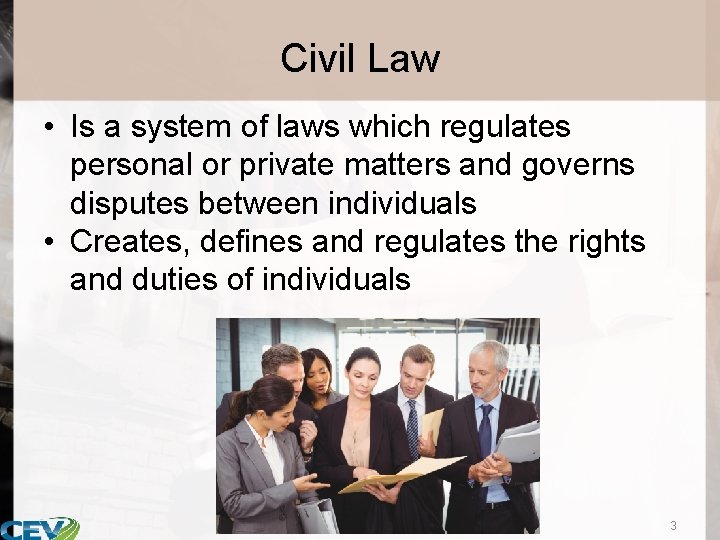
Civil Law • Is a system of laws which regulates personal or private matters and governs disputes between individuals • Creates, defines and regulates the rights and duties of individuals 3
Civil Law • Includes two parties – plaintiff • the person who brings a case against another in a court of law • the person who a civil law has allegedly been committed against by the defendant – defendant • the person who the case is brought against in a court of law • the person who allegedly committed the civil crime against the plaintiff 4
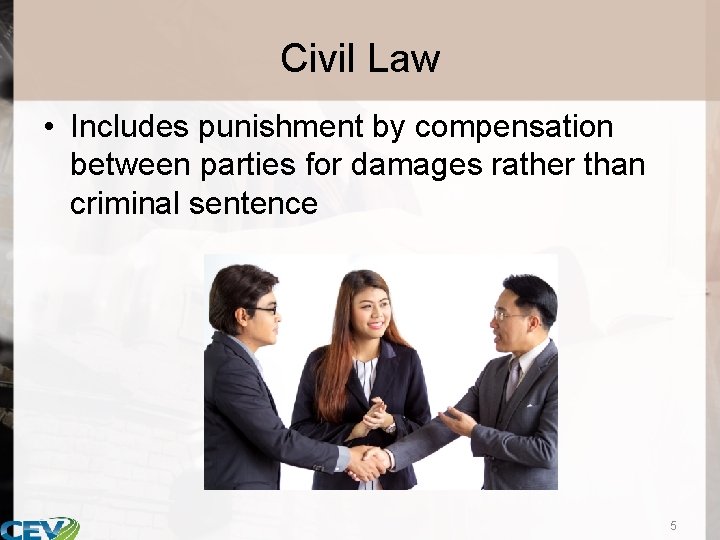
Civil Law • Includes punishment by compensation between parties for damages rather than criminal sentence 5
Civil Law • Can result in law enforcement officer involvement, such as: – preventing or stopping assault • one party assaulting another • defendant assaulting a person serving legal documents regarding their case – mediating disagreements between parties – defusing a hostile situation between parties – enforcing punishment for civil wrongdoings 6
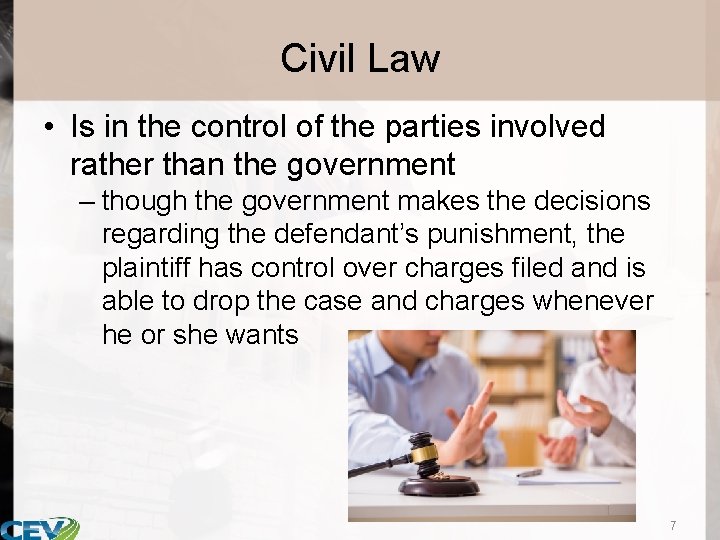
Civil Law • Is in the control of the parties involved rather than the government – though the government makes the decisions regarding the defendant’s punishment, the plaintiff has control over charges filed and is able to drop the case and charges whenever he or she wants 7
Civil Process • Begins when the plaintiff files a lawsuit stating what he or she wants done, such as: – ordering the defendant to pay damages – prohibiting the defendant from coming near them – ordering the defendant to cease a certain action 8
Civil Procedure • Begins when a person commits an offense against any of the following types of civil law: – tort law – contract law – property law – family law 9
Tort Law • Refers to the set of laws which provide remedies to individuals who have been injured by the wrongful acts of others • Holds people liable for the consequences of their actions, whether intentional or accidental – a victim can file a lawsuit against a person who violated a tort law against them 10
Tort Law • Includes three categories: – negligence – intentional tort – strict liability 11
Negligence • Refers to unintentional wrongdoing • Occurs when a person acts with reckless disregard of another person without intent to cause harm • Can include: – a diver accidently running a stop sign – a restaurant owner who mops the slippery floor, does not put up a "wet floor" sign and a customer slips 12
Intentional Tort • Refers to intentional wrongdoing • Occurs when a person acts with intent to cause harm or injury • Can include: – drunk driving • driving under the influence of alcohol knowing it poses a risk to others – assault • a physical attack on another – fraud • deceiving someone for financial or personal gain 13
Strict Liability • Occurs when someone has a strict duty to ensure something is safe – holds a person or company legally responsible for damages or injury • Includes categories such as: – animals owned or possessed • a pet dog biting another person – abnormally dangerous acts • disposing of chemical waste – product liability • a manufacturer selling a defected product 14
Contract Law • Deals with agreements between two or more parties, each of which is obligated to hold up their portion of the agreement • Protects transactions involving goods and services • States if a person breaks the terms of the contract agreement they can be held legally responsible 15
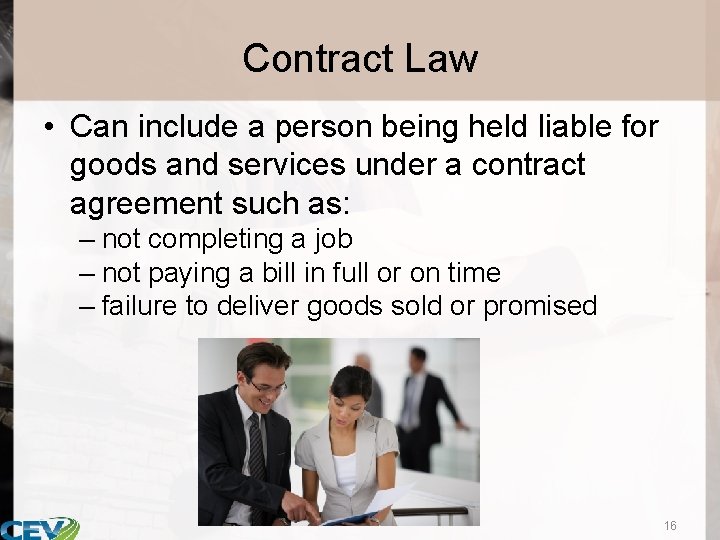
Contract Law • Can include a person being held liable for goods and services under a contract agreement such as: – not completing a job – not paying a bill in full or on time – failure to deliver goods sold or promised 16
Property Law • Are laws which deal with property owned by a person or entity • Includes crimes such as: – trespass • entering another person’s property without their consent – conversion • taking away another person’s property without their consent 17
Family Law • Is the branch of civil law dealing with issues affecting families such as: – marriage – divorce – child custody – adoption – child support • Includes laws which protect family members against domestic violence 18
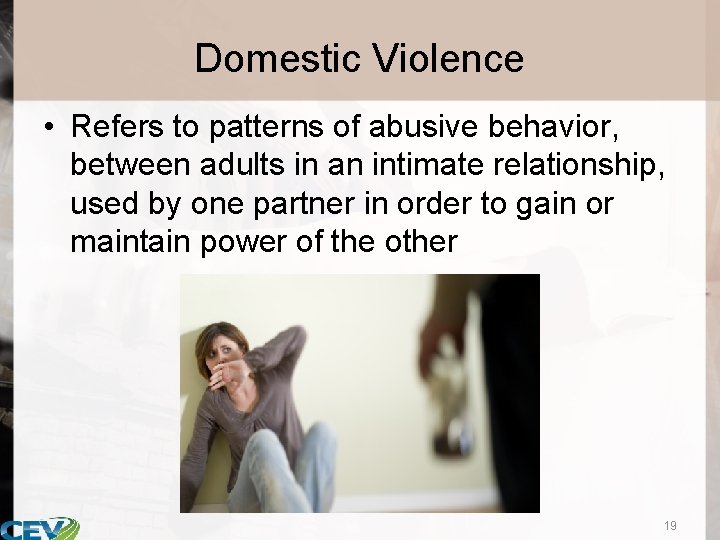
Domestic Violence • Refers to patterns of abusive behavior, between adults in an intimate relationship, used by one partner in order to gain or maintain power of the other 19
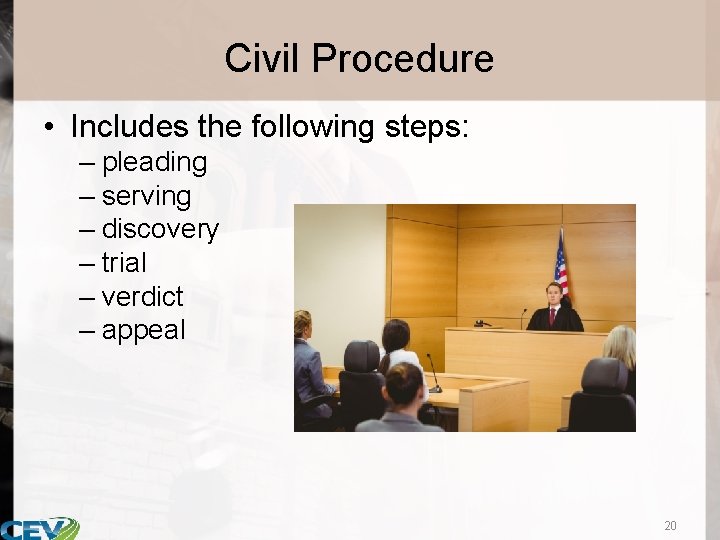
Civil Procedure • Includes the following steps: – pleading – serving – discovery – trial – verdict – appeal 20
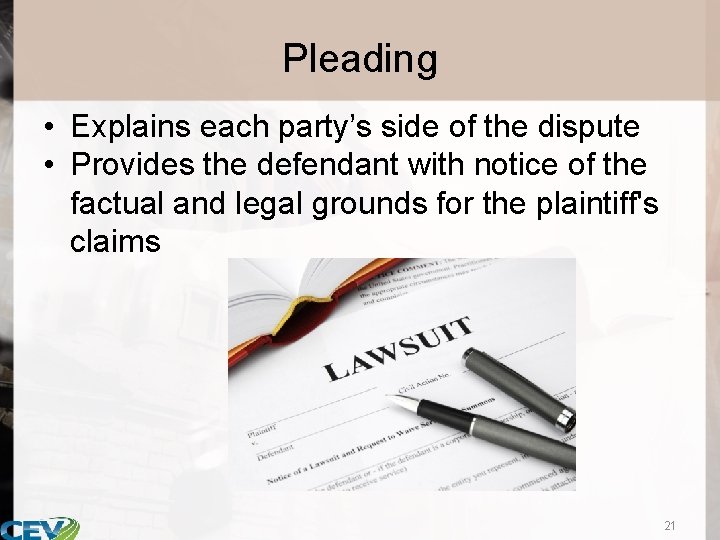
Pleading • Explains each party’s side of the dispute • Provides the defendant with notice of the factual and legal grounds for the plaintiff's claims 21
Pleading • Describes: – the defendant’s offense against the plaintiff – the legal basis for holding the defendant responsible • Is formally delivered to the defendant through a practice called delivery – begins the lawsuit 22
Serving • Is the physical transfer of a legal document from one person to another • Is performed by process servers to legally validate the transfer 23
Process Servers • Are individuals authorized by law to serve legal documents • Were originally only members of courts and law enforcement, however, legislation was written where others could become process servers to relieve law enforcement of some of the burden 24
Process Servers • Can include: – law enforcement officers – private process servers • some states require process servers to be licensed • some states allow all persons over the age of 18 to be servers as long as they are not involved with the case • Are required to follow laws and regulations when serving legal documents in order to avoid abuse of service 25
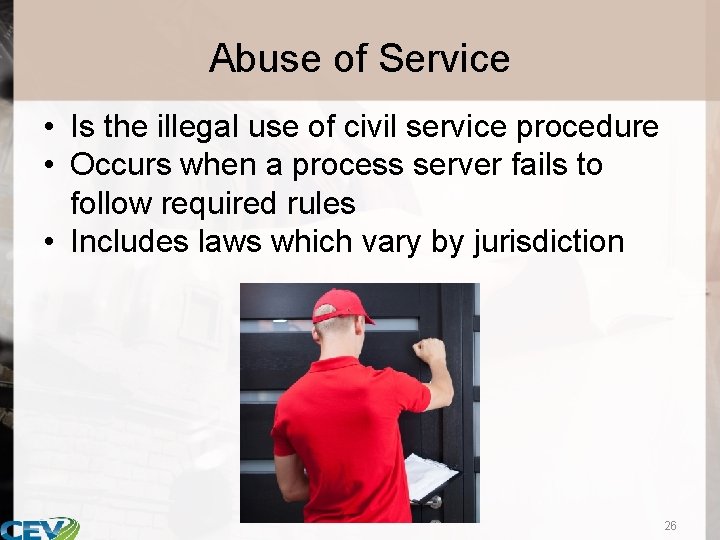
Abuse of Service • Is the illegal use of civil service procedure • Occurs when a process server fails to follow required rules • Includes laws which vary by jurisdiction 26
Abuse of Service • Includes: – using excessive force – serving legal papers to a person in which no legal process has been initiated – filing a false lawsuit in order to gain information – illegally forcing payment – violating right to approach a residence – entering private property through physical boundaries – harassing the person who is to be served 27
Abuse of Service • Includes serving people who lack the legal capability to make competent decisions regarding civil actions, such as: – a person who suffers a mental illness – children under the age of 18 • if these people are named in a lawsuit, documents should be served to an appointed person who is approved to make legal decisions for them 28
Process Servers • May have to make multiple attempts to deliver legal documents to the person’s home or place of work if the person to be served is absent • Must get proof of service from the recipient once the legal document has been successfully delivered • Deliver legal court documents in the form of writs 29
Writs • Are written commands from the court to act or abstain from acting in some way • Administer civil law procedure • Include types which require a person to appear in court, such as: – writ of summons • an official order requiring someone to attend court – writ of subpoena • commands the attendance in court, as a witness, of the person on whom it is served, under a penalty 30
Discovery • Is the act of both sides of the lawsuit sharing information to learn strengths and weaknesses within their cases before the trial – the parties ask each other and third parties for information about the facts and issues of the case • Includes conducting depositions – questioning and recording witnesses under oath 31
Trial • Is the formal hearing of the case by the judge and jury • Includes: – examining witnesses – presenting evidence – the plaintiff and defendant presenting their arguments • Includes a verdict about the case being made by the judge and jury 32
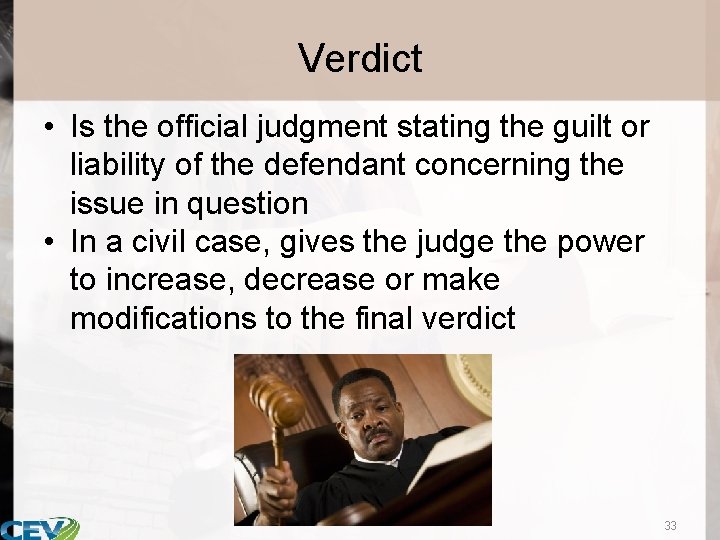
Verdict • Is the official judgment stating the guilt or liability of the defendant concerning the issue in question • In a civil case, gives the judge the power to increase, decrease or make modifications to the final verdict 33
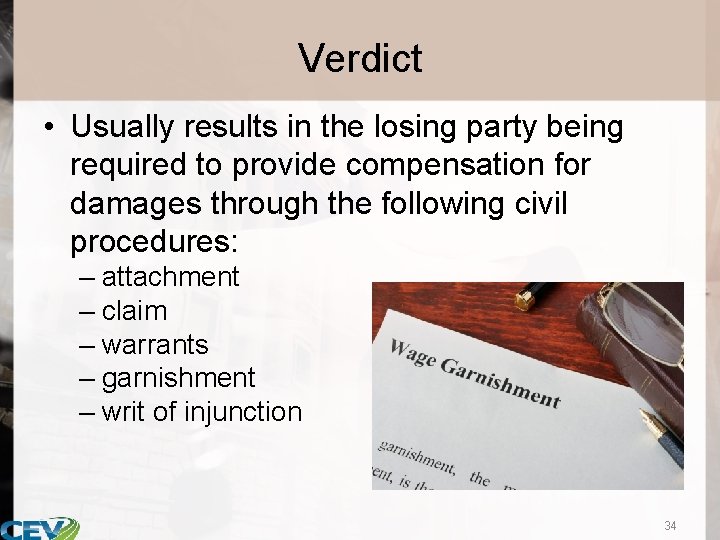
Verdict • Usually results in the losing party being required to provide compensation for damages through the following civil procedures: – attachment – claim – warrants – garnishment – writ of injunction 34
Attachment • Is the seizing of money or property • Is used to: – seize specific property – hold a person’s property until they pay off their debt • Is used to enforce property law 35
Claim • Is a legal demand of an asset or right which one party owes another • Includes a plaintiff suffering a loss from the defendant and requesting for the defendant to compensate for the loss • Is typically taken to legally obtain: – money – property – enforcement of a right provided by law • Is used to enforce property law 36
Warrants • Are used in civil cases for matters of repossessing property or monetary judgment • Are used by the plaintiff in order to repossess wrongfully withheld personal property • Are used to enforce property law Monetary Judgment: a court order which awards a plaintiff a sum of money 37
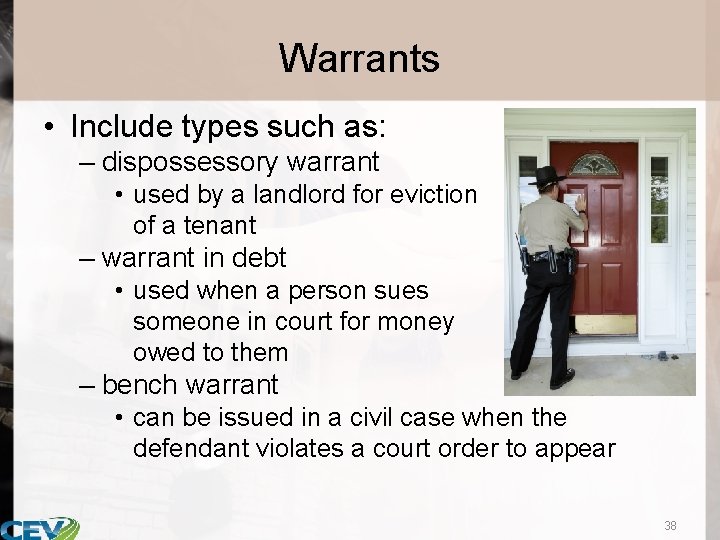
Warrants • Include types such as: – dispossessory warrant • used by a landlord for eviction of a tenant – warrant in debt • used when a person sues someone in court for money owed to them – bench warrant • can be issued in a civil case when the defendant violates a court order to appear 38
Garnishment • Is used to collect a debt from a third party rather than directly from the defendant – for example: • a court can order the defendant’s employer to withhold a certain amount of their wages for payment of: – child support – student loans – back taxes • Is used to enforce family law 39
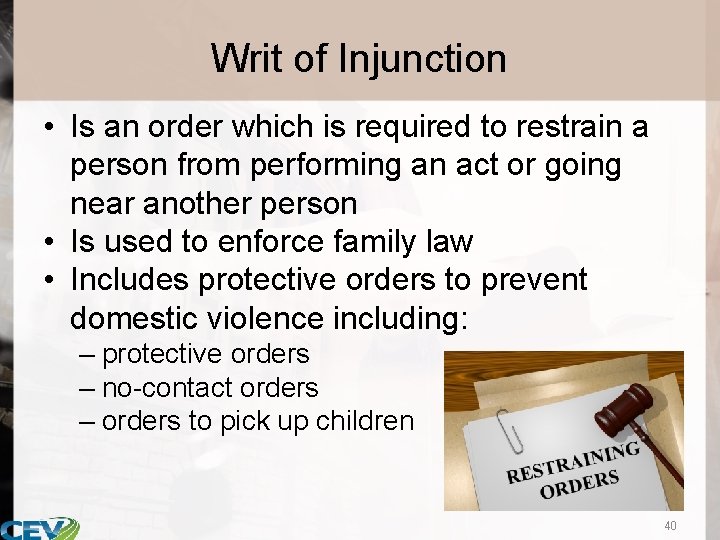
Writ of Injunction • Is an order which is required to restrain a person from performing an act or going near another person • Is used to enforce family law • Includes protective orders to prevent domestic violence including: – protective orders – no-contact orders – orders to pick up children 40
Protective Orders • Forbid a person from engaging in certain activities which affect the victim, such as: – prohibiting a person from contacting another – requiring a person to move out of the home of the victim – requiring a person to keep a certain amount of distance from the victim at all times – awarding sole custody of children 41
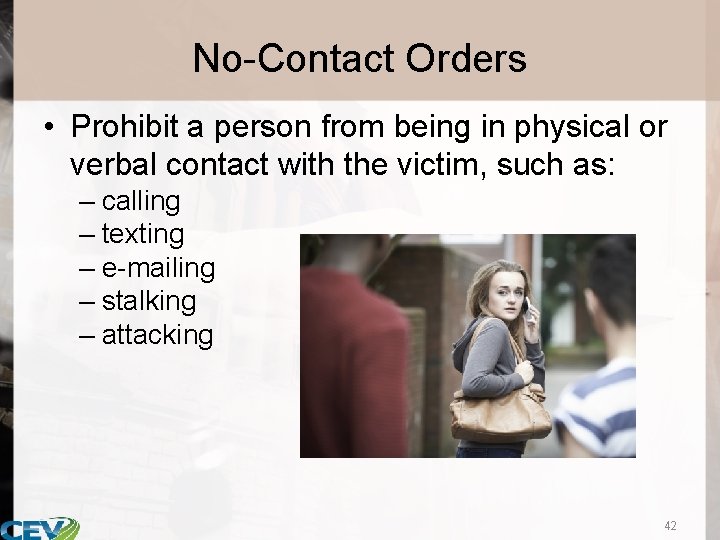
No-Contact Orders • Prohibit a person from being in physical or verbal contact with the victim, such as: – calling – texting – e-mailing – stalking – attacking 42
Orders to Pick Up Children • Direct a law enforcement officer to take a minor from the person who currently has physical possession of the child and deliver the minor to a person with legal rights over the child • Are requested when a person fears for a child's safety 43
Appeal • Occurs when the losing party is dissatisfied with the result of the case and asks a higher court to reverse the decision – there must be legal basis • an alleged error in the trial or violation of constitutional rights 44
Resources • https: //www. texasattorneygeneral. gov/cvs/protective-orders • https: //legaldictionary. net/civil-law/ • http: //research. lawyers. com/attachment-garnishment-andreplevin. html • http: //www. lectlaw. com/def 2/s 034. htm • https: //legaldictionary. net/tort-law/ • http: //www. uscourts. gov/about-federal-courts/types-cases/civil-cases • http: //www. processservers. com/resources/faqs#faq 13 • https: //www. britannica. com/topic/tort/Tort-law-and-alternativemethods-of-compensation#toc 16482 • http: //civilrights. findlaw. com/enforcing-your-civil-rights/thegovernment-s-role-in-civil-rights-enforcement. html • http: //legal-dictionary. thefreedictionary. com/civil+law • http: //litigation. findlaw. com/filing-a-lawsuit/civil-cases-vs-criminalcases-key-differences. html • http: //family. findlaw. com/domestic-violence-orders -of-protection-and-restraining-orders. html 45
Acknowledgements Production Coordinator Tylee Williams Brand Manager Amy Hogan Graphics Editor Melody Rowell V. P. of Brand Management Clayton Franklin Quality Control Director Angela Dehls © MMXVII CEV Multimedia, Ltd. Executive Producer Gordon W. Davis, Ph. D. 46
- Slides: 46