
1 Objectives Have a common vision for small
1
Objectives • Have a common vision for small groups within our corps • Understand the concept of authentic relationships and have practical ideas for fostering these within your groups • Have the basic facilitation skills needed to encourage participation and openness by all members of your small group • Have had exposure to various ideas for running small group sessions, including openers, worshipping and praying in small groups • Be able to start a small group • Know where to go to get assistance 2
Agenda Session One 1. Common vision 2. Small group meetings 3. Building authentic relationships Session Two 4. Small group leadership roles 5. Facilitation skills 6. How to start a small group 7. What else, resources 8. Summary 3
Common Vision Session 1 4
Small group vision • Corps have a wide range of small groups. What are some examples? • What do they all have in common? What goals do they share? • How are they different? • If a small group was referred to as being ‘holistic’, what do you think that might cover? 5
Small group vision • Natural Church Development definition of holistic small groups – groups where Christians find: – Intimate community • A place of authentic relationships – Practical help • Relevant, useful – Intensive spiritual interaction • Help grow in their relationship with God • How might a music team be ‘holistic’? • How might a craft group be ‘holistic’? • How might a home/life group not be ‘holistic’? 6
Small group vision • Vision is for all groups to be ‘holistic’ – places where Christians find intimate community, practical help and intensive spiritual interaction • This course is aimed at home/life groups • Most of it also applies to any small group aiming to be holistic – Authentic relationships – Interaction (facilitation) 7
Logistics • Groups can choose where and when they meet, and with whom • There are various tips in the manual We think groups should meet at least fortnightly and include regular social events ‘Open’ groups tend to be more healthy – Only add 1 -2 people at a time to let the group re-settle 8
Running a Small Group Meeting Session 2 9
Running a small group meeting • A proposed structure for small group meetings is: – Welcome (until time to start): as people arrive, friendly discussion about the week, to create a welcoming environment – Opening / Ice-breaker (5 -10 mins): a warm-up question, particularly useful for new groups – Worship (optional) (15 mins): a short time of worship – Body (45 -60 mins): the study with application – Prayer (15 mins): looking within and without – Food: enables you to keep talking to people – could be first • This structure covers the three components of a holistic small group, and provides a natural flow from warming up, through to study and personal application, then an opportunity to pray for each other and the commitments made during the study. 10
Welcome and Icebreakers • People don’t care how much you know until they know how much you care • Welcome time is important – A time to ask (and remember) what has been happening in the lives of group members – Take notes each week if remembering doesn’t come naturally to you – You may want to formalise this, by asking people to provide ‘praise reports’ – what’s been happening • Start the ‘formal’ part on time – Then you’ll find people won’t be late • In the early stages of a group, use an icebreaker questions to get to know each other (ideas in the manual) • Once these become ‘corny’, use an opener instead – a question that gets people thinking about the topic for the meeting. 11
Worship • Some small groups enjoy singing together – most don’t! • Each group to decide what works best for them • A time connecting with God can only be good. Try: – – Listening to music Sharing short prayers of adoration Reading passages of Scripture or words to songs Quietness • Try not to become predictable 12
Body • It’s all about application The scriptures were not given for our information, but for our transformation. DL Moody • Have only one key idea or theme • Think of yourself as a facilitator, not a teacher (more questions, less presenting) • There are many good books available to use as the basis for your study (refer Appendix A) • There also lots of ideas for structuring a lesson in the manual (Session 2 – Body) • Make sure you end with a time to consider how you will apply what you have learned. What will you do as a result of this study. 13
Prayer • Prayer is vital to spiritual health, both for individuals and groups • Many people will be uncomfortable praying. You can make them even more uncomfortable by having people pray for long periods in spiritualese • Your aim should be to encourage lots of people to pray, so let the group in on the game plan. We: – Ask for prayer topics up front – Encourage short 1 -2 sentence prayers for one topic at a time – People who want to pray for more than one thing can pray multiple times – Prompt people – ‘will someone please pray for …’ • Consider using a structure (e. g. ACTS – Adoration, Confession, Thanksgiving, Supplication) • Keeping a prayer diary is a great way to track answers to prayer and so deepen faith 14
Food and Social Interaction • Food is a great way to break down barriers and for developing relationships • Your host(ess) may enjoy ‘entertaining’. Otherwise, ask all group members to bring a contribution to share • Depending on when you meet, you may wish to start with food, end with food, or do both! • Similarly, regular social events help build community 15
Preparation and Follow-up • The amount of time you spend preparing is up to you (you reap what you sow) • As a minimum: – Pray for your group members – Prepare your meeting – Note particular issues so that you can ask about them next time you meet – Be the first point of contact for group members requiring extra pastoral care • Preferred: – Contact group members occasionally outside of the meeting (e. g. phone call, café, cards, etc. ) 16
Authentic relationships Session 3 17
Authentic relationships • Developing authentic relationships is critical to all ‘holistic’ groups • Permeate all aspects of group life, especially outside of the meeting • Must be intentional • Have five components: – – – Self Disclosure: Know and be Known Care Giving: Love and be Loved Humility: Serve and be Served Truth Telling: Admonish and be Admonished Affirmation: Celebrate and be Celebrated “We believe that authentic relationships facilitate life change” 18
Components of authentic relationships Self Disclosure: Know and be Known • Build trust (honour confidentiality, reduce belittling/teasing) • Ask questions that help people open up • Use relevant Icebreaker/Openers • Listen first, and remember • Take risks (e. g. re-write material to suit) • Be prepared to model vulnerability If you want people to really know you, you have to really get to know them. 19
Components of authentic relationships Care Giving: Love and be Loved • Notice – Active listening – Take notes • Act (thoughtful remembering) – Sending emails, notes, cards, flowers or making phone calls – Remembering birthdays – Delivering meals – Really noticing • Prepare for each meeting by thinking about each individual member of your group People communicate things to us all the time. To show we care, we have to Notice and Act. 20
Components of authentic relationships Humility: Serve and be Served • Serving members of the group (‘act’ from previous slide) • Serving outside the group creates an atmosphere of humility • Try to find a suitable project outside the group Serving often goes unnoticed, but not serving sticks out like a sore thumb. 21
Components of authentic relationships Truth Telling: Admonish and be Admonished • Withholding the truth robs people of opportunities for spiritual growth You do not have the right to admonish members of your group, if they do not perceive that you are working on knowing, loving and serving them. • Pray for them before you sit down • Listen intently – the person may already have identified the issue and be working to resolve it • Converse • Admonish actions, not people. Only speak facts • Control your emotions • Pray together 22
Components of authentic relationships Affirmation: Celebrate and be Celebrated We live in an affirmation deprived culture • Ideas for encouraging affirmation within your group – Write each member’s name on individual pieces of paper (one page person), then have everyone in the group write something encouraging for each member – Have someone sit on a chair in the middle, and have everyone else pray for that person 23
Authentic relationships – Summary • Authentic relationships must be intentional • It’s a risky business, and needs to be modelled by the leader • What is the cost of failure? – Mediocre relationships? – Lonely, unsupported people, who will eventually come to the conclusion that Small Groups don’t work. They may never try again. 24
Leadership Structure and Roles Session 4 25
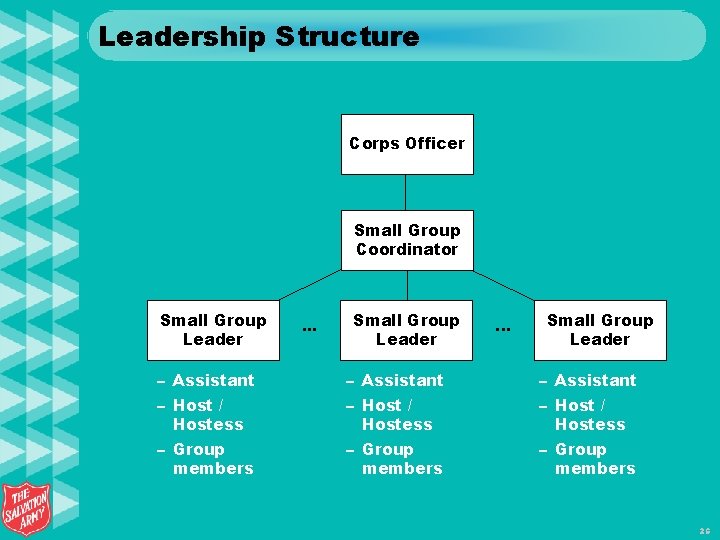
Leadership Structure Corps Officer Small Group Coordinator Small Group Leader . . . Small Group Leader – Assistant – Host / Hostess – Group members 26
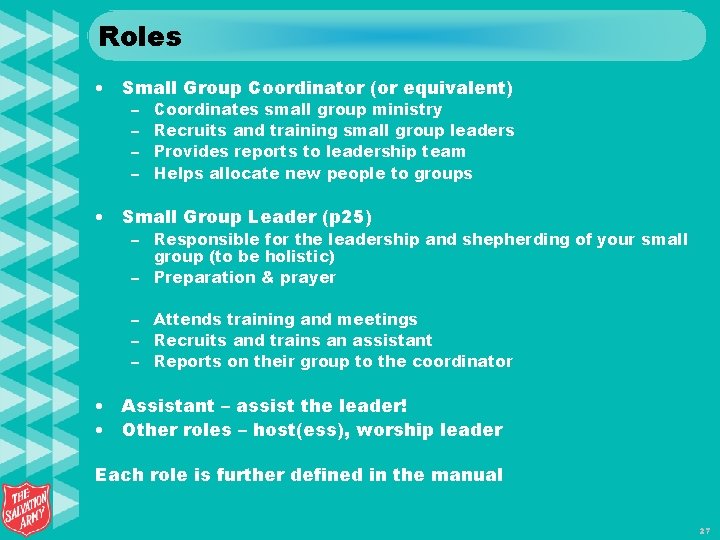
Roles • Small Group Coordinator (or equivalent) – – Coordinates small group ministry Recruits and training small group leaders Provides reports to leadership team Helps allocate new people to groups • Small Group Leader (p 25) – Responsible for the leadership and shepherding of your small group (to be holistic) – Preparation & prayer – Attends training and meetings – Recruits and trains an assistant – Reports on their group to the coordinator • Assistant – assist the leader! • Other roles – host(ess), worship leader Each role is further defined in the manual 27
Facilitation Skills Session 5 28
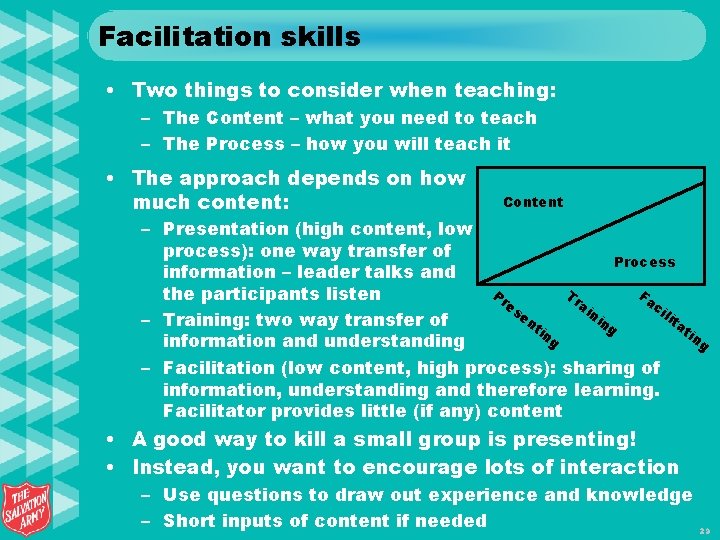
Facilitation skills • Two things to consider when teaching: – The Content – what you need to teach – The Process – how you will teach it • The approach depends on how much content: Content – Presentation (high content, low process): one way transfer of Process information – leader talks and Pr Tr Fa the participants listen es ai ci ni lit e nt ng – Training: two way transfer of at in in g g information and understanding – Facilitation (low content, high process): sharing of information, understanding and therefore learning. Facilitator provides little (if any) content • A good way to kill a small group is presenting! • Instead, you want to encourage lots of interaction – Use questions to draw out experience and knowledge – Short inputs of content if needed 29
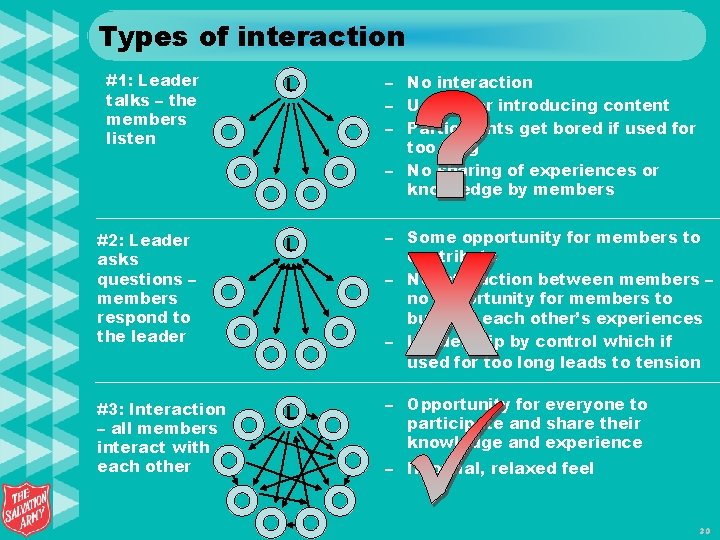
Types of interaction #1: Leader talks – the members listen L – No interaction – Useful for introducing content – Participants get bored if used for too long – No sharing of experiences or knowledge by members #2: Leader asks questions – members respond to the leader L – Some opportunity for members to contribute – No interaction between members – no opportunity for members to build on each other’s experiences – Leadership by control which if used for too long leads to tension #3: Interaction – all members interact with each other L – Opportunity for everyone to participate and share their knowledge and experience – Informal, relaxed feel 30
Common facilitation issues Lack of Interaction – things to check: • Seating arrangements • Questioning technique – Open v closed – Complexity of questions • Silence – If you keep talking, there won’t be much interaction – Ask a question, then count to 30 slowly in your head before you speak again • Use rebounds – “What do others think? ” • If all else fails, confess and tell the group what you’re trying to do! 31
Common facilitation issues Quiet Members: • Quiet people have much to contribute • Have the group write answers, then share • Ask them by name (questions they can answer) • Talk to them in private. Help them understand their quietness is cheating others of their insight • Make sure the group functions with a non-judgemental attitude. Their quietness may be related to fear Dominant Members: • Use closed questions and rebounds to cut them off • Ask them to hold their thought and you will get back to them later • Talk to them in private – Let them in on the game plan and ask them to work with you (i. e. let them know that letting others contribute will help them grow) – Get them to speak second or third – Admonish as a last resort 32
Common facilitation issues Inappropriate Group Behaviour • Tangents – Point it out to the group (e. g. “That seems to be a tangent”) – Defer until later (e. g. supper, another session) – Ask for further comments on the topic at hand • Private conversations – Use non-verbal communication first – Ask one of them a question by name – Ask them to refrain • Repeated lateness – Start on time regardless – Talk to offenders in private 33
Starting a Small Group Session 6 34
Starting a small group • • Pray Build a prospect list (form in manual) Coordinator may help you Be bold when approaching people. Don’t be apologetic – expect a yes, not a no • The manual provides suggestions for your first four gatherings: 1. 2. 3. 4. Social event (ideas in manual) Get to know each other plus agree purpose of group Building relationships #1 Building relationships #2 35
What else? Session 7 Appendices A-C 36
Multiplying your group • Tension – developing intimacy in small groups while remaining open to new people joining: – New people bring new life and vibrancy to groups – Need to re-build trust with each new person • Want our groups to be open • Recognise the need to take things slowly • Over time, groups should grow • Stage 1 (less than 10 people) – all meet and discuss together • Stage 2 (around 10 people) – consider all meeting together, but breaking into two groups for discussion • Stage 3 (around 14 people) – consider splitting • The manual provides more details about how to go about multiplying 37
Extra grace required (EGR) • A key role of a small group is supporting people who are struggling • Two kinds – temporary and dominant • EGR Temporary – Going through a difficult situation – Group should rally around the person and help support them through • EGR Dominant – Normal support has not resolved the issue – The circumstances have past but person continues to require extra grace – They will kill the group if unattended – The manual provides tips for how to help an EGR dominant 38
Resources • What resources do we already have? • How do I get resources? • A range of resources are recommended in the manual, plus ideas for study topics (Appendix A) • TSMP resources are a good place to start (they’re free and downloadable immediately) • The manual also provides studies for your first four group gatherings • Strongly recommend using resources rather than writing your own – Less time to prepare so more time to shepherd – Bring out other thoughts than your own 39
Small group leader reports • Appendix C in manual • To be handed in quarterly • Purpose – To help you be proactive in your planning around content, social activities and service – To ensure regular communication with your coordinator, so that you get support and the coordinator learns of any changes 40
Summary Session 8 41
Summary - Objectives • Have a common vision for small groups within our corps • Understand the concept of authentic relationships and have practical ideas for fostering these within your groups • Have the basic facilitation skills needed to encourage participation and openness by all members of your small group • Have had exposure to various ideas for running small group sessions, including openers, worshipping and praying in small groups • Be able to start a small group • Know where to go to get assistance 42
Summary • Natural Church Development definition of holistic small groups – groups where Christians find: – Intimate community • A place of authentic relationships – Practical help • Relevant, useful – Intensive spiritual interaction • Help grow in their relationship with God • Vision is for all groups to be ‘holistic’ – places where Christians find intimate community, practical help and intensive spiritual interaction 43
Summary • Authentic Relationships permeate all aspects of group life, especially outside of the meeting • Must be intentional • Have five components: – – – Self Disclosure: Know and be Known Care Giving: Love and be Loved Humility: Serve and be Served Truth Telling: Admonish and be Admonished Affirmation: Celebrate and be Celebrated • What is the cost of failure? – Mediocre relationships? – Lonely, unsupported people, who will eventually come to the conclusion that Small Groups don’t work. They may never try again. 44
Summary • A proposed structure for small group meetings is: – Welcome (until time to start): as people arrive, friendly discussion about the week, to create a welcoming environment – Opening / Ice-breaker (5 -10 mins): a warm-up question, particularly useful for new groups – Worship (optional) (15 mins): a short time of worship – Body (45 -60 mins): the study with application – Prayer (15 mins): looking within and without – Food: enables you to keep talking to people – could be first • This structure covers the three components of a holistic small group, and provides a natural flow from warming up, through to study and personal application, then an opportunity to pray for each other and the commitments made during the study. 45
Summary • All Groups should have an Assistant • If you need resources, see your coordinator (before you buy) • Facilitating and encouraging interaction: – – Seating arrangements Rebounds: “What does the group think? ” Silence: Don’t fill in gaps Tell people the game plan 46
Questions 47
- Slides: 47