
1 Objectives 1 To examine U S currency

1
Objectives 1. To examine U. S. currency and current exchange rates. 2. To identify common obstacles facing international businesses. 3. To discuss the advantages and disadvantages of an international market. 2
Main Menu • Introduction • Currencies & Exchange Rates • International Markets 3

Introduction 4
International Finance • Is the subject of economics across national boundaries • Is important to understand because the United States trades with countries all over the world 5
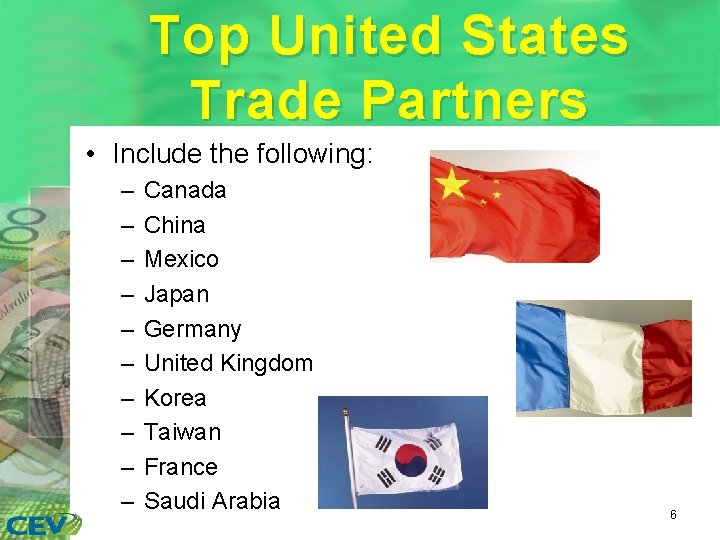
Top United States Trade Partners • Include the following: – – – – – Canada China Mexico Japan Germany United Kingdom Korea Taiwan France Saudi Arabia 6
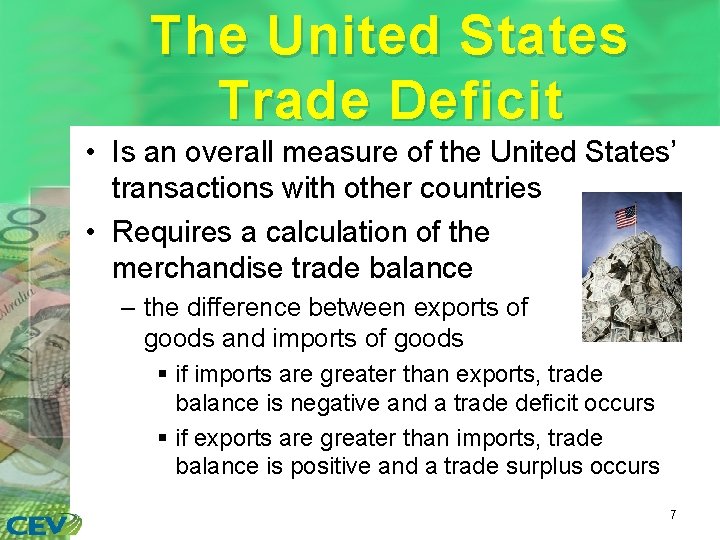
The United States Trade Deficit • Is an overall measure of the United States’ transactions with other countries • Requires a calculation of the merchandise trade balance – the difference between exports of goods and imports of goods § if imports are greater than exports, trade balance is negative and a trade deficit occurs § if exports are greater than imports, trade balance is positive and a trade surplus occurs 7
The International Monetary Fund • Was established in 1944 and began operations in 1946 • Is an agency regulated by the United Nations • Has more than 180 members • Promotes international monetary cooperation in order to expand international trade • Is a deposit bank in which member countries can carry out trade at established exchange rates 8
The World Bank • Was established in 1944 • Gives loans • Helps to improve various economic systems in disadvantaged countries • Helps countries develop international trade 9
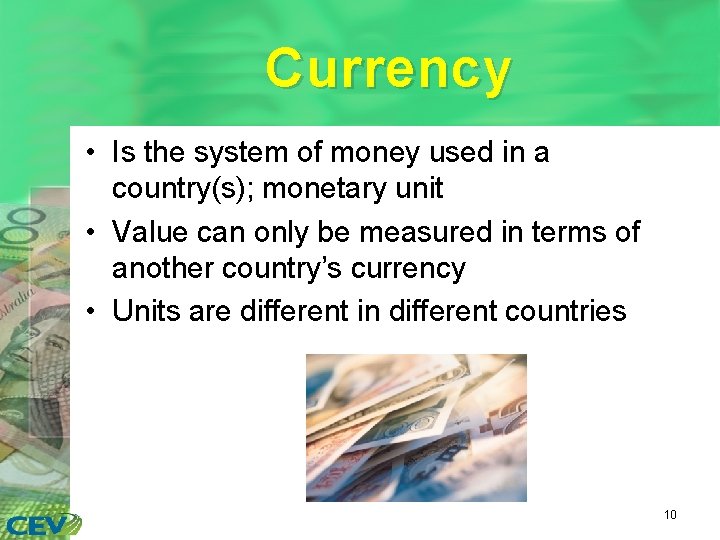
Currency • Is the system of money used in a country(s); monetary unit • Value can only be measured in terms of another country’s currency • Units are different in different countries 10
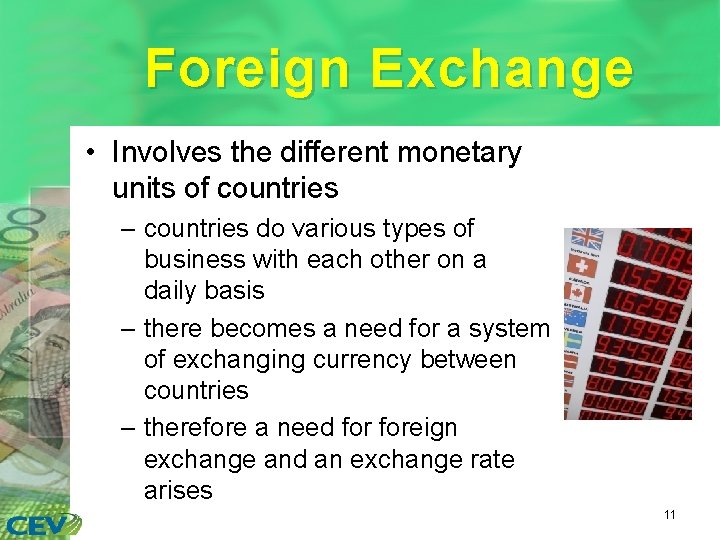
Foreign Exchange • Involves the different monetary units of countries – countries do various types of business with each other on a daily basis – there becomes a need for a system of exchanging currency between countries – therefore a need foreign exchange and an exchange rate arises 11
Exchange Rate • Is the rate at which a unit of the currency of a country can be exchanged for a unit of currency of another country – for example: pound/dollar (£/$) • Is changed daily • Is not a set rate for each country • Can be affected by various economic factors 12
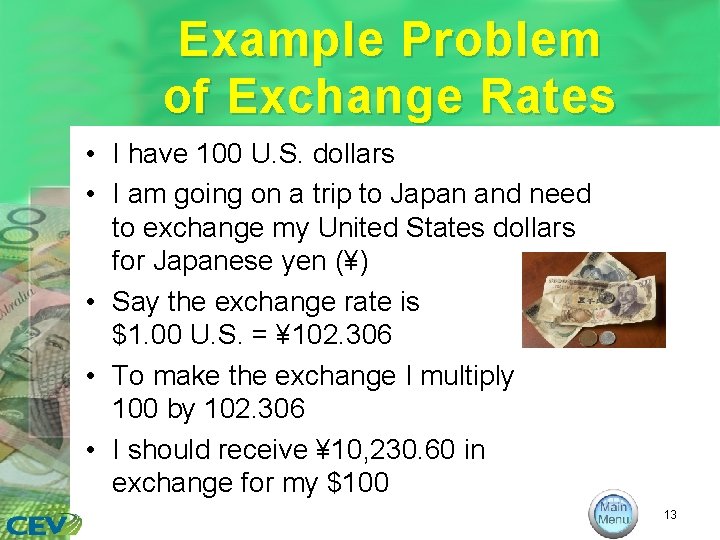
Example Problem of Exchange Rates • I have 100 U. S. dollars • I am going on a trip to Japan and need to exchange my United States dollars for Japanese yen (¥) • Say the exchange rate is $1. 00 U. S. = ¥ 102. 306 • To make the exchange I multiply 100 by 102. 306 • I should receive ¥ 10, 230. 60 in exchange for my $100 13

Currencies & Exchange Rates 14
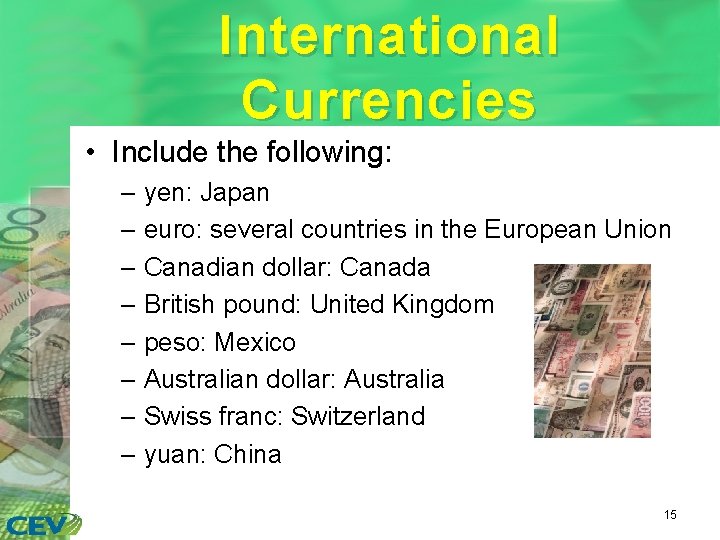
International Currencies • Include the following: – yen: Japan – euro: several countries in the European Union – Canadian dollar: Canada – British pound: United Kingdom – peso: Mexico – Australian dollar: Australia – Swiss franc: Switzerland – yuan: China 15
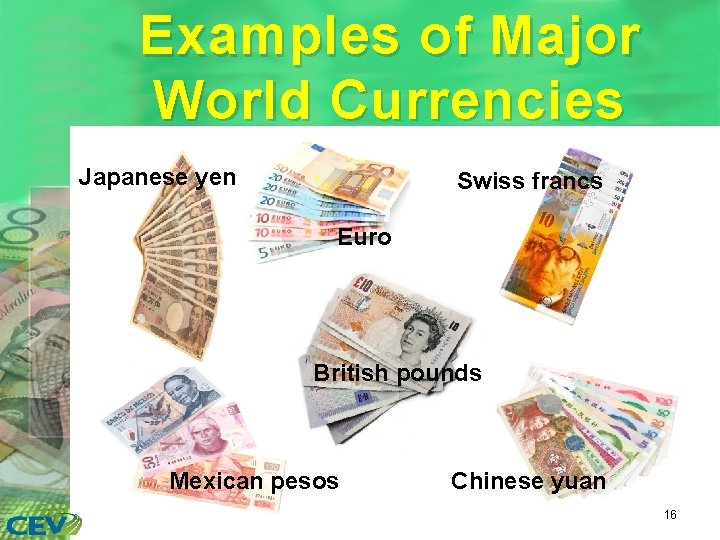
Examples of Major World Currencies Japanese yen Swiss francs Euro British pounds Mexican pesos Chinese yuan 16
European Currency • Is an existing currency known as “the euro” – used among 19 countries in the European Union • Has an effect on international trade – countries who use the same currency will have lower trading costs 17
European Currency • May be adopted for some neighboring countries as their reserve currency • Has the ability to become a worldwide reserve currency – will put the euro in competition with the dollar 18
Foreign Exchange Market • Connects exchanges around the world to enable international trade • Functions include: – transfer • converts one currency into another – credit • provides credit for international payments – hedging • entering in a contract to cover liabilities when exchange rates change 19
Exchange Rates • Are controlled by supply and demand • Are influenced by economic factors which include: – trade balance – inflation – stock market – interest rates – employment outlook – political stability – economic growth 20
Inflation • Is the rate of increase in prices in a country each year – countries with lower inflation rates see an appreciation in the value of their currency • Can be calculated with the following formula: – current period CPI – prior period CPI – consumer price index (CPI) 21

Interest Rates • Are the monthly percentage rate charged for borrowed money – higher interest rates cause an increase in the value of a currency • Have an effect on consumer spending – directly effects the economy 22
Employment Outlook • Involves employment levels which have a prompt effect on economic growth – when unemployment increases, consumer spending will decrease – unemployment can devalue a country’s currency because of the slowdown in the economy 23
Economic Growth • Can have a direct effect on the following: – inflation • higher growth results in higher inflation – interest • rates will rise if inflation increases • could signalize change in currency rates 24
Trade Balance • Is a country’s total value of exports minus the total value of imports • Has an impact on supply and demand for currency – trade surplus results in a demand for its currency – trade deficit results in a devaluation of a currency if supply exceeds demand 25
Stock Market • Is a financial market where securities such as bonds and stocks are sold or exchanged • Can be directly related to exchange rates – upward trends in the stock market can cause currency depreciation – weak currency could cause a decline in the stock market 26
Political Stability • Involves a country’s political state and economic performance – countries with less risk for war become more attractive to foreign investors which creates economic stability – countries who are prone to political disorientation could see a depreciation in exchange rates 27
Exchange Rates • Affect the following: – the buying and selling of goods – the importing and exporting of goods – international relations – the price of goods 28
Floating Exchange Rates • Are one type of exchange rate • Occur when a currency’s value is determined by supply and demand for a currency relative to other currencies • Are determined by the foreign-exchange market 29
Fixed Exchange Rates • Occur when the government (central bank) of a country decides what its currency will be worth relative to other currencies • Are known as pegged exchange rates 30
Examples of Exchange Rates • 1. 00 United States dollar = § § § § 78. 89475 Japanese yen 0. 79159 Euro 0. 98303 Canadian dollars 0. 62766 British pounds 13. 06741 pesos 0. 97263 Australian dollars 0. 95364 Swiss francs 6. 34295 Chinese yuan exchange rates as of September, 2012 31
Places to Find Exchange Rates • Include: – http: //www. xe. com – http: //finance. yahoo. com/currency-converter – http: //www. exchangerates. org. uk § each of these sites provide up-to-date exchange rates for almost all currencies 32
Spot Rates • Are “straight-forward” rates • Are the rates used for immediate delivery of a foreign-exchange contract • Are usually directly quoted daily 33
Forward Rates • Are currencies exchanged today for delivery in the future, usually up to 180 days 34
Interest Rate Parity • Occurs when the forward rate does not equal the spot rate – the difference serves to offset the differences in interest rates between the currencies 35

International Markets 36
Methods of Entry • Into international markets include the following: – exporting – licensing and franchising – strategic alliance – joint venture – global banking 37

Exporting • Involves the direct sale of goods to another country • Requires very little investment and capital • Is a generally safe way of entering the international market Example: U. S. Paper Company sells its textured paper products directly to a large paper company in France. 38
Licensing & Franchising • Are similar processes in which a business transfers rights to others – licensing is the transfer of rights and permission to produce and sell a product to a foreign firm – franchising is the transfer of rights of operation of an entire business • Hold the potential to be highly profitable as they require little investment Examples: Disney® licenses many of its characters for use by various companies. Mc. Donald’s® Corporation is one of the most popular franchising companies, operating in countries around the world. 39

Strategic Alliances • Occur when two companies agree to do business together while remaining independent – for example: Microsoft® and Nokia® working together to develop smart phone applications 40

Joint Ventures • Are agreements between two companies to work on a business project • Involve the joining of two companies to form one new company – for example: Sony® and Ericsson® teamed up to produce innovative cell phones • Are complex and involve a great deal of risk 41
Multinational Corporations • Are corporations operating or having direct investments in facilities in at least one country other than its home country • Are also known as transnational corporations Examples include: General Motors®, Ford® and Exxon® 42
Global Banking • Provides financial services and products to government, corporate and other institutions worldwide • Strategies include: – design for long term • focus on long-term goals of your business – start at the top • gain senior-level buy-in to properly execute your agenda 43
Global Banking • Strategies include: – prioritize rationalization • justify accounts to ensure control over banking decisions – gain operational/financial control • balance banking structure to maintain sovereignty at local and international levels – ensure universal policy is reflected • develop banking structure in alignment with global policies regarding exchange, debt and cash flow management 44
Problems with International Business • Include the following: – government regulations § obtaining licenses for a business – economics § exchange rate – politics § laws and political turmoil – culture § background and cultural etiquette – labor issues § domestic and international 45
Politics • Play a major role in determining which countries will take part in international business with another • Will establish policies which can restrict: – trading – franchising – foreign direct investments 46

Culture • Can create barriers which place a strain on international business – language • difficult to communicate – understanding of another’s culture • makes it easier to perform negotiations 47
Domestic Labor • Refers to individuals who are hired in the home country • Issues include: – employees receive higher pay due to minimum wage – stricter regulations to follow 48
International Labor • Refers to individuals who work for a foreign company outside of their country • Issues include: – less control – lack of communication 49
International Law • Is directed by the following major courts and tribunals: – – – – – Court of Justice of the European Communities International Court of Justice International Criminal Court International Criminal Tribunal for Rwanda International Criminal Tribunal for the Former Yugoslavia International Tribunal for the Law of the Sea Permanent Court of Arbitration Documents Rome Statute of the international Criminal Court WIPO Arbitration and Mediation Center 50
Business Economic Conditions • Depending on the value, can either positively or negatively affect business dealings in foreign countries • Include the following: – interest rates § monthly percentage rate charged for borrowed money – inflation rates § rate of increase of prices in a country each year 51
Business Economic Conditions • Also include the following: – GDP § gross domestic product § total amount of goods/services produced in a country each year – unemployment rates § percentage of the work force in a country which does not have jobs 52
Resources • (1992 -2008). Retrieved October 7, 2008, from Banknotes. Com: www. banknotes. com • (1997 -2008). Retrieved October 7, 2008, from The International Economics Study Center: www. internationalecon. com • (1999 - 2008). Retrieved October 7, 2008, from All. Business: www. allbusiness. com • (2008). Retrieved October 7, 2008, from The American: www. american. com • (2008). Retrieved October 7, 2008, from U. S. Census Bureau: www. census. gov • (2012). Retrieved September 6, 2012 from Exchange Rates: www. exchangerates. org. uk • Consumer Behavior: The Psychology of Marketing. (1999 -2008). Retrieved October 7, 2008, from University of Southern California: www. consumerpsychologist. com 53

Acknowledgements Production Coordinator: Technical Writer: Sarah Salinas Jessica Odom Project Coordinator: Production Manager: Meghan Blanek Dusty Moore Graphic Designer: Executive Producers: Ann Adams Gordon Davis, Ph. D. , Jeff Lansdell © MMXIII CEV Multimedia, Ltd. 54
- Slides: 54