
1 NTT 4 QUALITY MANAGEMENT SYSTEM QMS FOR




- Slides: 55
1 NTT 4 QUALITY MANAGEMENT SYSTEM (QMS) FOR SCHOOL BASED EDUCATORS ELRC Collective Agreement Number 2 of 2014 NATIONAL TRAINING TEAM Training Dates 27 -28 February 2020 (Cluster 1 - FS, KZN, MP) & Cluster 3 ( GP, LP & NW) 2 -3 March 2020 (Cluster 2 – EC, NC, WC)
2 4. Quality Management System
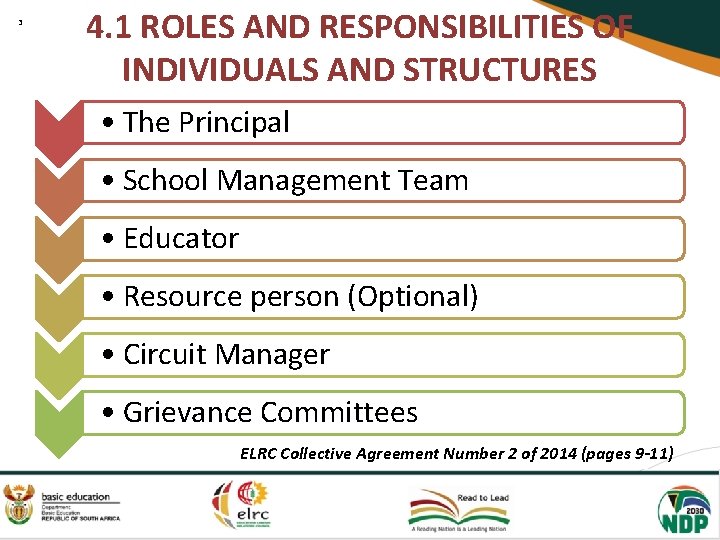
3 4. 1 ROLES AND RESPONSIBILITIES OF INDIVIDUALS AND STRUCTURES • The Principal • School Management Team • Educator • Resource person (Optional) • Circuit Manager • Grievance Committees ELRC Collective Agreement Number 2 of 2014 (pages 9 -11)
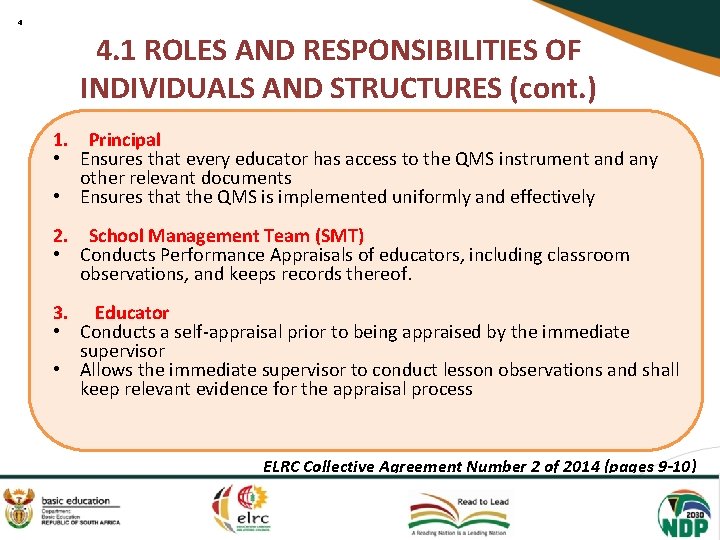
4 4. 1 ROLES AND RESPONSIBILITIES OF INDIVIDUALS AND STRUCTURES (cont. ) 1. Principal • Ensures that every educator has access to the QMS instrument and any other relevant documents • Ensures that the QMS is implemented uniformly and effectively 2. School Management Team (SMT) • Conducts Performance Appraisals of educators, including classroom observations, and keeps records thereof. 3. Educator • Conducts a self-appraisal prior to being appraised by the immediate supervisor • Allows the immediate supervisor to conduct lesson observations and shall keep relevant evidence for the appraisal process ELRC Collective Agreement Number 2 of 2014 (pages 9 -10)
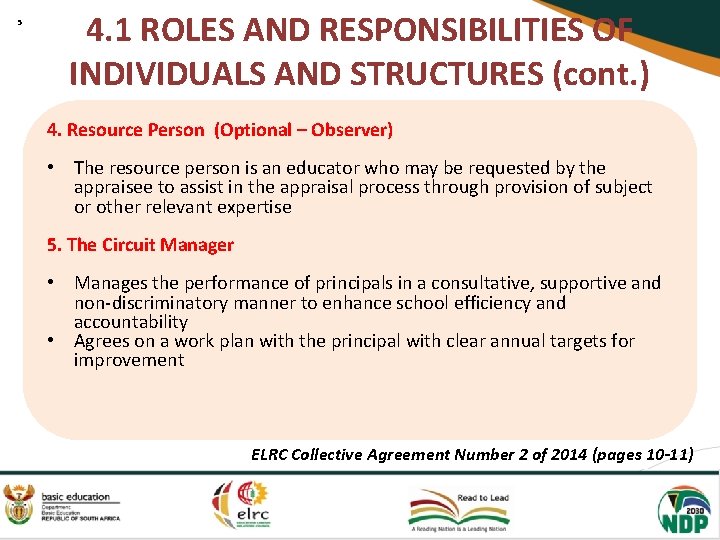
5 4. 1 ROLES AND RESPONSIBILITIES OF INDIVIDUALS AND STRUCTURES (cont. ) 4. Resource Person (Optional – Observer) • The resource person is an educator who may be requested by the appraisee to assist in the appraisal process through provision of subject or other relevant expertise 5. The Circuit Manager • Manages the performance of principals in a consultative, supportive and non-discriminatory manner to enhance school efficiency and accountability • Agrees on a work plan with the principal with clear annual targets for improvement ELRC Collective Agreement Number 2 of 2014 (pages 10 -11)
6 4. 1 ROLES AND RESPONSIBILITIES OF INDIVIDUALS AND STRUCTURES (cont. ) 6. Grievance Committee at school level • Resolve any grievance or disagreements at school level 7. Grievance Committee at circuit level • Resolve any grievance or disagreements referred to it by the school grievance committee. ELRC Collective Agreement Number 2 of 2014 (page 11)
7 4. 1. 1 QMS and PAM – Job Descriptions • Principal, Deputy Principal & Departmental Head o To participate in agreed school/educator appraisal processes in order to regularly review their professional practice with the aim of improving teaching, learning and management. Personnel Administrative Measures (PAM) - 2016 • Circuit Manager o Conduct performance reviews and appraisals of principals o Monitor and support the implementation of performance management systems in schools ELRC Collective Agreement 4 of 2017
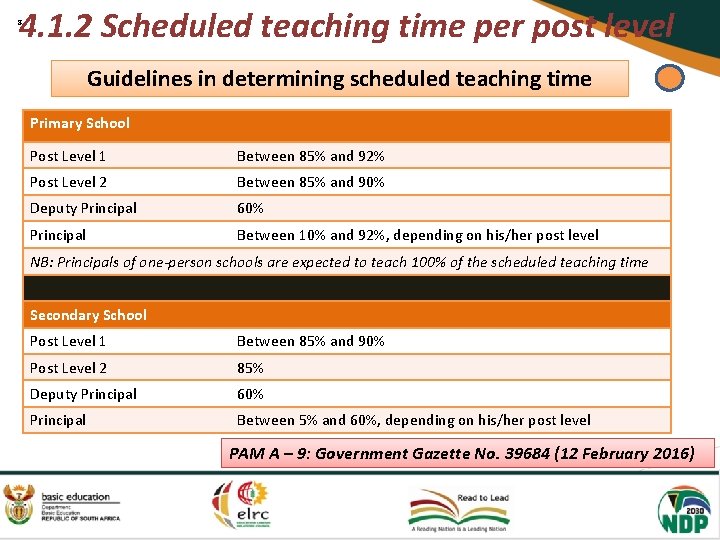
4. 1. 2 Scheduled teaching time per post level 8 Guidelines in determining scheduled teaching time Primary School Post Level 1 Between 85% and 92% Post Level 2 Between 85% and 90% Deputy Principal 60% Principal Between 10% and 92%, depending on his/her post level NB: Principals of one-person schools are expected to teach 100% of the scheduled teaching time Secondary School Post Level 1 Between 85% and 90% Post Level 2 85% Deputy Principal 60% Principal Between 5% and 60%, depending on his/her post level PAM A – 9: Government Gazette No. 39684 (12 February 2016)
9 4. 2 GUIDELINES ON IMPLEMENTATION OF QMS
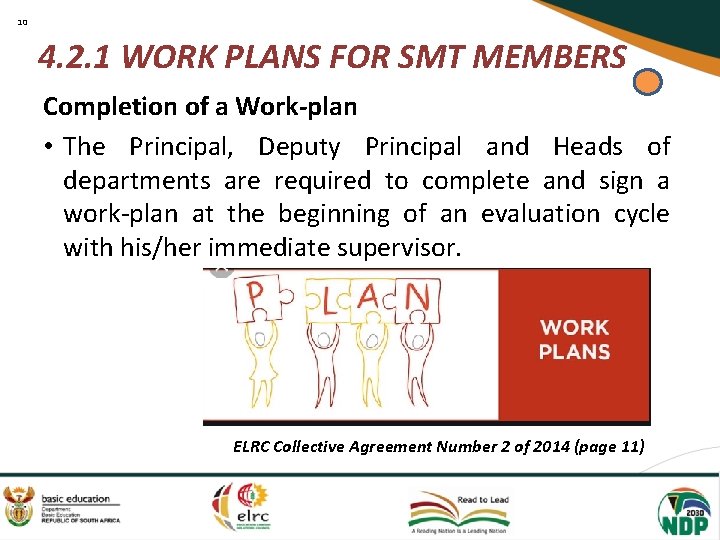
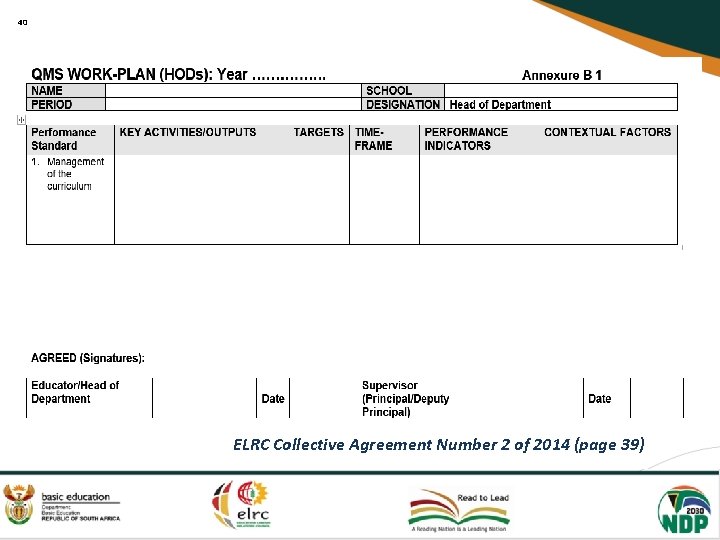
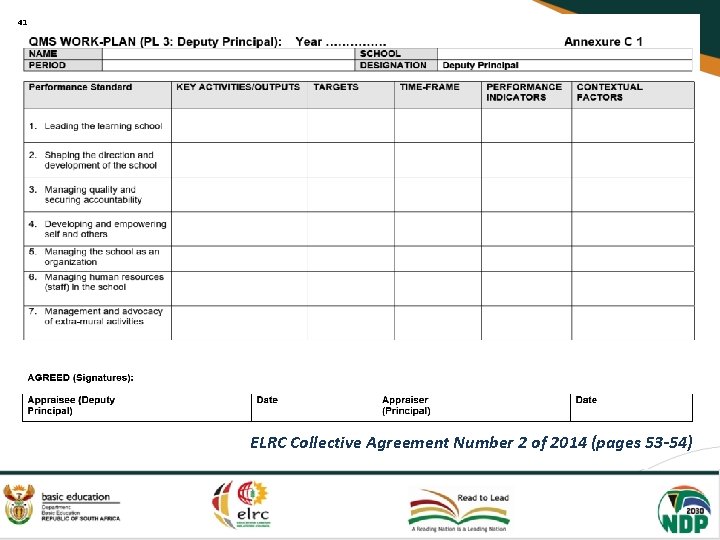
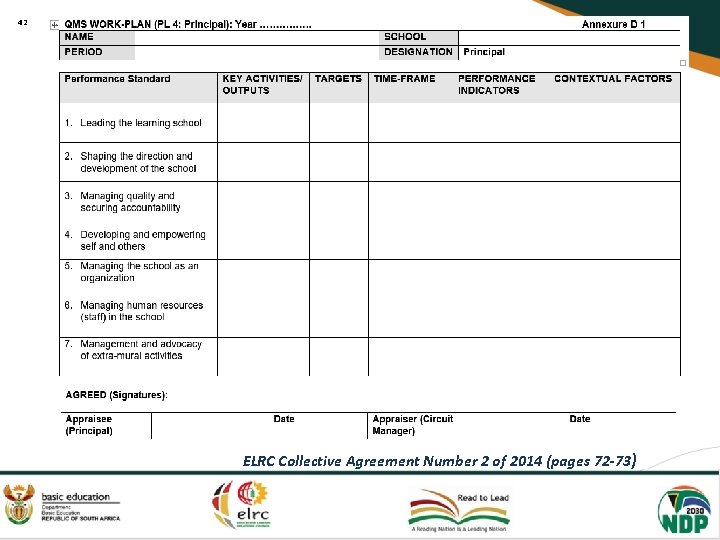
10 4. 2. 1 WORK PLANS FOR SMT MEMBERS Completion of a Work-plan • The Principal, Deputy Principal and Heads of departments are required to complete and sign a work-plan at the beginning of an evaluation cycle with his/her immediate supervisor. ELRC Collective Agreement Number 2 of 2014 (page 11)
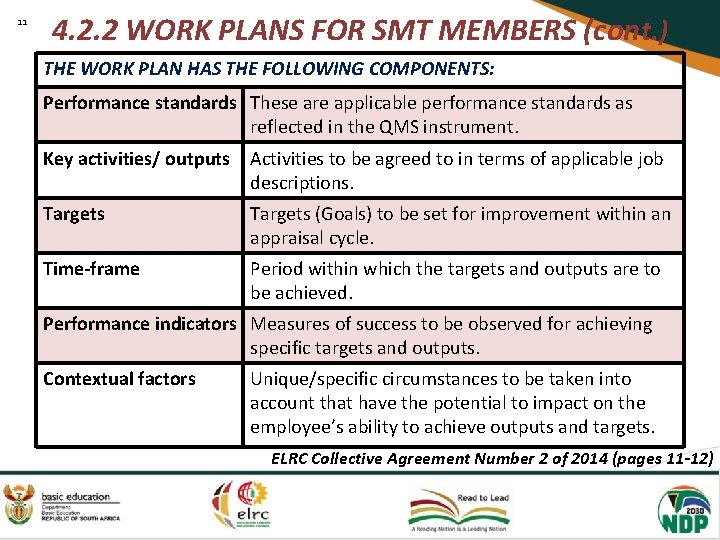
11 4. 2. 2 WORK PLANS FOR SMT MEMBERS (cont. ) THE WORK PLAN HAS THE FOLLOWING COMPONENTS: Performance standards These are applicable performance standards as reflected in the QMS instrument. Key activities/ outputs Activities to be agreed to in terms of applicable job descriptions. Targets (Goals) to be set for improvement within an appraisal cycle. Time-frame Period within which the targets and outputs are to be achieved. Performance indicators Measures of success to be observed for achieving specific targets and outputs. Contextual factors Unique/specific circumstances to be taken into account that have the potential to impact on the employee’s ability to achieve outputs and targets. ELRC Collective Agreement Number 2 of 2014 (pages 11 -12)
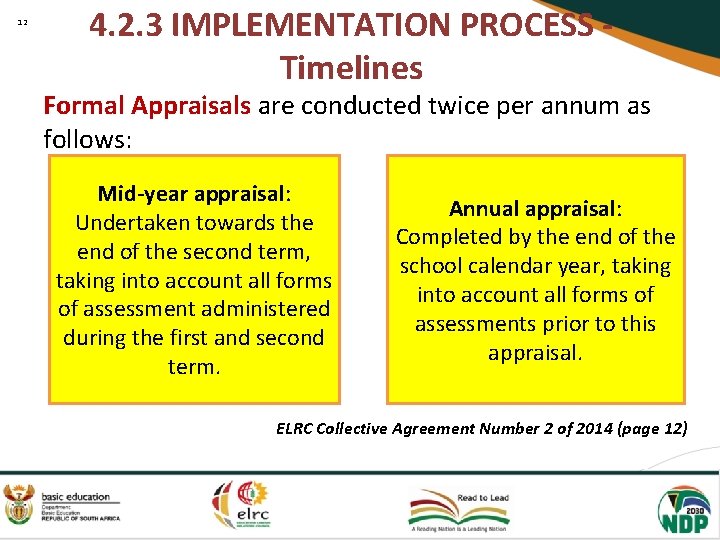
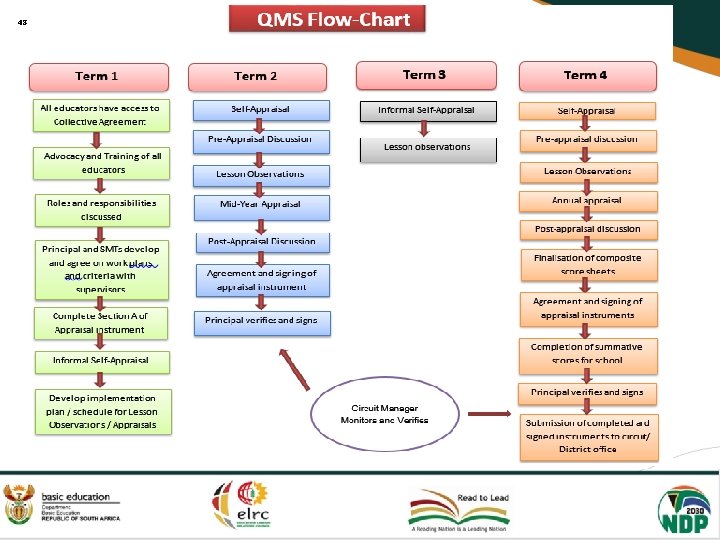
12 4. 2. 3 IMPLEMENTATION PROCESS Timelines Formal Appraisals are conducted twice per annum as follows: Mid-year appraisal: Undertaken towards the end of the second term, taking into account all forms of assessment administered during the first and second term. Annual appraisal: Completed by the end of the school calendar year, taking into account all forms of assessments prior to this appraisal. ELRC Collective Agreement Number 2 of 2014 (page 12)
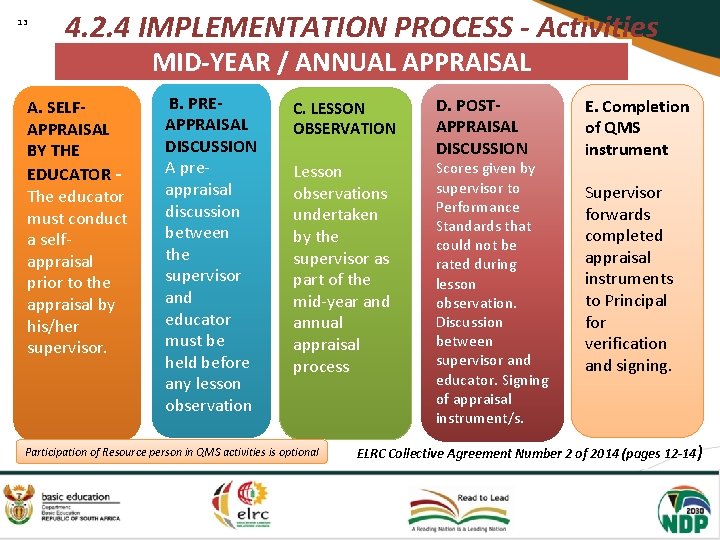
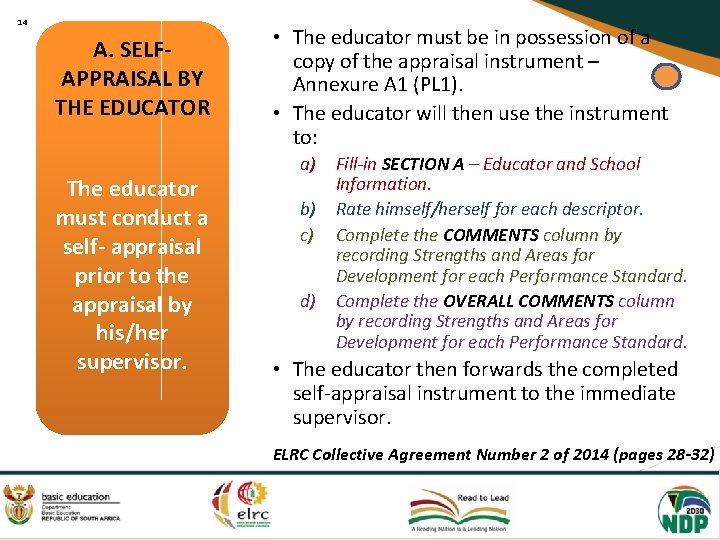
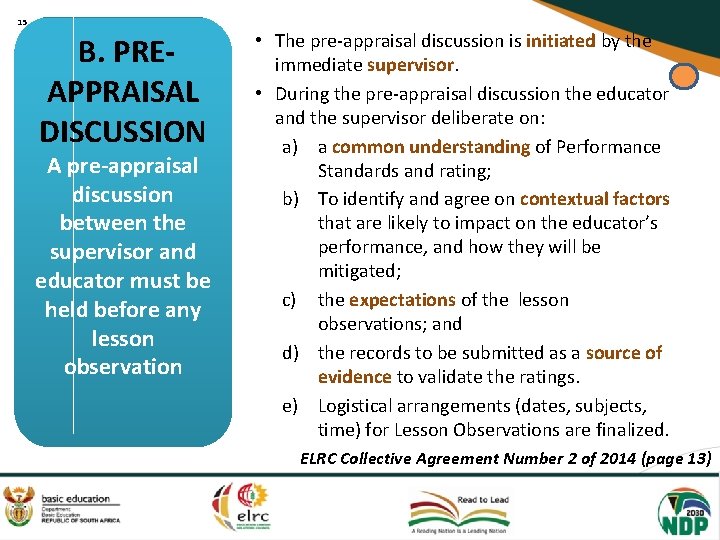
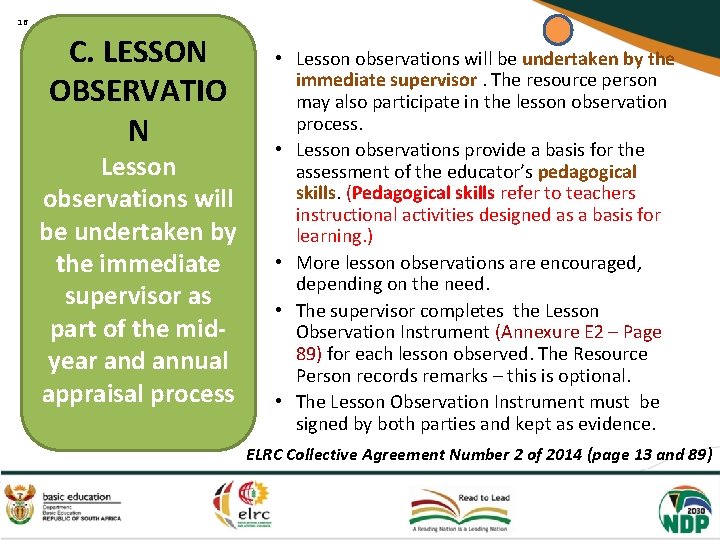
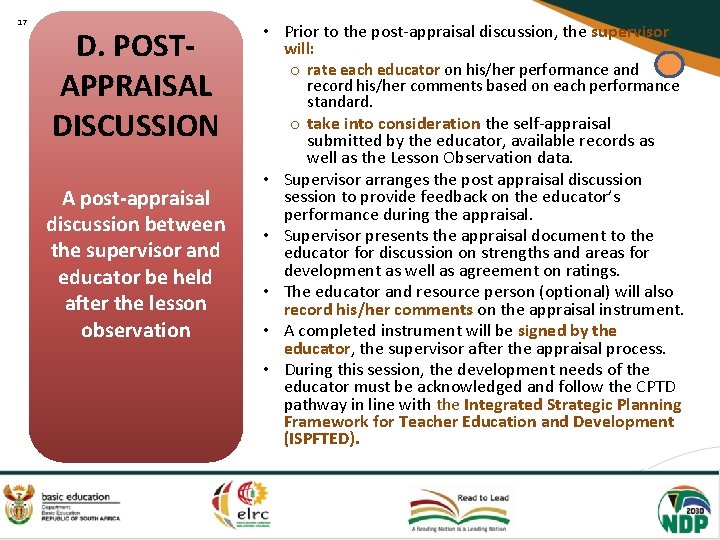
13 4. 2. 4 IMPLEMENTATION PROCESS - Activities MID-YEAR / ANNUAL APPRAISAL A. SELFAPPRAISAL BY THE EDUCATOR The educator must conduct a selfappraisal prior to the appraisal by his/her supervisor. B. PREAPPRAISAL DISCUSSION A preappraisal discussion between the supervisor and educator must be held before any lesson observation C. LESSON OBSERVATION Lesson observations undertaken by the supervisor as part of the mid-year and annual appraisal process Participation of Resource person in QMS activities is optional D. POSTAPPRAISAL DISCUSSION Scores given by supervisor to Performance Standards that could not be rated during lesson observation. Discussion between supervisor and educator. Signing of appraisal instrument/s. E. Completion of QMS instrument Supervisor forwards completed appraisal instruments to Principal for verification and signing. ELRC Collective Agreement Number 2 of 2014 (pages 12 -14)
14 A. SELFAPPRAISAL BY THE EDUCATOR The educator must conduct a self- appraisal prior to the appraisal by his/her supervisor. • The educator must be in possession of a copy of the appraisal instrument – Annexure A 1 (PL 1). • The educator will then use the instrument to: a) b) c) d) Fill-in SECTION A – Educator and School Information. Rate himself/herself for each descriptor. Complete the COMMENTS column by recording Strengths and Areas for Development for each Performance Standard. Complete the OVERALL COMMENTS column by recording Strengths and Areas for Development for each Performance Standard. • The educator then forwards the completed self-appraisal instrument to the immediate supervisor. ELRC Collective Agreement Number 2 of 2014 (pages 28 -32)
15 B. PREAPPRAISAL DISCUSSION A pre-appraisal discussion between the supervisor and educator must be held before any lesson observation • The pre-appraisal discussion is initiated by the immediate supervisor. • During the pre-appraisal discussion the educator and the supervisor deliberate on: a) a common understanding of Performance Standards and rating; b) To identify and agree on contextual factors that are likely to impact on the educator’s performance, and how they will be mitigated; c) the expectations of the lesson observations; and d) the records to be submitted as a source of evidence to validate the ratings. e) Logistical arrangements (dates, subjects, time) for Lesson Observations are finalized. ELRC Collective Agreement Number 2 of 2014 (page 13)
16 C. LESSON OBSERVATIO N Lesson observations will be undertaken by the immediate supervisor as part of the midyear and annual appraisal process • Lesson observations will be undertaken by the immediate supervisor. The resource person may also participate in the lesson observation process. • Lesson observations provide a basis for the assessment of the educator’s pedagogical skills. (Pedagogical skills refer to teachers instructional activities designed as a basis for learning. ) • More lesson observations are encouraged, depending on the need. • The supervisor completes the Lesson Observation Instrument (Annexure E 2 – Page 89) for each lesson observed. The Resource Person records remarks – this is optional. • The Lesson Observation Instrument must be signed by both parties and kept as evidence. ELRC Collective Agreement Number 2 of 2014 (page 13 and 89)
17 D. POSTAPPRAISAL DISCUSSION A post-appraisal discussion between the supervisor and educator be held after the lesson observation • Prior to the post-appraisal discussion, the supervisor will: • • • o rate each educator on his/her performance and record his/her comments based on each performance standard. o take into consideration the self-appraisal submitted by the educator, available records as well as the Lesson Observation data. Supervisor arranges the post appraisal discussion session to provide feedback on the educator’s performance during the appraisal. Supervisor presents the appraisal document to the educator for discussion on strengths and areas for development as well as agreement on ratings. The educator and resource person (optional) will also record his/her comments on the appraisal instrument. A completed instrument will be signed by the educator, the supervisor after the appraisal process. During this session, the development needs of the educator must be acknowledged and follow the CPTD pathway in line with the Integrated Strategic Planning Framework for Teacher Education and Development (ISPFTED).
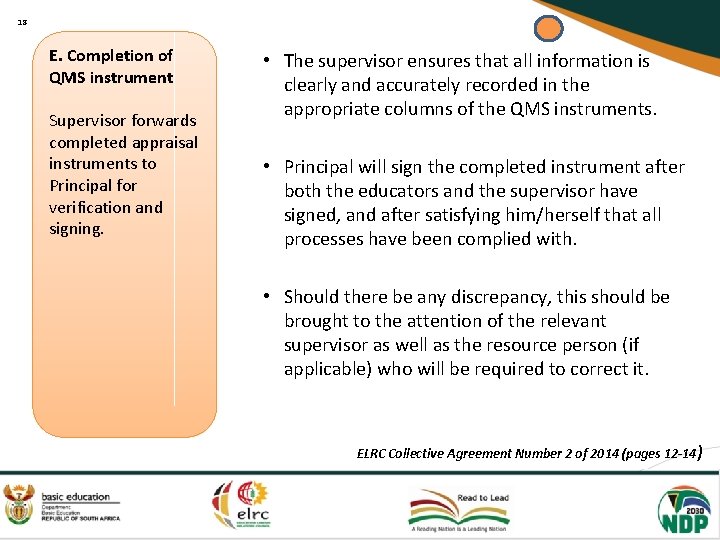
18 E. Completion of QMS instrument Supervisor forwards completed appraisal instruments to Principal for verification and signing. • The supervisor ensures that all information is clearly and accurately recorded in the appropriate columns of the QMS instruments. • Principal will sign the completed instrument after both the educators and the supervisor have signed, and after satisfying him/herself that all processes have been complied with. • Should there be any discrepancy, this should be brought to the attention of the relevant supervisor as well as the resource person (if applicable) who will be required to correct it. ELRC Collective Agreement Number 2 of 2014 (pages 12 -14)
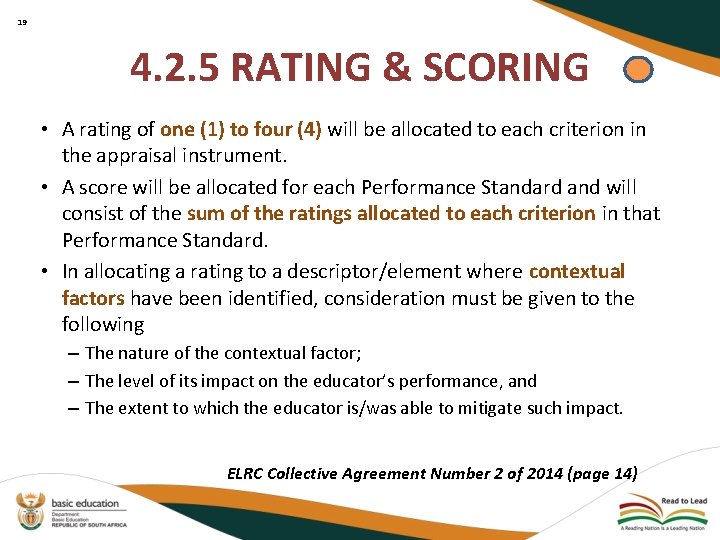
19 4. 2. 5 RATING & SCORING • A rating of one (1) to four (4) will be allocated to each criterion in the appraisal instrument. • A score will be allocated for each Performance Standard and will consist of the sum of the ratings allocated to each criterion in that Performance Standard. • In allocating a rating to a descriptor/element where contextual factors have been identified, consideration must be given to the following – The nature of the contextual factor; – The level of its impact on the educator’s performance, and – The extent to which the educator is/was able to mitigate such impact. ELRC Collective Agreement Number 2 of 2014 (page 14)
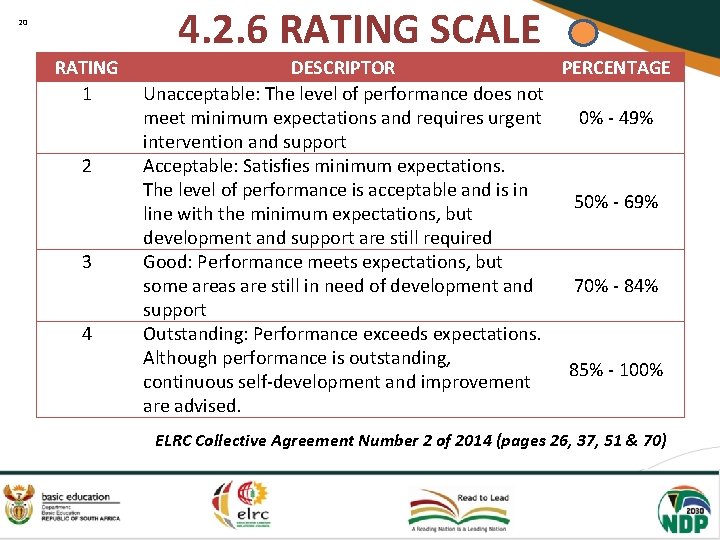
20 RATING 1 2 3 4 4. 2. 6 RATING SCALE DESCRIPTOR PERCENTAGE Unacceptable: The level of performance does not meet minimum expectations and requires urgent 0% - 49% intervention and support Acceptable: Satisfies minimum expectations. The level of performance is acceptable and is in 50% - 69% line with the minimum expectations, but development and support are still required Good: Performance meets expectations, but some areas are still in need of development and 70% - 84% support Outstanding: Performance exceeds expectations. Although performance is outstanding, 85% - 100% continuous self-development and improvement are advised. ELRC Collective Agreement Number 2 of 2014 (pages 26, 37, 51 & 70)
21 4. 3 EDUCATOR APPRAISALS
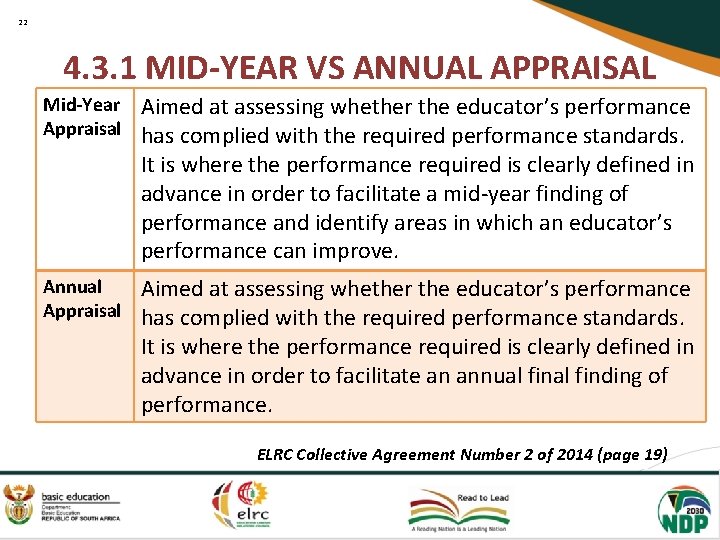
22 4. 3. 1 MID-YEAR VS ANNUAL APPRAISAL Mid-Year Appraisal Aimed at assessing whether the educator’s performance has complied with the required performance standards. It is where the performance required is clearly defined in advance in order to facilitate a mid-year finding of performance and identify areas in which an educator’s performance can improve. Annual Appraisal Aimed at assessing whether the educator’s performance has complied with the required performance standards. It is where the performance required is clearly defined in advance in order to facilitate an annual finding of performance. ELRC Collective Agreement Number 2 of 2014 (page 19)
23 4. 3. 2 Performance Standards
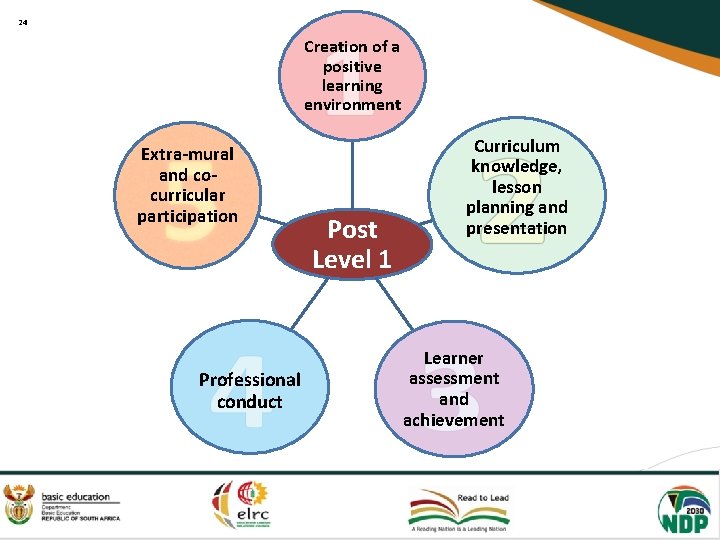
24 Creation of a positive learning environment Extra-mural and cocurricular participation Professional conduct Post Level 1 Curriculum knowledge, lesson planning and presentation Learner assessment and achievement
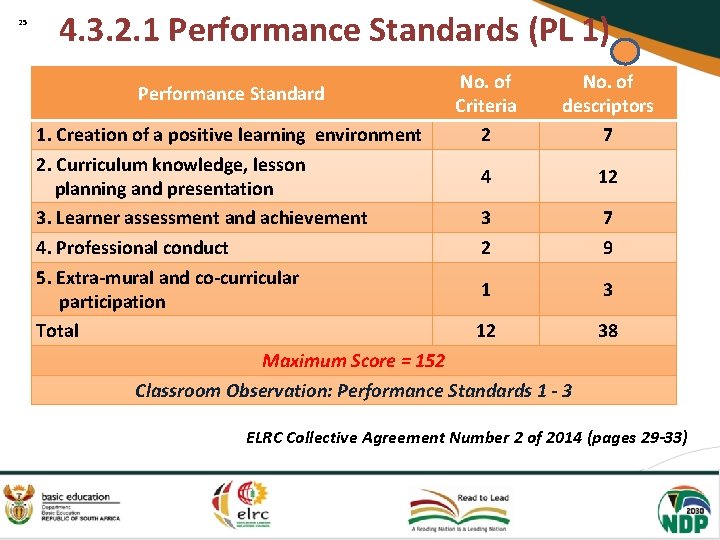
25 4. 3. 2. 1 Performance Standards (PL 1) Performance Standard No. of Criteria 2 No. of descriptors 7 1. Creation of a positive learning environment 2. Curriculum knowledge, lesson 4 planning and presentation 3. Learner assessment and achievement 3 4. Professional conduct 2 5. Extra-mural and co-curricular 1 participation Total 12 Maximum Score = 152 Classroom Observation: Performance Standards 1 - 3 12 7 9 3 38 ELRC Collective Agreement Number 2 of 2014 (pages 29 -33)
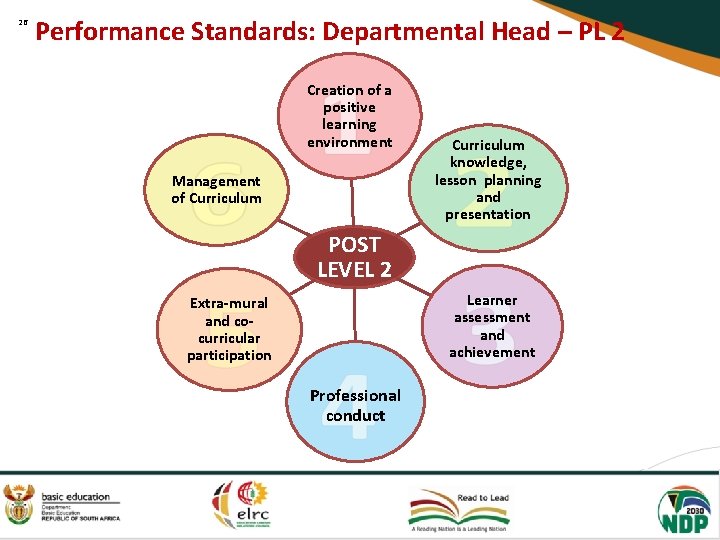
26 Performance Standards: Departmental Head – PL 2 Creation of a positive learning environment Management of Curriculum knowledge, lesson planning and presentation POST LEVEL 2 Learner assessment and achievement Extra-mural and cocurricular participation Professional conduct
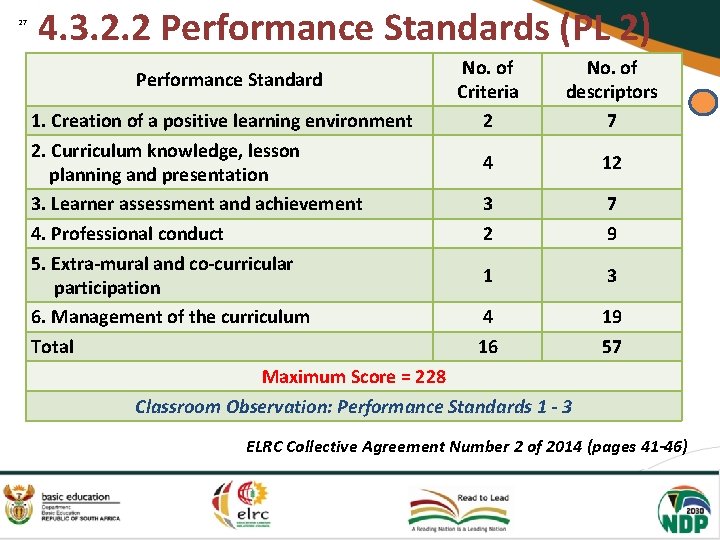
27 4. 3. 2. 2 Performance Standards (PL 2) Performance Standard No. of Criteria 2 No. of descriptors 7 1. Creation of a positive learning environment 2. Curriculum knowledge, lesson 4 planning and presentation 3. Learner assessment and achievement 3 4. Professional conduct 2 5. Extra-mural and co-curricular 1 participation 6. Management of the curriculum 4 Total 16 Maximum Score = 228 Classroom Observation: Performance Standards 1 - 3 12 7 9 3 19 57 ELRC Collective Agreement Number 2 of 2014 (pages 41 -46)
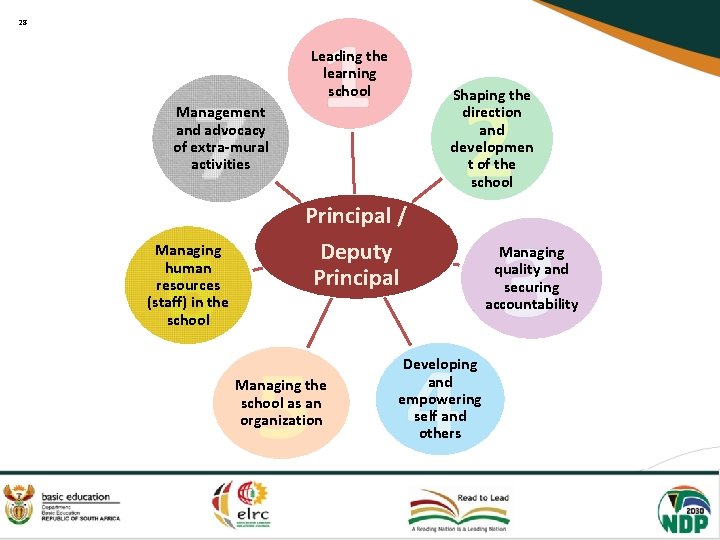
28 Leading the learning school Shaping the direction and developmen t of the school Management and advocacy of extra-mural activities Managing human resources (staff) in the school Principal / Deputy Principal Managing the school as an organization Developing and empowering self and others Managing quality and securing accountability
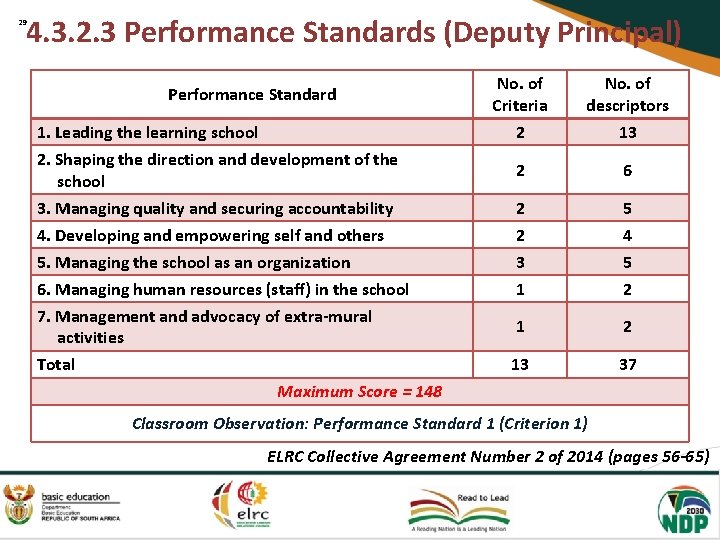
4. 3. 2. 3 Performance Standards (Deputy Principal) 29 No. of Criteria 2 No. of descriptors 13 2 6 2 5 4. Developing and empowering self and others 5. Managing the school as an organization 6. Managing human resources (staff) in the school 7. Management and advocacy of extra-mural activities 2 3 1 4 5 2 1 2 Total 13 37 Performance Standard 1. Leading the learning school 2. Shaping the direction and development of the school 3. Managing quality and securing accountability Maximum Score = 148 Classroom Observation: Performance Standard 1 (Criterion 1) ELRC Collective Agreement Number 2 of 2014 (pages 56 -65)
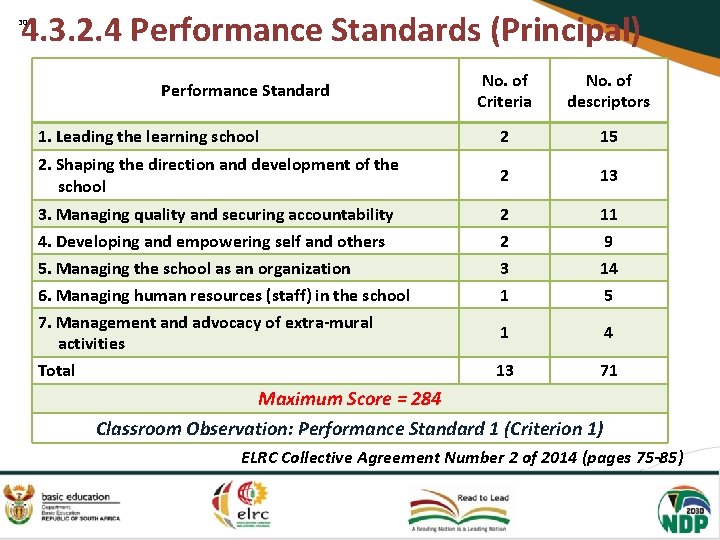
4. 3. 2. 4 Performance Standards (Principal) 30 No. of Criteria No. of descriptors 1. Leading the learning school 2 15 2. Shaping the direction and development of the school 2 13 3. Managing quality and securing accountability 4. Developing and empowering self and others 5. Managing the school as an organization 6. Managing human resources (staff) in the school 7. Management and advocacy of extra-mural activities 2 2 3 1 11 9 14 5 1 4 Total 13 71 Performance Standard Maximum Score = 284 Classroom Observation: Performance Standard 1 (Criterion 1) ELRC Collective Agreement Number 2 of 2014 (pages 75 -85)
31 4. 3. 3 Appraisal process at different post levels
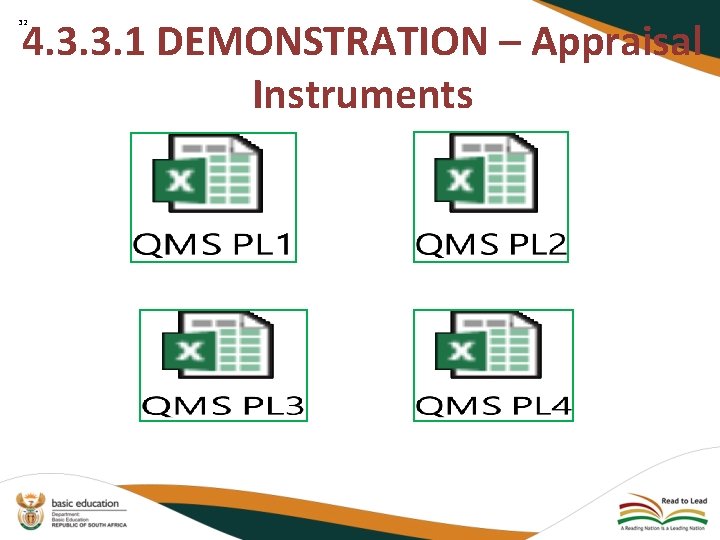
4. 3. 3. 1 DEMONSTRATION – Appraisal Instruments 32
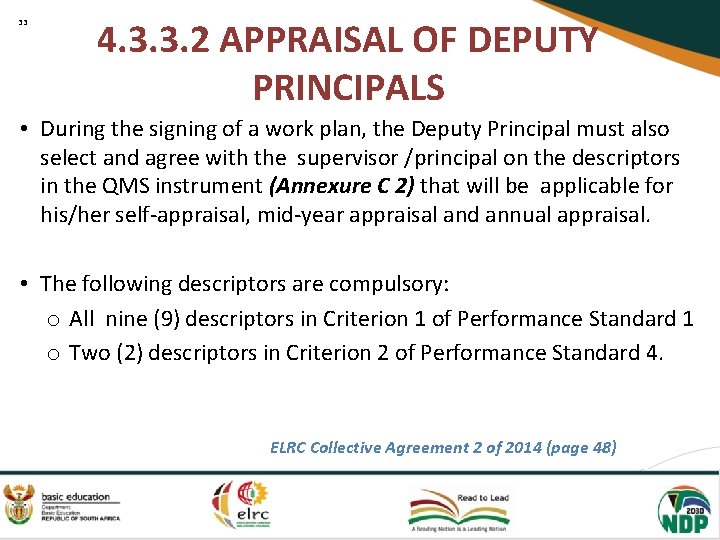
33 4. 3. 3. 2 APPRAISAL OF DEPUTY PRINCIPALS • During the signing of a work plan, the Deputy Principal must also select and agree with the supervisor /principal on the descriptors in the QMS instrument (Annexure C 2) that will be applicable for his/her self-appraisal, mid-year appraisal and annual appraisal. • The following descriptors are compulsory: o All nine (9) descriptors in Criterion 1 of Performance Standard 1 o Two (2) descriptors in Criterion 2 of Performance Standard 4. ELRC Collective Agreement 2 of 2014 (page 48)
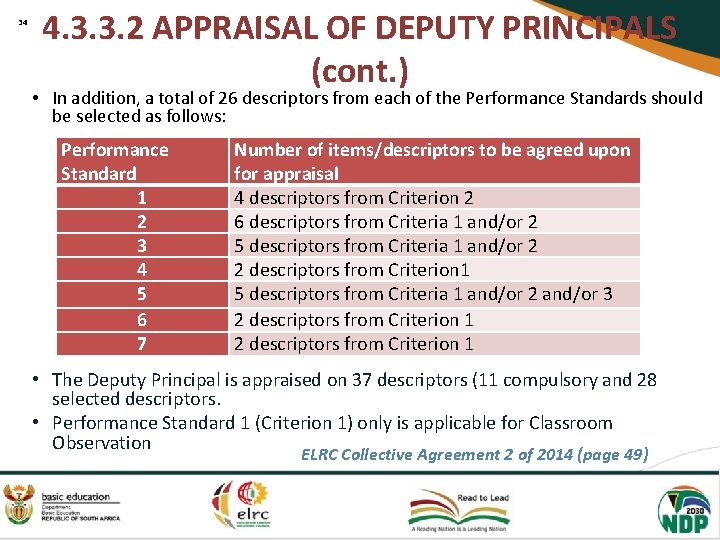
34 4. 3. 3. 2 APPRAISAL OF DEPUTY PRINCIPALS (cont. ) • In addition, a total of 26 descriptors from each of the Performance Standards should be selected as follows: Performance Standard 1 2 3 4 5 6 7 Number of items/descriptors to be agreed upon for appraisal 4 descriptors from Criterion 2 6 descriptors from Criteria 1 and/or 2 5 descriptors from Criteria 1 and/or 2 2 descriptors from Criterion 1 5 descriptors from Criteria 1 and/or 2 and/or 3 2 descriptors from Criterion 1 • The Deputy Principal is appraised on 37 descriptors (11 compulsory and 28 selected descriptors. • Performance Standard 1 (Criterion 1) only is applicable for Classroom Observation ELRC Collective Agreement 2 of 2014 (page 49)
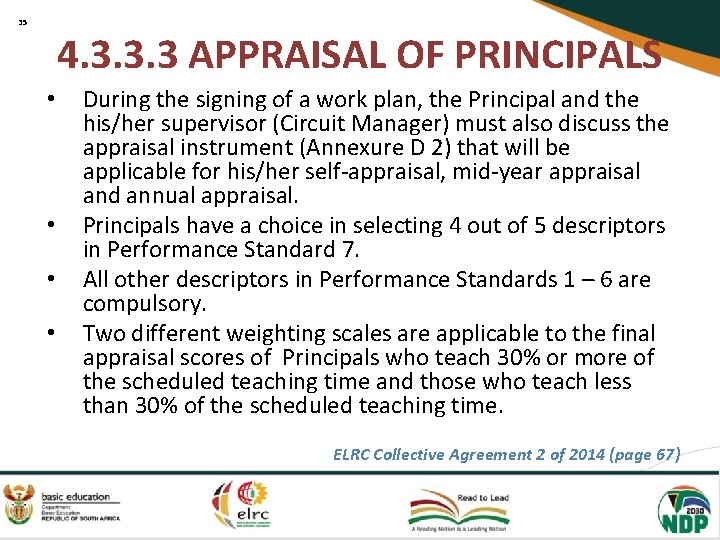
35 4. 3. 3. 3 APPRAISAL OF PRINCIPALS • • During the signing of a work plan, the Principal and the his/her supervisor (Circuit Manager) must also discuss the appraisal instrument (Annexure D 2) that will be applicable for his/her self-appraisal, mid-year appraisal and annual appraisal. Principals have a choice in selecting 4 out of 5 descriptors in Performance Standard 7. All other descriptors in Performance Standards 1 – 6 are compulsory. Two different weighting scales are applicable to the final appraisal scores of Principals who teach 30% or more of the scheduled teaching time and those who teach less than 30% of the scheduled teaching time. ELRC Collective Agreement 2 of 2014 (page 67)
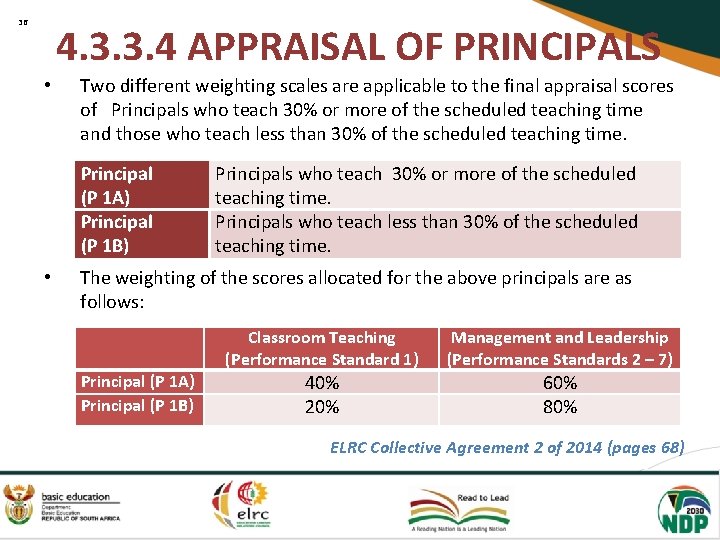
36 4. 3. 3. 4 APPRAISAL OF PRINCIPALS • Two different weighting scales are applicable to the final appraisal scores of Principals who teach 30% or more of the scheduled teaching time and those who teach less than 30% of the scheduled teaching time. Principal (P 1 A) Principal (P 1 B) • Principals who teach 30% or more of the scheduled teaching time. Principals who teach less than 30% of the scheduled teaching time. The weighting of the scores allocated for the above principals are as follows: Principal (P 1 A) Principal (P 1 B) Classroom Teaching (Performance Standard 1) 40% 20% Management and Leadership (Performance Standards 2 – 7) 60% 80% ELRC Collective Agreement 2 of 2014 (pages 68)
37 4. 4 WORK PLANS: SCHOOL MANAGEMENT TEAMS
38 4. 4. 1 WHAT IS A WORK PLAN? A work plan outlines what activities will be undertaken by an employee within a particular year, as well as setting specific targets and outlining outputs that need to be achieved. ELRC Collective Agreement Number 2 of 2014 (page 21)
39 4. 4. 2 Work Plan Templates
40 ELRC Collective Agreement Number 2 of 2014 (page 39)
41 ELRC Collective Agreement Number 2 of 2014 (pages 53 -54)
42 ELRC Collective Agreement Number 2 of 2014 (pages 72 -73)
43 4. 5 DISAGREEMENTS AND GRIEVANCES
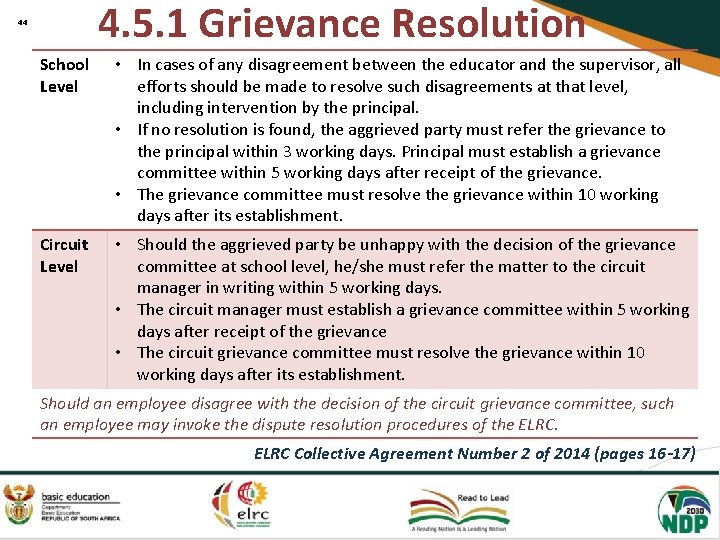
4. 5. 1 Grievance Resolution 44 School Level • In cases of any disagreement between the educator and the supervisor, all efforts should be made to resolve such disagreements at that level, including intervention by the principal. • If no resolution is found, the aggrieved party must refer the grievance to the principal within 3 working days. Principal must establish a grievance committee within 5 working days after receipt of the grievance. • The grievance committee must resolve the grievance within 10 working days after its establishment. Circuit Level • Should the aggrieved party be unhappy with the decision of the grievance committee at school level, he/she must refer the matter to the circuit manager in writing within 5 working days. • The circuit manager must establish a grievance committee within 5 working days after receipt of the grievance • The circuit grievance committee must resolve the grievance within 10 working days after its establishment. Should an employee disagree with the decision of the circuit grievance committee, such an employee may invoke the dispute resolution procedures of the ELRC Collective Agreement Number 2 of 2014 (pages 16 -17)
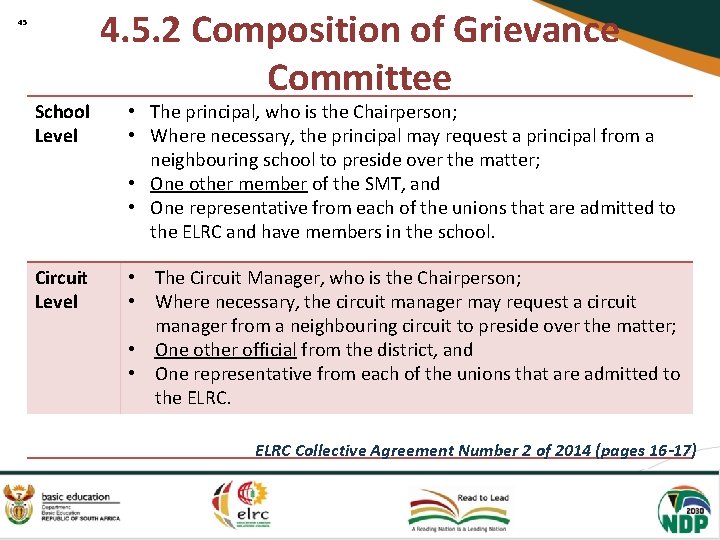
45 School Level Circuit Level 4. 5. 2 Composition of Grievance Committee • The principal, who is the Chairperson; • Where necessary, the principal may request a principal from a neighbouring school to preside over the matter; • One other member of the SMT, and • One representative from each of the unions that are admitted to the ELRC and have members in the school. • The Circuit Manager, who is the Chairperson; • Where necessary, the circuit manager may request a circuit manager from a neighbouring circuit to preside over the matter; • One other official from the district, and • One representative from each of the unions that are admitted to the ELRC Collective Agreement Number 2 of 2014 (pages 16 -17)
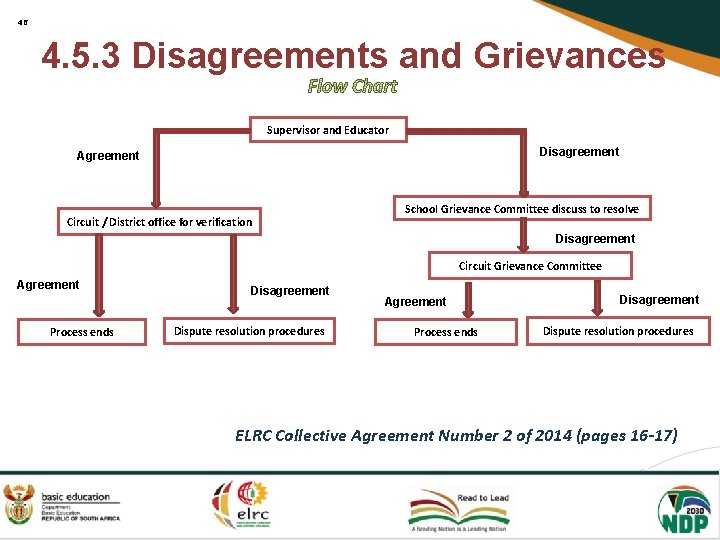
46 4. 5. 3 Disagreements and Grievances Supervisor and Educator Disagreement Agreement Circuit / District office for verification School Grievance Committee discuss to resolve Disagreement Circuit Grievance Committee Agreement Process ends Disagreement Dispute resolution procedures ELRC Collective Agreement Number 2 of 2014 (pages 16 -17)
47 4. 6 QMS MANAGEMENT PLAN FOR SCHOOLS MONTH January – March April - June July September October December ACTION 1. Advocacy & training 2. Signing of work plans (By end of January) 3. Ensure that educators have access to collective agreement and training manual 4. Roles and responsibilities discussed 5. Develop implementation plan/schedule 6. Circuit Manager verifies RESPONSIBILITY Principal, SMT & educators as well as Circuit Manager 1. Self-appraisal by educators 2. Pre-appraisal discussion 3. Lesson observation 4. Mid-year appraisal 5. Post-appraisal discussion 6. Principal verifies & signs 1. Performance Review Principal, SMT, educators, resource person (if applicable) as well as Circuit Manager 1. Self-appraisal by educators 2. Pre-appraisal discussion 3. Lesson Observation 4. Annual appraisal 4. Post-appraisal discussion 5. Principal verifies & signs 6. Verification and signing of annual appraisals 7. Submission of completed composite score sheet to District 8. Circuit Manager verifies Principal, SMT, educators, resource person (if applicable) as well as Circuit Manager Principal ELRC Collective Agreement Number 2 of 2014 (page 18)
48
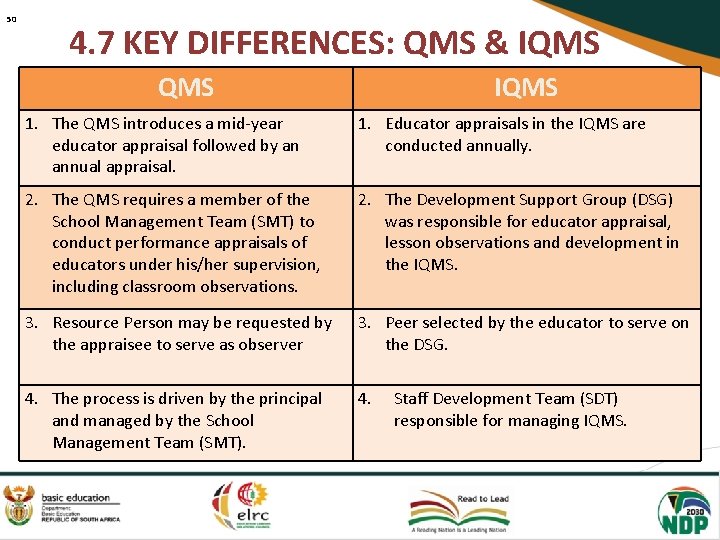
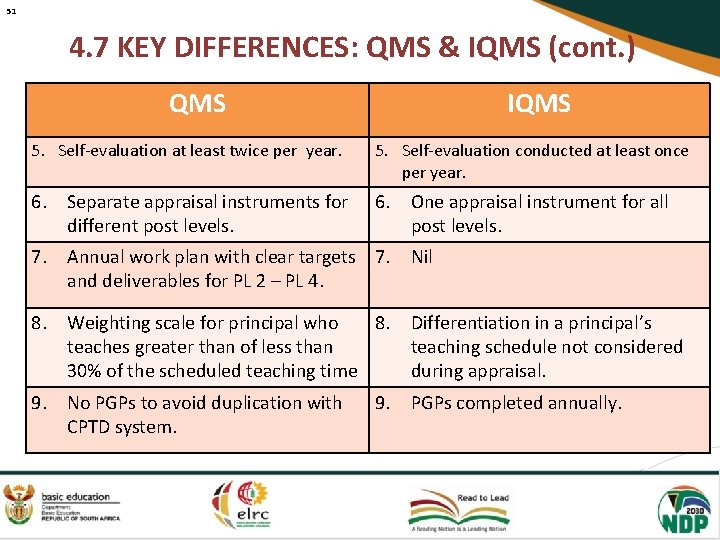
49 The following 3 slides illustrate the key differences between the QMS and IQMS and are for noting only….
50 4. 7 KEY DIFFERENCES: QMS & IQMS 1. The QMS introduces a mid-year educator appraisal followed by an annual appraisal. 1. Educator appraisals in the IQMS are conducted annually. 2. The QMS requires a member of the School Management Team (SMT) to conduct performance appraisals of educators under his/her supervision, including classroom observations. 2. The Development Support Group (DSG) was responsible for educator appraisal, lesson observations and development in the IQMS. 3. Resource Person may be requested by the appraisee to serve as observer 3. Peer selected by the educator to serve on the DSG. 4. The process is driven by the principal and managed by the School Management Team (SMT). 4. Staff Development Team (SDT) responsible for managing IQMS.
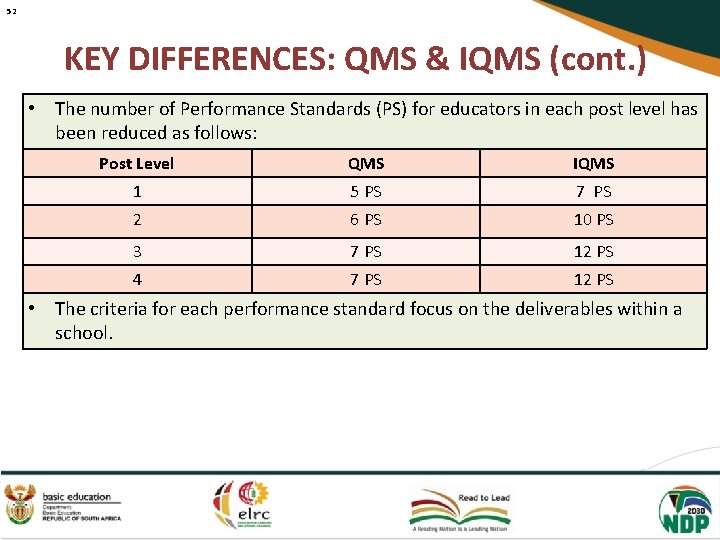
51 4. 7 KEY DIFFERENCES: QMS & IQMS (cont. ) QMS IQMS 5. Self-evaluation at least twice per year. 5. Self-evaluation conducted at least once per year. 6. Separate appraisal instruments for different post levels. 6. One appraisal instrument for all post levels. 7. Annual work plan with clear targets 7. Nil and deliverables for PL 2 – PL 4. 8. Weighting scale for principal who 8. Differentiation in a principal’s teaches greater than of less than teaching schedule not considered 30% of the scheduled teaching time during appraisal. 9. No PGPs to avoid duplication with CPTD system. 9. PGPs completed annually.
52 KEY DIFFERENCES: QMS & IQMS (cont. ) • The number of Performance Standards (PS) for educators in each post level has been reduced as follows: Post Level QMS IQMS 1 5 PS 7 PS 2 6 PS 10 PS 3 7 PS 12 PS 4 7 PS 12 PS • The criteria for each performance standard focus on the deliverables within a school.
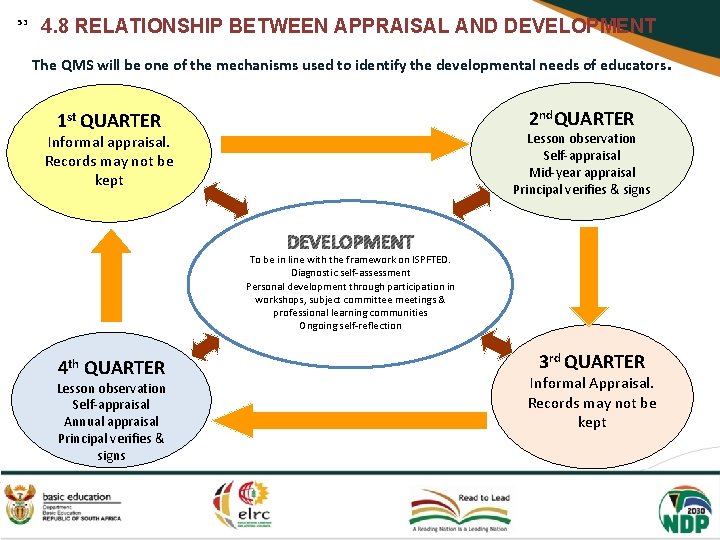
53 4. 8 RELATIONSHIP BETWEEN APPRAISAL AND DEVELOPMENT The QMS will be one of the mechanisms used to identify the developmental needs of educators. 2 nd. QUARTER 1 st QUARTER Lesson observation Self-appraisal Mid-year appraisal Principal verifies & signs Informal appraisal. Records may not be kept DEVELOPMENT To be in line with the framework on ISPFTED. Diagnostic self-assessment Personal development through participation in workshops, subject committee meetings & professional learning communities Ongoing self-reflection 4 th QUARTER Lesson observation Self-appraisal Annual appraisal Principal verifies & signs 3 rd QUARTER Informal Appraisal. Records may not be kept
54 END OF SESSION