
1 Notes 2 Building implicit surfaces Simplest examples
1 Notes
2 Building implicit surfaces § Simplest examples: a plane, a sphere § Can do unions and intersections with min and max § This works great for isolated particles, but we want a smooth liquid mass when we have lots of particles together § Not a bumpy union of spheres
3 Blobbies and Metaballs § Solution is to add kernel functions together § Typically use a spline or Gaussian kernel around each particle § Still may look a little bumpy - can process surface geometry to smooth it out afterwards…

4 Marching Cubes § Going back to blobby/metaball implicit surfaces: often need mesh of surface § Idea of marching cubes (or marching tets): § Split space up into cells § Look at implicit surface function at corners of cell § If there’s a zero crossing, estimate where, put a polygon there § Make sure polygons automatically connect up
5 Acceleration § Efficiency of neighbour location § Rendering implicit surfaces - need to quickly add only the kernel functions that are not zero (avoid O(n) sums!) § Also useful later for liquid animation and collisions § Use an acceleration structure § Background grid or hashtable § Kd-trees also popular
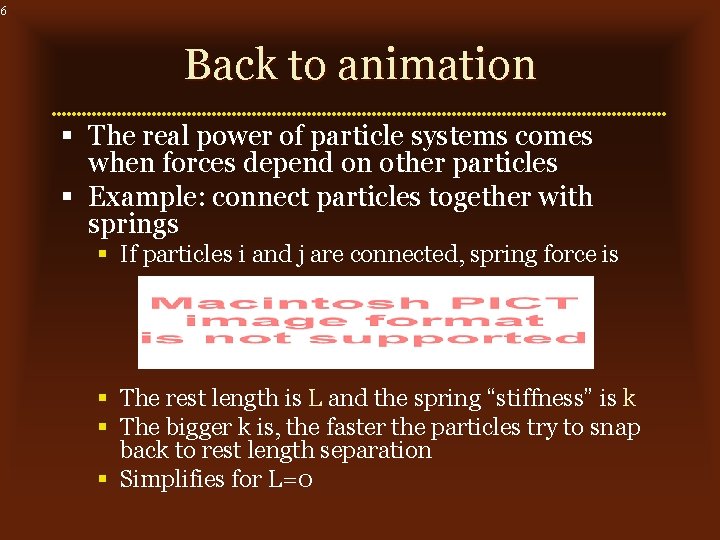
6 Back to animation § The real power of particle systems comes when forces depend on other particles § Example: connect particles together with springs § If particles i and j are connected, spring force is § The rest length is L and the spring “stiffness” is k § The bigger k is, the faster the particles try to snap back to rest length separation § Simplifies for L=0
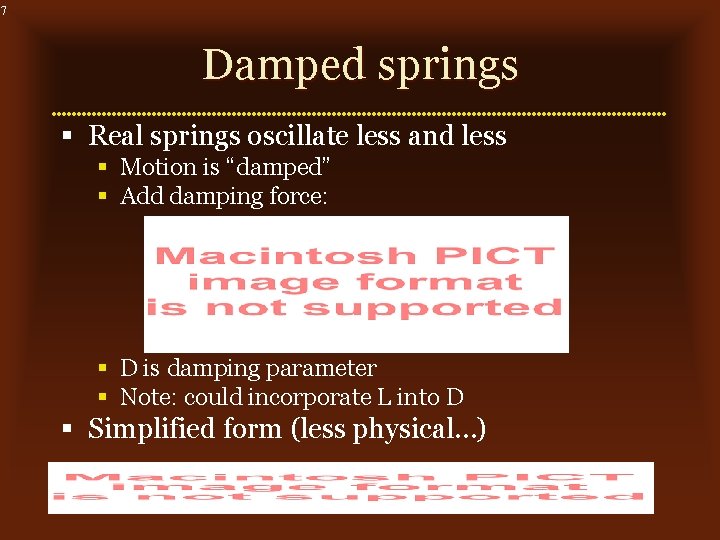
7 Damped springs § Real springs oscillate less and less § Motion is “damped” § Add damping force: § D is damping parameter § Note: could incorporate L into D § Simplified form (less physical…)

8 Elastic objects § Can animate elastic objects by sprinkling particles through them, then connecting them up with a mesh of springs § Hair - lines of springs § Cloth - 2 D mesh of springs § Jello - 3 D mesh of springs § With complex models, can be tricky to get the springs laid out right, with the right stiffnesses § More sophisticated methods like Finite Element Method (FEM) can solve this
9 Liquids § Can even animate liquids (water, mud…) § Instead of fixing which particles are connected, just let nearby particles interact § § If particles are too close, force pushes them apart If particles a bit further, force pulls them closer If particles even further, no more force Controlled by a smooth kernel function § Related to numerical technique called SPH: smoothed particle hydrodynamics § With enough particles (and enough tweaking!) can get a nice liquid look § Render with implicit surface
10 Noise § Useful for defining velocity/force fields, particle variations, and much more (especially shaders) § Need a smooth random number field § Several approaches § Most popular is Perlin noise § Put a smooth cubic (Hermite) spline patch in every cell of space § Control points have value 0, slope looked up from table by hashing knot coordinates § You can decide spatial frequency of noise by rescaling grid
11 Time integration for particles § Back to the ODE problem, either § Accuracy, stability, and ease-ofimplementation are main issues § Obviously Forward Euler and Symplectic Euler are easy to implement - how do they fare in other ways?
12 Stability § Do the particles fly off to infinity? § Particularly a problem with stiff springs § Can always be fixed with small enough time steps - but expensive! § Basically the problem is extrapolation: § From time t we take aim and step off to time t+∆t § Called “explicit” methods § Can turn this into interpolation: § Solve for future position at t+∆t that points back to time t § Called “implicit” methods
13 Backward Euler § Simplest implicit method: very stable, not so accurate, can be painful to implement § Again, can use for both 1 st order and 2 nd order systems § Solving the system for xn+1 often means Newton’s method (linearize as in Gauss-Newton)
14 Simplified Backward Euler § Take just one step of Newton, i. e. linearize nonlinear velocity field: § Then Backward Euler becomes a linear system:
- Slides: 14