
1 Neurotransmitter released from the presynaptic terminal into

- Slides: 24
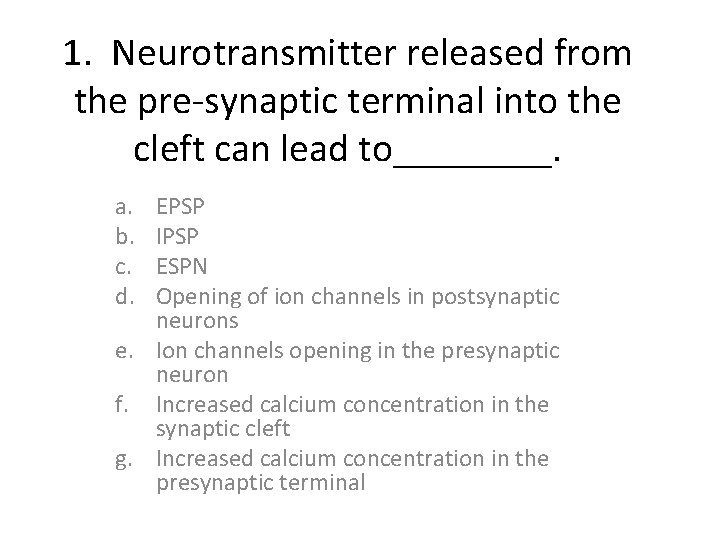
1. Neurotransmitter released from the pre-synaptic terminal into the cleft can lead to____. a. b. c. d. EPSP IPSP ESPN Opening of ion channels in postsynaptic neurons e. Ion channels opening in the presynaptic neuron f. Increased calcium concentration in the synaptic cleft g. Increased calcium concentration in the presynaptic terminal
Practice Quiz Action Potential Conduction Velocity Lab Synapses Somatic and Autonomic Nervous System
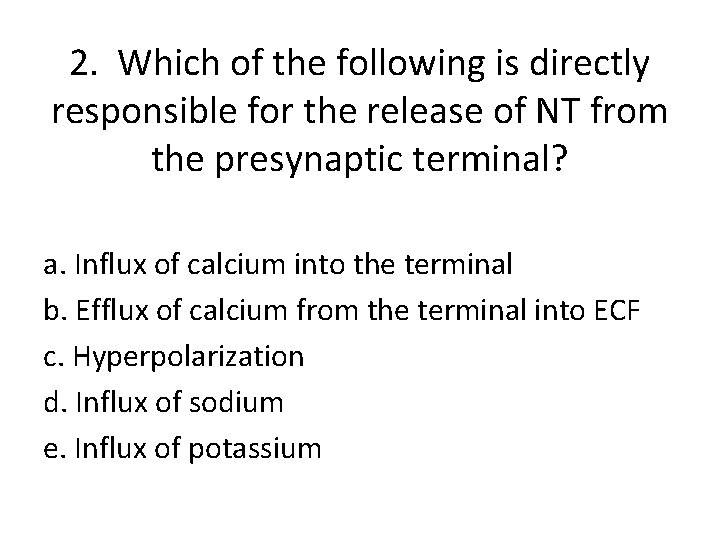
2. Which of the following is directly responsible for the release of NT from the presynaptic terminal? a. Influx of calcium into the terminal b. Efflux of calcium from the terminal into ECF c. Hyperpolarization d. Influx of sodium e. Influx of potassium
3. True or False: The actions of neurotransmitters are usually faster than those of neuromodulators.
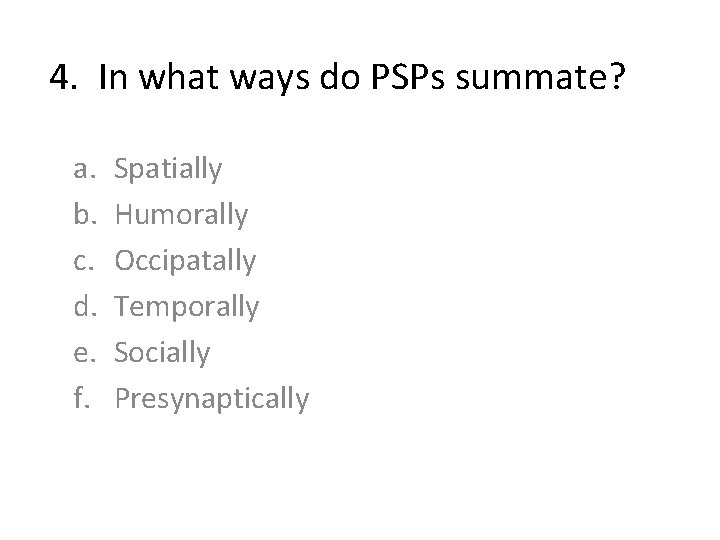
4. In what ways do PSPs summate? a. b. c. d. e. f. Spatially Humorally Occipatally Temporally Socially Presynaptically
5. How do MAO inhibitor drugs work? a. Increase the release of norepinephrine and dopamine into cleft b. Speed up degradation of norepinephrine and dopamine c. Decrease the release of norepinephrine and dopamine into cleft d. Slows degradation of norepinephrine and dopamine
6. Which are examples of biogenic amine neurotransmitters? a. b. c. d. e. f. g. Dopamine Norepinephrine Acetylcholine Glutamate GABA Neuropeptides Catecholamines
7. Which ganglia can be found in chains that are connected to each other close to the spinal cord? a. b. c. d. e. Sympathetic Parasympathetic Somatic Cervical Dorsal root
8. Which system has ganglia that lie within or close to the organs they innervate? a. b. c. d. e. f. Autonomic Sympathetic Parasympathetic Somatic Pathetic Dorsal Root
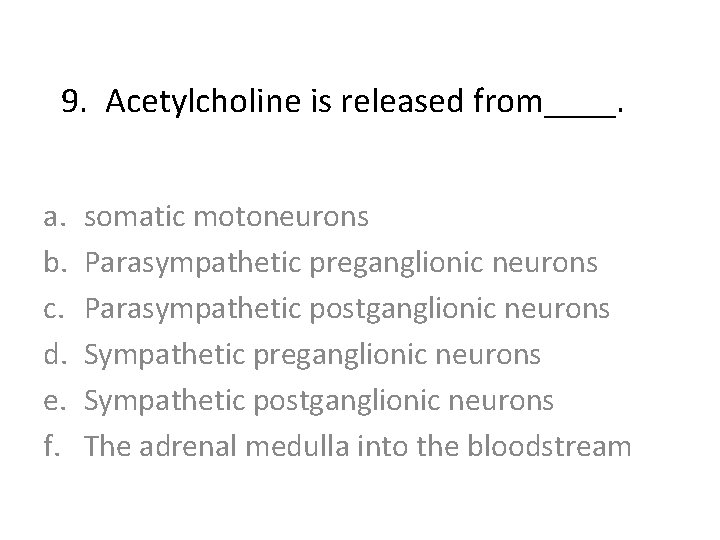
9. Acetylcholine is released from____. a. b. c. d. e. f. somatic motoneurons Parasympathetic preganglionic neurons Parasympathetic postganglionic neurons Sympathetic preganglionic neurons Sympathetic postganglionic neurons The adrenal medulla into the bloodstream
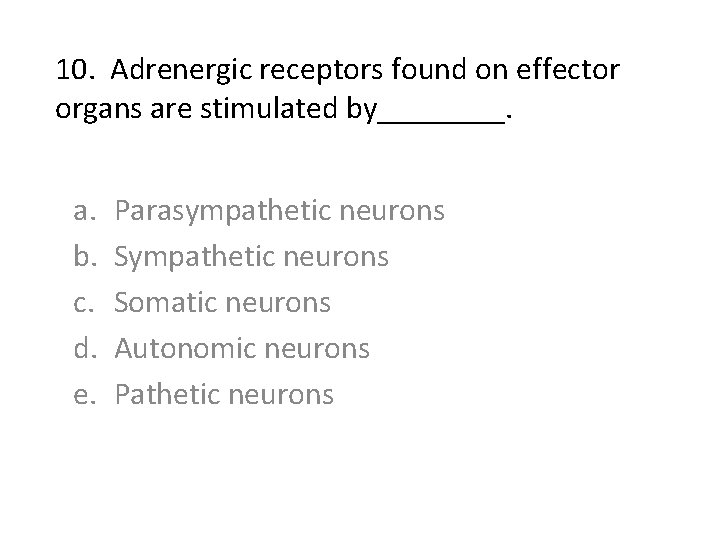
10. Adrenergic receptors found on effector organs are stimulated by____. a. b. c. d. e. Parasympathetic neurons Somatic neurons Autonomic neurons Pathetic neurons
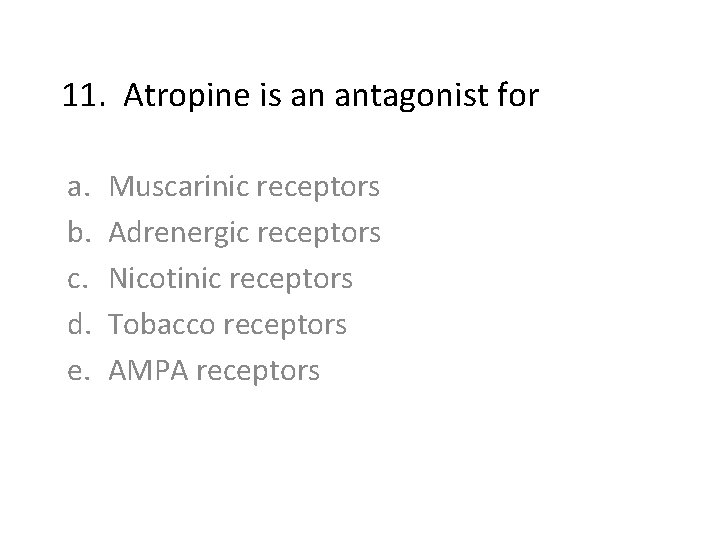
11. Atropine is an antagonist for a. b. c. d. e. Muscarinic receptors Adrenergic receptors Nicotinic receptors Tobacco receptors AMPA receptors
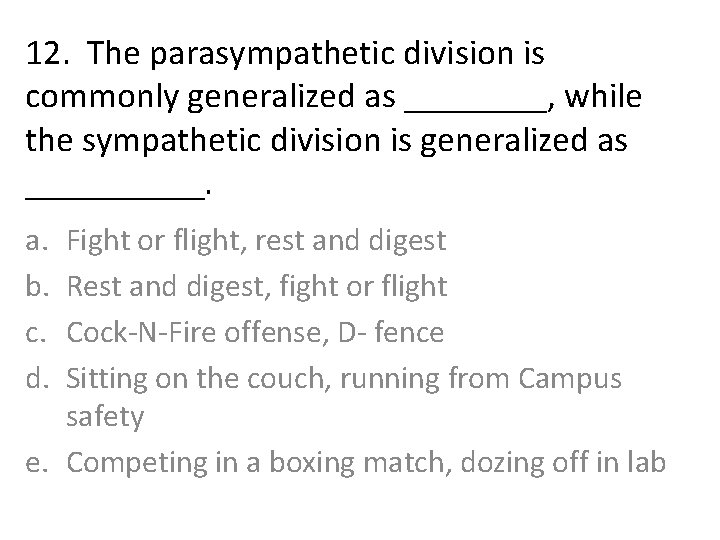
12. The parasympathetic division is commonly generalized as ____, while the sympathetic division is generalized as _____. a. b. c. d. Fight or flight, rest and digest Rest and digest, fight or flight Cock-N-Fire offense, D- fence Sitting on the couch, running from Campus safety e. Competing in a boxing match, dozing off in lab
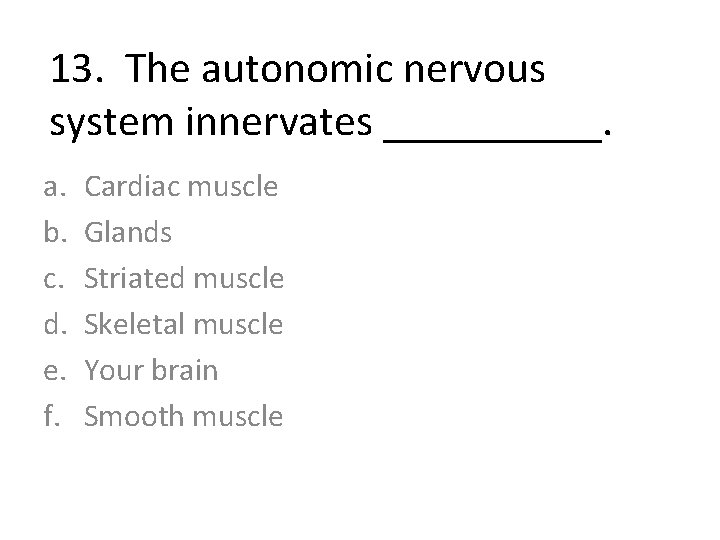
13. The autonomic nervous system innervates _____. a. b. c. d. e. f. Cardiac muscle Glands Striated muscle Skeletal muscle Your brain Smooth muscle
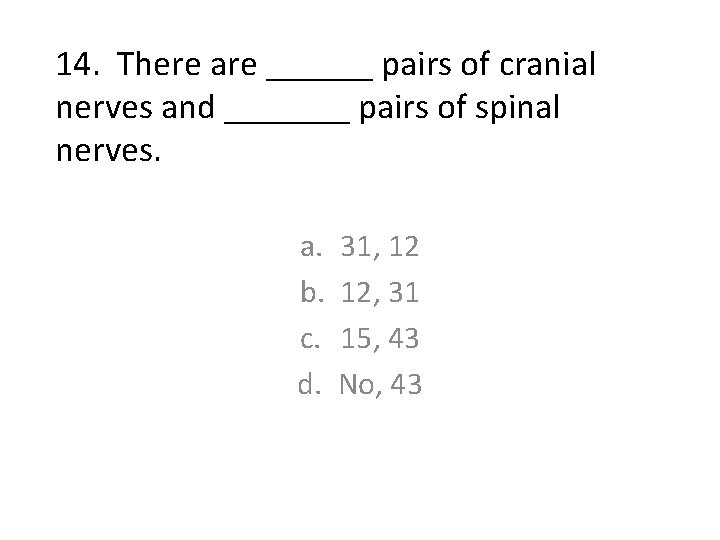
14. There are ______ pairs of cranial nerves and _______ pairs of spinal nerves. a. b. c. d. 31, 12 12, 31 15, 43 No, 43
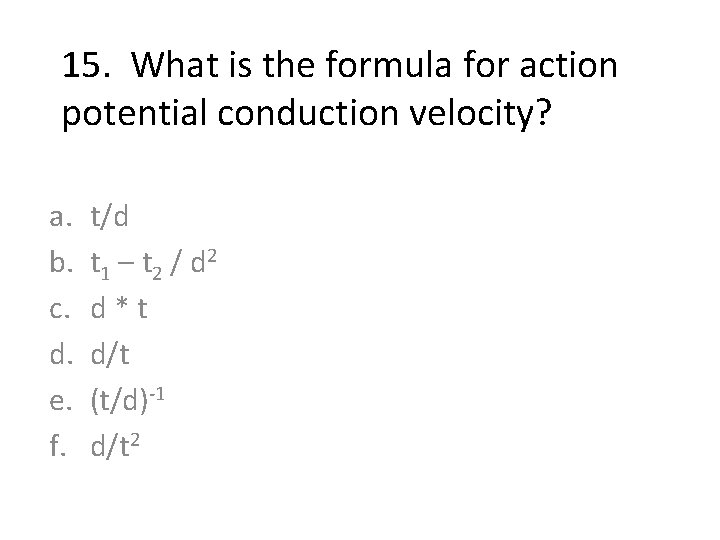
15. What is the formula for action potential conduction velocity? a. b. c. d. e. f. t/d t 1 – t 2 / d 2 d*t d/t (t/d)-1 d/t 2
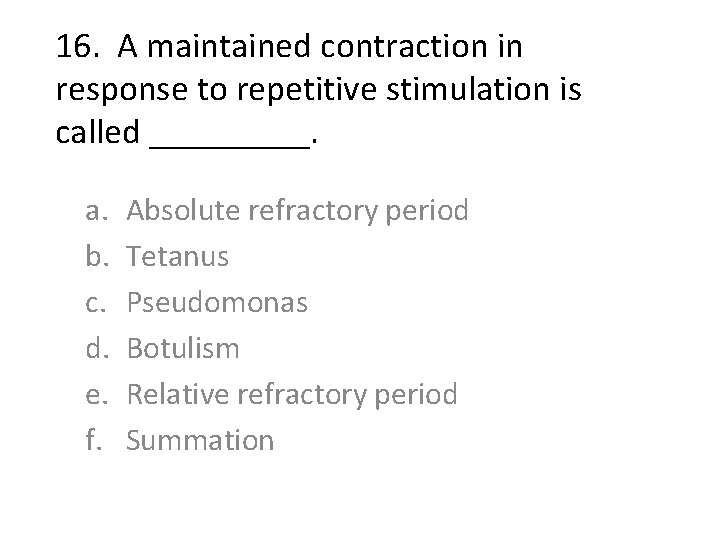
16. A maintained contraction in response to repetitive stimulation is called _____. a. b. c. d. e. f. Absolute refractory period Tetanus Pseudomonas Botulism Relative refractory period Summation
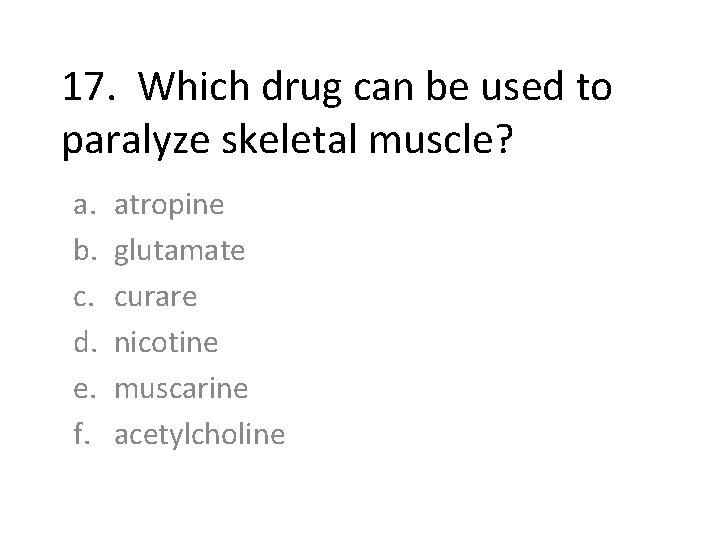
17. Which drug can be used to paralyze skeletal muscle? a. b. c. d. e. f. atropine glutamate curare nicotine muscarine acetylcholine
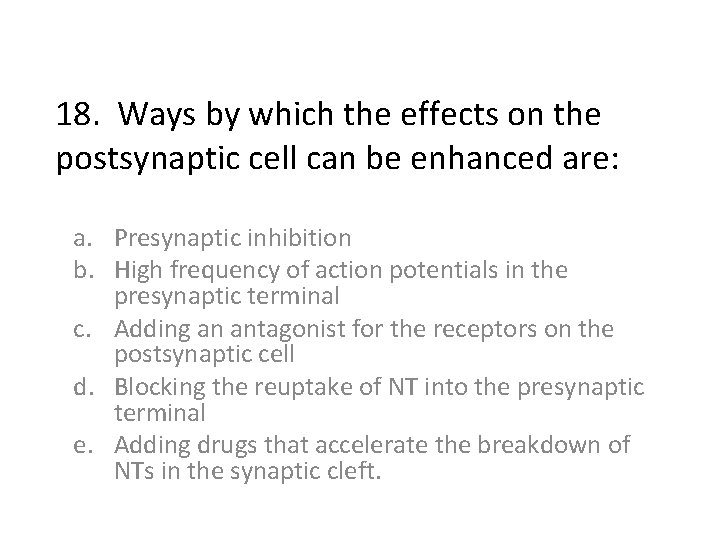
18. Ways by which the effects on the postsynaptic cell can be enhanced are: a. Presynaptic inhibition b. High frequency of action potentials in the presynaptic terminal c. Adding an antagonist for the receptors on the postsynaptic cell d. Blocking the reuptake of NT into the presynaptic terminal e. Adding drugs that accelerate the breakdown of NTs in the synaptic cleft.
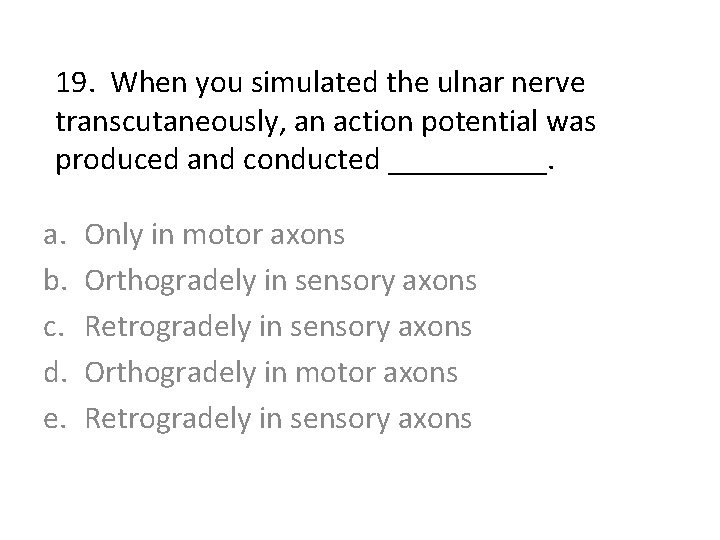
19. When you simulated the ulnar nerve transcutaneously, an action potential was produced and conducted _____. a. b. c. d. e. Only in motor axons Orthogradely in sensory axons Retrogradely in sensory axons Orthogradely in motor axons Retrogradely in sensory axons
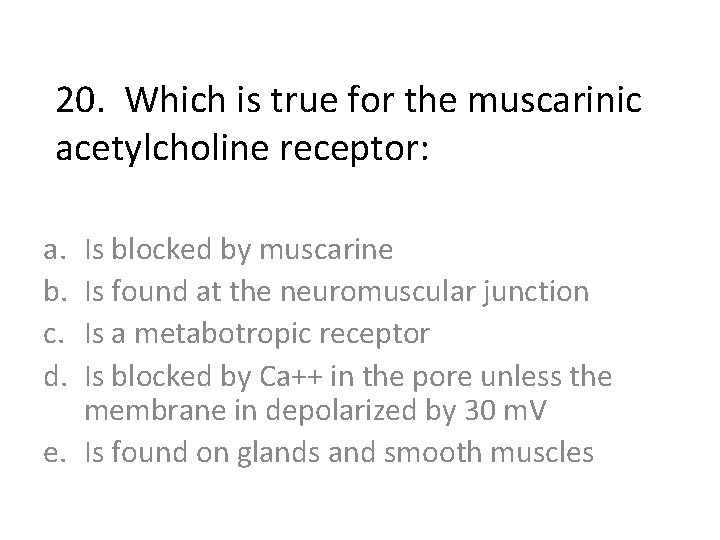
20. Which is true for the muscarinic acetylcholine receptor: a. b. c. d. Is blocked by muscarine Is found at the neuromuscular junction Is a metabotropic receptor Is blocked by Ca++ in the pore unless the membrane in depolarized by 30 m. V e. Is found on glands and smooth muscles
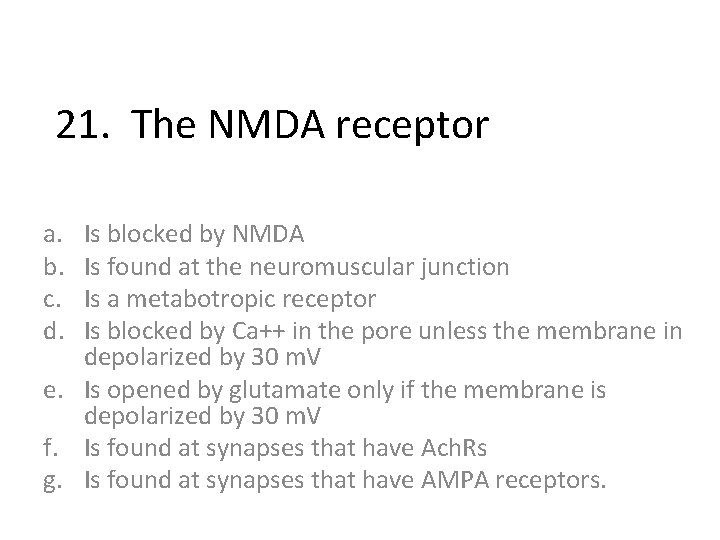
21. The NMDA receptor a. b. c. d. Is blocked by NMDA Is found at the neuromuscular junction Is a metabotropic receptor Is blocked by Ca++ in the pore unless the membrane in depolarized by 30 m. V e. Is opened by glutamate only if the membrane is depolarized by 30 m. V f. Is found at synapses that have Ach. Rs g. Is found at synapses that have AMPA receptors.
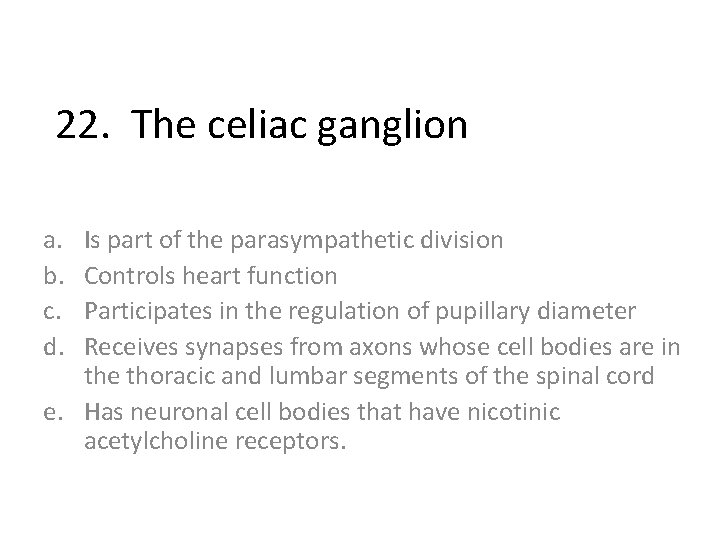
22. The celiac ganglion a. b. c. d. Is part of the parasympathetic division Controls heart function Participates in the regulation of pupillary diameter Receives synapses from axons whose cell bodies are in the thoracic and lumbar segments of the spinal cord e. Has neuronal cell bodies that have nicotinic acetylcholine receptors.
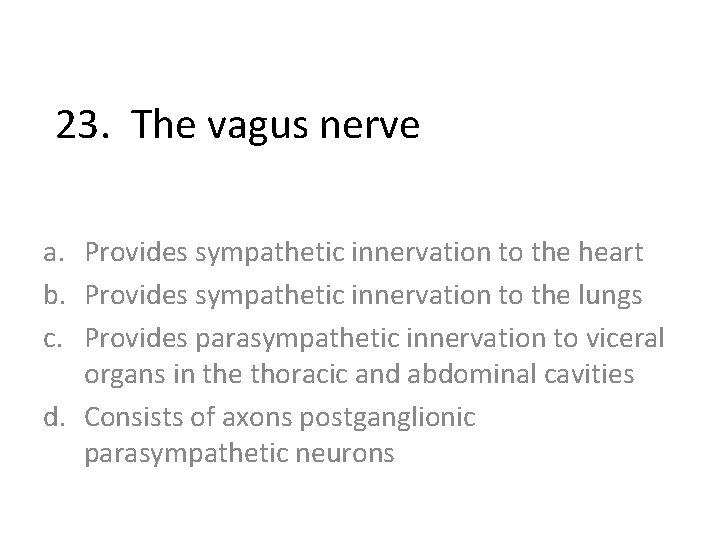
23. The vagus nerve a. Provides sympathetic innervation to the heart b. Provides sympathetic innervation to the lungs c. Provides parasympathetic innervation to viceral organs in the thoracic and abdominal cavities d. Consists of axons postganglionic parasympathetic neurons