
1 Name the following compounds include any isomer
- Slides: 5
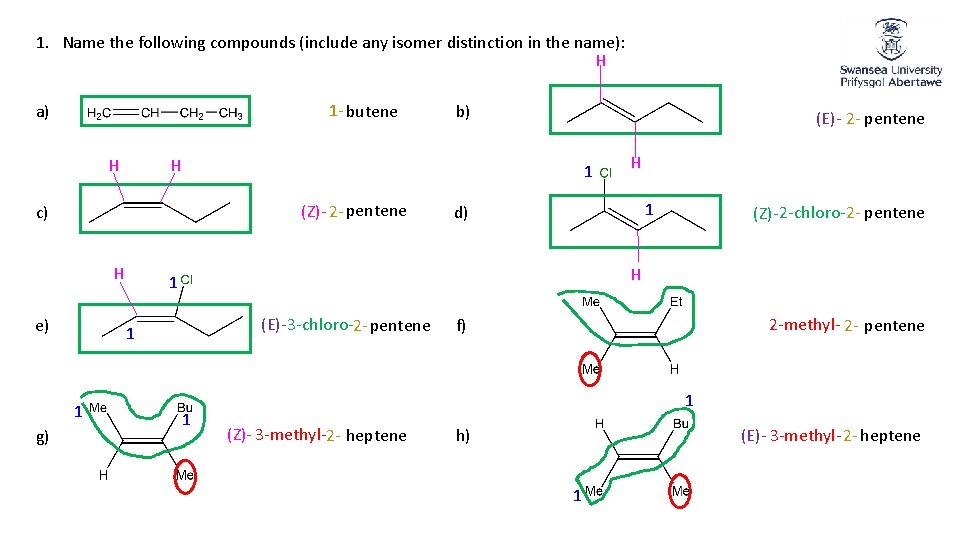
1. Name the following compounds (include any isomer distinction in the name): H 1 - butene a) H 1 (Z)- 2 - pentene H g) H 1 d) (Z)- 2 -chloro-2 - pentene H 1 (E)- 3 -chloro-2 - pentene 1 1 (E)- 2 - pentene H c) e) b) 1 2 -methyl- 2 - pentene f) 1 (Z)- 3 -methyl-2 - heptene h) (E)- 3 -methyl- 2 - heptene 1
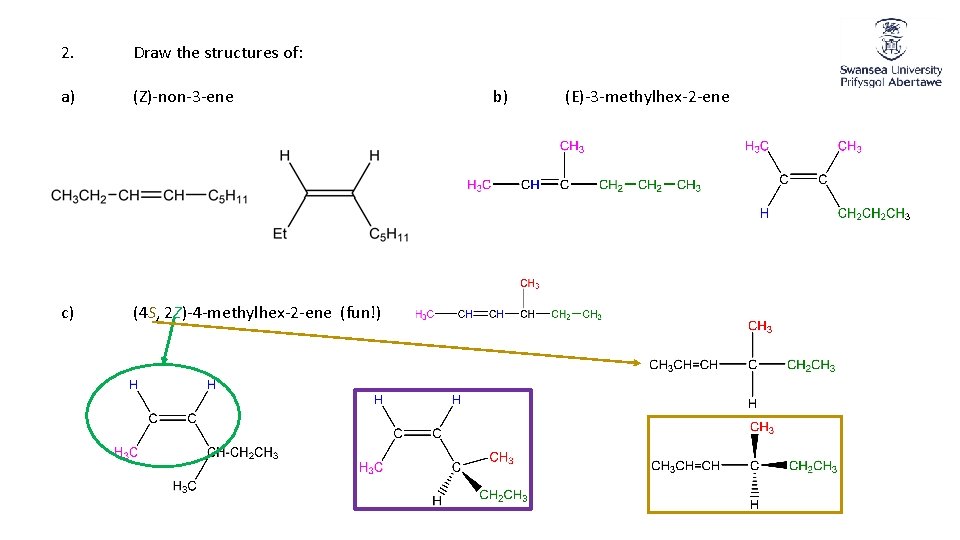
2. a) Draw the structures of: c) (4 S, 2 Z)-4 -methylhex-2 -ene (fun!) (Z)-non-3 -ene b) (E)-3 -methylhex-2 -ene
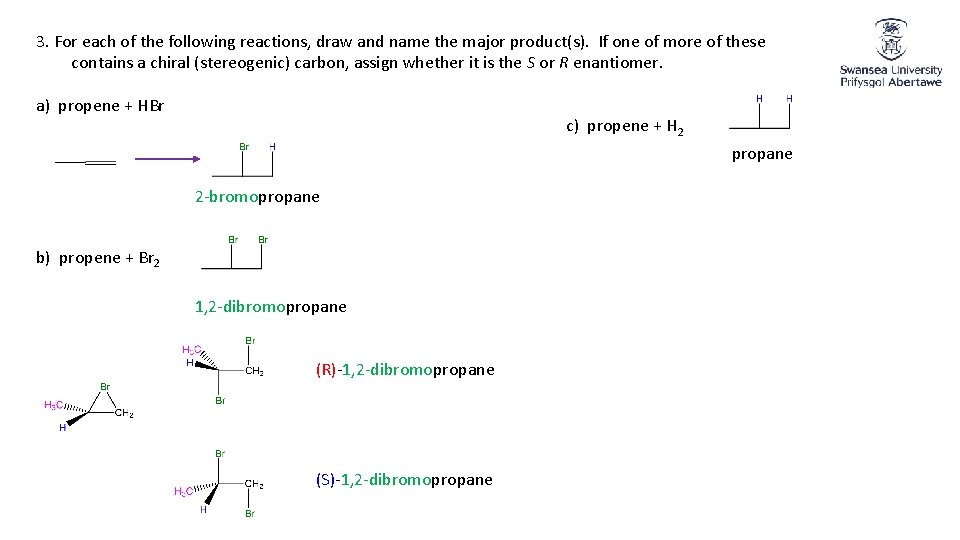
3. For each of the following reactions, draw and name the major product(s). If one of more of these contains a chiral (stereogenic) carbon, assign whether it is the S or R enantiomer. a) propene + HBr c) propene + H 2 propane 2 -bromopropane b) propene + Br 2 1, 2 -dibromopropane (R)-1, 2 -dibromopropane (S)-1, 2 -dibromopropane
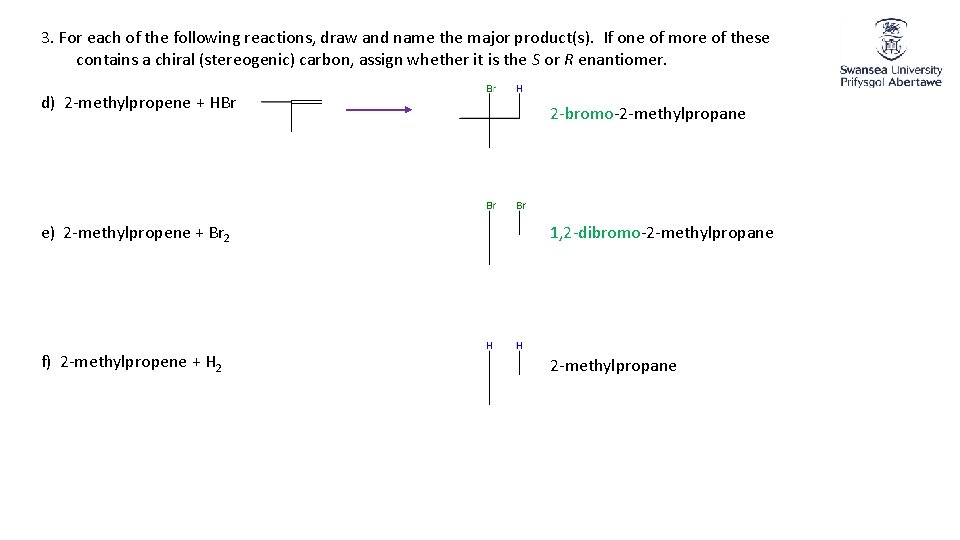
3. For each of the following reactions, draw and name the major product(s). If one of more of these contains a chiral (stereogenic) carbon, assign whether it is the S or R enantiomer. d) 2 -methylpropene + HBr 2 -bromo-2 -methylpropane e) 2 -methylpropene + Br 2 1, 2 -dibromo-2 -methylpropane f) 2 -methylpropene + H 2 2 -methylpropane
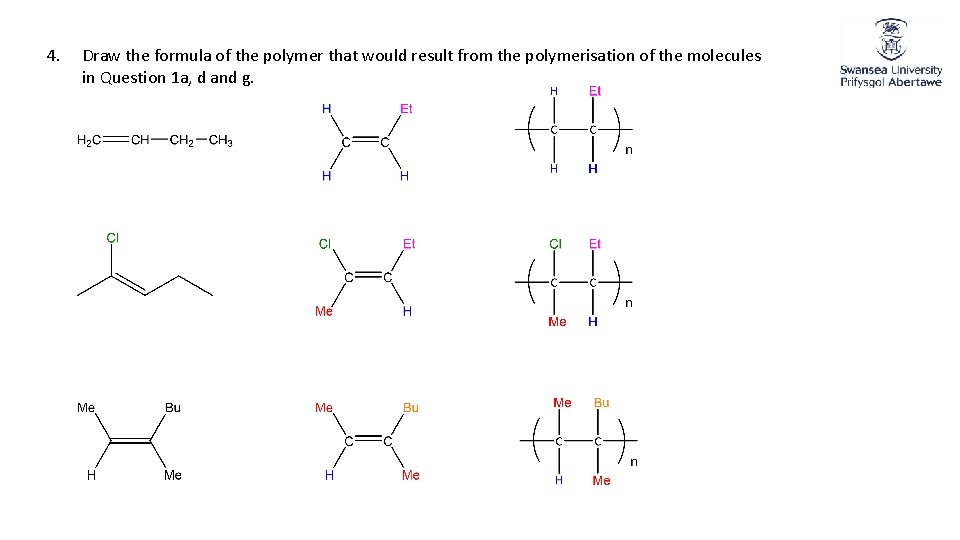
4. Draw the formula of the polymer that would result from the polymerisation of the molecules in Question 1 a, d and g.