
1 More NPComplete Problems NPHARD PROBLEMS TAUTOLOGY PROBLEM

1 More NP-Complete Problems NP-HARD PROBLEMS TAUTOLOGY PROBLEM NODE COVER KNAPSACK
Next Steps 2 We can now reduce 3 -SAT to a large number of problems, either directly or indirectly. Each reduction must be polytime. Usually we focus on length of the output from the transducer, because the construction is easy.
Next Steps – (2) Another essential part of an NP-completeness proof is showing the problem is in NP. Sometimes, we can only show a problem NP-hard = “if the problem is in P, then P = NP”, but the problem may not be in NP. 3
Example: NP-Hard Problem The Tautology Problem is: given a Boolean expression, is it satisfied by all truth assignments? Example: x + -x + yz Not obviously in NP, but it’s complement is. Guess a truth assignment; accept if that assignment doesn’t satisfy the expression. 4
Co-NP A problem/language whose complement is in NP is said to be in Co-NP. Note: P is closed under complementation. Thus, P Co-NP. Also, if P = NP, then P = NP = Co-NP. 5
Tautology is NP-Hard While we can’t prove Tautology is in NP, we can prove it is NP-hard. Suppose we had a polytime algorithm for Tautology. Take any Boolean expression E and convert it to NOT(E). Obviously linear time. 6
Tautology is NP-Hard – (2) E is satisfiable if and only if NOT(E) is not a tautology. Use the hypothetical polytime algorithm for Tautology to test if NOT(E) is a tautology. Say “yes, E is in SAT” if NOT(E) is not a tautology and say “no” otherwise. Then SAT would be in P, and P = NP. 7
The Node Cover Problem Given a graph G, we say N is a node cover for G if every edge of G has at least one end in N. The problem Node Cover is: given a graph G and a “budget” k, does G have a node cover of k or fewer nodes? 8
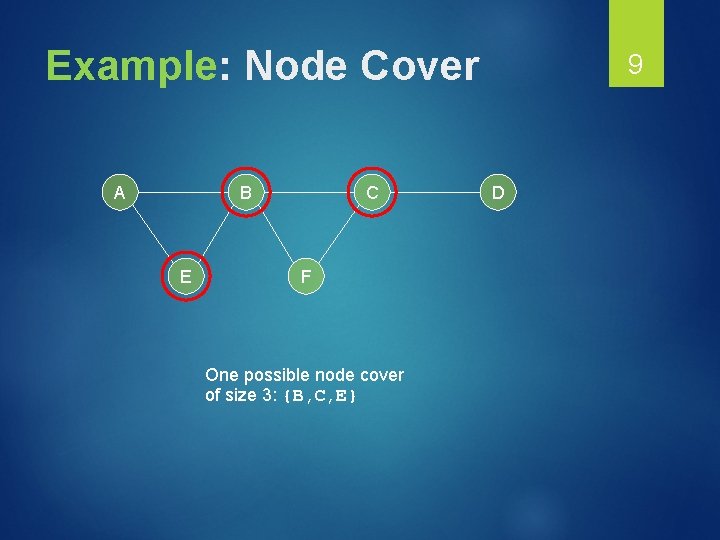
Example: Node Cover A B E C F One possible node cover of size 3: {B, C, E} 9 D
NP-Completeness of Node Cover 10 Reduction from 3 -SAT. For each clause (x+y+z) construct a “column” of three nodes, all connected by vertical edges. Add a horizontal edge between nodes that represent any variable and its negation. Budget = twice the number of clauses.
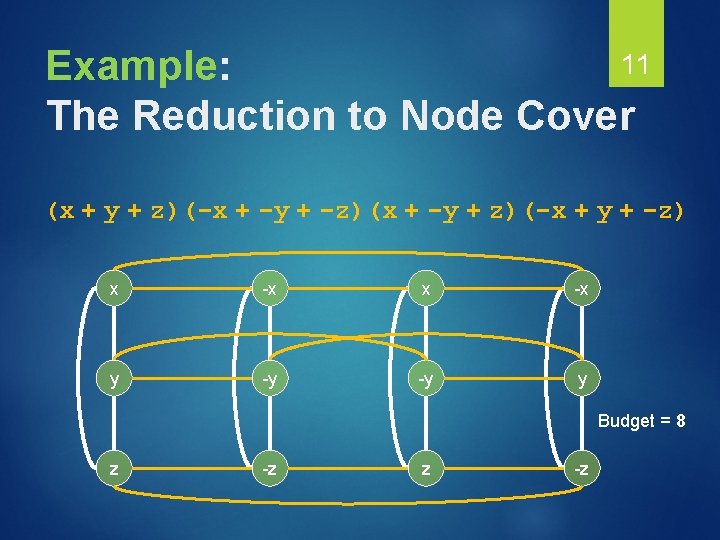
11 Example: The Reduction to Node Cover (x + y + z)(-x + -y + -z)(x + -y + z)(-x + y + -z) x -x y -y -y y Budget = 8 z -z
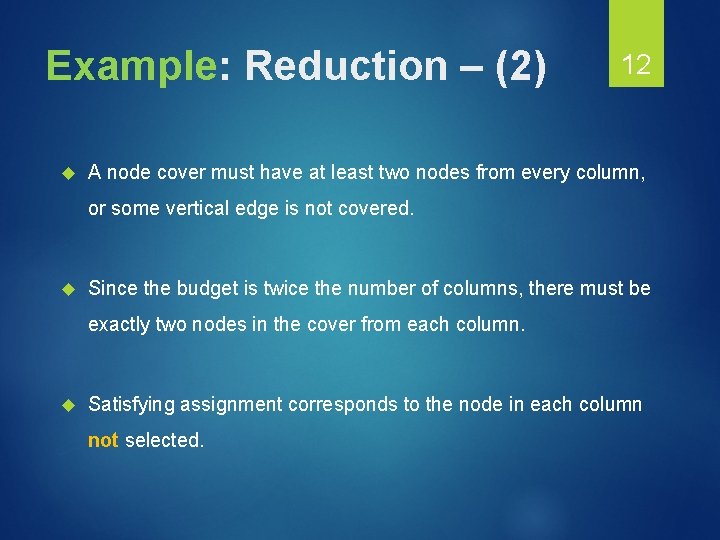
Example: Reduction – (2) 12 A node cover must have at least two nodes from every column, or some vertical edge is not covered. Since the budget is twice the number of columns, there must be exactly two nodes in the cover from each column. Satisfying assignment corresponds to the node in each column not selected.
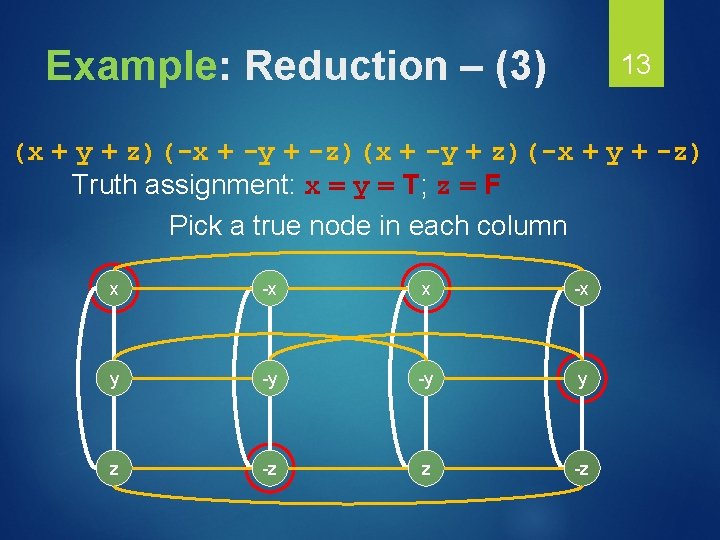
Example: Reduction – (3) 13 (x + y + z)(-x + -y + -z)(x + -y + z)(-x + y + -z) Truth assignment: x = y = T; z = F Pick a true node in each column x -x y -y -y y z -z
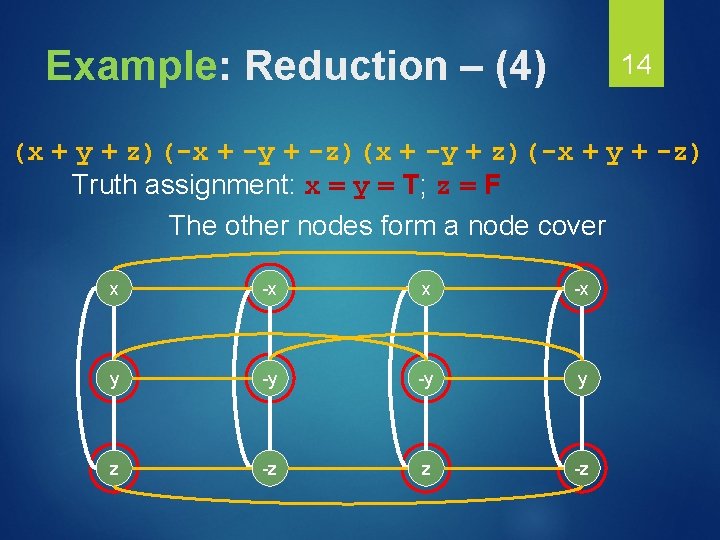
Example: Reduction – (4) 14 (x + y + z)(-x + -y + -z)(x + -y + z)(-x + y + -z) Truth assignment: x = y = T; z = F The other nodes form a node cover x -x y -y -y y z -z
Proof That the Reduction Works The reduction is clearly polytime. Need to show: If we construct from 3 -SAT instance E a graph G and a budget k, then G has a node cover of size < k if and only if E is satisfiable. 15
Proof: If Suppose we have a satisfying assignment A for E. For each clause of E, pick one of its three literals that A makes true. Put in the node cover the two nodes for that clause that do not correspond to the selected literal. Total = k nodes – meets budget. 16
Proof: If – (2) 17 The selected nodes cover all vertical edges. Why? Any two nodes for a clause cover the triangle of vertical edges for that clause. Horizontal edges are also covered. A horizontal edge connects nodes for some x and -x. One is false in A and therefore its node must be selected for the node cover.
Proof: Only If Suppose G has a node cover with at most k nodes. One node cannot cover the vertical edges of any column, so 18 each column has exactly 2 nodes in the cover. Construct a satisfying assignment for E by making true the literal for any node not in the node cover.
Proof: Only If – (2) Worry: What if there are unselected nodes corresponding to both x and -x? Then we would not have a truth assignment. But there is a horizontal edge between these nodes. Thus, at least one is in the node cover. 19
The Knapsack Problem We shall prove NP-complete a version of Knapsack with a target: Given a list L of integers and a target k, is there a subset of L whose sum is exactly k? Later, we’ll reduce this version of Knapsack to our earlier one: given an integer list L, can we divide it into two equal parts? 20
21 Knapsack-With-Target is in NP Guess a subset of the list L. Add ‘em up. Accept if the sum is k.
Polytime Reduction of 3 SAT to Knapsack-With. Target Given 3 -SAT instance E, we need to construct a list L and a target k. Suppose E has c clauses and v variables. L will have base-32 integers of length c+v, and there will be 3 c+2 v of them. 22
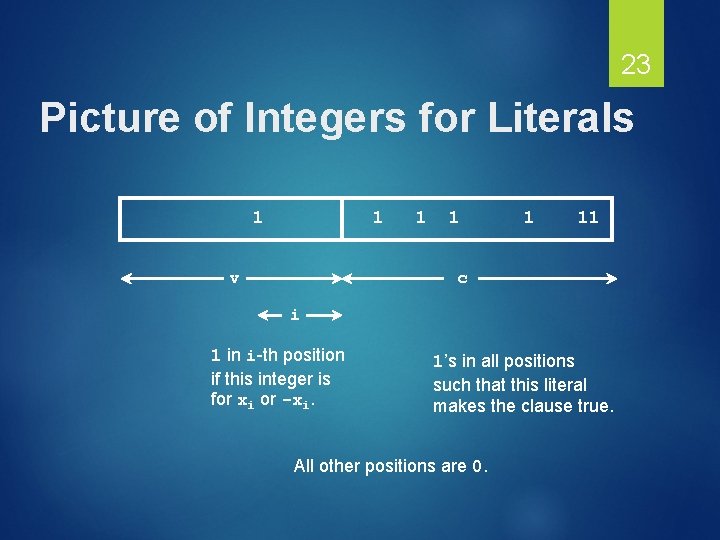
23 Picture of Integers for Literals 1 1 v 1 11 c i 1 in i-th position if this integer is for xi or -xi. 1’s in all positions such that this literal makes the clause true. All other positions are 0.
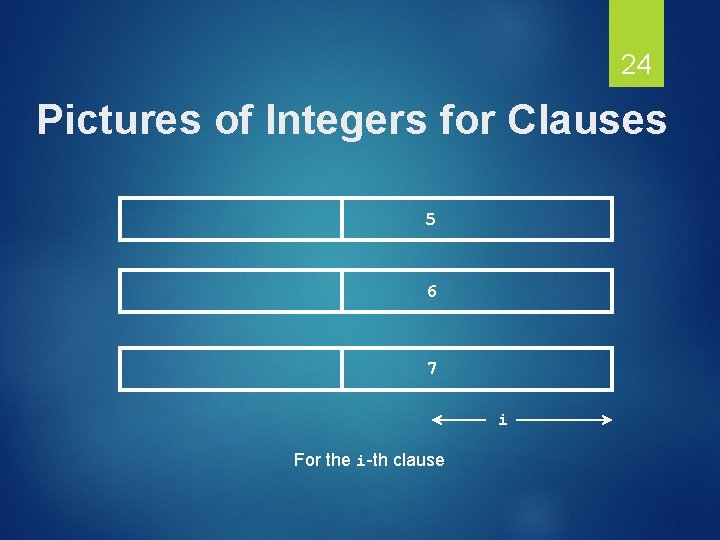
24 Pictures of Integers for Clauses 5 6 7 i For the i-th clause
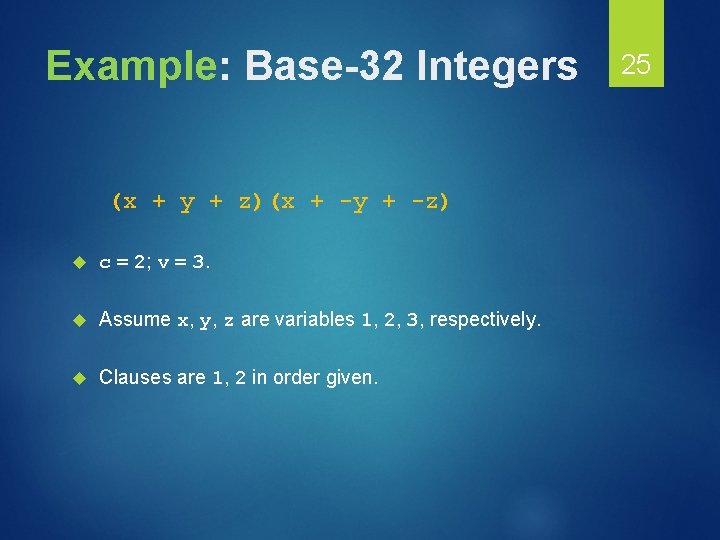
Example: Base-32 Integers (x + y + z)(x + -y + -z) c = 2; v = 3. Assume x, y, z are variables 1, 2, 3, respectively. Clauses are 1, 2 in order given. 25
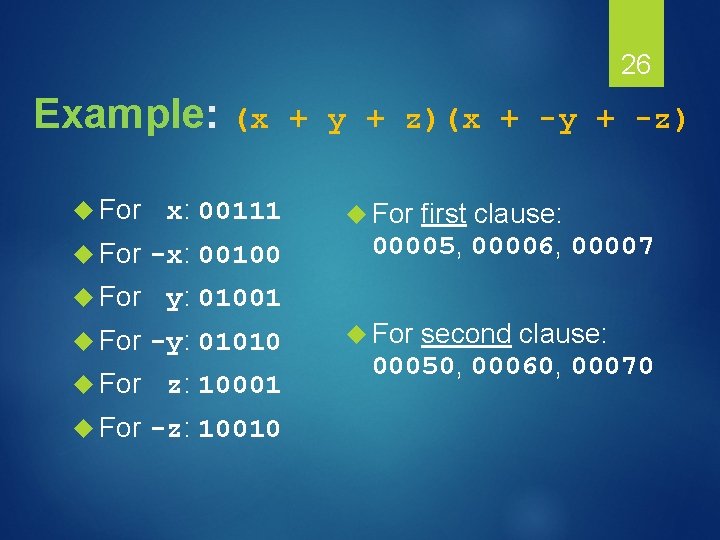
26 Example: (x For x: 00111 For -x: 00100 For y: 01001 For -y: 01010 For z: 10001 For -z: 10010 + y + z)(x + -y + -z) For first clause: 00005, 00006, 00007 For second clause: 00050, 00060, 00070
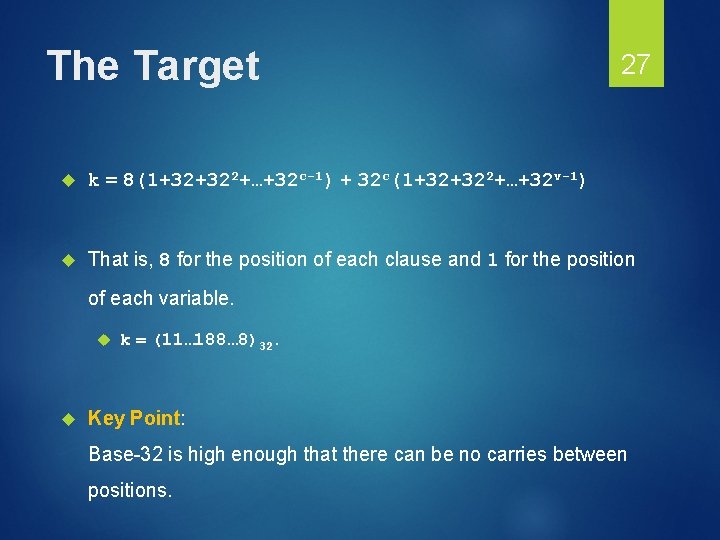
The Target 27 k = 8(1+32+322+…+32 c-1) + 32 c(1+32+322+…+32 v-1) That is, 8 for the position of each clause and 1 for the position of each variable. k = (11… 188… 8)32. Key Point: Base-32 is high enough that there can be no carries between positions.
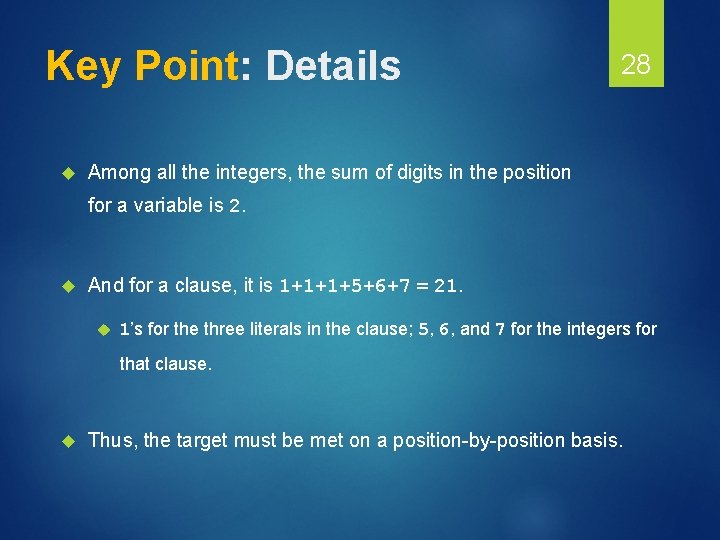
Key Point: Details 28 Among all the integers, the sum of digits in the position for a variable is 2. And for a clause, it is 1+1+1+5+6+7 = 21. 1’s for the three literals in the clause; 5, 6, and 7 for the integers for that clause. Thus, the target must be met on a position-by-position basis.
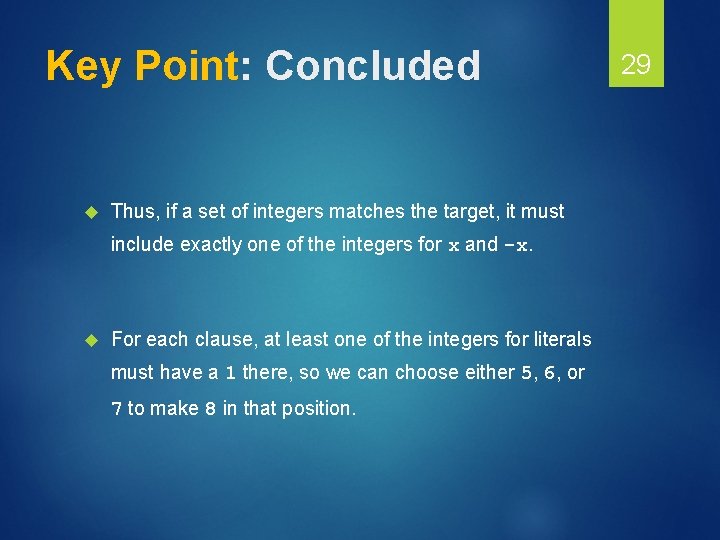
Key Point: Concluded Thus, if a set of integers matches the target, it must include exactly one of the integers for x and -x. For each clause, at least one of the integers for literals must have a 1 there, so we can choose either 5, 6, or 7 to make 8 in that position. 29
Proof the Reduction Works Each integer can be constructed from the 3 -SAT instance E in time proportional to its length. Thus, reduction is O(n 2). If E is satisfiable, take a satisfying assignment A. Pick integers for those literals that A makes true. 30
31 Proof the Reduction Works – (2) The selected integers sum to between 1 and 3 in the digit for each clause. For each clause, choose the integer with 5, 6, or 7 in that digit to make a sum of 8. These selected integers sum to exactly the target.
Proof: Converse 32 We must also show that a sum of integers equal to the target k implies E is satisfiable. In each digit for a variable x, either the integer for x or the digit for -x, but not both is selected. Let truth assignment A make this literal true.
Proof: Converse – (2) In the digits for the clauses, a sum of 8 can only be achieved if among the integers for the variables, there is at least one 1 in that digit. Thus, truth assignment A makes each clause true, so it satisfies E. 33
34 The Partition-Knapsack Problem This problem is what we originally referred to as “knapsack”. Given a list of integers L, can we partition it into two disjoint sets whose sums are equal? Partition-Knapsack is NP-complete; reduction from Knapsack-With-Target.
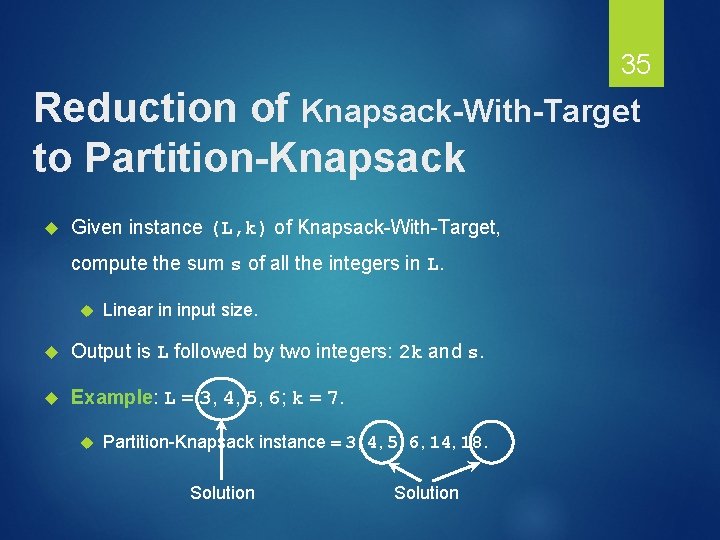
35 Reduction of Knapsack-With-Target to Partition-Knapsack Given instance (L, k) of Knapsack-With-Target, compute the sum s of all the integers in L. Linear in input size. Output is L followed by two integers: 2 k and s. Example: L = 3, 4, 5, 6; k = 7. Partition-Knapsack instance = 3, 4, 5, 6, 14, 18. Solution
36 Proof That Reduction Works The sum of all integers in the output instance is 2(s+k). Thus, the two partitions must each sum to s+k. If the input instance has a subset of L that sums to k, then pick it plus the integer s to solve the output instance.
Proof: Converse Suppose the output instance of Partition-Knapsack has a solution. The integers s and 2 k cannot be in the same partition. Because their sum is more than half 2(s+k). Thus, the subset of L that is in the partition with s sums to k. Thus, it solves the input instance. 37
- Slides: 37