
1 Minute OBE How much you can learn
1 -Minute OBE How much you can learn about OBE in 1 minute?
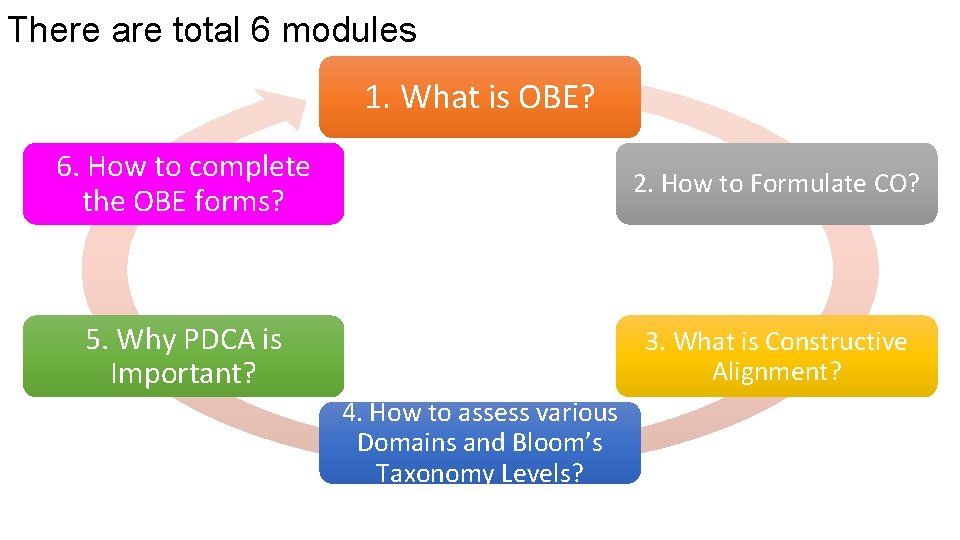
There are total 6 modules 1. What is OBE? 6. How to complete the OBE forms? 2. How to Formulate CO? 5. Why PDCA is Important? 3. What is Constructive Alignment? 4. How to assess various Domains and Bloom’s Taxonomy Levels?
Module 1: What is OBE? Yeoh KH & Poon HM
What is OBE?
OBE is an approach that focuses on the attainment of learning outcomes. It focuses on what is essential for students to be able to do successfully at the end of their learning experiences.
What are the differences between traditional and OBE approach?

The differences are: PLANNING Traditional OBE What content should be taught, what teaching method should be used What student will know and able to do after lecture

The differences are: TEACHING Traditional OBE To transmit To devise teaching knowledge, ideas and learning values to the students activities that require students to demonstrate how well they have achieve the learning outcome

The differences are: ASSESSMENT Traditional OBE To assess how well the students have received the knowledge To assess how well the students have achieved the learning outcome
In short, OBE approach is Student Centred while traditional approach is Teacher Centred.

What are the impacts of transformation from teachercentred to student -centred?
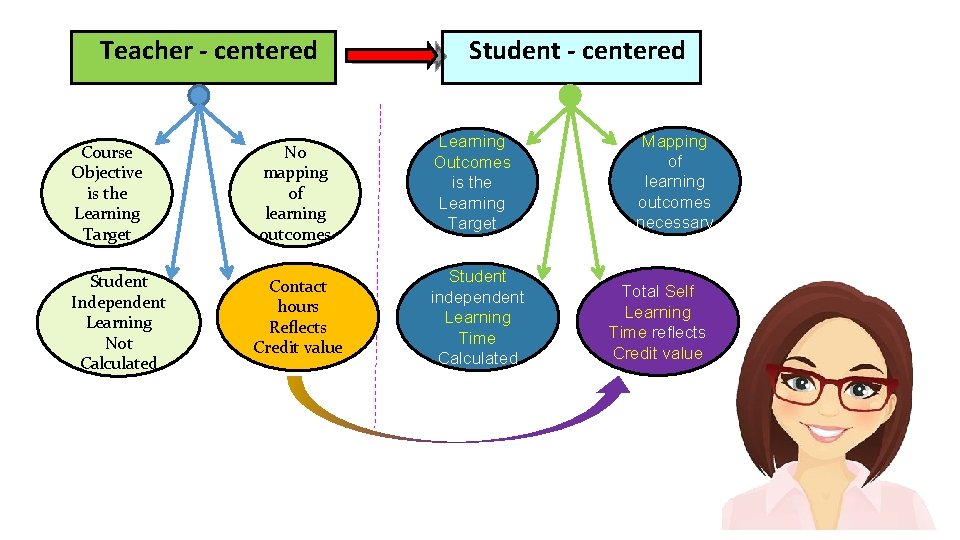
Teacher - centered Course Objective is the Learning Target Student Independent Learning Not Calculated No mapping of learning outcomes Contact hours Reflects Credit value Student - centered Learning Outcomes is the Learning Target Student independent Learning Time Calculated Mapping of learning outcomes necessary Total Self Learning Time reflects Credit value
How does OBE work?
Basically OBE answers these questions : What do you want the students to learn? Why do you want them to learn it? How can you best help students to learn it? How will you know what they have learnt?
How OBE approach answer those questions?
1. Defining course outcomes to explicate what a student is expected to know/understand, 2. Providing learning activities to attain these outcomes; 3. Assessing the students through the use of explicit assessment criteria as performance indicator.
How OBE can help to improve the teaching and the quality of learning?
1. Clarity of focus - Teachers must be focused on what they want students to know/understand 2. Designing down – Clear definition of the curriculum design with clear outcomes that students are to achieve by the end of the program. 3. High expectations - Teachers can establish challenging standards of performance in order to encourage students to engage deeply in what they are learning. 4. Expanded opportunities - Teachers strive to provide opportunities for all students based on the idea that not all learners can learn the same thing in the same way and in the same time.
Also, OBE is a requirement from qualification bodies / professional bodies such as MQA, MOHE, BEM and EAC
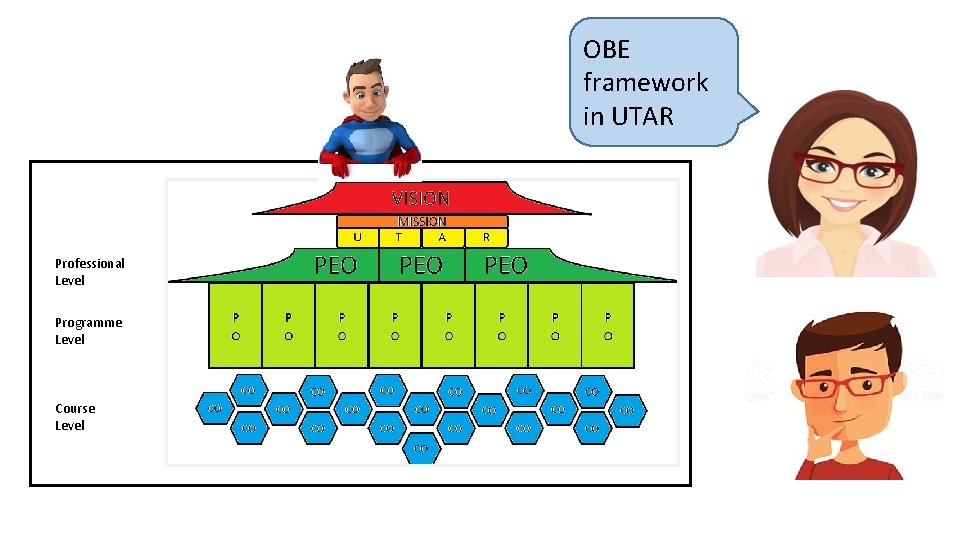
OBE framework in UTAR Professional Level Programme Level Course Level
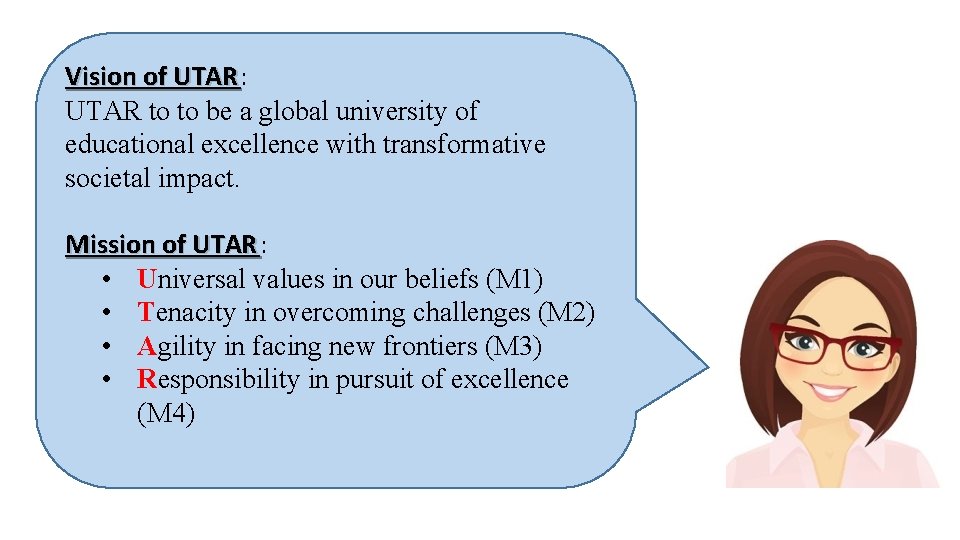
Vision of UTAR: UTAR to to be a global university of educational excellence with transformative societal impact. Mission of UTAR: UTAR • Universal values in our beliefs (M 1) • Tenacity in overcoming challenges (M 2) • Agility in facing new frontiers (M 3) • Responsibility in pursuit of excellence (M 4)
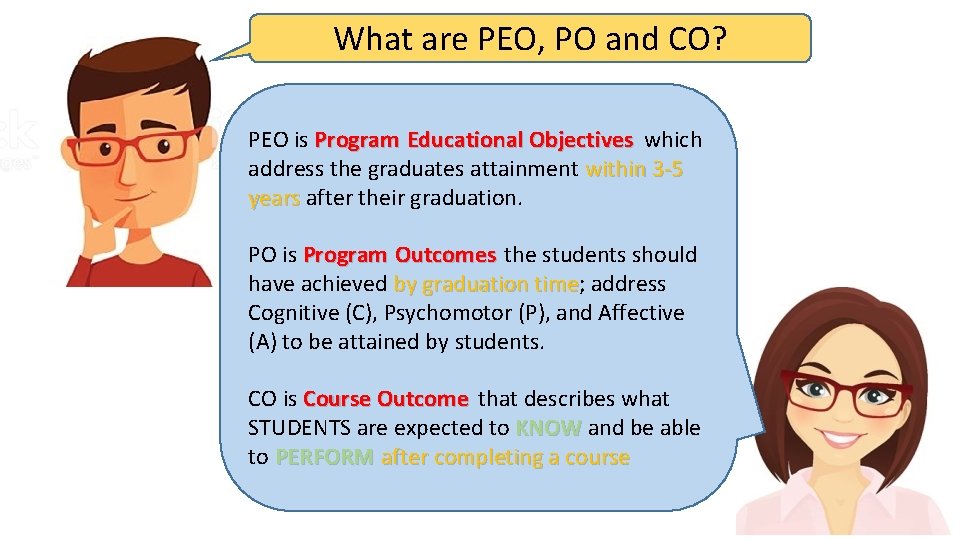
What are PEO, PO and CO? PEO is Program Educational Objectives which address the graduates attainment within 3 -5 years after their graduation. PO is Program Outcomes the students should have achieved by graduation time; time address Cognitive (C), Psychomotor (P), and Affective (A) to be attained by students. CO is Course Outcome that describes what STUDENTS are expected to KNOW and be able to PERFORM after completing a course
Module 2: How to Formulate Course Outcomes (CO)? Mariam
How many COs should a course have?
Typically a course should have between 3 to 5 COs
Remember that COs should NOT be a listing of the Course Topics
What are the components every CO must have?
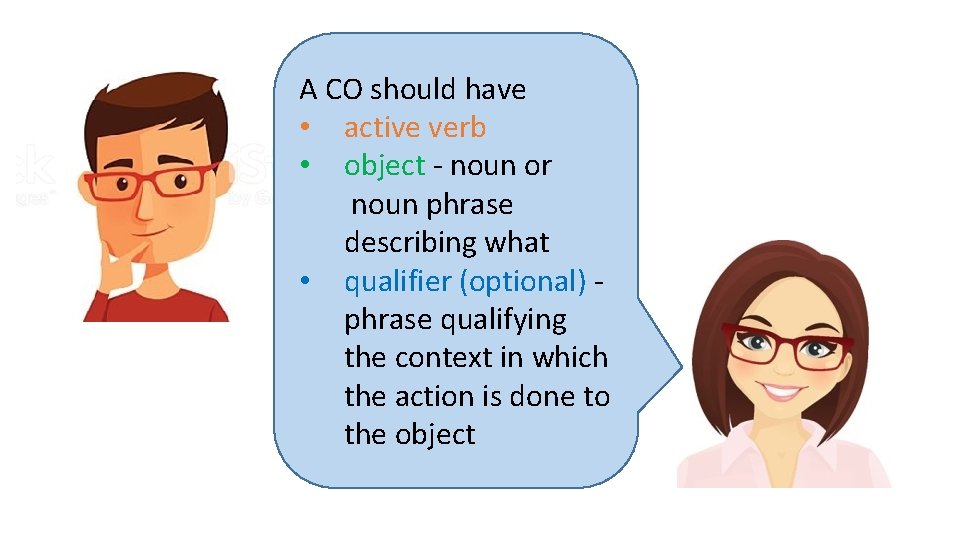
A CO should have • active verb • object - noun or noun phrase describing what • qualifier (optional) phrase qualifying the context in which the action is done to the object
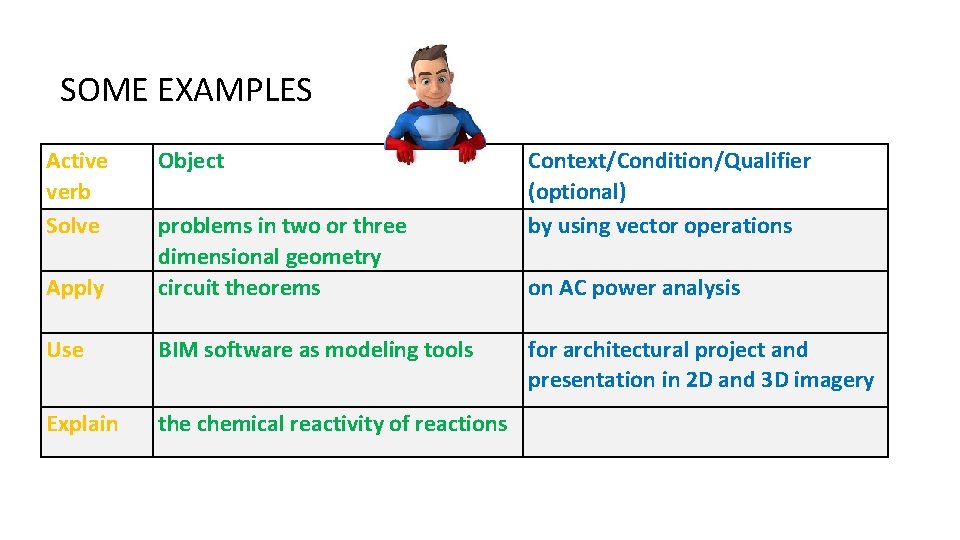
SOME EXAMPLES Active verb Solve Object Apply problems in two or three dimensional geometry circuit theorems Use BIM software as modeling tools Explain the chemical reactivity of reactions Context/Condition/Qualifier (optional) by using vector operations on AC power analysis for architectural project and presentation in 2 D and 3 D imagery
Remember that a CO should have only ONE active verb or action

What distinguishes a Good CO?
The ultimate test when writing a Good CO is whether the ACTION can be ASSESSED. Avoid vague terms such as know, understand, familiar, aware, etc.
Remember that COs are SUPPORTED through TEACHING and LEARNING activities
Remember that ASSESSMENTS give us the EVIDENCE that the CO was ACHIEVED
How to measure a CO?
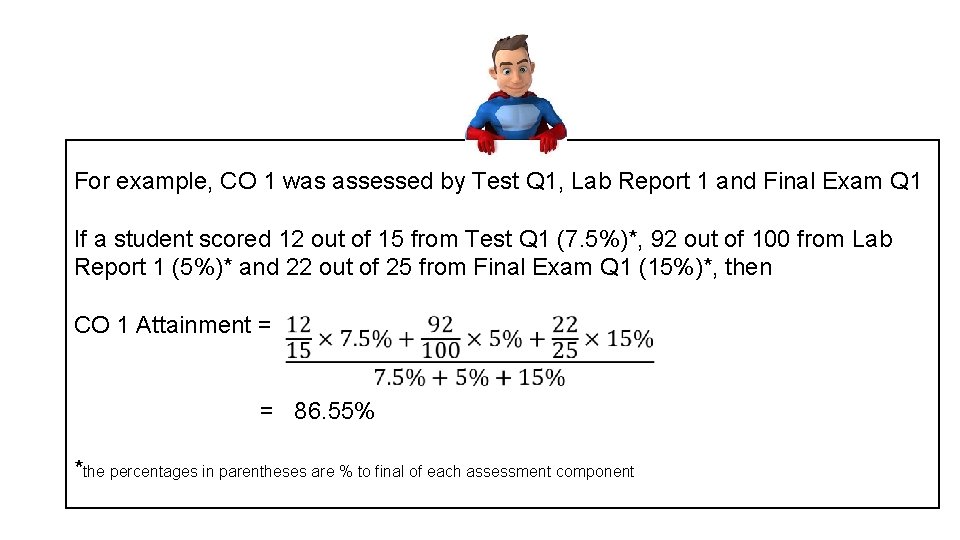
For example, CO 1 was assessed by Test Q 1, Lab Report 1 and Final Exam Q 1 If a student scored 12 out of 15 from Test Q 1 (7. 5%)*, 92 out of 100 from Lab Report 1 (5%)* and 22 out of 25 from Final Exam Q 1 (15%)*, then CO 1 Attainment = = 86. 55% *the percentages in parentheses are % to final of each assessment component
How are COs mapped to POs?
Each CO is mapped to One PO only
Each CO is also mapped to ONE Learning Domain only (Cognitive / Affective / Psychomotor)
How to determine the Bloom’s taxonomy level of CO?
The Bloom’s taxonomy level of CO depends on the nature of the course. For example, first year courses might have more low levels while final year courses should have more high levels.
Although there is no fix rule to determine the Bloom’s taxonomy level for CO, we are encouraged to challenge our student for higher level.
Another way to look at it … COs will help us answers these questions: • HOW WILL STUDENTS BE DIFFERENT by the end of the course? • What will they be able to do at the end of the course that THEY COULDN’T DO BEFORE ?
Module 3: What is Constructive Alignment? Jeffrey Yap BH & Ivan Yeo HG
What is Constructive Alignment?
The lecturer aligns each CO to appropriate teaching and learning activities; activities and base assessment tasks on effective marking scheme and rubric.
Teaching and learning activities that can enhance the students’ learning experience are carefully designed and carried out to facilitate COs attainment
All COs must be assessed , regardless of students’ choice of answering optional questions in continuous assessment and the final examination. Each assessment task / question is mapped to one CO only.
What is assessment task / question?
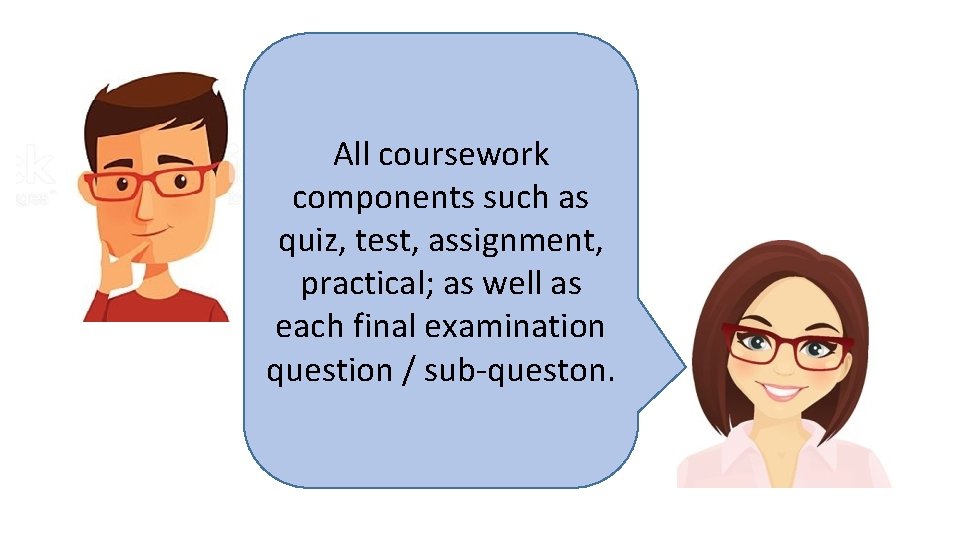
All coursework components such as quiz, test, assignment, practical; as well as each final examination question / sub-queston.
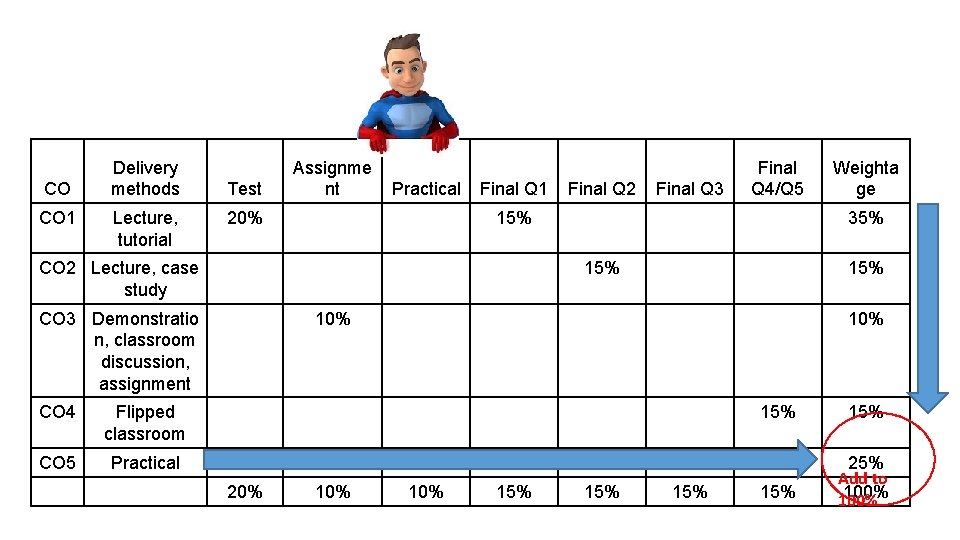
CO CO 1 Delivery methods Lecture, tutorial Test Assignme nt Practical 20% Final Q 1 CO 5 Practical 15% 10% 10% 20% 10% Weighta ge 35% 15% CO 3 Demonstratio n, classroom discussion, assignment Flipped classroom Final Q 3 15% CO 2 Lecture, case study CO 4 Final Q 2 Final Q 4/Q 5 10% 15% 15% 25% Add to 100% 15% 15%
Lecturers are encourage to ensure that the weightages of the COs are distributed in a balance manner.
What other documents do I need to take care of?
The constructive alignment assessment methods must be included in the teaching plan.
The assessment methods must be consistent with those stated in the syllabus.
Remember that each CO must be assessable in each task that it is aligned with the designed Bloom’s taxonomy level
What do you mean?
If Bloom’s taxonomy level of a CO is 5, the questions / tasks that designed must be UP to level 5 only. In other words, portion of the question should assess at level 5 and / or levels 1 - 4, and should not have level 6.
Got it!
4. How to assess various Domains and Bloom’s Taxonomy Levels? Teoh BY and Abdul Rahim
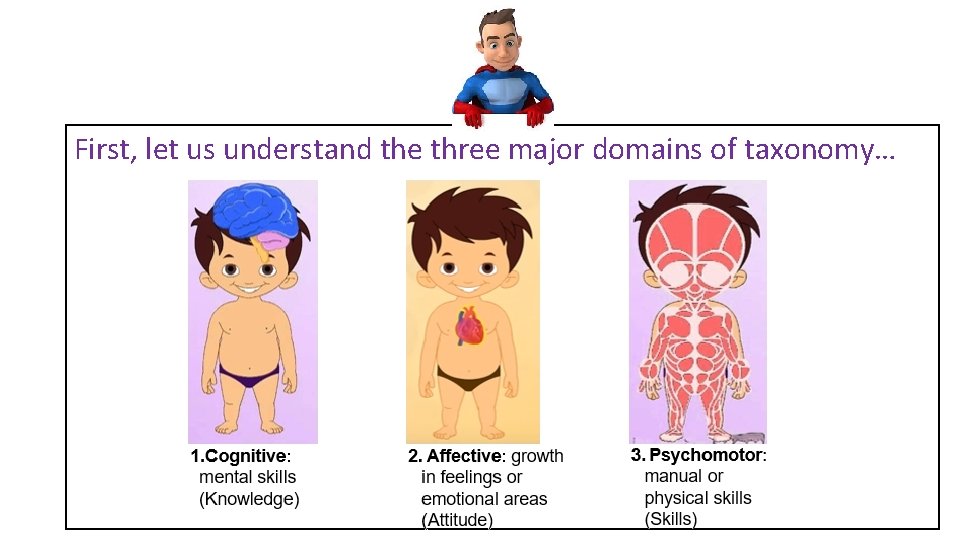
First, let us understand the three major domains of taxonomy…
How many levels of Bloom’s taxonomy for each domain? Let’s start with Cognitive.
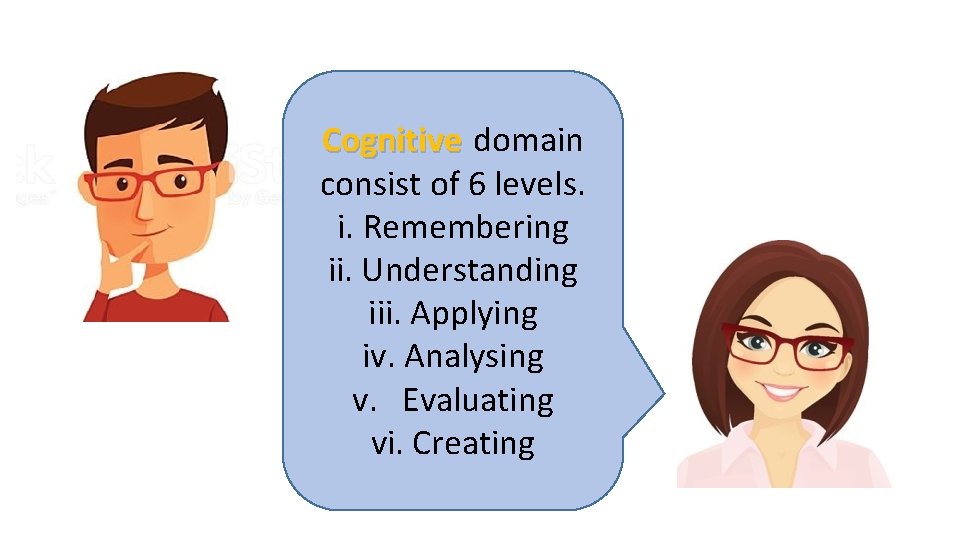
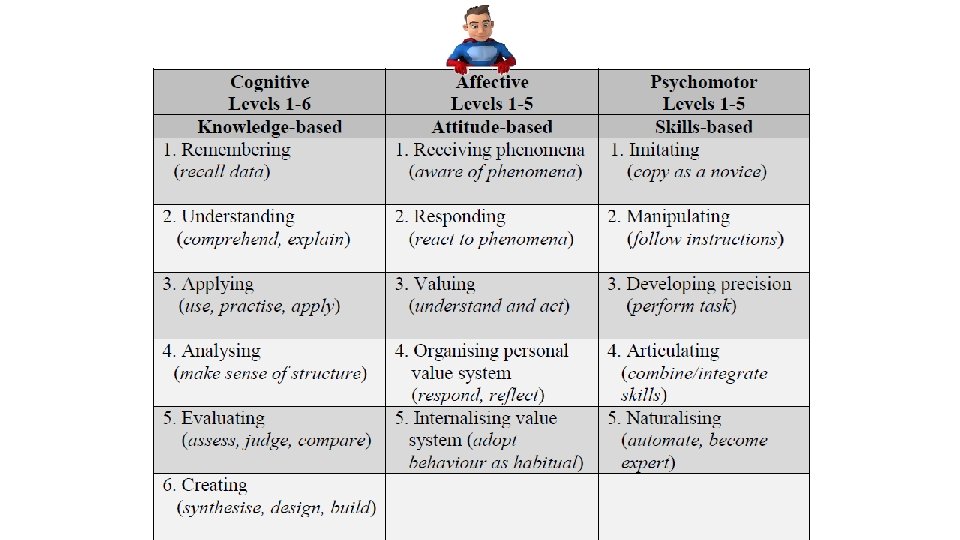
Cognitive domain consist of 6 levels. i. Remembering ii. Understanding iii. Applying iv. Analysing v. Evaluating vi. Creating
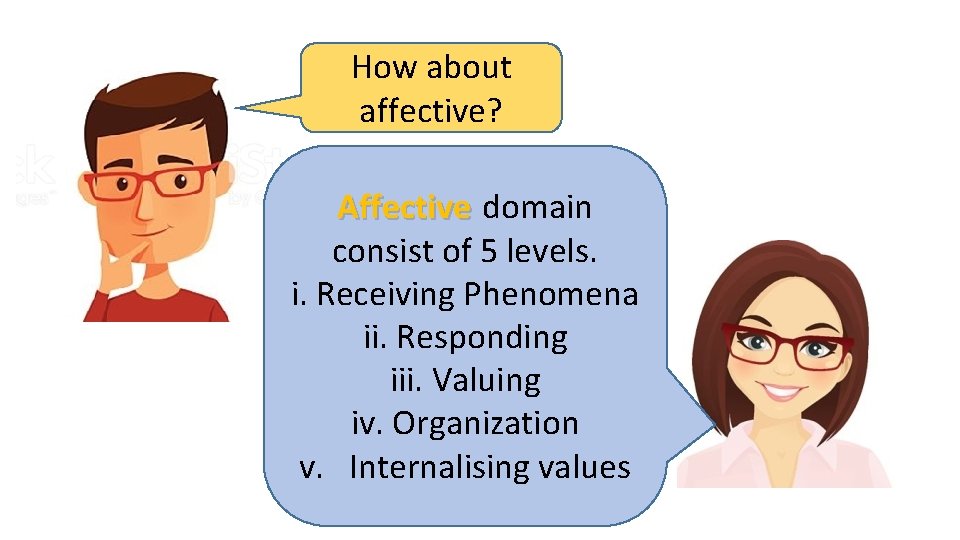
How about affective? Affective domain consist of 5 levels. i. Receiving Phenomena ii. Responding iii. Valuing iv. Organization v. Internalising values
Then psychomotor? Psychomotor domain consist of 5 levels. i. Imitating ii. Manipulating iii. Developing precision iv. Articulating v. Naturalising
Got it. But how do I assess the Bloom’s taxonomy level appropriately?
Bloom’s taxonomy level has been determined in course outcome (CO) to be achieved by the individual course
Assessment should be designed according to the Bloom’s taxonomy level set in CO.
Also take note of the learning domain. Like, are you assessing Affective using a written test?
Affective domain can be tested using written tests or exams, but the questions must be carefully set.
Module 5: Why PDCA is Important? Teoh HC

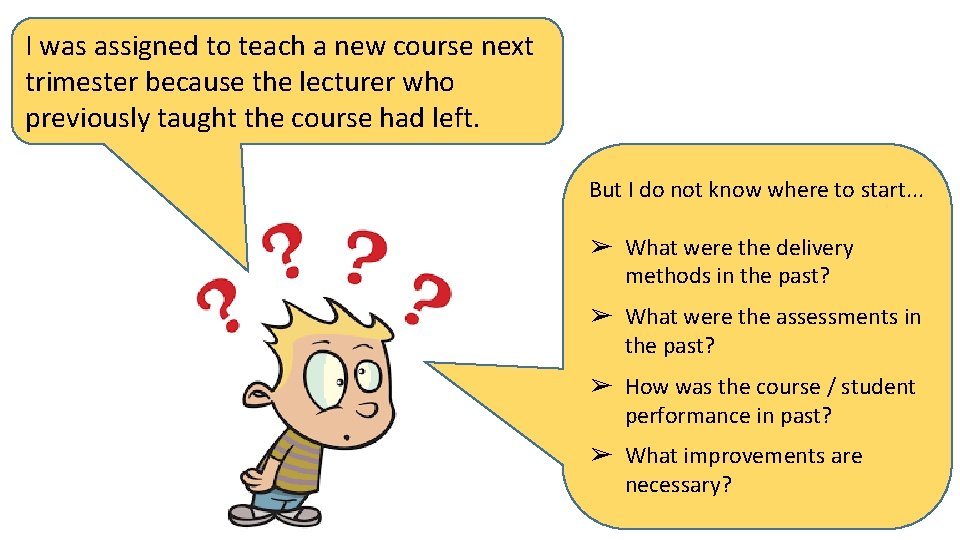
I was assigned to teach a new course next trimester because the lecturer who previously taught the course had left. But I do not know where to start. . . ➢ What were the delivery methods in the past? ➢ What were the assessments in the past? ➢ How was the course / student performance in past? ➢ What improvements are necessary?
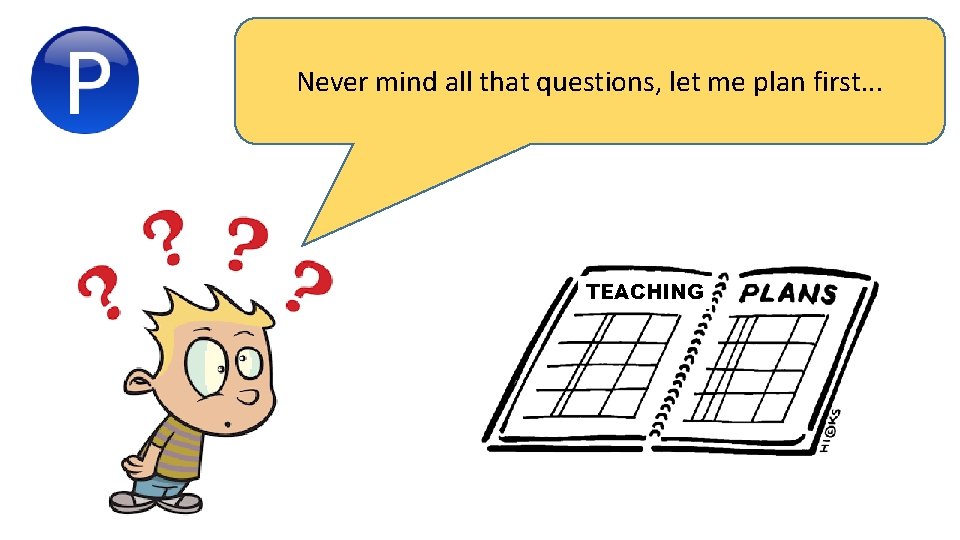
Never mind all that questions, let me plan first. . . TEACHING
Week 1 cover this topic, Week 2 cover that topic. . . hey, I need to know what are the topics in the course la. . . where to get ah?
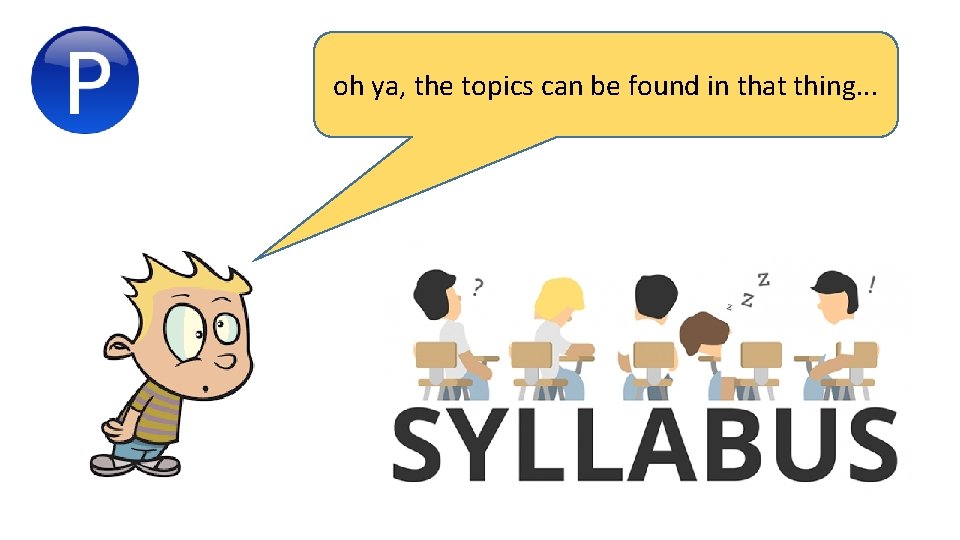
oh ya, the topics can be found in that thing. . .
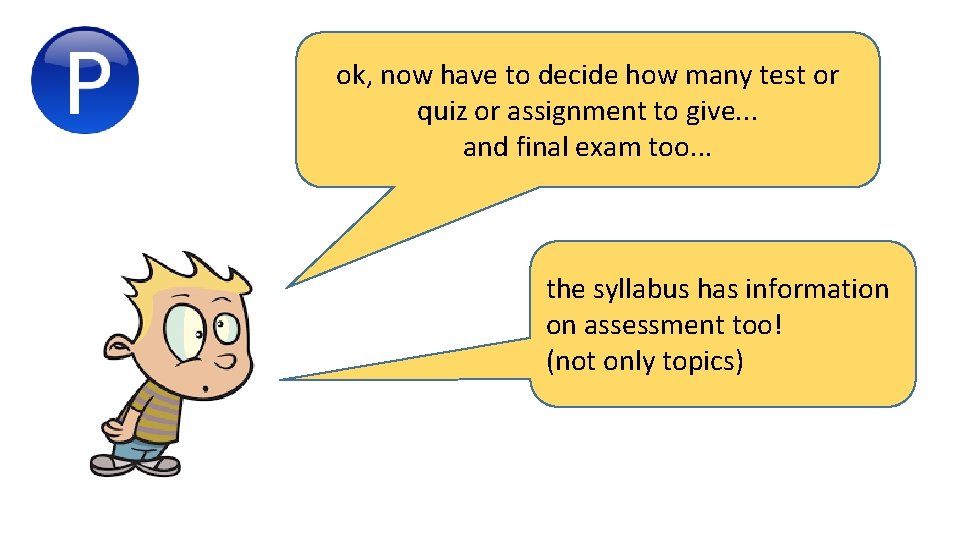
ok, now have to decide how many test or quiz or assignment to give. . . and final exam too. . . the syllabus has information on assessment too! (not only topics)
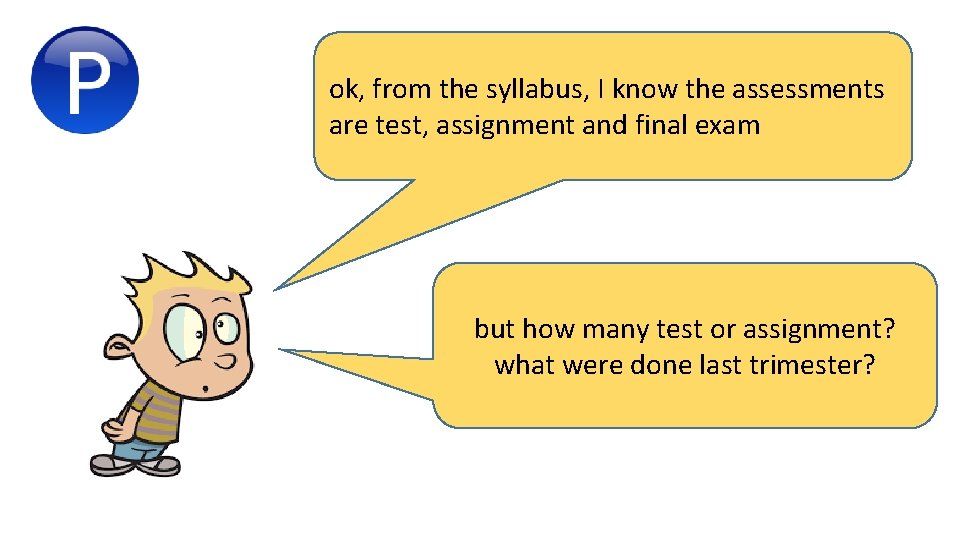
ok, from the syllabus, I know the assessments are test, assignment and final exam but how many test or assignment? what were done last trimester?

get the previous trimester Course Report
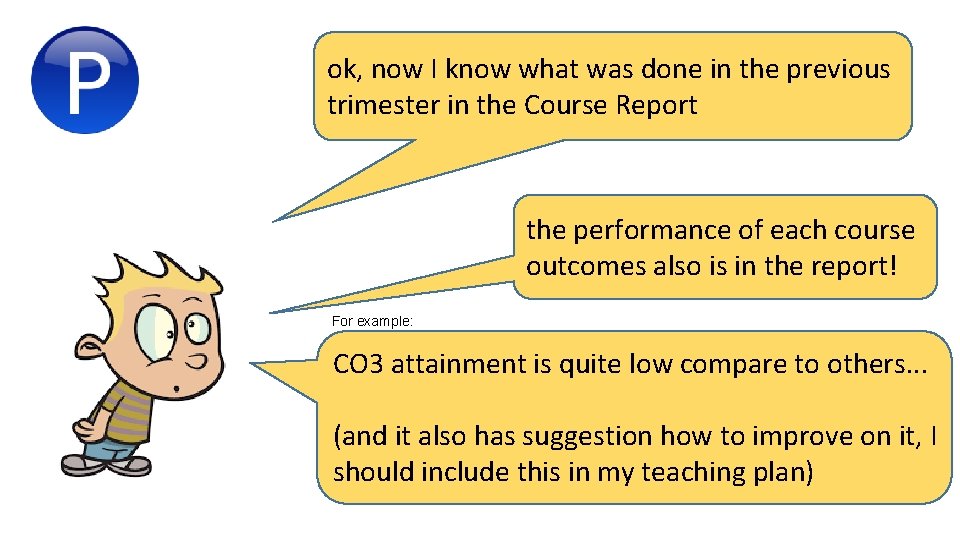
ok, now I know what was done in the previous trimester in the Course Report the performance of each course outcomes also is in the report! For example: CO 3 attainment is quite low compare to others. . . (and it also has suggestion how to improve on it, I should include this in my teaching plan)
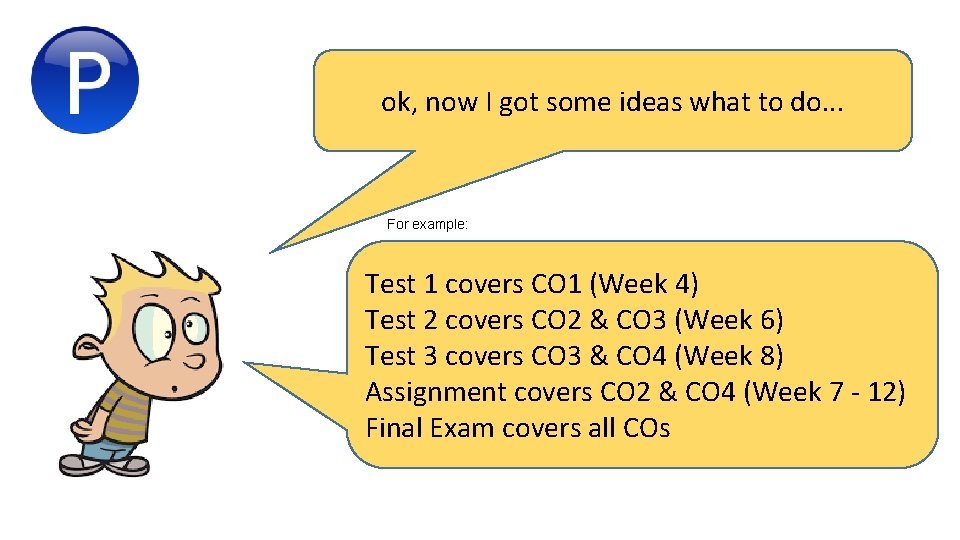
ok, now I got some ideas what to do. . . For example: Test 1 covers CO 1 (Week 4) Test 2 covers CO 2 & CO 3 (Week 6) Test 3 covers CO 3 & CO 4 (Week 8) Assignment covers CO 2 & CO 4 (Week 7 - 12) Final Exam covers all COs
Done Planning!

Trimester Started! Let the teaching and learning experience begin!
deadlines are coming… Setting of Test paper. . . Setting of Assignment questions. . . Setting of Final Exam paper. . . Hmm. . . i think i can refer to Bloom’s Taxonomy to set my question properly!
need someone to help me check if my assessment questions are ok. . . (according to the course outcomes, taxonomy level, clarity and no careless mistake. . . ) oh ya, the moderator of my course can help!
This is the Coursework Moderation Form for my tests and assignment. . . This is the Final Exam Moderation Form for my final exam paper. . . Please help me check if everything is ok ya
End of Trimester. . . Done Doing!

marking. . . ↓ results for every CO. . . ↓ CO attainment
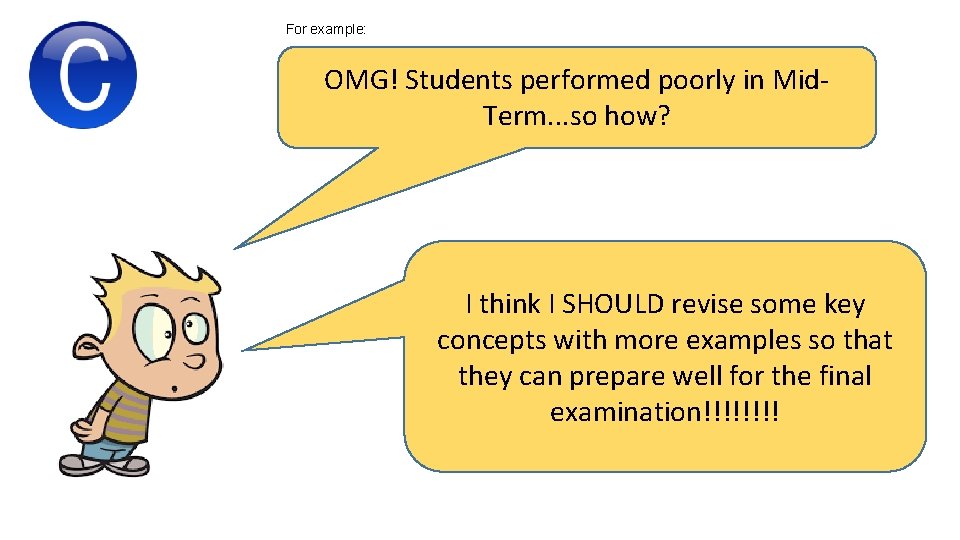
For example: OMG! Students performed poorly in Mid. Term. . . so how? I think I SHOULD revise some key concepts with more examples so that they can prepare well for the final examination!!!!

Done Checking!
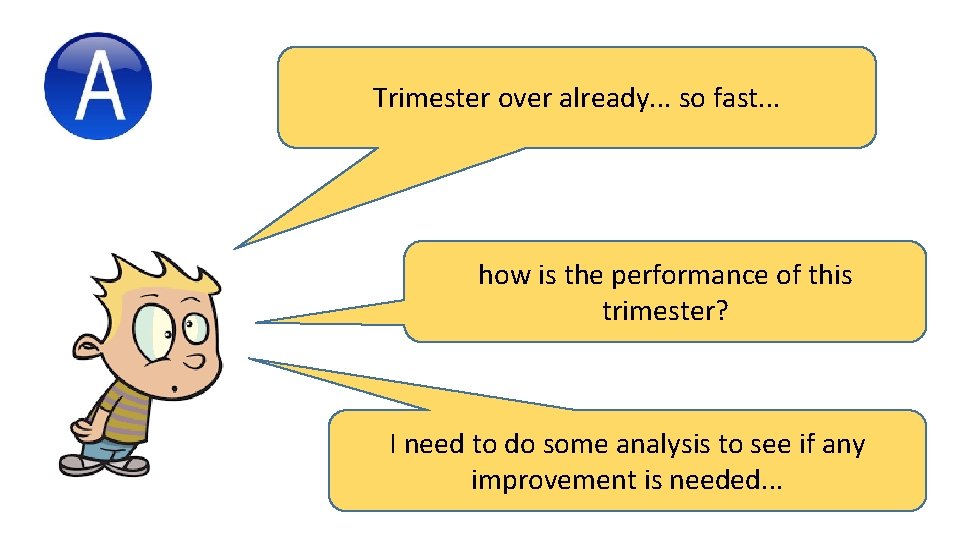
Trimester over already. . . so fast. . . how is the performance of this trimester? I need to do some analysis to see if any improvement is needed. . .
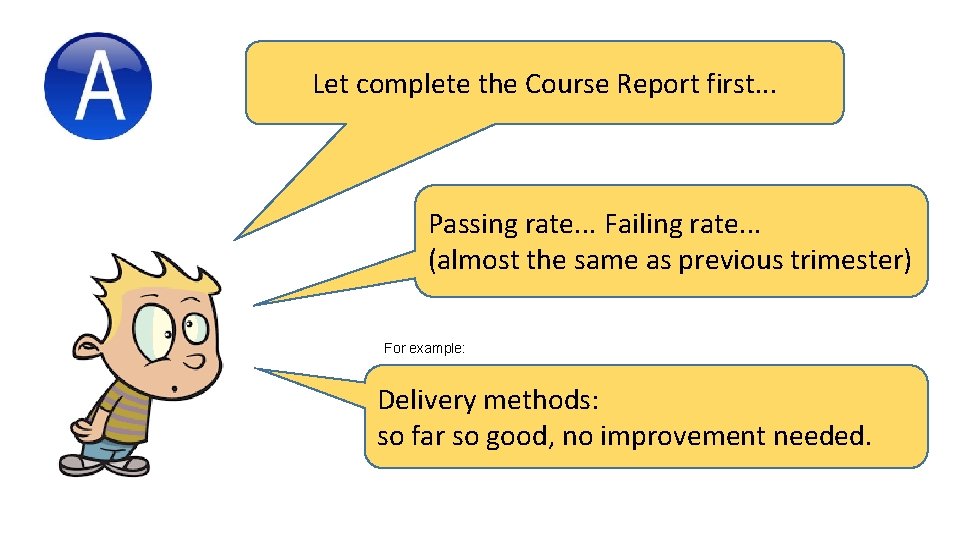
Let complete the Course Report first. . . Passing rate. . . Failing rate. . . (almost the same as previous trimester) For example: Delivery methods: so far so good, no improvement needed.
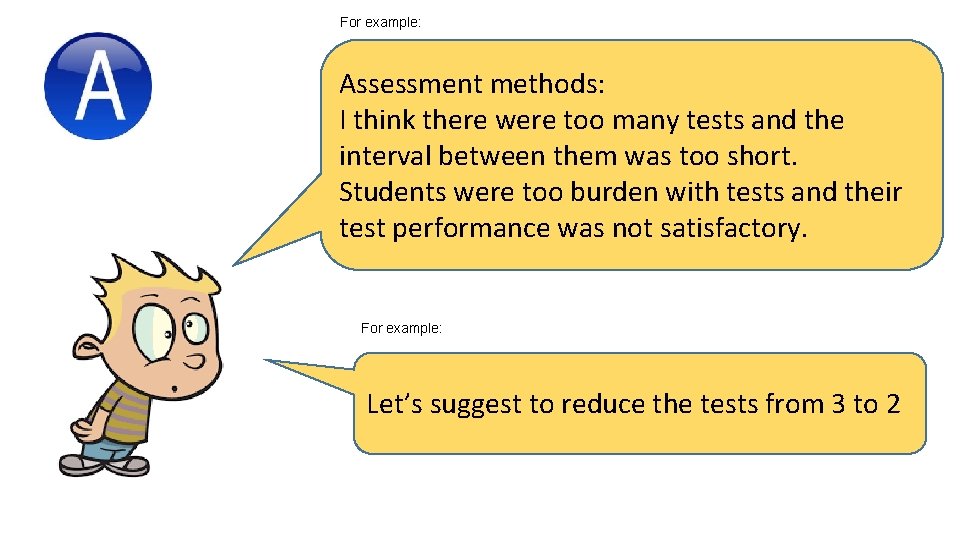
For example: Assessment methods: I think there were too many tests and the interval between them was too short. Students were too burden with tests and their test performance was not satisfactory. For example: Let’s suggest to reduce the tests from 3 to 2
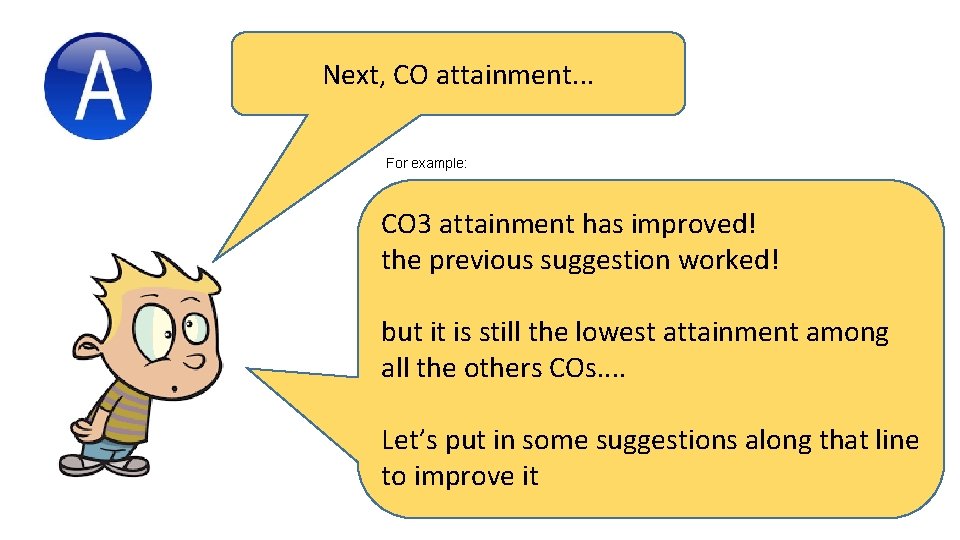
Next, CO attainment. . . For example: CO 3 attainment has improved! the previous suggestion worked! but it is still the lowest attainment among all the others COs. . Let’s put in some suggestions along that line to improve it
Done Acting! This Course Report will be used as reference in the next trimester to understand the previous performance of this course and what improvements are needed for teaching plan preparation
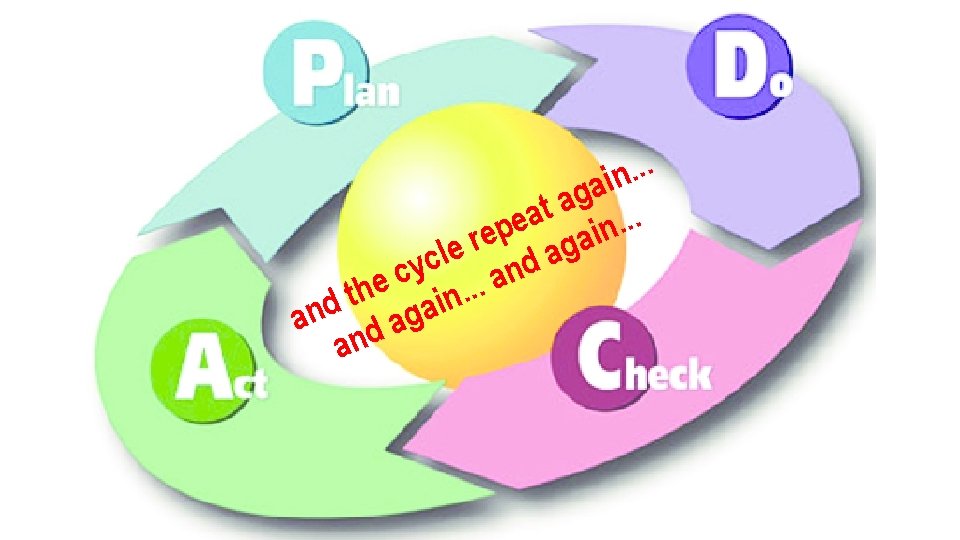
. . . n i a g a t a. . e. p n i e a r g e l a c d y n c a e. . h. t n i d a n g a a d an
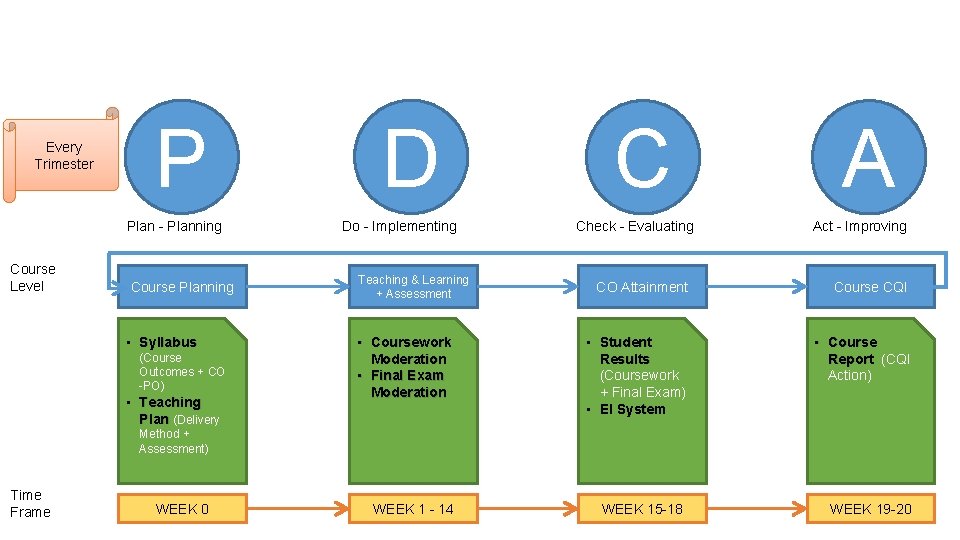
Every Trimester P Plan - Planning Course Level Course Planning • Syllabus (Course Outcomes + CO -PO) • Teaching Plan (Delivery D Do - Implementing Teaching & Learning + Assessment C Check - Evaluating A Act - Improving CO Attainment Course CQI • Coursework Moderation • Final Exam Moderation • Student Results (Coursework + Final Exam) • EI System • Course Report (CQI Action) WEEK 1 - 14 WEEK 15 -18 WEEK 19 -20 Method + Assessment) Time Frame WEEK 0
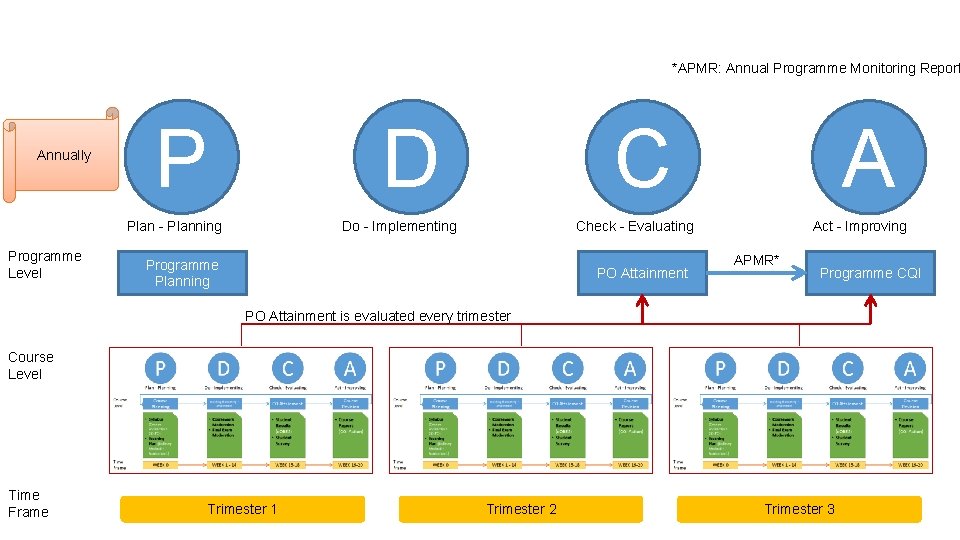
*APMR: Annual Programme Monitoring Report Annually P D Plan - Planning Programme Level C Do - Implementing A Check - Evaluating Programme Planning PO Attainment Act - Improving APMR* Programme CQI PO Attainment is evaluated every trimester Course Level Time Frame Trimester 1 Trimester 2 Trimester 3
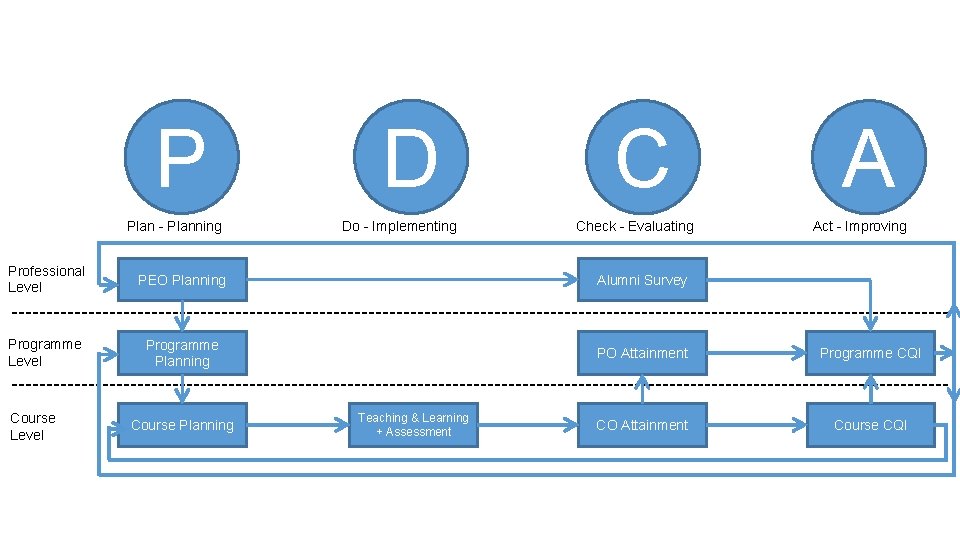
P Plan - Planning D Do - Implementing C Check - Evaluating A Act - Improving Professional Level PEO Planning Alumni Survey Programme Level Programme Planning PO Attainment Programme CQI CO Attainment Course CQI Course Level Course Planning Teaching & Learning + Assessment
Module 6: How to complete the OBE forms? Dr Lau SH & Dr Gan CH

Where to get the latest form and sample?
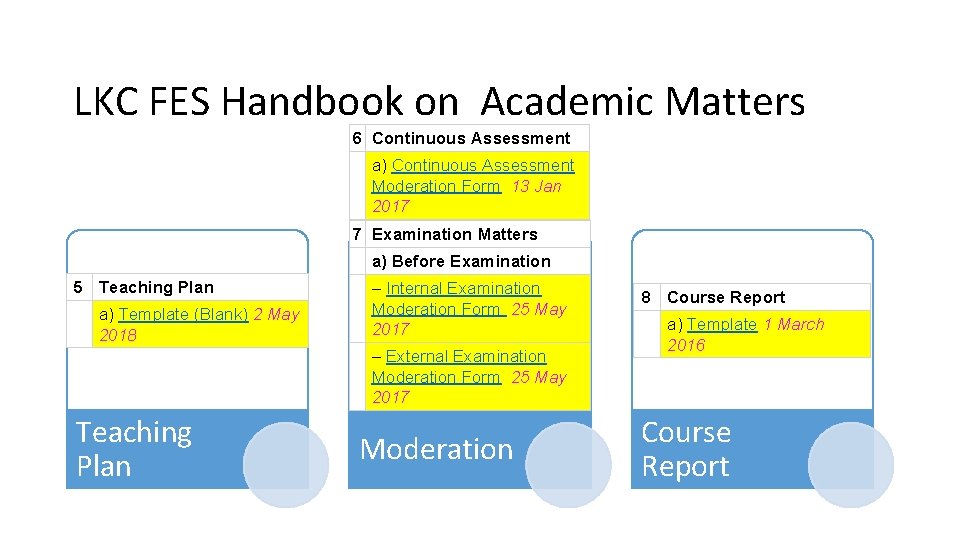
LKC FES Handbook on Academic Matters 6 Continuous Assessment a) Continuous Assessment Moderation Form 13 Jan 2017 7 Examination Matters a) Before Examination 5 Teaching Plan a) Template (Blank) 2 May 2018 – Internal Examination Moderation Form 25 May 2017 – External Examination Moderation Form 25 May 2017 Teaching Plan Moderation 8 Course Report a) Template 1 March 2016 Course Report

How to fill up these forms?
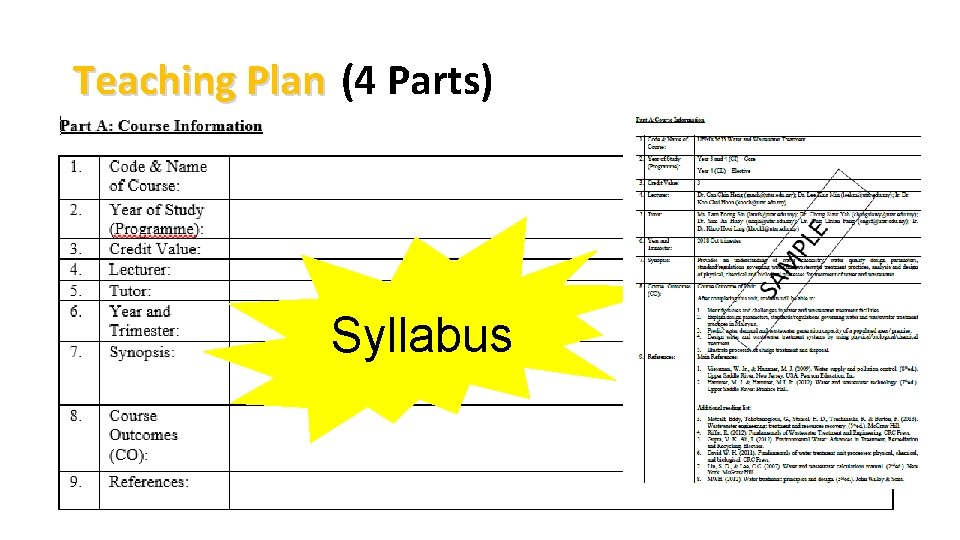
Teaching Plan (4 Parts) Syllabus
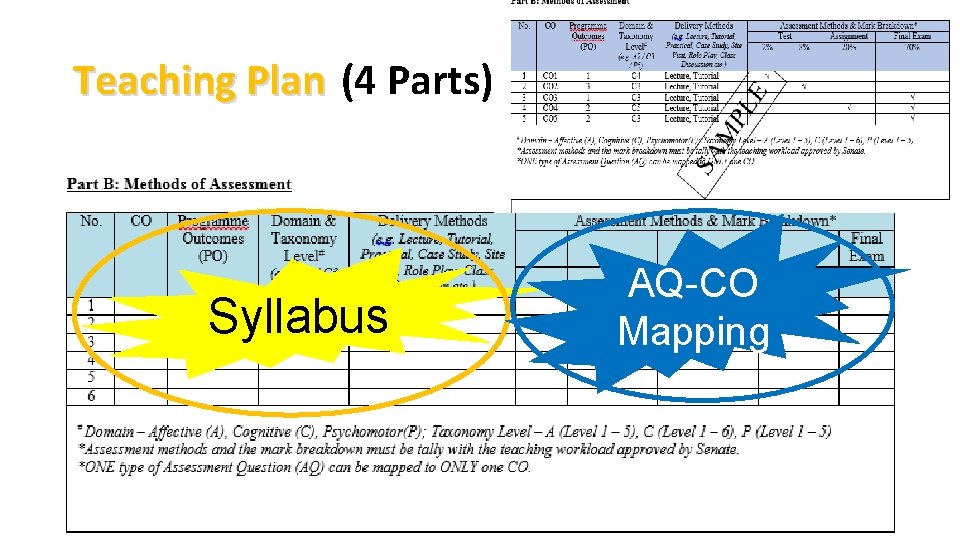
Teaching Plan (4 Parts) Syllabus AQ-CO Mapping
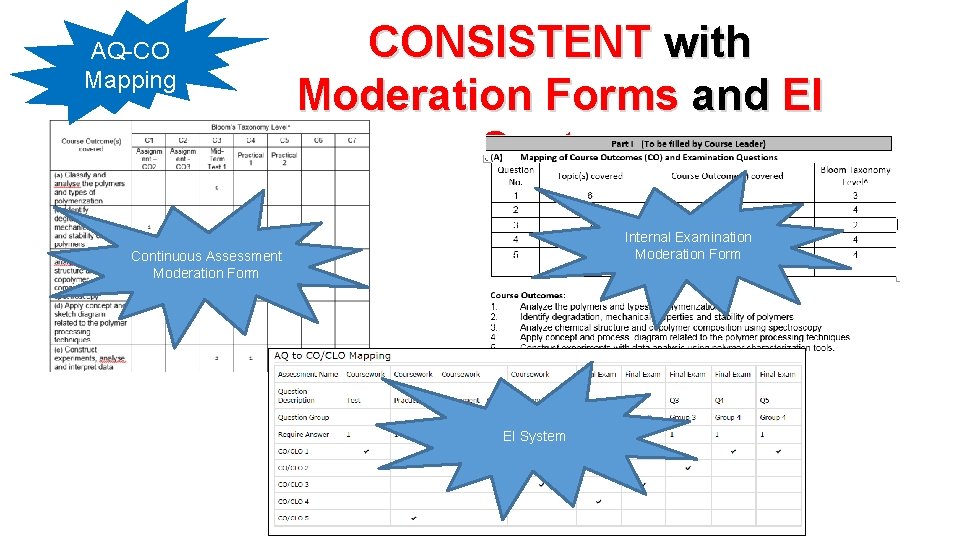
AQ-CO Mapping CONSISTENT with Moderation Forms and EI System Internal Examination Moderation Form Continuous Assessment Moderation Form EI System
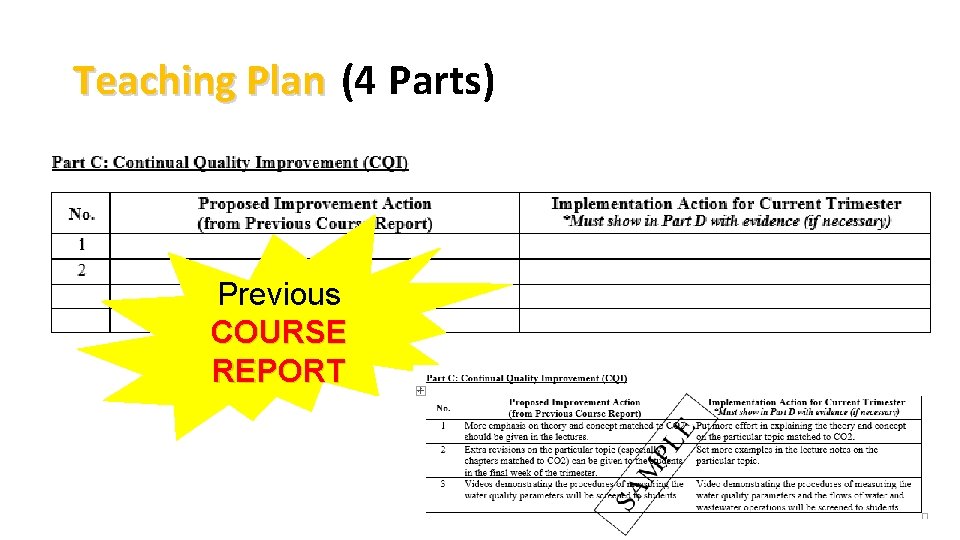
Teaching Plan (4 Parts) Previous COURSE REPORT
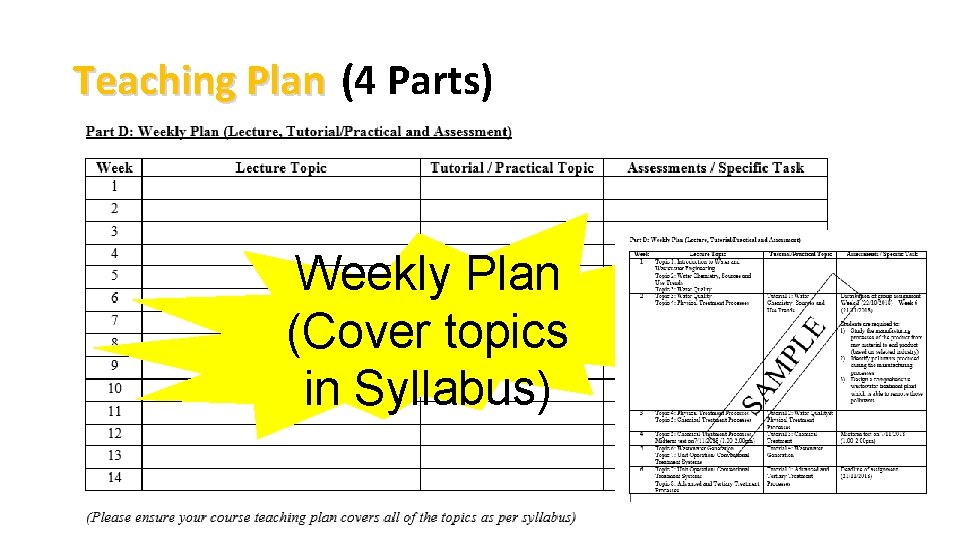
Teaching Plan (4 Parts) Weekly Plan (Cover topics in Syllabus)
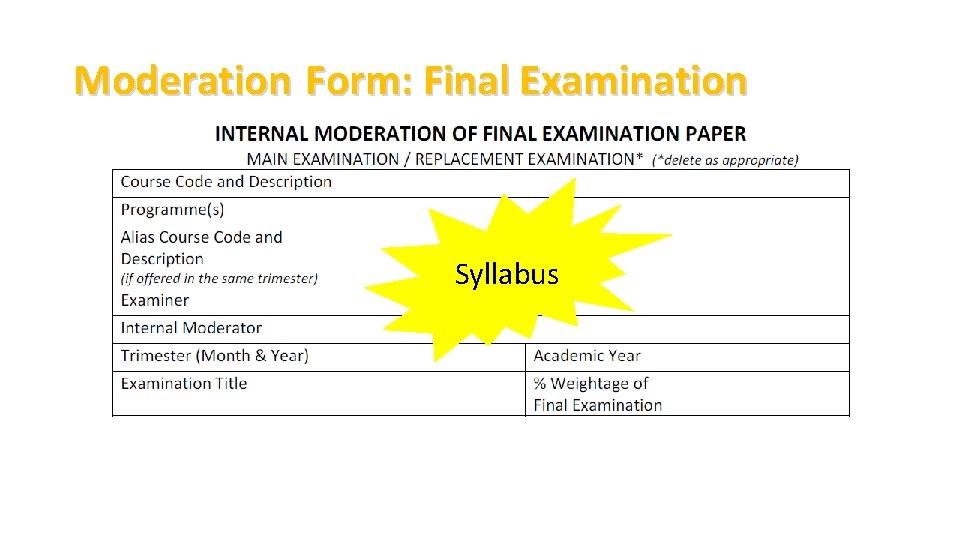
Moderation Form: Final Examination Syllabus
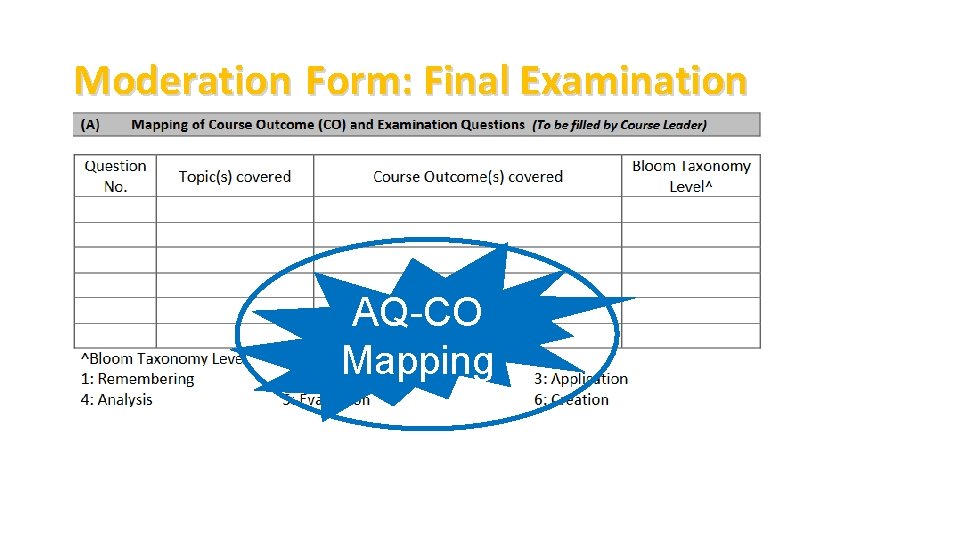
Moderation Form: Final Examination AQ-CO Mapping
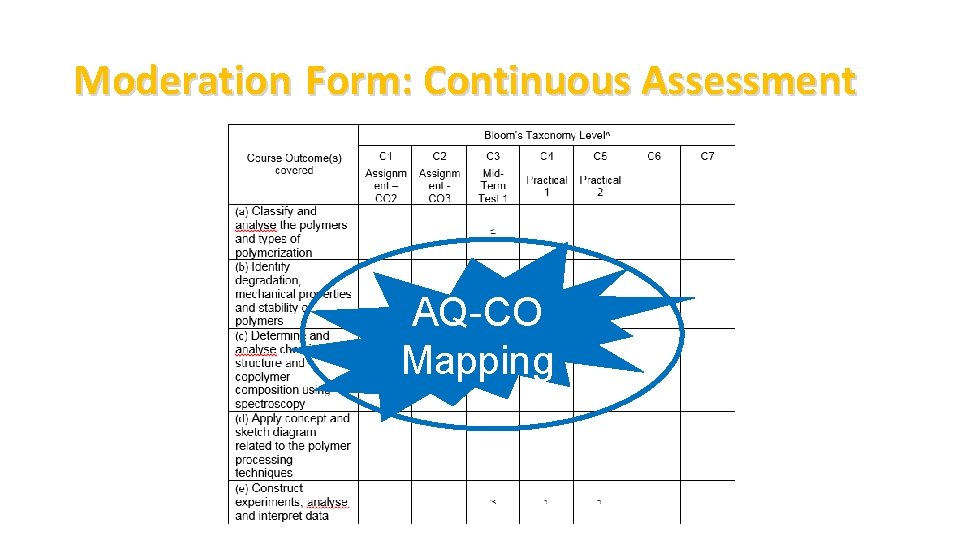
Moderation Form: Continuous Assessment AQ-CO Mapping
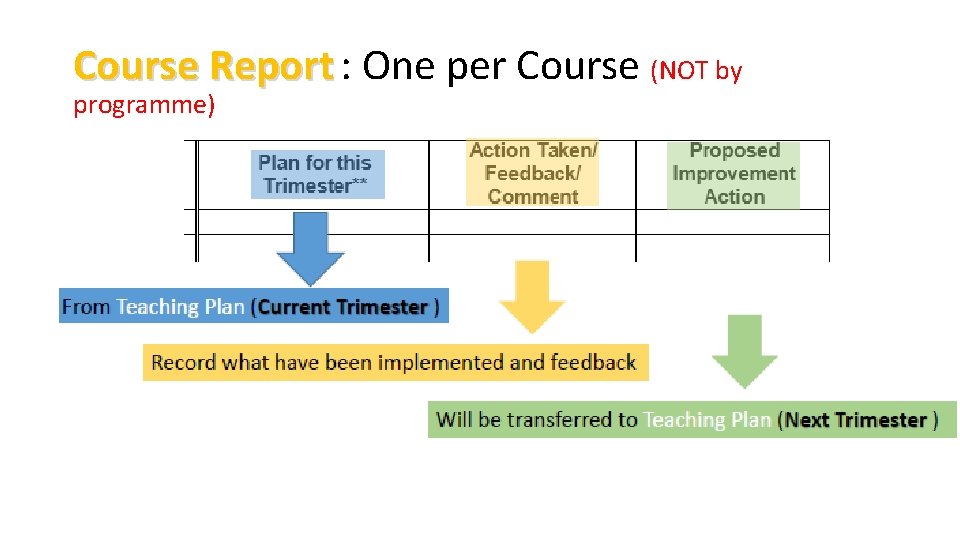
Course Report : One per Course (NOT by programme)
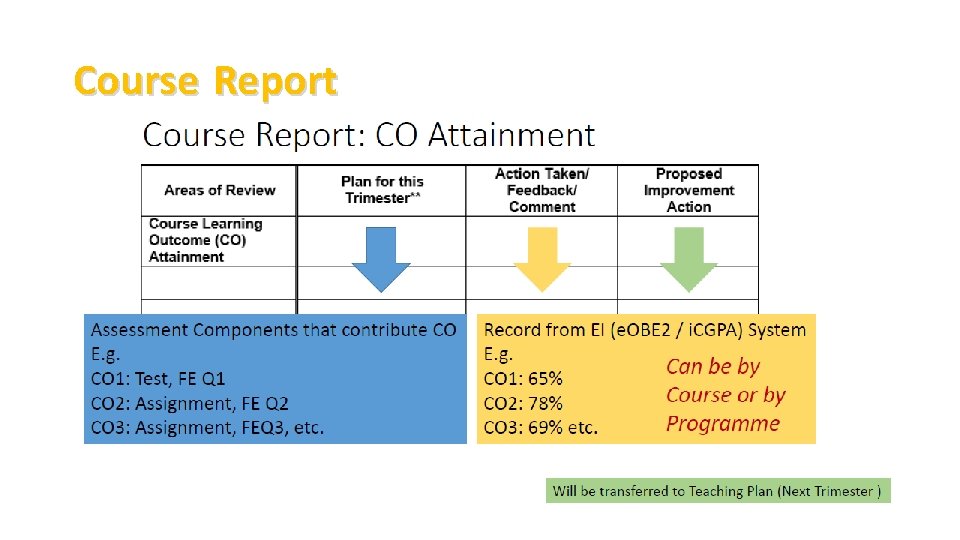
Course Report
How these forms are correlated?
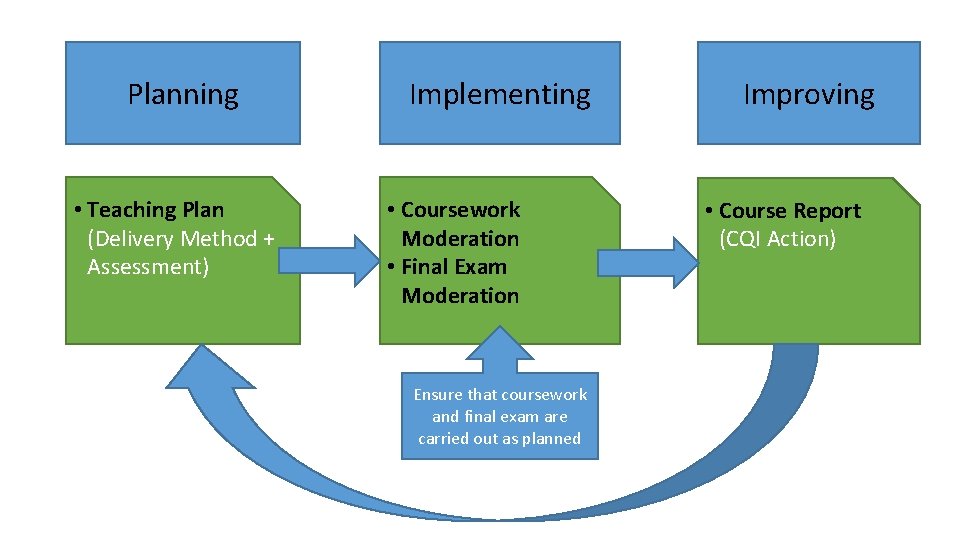
Planning • Teaching Plan (Delivery Method + Assessment) Implementing • Coursework Moderation • Final Exam Moderation Ensure that coursework and final exam are carried out as planned Improving • Course Report (CQI Action)
CONGRATULATION! You have completed all 6 modules! You could proceed to test your understanding! GOOD LUCK!
- Slides: 118