
1 Mendel was an Austrian monk 2 Mendel

- Slides: 51
1. Mendel was an Austrian monk. 2. Mendel formulated two fundamental laws of heredity in the early 1860's. 3. He had previously studied science and mathematics at the University of Vienna. 4. At time of his research, he was a substitute science teacher at a local technical high school.
1. This theory stated that offspring would possess traits intermediate between those of different parents. 2. Red and white flowers produce pink; a later return to red or white progeny was considered instability in genetic material. 3. Charles Darwin wanted to develop a theory of evolution based on hereditary principles; blending theory was of no help.
1. Mendel did a statistical study (he had a mathematical background). 2. He prepared his experiments carefully and conducted preliminary studies.
3. Mendel traced inheritance of individual traits and kept careful records of numbers. 4. He used his understanding of mathematical principles of probability to interpret results.
1. A hybrid is the product of parent organisms that are true-breeding for different forms of one trait. 2. A monohybrid cross is between two parent organisms true-breeding for two distinct forms of a trait. 3. Mendel tracked each trait through two generations. a. P generation b. F 1 (for filial) c. F 2 generation
1. His results were contrary to those predicted by a blending theory of inheritance. 2. He found that the F 1 plants resembled only one of the parents. 3. Characteristic of other parent reappeared in about 1/4 of F 2 plants; 3/4 of offspring resembled the F 1 plants. 4. Mendel saw that these 3: 1 results were possible if a. F 1 hybrids contained two factors for each trait, one dominant and one recessive;
b. factors separated when gametes were formed; a gamete carried on copy of each factor; c. Random fusion of all possible gametes occurred upon fertilization. 5. Results of his experiments led Mendel to develop his first law of inheritance: a. Mendel's law of segregation: Each organism contains two factors for each trait; factors segregate in formation of gametes; each gamete contains one factor for each trait. b. Mendel's law of segregation is consistent with a particulate theory of inheritance because many individual factors are passed on from generation to generation. c. Reshuffling of factors explains variations and why offspring differ from their parents.
1. Each trait in a pea plant is controlled by two alleles, alternate forms of a gene that occur at the same gene locus on homologous chromosomes. a. A dominant allele masks or hides expression of a recessive allele; it is represented by an uppercase letter (T). b. A recessive allele is an allele that exerts its effect only in the homozygous state; its expression is masked by a dominant allele; it is represented by a lowercase letter (t).
2. Gene locus is specific location of a particular gene on homologous chromosomes. 3. In Mendel's cross, the parents were true-breeding; each parent had two identical alleles for a trait -- they were homozygous, indicating they possess two identical alleles for a trait. a. Homozygous dominant genotypes possess two dominant alleles for a trait (TT). b. Homozygous recessive genotypes possess two recessive alleles for a trait (tt). 4. After cross-pollination, all individuals of the F 1 generation had one of each type of allele. a. Heterozygous genotypes possess one of each allele for a particular trait (Tt). b. The allele not expressed in a heterozygote is a recessive allele.
1. Two organisms with different allele combinations can have same outward appearance (e. g. , TT and Tt pea plants are both tall; therefore, it is necessary to distinguish between alleles and appearance of organism). 2. Genotype refers to the alleles an individual receives at fertilization. 3. Phenotype refers to the physical appearance of the individual.
1. First determine with characteristic is dominant; then code the alleles involved. 2. Determine genotype and gametes for both parents; an individual has two alleles for each trait; each gamete has only on allele for each trait. 3. Each gamete has a 50% chance of having either allele.
1. Probability is the likely outcome a given event will occur from random chance. a. With each coin flip there is a 50% chance of heads and 50% chance of tails. b. Chance of inheriting one of two alleles from a parent is also 50%. 2. Multiplicative law of probability states that the chance of two or more independent events occurring together is the product of the probability of the events occurring separately.
1. Provides a simple method to calculate probable results of a genetic cross. 2. In a Punnett square, all possible types of sperm alleles are lined up vertical, all possible egg alleles are lined up horizontally; every possible combination is placed in squares. 3. The larger the sample size examined, the more likely the outcome will reflect predicted ratios; a large number of offspring must be counted to observe the expected results; only in that way can all possible genetic types of sperm fertilize all possible types of eggs.
4. We cannot testcross humans in order to count many offspring; in humans, the phenotypic ratio is used to estimate the probability of any child having a particular characteristic. 5. Punnett square uses laws of probability; it does not dictate what the next child will inherit. 6. "Chance has no memory": if two heterozygous parents have first child with attached earlobes(likely in 1/4 th of children), second child born still has 1/4 chance of having attached earlobes.
1. Mendel performed testcrosses by crossing his F 1 plants with homozygous recessive plants. 2. Results indicated the recessive factor with present in the F 1 plants; they were heterozygous. 3. A testcross is between an individual with dominant phenotype and individual with recessive phenotype to see if the individual with dominant phenotype is homozygous or heterozygous.
1. A dihybrid cross is an experimental cross between two parent organisms that are true-breeding for different forms of two traits; produces offspring heterozygous for both traits. 2. Mendel observed that the F 1 individuals were dominant in both traits.
1. Mendel observed four phenotypes among F 2 offspring; he deduced second law of heredity. 2. Mendel's law of independent assortment states members of one pair of factors assort independently of members of another pair; all combinations of factors occur in gametes.
1. Laws of probability indicate a 9: 3: 3: 1 phenotypic ratio of F 2 offspring resulting in the following: a. 9/16 of the offspring are dominant for both traits; b. 3/16 of the offspring are dominant for one trait and recessive for the other trait; c. 3/16 of the offspring are dominant and recessive opposite of the previous proportions; and d. 1/16 of the offspring are recessive for both traits.
2. The Punnett Square for Dihybrid Crosses a. A larger Punnett square is used to calculate probable results of a dihybrid cross. b. A phenotypic ratio of 9: 3: 3: 1 is expected when heterozygotes for two traits are crossed and simple dominance is present for both genes. c. Meiosis explains these results of independent assortment.
1. A dihybrid test cross tests if individuals showing two dominant characteristics are homozygous for both or for one trait only, or is heterozygous for both. 2. If an organism heterozygous for two traits is crossed with another recessive for both traits, expected phenotypic ratio is 1: 1: 1: 1. 3. In dihybrid genetics problems, the individual has four alleles, two for each trait.
1. Incomplete dominance: offspring show traits intermediate between two parental phenotypes. a. Red and white-flowered four o'clocks produce pink-flowered offspring. b. Incomplete dominance has a biochemical basis; level of gene-directed protein production may be between that of the two homozygotes. c. One allele of a heterozygous pair only partially dominates expression of its partner.
d. This does not support a blending theory; parental phenotypes reappear in F 2 generation. 2. Codominance is a pattern of inheritance in which both alleles of a gene are expressed. a. A person with AB blood has both A and B antigens on their red blood cells. b. With codominance, both alleles produce and effective product.
1. More than one pair of genes may interact to produce the phenotype. 2. Epistasis: absence of expected phenotype as a result of masking expression of one gene pair by the expression of another gene pair. a. The homozygous recessive condition masks the effect of a dominant allele at another locus. b. Crossing sweet pea plants produces purple; F 2 generation has a 9: 7 rather than 9: 3: 3: 1 dihybrid ratio; explained by homozygous recessive blocking production of a metabolic enzyme. c. Albino animals inherit allelic pair (aa) preventing production of melanin, expression of eye, hair, color.
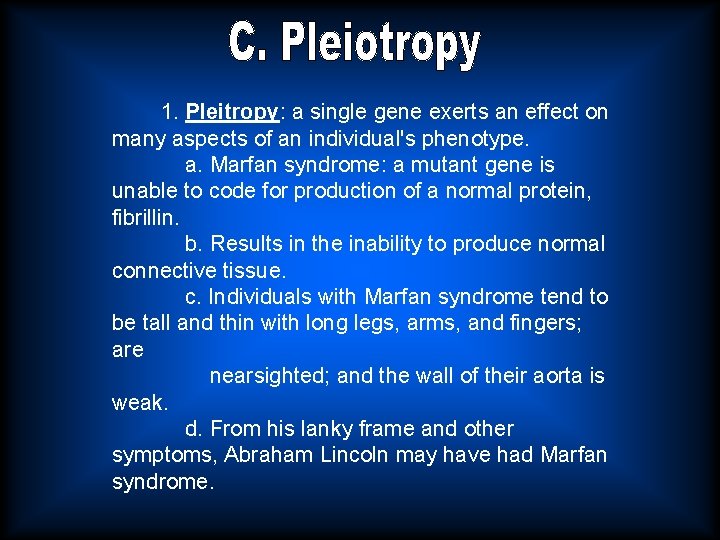
1. Pleitropy: a single gene exerts an effect on many aspects of an individual's phenotype. a. Marfan syndrome: a mutant gene is unable to code for production of a normal protein, fibrillin. b. Results in the inability to produce normal connective tissue. c. Individuals with Marfan syndrome tend to be tall and thin with long legs, arms, and fingers; are nearsighted; and the wall of their aorta is weak. d. From his lanky frame and other symptoms, Abraham Lincoln may have had Marfan syndrome.
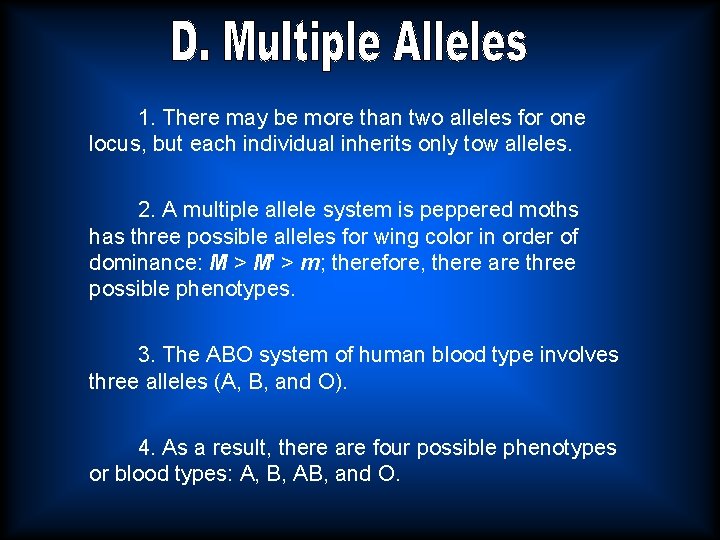
1. There may be more than two alleles for one locus, but each individual inherits only tow alleles. 2. A multiple allele system is peppered moths has three possible alleles for wing color in order of dominance: M > M' > m; therefore, there are three possible phenotypes. 3. The ABO system of human blood type involves three alleles (A, B, and O). 4. As a result, there are four possible phenotypes or blood types: A, B, AB, and O.
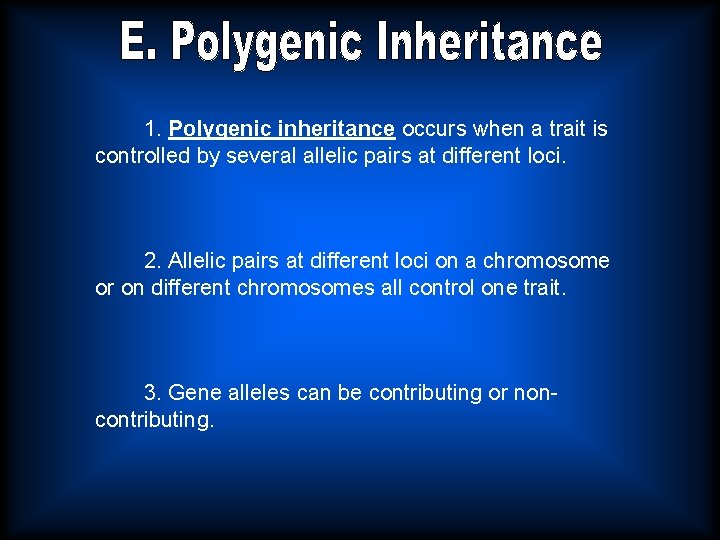
1. Polygenic inheritance occurs when a trait is controlled by several allelic pairs at different loci. 2. Allelic pairs at different loci on a chromosome or on different chromosomes all control one trait. 3. Gene alleles can be contributing or noncontributing.
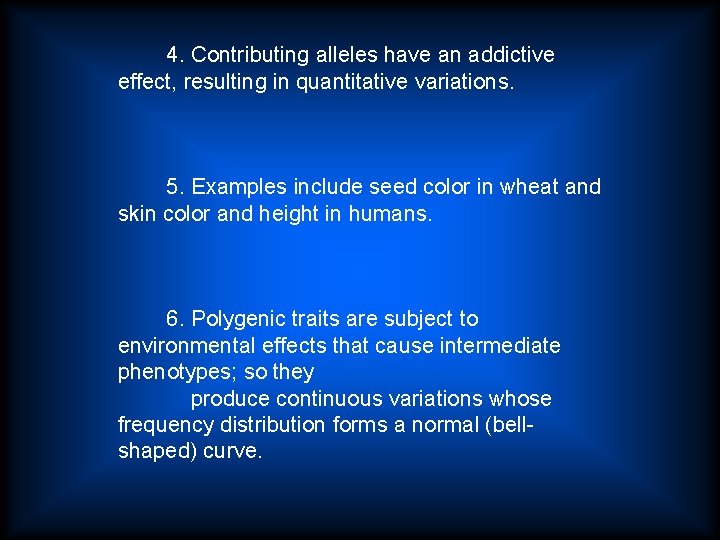
4. Contributing alleles have an addictive effect, resulting in quantitative variations. 5. Examples include seed color in wheat and skin color and height in humans. 6. Polygenic traits are subject to environmental effects that cause intermediate phenotypes; so they produce continuous variations whose frequency distribution forms a normal (bellshaped) curve.
1. Both genotype and environment affect phenotype; relative importance of both influences vary. 2. Aquatic environment (above and below water level) influences the phenotype of water buttercup, Ranunculus peltatus. 3. Temperature can affect the phenotypes of some plants (e. g. , primroses) and animals (e. g. , Siamese cats, Himalaya rabbits).
1. Genes are located on chromosomes; behavior of chromosomes during mitosis was described in 1875 and for meiosis, in 1890's. 2. Chromosome theory independently proposed in 1902 by Theodor Boveri and Walter S. Sutton. 3. Accounts for the similarity of chromosomal behavior during meiosis and fertilization.
4. Theory is supported by the following observations: a. Both chromosomes and factors (now called alleles) are paired in diploid cells. b. Chromosomes and alleles of each pair separate during meiosis so gametes have onehalf. c. Chromosomes and alleles of separate independently; gametes contain all combinations. d. Fertilization restores diploid chromosome number and paired condition for alleles in zygote.
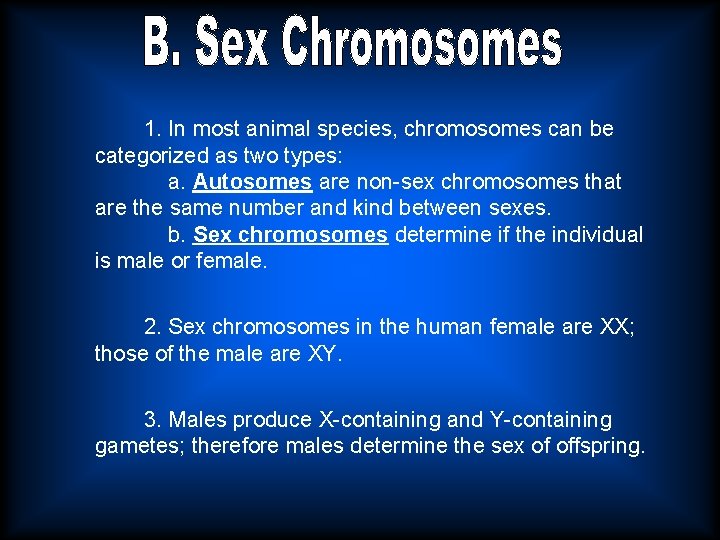
1. In most animal species, chromosomes can be categorized as two types: a. Autosomes are non-sex chromosomes that are the same number and kind between sexes. b. Sex chromosomes determine if the individual is male or female. 2. Sex chromosomes in the human female are XX; those of the male are XY. 3. Males produce X-containing and Y-containing gametes; therefore males determine the sex of offspring.
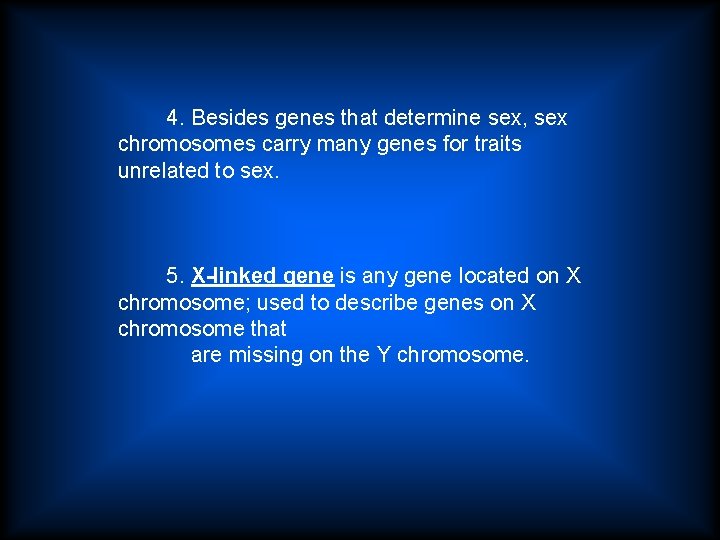
4. Besides genes that determine sex, sex chromosomes carry many genes for traits unrelated to sex. 5. X-linked gene is any gene located on X chromosome; used to describe genes on X chromosome that are missing on the Y chromosome.
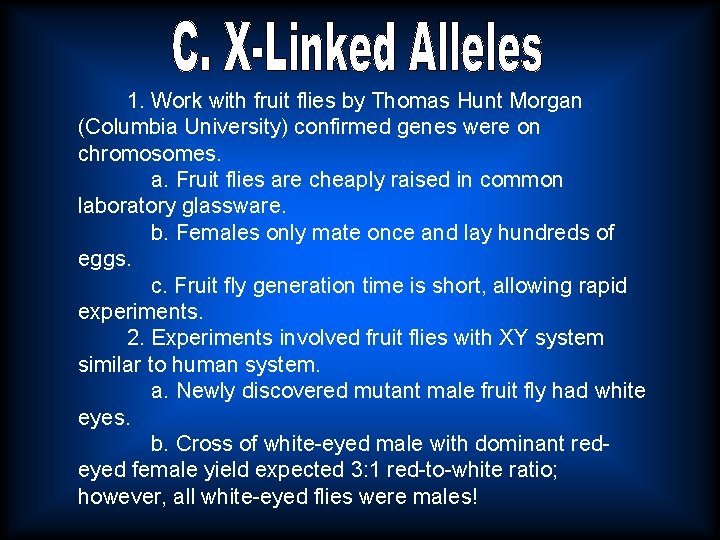
1. Work with fruit flies by Thomas Hunt Morgan (Columbia University) confirmed genes were on chromosomes. a. Fruit flies are cheaply raised in common laboratory glassware. b. Females only mate once and lay hundreds of eggs. c. Fruit fly generation time is short, allowing rapid experiments. 2. Experiments involved fruit flies with XY system similar to human system. a. Newly discovered mutant male fruit fly had white eyes. b. Cross of white-eyed male with dominant redeyed female yield expected 3: 1 red-to-white ratio; however, all white-eyed flies were males!
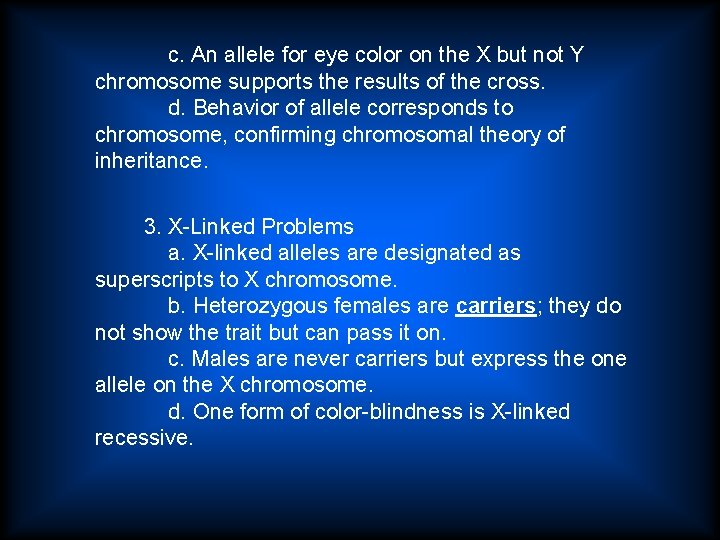
c. An allele for eye color on the X but not Y chromosome supports the results of the cross. d. Behavior of allele corresponds to chromosome, confirming chromosomal theory of inheritance. 3. X-Linked Problems a. X-linked alleles are designated as superscripts to X chromosome. b. Heterozygous females are carriers; they do not show the trait but can pass it on. c. Males are never carriers but express the one allele on the X chromosome. d. One form of color-blindness is X-linked recessive.
1. Fruit flies have four pairs of chromosomes to hold thousands of genes; Sutton concluded each chromosome must hold many genes. 2. All alleles on a chromosome form a linkage group that stays together except when crossing over. 3. Crossing-over causes recombinant gametes and at fertilization, recombinant phenotypes.
4. Linked alleles do not obey Mendel's laws because they tend to go into the gametes together. 5. Crosses involving linked genes do not give same results as unlinked genes. 6. Heterozygote forms only two types of gametes and produces offspring with only two phenotypes.
1. Percentage of recombinant phenotypes measures distance between genes to map the chromosomes. 2. Linked genes indicate the distance between genes on the chromosomes. 3. If 1% of crossing-over equals one map unit, then 6% recombinants reveal 6 map units between genes. 4. If crosses are performed for three alleles on a chromosome, only one map order explains map units. 5. Humans have few offspring and a long generation time, and it is not ethical to designate matings; therefore biochemical methods are used to map human chromosomes.
1. Changes in chromosomes or genes that pass to offspring if they occur in gametes. 2. Mutations increase the amount of variation among offspring. 3. Chromosomal mutations include changes in chromosome number and structure.
1. Monosomy occurs when and individual has only one of a particular type of chromosome. 2. Trisomy occurs when and individual has three of a particular type of chromosome. 3. Nondisjunction is the failure of chromosomes to separate; it is more common during meiosis I than meiosis II; it can occur in mitosis. 4. Monosomy and trisomy occur in plants and animals; in autosomes of animals, it is generally lethal.
5. Nonlethal human monosomies and trisomies include the following: a. Turner syndrome: monosomy where the individual has single X chromosome. b. Down syndrome is most common trisomy among humans; it involves chromosome 21. 6. Polyploidy: offspring end up with more than two complete sets of chromosomes. a. Terms indicate how many sets of chromosomes are present (triploids [3 n], tetraploids [4 n], etc. ).
b. Polyploidy does not increase variation in animals; judging from trisomies, it would be lethal. c. Polyploidy is a major evolutionary mechanism in plants; probably involved in 47% of flowering plants including major crops. d. Hybridization in plants can result in doubled number of chromosomes; an even number of chromosomes can undergo synapsis during meiosis; successful polyploidy results in a new species.
1. Environmental factors including radiation, chemicals, and viruses, can cause chromosomes to break; if the broken ends do not rejoin in the same pattern, this causes a change in chromosomal structure. 2. Inversion: a segment that has become separated from the chromosome is reinserted at the same place but in reverse; the position and sequence of genes are altered. 3. Translocation: a chromosomal segment is removed from one chromosome and inserted into another, nonhomologous chromosome. Translocation heterozygotes usually have reduced fertility due to production of abnormal gametes.
4. A deletion is a type of mutation in which an end of a chromosome breaks off or when two simultaneous breaks lead to the loss of a segment. a. Even if only one member of pair of chromosomes is affected, a deletion cause abnormalities. b. Cri du chat syndrome is deletion in which an individual has a small head, is mentally retarded, has facial abnormalities, and abnormal glottis and larynx resulting in a cry resembling that of a cat. 5. A duplications is a doubling of a chromosomal segment. a. A broken segment from one chromosome can simply attach to its homologue. b. Unequal crossing-over may occur. 6. Multiple copies of genes can mutate differently and provide additional genetic variation for a species.