
1 Measuring Sustainability Identifying Selecting and Measuring the
1 Measuring Sustainability Identifying, Selecting and Measuring the Relevant Variables (Sessions #1 and #2) The Sustainable Enterprise Fieldbook Chapter 6 Copyright © 2011, Enterprise Sustainability Action Team
2 Overview • Explain and describe the context and “language” of indicators so as to determine which indicators are most appropriately applied to the task of measuring the sustainability of any given enterprise system • Explore and select an appropriate mix of indicators to be measured, within a context of optimal policy parameters established within a particular enterprise system • Explore and identify elements of relevant indicators to be measured in a system, in keeping with a stated policy of enterprise performance; and • Learn how to measure relevant indicators, so as to achieve established policy objectives Copyright © 2011, Enterprise Sustainability Action Team
Introduction 3 • Context for Sustainability Measurements • Introduction to Metrics – Types, KPIs, Goals and Targets • Enterprise Measurements – Energy & GHG Emissions – Triple Bottom Line & Social Performance – SRI, ESG – Strategic: Green Sigma, Balanced Scorecard Copyright © 2011, Enterprise Sustainability Action Team

4 What is Sustainability? Key aspects: Triple Bottom Line • Social • Environmental • Economic Copyright © 2011, Enterprise Sustainability Action Team 4
The Language of Indicators • Indicator – A measure of a key attribute or characteristic considered indicative of the state of a system (a business, an economy, an ecosystem); a measure of public health & safety (mortality and morbidity, nutritional status), environmental quality (air quality, energy use), economic vitality (profit, job creation), and the like. – A simple variable that can be measured objectively, such as population, revenues, and number of events. – Provides a basis for measuring change over time and, thereby, for understanding the relative condition of an entity – both to itself and to other entities and groups of entities. Copyright © 2011, Enterprise Sustainability Action Team 5
The Language of Indicators • Index – An indicator, but more typically applied in a relative scale and often in combination with multiple indicators: for example, multiple indicators may be combined into a single index that is deemed to indicate the overall relative performance or condition of an entity. Copyright © 2011, Enterprise Sustainability Action Team 6
The Language of Indicators • Footprint – A measurement of impacts on the environment and natural resources. – An “ecological footprint” measures how much land water area a human population requires to produce the resources it consumes and to absorb its wastes under prevailing technology. – A carbon footprint measuring human impacts on climate through greenhouse gas emissions, represented as carbon equivalents, is another rapidly growing footprint measure. Copyright © 2011, Enterprise Sustainability Action Team 7
The Language of Indicators • Inputs – Measures of the resources an organization uses to produce a product or provide a service, such as total dollars invested, raw materials purchased, number of people employed, amount of energy used. • Outputs – Indicators of the amount of product or service provided; for example, refrigerators manufactured, revenues or profits realized, amount of greenhouse gas (GHG) generated. Copyright © 2011, Enterprise Sustainability Action Team 8
The Language of Indicators • Outcomes – Measures that assess how well a product’s or service’s goals and objectives are accomplished. – Outcome measures indicate the quality of effectiveness of a product or service: for instance, cleanliness ratings based on routine inspections could describe a city’s success (or lack thereof) at cleaning its streets or parks. A business might track market share, share value, customer satisfaction, or progress toward mission. Copyright © 2011, Enterprise Sustainability Action Team 9
The Language of Indicators - cont’d • Efficiency – Indicators that measure the amount of resources required to produce a unit of output or to achieve a certain outcome. – These measures inform judgments about how well resources were used to achieve intended aims – the question of “bang for the buck” – by comparing input indicators with output and outcome indicators. Copyright © 2011, Enterprise Sustainability Action Team 10
The Language of Indicators - cont’d • Input-Output - These comparisons include energy use per unit of product, water use per gallon of product. • Input-Outcome - These measures include tons of GHG per dollar of profit, tons of compost per acre of land reclaimed, dollars invested percentage increase in market share. • Benchmarks - Performance comparisons to peers, best-in-class performers, and the like, which help identify leaders’ and laggards’ best practices and opportunities for performance improvement. Copyright © 2011, Enterprise Sustainability Action Team 11
12 Context Sustainability Performance How do we know if our business decisions are moving us toward or away from a more sustainable world? Copyright © 2011, Enterprise Sustainability Action Team
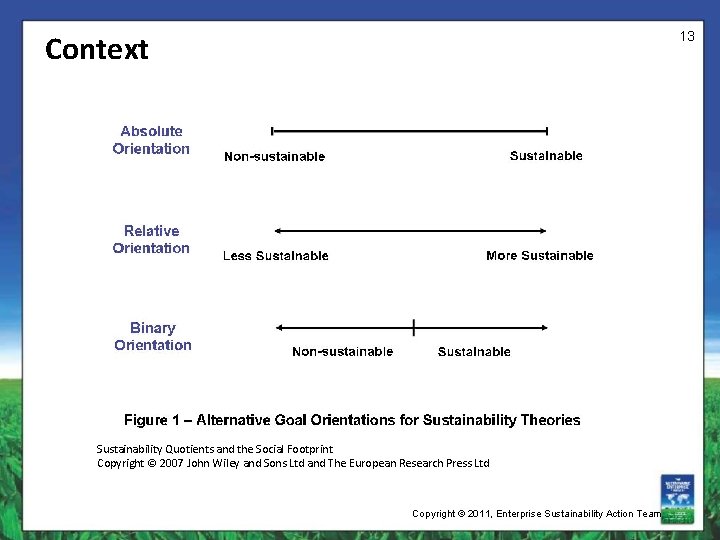
Context 13 Sustainability Quotients and the Social Footprint Copyright © 2007 John Wiley and Sons Ltd and The European Research Press Ltd Copyright © 2011, Enterprise Sustainability Action Team
14 Context • Metrics are a key ingredient to move people from awareness about sustainability to understanding and ultimately to action. • Well designed sustainability metrics will supply intelligence that aligns an enterprise’s need for knowing with informed business decisions and effective strategic actions. • Sustainability metrics need holistic context. – Integrated metrics for ecosystems, social systems, and economic systems enable business to contribute to global actions and appropriately respond to changing market conditions and long term global trends. Copyright © 2011, Enterprise Sustainability Action Team
Metrics Introduction 15 Categories and Types Criteria for Effective Metrics • Comparability - trend analysis • Scope - limited number • Credibility - verifiable and reproducible • Transparency - relate to actual developments in time. • Extendability - relate to cause and effect Copyright © 2011, Enterprise Sustainability Action Team
Metrics Introduction 16 Categories and Types of Measures • Ratios - Put data into context with relation to other flows and processes • Trends - Put data into context with relation to time • Benchmarks - Put data into context – internally, in relation to customers’ performance – Externally, in relation to competitors’ performance Copyright © 2011, Enterprise Sustainability Action Team

Metrics Introduction 17 Categories and Types Key Result Indicators Examples: • # Entering Students • # Students Graduating • Student satisfaction (Q) • Faculty (Employee) satisfaction (Q) • Avg. Salary – New / recent Grads • Avg. Salary – 10 yr Alums • Avg. Tenure of Program faculty members • Avg. Yrs professional experience of Program faculty • Avg. cost of course resources / student (e. g. , facilities, materials, instructional hours, other) Copyright © 2011, Enterprise Sustainability Action Team
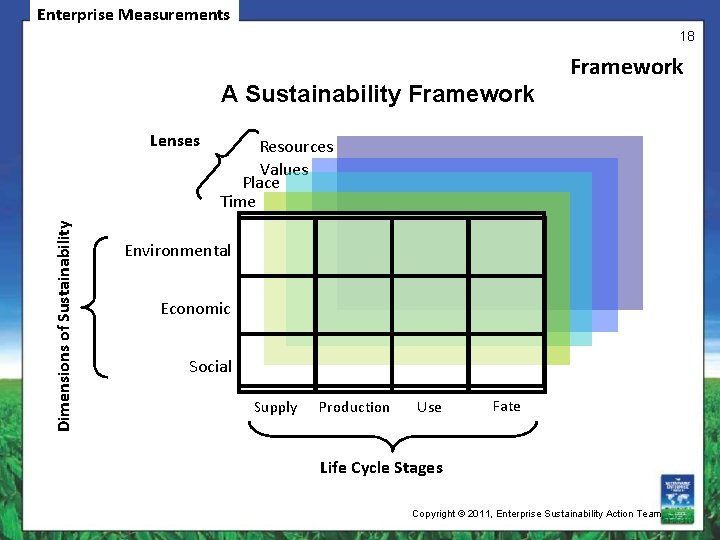
Enterprise Measurements 18 A Sustainability Framework Dimensions of Sustainability Lenses Framework Resources Values Place Time Environmental Economic Social Supply Production Use Fate Life Cycle Stages Copyright © 2011, Enterprise Sustainability Action Team
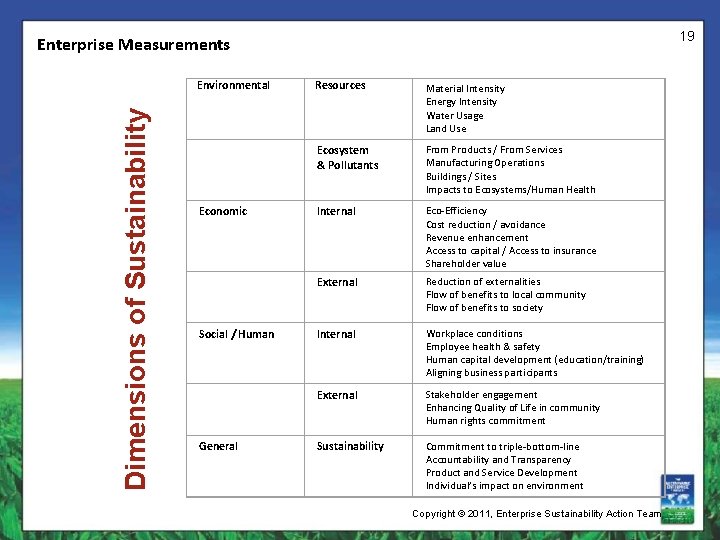
19 Enterprise Measurements Dimensions of Sustainability Environmental Economic Social / Human General Resources Material Intensity Energy Intensity Water Usage Land Use Ecosystem & Pollutants From Products / From Services Manufacturing Operations Buildings / Sites Impacts to Ecosystems/Human Health Internal Eco-Efficiency Cost reduction / avoidance Revenue enhancement Access to capital / Access to insurance Shareholder value External Reduction of externalities Flow of benefits to local community Flow of benefits to society Internal Workplace conditions Employee health & safety Human capital development (education/training) Aligning business participants External Stakeholder engagement Enhancing Quality of Life in community Human rights commitment Sustainability Commitment to triple-bottom-line Accountability and Transparency Product and Service Development Individual’s impact on environment Copyright © 2011, Enterprise Sustainability Action Team
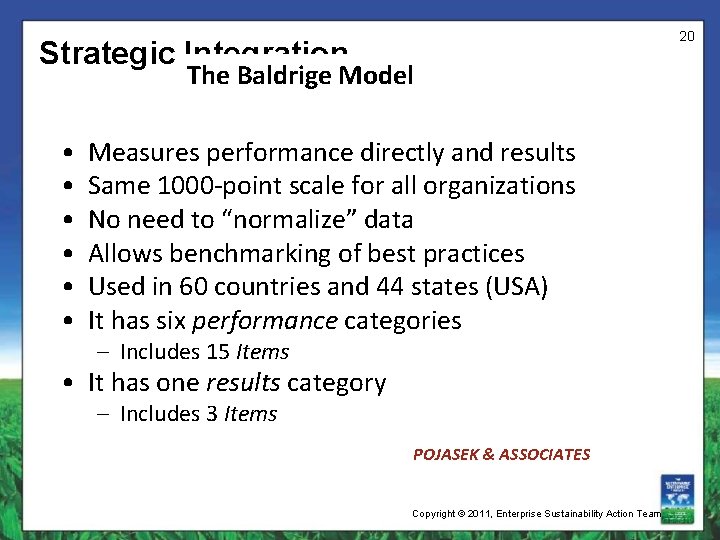
20 Strategic Integration The Baldrige Model • • • Measures performance directly and results Same 1000 -point scale for all organizations No need to “normalize” data Allows benchmarking of best practices Used in 60 countries and 44 states (USA) It has six performance categories – Includes 15 Items • It has one results category – Includes 3 Items POJASEK & ASSOCIATES Copyright © 2011, Enterprise Sustainability Action Team
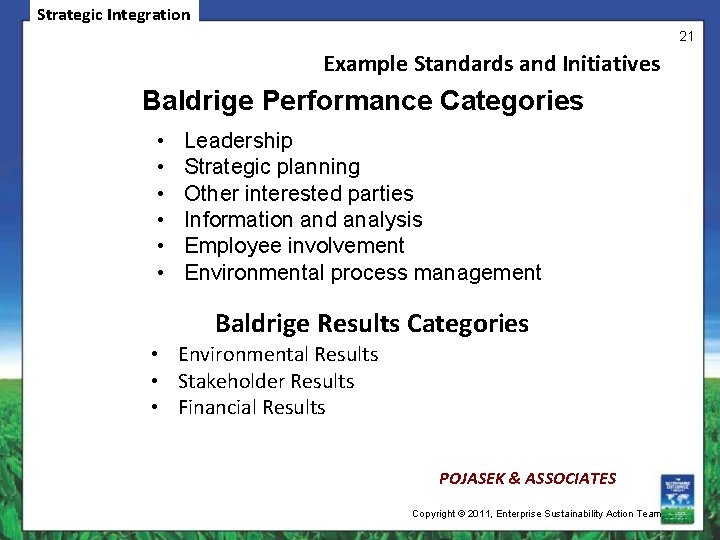
Strategic Integration 21 Example Standards and Initiatives Baldrige Performance Categories • • • Leadership Strategic planning Other interested parties Information and analysis Employee involvement Environmental process management Baldrige Results Categories • Environmental Results • Stakeholder Results • Financial Results POJASEK & ASSOCIATES Copyright © 2011, Enterprise Sustainability Action Team
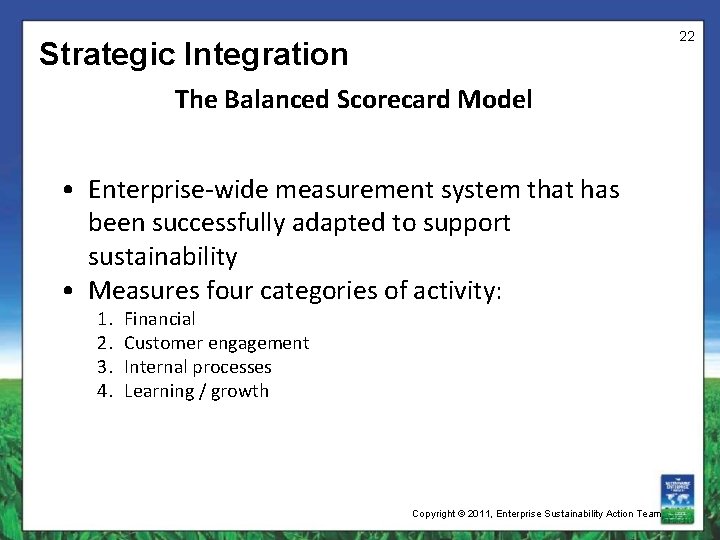
22 Strategic Integration The Balanced Scorecard Model • Enterprise-wide measurement system that has been successfully adapted to support sustainability • Measures four categories of activity: 1. 2. 3. 4. Financial Customer engagement Internal processes Learning / growth Copyright © 2011, Enterprise Sustainability Action Team
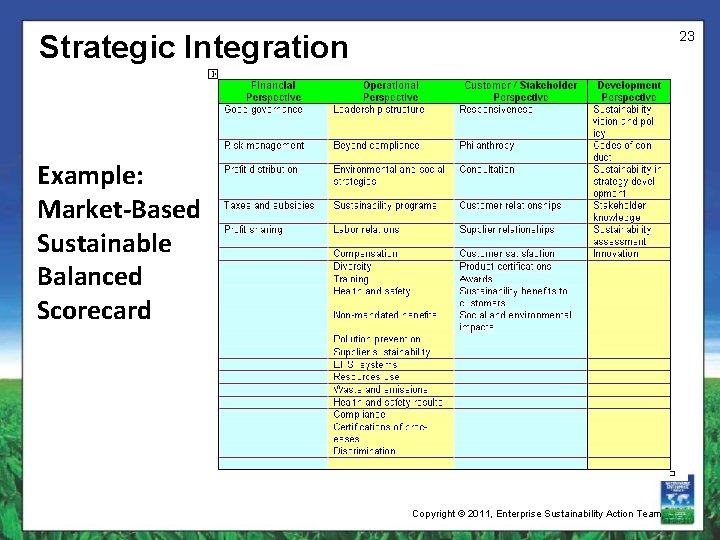
23 Strategic Integration Example: Market-Based Sustainable Balanced Scorecard Copyright © 2011, Enterprise Sustainability Action Team
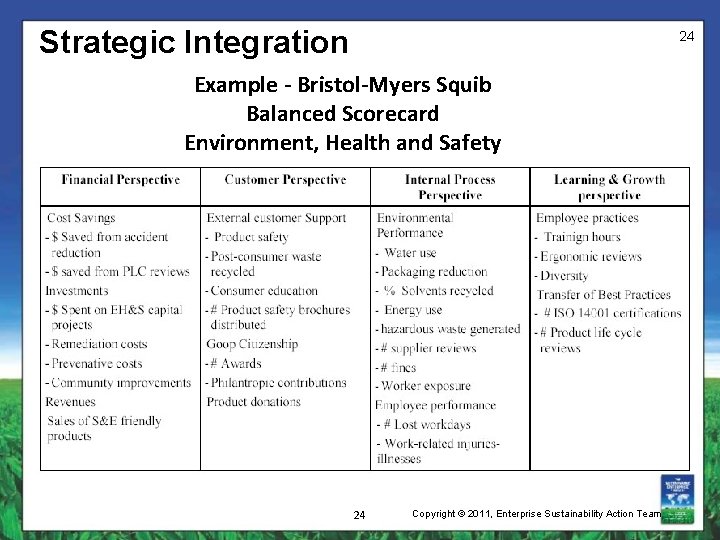
Strategic Integration 24 Example - Bristol-Myers Squib Balanced Scorecard Environment, Health and Safety 24 Copyright © 2011, Enterprise Sustainability Action Team
Assignment Your Team - ___Your Model _______ • Determine objectives for your organization team (class); • Define organization purpose / policy standards / outcomes • Select model for designing metrics (KPI Matrix, Baldrige or Balanced Scorecard) • Determine variables for the relevant metrics to be measured • Identify relevant data and criteria elements for each selected variable; Develop implementation Plan or Story to generate and share sustainability measures using the metrics matrix which you developed • Develop 20 -minute team presentation, sharing your process and results Copyright © 2011, Enterprise Sustainability Action Team 25
- Slides: 25