
1 Manufacturing Engineering Technology in SI Units 6
- Slides: 98
1 Manufacturing Engineering Technology in SI Units, 6 th Edition Chapter 27: Advanced Machining Processes Copyright © 2010 Pearson Education South Asia Pte Ltd
Chapter Outline 2 1. Introduction 2. Chemical Machining 3. Electrochemical Machining 4. Electrical-discharge Machining 5. Laser-beam Machining 6. Electron-beam Machining 7. Water-jet Machining 8. Ultrasonic machining Copyright © 2010 Pearson Education South Asia Pte Ltd
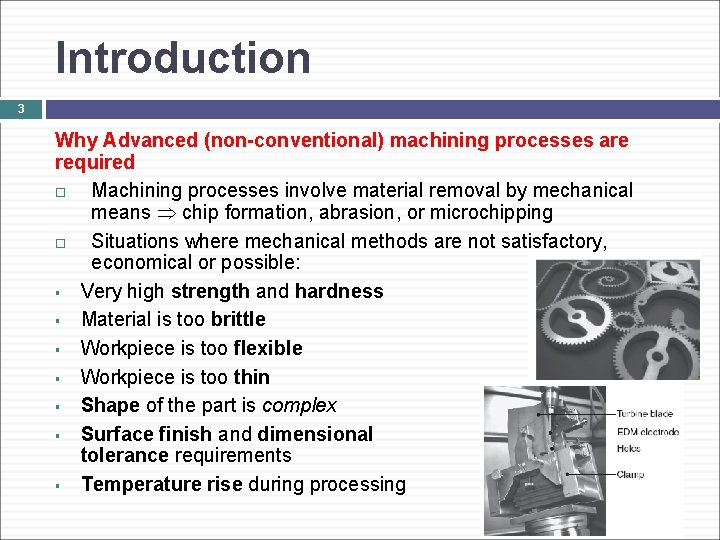
Introduction 3 Why Advanced (non-conventional) machining processes are required Machining processes involve material removal by mechanical means chip formation, abrasion, or microchipping Situations where mechanical methods are not satisfactory, economical or possible: § Very high strength and hardness § Material is too brittle § Workpiece is too flexible § Workpiece is too thin § Shape of the part is complex § Surface finish and dimensional tolerance requirements § Temperature rise during processing
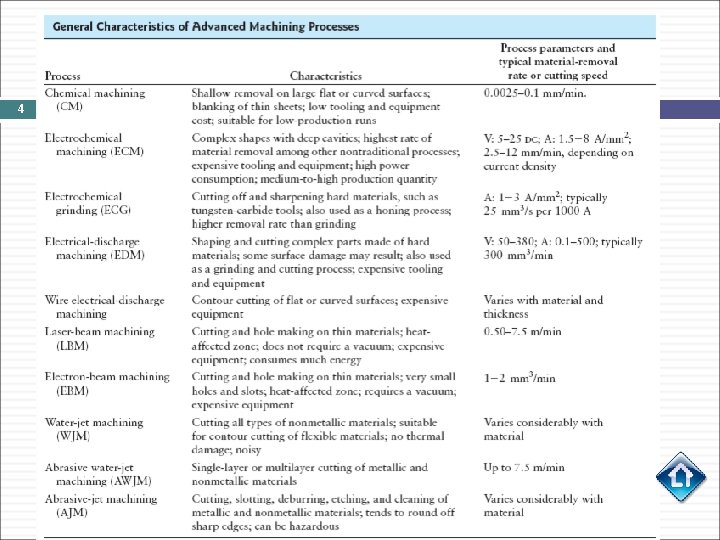
Introduction 4
Chemical Machining 5 • Chemical machining(CHM) is developed based on the observation that chemicals attack metals and etch them by using chemical solutions. CHM is the removal of metal by chemical attack by a corrosive liquid. The area affected by the chemical reagent is controlled by masking or by partial immersion The areas of the workpiece which are not to be machined are masked. The workpiece is either immersed in or exposed to a spray of chemical reagent. CHM was basically developed for aerospace industry to maintain strength of part at reduced weight.
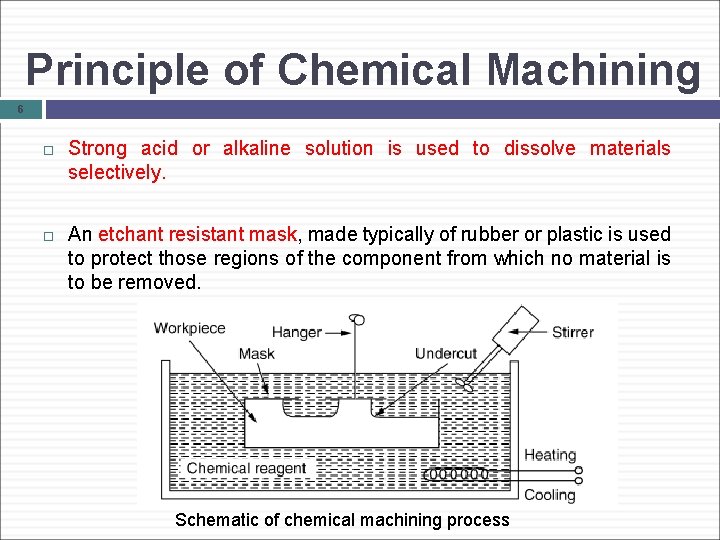
Principle of Chemical Machining 6 Strong acid or alkaline solution is used to dissolve materials selectively. An etchant resistant mask, made typically of rubber or plastic is used to protect those regions of the component from which no material is to be removed. Schematic of chemical machining process
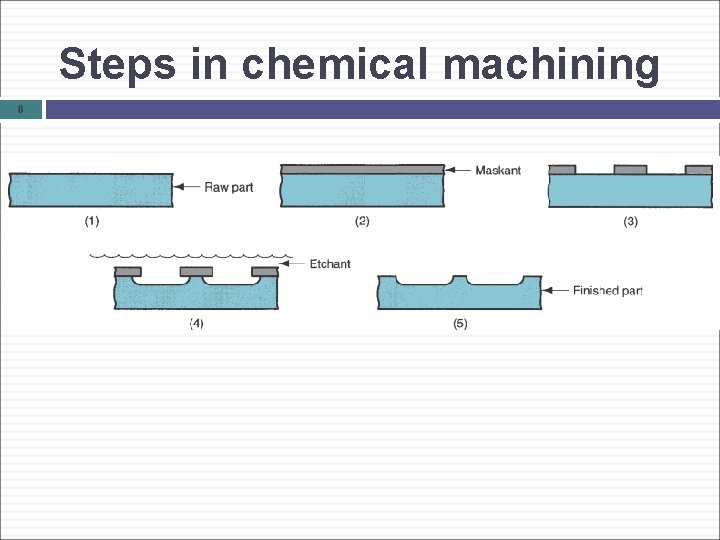
Steps in chemical machining 7 The four steps in chemical machining are as follows: Cleaning. The first step is a cleaning operation to ensure that material will be removed uniformly from the surfaces to be etched. Masking. A protective coating called a maskant is applied to certain portions of the part surface. This maskant is made of a material that is chemically resistant to the etchant (the term resist is used for this masking material). It is therefore applied to those portions of the work surface that are not to be etched. Etching. This is the material removal step. The part is immersed in an etchant that chemically attacks those portions of the part surface that are not masked. The usual method of attack is to convert the work material (e. g. a metal) into a salt that dissolves in the etchant and is thereby removed from the surface. When the desired amount of material has been removed, the part is withdrawn from the etchant and washed to stop the process. Demasking. The maskant is removed from the part
Steps in chemical machining 8
Steps in chemical machining 9 The Cleaning and Demasking are common steps in all kinds of CHM processes. However, significant variations are involved in Masking and Etching steps.
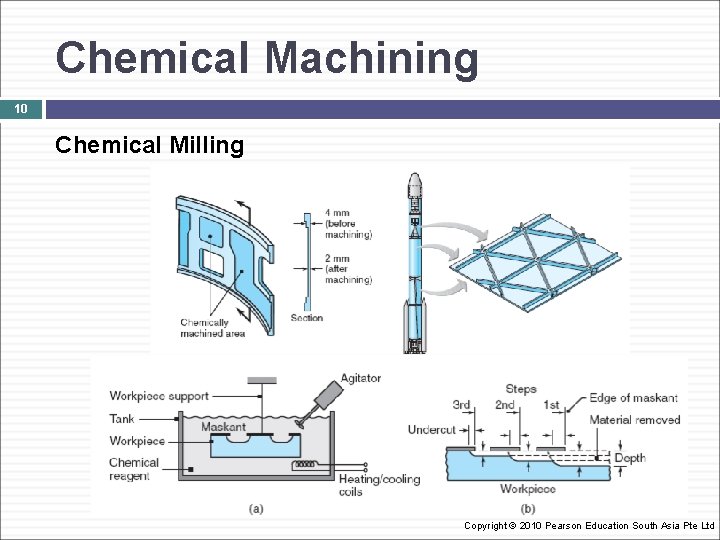
Chemical Machining 10 Chemical Milling Copyright © 2010 Pearson Education South Asia Pte Ltd
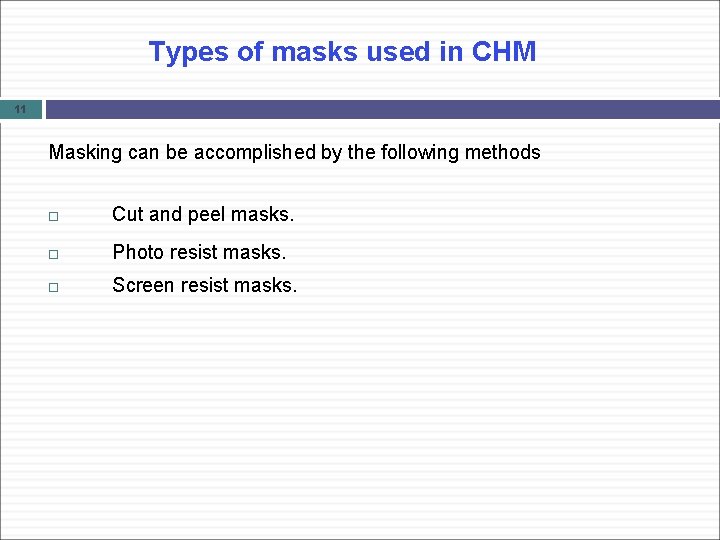
Types of masks used in CHM 11 Masking can be accomplished by the following methods Cut and peel masks. Photo resist masks. Screen resist masks.
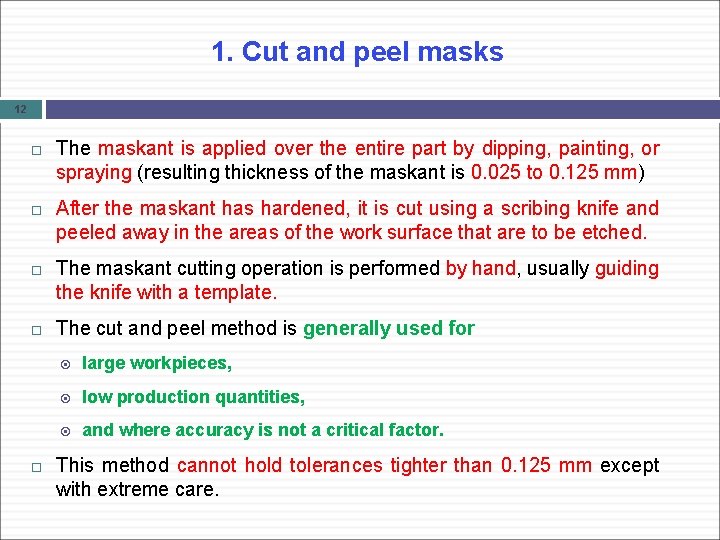
1. Cut and peel masks 12 The maskant is applied over the entire part by dipping, painting, or spraying (resulting thickness of the maskant is 0. 025 to 0. 125 mm) After the maskant has hardened, it is cut using a scribing knife and peeled away in the areas of the work surface that are to be etched. The maskant cutting operation is performed by hand, usually guiding the knife with a template. The cut and peel method is generally used for large workpieces, low production quantities, and where accuracy is not a critical factor. This method cannot hold tolerances tighter than 0. 125 mm except with extreme care.
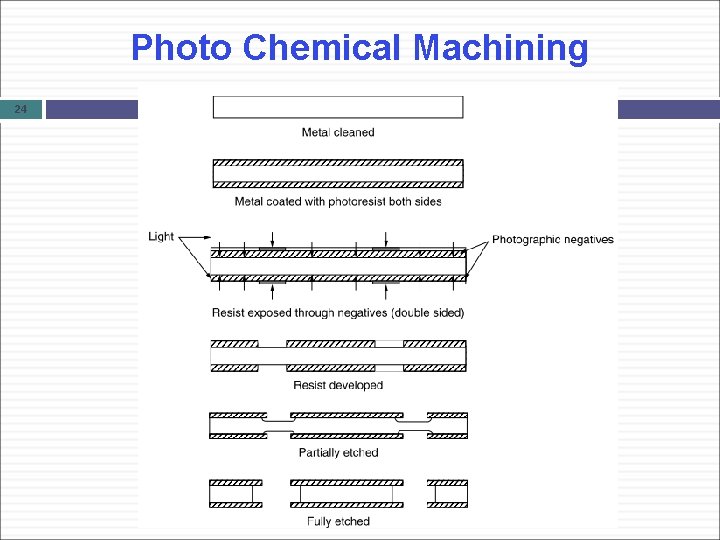
2. Photographic resist masks https: //www. youtube. com/watch? v=NDp 3 OPI 6 dgo 13 As the name suggests, the photographic resist method (called the photoresist method for short) uses photographic techniques to perform the masking step. The masking materials contain photosensitive chemicals. They are applied to the work surface and exposed to light through a negative image of the desired areas to be etched. These areas of the maskant can then be removed from the surface using photographic developing techniques. This procedure leaves the desired surfaces of the part protected by the maskant and the remaining areas unprotected, vulnerable to chemical etching. Photoresist masking techniques are normally applied where small parts are produced in high quantities, and close tolerances are required. Tolerances closer than ± 0. 0125 mm can be held.
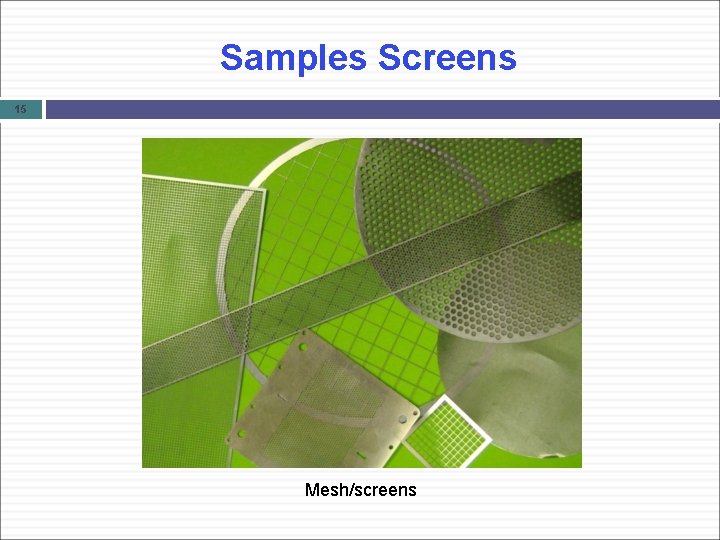
3. Screen resist masks 14 The screen resist method applies the maskant by means of screening methods. In these methods, the maskant is painted onto the workpart surface through a silk or stainless steel mesh. Embedded in the mesh is a stencil that protects those areas to be etched from being painted. The maskant is thus painted onto the work areas that are not to be etched through the screen. The screen resist method is generally used in applications that are between the other two masking methods in terms of accuracy, part size, and production quantities. Tolerances of ± 0. 075 mm can be achieved with this masking method.
Samples Screens 15 Mesh/screens
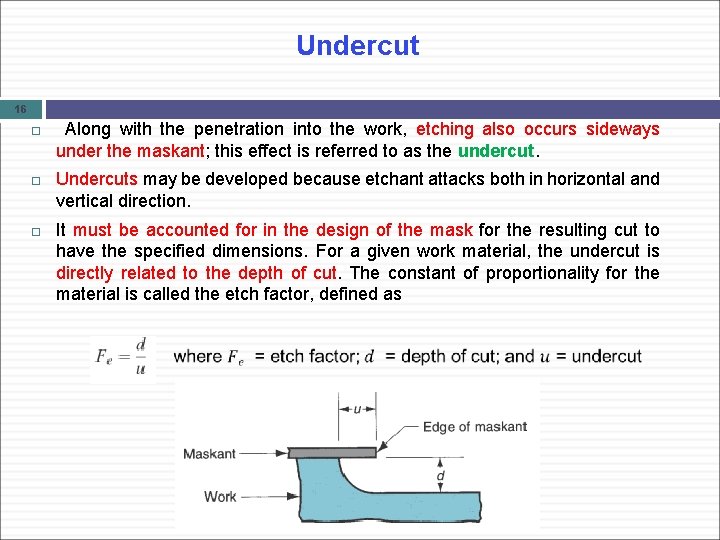
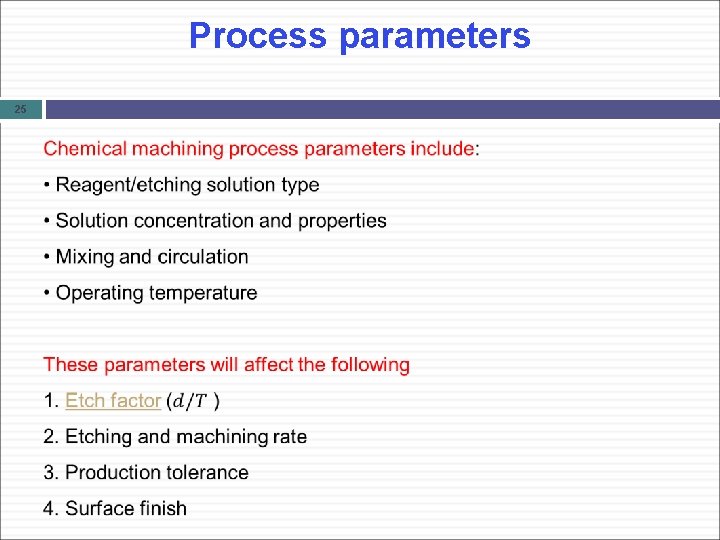
Undercut 16 Along with the penetration into the work, etching also occurs sideways under the maskant; this effect is referred to as the undercut. Undercuts may be developed because etchant attacks both in horizontal and vertical direction. It must be accounted for in the design of the mask for the resulting cut to have the specified dimensions. For a given work material, the undercut is directly related to the depth of cut. The constant of proportionality for the material is called the etch factor, defined as
Design considerations for Chemical machining 17 Designs involving sharp corners, deep & narrow cavities, or porous workpiece should be avoided due to undercuts. Dimensional variations can occur, this can be minimized by proper controlling of the environment.
Chemical machining processes types 18 Chemical milling Chemical blanking Chemical engraving Photochemical machining
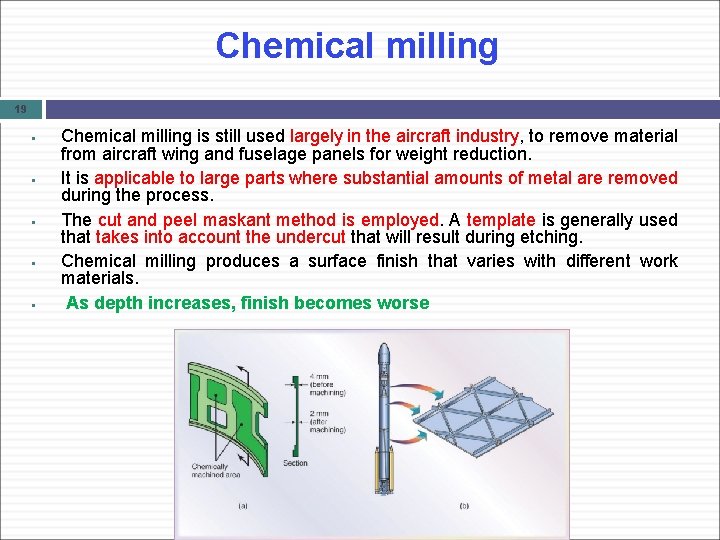
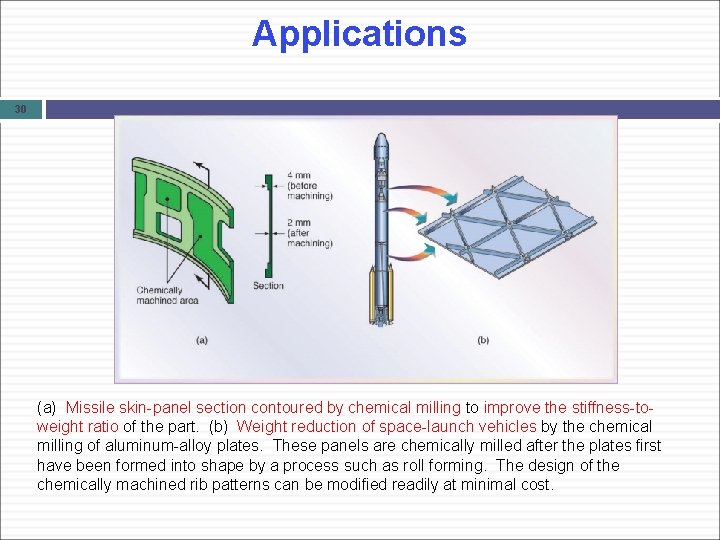
Chemical milling 19 § § § Chemical milling is still used largely in the aircraft industry, to remove material from aircraft wing and fuselage panels for weight reduction. It is applicable to large parts where substantial amounts of metal are removed during the process. The cut and peel maskant method is employed. A template is generally used that takes into account the undercut that will result during etching. Chemical milling produces a surface finish that varies with different work materials. As depth increases, finish becomes worse
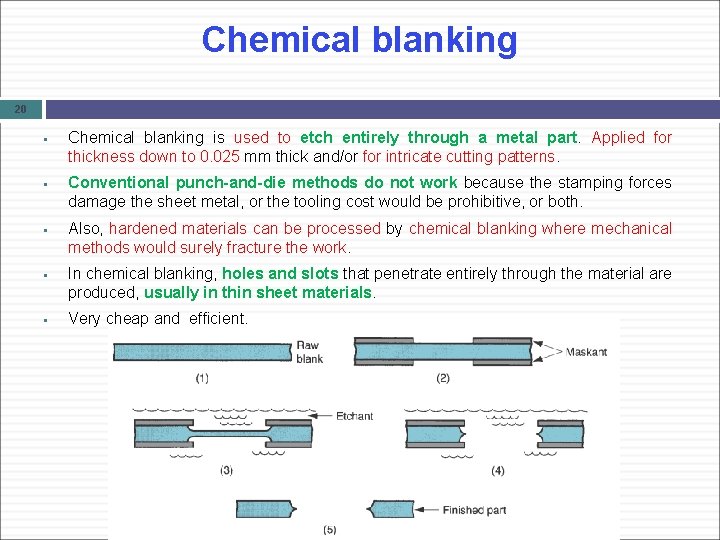
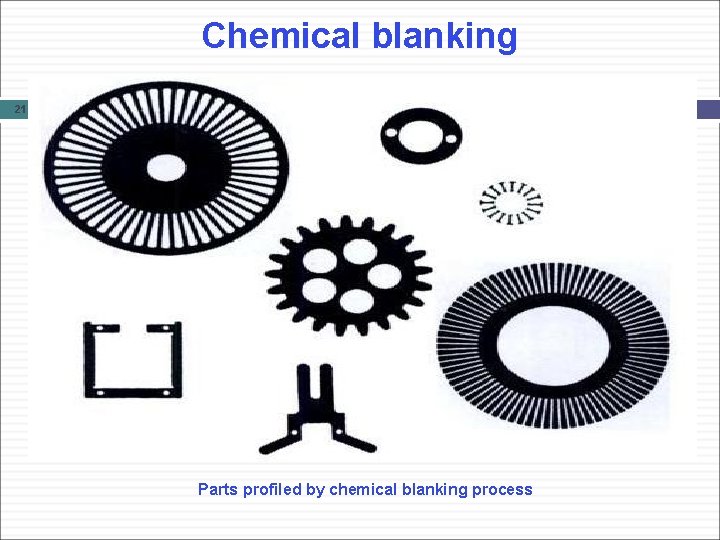
Chemical blanking 20 § § § Chemical blanking is used to etch entirely through a metal part. Applied for thickness down to 0. 025 mm thick and/or for intricate cutting patterns. Conventional punch-and-die methods do not work because the stamping forces damage the sheet metal, or the tooling cost would be prohibitive, or both. Also, hardened materials can be processed by chemical blanking where mechanical methods would surely fracture the work. In chemical blanking, holes and slots that penetrate entirely through the material are produced, usually in thin sheet materials. Very cheap and efficient.
Chemical blanking 21 Parts profiled by chemical blanking process
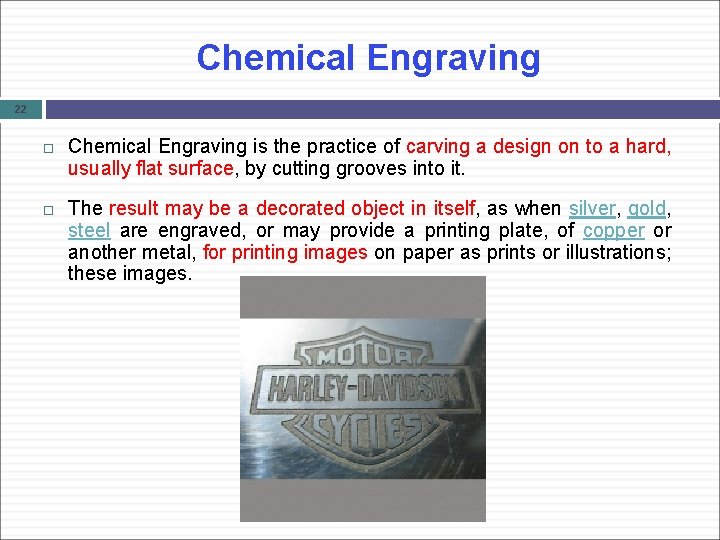
Chemical Engraving 22 Chemical Engraving is the practice of carving a design on to a hard, usually flat surface, by cutting grooves into it. The result may be a decorated object in itself, as when silver, gold, steel are engraved, or may provide a printing plate, of copper or another metal, for printing images on paper as prints or illustrations; these images.
Photo Chemical Machining 23 Photochemical machining (PCM) is chemical machining in which the photoresist method of masking is used. Photochemical machining (PCM) is also known as photochemical milling or photo etching. The term can, therefore, be applied correctly to chemical blanking and chemical engraving when these methods use the photographic resist method. It involves fabricating sheet metal components using photo resist masks and etchants to corrosively machine away selected areas. PCM can be used on virtually any commercially available metal or alloy, of any hardness. Metals include aluminium, brass, copper, inconel, nickel, silver, steel, stainless steel, zinc and titanium.
Photo Chemical Machining 24
Process parameters 25
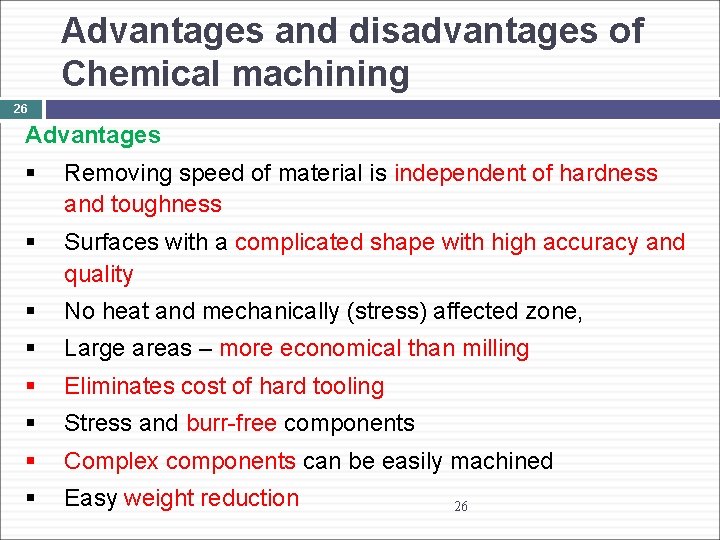
Advantages and disadvantages of Chemical machining 26 Advantages § Removing speed of material is independent of hardness and toughness § Surfaces with a complicated shape with high accuracy and quality § No heat and mechanically (stress) affected zone, § Large areas – more economical than milling § Eliminates cost of hard tooling § Stress and burr-free components § Complex components can be easily machined § Easy weight reduction 26
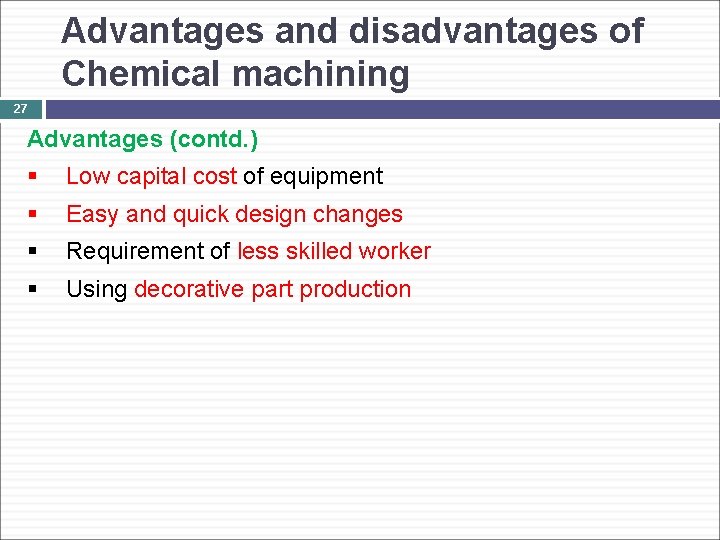
Advantages and disadvantages of Chemical machining 27 Advantages (contd. ) § Low capital cost of equipment § Easy and quick design changes § Requirement of less skilled worker § Using decorative part production
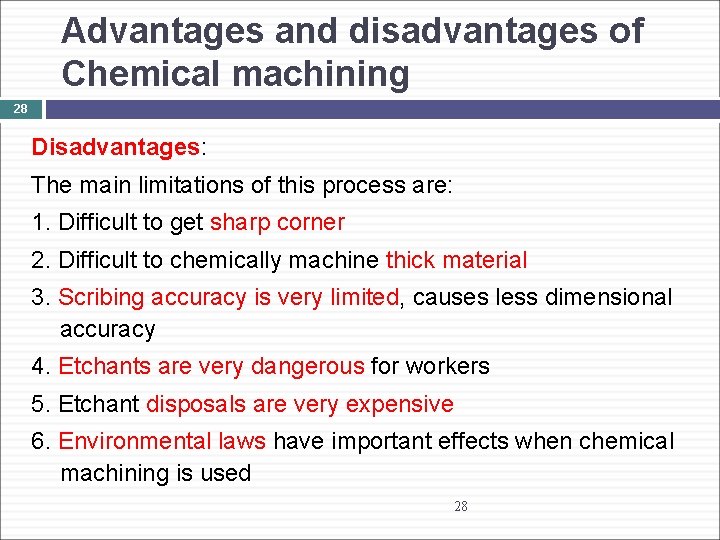
Advantages and disadvantages of Chemical machining 28 Disadvantages: The main limitations of this process are: 1. Difficult to get sharp corner 2. Difficult to chemically machine thick material 3. Scribing accuracy is very limited, causes less dimensional accuracy 4. Etchants are very dangerous for workers 5. Etchant disposals are very expensive 6. Environmental laws have important effects when chemical machining is used 28
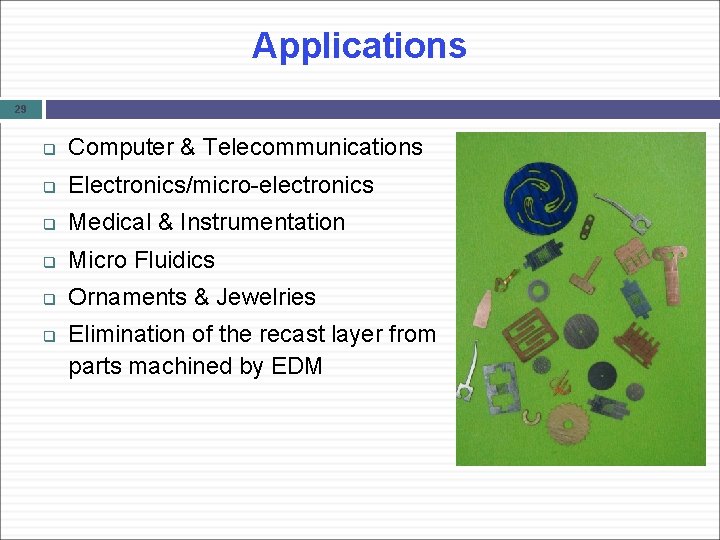
Applications 29 q Computer & Telecommunications q Electronics/micro-electronics q Medical & Instrumentation q Micro Fluidics q Ornaments & Jewelries q Elimination of the recast layer from parts machined by EDM
Applications 30 (a) Missile skin-panel section contoured by chemical milling to improve the stiffness-toweight ratio of the part. (b) Weight reduction of space-launch vehicles by the chemical milling of aluminum-alloy plates. These panels are chemically milled after the plates first have been formed into shape by a process such as roll forming. The design of the chemically machined rib patterns can be modified readily at minimal cost.
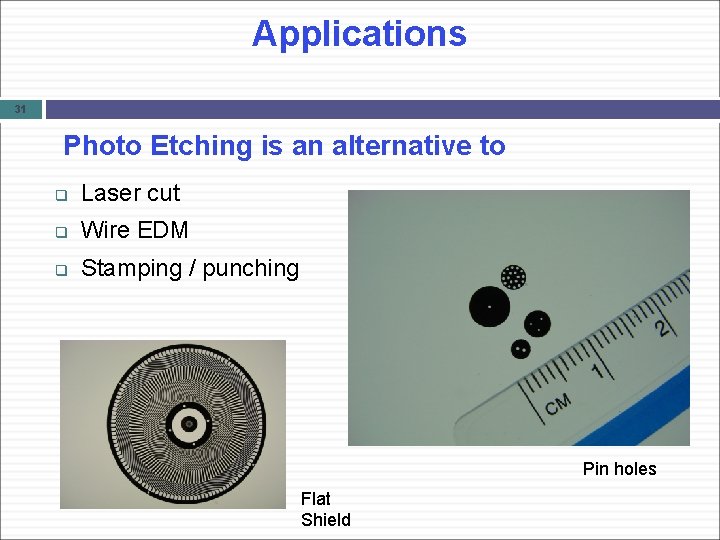
Applications 31 Photo Etching is an alternative to q Laser cut q Wire EDM q Stamping / punching Pin holes Flat Shield
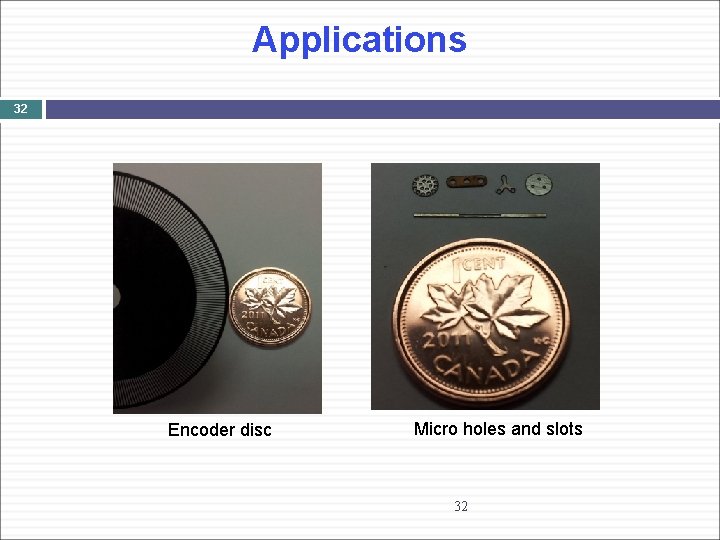
Applications 32 Encoder disc Micro holes and slots 32
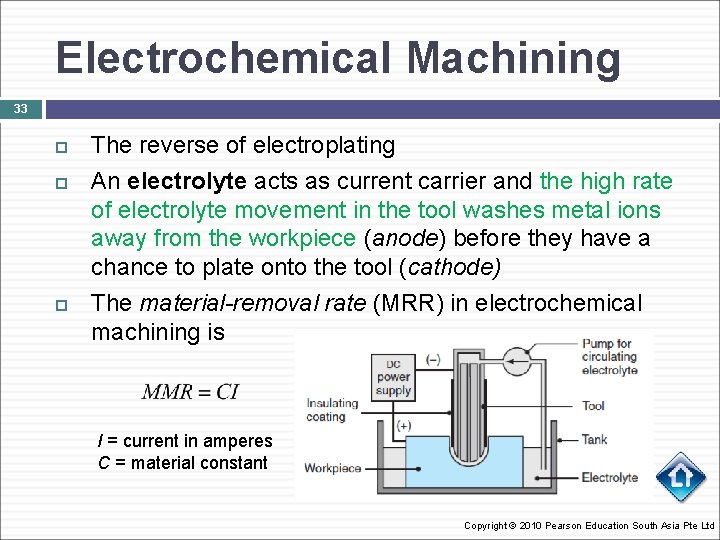
Electrochemical Machining 33 The reverse of electroplating An electrolyte acts as current carrier and the high rate of electrolyte movement in the tool washes metal ions away from the workpiece (anode) before they have a chance to plate onto the tool (cathode) The material-removal rate (MRR) in electrochemical machining is I = current in amperes C = material constant Copyright © 2010 Pearson Education South Asia Pte Ltd
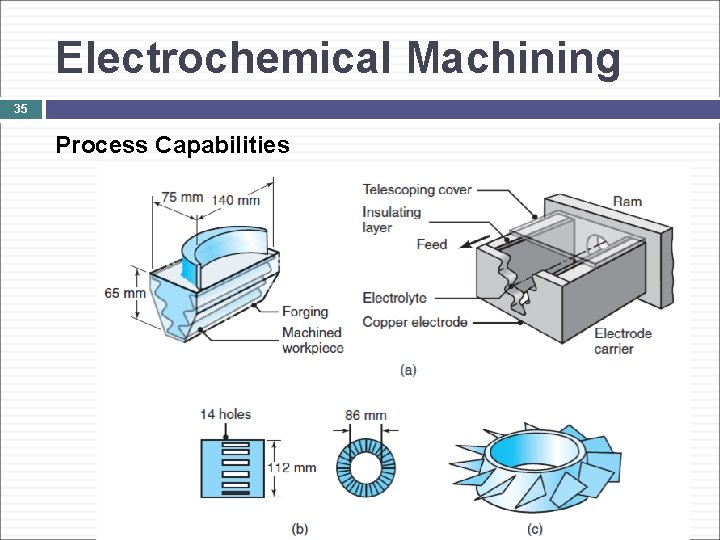
Electrochemical Machining 34 Process Capabilities Used to machine complex cavities and shapes in highstrength materials Aerospace industry for the mass production of turbine blades, jet-engine parts and nozzles Modification of ECM, shaped-tube electrolytic machining (STEM), is used for drilling small-diameter deep holes ECM process leaves a burr-free, bright surface and can be used as a deburring process Available as numerically controlled machining centers with high production rates, high flexibility, and close dimensional tolerances Copyright © 2010 Pearson Education South Asia Pte Ltd
Electrochemical Machining 35 Process Capabilities
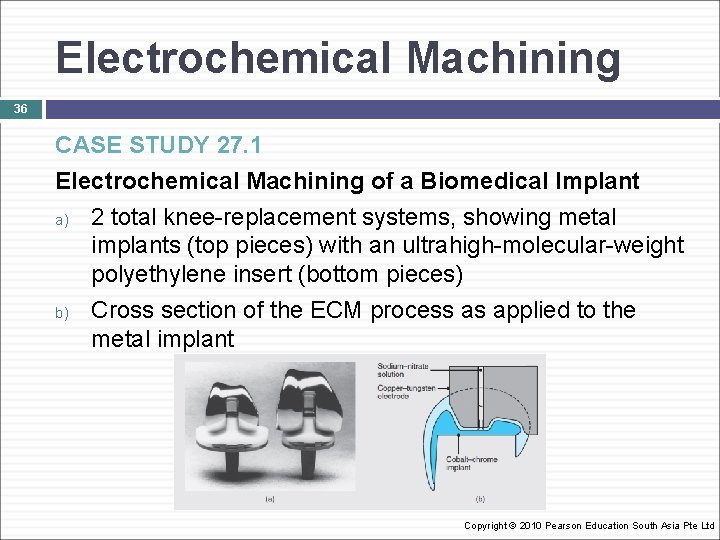
Electrochemical Machining 36 CASE STUDY 27. 1 Electrochemical Machining of a Biomedical Implant a) 2 total knee-replacement systems, showing metal implants (top pieces) with an ultrahigh-molecular-weight polyethylene insert (bottom pieces) b) Cross section of the ECM process as applied to the metal implant Copyright © 2010 Pearson Education South Asia Pte Ltd
37 Electrical-discharge (EDM) Machining Process is based on the erosion of metals by spark discharges When two current-conducting wires are allowed to touch each other, an arc is produced At the point of contact between the two wires, a small portion of the metal is eroded away leaves a small crater Copyright © 2010 Pearson Education South Asia Pte Ltd
Electrical-discharge Machining 38 § Electric discharge processes remove metal by a series of discrete electrical discharges (sparks) that cause localized temperatures high enough to melt or vaporize the metal in the immediate vicinity of the discharge. § The two main processes in this category are (1) electric discharge machining die sinking (ram type) (2) wire electric discharge machining. § These processes can be used only on electrically conducting work materials. § Electric discharge machining (EDM) is one of the most widely used nontraditional processes.
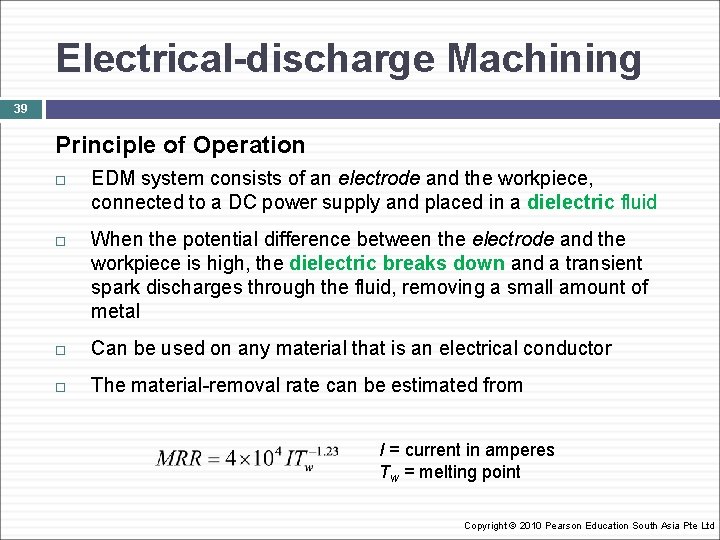
Electrical-discharge Machining 39 Principle of Operation EDM system consists of an electrode and the workpiece, connected to a DC power supply and placed in a dielectric fluid When the potential difference between the electrode and the workpiece is high, the dielectric breaks down and a transient spark discharges through the fluid, removing a small amount of metal Can be used on any material that is an electrical conductor The material-removal rate can be estimated from I = current in amperes Tw = melting point Copyright © 2010 Pearson Education South Asia Pte Ltd
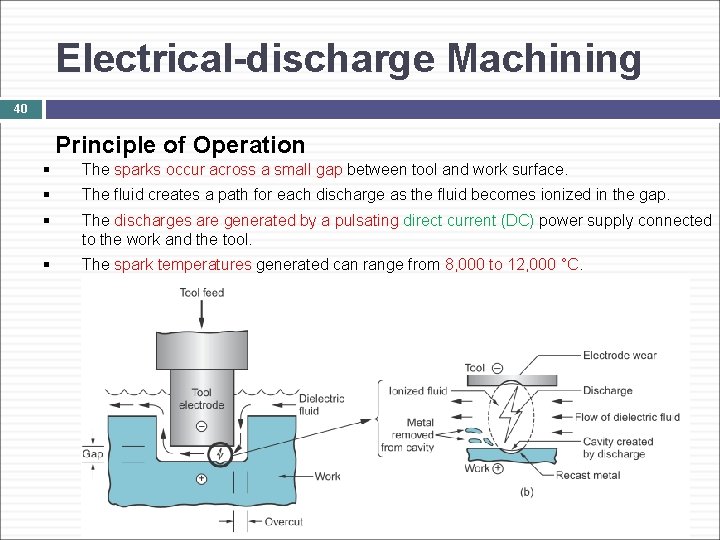
Electrical-discharge Machining 40 Principle of Operation § The sparks occur across a small gap between tool and work surface. § The fluid creates a path for each discharge as the fluid becomes ionized in the gap. § The discharges are generated by a pulsating direct current (DC) power supply connected to the work and the tool. § The spark temperatures generated can range from 8, 000 to 12, 000 °C.
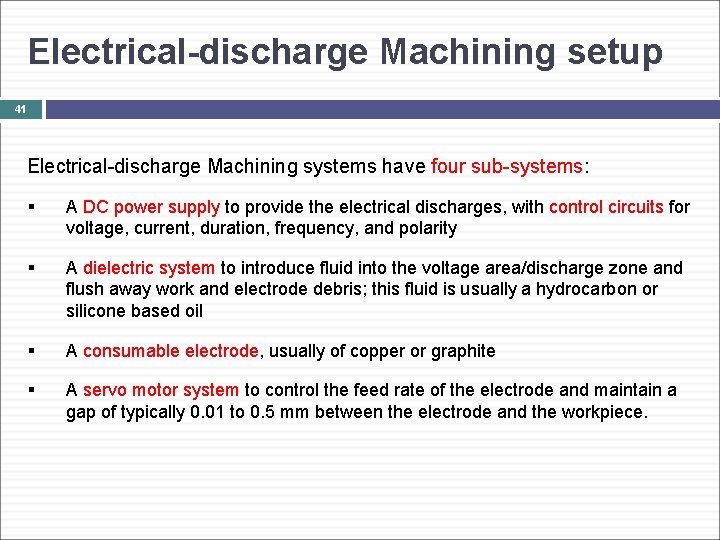
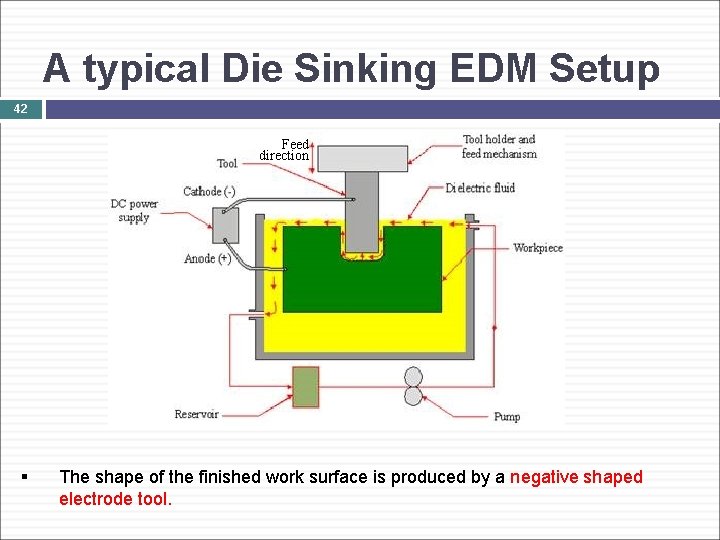
Electrical-discharge Machining setup 41 Electrical-discharge Machining systems have four sub-systems: § A DC power supply to provide the electrical discharges, with control circuits for voltage, current, duration, frequency, and polarity § A dielectric system to introduce fluid into the voltage area/discharge zone and flush away work and electrode debris; this fluid is usually a hydrocarbon or silicone based oil § A consumable electrode, usually of copper or graphite § A servo motor system to control the feed rate of the electrode and maintain a gap of typically 0. 01 to 0. 5 mm between the electrode and the workpiece.
A typical Die Sinking EDM Setup 42 Feed direction § The shape of the finished work surface is produced by a negative shaped electrode tool.
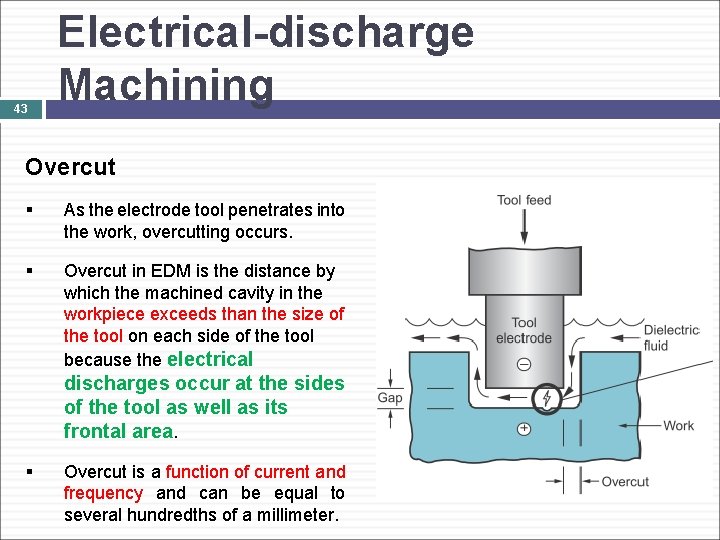
43 Electrical-discharge Machining Overcut § As the electrode tool penetrates into the work, overcutting occurs. § Overcut in EDM is the distance by which the machined cavity in the workpiece exceeds than the size of the tool on each side of the tool because the electrical discharges occur at the sides of the tool as well as its frontal area. § Overcut is a function of current and frequency and can be equal to several hundredths of a millimeter.
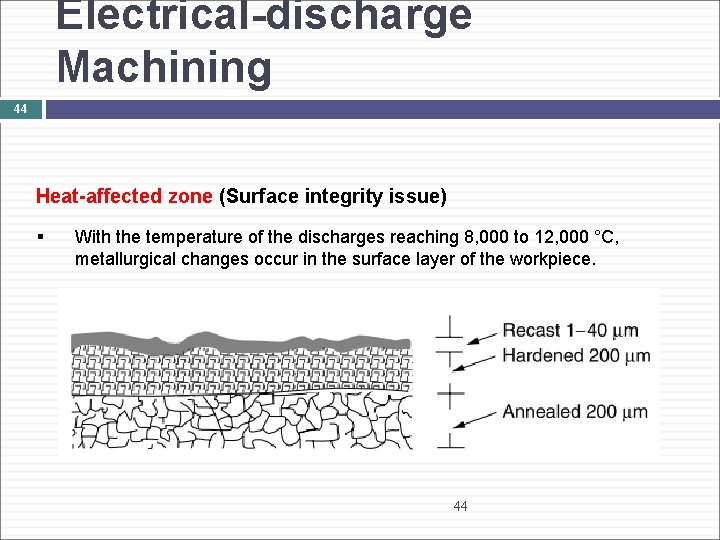
Electrical-discharge Machining 44 Heat-affected zone (Surface integrity issue) § With the temperature of the discharges reaching 8, 000 to 12, 000 °C, metallurgical changes occur in the surface layer of the workpiece. 44
Electrical-discharge Machining 45 Dielectric Fluids The functions of the dielectric fluid are to: 1. Act as an insulator until the potential is sufficiently high 2. Provide a cooling medium 3. Act as a flushing medium and carry away the debris in the gap Electrodes are made of graphite, brass, copper or copper–tungsten alloys Copyright © 2010 Pearson Education South Asia Pte Ltd
Electrical-discharge Machining 46 Electrodes Can be made (shaped) by forming, casting, powder metallurgy, or CNC machining techniques Wear ratio* is defined as the ratio of the volume of workpiece material removed to the volume of tool wear Tool wear is related to the melting points of the materials involved The lower the melting point of the electrode, the higher is the wear rate Tool wear can be minimized by reversing the polarity and using copper tools Copyright © 2010 Pearson Education South Asia Pte Ltd
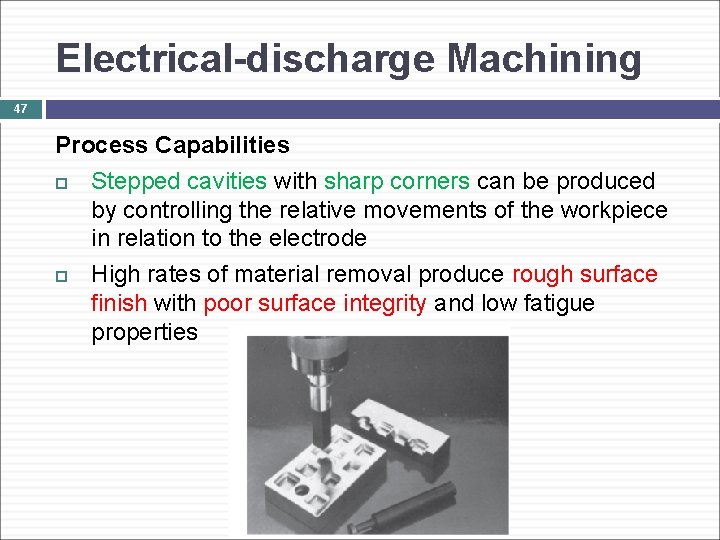
Electrical-discharge Machining 47 Process Capabilities Stepped cavities with sharp corners can be produced by controlling the relative movements of the workpiece in relation to the electrode High rates of material removal produce rough surface finish with poor surface integrity and low fatigue properties
Electrical-discharge Machining 48 Design Considerations for EDM General design guidelines: 1. Parts should be designed so that the required electrodes can be shaped properly and economically 2. Deep slots and narrow openings should be avoided 3. The surface finish specified should not be too fine. 4. Bulk of material removal should be done by conventional processes Copyright © 2010 Pearson Education South Asia Pte Ltd
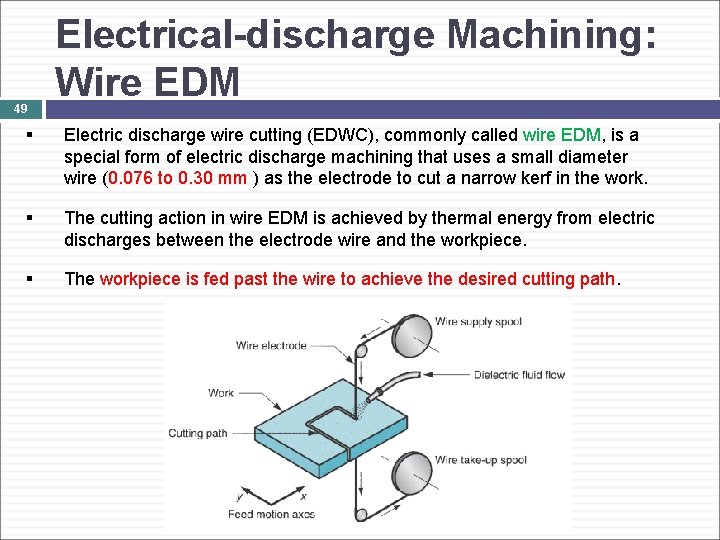
49 Electrical-discharge Machining: Wire EDM § Electric discharge wire cutting (EDWC), commonly called wire EDM, is a special form of electric discharge machining that uses a small diameter wire (0. 076 to 0. 30 mm ) as the electrode to cut a narrow kerf in the work. § The cutting action in wire EDM is achieved by thermal energy from electric discharges between the electrode wire and the workpiece. § The workpiece is fed past the wire to achieve the desired cutting path. 49
Electrical-discharge Machining 50 Advantages: The main advantages of EDM are: § By this process, materials of any hardness can be machined § One of the main advantages of this process is that thin and fragile components can be machined without distortion § Complex internal shapes can be machined § No burrs are left in machined surface 50
Electrical-discharge Machining 51 Disadvantages: The main limitations of this process are: § This process can only be employed in electrically conductive materials § Material removal rate is low compared to conventional machining processes § Unwanted erosion and overcut of material can occur § Rough surface finish when at high rates of material removal § Lead time is needed to produce specific, consumable electrode shapes 51
Electrical-discharge Machining 52 Disadvantages: § The chance of flash fire in the dielectric fluid if the level falls too low. § Smoke can be irritating to the eyes and lungs and but can be controlled with exhaust and smoke-eating devices 52
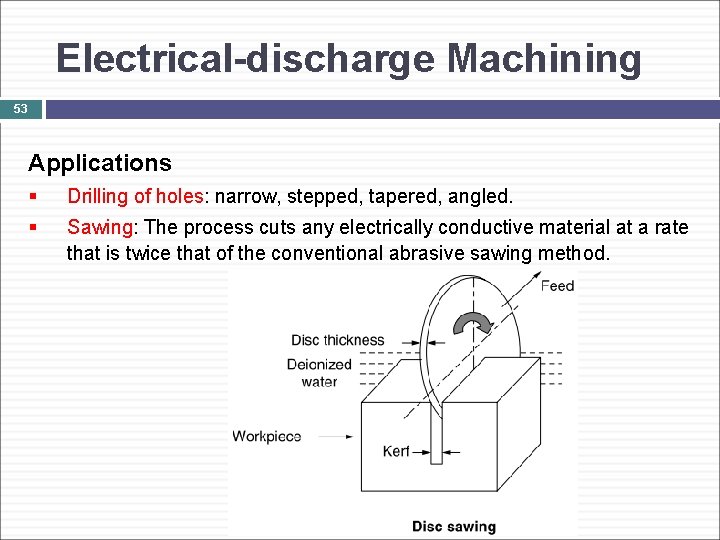
Electrical-discharge Machining 53 Applications § Drilling of holes: narrow, stepped, tapered, angled. § Sawing: The process cuts any electrically conductive material at a rate that is twice that of the conventional abrasive sawing method. 53
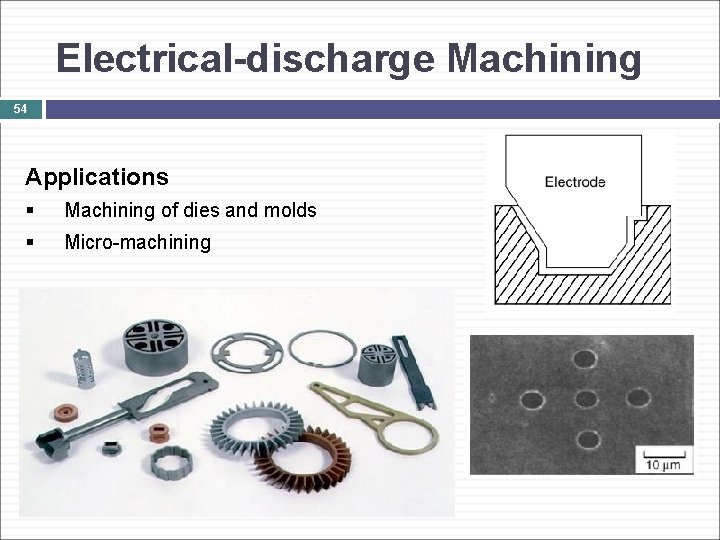
Electrical-discharge Machining 54 Applications § Machining of dies and molds § Micro-machining
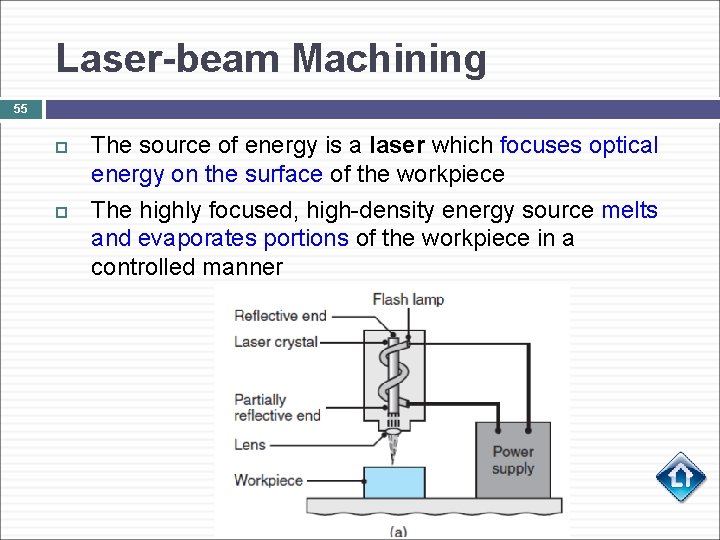
Laser-beam Machining 55 The source of energy is a laser which focuses optical energy on the surface of the workpiece The highly focused, high-density energy source melts and evaporates portions of the workpiece in a controlled manner
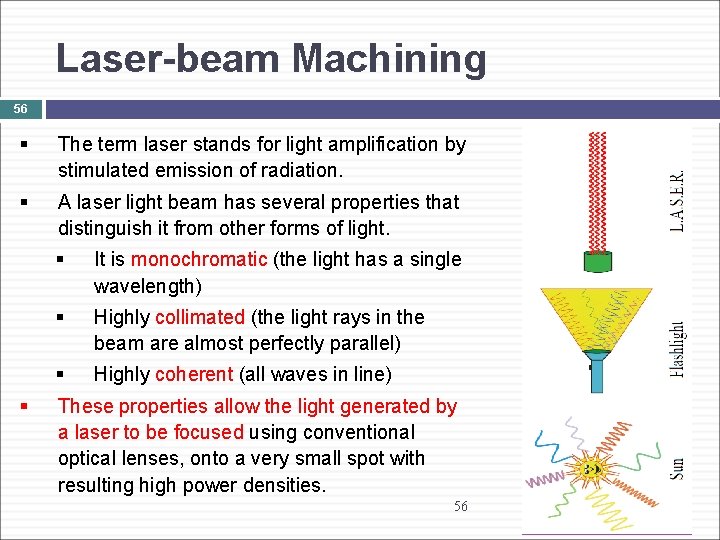
Laser-beam Machining 56 § The term laser stands for light amplification by stimulated emission of radiation. § A laser light beam has several properties that distinguish it from other forms of light. § § It is monochromatic (the light has a single wavelength) § Highly collimated (the light rays in the beam are almost perfectly parallel) § Highly coherent (all waves in line) These properties allow the light generated by a laser to be focused using conventional optical lenses, onto a very small spot with resulting high power densities. 56
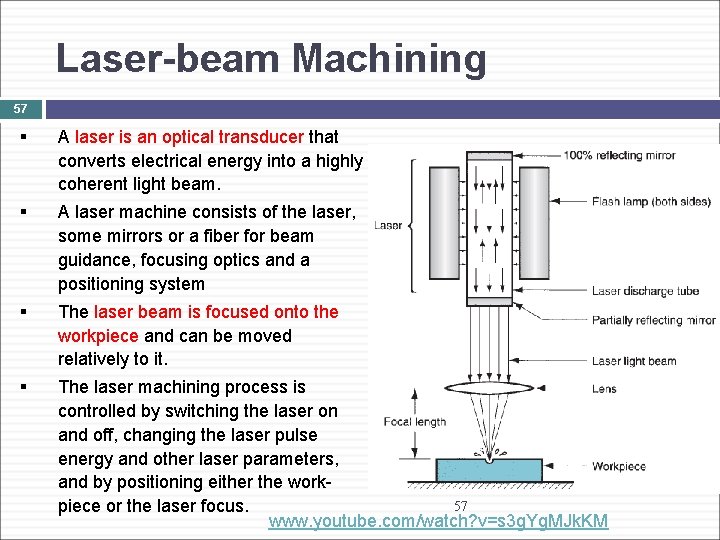
Laser-beam Machining 57 § A laser is an optical transducer that converts electrical energy into a highly coherent light beam. § A laser machine consists of the laser, some mirrors or a fiber for beam guidance, focusing optics and a positioning system § The laser beam is focused onto the workpiece and can be moved relatively to it. § The laser machining process is controlled by switching the laser on and off, changing the laser pulse energy and other laser parameters, and by positioning either the work 57 piece or the laser focus. www. youtube. com/watch? v=s 3 g. Yg. MJk. KM
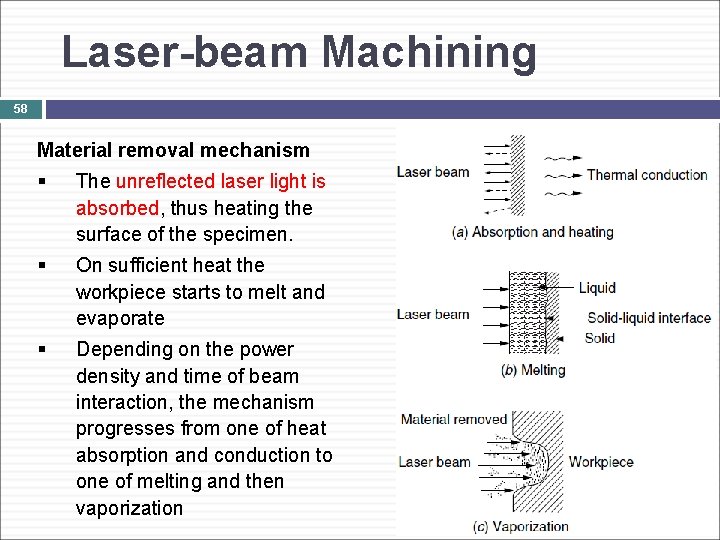
Laser-beam Machining 58 Material removal mechanism § The unreflected laser light is absorbed, thus heating the surface of the specimen. § On sufficient heat the workpiece starts to melt and evaporate § Depending on the power density and time of beam interaction, the mechanism progresses from one of heat absorption and conduction to one of melting and then vaporization
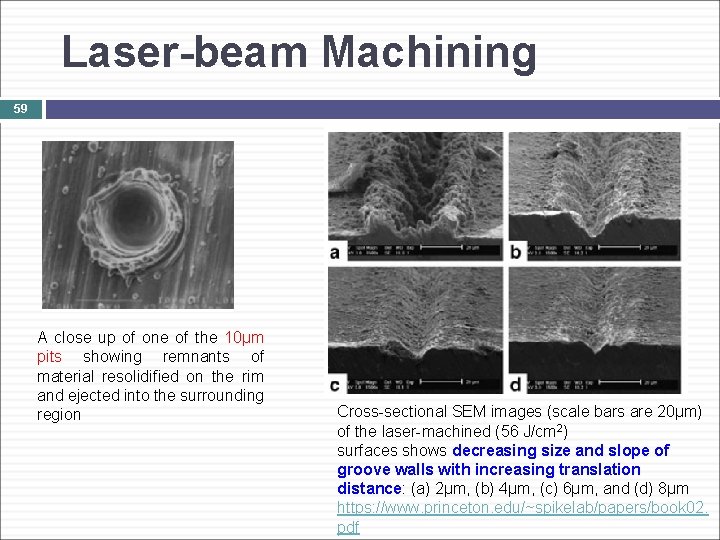
Laser-beam Machining 59 A close up of one of the 10µm pits showing remnants of material resolidified on the rim and ejected into the surrounding region Cross-sectional SEM images (scale bars are 20µm) of the laser-machined (56 J/cm 2) surfaces shows decreasing size and slope of groove walls with increasing translation distance: (a) 2µm, (b) 4µm, (c) 6µm, and (d) 8µm https: //www. princeton. edu/~spikelab/papers/book 02. pdf
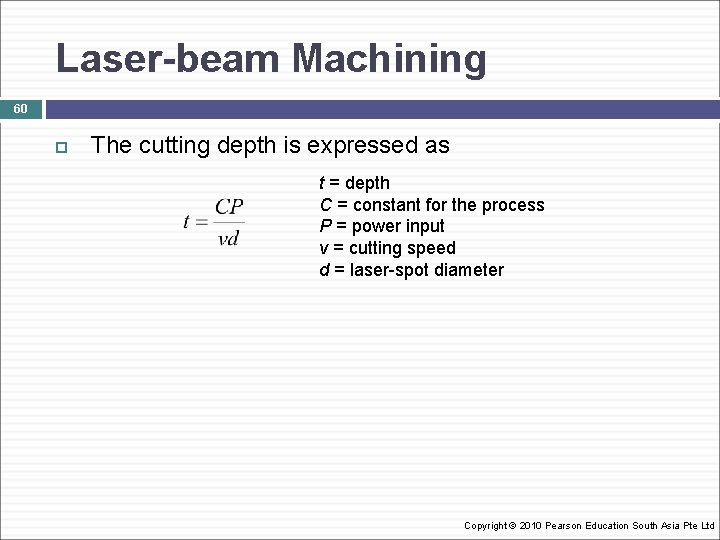
Laser-beam Machining 60 The cutting depth is expressed as t = depth C = constant for the process P = power input v = cutting speed d = laser-spot diameter Copyright © 2010 Pearson Education South Asia Pte Ltd
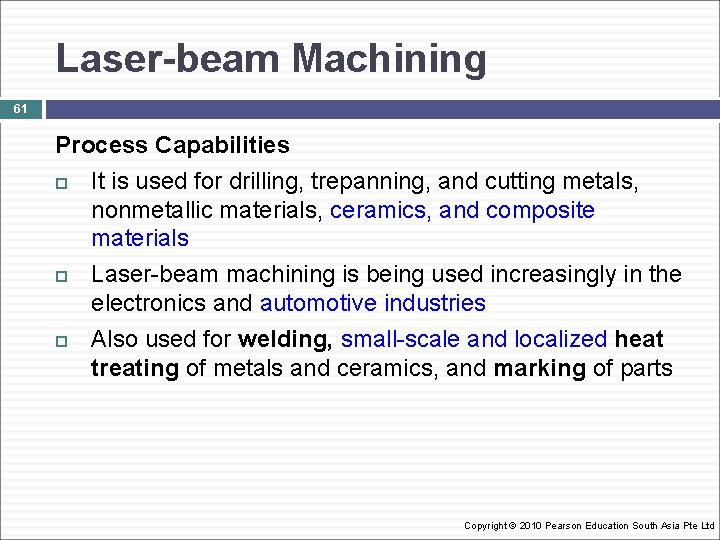
Laser-beam Machining 61 Process Capabilities It is used for drilling, trepanning, and cutting metals, nonmetallic materials, ceramics, and composite materials Laser-beam machining is being used increasingly in the electronics and automotive industries Also used for welding, small-scale and localized heat treating of metals and ceramics, and marking of parts Copyright © 2010 Pearson Education South Asia Pte Ltd
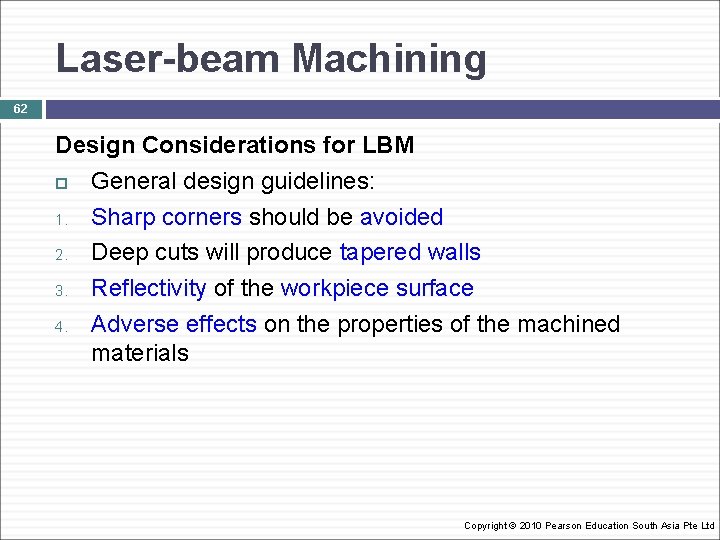
Laser-beam Machining 62 Design Considerations for LBM General design guidelines: 1. Sharp corners should be avoided 2. Deep cuts will produce tapered walls 3. Reflectivity of the workpiece surface 4. Adverse effects on the properties of the machined materials Copyright © 2010 Pearson Education South Asia Pte Ltd
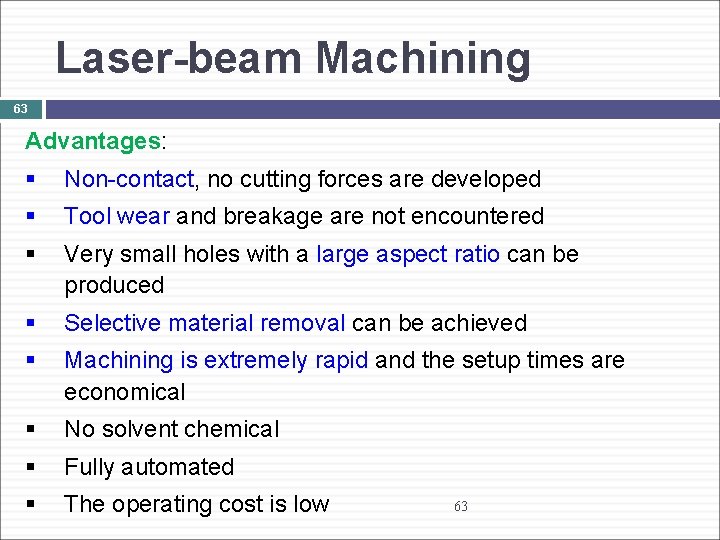
Laser-beam Machining 63 Advantages: § Non-contact, no cutting forces are developed § Tool wear and breakage are not encountered § Very small holes with a large aspect ratio can be produced § Selective material removal can be achieved § Machining is extremely rapid and the setup times are economical § No solvent chemical § Fully automated § The operating cost is low 63
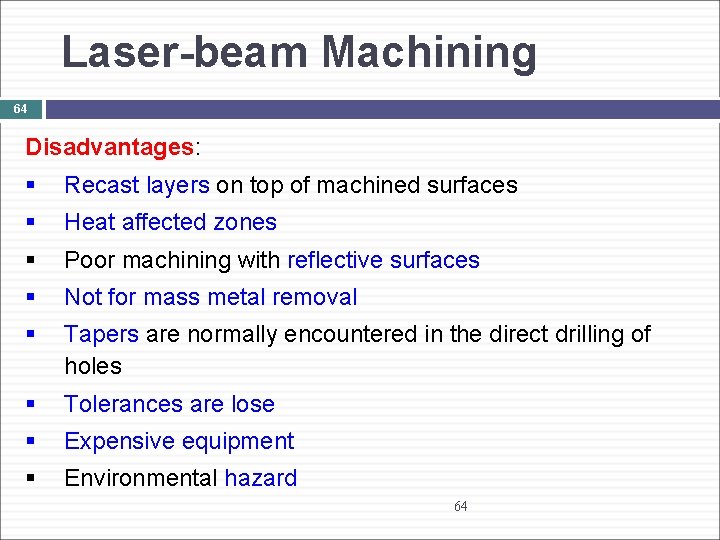
Laser-beam Machining 64 Disadvantages: § Recast layers on top of machined surfaces § Heat affected zones § Poor machining with reflective surfaces § Not for mass metal removal § Tapers are normally encountered in the direct drilling of holes § Tolerances are lose § Expensive equipment § Environmental hazard 64
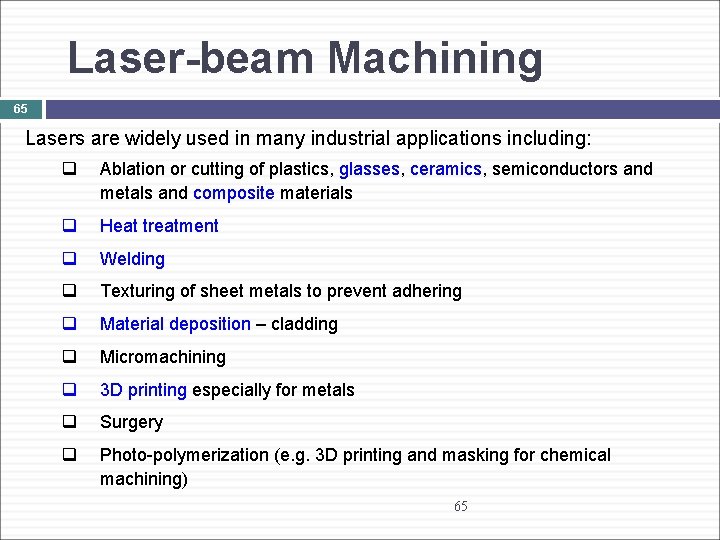
Laser-beam Machining 65 Lasers are widely used in many industrial applications including: q Ablation or cutting of plastics, glasses, ceramics, semiconductors and metals and composite materials q Heat treatment q Welding q Texturing of sheet metals to prevent adhering q Material deposition – cladding q Micromachining q 3 D printing especially for metals q Surgery q Photo-polymerization (e. g. 3 D printing and masking for chemical machining) 65
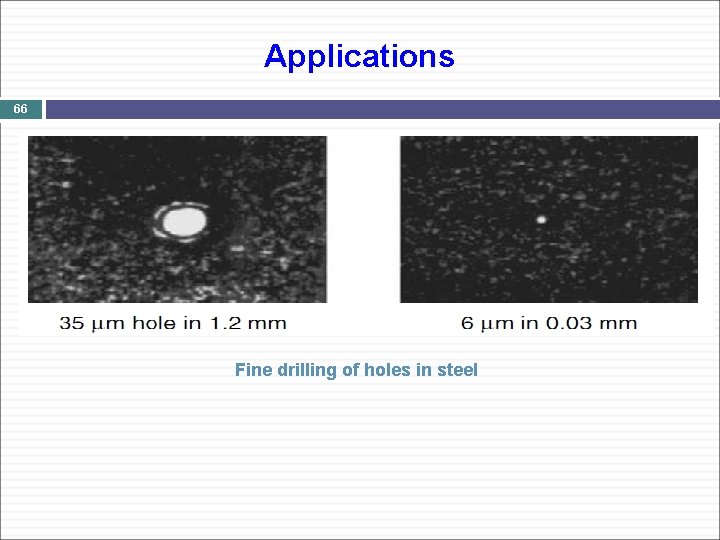
Applications 66 Fine drilling of holes in steel
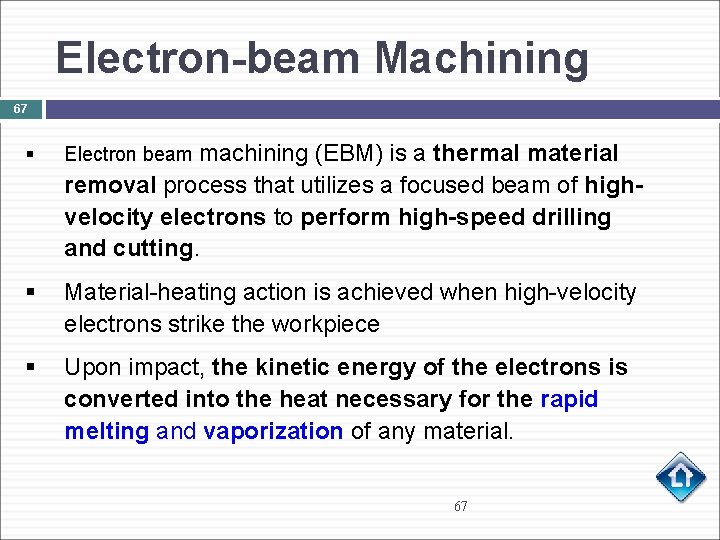
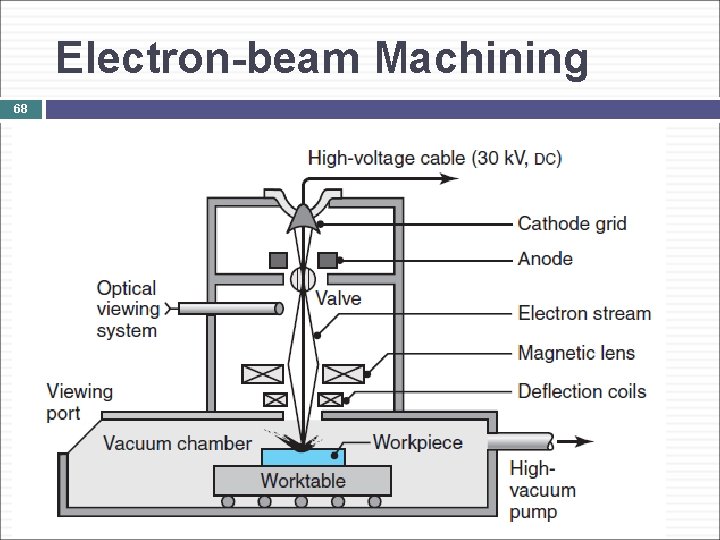
Electron-beam Machining 67 § Electron beam machining (EBM) is a thermal material removal process that utilizes a focused beam of highvelocity electrons to perform high-speed drilling and cutting. § Material-heating action is achieved when high-velocity electrons strike the workpiece § Upon impact, the kinetic energy of the electrons is converted into the heat necessary for the rapid melting and vaporization of any material. 67
Electron-beam Machining 68 68
Electron-beam Machining 69 Generally used for very accurate cutting of a wide variety of metals Surface finish is better and kerf width is narrower than in othermal cutting processes e. g. better than Laser machining. Copyright © 2010 Pearson Education South Asia Pte Ltd
Electron-beam Machining 70 Design Considerations for EBM Guidelines for EBM: 1. Individual parts or batches should closely match the size of the vacuum chamber for a high production rate per cycle 2. Manufacture in small batches Copyright © 2010 Pearson Education South Asia Pte Ltd
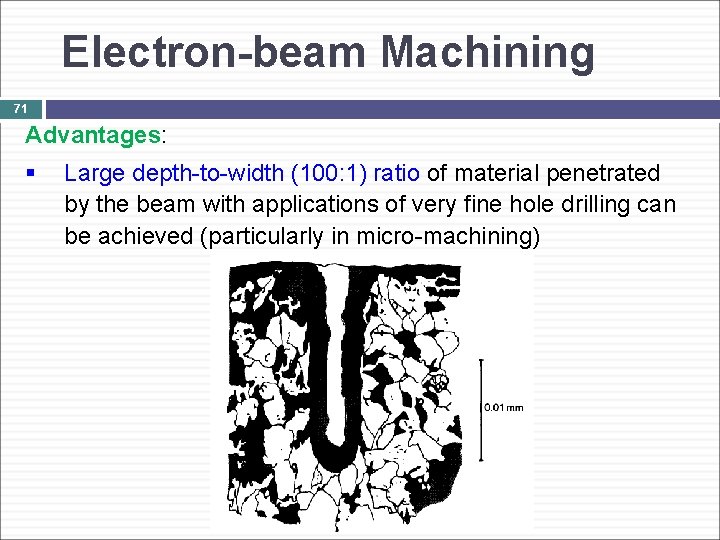
Electron-beam Machining 71 Advantages: § Large depth-to-width (100: 1) ratio of material penetrated by the beam with applications of very fine hole drilling can be achieved (particularly in micro-machining) 71
Electron-beam Machining 72 Advantages (contd. ): § There is no mechanical contact between tool and workpiece; hence no tool wear and cutting forces § 104 to 105 holes per second can be produced in thin sheets (µs pulses needed); e. g. 620 holes per square millimeter for filter application at a rate of one hole every 10 μs § No limitation is imposed by workpiece hardness, ductility, and surface reflectivity
Electron-beam Machining 73 Disadvantages: § Environmental hazard: the interaction of the electron beam with the workpiece produces hazardous x-rays § EBM is best suited for small parts only due to the restriction of vacuum § Rate of material removal is low § Cost of equipment is high § Need for auxiliary backing material
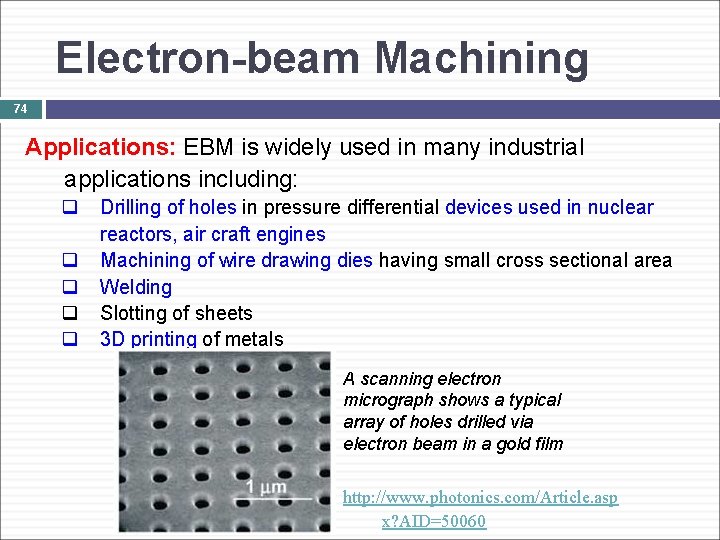
Electron-beam Machining 74 Applications: EBM is widely used in many industrial applications including: q q q Drilling of holes in pressure differential devices used in nuclear reactors, air craft engines Machining of wire drawing dies having small cross sectional area Welding Slotting of sheets 3 D printing of metals A scanning electron micrograph shows a typical array of holes drilled via electron beam in a gold film http: //www. photonics. com/Article. asp x? AID=50060
Electron-beam Machining: Plasma machining 75 § A plasma is defined as a superheated, electrically ionized gas § A plasma is generated by subjecting a flow of the gas to the electron bombardment of an electric arc. § Plasma beam machining (PBM) or plasma arc cutting (PAC) uses a plasma stream operating at temperatures in the range 10, 000 to 14, 000 o. C to cut metal by melting § Plasma cutting is a process that is used to cut ferrous (stainless steel, cast iron, etc. ) and non-ferrous metal (aluminum, copper, tool steel, die steel, lead, nickel, tin, titanium and zinc, and alloys such as brass, etc. ) § Can be used to machine non-conductive materials as well 75
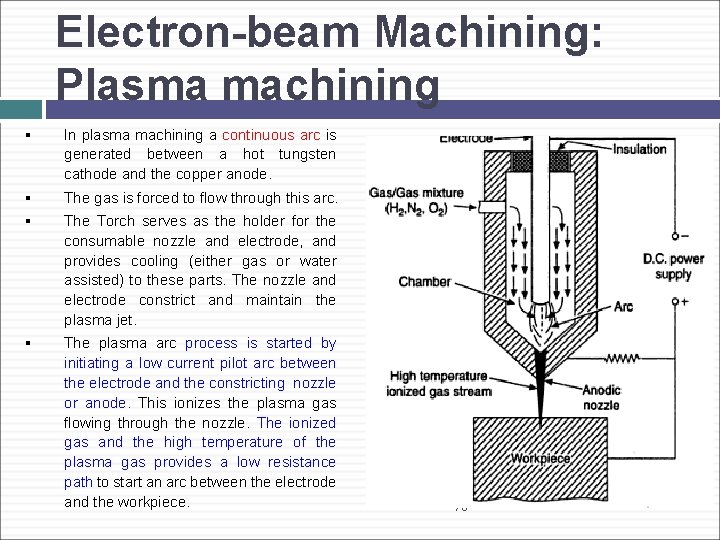
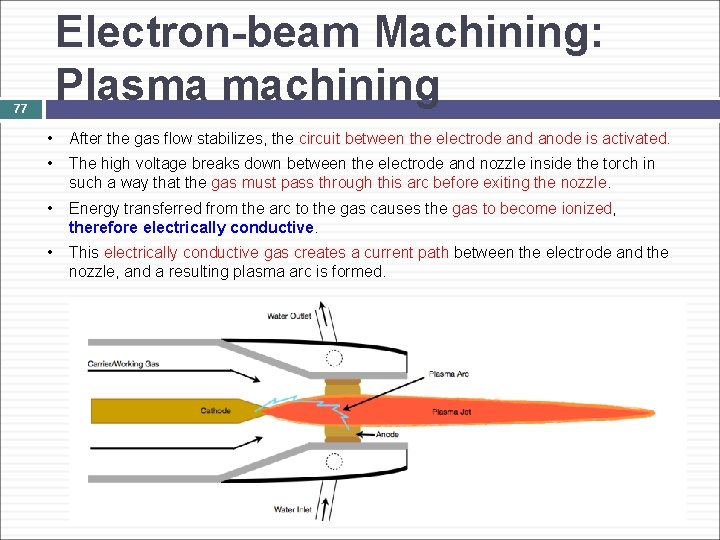
Electron-beam Machining: Plasma machining § In plasma machining a continuous arc is generated between a hot tungsten cathode and the copper anode. § The gas is forced to flow through this arc. § The Torch serves as the holder for the consumable nozzle and electrode, and provides cooling (either gas or water assisted) to these parts. The nozzle and electrode constrict and maintain the plasma jet. § The plasma arc process is started by initiating a low current pilot arc between the electrode and the constricting nozzle or anode. This ionizes the plasma gas flowing through the nozzle. The ionized gas and the high temperature of the plasma gas provides a low resistance path to start an arc between the electrode and the workpiece. 76
Electron-beam Machining: Plasma machining 77 • After the gas flow stabilizes, the circuit between the electrode and anode is activated. • The high voltage breaks down between the electrode and nozzle inside the torch in such a way that the gas must pass through this arc before exiting the nozzle. • Energy transferred from the arc to the gas causes the gas to become ionized, therefore electrically conductive. • This electrically conductive gas creates a current path between the electrode and the nozzle, and a resulting plasma arc is formed.
78 Electron-beam Machining: Plasma machining • The temperature of the plasma arc melts the metal, pierces through the workpiece. • The high velocity gas flow removes the molten material from the bottom of the cut kerf. • At this time, torch motion is initiated and the cutting process begins. 78
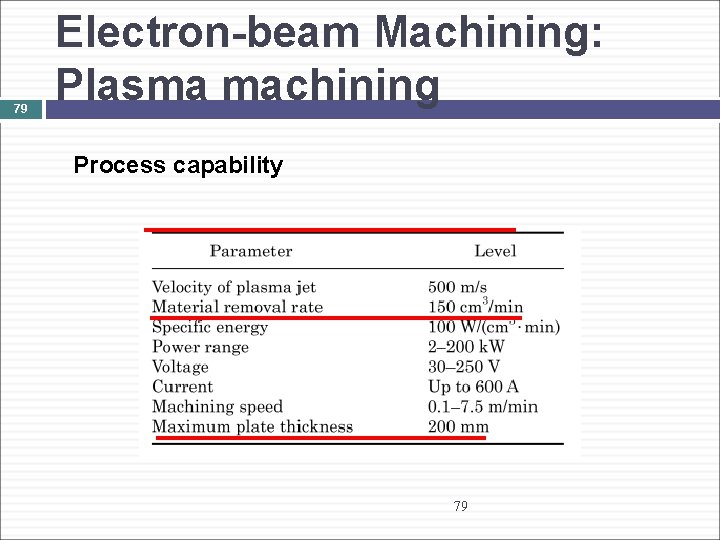
79 Electron-beam Machining: Plasma machining Process capability 79
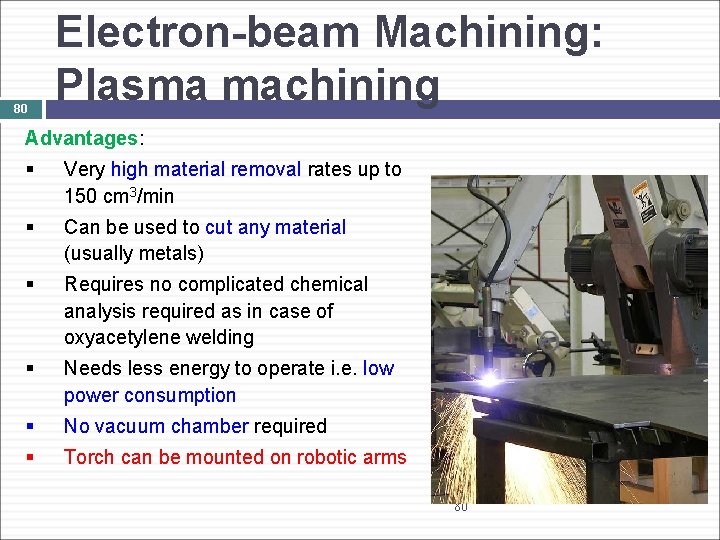
80 Electron-beam Machining: Plasma machining Advantages: § Very high material removal rates up to 150 cm 3/min § Can be used to cut any material (usually metals) § Requires no complicated chemical analysis required as in case of oxyacetylene welding § Needs less energy to operate i. e. low power consumption § No vacuum chamber required § Torch can be mounted on robotic arms 80
Electron-beam Machining: Plasma machining 81 Disadvantages: § Severe heat affected zones § Thick recrystallized (recast layer) top machined surface and microstructure changes § Toxic fumes are produced § Need to frequently replace the nozzle surrounding the electrode § More chances of electrical hazards are associated with this process (especially in hand operated plasma) § Unpleasant, disturbing and damaging noise 81
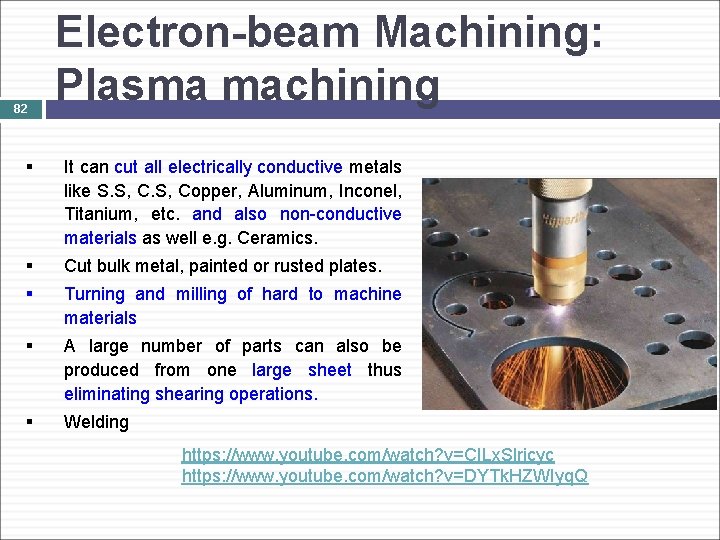
82 Electron-beam Machining: Plasma machining § It can cut all electrically conductive metals like S. S, Copper, Aluminum, Inconel, Titanium, etc. and also non-conductive materials as well e. g. Ceramics. § Cut bulk metal, painted or rusted plates. § Turning and milling of hard to machine materials § A large number of parts can also be produced from one large sheet thus eliminating shearing operations. § Welding https: //www. youtube. com/watch? v=CILx. Slricyc https: //www. youtube. com/watch? v=DYTk. HZWIyq. Q
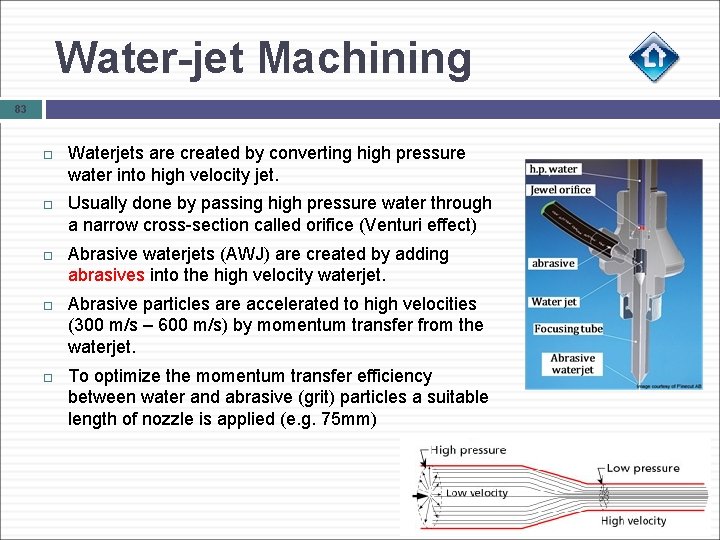
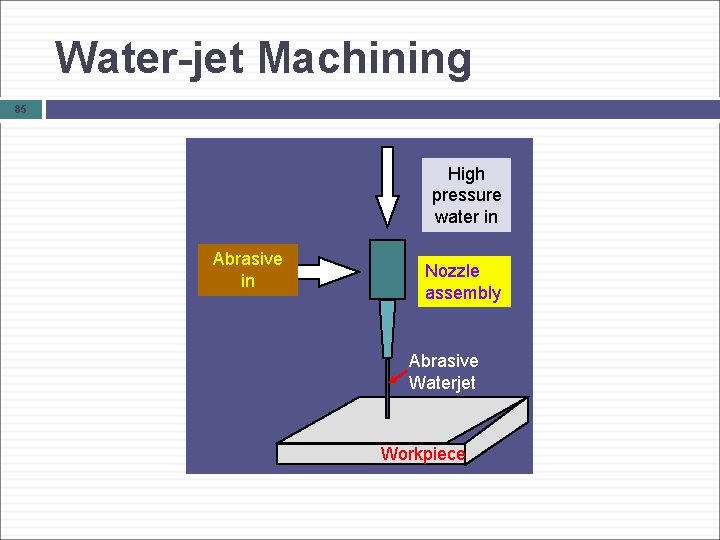
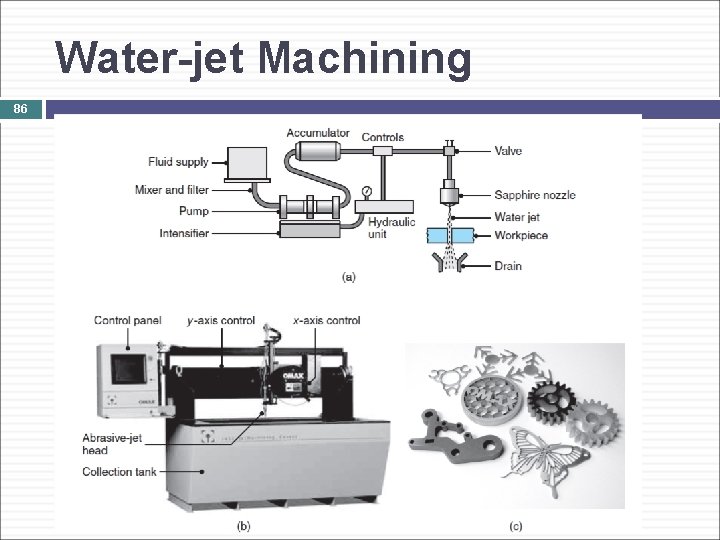
Water-jet Machining 83 Waterjets are created by converting high pressure water into high velocity jet. Usually done by passing high pressure water through a narrow cross-section called orifice (Venturi effect) Abrasive waterjets (AWJ) are created by adding abrasives into the high velocity waterjet. Abrasive particles are accelerated to high velocities (300 m/s – 600 m/s) by momentum transfer from the waterjet. To optimize the momentum transfer efficiency between water and abrasive (grit) particles a suitable length of nozzle is applied (e. g. 75 mm)
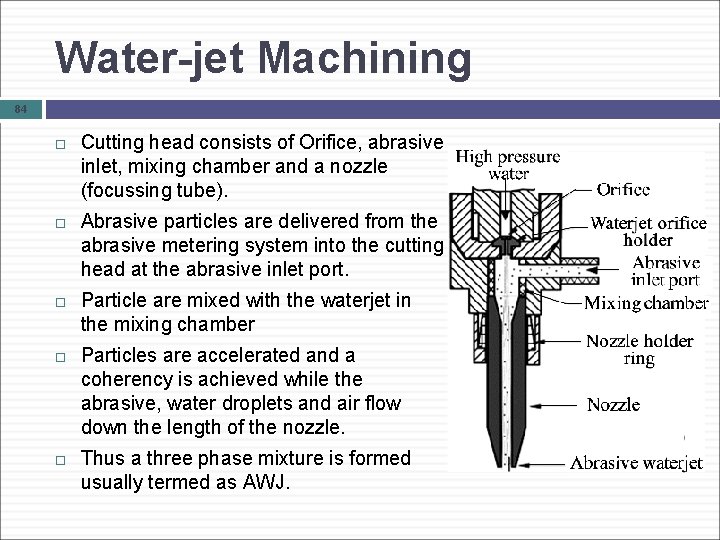
Water-jet Machining 84 Cutting head consists of Orifice, abrasive inlet, mixing chamber and a nozzle (focussing tube). Abrasive particles are delivered from the abrasive metering system into the cutting head at the abrasive inlet port. Particle are mixed with the waterjet in the mixing chamber Particles are accelerated and a coherency is achieved while the abrasive, water droplets and air flow down the length of the nozzle. Thus a three phase mixture is formed usually termed as AWJ.
Water-jet Machining 85 High pressure water in Abrasive in Nozzle assembly Abrasive Waterjet Workpiece
Water-jet Machining 86
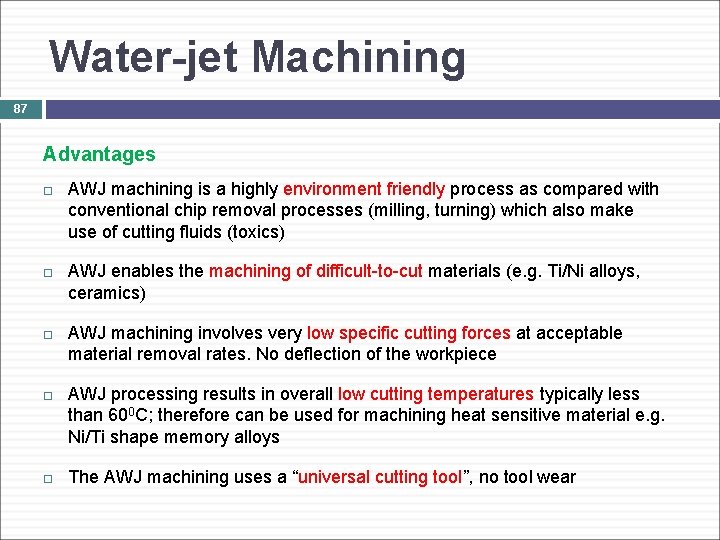
Water-jet Machining 87 Advantages AWJ machining is a highly environment friendly process as compared with conventional chip removal processes (milling, turning) which also make use of cutting fluids (toxics) AWJ enables the machining of difficult-to-cut materials (e. g. Ti/Ni alloys, ceramics) AWJ machining involves very low specific cutting forces at acceptable material removal rates. No deflection of the workpiece AWJ processing results in overall low cutting temperatures typically less than 600 C; therefore can be used for machining heat sensitive material e. g. Ni/Ti shape memory alloys The AWJ machining uses a “universal cutting tool”, no tool wear
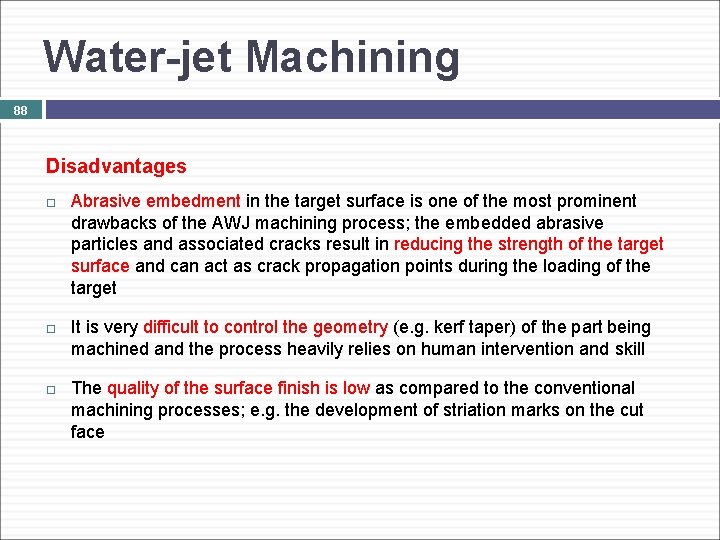
Water-jet Machining 88 Disadvantages Abrasive embedment in the target surface is one of the most prominent drawbacks of the AWJ machining process; the embedded abrasive particles and associated cracks result in reducing the strength of the target surface and can act as crack propagation points during the loading of the target It is very difficult to control the geometry (e. g. kerf taper) of the part being machined and the process heavily relies on human intervention and skill The quality of the surface finish is low as compared to the conventional machining processes; e. g. the development of striation marks on the cut face
Water-jet Machining 89 Applications Ti/Ni alloys for aerospace applications (e. g. casings) Biologic (bones) compatible materials (Ni. Ti) for medical applications (e. g. implants) Engineered ceramics (Si. C, Al 2 O 3) for parts with chemical inertness and/or high wear resistance. Ultra-hard materials (e. g. diamond) for tooling fabrication Engineering composites for aerospace, automotive applications Turning and dressing of grinding wheels Coating removal in aerospace and nuclear industries Machining of large and/or complex shape parts by mounting the cutting head on a robotic arm
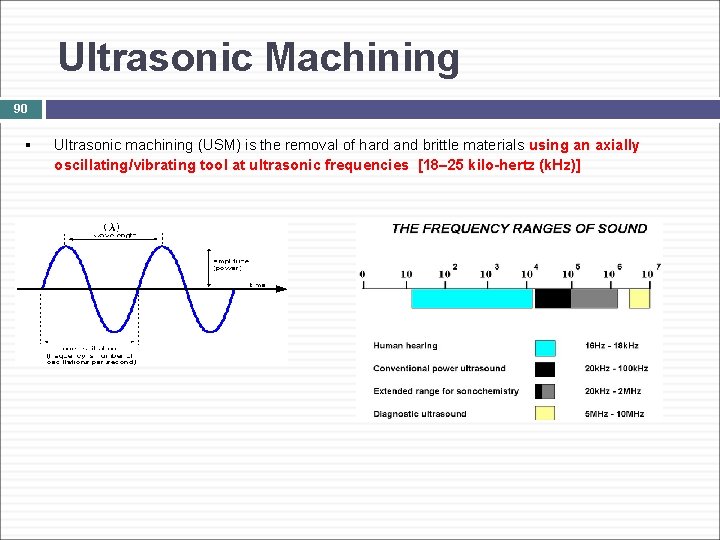
Ultrasonic Machining 90 § Ultrasonic machining (USM) is the removal of hard and brittle materials using an axially oscillating/vibrating tool at ultrasonic frequencies [18– 25 kilo-hertz (k. Hz)]
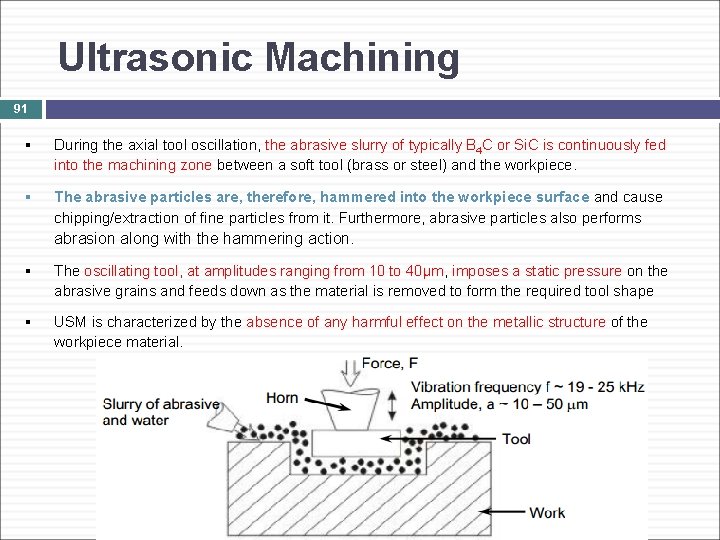
Ultrasonic Machining 91 § During the axial tool oscillation, the abrasive slurry of typically B 4 C or Si. C is continuously fed into the machining zone between a soft tool (brass or steel) and the workpiece. § The abrasive particles are, therefore, hammered into the workpiece surface and cause chipping/extraction of fine particles from it. Furthermore, abrasive particles also performs abrasion along with the hammering action. § The oscillating tool, at amplitudes ranging from 10 to 40µm, imposes a static pressure on the abrasive grains and feeds down as the material is removed to form the required tool shape § USM is characterized by the absence of any harmful effect on the metallic structure of the workpiece material.
Ultrasonic Machining 92 Tools § Tool tips must have high wear resistance and fatigue strength. § For machining glass and tungsten carbide, copper and chromium silver steel tools are recommended. Silver and chromium nickel steel are used for machining sintered carbides. § Since impact is the basic phenomenon responsible for machining in USM, therefore, the tool material employed is always more soft/tough as compared to the workpiece material being cut.
Ultrasonic Machining 93 Abrasive slurry § Abrasive slurry is usually composed of 50 percent (by volume) fine abrasive grains (100– 800 grit number) of boron carbide (B 4 C), aluminum oxide (Al 2 O 3 ), or silicon carbide (Si. C) in 50 percent water. The abrasive slurry is circulated between the oscillating tool and workpiece. § Under the effect of the ultrasonic vibration, the abrasive particles are hammered into the workpiece surface causing mechanical chipping of minute particles.
Ultrasonic Machining 94 Limitations § Low MRR § High tool wear § Low depth of hole 94
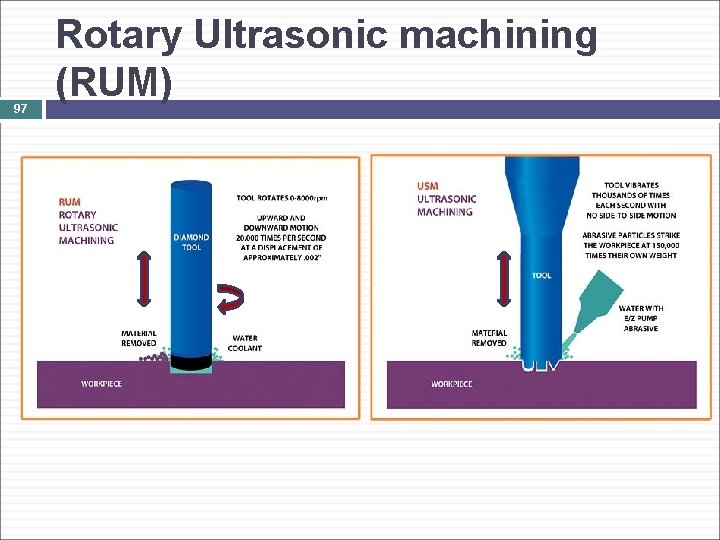
95 Rotary Ultrasonic machining (RUM) Process principle and working RUM is a mechanical material removal process used to machine hard or brittle materials by combining the ultrasonic impacts (hammering, extraction, abrasion) and the grinding action of the diamond abrasives bonded on the tool. The key difference between USM and RUM is that in RUM the tool also rotates and the tool has metal bonded diamond abrasive particles.
96 Rotary Ultrasonic machining (RUM)
97 Rotary Ultrasonic machining (RUM)
98 Rotary Ultrasonic machining (RUM) RUM VS USM § High depths of cuts and aspect-ratios can be achieved in RUM as compared to USM § Lower tool wear rate in RUM as compared to USM § Very high dimensional accuracy in RUM as compared to USM 98