
1 LES of Turbulent Flows Lecture 2 ME
1 LES of Turbulent Flows: Lecture 2 (ME EN 7960 -003) Prof. Rob Stoll Department of Mechanical Engineering University of Utah Fall 2014
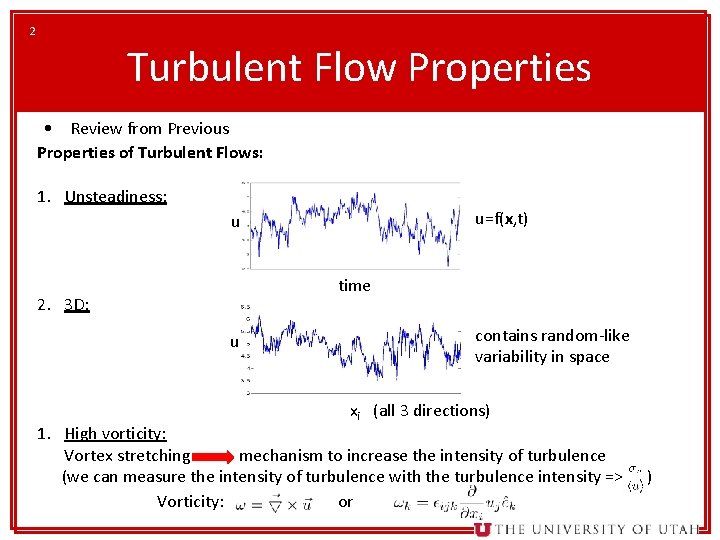
2 Turbulent Flow Properties • Review from Previous Properties of Turbulent Flows: 1. Unsteadiness: u=f(x, t) u time 2. 3 D: u contains random-like variability in space xi (all 3 directions) 1. High vorticity: Vortex stretching mechanism to increase the intensity of turbulence (we can measure the intensity of turbulence with the turbulence intensity => Vorticity: or )
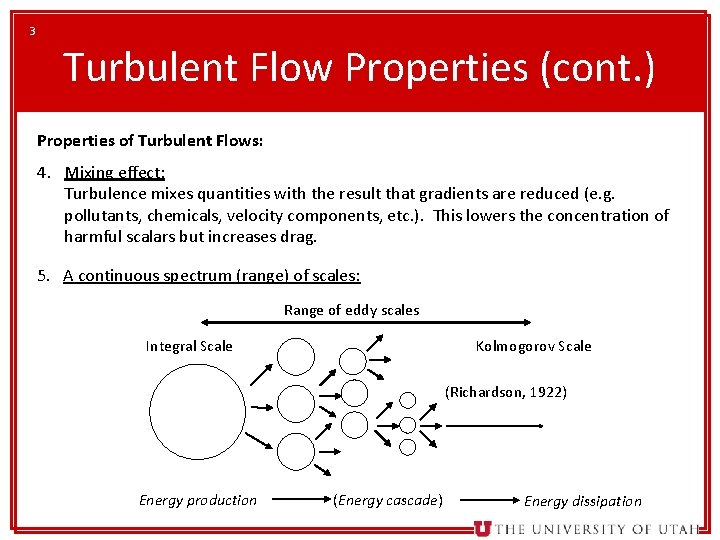
3 Turbulent Flow Properties (cont. ) Properties of Turbulent Flows: 4. Mixing effect: Turbulence mixes quantities with the result that gradients are reduced (e. g. pollutants, chemicals, velocity components, etc. ). This lowers the concentration of harmful scalars but increases drag. 5. A continuous spectrum (range) of scales: Range of eddy scales Kolmogorov Scale Integral Scale (Richardson, 1922) Energy production (Energy cascade) Energy dissipation

4 Turbulence Scales • The largest scale is referred to as the Integral scale (lo). It is on the order of the autocorrelation length. • In a boundary layer, the integral scale is comparable to the boundary layer height. Range of eddy scales lo (~ 1 Km in ABL) η (~ 1 mm in ABL) Integral scale Kolmogorov micro scale (viscous length scale) Energy cascad e (tran contin uous r Energy production (due to shear) sfer) la r ange o f ge=>sm scale all Energy dissipation (due to viscosity)
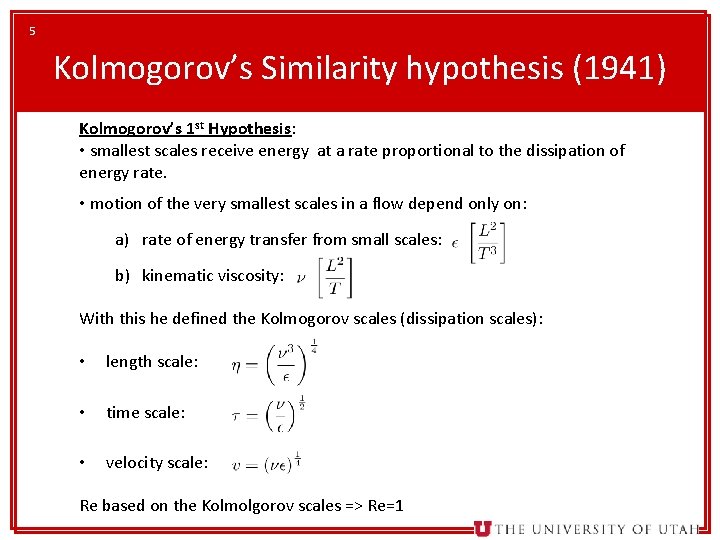
5 Kolmogorov’s Similarity hypothesis (1941) Kolmogorov’s 1 st Hypothesis: • smallest scales receive energy at a rate proportional to the dissipation of energy rate. • motion of the very smallest scales in a flow depend only on: a) rate of energy transfer from small scales: b) kinematic viscosity: With this he defined the Kolmogorov scales (dissipation scales): • length scale: • time scale: • velocity scale: Re based on the Kolmolgorov scales => Re=1
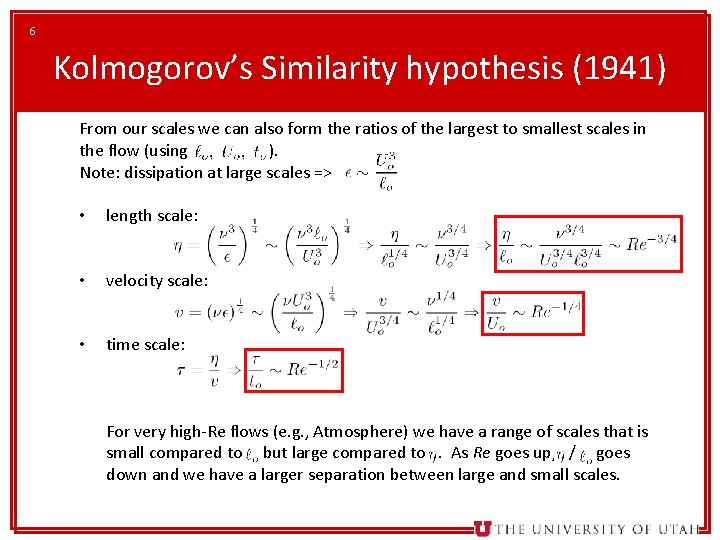
6 Kolmogorov’s Similarity hypothesis (1941) From our scales we can also form the ratios of the largest to smallest scales in the flow (using ). Note: dissipation at large scales => • length scale: • velocity scale: • time scale: For very high-Re flows (e. g. , Atmosphere) we have a range of scales that is small compared to but large compared to. As Re goes up, / goes down and we have a larger separation between large and small scales.
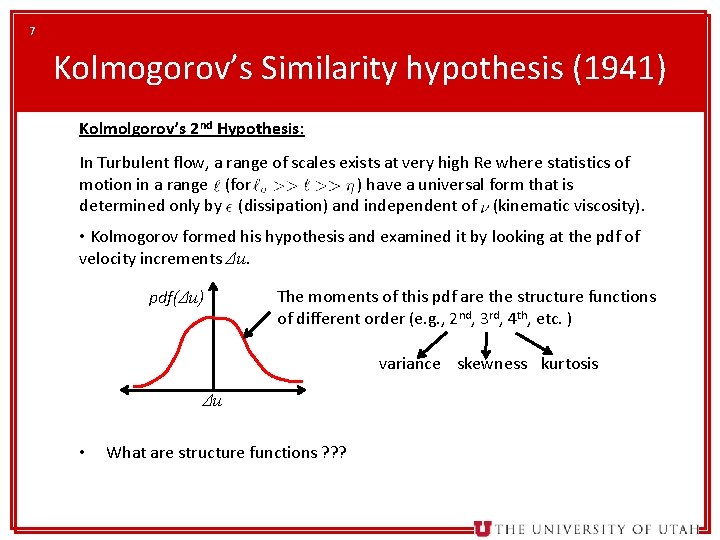
7 Kolmogorov’s Similarity hypothesis (1941) Kolmolgorov’s 2 nd Hypothesis: In Turbulent flow, a range of scales exists at very high Re where statistics of motion in a range (for ) have a universal form that is determined only by (dissipation) and independent of (kinematic viscosity). • Kolmogorov formed his hypothesis and examined it by looking at the pdf of velocity increments Δu. pdf(Δu) The moments of this pdf are the structure functions of different order (e. g. , 2 nd, 3 rd, 4 th, etc. ) variance skewness kurtosis Δu • What are structure functions ? ? ?
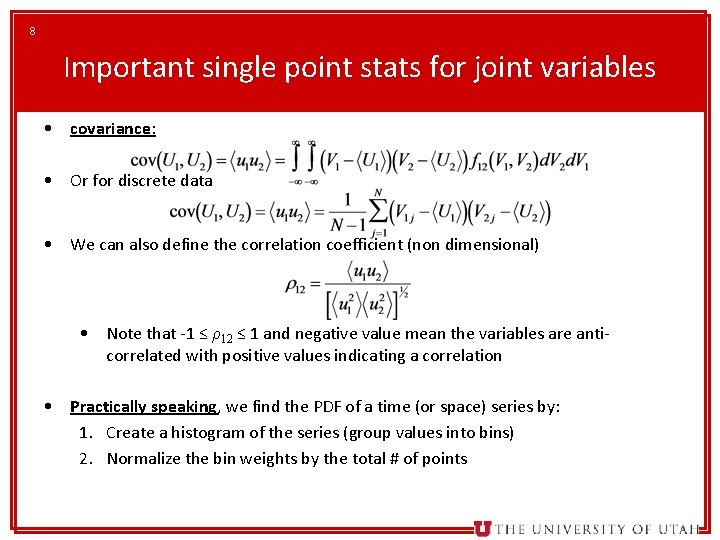
8 Important single point stats for joint variables • covariance: • Or for discrete data • We can also define the correlation coefficient (non dimensional) • Note that -1 ≤ ρ12 ≤ 1 and negative value mean the variables are anticorrelated with positive values indicating a correlation • Practically speaking, we find the PDF of a time (or space) series by: 1. Create a histogram of the series (group values into bins) 2. Normalize the bin weights by the total # of points
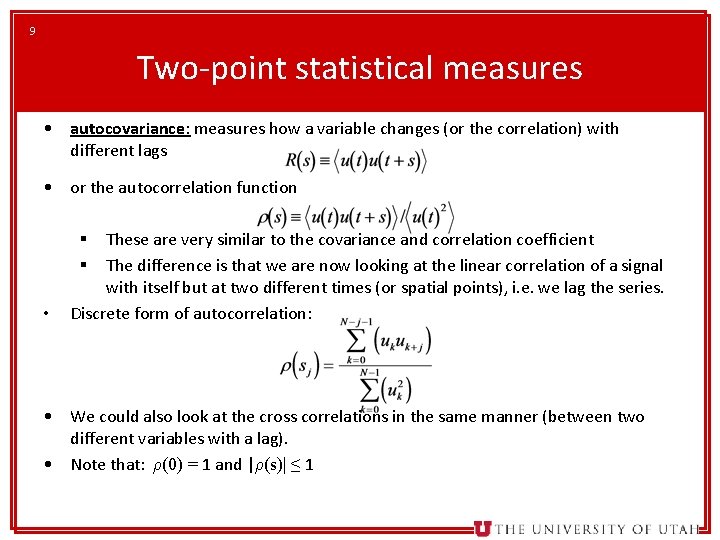
9 Two-point statistical measures • autocovariance: measures how a variable changes (or the correlation) with different lags • or the autocorrelation function These are very similar to the covariance and correlation coefficient The difference is that we are now looking at the linear correlation of a signal with itself but at two different times (or spatial points), i. e. we lag the series. Discrete form of autocorrelation: § § • • We could also look at the cross correlations in the same manner (between two different variables with a lag). • Note that: ρ(0) = 1 and |ρ(s)| ≤ 1
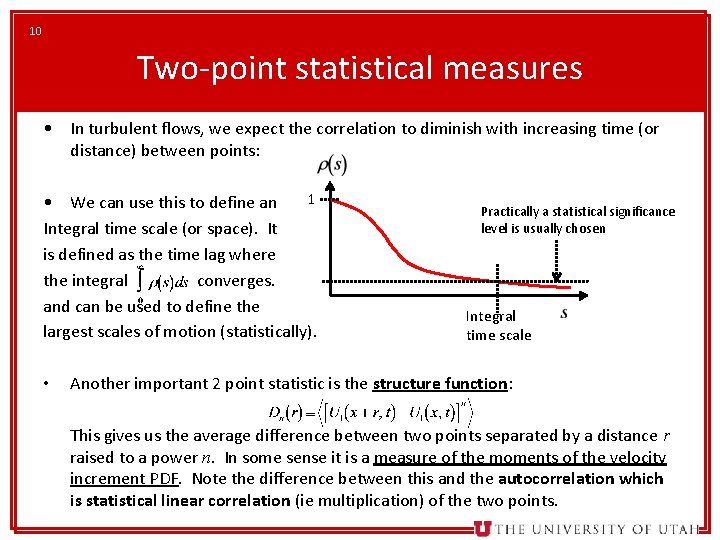
10 Two-point statistical measures • In turbulent flows, we expect the correlation to diminish with increasing time (or distance) between points: 1 • We can use this to define an Integral time scale (or space). It is defined as the time lag where the integral converges. and can be used to define the largest scales of motion (statistically). • Practically a statistical significance level is usually chosen Integral time scale Another important 2 point statistic is the structure function: This gives us the average difference between two points separated by a distance r raised to a power n. In some sense it is a measure of the moments of the velocity increment PDF. Note the difference between this and the autocorrelation which is statistical linear correlation (ie multiplication) of the two points.
11 Fourier Transforms Alternatively, we can also look at turbulence in wave (frequency) space: Fourier Transforms are a common tool in fluid dynamics (see Pope, Appendix D-G, Stull handouts online) Some uses: • Analysis of turbulent flow • Numerical simulations of N-S equations • Analysis of numerical schemes (modified wavenumbers) • consider a periodic function f(x) (could also be f(t)) on a domain of length 2π • The Fourier representation of this function (or a general signal) is: * - where k is the wavenumber (frequency if f(t)) - are the Fourier coefficients which in general are complex
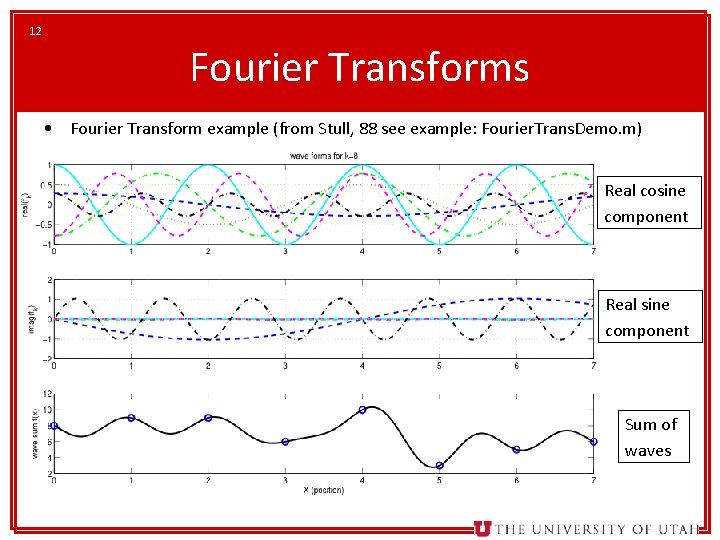
12 Fourier Transforms • Fourier Transform example (from Stull, 88 see example: Fourier. Trans. Demo. m) Real cosine component Real sine component Sum of waves
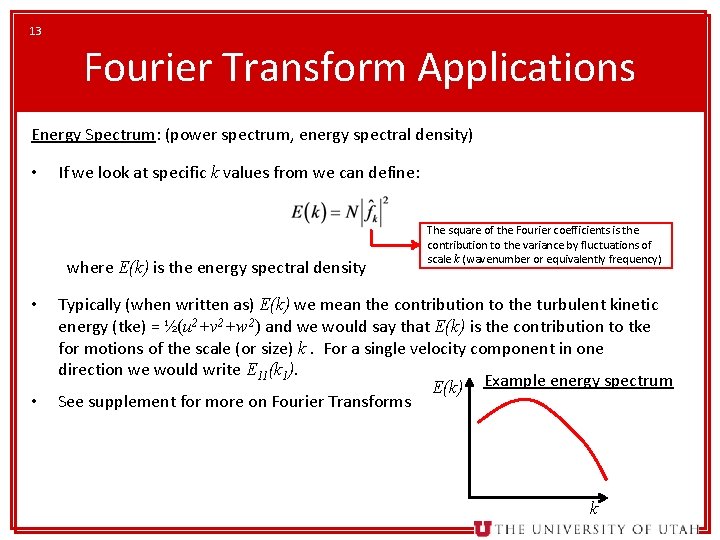
13 Fourier Transform Applications Energy Spectrum: (power spectrum, energy spectral density) • If we look at specific k values from we can define: where E(k) is the energy spectral density • • The square of the Fourier coefficients is the contribution to the variance by fluctuations of scale k (wavenumber or equivalently frequency) Typically (when written as) E(k) we mean the contribution to the turbulent kinetic energy (tke) = ½(u 2+v 2+w 2) and we would say that E(k) is the contribution to tke for motions of the scale (or size) k. For a single velocity component in one direction we would write E 11(k 1). E(k) Example energy spectrum See supplement for more on Fourier Transforms k
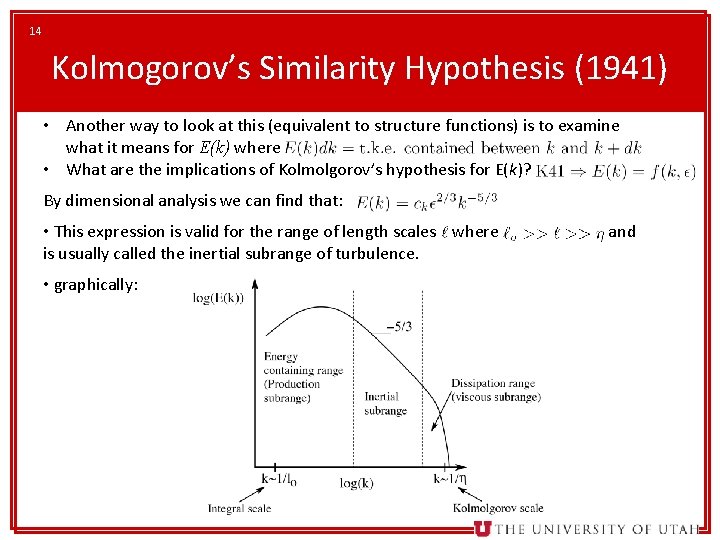
14 Kolmogorov’s Similarity Hypothesis (1941) • Another way to look at this (equivalent to structure functions) is to examine what it means for E(k) where • What are the implications of Kolmolgorov’s hypothesis for E(k)? By dimensional analysis we can find that: • This expression is valid for the range of length scales where is usually called the inertial subrange of turbulence. • graphically: and
- Slides: 14