
1 LES of Turbulent Flows Lecture 1 Supplement

1 LES of Turbulent Flows: Lecture 1 Supplement (ME EN 7960 -003) Prof. Rob Stoll Department of Mechanical Engineering University of Utah Fall 2014
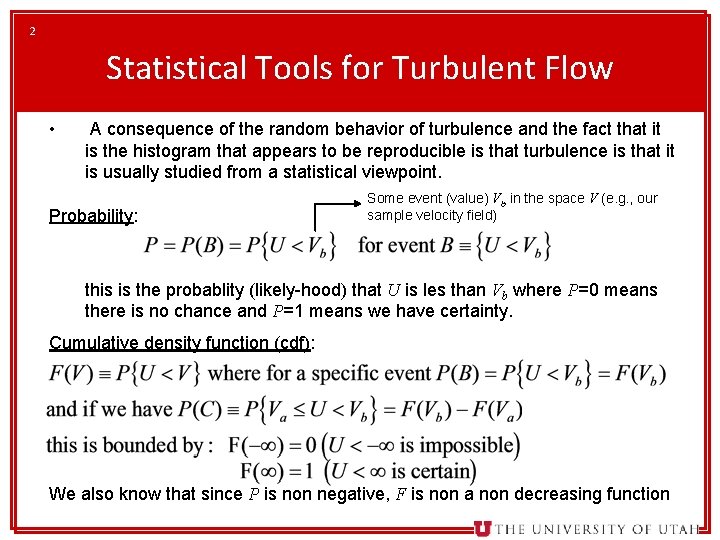
2 Statistical Tools for Turbulent Flow • A consequence of the random behavior of turbulence and the fact that it is the histogram that appears to be reproducible is that turbulence is that it is usually studied from a statistical viewpoint. Probability: Some event (value) Vb in the space V (e. g. , our sample velocity field) this is the probablity (likely-hood) that U is les than Vb where P=0 means there is no chance and P=1 means we have certainty. Cumulative density function (cdf): We also know that since P is non negative, F is non a non decreasing function
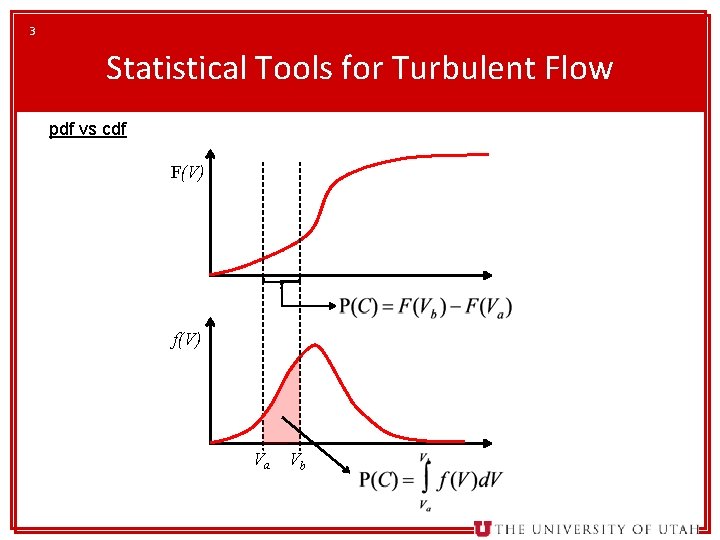
3 Statistical Tools for Turbulent Flow pdf vs cdf F(V) f(V) Va Vb
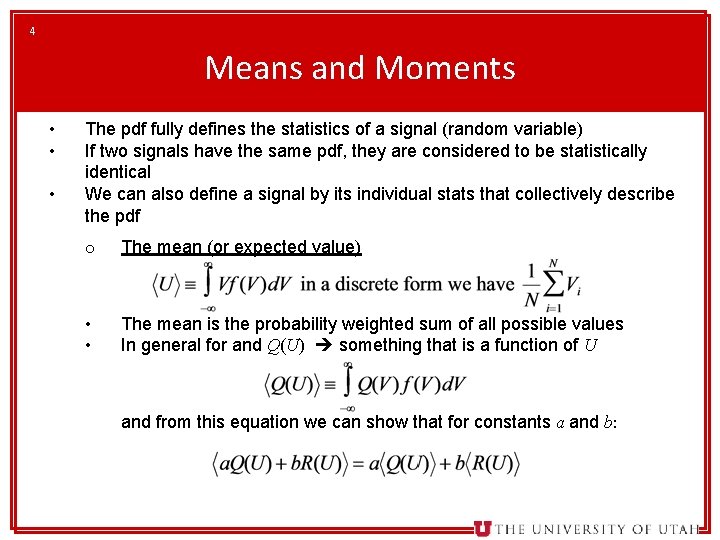
4 Means and Moments • • • The pdf fully defines the statistics of a signal (random variable) If two signals have the same pdf, they are considered to be statistically identical We can also define a signal by its individual stats that collectively describe the pdf o The mean (or expected value) • • The mean is the probability weighted sum of all possible values In general for and Q(U) something that is a function of U and from this equation we can show that for constants a and b:
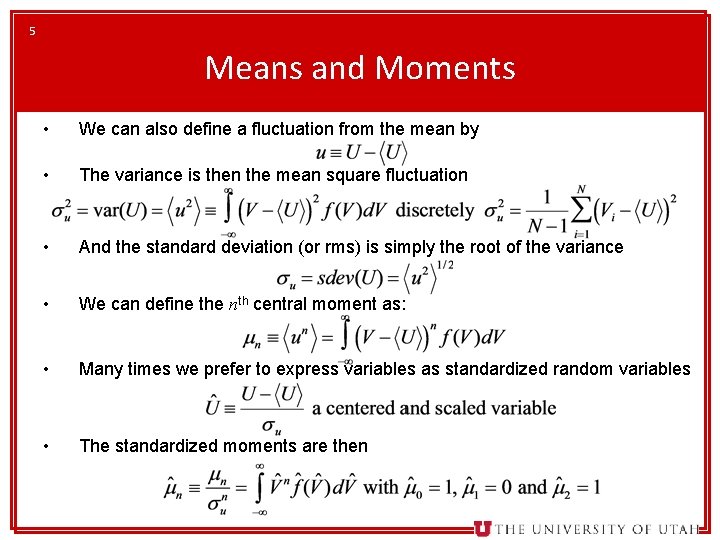
5 Means and Moments • We can also define a fluctuation from the mean by • The variance is then the mean square fluctuation • And the standard deviation (or rms) is simply the root of the variance • We can define the nth central moment as: • Many times we prefer to express variables as standardized random variables • The standardized moments are then
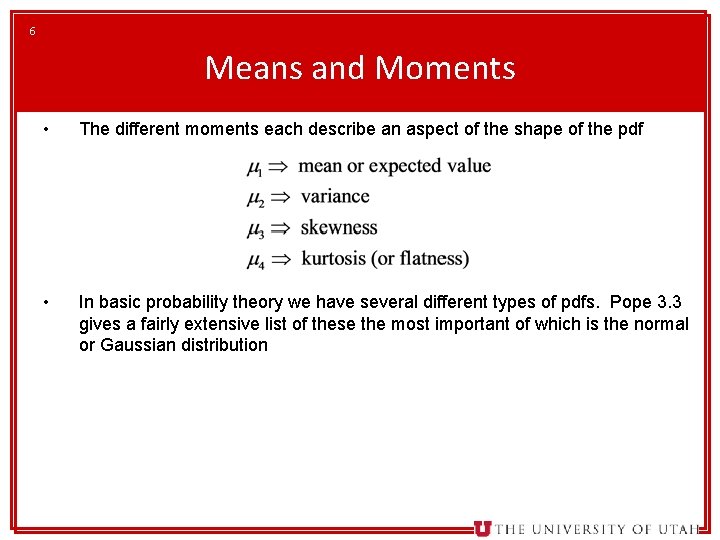
6 Means and Moments • The different moments each describe an aspect of the shape of the pdf • In basic probability theory we have several different types of pdfs. Pope 3. 3 gives a fairly extensive list of these the most important of which is the normal or Gaussian distribution
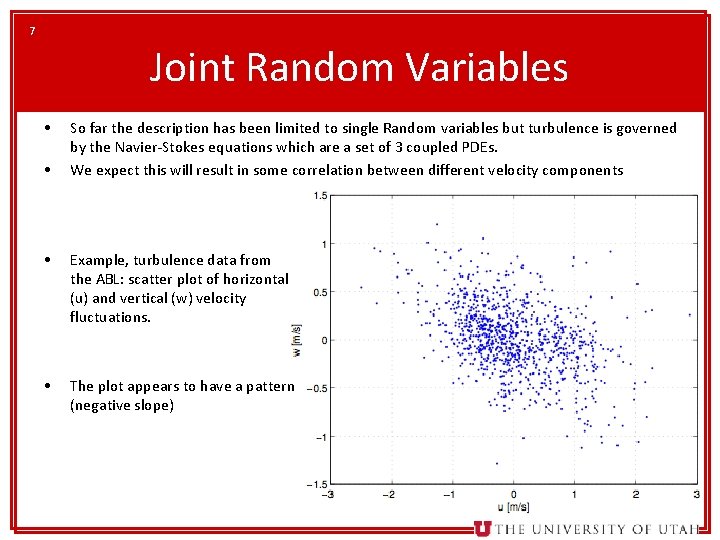
7 Joint Random Variables • • So far the description has been limited to single Random variables but turbulence is governed by the Navier-Stokes equations which are a set of 3 coupled PDEs. We expect this will result in some correlation between different velocity components • Example, turbulence data from the ABL: scatter plot of horizontal (u) and vertical (w) velocity fluctuations. • The plot appears to have a pattern (negative slope)
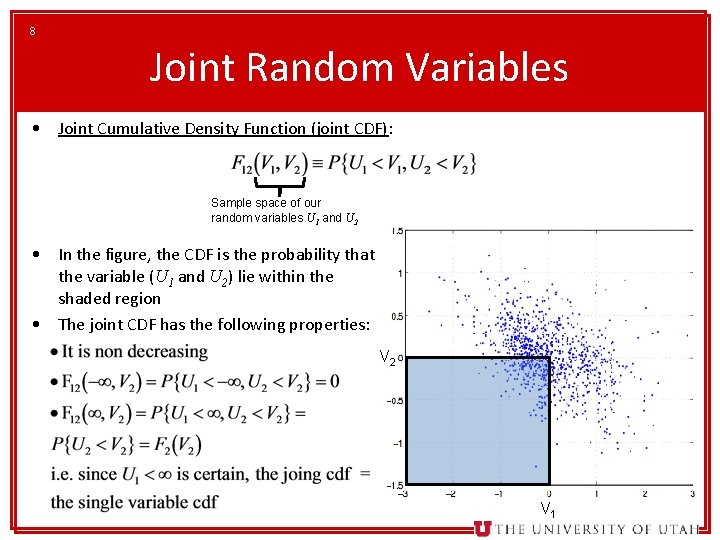
8 Joint Random Variables • Joint Cumulative Density Function (joint CDF): Sample space of our random variables U 1 and U 2 • In the figure, the CDF is the probability that the variable (U 1 and U 2) lie within the shaded region • The joint CDF has the following properties: V 2 V 1
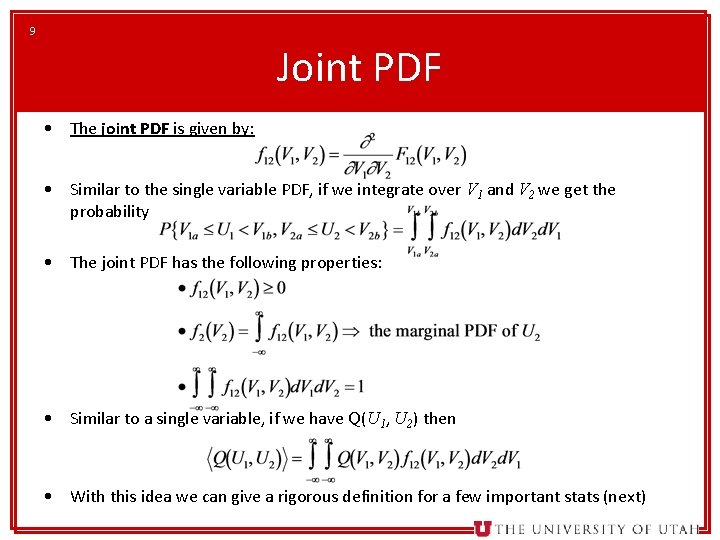
9 Joint PDF • The joint PDF is given by: • Similar to the single variable PDF, if we integrate over V 1 and V 2 we get the probability • The joint PDF has the following properties: • Similar to a single variable, if we have Q(U 1, U 2) then • With this idea we can give a rigorous definition for a few important stats (next)
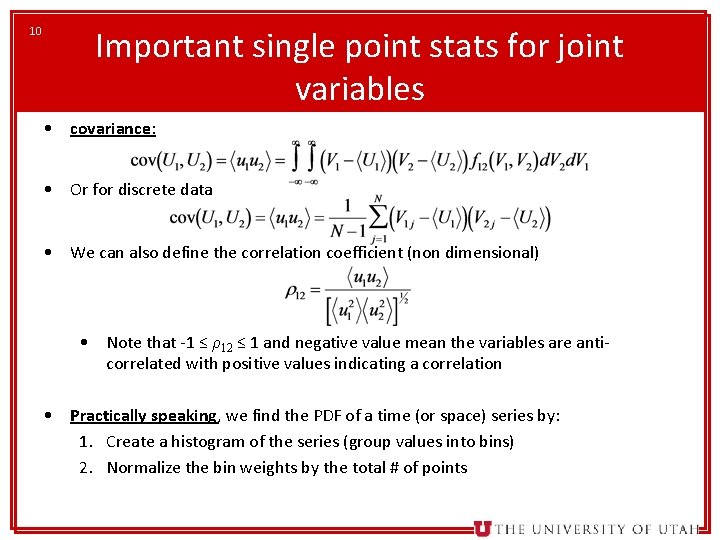
10 Important single point stats for joint variables • covariance: • Or for discrete data • We can also define the correlation coefficient (non dimensional) • Note that -1 ≤ ρ12 ≤ 1 and negative value mean the variables are anticorrelated with positive values indicating a correlation • Practically speaking, we find the PDF of a time (or space) series by: 1. Create a histogram of the series (group values into bins) 2. Normalize the bin weights by the total # of points
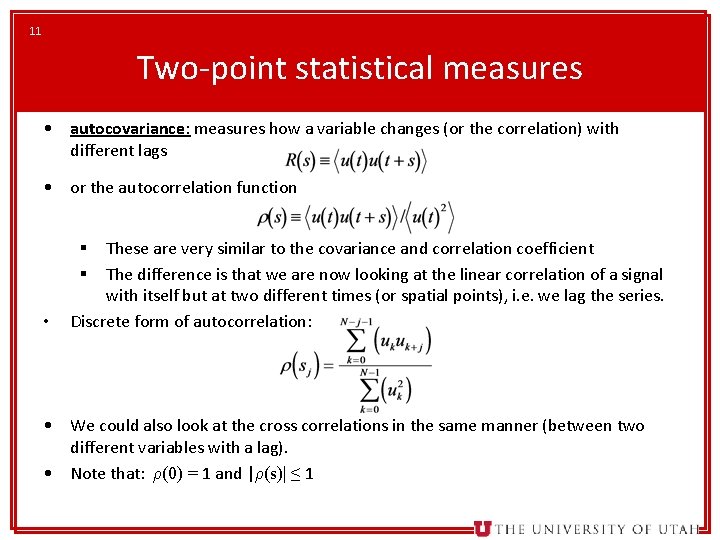
11 Two-point statistical measures • autocovariance: measures how a variable changes (or the correlation) with different lags • or the autocorrelation function These are very similar to the covariance and correlation coefficient The difference is that we are now looking at the linear correlation of a signal with itself but at two different times (or spatial points), i. e. we lag the series. Discrete form of autocorrelation: § § • • We could also look at the cross correlations in the same manner (between two different variables with a lag). • Note that: ρ(0) = 1 and |ρ(s)| ≤ 1
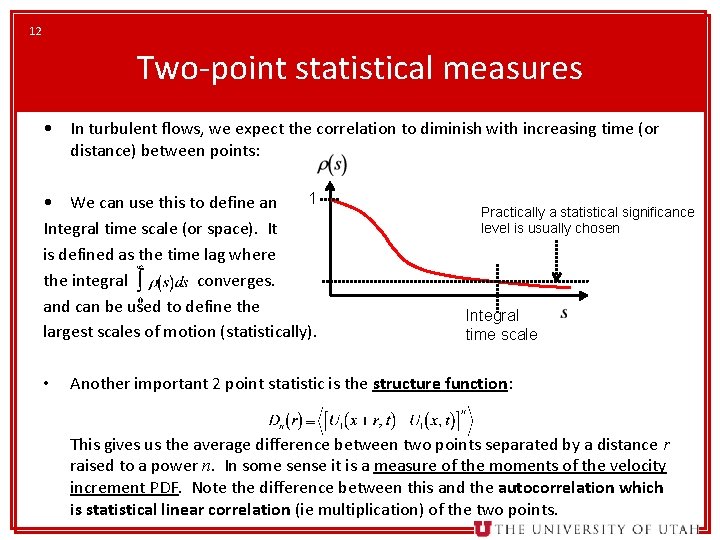
12 Two-point statistical measures • In turbulent flows, we expect the correlation to diminish with increasing time (or distance) between points: 1 • We can use this to define an Integral time scale (or space). It is defined as the time lag where the integral converges. and can be used to define the largest scales of motion (statistically). • Practically a statistical significance level is usually chosen Integral time scale Another important 2 point statistic is the structure function: This gives us the average difference between two points separated by a distance r raised to a power n. In some sense it is a measure of the moments of the velocity increment PDF. Note the difference between this and the autocorrelation which is statistical linear correlation (ie multiplication) of the two points.
- Slides: 12