
1 LECTURE CONTENTS Part UNIT Two individual BEHAVIOUR
1
LECTURE CONTENTS Part (UNIT) Two: individual BEHAVIOUR AND PROCESSES • • • individual differences, BEHAVIOUR, PERSONALITY and VALUES Perception and attribution The nature of learning The nature of motivation at work WORK ATTITUDES
Part (UNIT) Two: individuals in organisations • • individual differences and personality Perception and attribution The nature of learning The nature of motivation at work
Lecture (unit) two: individual differences and personality

Lecture OBJECTIVES Ø To examine the significance of valuing differences and diversity Ø Discuss the concept of personality and factors that affect its development. Ø Specify and define several dimensions of personality that are relevant to organisational behavior. ØExplain some organisational applications of individual differences and personality.
introduction Ø Changing population demographics, rights gains made by women and other minorities have created organizations that are more and more heterogeneous. Ø As organisations increasingly operate in a multinational and multicultural context, understanding how diversity in the composition of organizations and groups affects outcomes such as satisfaction and turnover will be of increasing importance.
WHAT ARE THE KEY ISSUES SURROUNDING INDIVIDUAL DIFFERENCES, Key issues: (1) what is the meaning of diversity/individual difference (2) types of diversity (3) impact of diversity on individual, group and organisational behaviour (4) Diversity management
KEY ISSUE 1: INDIVIDUAL DIFFERENCE/DIVERSITY Ø Diverse workforce is a fact of organisational life. Ø In principle, diversity refers to an almost infinite number of dimensions, ranging from age to nationality, from religious background to functional background, and from task skills to relational skills. Ø Research findings have shown that the concept of diversity is bound up in complexity. Ø Till date, one common definition or
DIVERSITY ØDefinitions: "variety" or a "point or respect in which things differ" (American Heritage Dictionary of the English Language, 1993; Webster's Dictionary of the English Language, 1992). “the distribution of differences among the members of a unit with respect to a common attribute, X”. (Harrison and Klein, 2007: 1199). “ the host of differences that makes people different from, and similar to, each other”
MULTIPLE TYPES OF DIVERSITY ØObservable or readily detectable: differences in race/ethnic background, nationality, age and gender. Ø Non-observable: differences in less visible or underlying attributes including diversity in values, personality characteristics, cultural values, diversity in skills and knowledge, including educational background, occupational background, functional background, range of industry experience, organisational membership; organisational tenure and group tenure (Milliken and Martins, 1996)

MULTIPLE TYPES OF DIVERSITY Ø“Surface-level diversity” (Harrison et al. , 1998): differences in overt demographic characteristics (also described these as visible dimensions“), including age, sex, race/ethnicity, marital status, are often reflected in physical features (Milliken and Martins, 1996). ØSurface-level diversity is equivalent to "social category diversity“ (Jehn, Northcraft, & Neale, 1999) or "demographic diversity" (e. g. , O'Reilly et al. , 1989). Ø Deep-level diversity: differences in psychological characteristics, including personalities, values and attitudes (Jackson et

TYPES OF DIVERSITY Ø Other types include: Ø Differences in functional characteristics differences within workforce in knowledge, skills and abilities (KSAs)(education, functional knowledge information or expertise, training, experience, abilities); Ø Personality differences: cognitive style, affective disposition, motivational factors etc. (personality, cognitive style and behavioural styles (PCBs); Ø Differences in values, beliefs and attitudes
TYPES OF DIVERSITY cont’d ØPhysical description: such as height, weight, build, hair, colour, dress etc. ; ØEmotional description: such as gushing, withdrawing, nervous, aggressive; ØSociability such as friendly, responsive, giving, likeable, and ‘nice’; ØDifferences in social and network ties work-related ties, friendship ties, community ties, in-group membership; üIt is well established that individuals quickly use these characteristics to assign themselves and others to social classifications (in-group and out-group,

Figure 2 -1. The layers of diversity Source: Gardenswartz and Rowe (1994) 15
Virtue and vice of diversity ü The results of research on heterogeneity in groups suggests that diversity offers both a great opportunity for organizations as well as an enormous challenge. ü On the one hand, some research suggests that more diverse groups have the potential to consider a greater range of perspectives and to generate more high-quality solutions than less diverse groups (e. g. , Mohammed and Angell, 2004).
Virtue and vice of diversity ü On the other hand, the greater the amount of diversity in a group or an organizational subunit, the less integrated the group is likely to be, and the higher the level of dissatisfaction and turnover. ü Diversity thus appears to be a doubleedged sword, increasing the opportunity for creativity as well as the likelihood that group members will be dissatisfied and fail to identify with the group.
Diversity management Ø Managing diversity involves creating organisational changes that enable all people to perform up their maximum potential. Ø Strategies for managing diversity include education (e. g. valuing diversity), enforcement (e. g. equal employment opportunity (EEO) and exposure (e. g. glass ceiling).
Diversity theories Ø Notably, theories marshalled by authors to support surface-level diversity and deep-level diversity (Tsui et al. , 1992) are the basis of: Ø (1) similarity-attraction or fit paradigms, including social psychological theories about similarity in attitudes (e. g. , Byrne. 1971).
Diversity theories Ø The arguments that people find it more pleasurable to interact with others who have similar psychological characteristics, because that interaction verifies and reinforces their own beliefs, affect, and expressed behaviours (e. g. Swann et al. , 1992). Ø (2) Self categorisation: assumes that people define their self-concept in terms of membership in social group.
IMPACT OF DIVERSITY Ø (1) At the individual level, it has been demonstrated that conscientiousness ("Big Five Factor" personality dimension) can be strongly related to performance in a variety of task settings. The notion of personality permeates popular culture and discussion in the workplace. Ø We all use the term “personality” quite often. Ø But what exactly is personality?
WHAT ARE THE KEY ISSUES SURROUNDING personality üWHAT IS THE MEANING OF PERSONALITY ü PERSONALITY (INDIVIDUAL) ü PERSONALITY IN ORGANISATIONS ü THEORY AND PRACTICE
PERSONALITY DEFINED Ø The notion of personality permeates popular culture and discussion in the workplace. Ø The mass media also endlessly discuss “nice” personalities. Ø We all use the term ‘personality quite often, and most people feel they understand it instinctively. Ø But again, what exactly is personality?
PERSONALITY DEFINED ØPersonality is: “a relatively enduring pattern of thinking, feeling and acting that characterize a person’s response to his or her environment”. (Bratton et al. , 2007: 193). “the pattern of relatively enduring ways that a person feels, think, and behaves. (George and Jones, 2008: 42).
PERSONALITY DEFINED ØPersonality is: “the relatively enduring individual traits and disposition that forms a pattern distinguishing one person from all others. (Vecchio, 2006: 26).
PERSONALITY DEFINED ØThe definitions suggest that: ØThe concept of personality refers to notion of individuality - people differ significantly in the ways they routinely think, feel and act. ØPersonality refers to an enduring set of characteristics and tendencies of a person. ØPersonality rests on the observation that people seem to behave somewhat consistently over time and across different life situations. üIndividual behaviour is influenced by the social context.
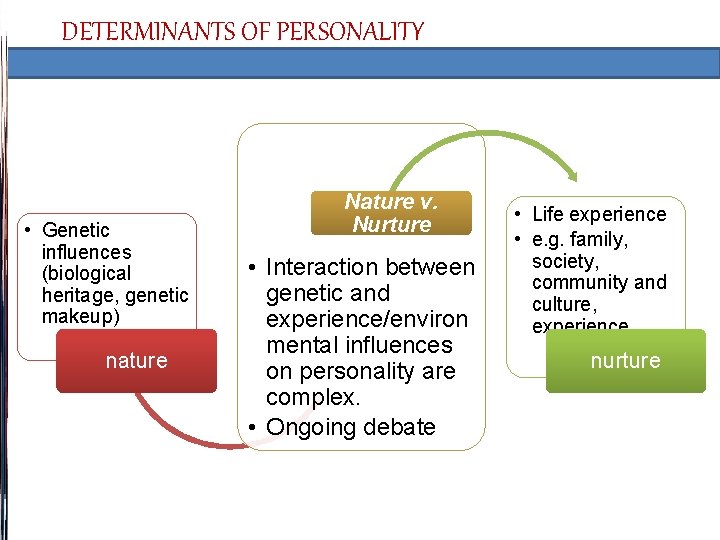
DETERMINANTS OF PERSONALITY • Genetic influences (biological heritage, genetic makeup) nature Nature v. Nurture • Interaction between genetic and experience/environ mental influences on personality are complex. • Ongoing debate • Life experience • e. g. family, society, community and culture, experience nurture
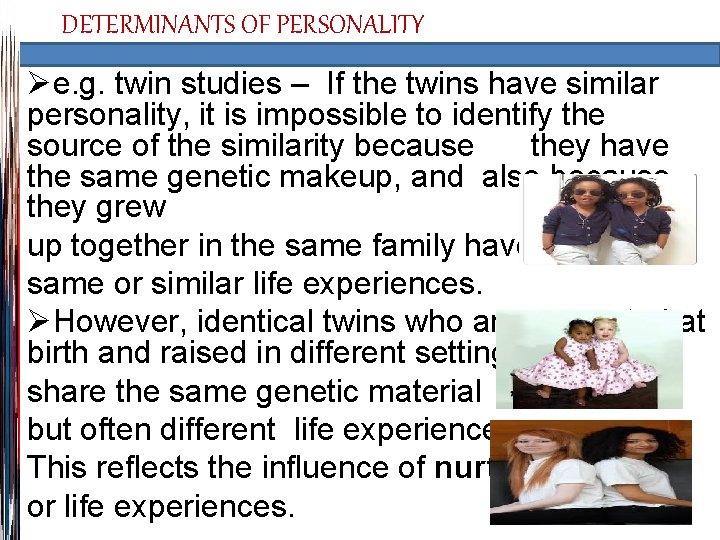
DETERMINANTS OF PERSONALITY Øe. g. twin studies – If the twins have similar personality, it is impossible to identify the source of the similarity because they have the same genetic makeup, and also because they grew up together in the same family have same or similar life experiences. ØHowever, identical twins who are separated at birth and raised in different setting share the same genetic material but often different life experiences. This reflects the influence of nurture or life experiences.
ISSUES SURROUNDING NATURE VERSUS NURTURE Ø Is personality stable over periods of time? Ø It is perceived that personality is stable over periods of time (e. g. from 5 to 10 years) because half of the variations is inherited from parents. Ø Is personality likely to change only over the years?
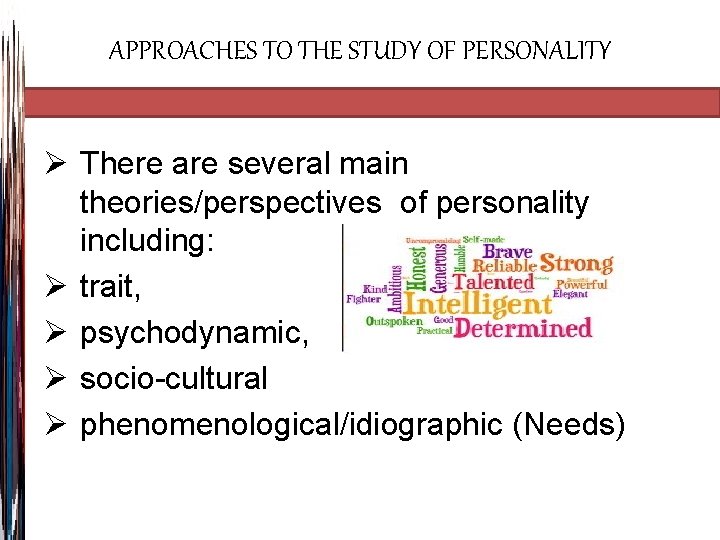
APPROACHES TO THE STUDY OF PERSONALITY Ø There are several main theories/perspectives of personality including: Ø trait, Ø psychodynamic, Ø socio-cultural Ø phenomenological/idiographic (Needs)
the TRAIT perspective Trait theory üIn describing the personality of an employee, one would probably make a number of descriptive statements such as: ü“she is extrovert. She likes to be the focus of attention, but she is also brilliant. ü‘She works very hard but she is generous with her time and a truly caring person”. Together, these statements describe personality traits – that reveal themselves in a particular pattern of human behaviour.
TRAIT theory Ø “A trait is a specific component of personality that describes the particular tendencies a person has to feel, think, and act in certain ways such as shy or outgoing” (George and Jones, 2008: 46). Ø “A trait is a relatively enduring personal characteristic”.
TRAIT theory Ø Historical background: Ø Almost two thousand years ago, the ancient Greek used humoral theory to explain individual differences in personality. The body was thought to contain four humours or fluids: Ø black bile, blood, phlegm yellow bile. Ø The personality of individuals was classified according to the disposition supposedly produced by the
TRAIT theory CONT’D: four primary temperaments: sanguine/melancholic Ø e. g. Sanguine people, who has a predominance of blood (sanguis), were cheerful and passionate. • the sanguine is an extroverted, fun-loving, activity-prone, impulsive, entertaining, persuasive, easily amused and optimistic person. Ø Melancholic people, who had excess of black bile, had a pessimistic temperament. • The Melancholy is an introverted, logical, analytical, factual, private, lets-do-it-right
TRAIT theory CONT’D: four primary temperaments: phlegmatic Ø Phlegmatic individuals, whose body systems contained an excessive proportion of phlegm, were calm and unexcitable. Ø The phlegmatic is an introverted, calm, unemotional, easygoing, never-get-upset person. Ø Choleric individuals, on the other hand, had excess of yellow bile and were badtempered and irritable. • The Choleric is an extroverted, hot-tempered, quick thinking, active, practical,
TRAIT / traditional (2) perspective: Eysenck’s theory Ø Individuals in Eysenck (1916 -1997) theory could be one of four main personality types; choleric, melancholic, phlegmatic and sanguine. Ø These personality types can be understood in terms of two basic factors; (1)introversion – extroversion, (2)stability – instability. Ø These factors are polar dimensions. Introversion is the opposite of extroversion and stability is the opposite of instability.
Eysenck’s theory CONT’D ü Type would lead a predisposition of traits which, itself would lead to the likelihood of certain behaviours, e. g. ü Introversion - Introverts tend to be shy, thoughtful, risk avoiders and shun social engagements. ü Extroversion - Extroverts tend to be sociable, spontaneous, thrive on change and willing to take risks. ü The stable person is calm, even-tempered, carefree and reliable ü The unstable/neurotic person tends to worry, is anxious, moody and unstable.
TRAIT: Eysenck’s theory CONT’D Ø The two dimensions led to the four temperaments: Ø sanguine -refer to people who are carefree, hopeful, in the moment, easily fatigued and bored. Ø Phlegmatic people display a lack of emotions, are steady, reasonable in interaction… Ø Melancholic describes people who are egoistic, anxious and pessimistic…. Ø Choleric people who are seen as impulsive, quick-tempered yet easily calm down if opponents give in….
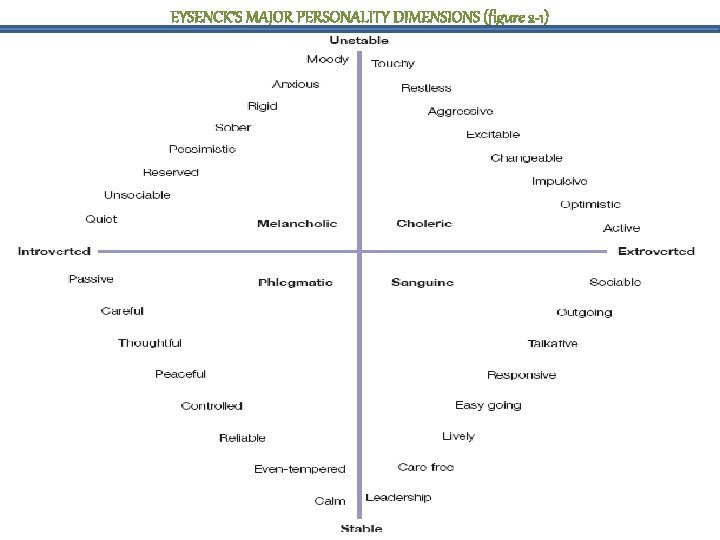
EYSENCK’S MAJOR PERSONALITY DIMENSIONS (figure 2 -1)
TRAIT THEORY 3: CATTEL AND PERSONALITY CHARACTERISTICS Ø Cattell (1965) used a process of factor analysis to identify clusters of traits that he believed represented a person’s central traits. Ø He used the idea of statistical tool of ‘factor analysis’ by defining core traits with the ’ 16 Personality Factor Questionnaire’ widely known today as “Sixteen Personality Factor Questionnaire” or “ 16 PF” (‘source traits’) were building blocks upon which personality is built. e. g. Factor Warm Left Meaning reserved impersonal Right Meaning warm, outgoing, attentive to
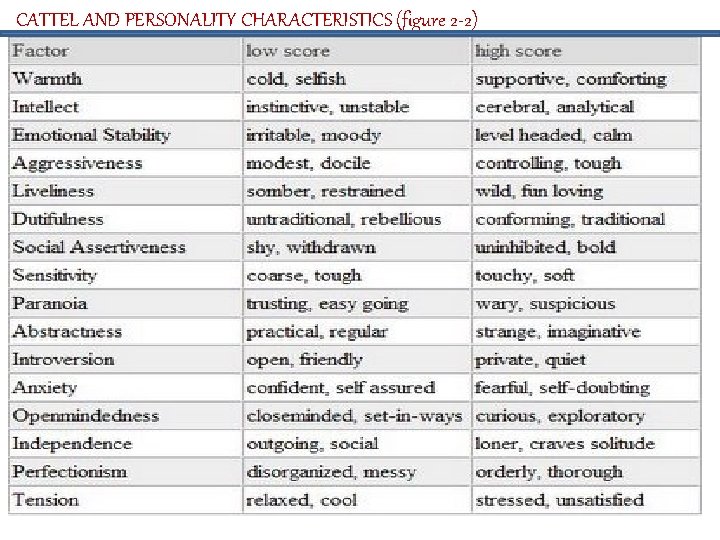
CATTEL AND PERSONALITY CHARACTERISTICS (figure 2 -2)
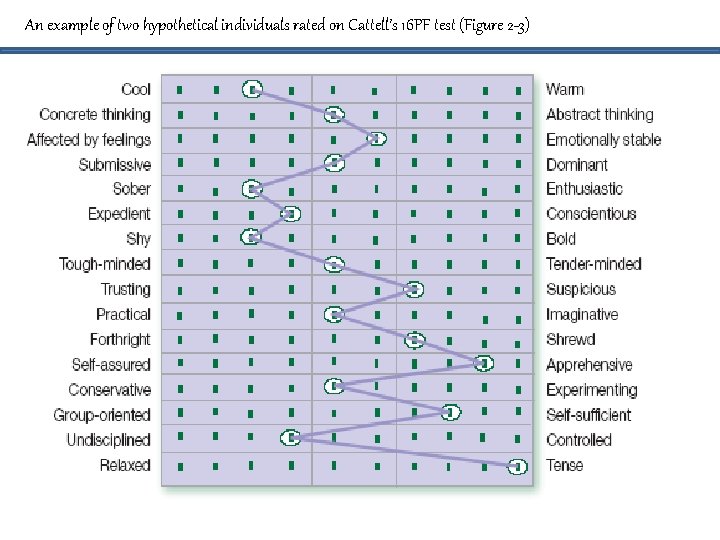
An example of two hypothetical individuals rated on Cattell’s 16 PF test (Figure 2 -3)
TRAIT THEORY 4: THE BIG FIVE MODEL OF PERSONALITY TRAIT STRUCTURE: Ø The Five Factor Model (FFM) of Personality (“The Big Five”) proposes that personality is organized around five core dimensions: Ø Openness – Openness reflects the degree of intellectual curiosity, creativity and a preference for novelty and variety a person has (''inventive/curious'' vs. ''consistent/cautious'')
THE BIG FIVE MODEL OF PERSONALITY TRAIT STRUCTURE Ø Conscientiousness – a tendency to be organized and dependable, show selfdiscipline, act duty/dutifully, aim for achievement, and prefer planned rather than spontaneous behavior (''efficient/organized'' vs. ''easy going/careless'') Ø Extraversion/Extroversion – energy, positive emotions, assertiveness, sociability and the tendency to seek stimulation in the company of others, and talkativeness (''outgoing/energetic'' vs. ''solitary/reserved'').
THE BIG FIVE MODEL OF PERSONALITY TRAIT STRUCTURE ØAgreeableness – A tendency to be compassionate and cooperative rather than suspicious and antagonism towards others. It is also a measure of one's trusting and helpful nature, and whether a person is generally well tempered or not (''friendly/compassionate'' vs. ''analytical/detached'‘ ØNeuroticism – the tendency to experience unpleasant emotions easily, such as anger, anxiety, depression, and vulnerability. (''sensitive/nervous'' vs. ''secure/confident'').
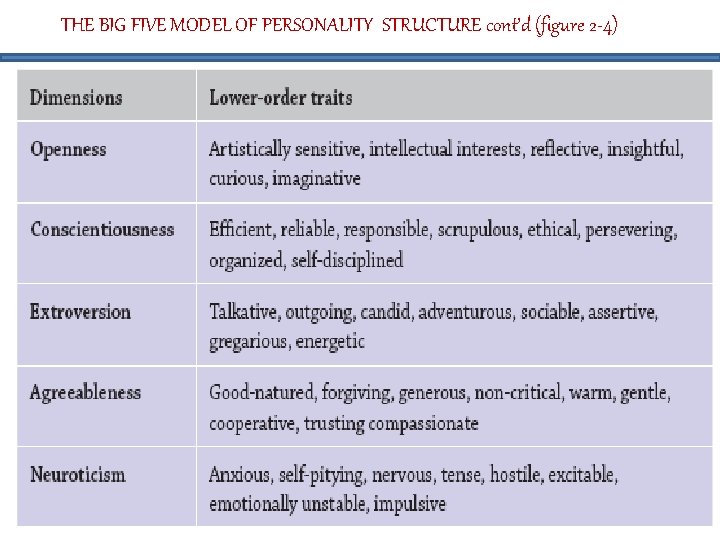
THE BIG FIVE MODEL OF PERSONALITY STRUCTURE cont’d (figure 2 -4)
THE BIG FIVE MODEL OF PERSONALITY TRAIT STRUCTURE cont’d ØThese dimensions (it is similar to Eysenck’s theory) have been identified to have special relevance to for the workplace. ØFor example, it has been suggested that conscientiousness is related to job performance because it assesses personal characteristics such as dependability, careful, thorough, responsible, organised, hardworking, achievement-oriented and persevering are important attributes for accomplishing work tasks in all jobs.
PSYCHODYNAMIC THEORY Ø Sigmund Freud (1856 -1939) developed the psychodynamic theory of personality- which claim that the dynamics interplay of inner psychological processes determines ways of thinking, feeling, and acting. Ø His theory proposed that an individual’s personality is determined by conscious, preconscious and unconscious brain activity, with the unconscious part of the mind exerting great influence on the conscious and
Freud’s PSYCHODYNAMIC THEORY ØA mix of conscious and subconscious process expressed as linking id, ego and superego. Ø(1) The Id – (Latin word for it) is the unconscious portion of the personality. ØThe id is the only structure at birth and functions in a totally irrational manner. The id operates on the pleasure principle, seeking the immediate gratification of impulses produced by innate drives such as aggression. ØThe (2) The Ego – (Latin word for ‘I’) is the thinking, organising and protective self. It functions primarily at a conscious level, it
PSYCHODYNAMIC THEORY cont’d Ø(3) The Superego – (Latin meaning ‘beyond’ or above the ego) which is subdivided into the conscience and the ego ideal, and tells us what one should do and should not. ØThe superego, the moral arm of the personality, determines which actions are permissible and punishes wrongdoing with guilt feelings. ØLike the ego, the superego strives to control the instincts of the id.
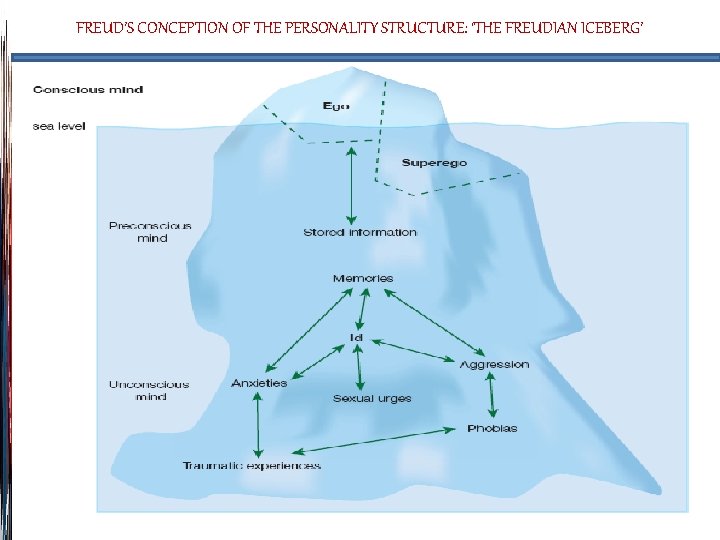
FREUD’S CONCEPTION OF THE PERSONALITY STRUCTURE: ‘THE FREUDIAN ICEBERG’
FREUDIAN DEFENCE MECHANISMS ØIt sees anxiety as being formed by the conflict of id and superego to control the ego. It however serves as a signal, and motivates the ego to deal with the problem. ØSome of the defence mechanisms include: (1) Repression: describes a process where the existence of something is deliberately kept hidden from the conscious thinking level because it might be too painful or an active defence process through which anxiety.
FREUDIAN DEFENCE MECHANISMS cont’d Ø(2) Denial: a defence mechanism in which the ego alters the perception of a situation in order to maintain a balance in the mind or a person refuses to acknowledge anxiety-arousing aspects of the environment. The denial may involve either the emotions connected with the event or the event itself. Ø(3) Displacement: an unacceptable or dangerous impulse is repressed and then directed at a safer substitute target.
FREUDIAN DEFENCE MECHANISMS cont’d Ø (3) Rationalisation: a person constructs a false but plausible explanation or an excuse for an anxiety-rousing behaviour or event that has already occurred. Ø (4) Reaction formation: this produces the opposite feeling and behaviour at the conscious level to those held at the unconscious level. e. g. unrequited love can become hate.
JUNG AND COGNITIVE APPROACH ü Developed based on Freudian theory but incorporated future goals instead of the past ü A conscious level: allowed for reality to be incorporated as a result of the everyday experience of the individual. ü An unconscious level: makes up the individuality of each person and is composed of the complexes within the individual. ü A collective unconscious: this is the pool of inherited and socially derived universal experience that each person carries with them inside their personality.
JUNG AND COGNITIVE APPROACH Dimensions within Jungian theory: ü Sensing: people who prefer to deal with hard information in a structured context. ü Intuiting: people who dislike routine activities, but who prefer to deal with possibilities rather than certainty.
Dimensions within Jungian theory ü Thinking: people who prefer the use of logic and rationality as the basis of solving problems, without the feelings of others entering into the process. ü Feeling: people who prefer to have social harmony around them, get along with others and have sympathy for those around them.
THE SOCIAL COGNITIVE APPROACH ØThese theories view personality as the sum total of the cognitive habits and behaviours that develop as people learn through experience. Thus, Rotter proposed: Ø 1. Locus of control: people differ in how much control they believe they have over situations. Ø‘Externals’ or individuals with an external locus of control tend to believe that the environment or outside forces are largely responsible for their fate, and they see little
THE SOCIAL COGNITIVE APPROACH Ø ‘Internals’ or individuals with an internal locus of control, think that their own actions and behaviours have on impact on what happens to them. The strong inner locus of control is associated with workplace success Ø Others argue that both personality and environment reciprocally determine the development of personality, e. g. Ø Self-efficacy: a person’s belief that he or she has the ability, motivation and resources to complete a task successfully.
THE SOCIAL COGNITIVE APPROACH ØSelf-esteem: the extent to which people have pride in themselves and their capabilities. e. g. Individuals with high selfesteem think they are generally capable and worthy who can deal with most situations. ØIndividuals with low self-esteem question their self-worth, doubt their capabilities and are apprehensive about their ability to succeed.
HUMAN NEEDS THEORY ØThe theory argues that the way people perceive and interpret their social experiences from their personality. e. g. ØAbraham Maslow’s hierarchy of needs (physiological, safety, social, self-esteem, and self-actualisation). Human motivation is based on needs. ØDavid Mc. Clelland suggests that there are three traits that are present in all people to varying degrees: üneed for achievement, need for affiliation, and need for power.
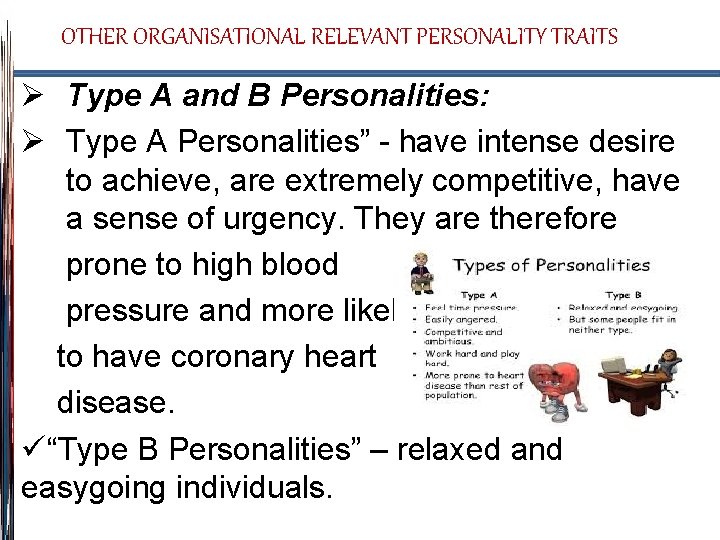
OTHER ORGANISATIONAL RELEVANT PERSONALITY TRAITS Ø Type A and B Personalities: Ø Type A Personalities” - have intense desire to achieve, are extremely competitive, have a sense of urgency. They are therefore prone to high blood pressure and more likely to have coronary heart disease. ü“Type B Personalities” – relaxed and easygoing individuals.
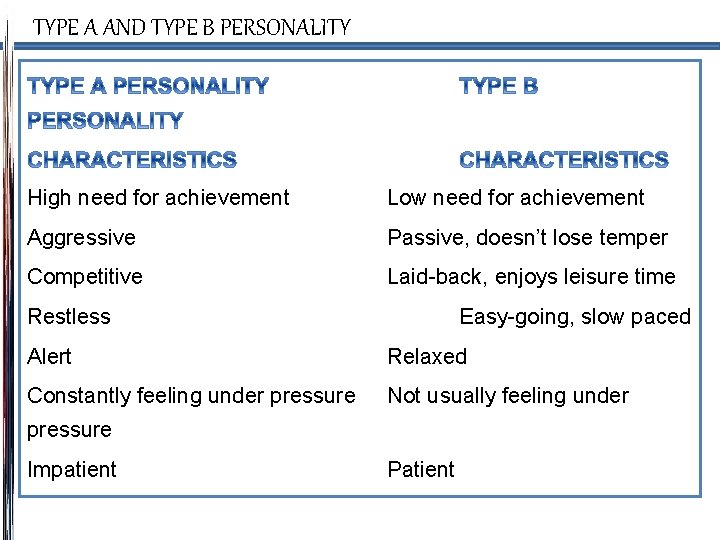
TYPE A AND TYPE B PERSONALITY High need for achievement Low need for achievement Aggressive Passive, doesn’t lose temper Competitive Laid-back, enjoys leisure time Restless Easy-going, slow paced Alert Relaxed Constantly feeling under pressure Not usually feeling under pressure Impatient Patient
APPLYING OF diversity and PERSONALITY THEORIES IN THE WORKPLACE ü Diversity in terms of factors such as gender, ethnic origin and variety of personalities in the workplace and personality attributes determine how people interact with other workers, whether they can work on their own without supervision, whether they are conscientious or just do the minimum to ‘get by’, how they respond to change etc. ü Holland (1985) emphasised the matching of personality and work characteristics.
APPLYING OF PERSONALITY THEORIES IN THE WORKPLACE ØHe evolved a personality/job fit model which included traits matched to occupations. ØHe discerned six personality ‘types’: (realistic, investigative, social, conventional, enterprising and artistic). ØHis conclusions show intrinsic differences in personalities exist and are practical relative to work place match of personality and job-type (see the slide after that). ØThe conclusions are important for the new forms of ‘knowledge worker’ – the new human capital. . .
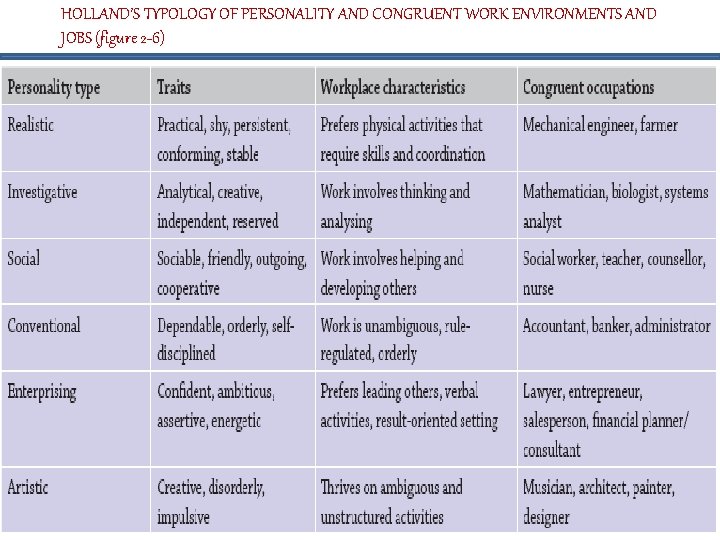
HOLLAND’S TYPOLOGY OF PERSONALITY AND CONGRUENT WORK ENVIRONMENTS AND JOBS (figure 2 -6)
KEY ISSUES SURROUNDING HOLLAND’S MODEL Ø Different types of occupations are better suited to certain types of personality. Ø Employees in workplaces and occupations congruent with their personality types should be more satisfied and more likely to remain with the organisation than employees in incongruent occupations. Ø Some researchers doubt whether the model can be generalised across
Organisational applications of individual difference &personality Ø There a number of areas in which organisations employ personality concepts, theories and measures and types of behaviour types e. g. Ø Job performance and on selection methods (including interviews, behavioural assessment, personality test, and e-assessment test) in general. Ø Training and development.
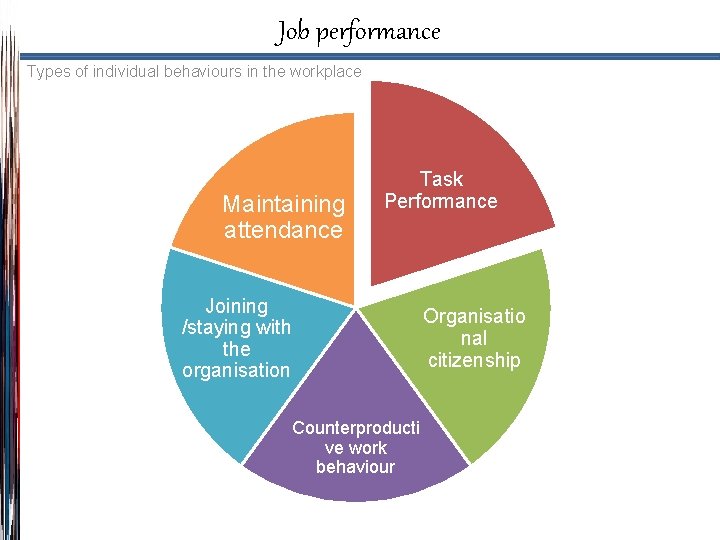
Job performance Types of individual behaviours in the workplace Maintaining attendance Task Performance Joining /staying with the organisation Organisatio nal citizenship Counterproducti ve work behaviour
summary üPersonality is the distinctive and relatively enduring pattern of thinking, feeling and acting that characterises a person’s response to his or her environment. üTraits theorists try to identify and measure personality variables, eg. Eysenck’s two-factor model and Mc. Crae and Costa suggested the ‘Big Five’ factor model. üIn addition, the lesson examined Freud’s three structures (psychoanalytic theory) Maslow and Mc. Clelland’s need theories of personality. üHuman resource professional and managers use a variety of instruments and techniques to asses
four primary temperaments: choleric The Choleric is an extroverted, hottempered, quick thinking, active, practical, strong-willed and easily annoyed person. Cholerics are self-confident, self-sufficient and very independent minded. They are decisive and opinionated and find it easy to make decisions for themselves as well as others. Cholerics tend to leave little room for negotiating. The Choleric is a visionary and seems to never run out of ideas, plans and goals, which are usually
four primary temperaments: choleric Their activity almost always has a purpose because they are by nature result-oriented. They usually do not give in to the pressure of what others think unless they see that they cannot get the desired results. Cholerics are both direct and firm when responding to others. They are slow to build relationships because results tend to be more important than people. They do not easily empathize with the feelings of others or show compassion. Cholerics think big and seek positions of authority.
four primary temperaments: sanguine The Sanguine is an extroverted, fun-loving, activity-prone, impulsive, entertaining, persuasive, easily amused and optimistic person. Sanguines are receptive and open to others and build relationships quickly. They are animated, excited and accepting of others. They will smile and talk easily and often. It is not unusual to feel as if you have known the Sanguine person for years after only a few minutes. Sanguines are so people-oriented that they easily forget about time and are often late arriving at their destination. Sanguines get bored easily because of their orientation to social involvement, activity and general dislike for solitude.
sanguine The Sanguine never lacks for friends. Their attention span is based on whether or not they are interested in the person or event. The Sanguine can change their focus or interest in an instant. Sanguines are competitive and tend to be disorganized. Unless very disciplined, the Sanguine will have difficulty controlling their emotions. They usually like sports of any kind because of the activity and involvement with other people. Their voice will show excitement and friendliness. Sanguines usually dress according to current fashion. The Sanguine fears rejection or not making a favorable impression. They also fear others viewing them as unsuccessful. Sanguines are very effective working with people.
four primary temperaments: phlegmatic The Phlegmatic is an introverted, calm, unemotional, easygoing, never-get-upset, person. Phlegmatics are both slow and indirect when responding to others. They are also slow to warm-up but will be accommodating in the process. Phlegmatics are by far the easiest person with which to get along. They live a quiet, routine, life, free of the normal anxieties and stresses of the other temperaments. The Phlegmatic will avoid getting too involved with people and life in general. Phlegmatics seldom exert themselves with others or push
phlegmatic The Phlegmatic communicates a warm, sincere interest in others preferring to have just a few close friends. They will be very loyal to their friends and find it difficult to break long standing relationships regardless of what the other person does. The Phlegmatic tends to resist change of any kind without reason, other than they just do not want the change to occur. Phlegmatics show little emotion and are prone to be a grudge holder. Phlegmatics tend to avoid conflict and making decisions of any kind. They are practical, concrete and traditional thinkers. Their stoic expression often hides their true feelings. The Phlegmatic may be patient to the point of paralysis. Phlegmatics are persistent and consistent at whatever they undertake.
four primary temperaments: melancholy The Melancholy is an introverted, logical, analytical, factual, private, lets-do-it-right person. Melancholies respond to others in a slow, cautious and indirect manner. Melancholies are reserved and suspicious until sure of your intentions. The Melancholy probe for the "hidden meaning" behind your words. They are timid and may appear unsure and have a serious expression. They are self-sacrificing, gifted and they tend to be a perfectionist. Melancholies are very sensitive to what others think about their work. The Melancholy is well organized; on occasion you may find a Melancholy that keeps things cluttered, however, they know what’s in the piles.
melancholy The Melancholy is determined to make the right and best decision. Melancholies will ask specific questions and sometimes they will ask the same question again and again. The Melancholy needs reassurance, feedback and reasons why they should do something. They need information, time to think and a plan. The Melancholy fears taking a risk, making a wrong decision and being viewed as incompetent. Melancholies tend to have a negative attitude toward something new until they have had time to think it over. Melancholies are skeptical about most everything but they are creative and capable people. Melancholies tend to get bored with something once they get it figured out.
REFERENCES AND FURTHER READING Schein, E. (1985) Organisational Culture and Leadership - A Dynamic View London: Jossey-Bass. Senge, P. (1990) The Fifth Discipline: The Art and Practice of the Learning Organisation. London: Century. Thomas, K. W. (1976) Conflict and Conflict Management. In M. D. Dunnette (ed. ), Handbook of Industrial and Organisational Psychology (pp. 889 -935) Chicago: Rand-Mc. Nally. Tannenbaum, R. M. and Shmidt, W. H. (1973) How to Choose a leadership pattern, Harvard Business Review, May-June Tuckman, B. and Jensen, N. (1977) Stages of Small Group Development revisited. , Group and Organisational studies, 2. Vecchio, R. V. (2006). Organisational Behaviour: Core Concepts, 6 th Edition. Australia: Thomson South-Western. Watson, C. M. (1983) Leadership, Management, and the Seven Keys, Business Horizons, 8 -13. Wheelen, T. L. and Hunger, J. D. (1998) Strategic Management and Business Policy: Entering the 21 st Century Global Society, Harlow, England: Addison-Wesley. Zoogah, D. B. and Beugre, C. D. (2013) Managing Organisation Behaviour in the African Context. London, UK: Routledge.
- Slides: 79