
1 Lecture 5 Introduction to Assembly CS 105
1 Lecture 5: Introduction to Assembly CS 105 Fall 2020
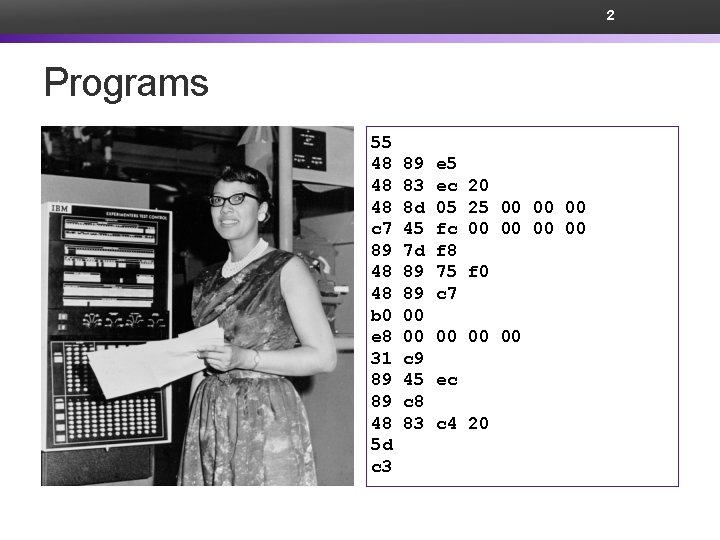
2 Programs 55 #include<stdio. h> 48 89 e 5 int main(int argc, 48 83 ec 20 char ** argv){ 48 8 d 05 25 00 00 00 c 7 45 fc 00 00 printf("Hello 89 7 d f 8 world!n"); 48 89 75 f 0 return 0; 48 89 c 7 } b 0 00 e 8 00 00 31 c 9 89 45 ec 89 c 8 48 83 c 4 20 5 d c 3
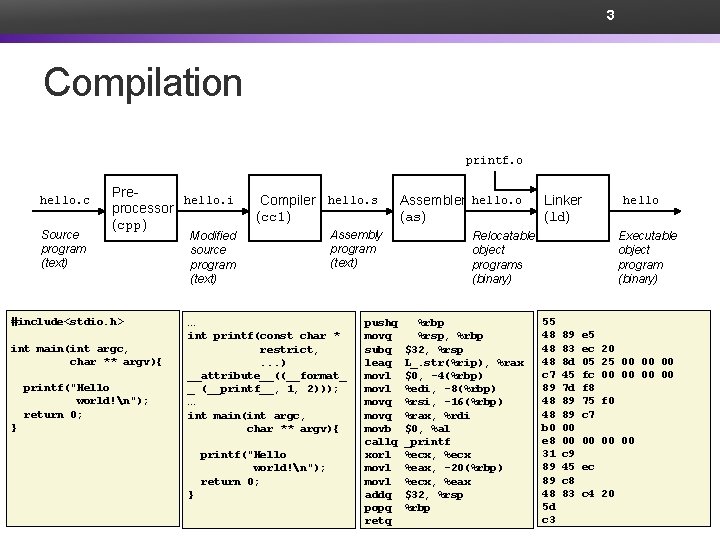
3 Compilation printf. o hello. c Source program (text) Prehello. i processor (cpp) #include<stdio. h> int main(int argc, char ** argv){ printf("Hello world!n"); return 0; } Compiler hello. s (cc 1) Modified source program (text) Assembly program (text) … int printf(const char * restrict, . . . ) __attribute__((__format_ _ (__printf__, 1, 2))); … int main(int argc, char ** argv){ printf("Hello world!n"); return 0; } Assembler hello. o (as) Relocatable object programs (binary) pushq %rbp movq %rsp, %rbp subq $32, %rsp leaq L_. str(%rip), %rax movl $0, -4(%rbp) movl %edi, -8(%rbp) movq %rsi, -16(%rbp) movq %rax, %rdi movb $0, %al callq _printf xorl %ecx, %ecx movl %eax, -20(%rbp) movl %ecx, %eax addq $32, %rsp popq %rbp retq Linker (ld) hello Executable object program (binary) 55 48 89 e 5 48 83 ec 20 48 8 d 05 25 00 00 00 c 7 45 fc 00 00 89 7 d f 8 48 89 75 f 0 48 89 c 7 b 0 00 e 8 00 00 31 c 9 89 45 ec 89 c 8 48 83 c 4 20 5 d c 3
5 x 86 -64 Assembly Language • Evolutionary design, going back to 8086 in 1978 • Basis for original IBM Personal Computer, 16 -bits • Intel Pentium 4 E (2004): 64 bit instruction set • High-level languages are translated into x 86 instructions and then executed on the CPU • Actual instructions are sequences of bytes • We give them mnemonic names

6 Assembly/Machine Code View Memory Central Processing Unit (CPU) PC Stack Registers Float registers Condition Codes Heap Addresses Instructions Programmer-Visible State � PC: 0 x 7 FFF Program counter (%rip) � Register file: 16 Registers � Float registers � Condition codes Data Code 0 x 0000 Memory �Byte addressable array �Code and user data �Stack to support procedures

8 Assembly Characteristics: Instructions • Transfer data between memory and register • Load data from memory into register • Store register data into memory • Perform arithmetic operations on register or memory data • Transfer control • Conditional branches • Unconditional jumps to/from procedures

9 DATA TRANSFER IN ASSEMBLY
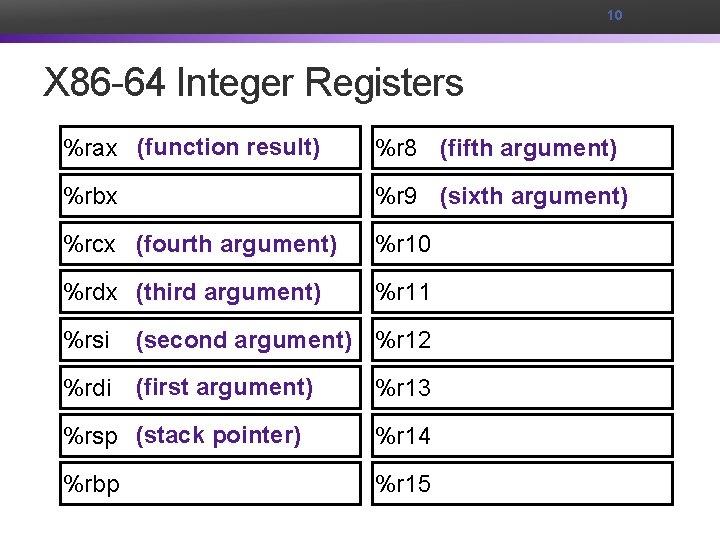
10 X 86 -64 Integer Registers %rax (function result) %r 8 (fifth argument) %rbx %r 9 (sixth argument) %rcx (fourth argument) %r 10 %rdx (third argument) %r 11 %rsi (second argument) %r 12 %rdi (first argument) %r 13 %rsp (stack pointer) %r 14 %rbp %r 15
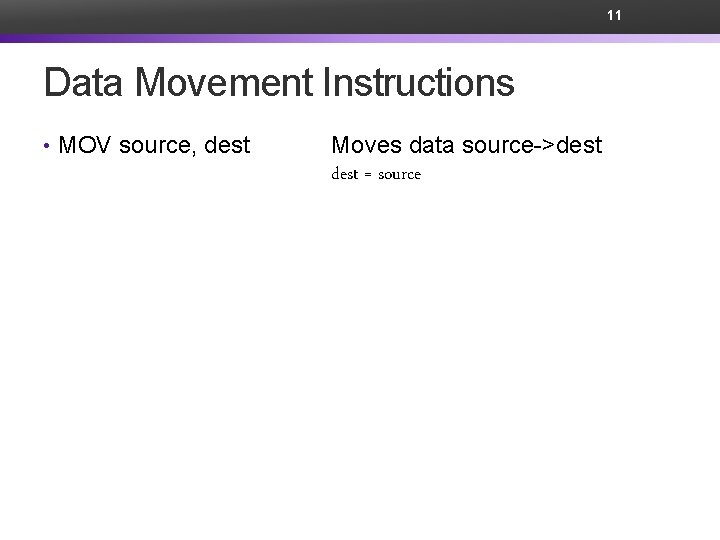
11 Data Movement Instructions • MOV source, dest Moves data source->dest = source
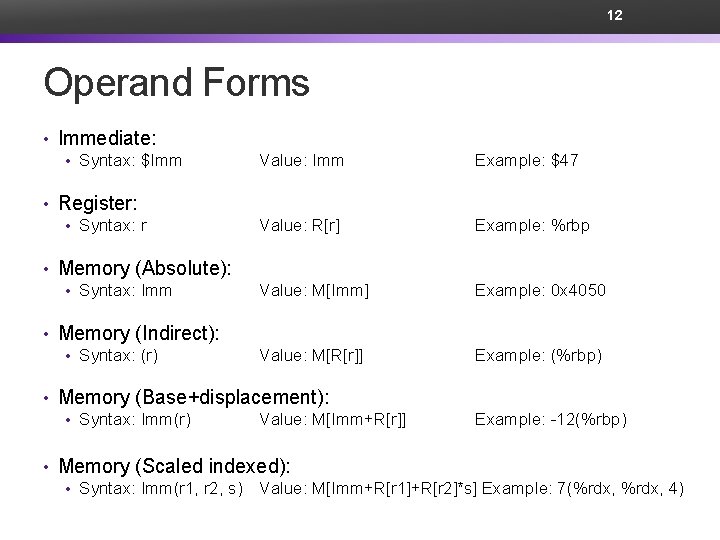
12 Operand Forms • Immediate: • Syntax: $Imm Value: Imm Example: $47 • Register: • Syntax: r Value: R[r] Example: %rbp • Memory (Absolute): • Syntax: Imm Value: M[Imm] Example: 0 x 4050 • Memory (Indirect): • Syntax: (r) Value: M[R[r]] Example: (%rbp) • Memory (Base+displacement): • Syntax: Imm(r) Value: M[Imm+R[r]] Example: -12(%rbp) • Memory (Scaled indexed): • Syntax: Imm(r 1, r 2, s) Value: M[Imm+R[r 1]+R[r 2]*s] Example: 7(%rdx, 4)
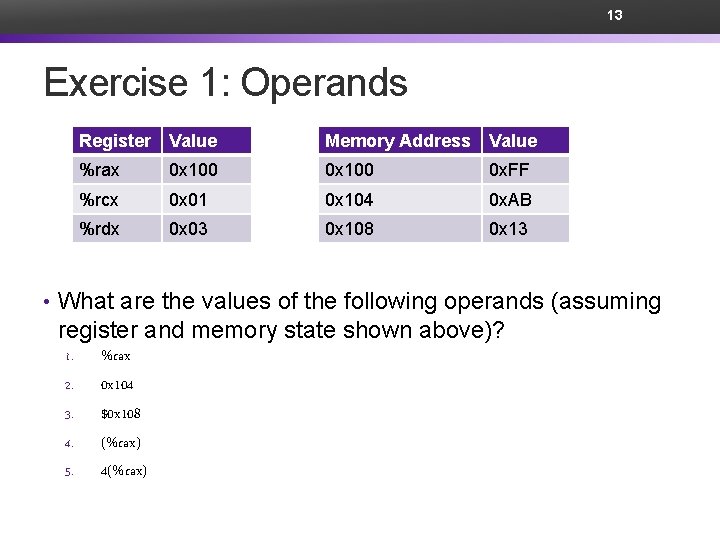
13 Exercise 1: Operands Register Value Memory Address Value %rax 0 x 100 0 x. FF %rcx 0 x 01 0 x 104 0 x. AB %rdx 0 x 03 0 x 108 0 x 13 • What are the values of the following operands (assuming register and memory state shown above)? 1. 2. 3. 4. 5. %rax 0 x 104 $0 x 108 (%rax) 4(%rax)
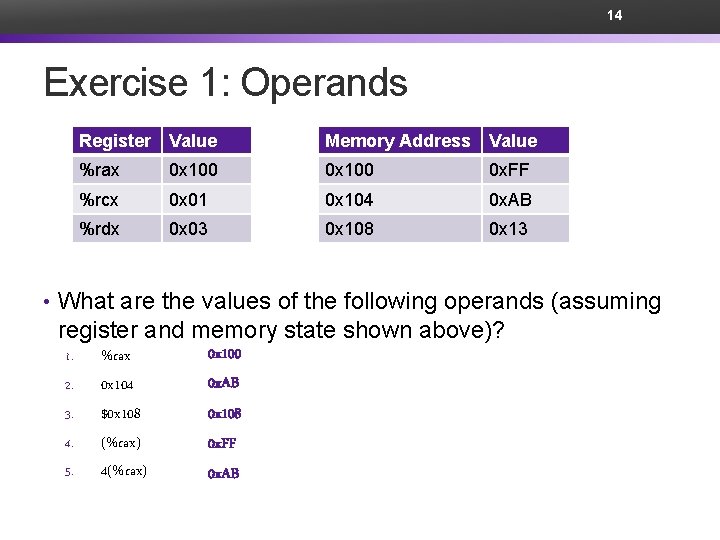
14 Exercise 1: Operands Register Value Memory Address Value %rax 0 x 100 0 x. FF %rcx 0 x 01 0 x 104 0 x. AB %rdx 0 x 03 0 x 108 0 x 13 • What are the values of the following operands (assuming register and memory state shown above)? 1. 2. 3. 4. 5. %rax 0 x 104 $0 x 108 (%rax) 4(%rax) 0 x 100 0 x. AB 0 x 108 0 x. FF 0 x. AB
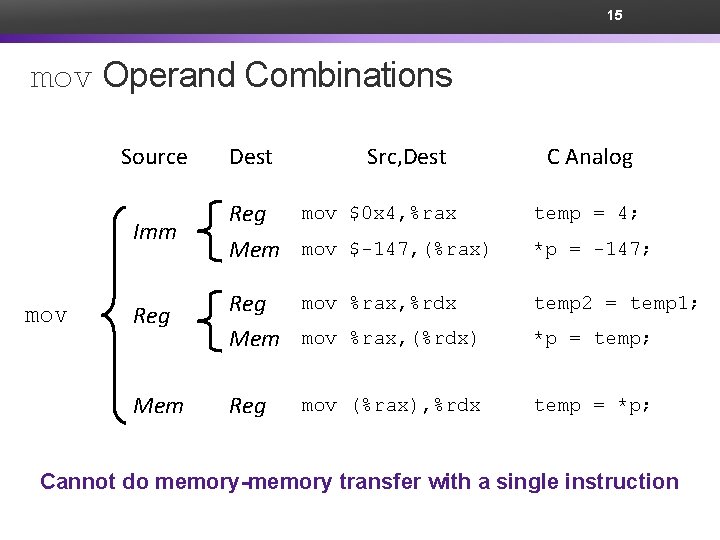
15 mov Operand Combinations Source mov Dest Src, Dest C Analog Imm Reg mov $0 x 4, %rax Mem mov $-147, (%rax) temp = 4; Reg mov %rax, %rdx Mem mov %rax, (%rdx) temp 2 = temp 1; Mem Reg temp = *p; mov (%rax), %rdx *p = -147; *p = temp; Cannot do memory-memory transfer with a single instruction
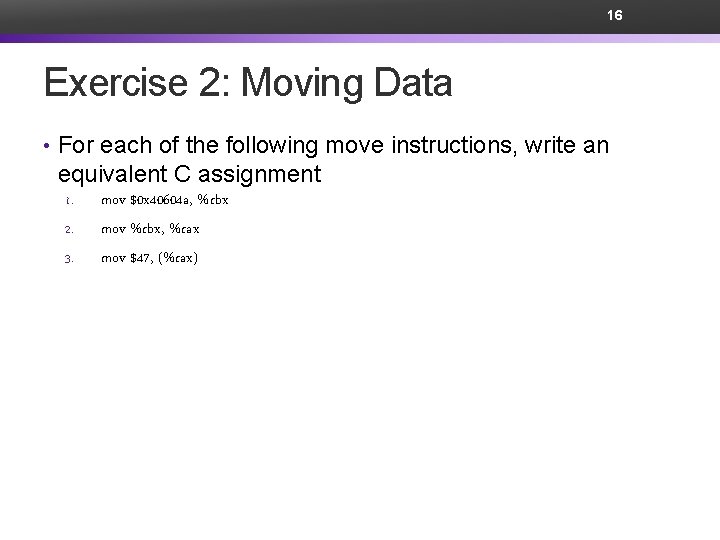
16 Exercise 2: Moving Data • For each of the following move instructions, write an equivalent C assignment 1. 2. 3. mov $0 x 40604 a, %rbx mov %rbx, %rax mov $47, (%rax)
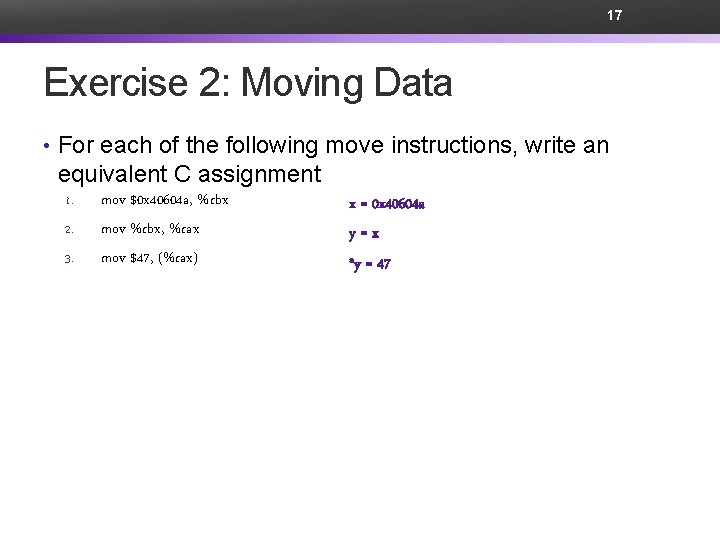
17 Exercise 2: Moving Data • For each of the following move instructions, write an equivalent C assignment 1. 2. 3. mov $0 x 40604 a, %rbx mov %rbx, %rax mov $47, (%rax) x = 0 x 40604 a y=x *y = 47
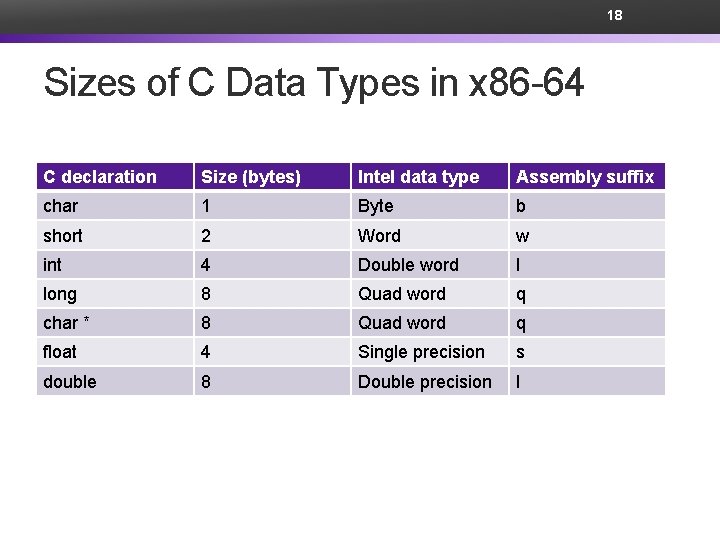
18 Sizes of C Data Types in x 86 -64 C declaration Size (bytes) Intel data type Assembly suffix char 1 Byte b short 2 Word w int 4 Double word l long 8 Quad word q char * 8 Quad word q float 4 Single precision s double 8 Double precision l
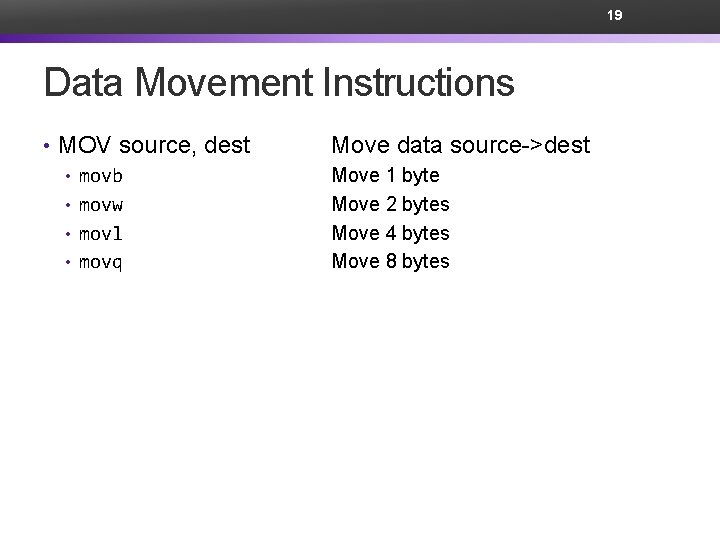
19 Data Movement Instructions • MOV source, dest • movb • movw • movl • movq Move data source->dest Move 1 byte Move 2 bytes Move 4 bytes Move 8 bytes
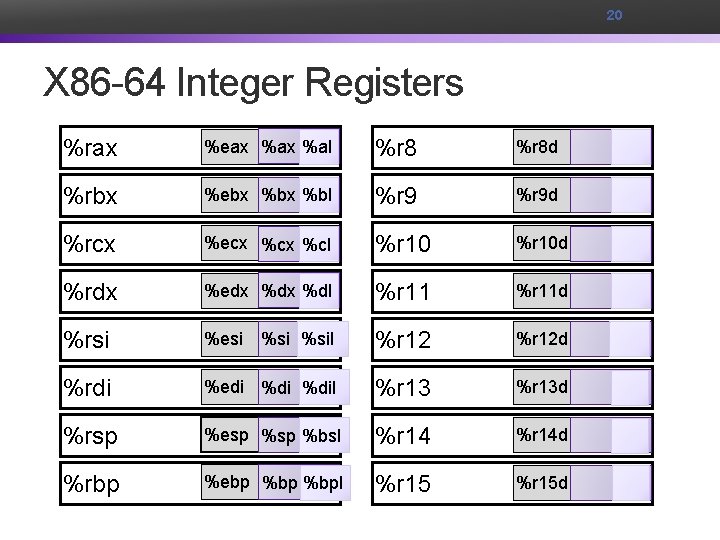
20 X 86 -64 Integer Registers %rax %eax %al %r 8 d %rbx %ebx %bl %r 9 d %rcx %ecx %cl %r 10 d %rdx %edx %dl %r 11 d %rsi %esi %sil %r 12 d %rdi %edi %dil %r 13 d %rsp %esp %bsl %r 14 d %rbp %ebp %bpl %r 15 d
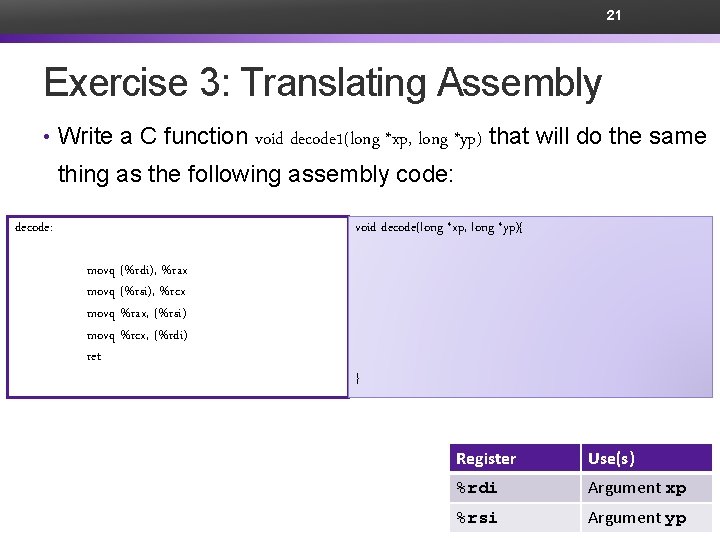
21 Exercise 3: Translating Assembly • Write a C function void decode 1(long *xp, long *yp) that will do the same thing as the following assembly code: decode: void decode(long *xp, long *yp){ movq (%rdi), %rax movq (%rsi), %rcx movq %rax, (%rsi) movq %rcx, (%rdi) ret } Register Use(s) %rdi Argument xp %rsi Argument yp
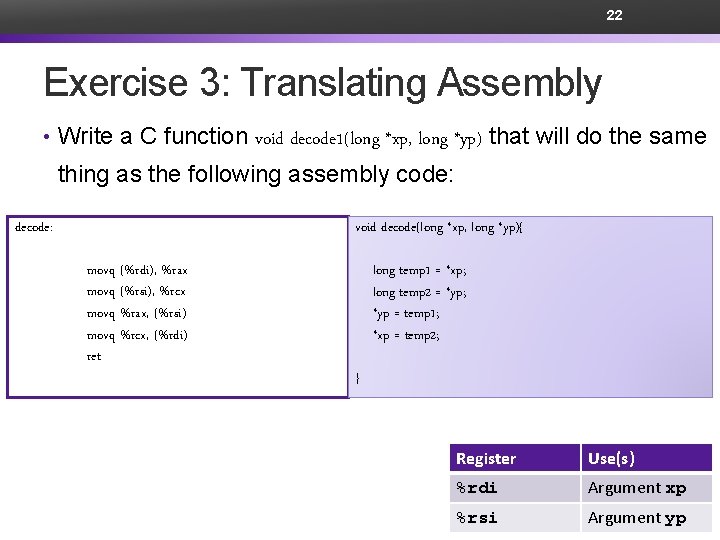
22 Exercise 3: Translating Assembly • Write a C function void decode 1(long *xp, long *yp) that will do the same thing as the following assembly code: decode: void decode(long *xp, long *yp){ movq (%rdi), %rax movq (%rsi), %rcx movq %rax, (%rsi) movq %rcx, (%rdi) ret long temp 1 = *xp; long temp 2 = *yp; *yp = temp 1; *xp = temp 2; } Register Use(s) %rdi Argument xp %rsi Argument yp
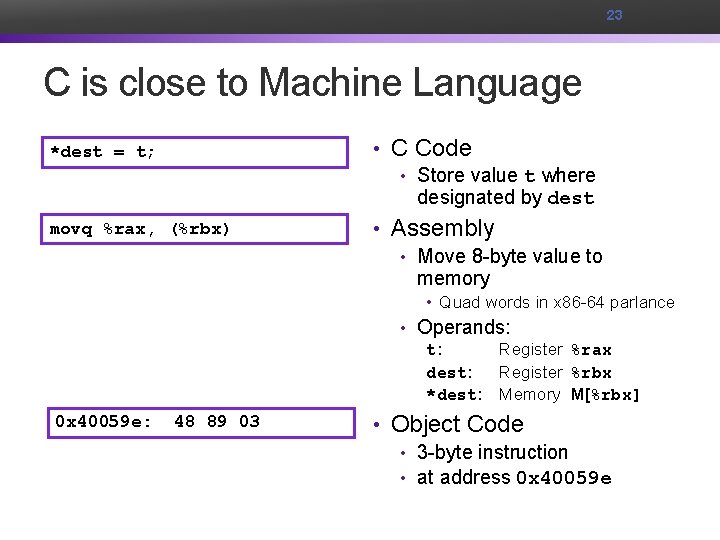
23 C is close to Machine Language *dest = t; • C Code • Store value t where designated by dest movq %rax, (%rbx) • Assembly • Move 8 -byte value to memory • Quad words in x 86 -64 parlance • Operands: t: Register %rax dest: Register %rbx *dest: Memory M[%rbx] 0 x 40059 e: 48 89 03 • Object Code • 3 -byte instruction • at address 0 x 40059 e
24 ARITHMETIC IN ASSEMBLY
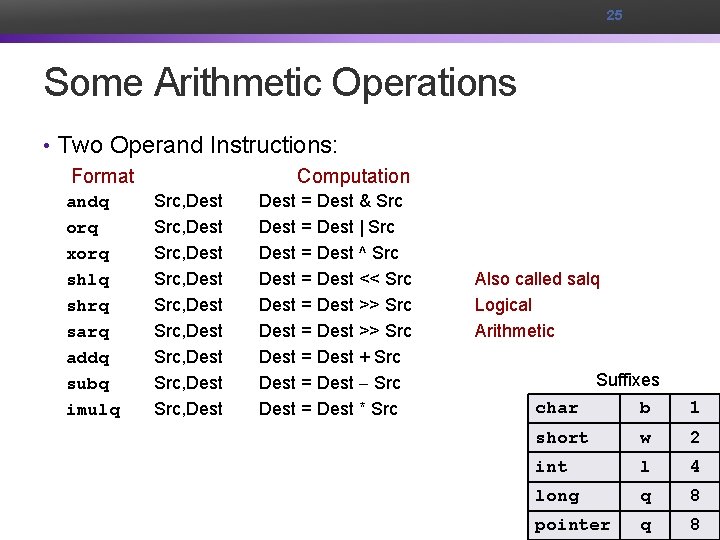
25 Some Arithmetic Operations • Two Operand Instructions: Format Computation andq orq xorq shlq shrq sarq addq subq imulq Src, Dest Src, Dest Src, Dest = Dest & Src Dest = Dest | Src Dest = Dest ^ Src Dest = Dest << Src Dest = Dest >> Src Dest = Dest + Src Dest = Dest * Src Also called salq Logical Arithmetic Suffixes char b 1 short w 2 int l 4 long q 8 pointer q 8
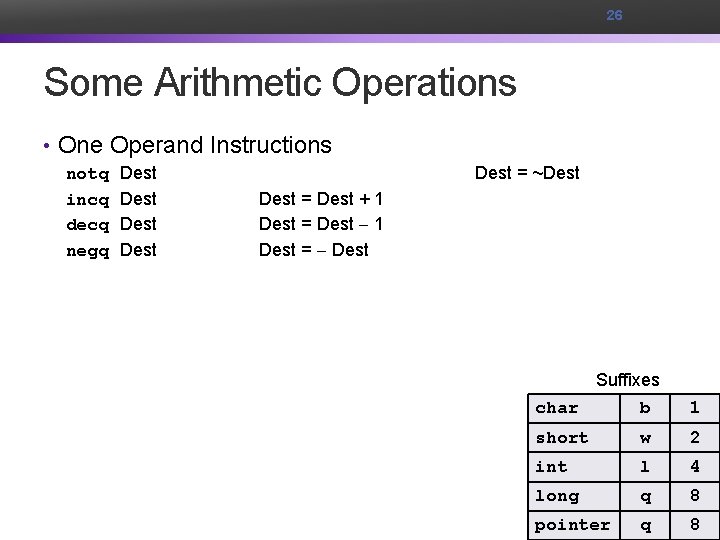
26 Some Arithmetic Operations • One Operand Instructions notq Dest incq Dest decq Dest negq Dest = ~Dest = Dest + 1 Dest = Dest 1 Dest = Dest Suffixes char b 1 short w 2 int l 4 long q 8 pointer q 8
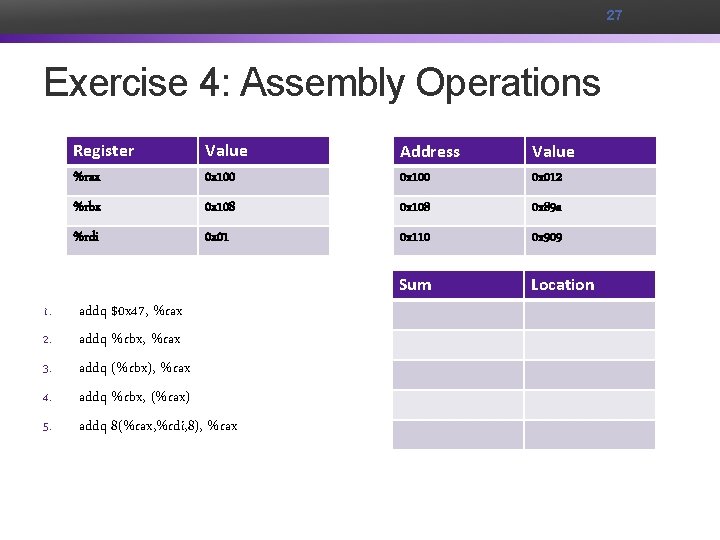
27 Exercise 4: Assembly Operations 1. 2. 3. 4. 5. Register %rax Value 0 x 100 Address 0 x 100 Value 0 x 012 %rbx 0 x 108 0 x 89 a %rdi 0 x 01 0 x 110 0 x 909 Sum Location addq $0 x 47, %rax addq %rbx, %rax addq (%rbx), %rax addq %rbx, (%rax) addq 8(%rax, %rdi, 8), %rax
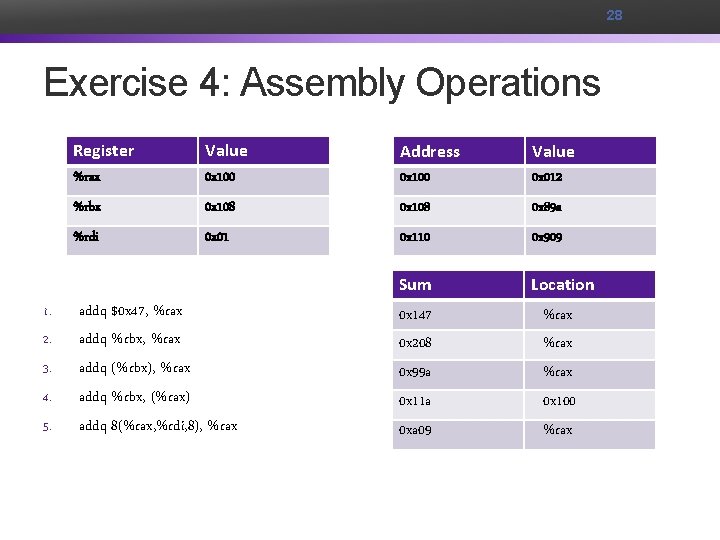
28 Exercise 4: Assembly Operations 1. 2. 3. 4. 5. Register %rax Value 0 x 100 Address 0 x 100 Value 0 x 012 %rbx 0 x 108 0 x 89 a %rdi 0 x 01 0 x 110 0 x 909 Sum Location 0 x 147 0 x 208 0 x 99 a 0 x 11 a 0 xa 09 %rax 0 x 100 %rax addq $0 x 47, %rax addq %rbx, %rax addq (%rbx), %rax addq %rbx, (%rax) addq 8(%rax, %rdi, 8), %rax
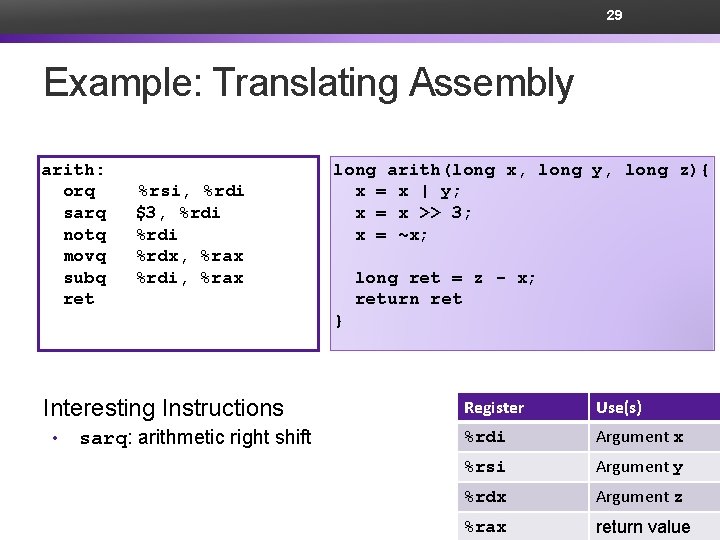
29 Example: Translating Assembly arith: orq %rsi, %rdi sarq $3, %rdi notq %rdi movq %rdx, %rax subq %rdi, %rax ret Interesting Instructions • sarq: arithmetic right shift long arith(long x, long y, long z){ x = x | y; x = x >> 3; x = ~x; long ret = z - x; return ret } Register Use(s) %rdi Argument x %rsi Argument y %rdx Argument z %rax return value
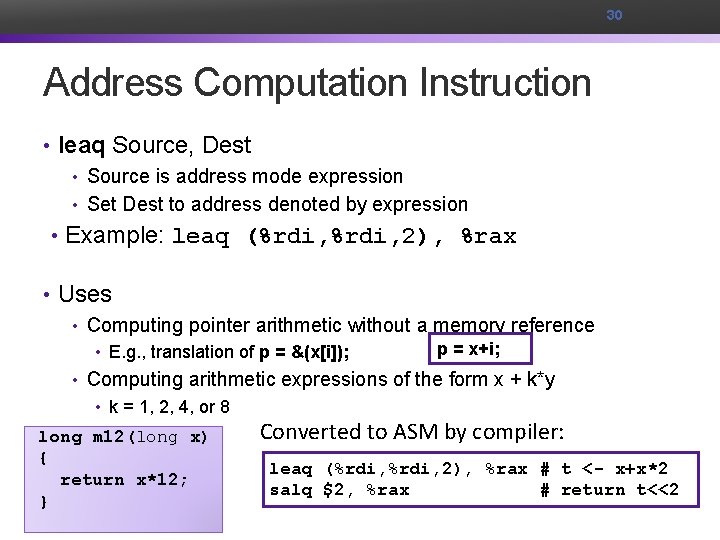
30 Address Computation Instruction • leaq Source, Dest • Source is address mode expression • Set Dest to address denoted by expression • Example: leaq (%rdi, 2), %rax • Uses • Computing pointer arithmetic without a memory reference • E. g. , translation of p = &(x[i]); p = x+i; • Computing arithmetic expressions of the form x + k*y • k = 1, 2, 4, or 8 long m 12(long x) • Example { return x*12; } Converted to ASM by compiler: leaq (%rdi, 2), %rax # t <- x+x*2 salq $2, %rax # return t<<2

31 Exercise 5: Translating Assembly arith: leaq (%rdi, %rsi), %rax addq %rdx, %rax leaq (%rsi, 2), %rdx salq $4, %rdx leaq 4(%rdi, %rdx), %rcx imulq %rcx, %rax ret long arith(long x, long y, long z){ } Interesting Instructions • • • leaq: address computation salq: shift imulq: multiplication • But, only used once Register Use(s) %rdi Argument x %rsi Argument y %rdx Argument z %rax return value
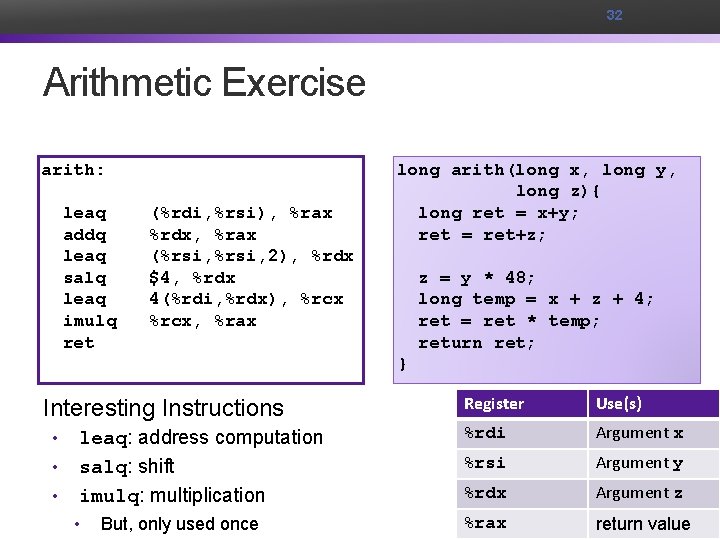
32 Arithmetic Exercise arith: leaq (%rdi, %rsi), %rax addq %rdx, %rax leaq (%rsi, 2), %rdx salq $4, %rdx leaq 4(%rdi, %rdx), %rcx imulq %rcx, %rax ret Interesting Instructions • • • leaq: address computation salq: shift imulq: multiplication • But, only used once long arith(long x, long y, long z){ long ret = x+y; ret = ret+z; z = y * 48; long temp = x + z + 4; ret = ret * temp; return ret; } Register Use(s) %rdi Argument x %rsi Argument y %rdx Argument z %rax return value
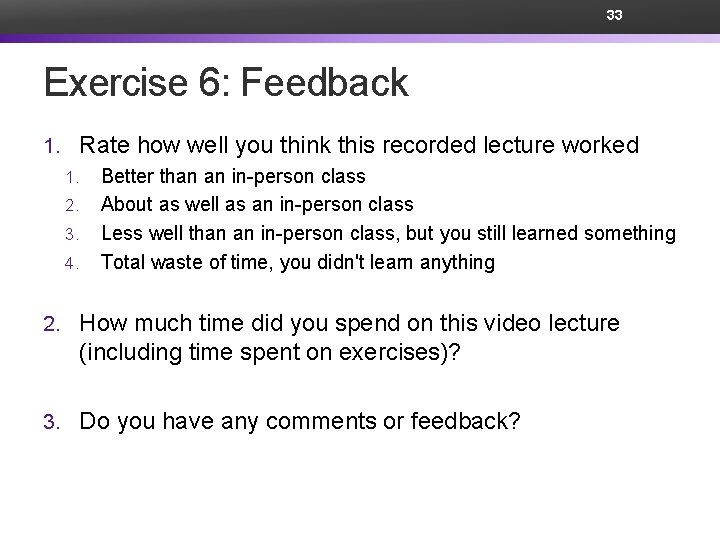
33 Exercise 6: Feedback 1. Rate how well you think this recorded lecture worked 1. Better than an in-person class 2. About as well as an in-person class 3. Less well than an in-person class, but you still learned something 4. Total waste of time, you didn't learn anything 2. How much time did you spend on this video lecture (including time spent on exercises)? 3. Do you have any comments or feedback?
- Slides: 31