
1 Last update 7 May 2005 Object Oriented
1 Last update: 7 May 2005 Object Oriented Software Construction Prof. Dr. Bertrand Meyer Lecture 9: Introduction to Patterns, Model View Controller and Observer Pattern Till G. Bay Chair of Software Engineering OOSC - Summer Semester 2005
Introduction to Patterns, Model View Controller and Observer Pattern § § What is a Pattern? Model View Controller Pattern Observer Pattern Event Library Chair of Software Engineering OOSC - Summer Semester 2005 2
Design pattern: Gang of Four’s description “A design pattern names, abstracts, and identifies the key aspects of a common design structure that make it useful for creating a reusable objectoriented design. ” Erich Gamma et al. , Design Patterns: Elements of Reusable Object-Oriented Software, 1995, p 3. Chair of Software Engineering OOSC - Summer Semester 2005 3
Design pattern: A definition A design pattern is a set of domain-independent architectural ideas — typically a design scheme describing some classes involved and the collaboration between their instances — captured from real-world systems that programmers can learn and apply to their software in response to a specific problem. Karine Arnout, From Patterns to Components, 2004 Chair of Software Engineering OOSC - Summer Semester 2005 4
Description of a design pattern A design pattern is given by one or more of § A description of the pattern’s intent § Use cases § A software architecture for typical implementations Chair of Software Engineering OOSC - Summer Semester 2005 5
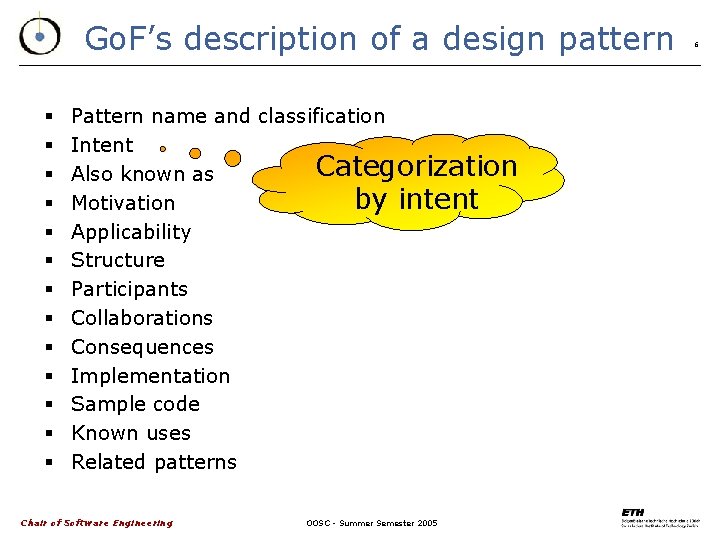
Go. F’s description of a design pattern § § § § Pattern name and classification Intent Categorization Also known as by intent Motivation Applicability Structure Participants Collaborations Consequences Implementation Sample code Known uses Related patterns Chair of Software Engineering OOSC - Summer Semester 2005 6
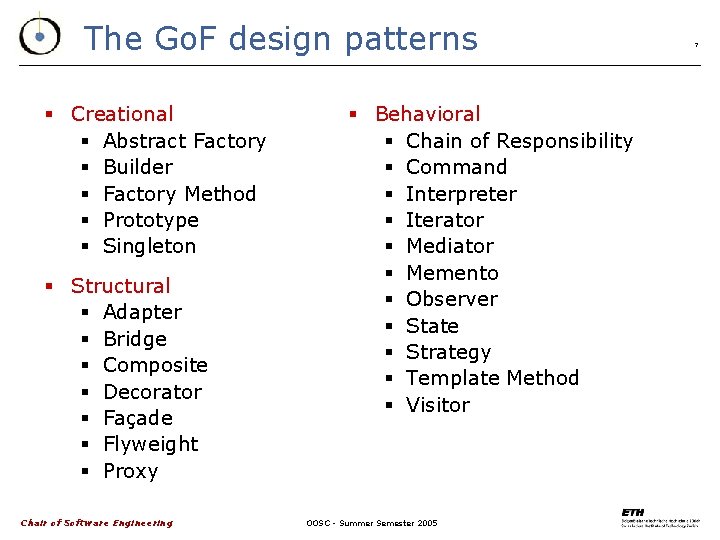
The Go. F design patterns § Creational § Abstract Factory § Builder § Factory Method § Prototype § Singleton § Structural § Adapter § Bridge § Composite § Decorator § Façade § Flyweight § Proxy Chair of Software Engineering § Behavioral § Chain of Responsibility § Command § Interpreter § Iterator § Mediator § Memento § Observer § State § Strategy § Template Method § Visitor OOSC - Summer Semester 2005 7
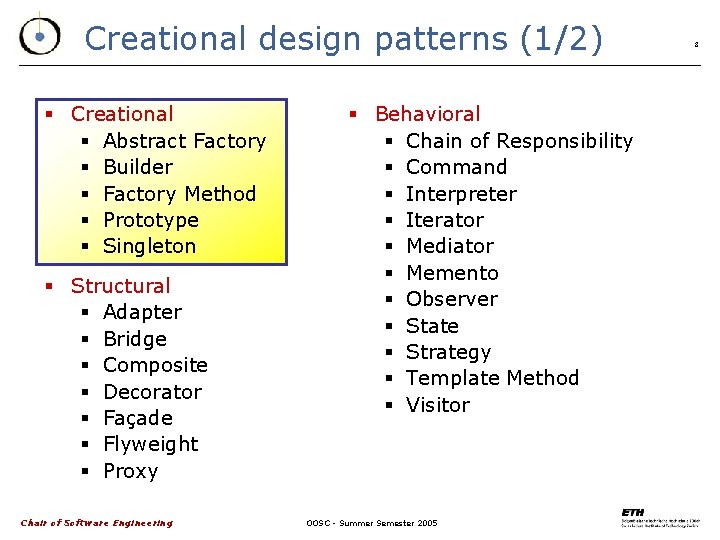
Creational design patterns (1/2) § Creational § Abstract Factory § Builder § Factory Method § Prototype § Singleton § Structural § Adapter § Bridge § Composite § Decorator § Façade § Flyweight § Proxy Chair of Software Engineering § Behavioral § Chain of Responsibility § Command § Interpreter § Iterator § Mediator § Memento § Observer § State § Strategy § Template Method § Visitor OOSC - Summer Semester 2005 8
Creational design patterns (2/2) § Goal: § Put more flexibility into the instantiation process § How: § Through inheritance or delegation § What: § Defer parts of object creation Chair of Software Engineering OOSC - Summer Semester 2005 9
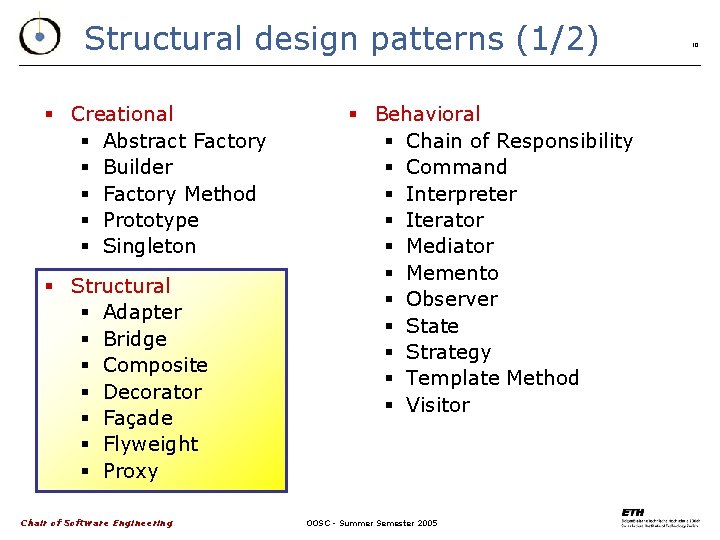
Structural design patterns (1/2) § Creational § Abstract Factory § Builder § Factory Method § Prototype § Singleton § Structural § Adapter § Bridge § Composite § Decorator § Façade § Flyweight § Proxy Chair of Software Engineering § Behavioral § Chain of Responsibility § Command § Interpreter § Iterator § Mediator § Memento § Observer § State § Strategy § Template Method § Visitor OOSC - Summer Semester 2005 10
Structural design patterns (2/2) § Goal: § Compose software elements into bigger structures § How: § Through inheritance (static binding) or composition (flexibility) Chair of Software Engineering OOSC - Summer Semester 2005 11
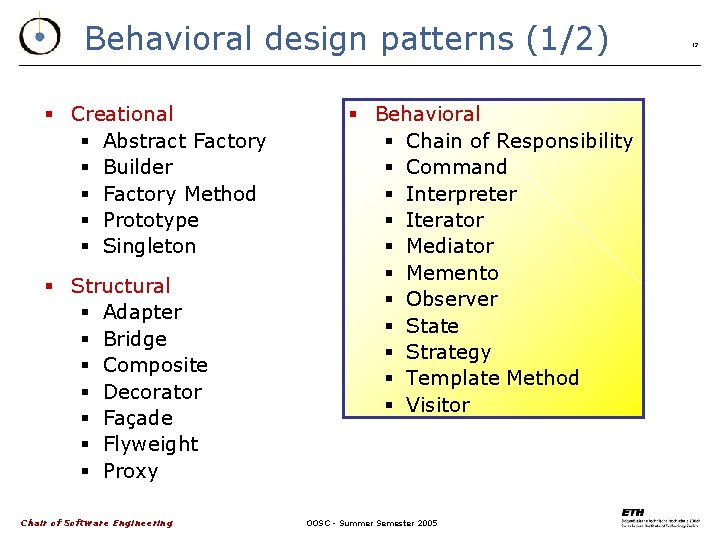
Behavioral design patterns (1/2) § Creational § Abstract Factory § Builder § Factory Method § Prototype § Singleton § Structural § Adapter § Bridge § Composite § Decorator § Façade § Flyweight § Proxy Chair of Software Engineering § Behavioral § Chain of Responsibility § Command § Interpreter § Iterator § Mediator § Memento § Observer § State § Strategy § Template Method § Visitor OOSC - Summer Semester 2005 12
Behavioral design patterns (2/2) § Deal with: § Algorithms § Assignment of responsibilities between objects § Communication between objects § How: § Through inheritance or composition Chair of Software Engineering OOSC - Summer Semester 2005 13
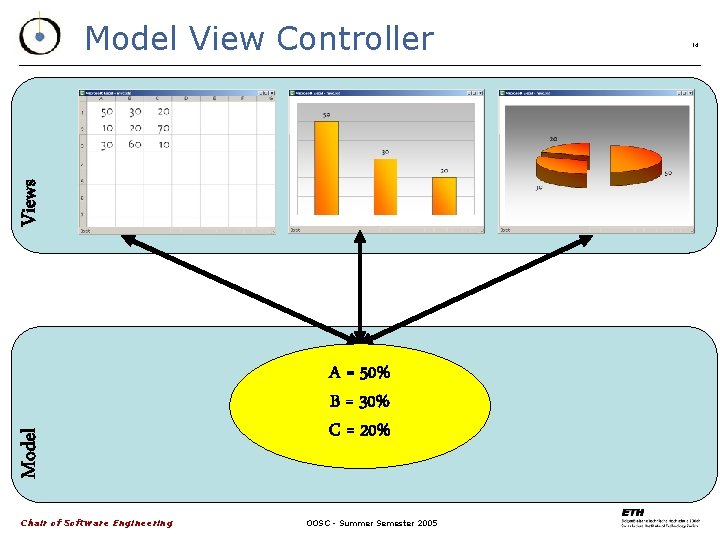
Model View Controller Model Views VIEW Chair of Software Engineering A = 50% B = 30% C = 20% OOSC - Summer Semester 2005 14
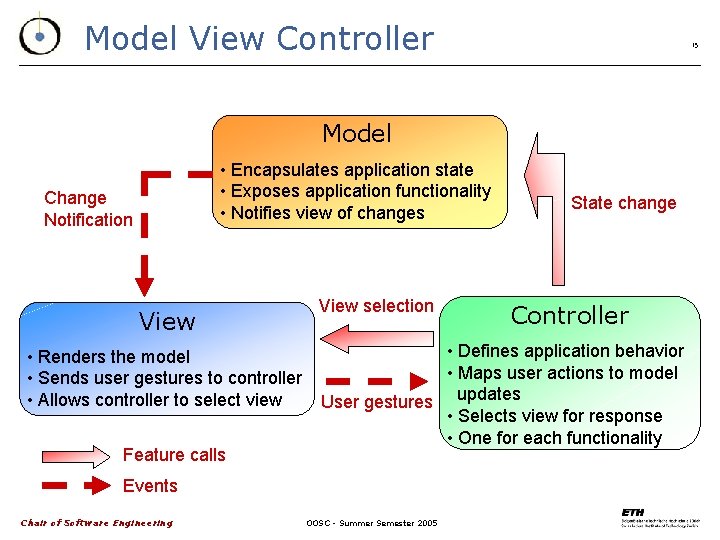
Model View Controller 15 Model • Encapsulates application state • Exposes application functionality • Notifies view of changes Change Notification View • Renders the model • Sends user gestures to controller • Allows controller to select view Feature calls View selection Controller • Defines application behavior • Maps user actions to model User gestures updates • Selects view for response • One for each functionality Events Chair of Software Engineering State change OOSC - Summer Semester 2005
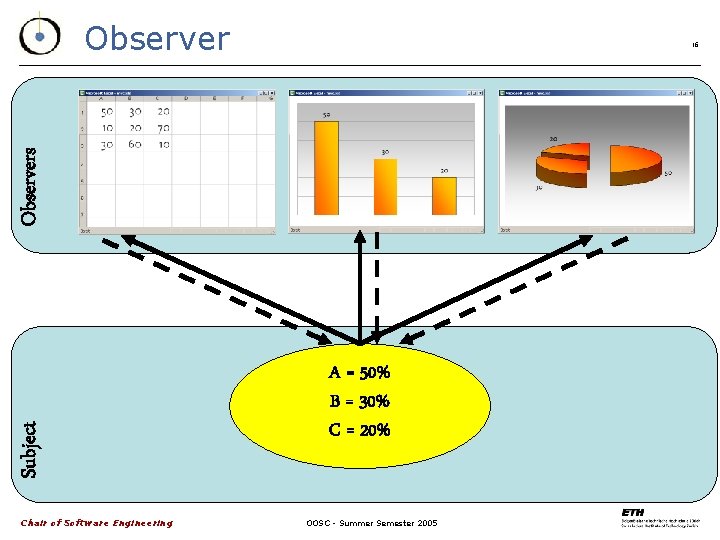
Subject Observers Observer Chair of Software Engineering 16 VIEW A = 50% B = 30% C = 20% OOSC - Summer Semester 2005
![Observer pattern 17 “Define[s] a one-to-many dependency between objects so that when one object](http://slidetodoc.com/presentation_image_h2/b2c9426c578cf1d3aed1b2851587dc5d/image-17.jpg "Observer pattern 17 “Define[s] a one-to-many dependency between objects so that when one object")
Observer pattern 17 “Define[s] a one-to-many dependency between objects so that when one object changes state, all its dependents are notified and updated automatically. ” [Go. F, p 293] * OBSERVER observers * SUBJECT update* add_observer* remove_observer* notify_observers* + MY_OBSERVER update+ + MY_SUBJECT subject add_observer+ remove_observer+ notify_observers+ Chair of Software Engineering OOSC - Summer Semester 2005
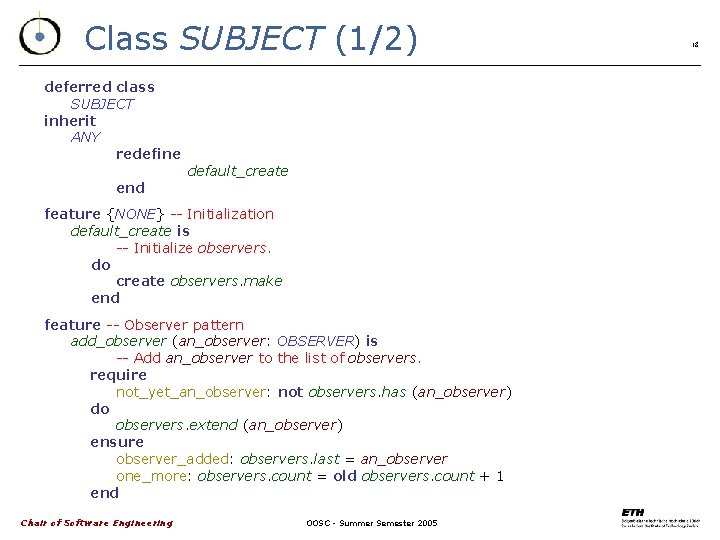
Class SUBJECT (1/2) deferred class SUBJECT inherit ANY redefine end default_create feature {NONE} -- Initialization default_create is -- Initialize observers. do create observers. make end feature -- Observer pattern add_observer (an_observer: OBSERVER) is -- Add an_observer to the list of observers. require not_yet_an_observer: not observers. has (an_observer) do observers. extend (an_observer) ensure observer_added: observers. last = an_observer one_more: observers. count = old observers. count + 1 end Chair of Software Engineering OOSC - Summer Semester 2005 18
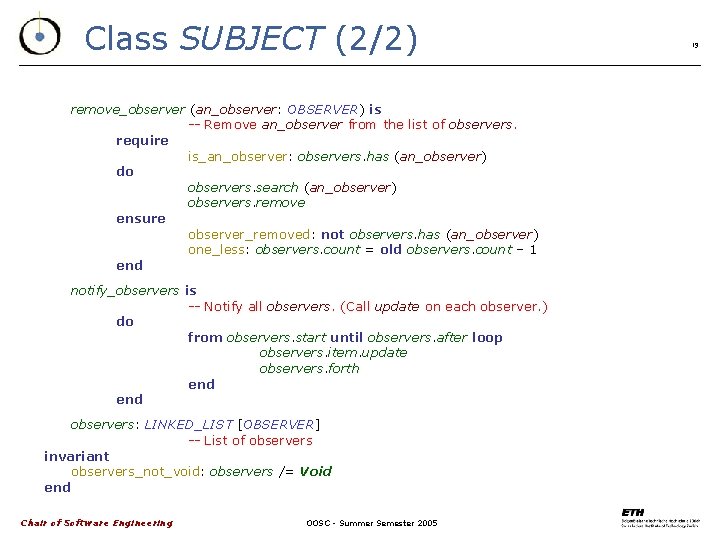
Class SUBJECT (2/2) remove_observer (an_observer: OBSERVER) is -- Remove an_observer from the list of observers. require is_an_observer: observers. has (an_observer) do observers. search (an_observer) observers. remove ensure observer_removed: not observers. has (an_observer) one_less: observers. count = old observers. count – 1 end notify_observers is -- Notify all observers. (Call update on each observer. ) do from observers. start until observers. after loop observers. item. update observers. forth end observers: LINKED_LIST [OBSERVER] -- List of observers invariant observers_not_void: observers /= Void end Chair of Software Engineering OOSC - Summer Semester 2005 19
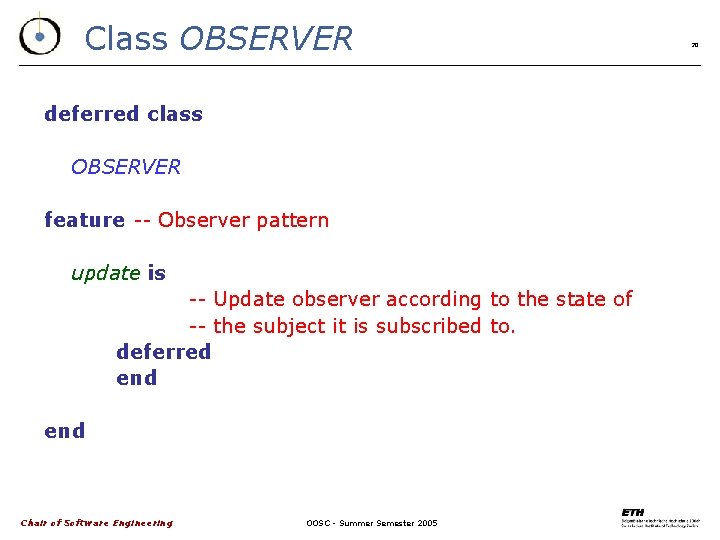
Class OBSERVER deferred class OBSERVER feature -- Observer pattern update is -- Update observer according to the state of -- the subject it is subscribed to. deferred end Chair of Software Engineering OOSC - Summer Semester 2005 20
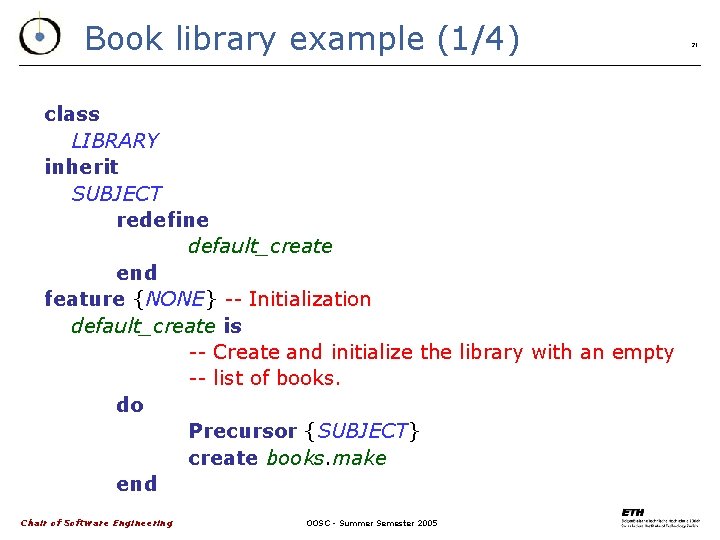
Book library example (1/4) class LIBRARY inherit SUBJECT redefine default_create end feature {NONE} -- Initialization default_create is -- Create and initialize the library with an empty -- list of books. do Precursor {SUBJECT} create books. make end Chair of Software Engineering OOSC - Summer Semester 2005 21
![Book library example (2/4) 22 feature -- Access books: LINKED_LIST [BOOKS] -- Books currently](http://slidetodoc.com/presentation_image_h2/b2c9426c578cf1d3aed1b2851587dc5d/image-22.jpg "Book library example (2/4) 22 feature -- Access books: LINKED_LIST [BOOKS] -- Books currently")
Book library example (2/4) 22 feature -- Access books: LINKED_LIST [BOOKS] -- Books currently in the library feature -- Element change add_book (a_book: BOOK) is -- Add a_book to the list of books and notify all library observers. require a_book_not_void: a_book /= Void not_yet_in_library: not books. has (a_book) do books. extend (a_book) notify_observers ensure one_more: books. count = old books. count + 1 book_added: books. last = a_book end. . . invariant books_not_void: books /= Void no_void_book: not books. has (Void) end Chair of Software Engineering OOSC - Summer Semester 2005
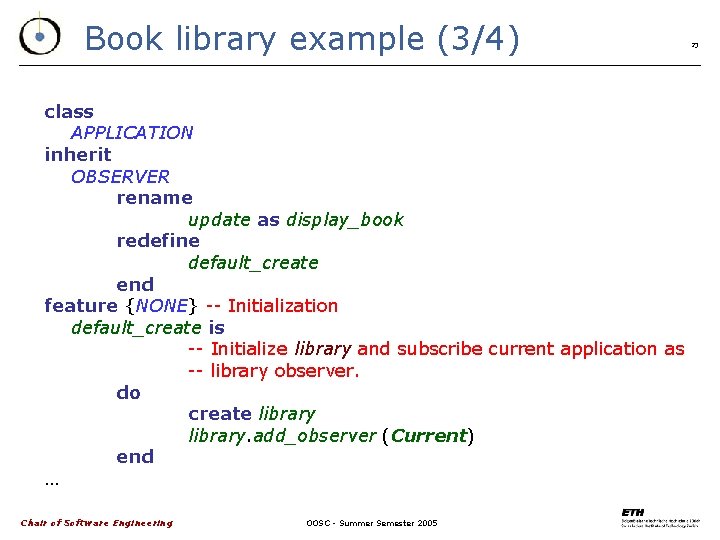
Book library example (3/4) class APPLICATION inherit OBSERVER rename update as display_book redefine default_create end feature {NONE} -- Initialization default_create is -- Initialize library and subscribe current application as -- library observer. do create library. add_observer (Current) end … Chair of Software Engineering OOSC - Summer Semester 2005 23
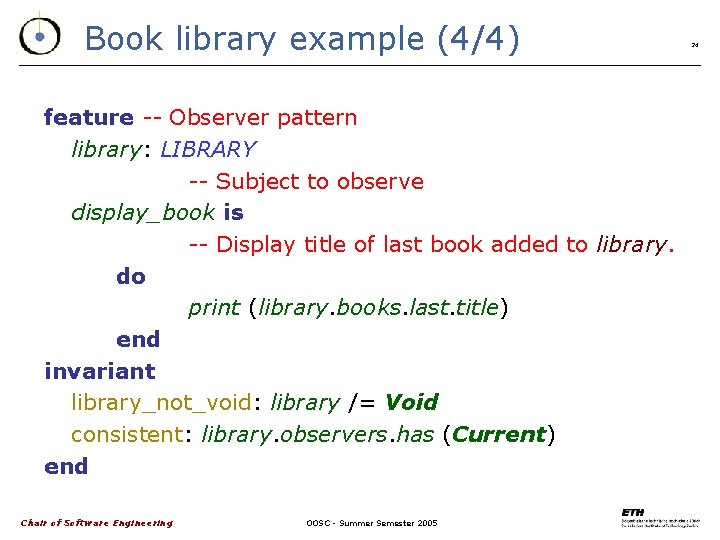
Book library example (4/4) feature -- Observer pattern library: LIBRARY -- Subject to observe display_book is -- Display title of last book added to library. do print (library. books. last. title) end invariant library_not_void: library /= Void consistent: library. observers. has (Current) end Chair of Software Engineering OOSC - Summer Semester 2005 24
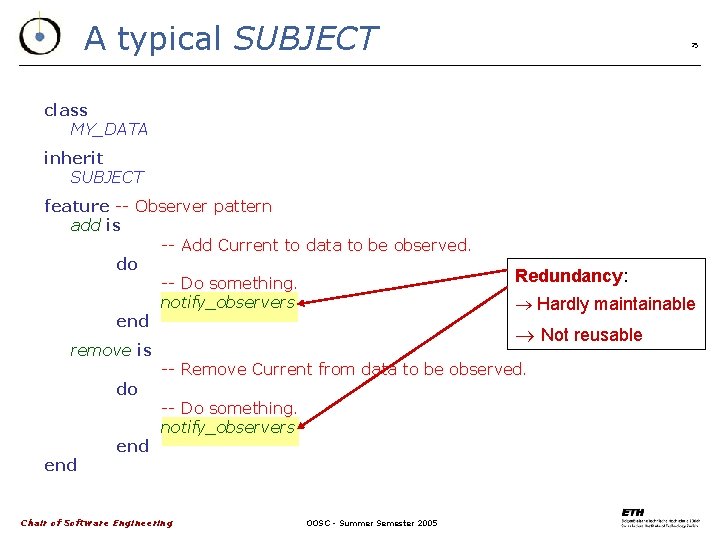
A typical SUBJECT 25 class MY_DATA inherit SUBJECT feature -- Observer pattern add is -- Add Current to data to be observed. do -- Do something. notify_observers end remove is do end Redundancy: Hardly maintainable Not reusable -- Remove Current from data to be observed. -- Do something. notify_observers Chair of Software Engineering OOSC - Summer Semester 2005
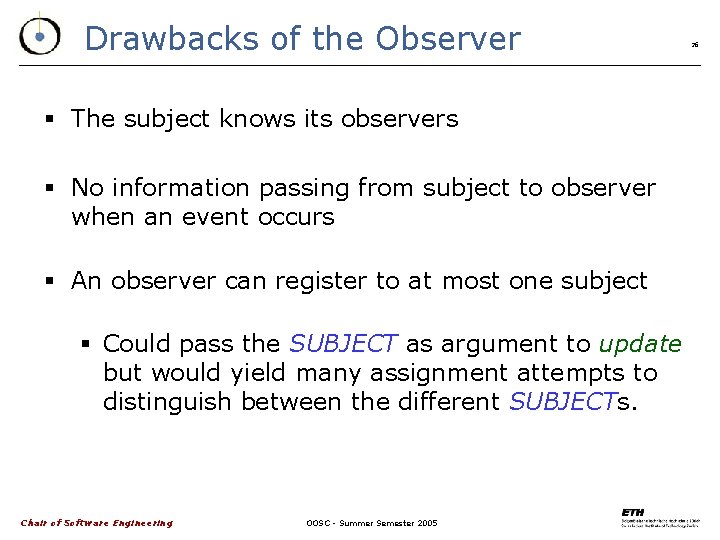
Drawbacks of the Observer § The subject knows its observers § No information passing from subject to observer when an event occurs § An observer can register to at most one subject § Could pass the SUBJECT as argument to update but would yield many assignment attempts to distinguish between the different SUBJECTs. Chair of Software Engineering OOSC - Summer Semester 2005 26
Event Library 27 § Basically: § One generic class: EVENT_TYPE § Two features: publish and subscribe § For example: A button my_button that reacts in a way defined in my_procedure when clicked (event mouse_click): Chair of Software Engineering OOSC - Summer Semester 2005
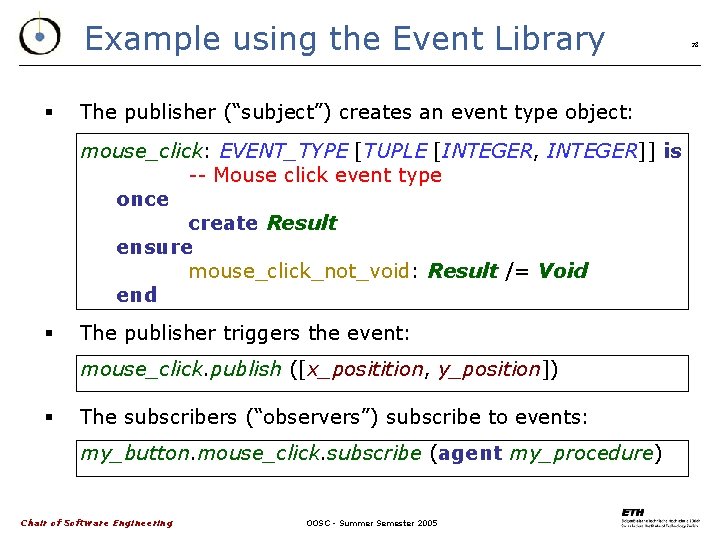
Example using the Event Library § The publisher (“subject”) creates an event type object: mouse_click: EVENT_TYPE [TUPLE [INTEGER, INTEGER]] is -- Mouse click event type once create Result ensure mouse_click_not_void: Result /= Void end § The publisher triggers the event: mouse_click. publish ([x_positition, y_position]) § The subscribers (“observers”) subscribe to events: my_button. mouse_click. subscribe (agent my_procedure) Chair of Software Engineering OOSC - Summer Semester 2005 28
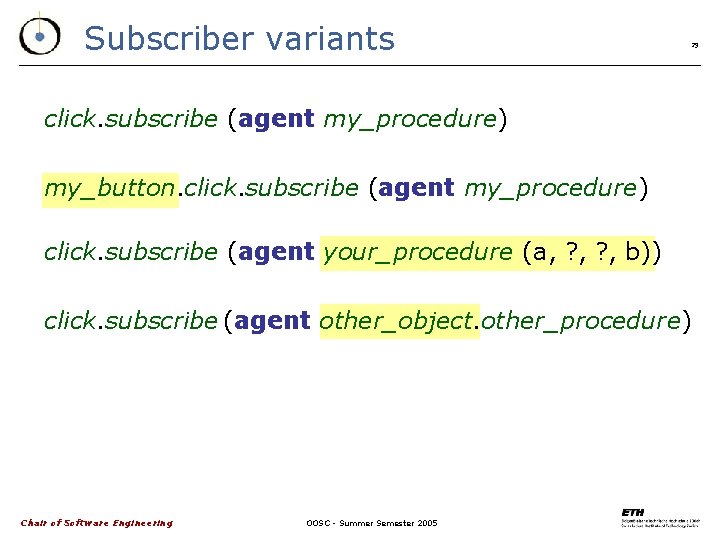
Subscriber variants 29 click. subscribe (agent my_procedure) my_button. click. subscribe (agent my_procedure) click. subscribe (agent your_procedure (a, ? , b)) click. subscribe (agent other_object. other_procedure) Chair of Software Engineering OOSC - Summer Semester 2005
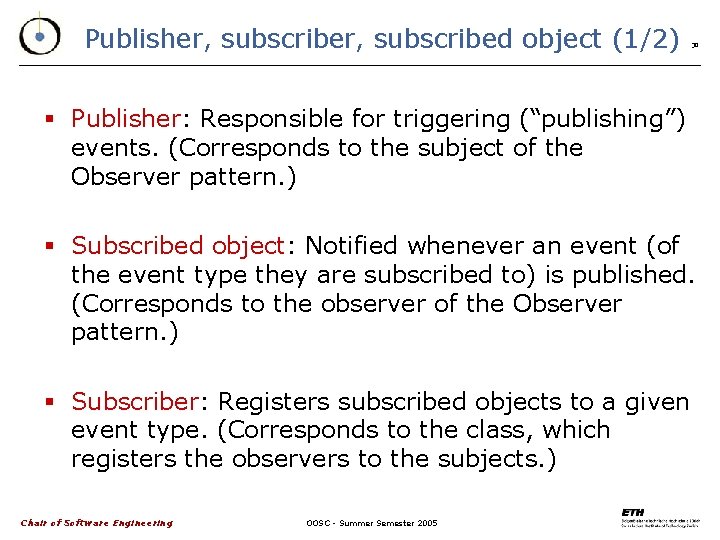
Publisher, subscribed object (1/2) 30 § Publisher: Responsible for triggering (“publishing”) events. (Corresponds to the subject of the Observer pattern. ) § Subscribed object: Notified whenever an event (of the event type they are subscribed to) is published. (Corresponds to the observer of the Observer pattern. ) § Subscriber: Registers subscribed objects to a given event type. (Corresponds to the class, which registers the observers to the subjects. ) Chair of Software Engineering OOSC - Summer Semester 2005
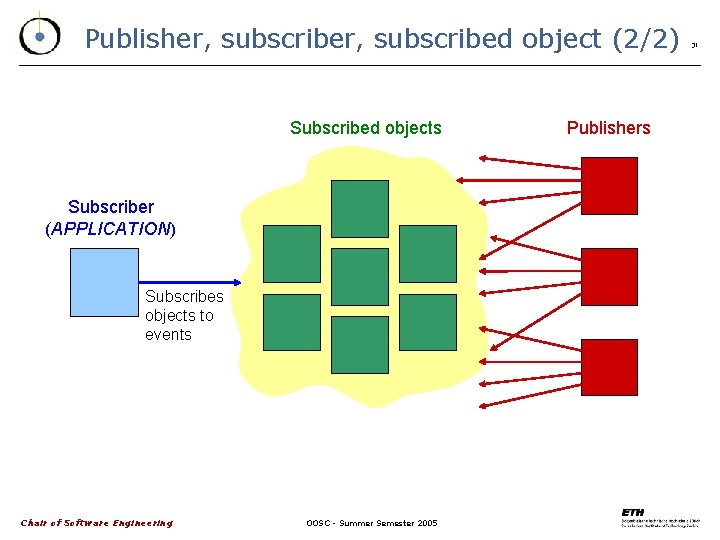
Publisher, subscribed object (2/2) Subscribed objects Subscriber (APPLICATION) Subscribes objects to events Chair of Software Engineering OOSC - Summer Semester 2005 Publishers 31
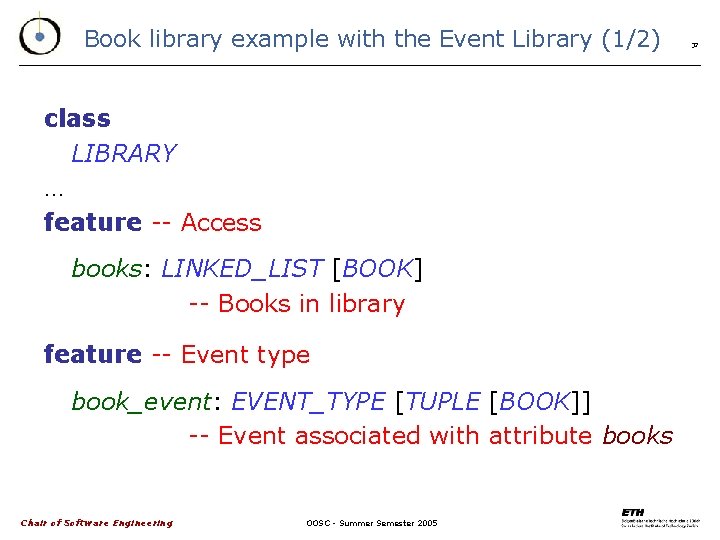
Book library example with the Event Library (1/2) class LIBRARY … feature -- Access books: LINKED_LIST [BOOK] -- Books in library feature -- Event type book_event: EVENT_TYPE [TUPLE [BOOK]] -- Event associated with attribute books Chair of Software Engineering OOSC - Summer Semester 2005 32
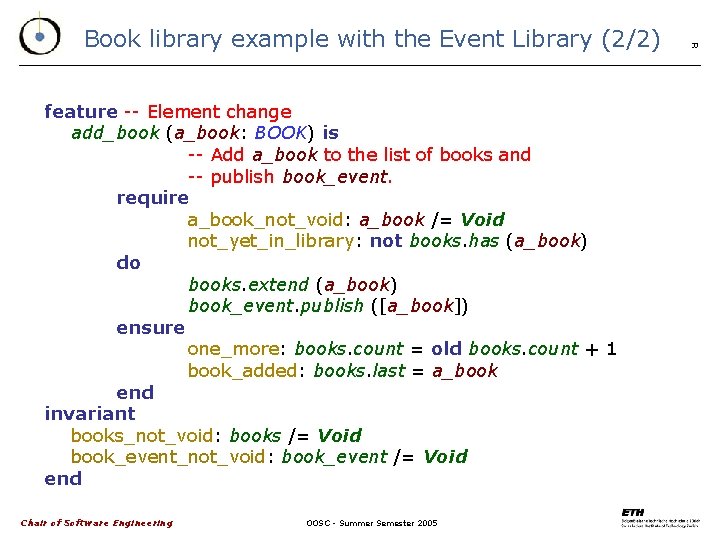
Book library example with the Event Library (2/2) feature -- Element change add_book (a_book: BOOK) is -- Add a_book to the list of books and -- publish book_event. require a_book_not_void: a_book /= Void not_yet_in_library: not books. has (a_book) do books. extend (a_book) book_event. publish ([a_book]) ensure one_more: books. count = old books. count + 1 book_added: books. last = a_book end invariant books_not_void: books /= Void book_event_not_void: book_event /= Void end Chair of Software Engineering OOSC - Summer Semester 2005 33
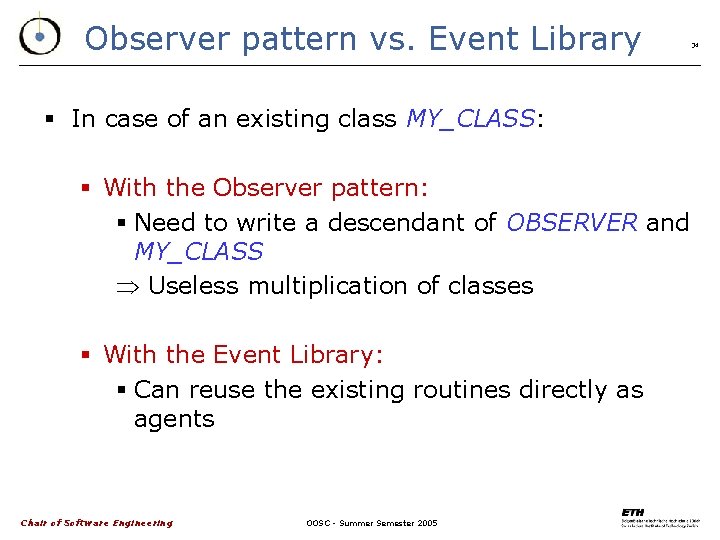
Observer pattern vs. Event Library § In case of an existing class MY_CLASS: § With the Observer pattern: § Need to write a descendant of OBSERVER and MY_CLASS Useless multiplication of classes § With the Event Library: § Can reuse the existing routines directly as agents Chair of Software Engineering OOSC - Summer Semester 2005 34
35 End of lecture 9 Chair of Software Engineering OOSC - Summer Semester 2005
- Slides: 35