
1 KWL CHARTREACTIONS What do I already know
- Slides: 35
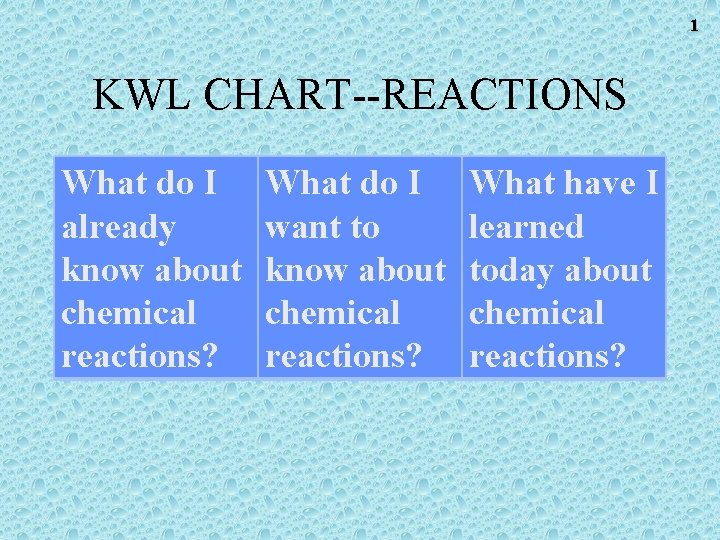
1 KWL CHART--REACTIONS What do I already know about chemical reactions? What do I want to know about chemical reactions? What have I learned today about chemical reactions?
2 Intro video: types of reactions http: //www. youtube. com/watch? v=i. HHvx 1 VC_8
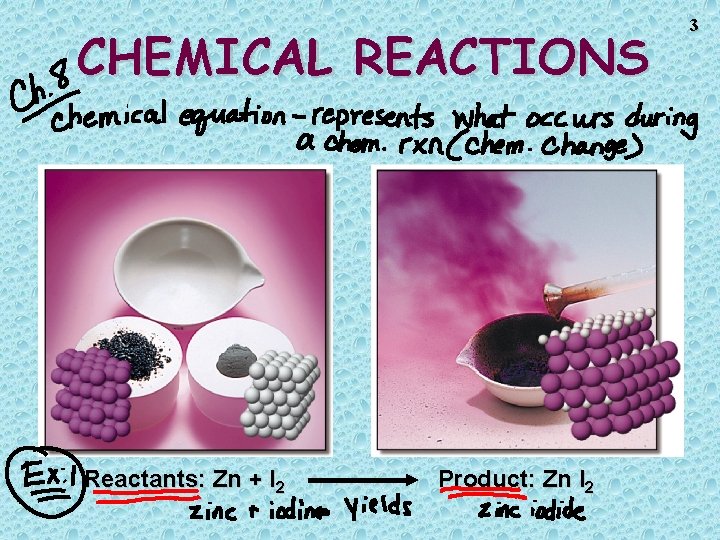
CHEMICAL REACTIONS Reactants: Zn + I 2 Product: Zn I 2 3
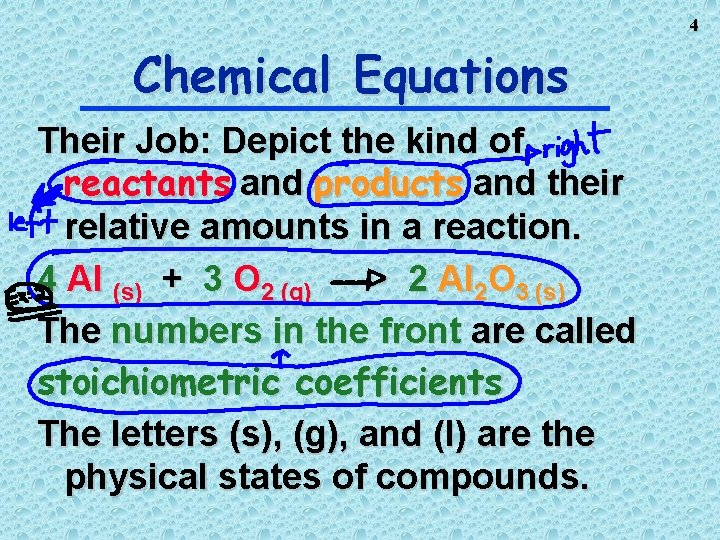
4 Chemical Equations Their Job: Depict the kind of reactants and products and their relative amounts in a reaction. 4 Al (s) + 3 O 2 (g) ---> 2 Al 2 O 3 (s) The numbers in the front are called stoichiometric coefficients The letters (s), (g), and (l) are the physical states of compounds.
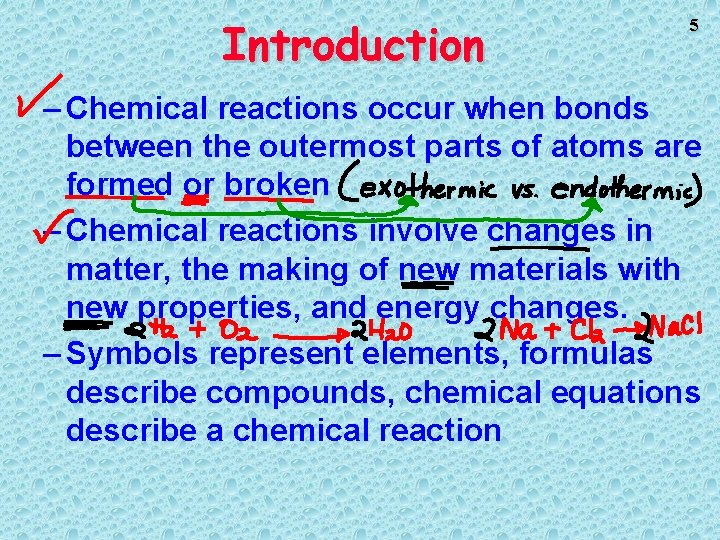
Introduction 5 – Chemical reactions occur when bonds between the outermost parts of atoms are formed or broken – Chemical reactions involve changes in matter, the making of new materials with new properties, and energy changes. – Symbols represent elements, formulas describe compounds, chemical equations describe a chemical reaction
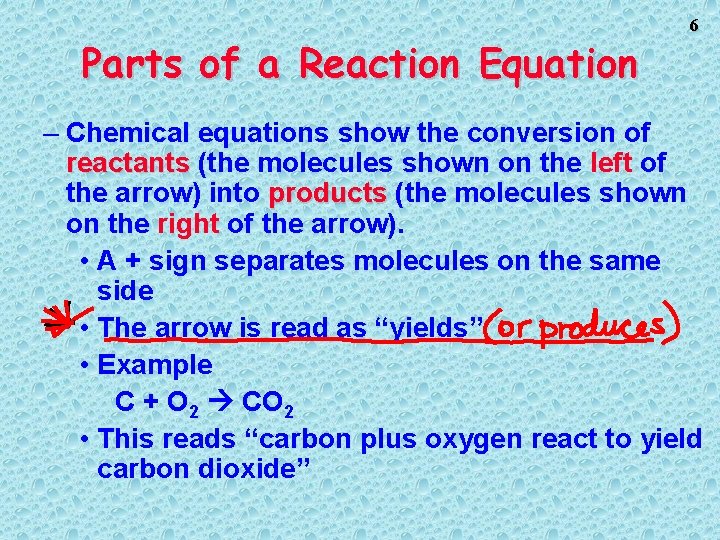
Parts of a Reaction Equation 6 – Chemical equations show the conversion of reactants (the molecules shown on the left of the arrow) into products (the molecules shown on the right of the arrow). • A + sign separates molecules on the same side • The arrow is read as “yields” • Example C + O 2 CO 2 • This reads “carbon plus oxygen react to yield carbon dioxide”
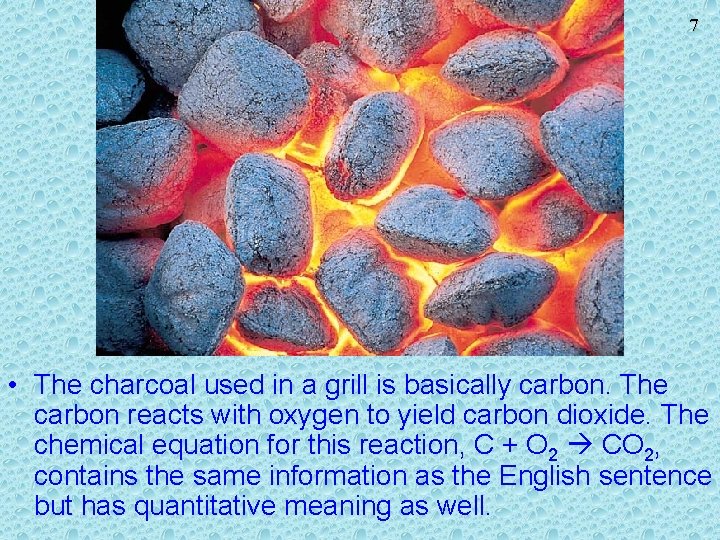
7 • The charcoal used in a grill is basically carbon. The carbon reacts with oxygen to yield carbon dioxide. The chemical equation for this reaction, C + O 2 CO 2, contains the same information as the English sentence but has quantitative meaning as well.
8 Activator: Name the 5 types of reactions.
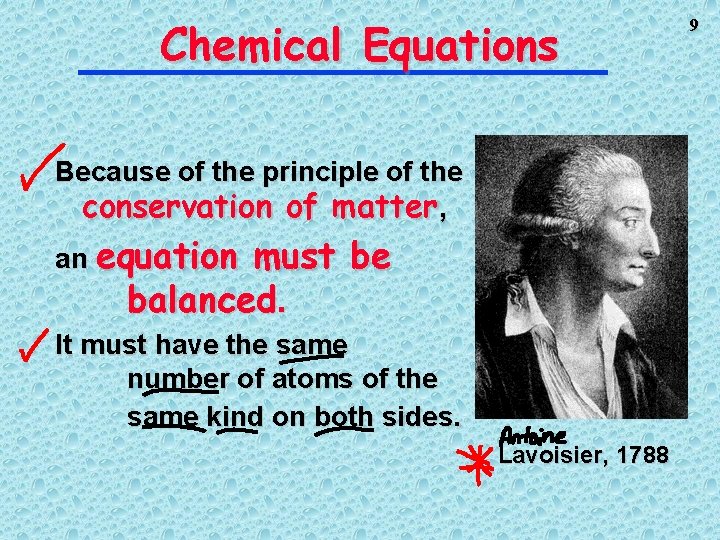
Chemical Equations Because of the principle of the conservation of matter, an equation must be balanced. It must have the same number of atoms of the same kind on both sides. Lavoisier, 1788 9
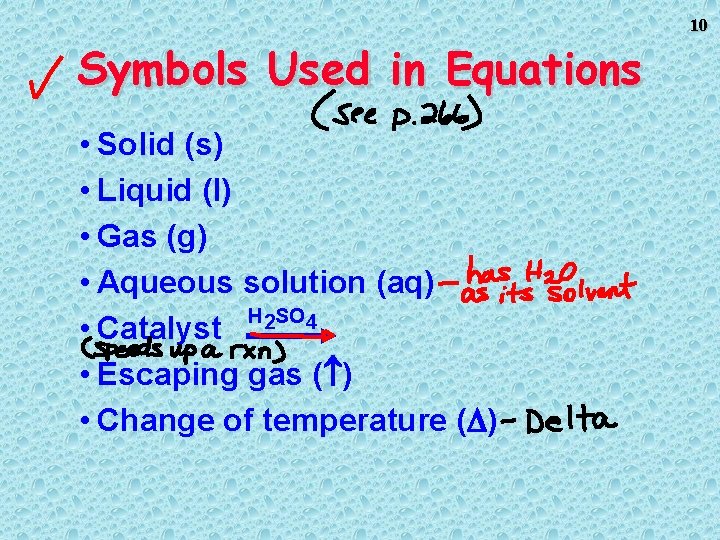
10 Symbols Used in Equations • Solid (s) • Liquid (l) • Gas (g) • Aqueous solution (aq) H 2 SO 4 • Catalyst • Escaping gas ( ) • Change of temperature ( )
11 Ticket out the Door 1. Name the 5 types of reactions. 2. How do you know a chemical reaction has occurred? 3. Name 5 symbols that may be used in a chemical equation.
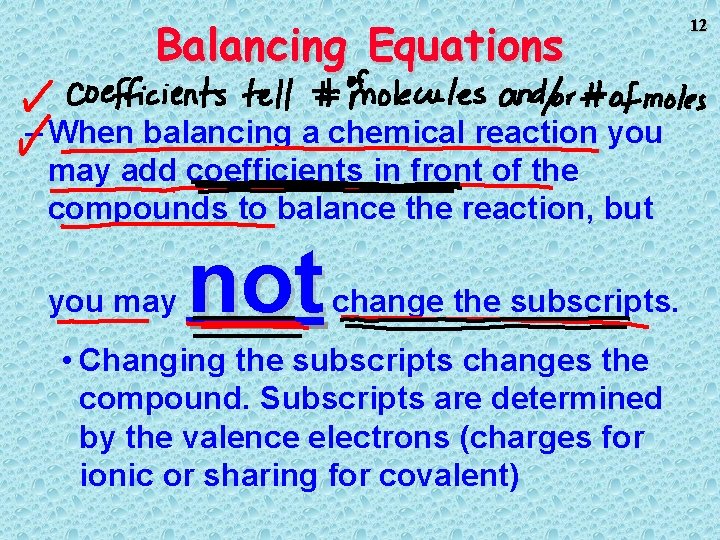
Balancing Equations – When balancing a chemical reaction you may add coefficients in front of the compounds to balance the reaction, but you may not change the subscripts. • Changing the subscripts changes the compound. Subscripts are determined by the valence electrons (charges for ionic or sharing for covalent) 12
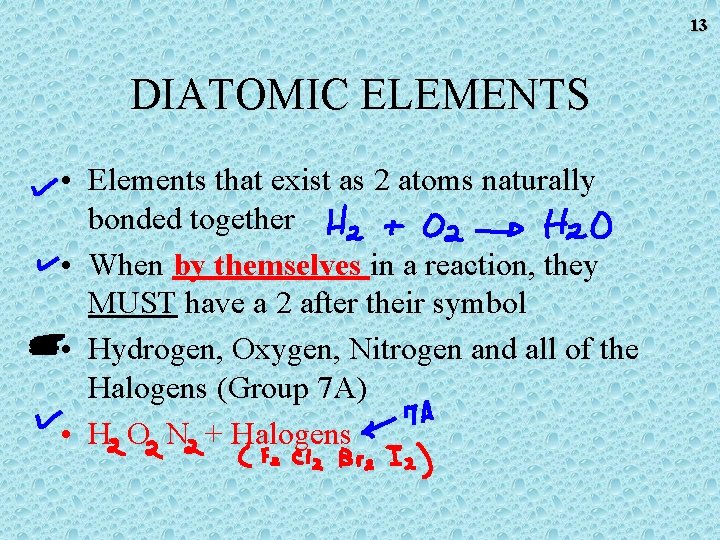
13 DIATOMIC ELEMENTS • Elements that exist as 2 atoms naturally bonded together • When by themselves in a reaction, they MUST have a 2 after their symbol • Hydrogen, Oxygen, Nitrogen and all of the Halogens (Group 7 A) • H, O, N, + Halogens
14 HANDOUT—SIDE B
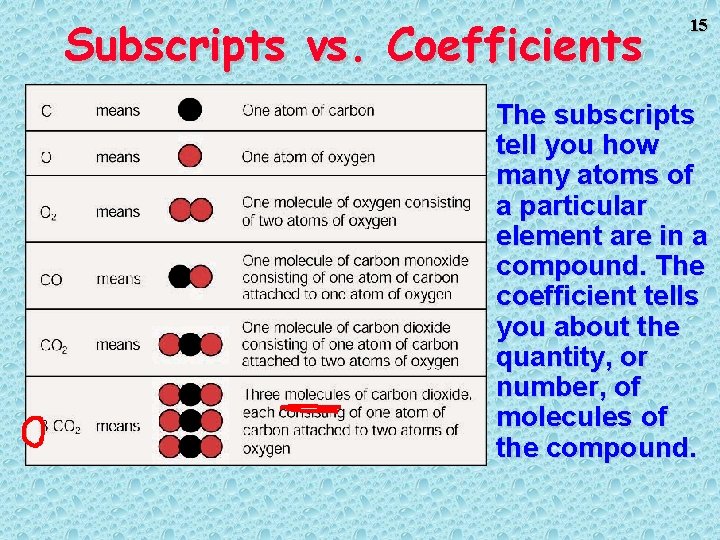
Subscripts vs. Coefficients 15 • The subscripts tell you how many atoms of a particular element are in a compound. The coefficient tells you about the quantity, or number, of molecules of the compound.
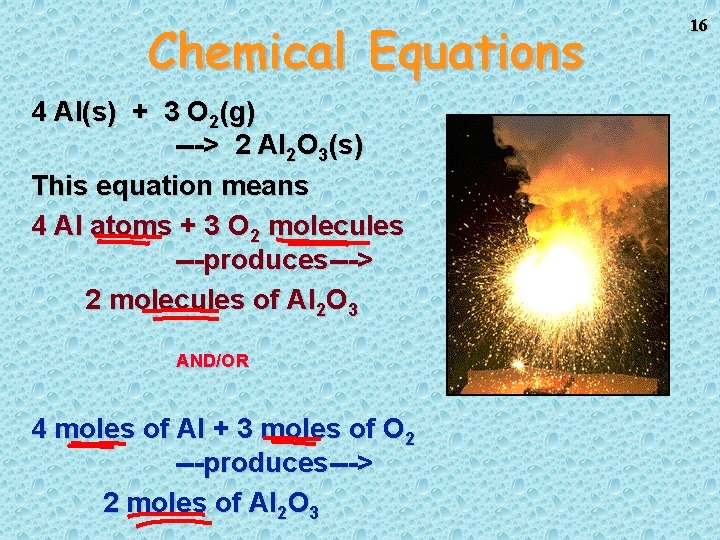
Chemical Equations 4 Al(s) + 3 O 2(g) ---> 2 Al 2 O 3(s) This equation means 4 Al atoms + 3 O 2 molecules ---produces---> 2 molecules of Al 2 O 3 AND/OR 4 moles of Al + 3 moles of O 2 ---produces---> 2 moles of Al 2 O 3 16
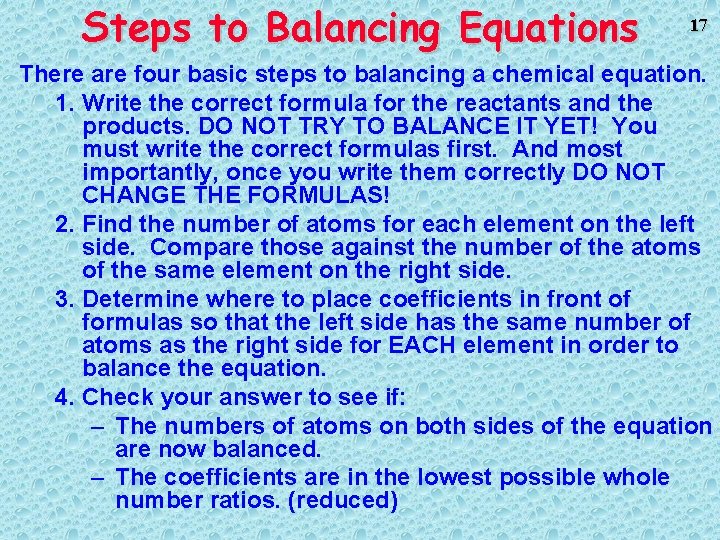
Steps to Balancing Equations 17 There are four basic steps to balancing a chemical equation. 1. Write the correct formula for the reactants and the products. DO NOT TRY TO BALANCE IT YET! You must write the correct formulas first. And most importantly, once you write them correctly DO NOT CHANGE THE FORMULAS! 2. Find the number of atoms for each element on the left side. Compare those against the number of the atoms of the same element on the right side. 3. Determine where to place coefficients in front of formulas so that the left side has the same number of atoms as the right side for EACH element in order to balance the equation. 4. Check your answer to see if: – The numbers of atoms on both sides of the equation are now balanced. – The coefficients are in the lowest possible whole number ratios. (reduced)
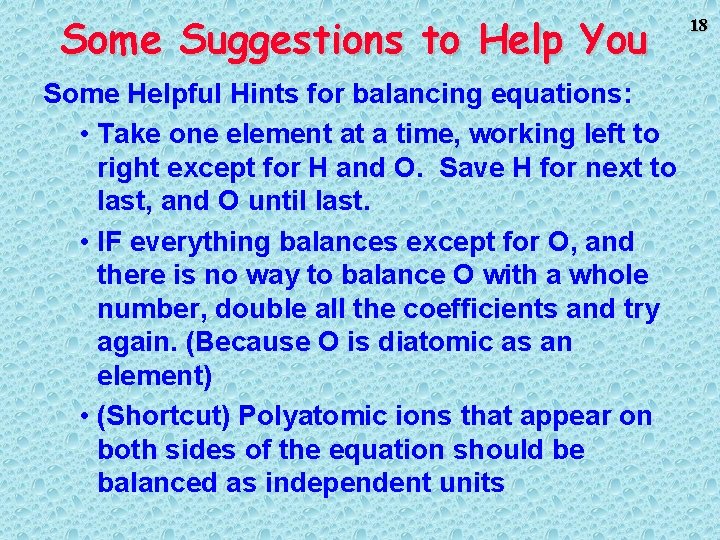
Some Suggestions to Help You Some Helpful Hints for balancing equations: • Take one element at a time, working left to right except for H and O. Save H for next to last, and O until last. • IF everything balances except for O, and there is no way to balance O with a whole number, double all the coefficients and try again. (Because O is diatomic as an element) • (Shortcut) Polyatomic ions that appear on both sides of the equation should be balanced as independent units 18
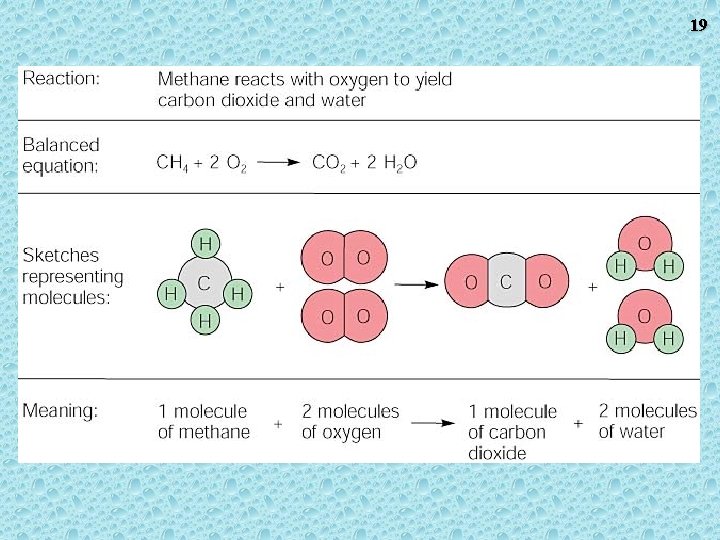
19
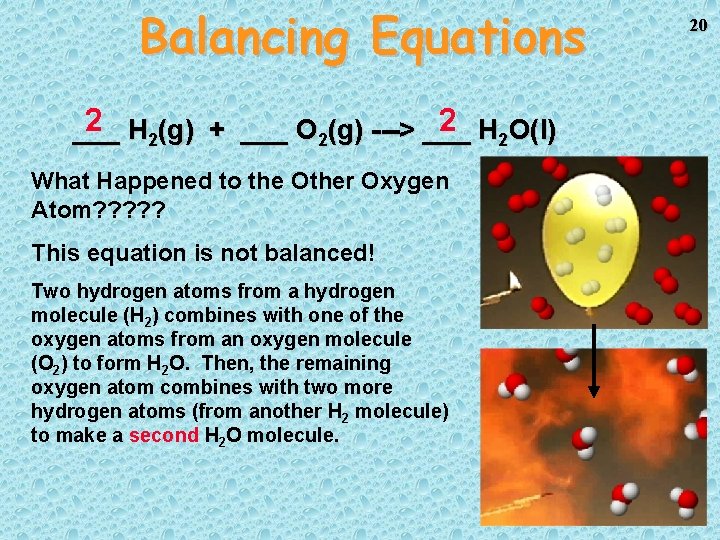
Balancing Equations 2 H 2(g) + ___ O 2(g) ---> ___ 2 H 2 O(l) ___ What Happened to the Other Oxygen Atom? ? ? This equation is not balanced! Two hydrogen atoms from a hydrogen molecule (H 2) combines with one of the oxygen atoms from an oxygen molecule (O 2) to form H 2 O. Then, the remaining oxygen atom combines with two more hydrogen atoms (from another H 2 molecule) to make a second H 2 O molecule. 20
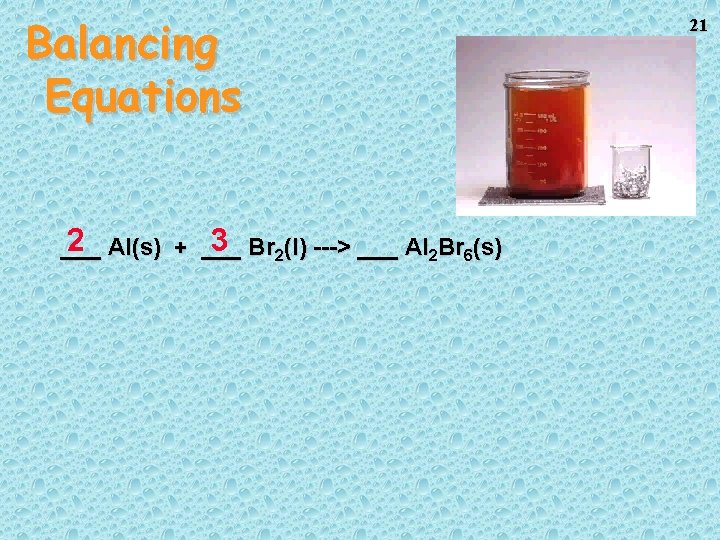
Balancing Equations 2 Al(s) + ___ 3 Br 2(l) ---> ___ Al 2 Br 6(s) ___ 21
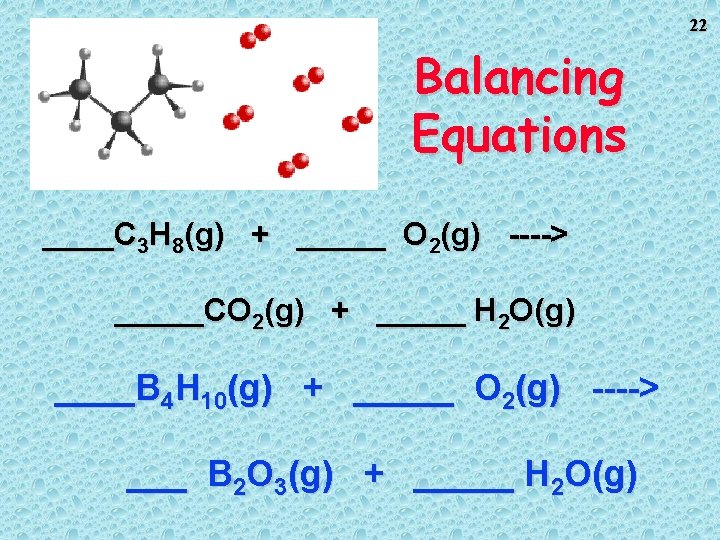
22 Balancing Equations ____C 3 H 8(g) + _____ O 2(g) ----> _____CO 2(g) + _____ H 2 O(g) ____B 4 H 10(g) + _____ O 2(g) ----> ___ B 2 O 3(g) + _____ H 2 O(g)
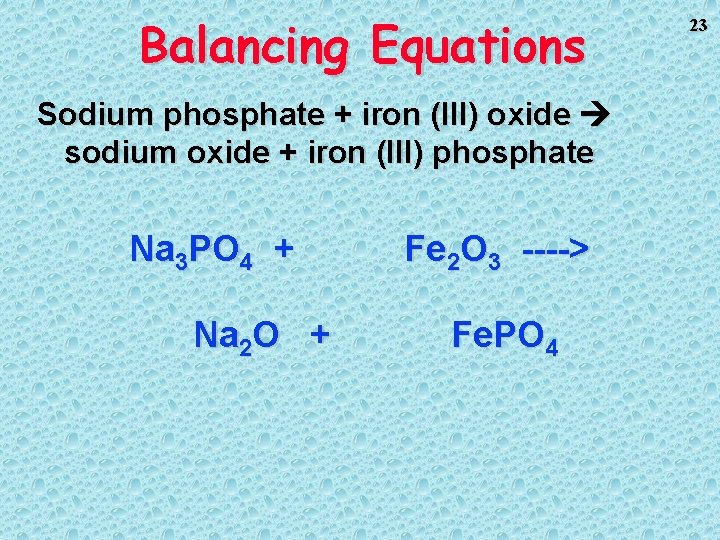
Balancing Equations Sodium phosphate + iron (III) oxide sodium oxide + iron (III) phosphate Na 3 PO 4 + Na 2 O + Fe 2 O 3 ----> Fe. PO 4 23
24 IPAD--Balancing Equations Practice 1. http: //funbasedlearning. com/chemistry/chem Balancer/default. htm 2. https: //www. khanacademy. org/science/mcat /physicalprocesses/stoichiometry/v/balancingchemical-equations 3. http: //chemistry. csudh. edu/lechelpcs/rxnbalancingc sn 7. html
25 Activator—WORD SPLASH Write down as many words as you can think of that come to mind when you hear “chemical reactions”
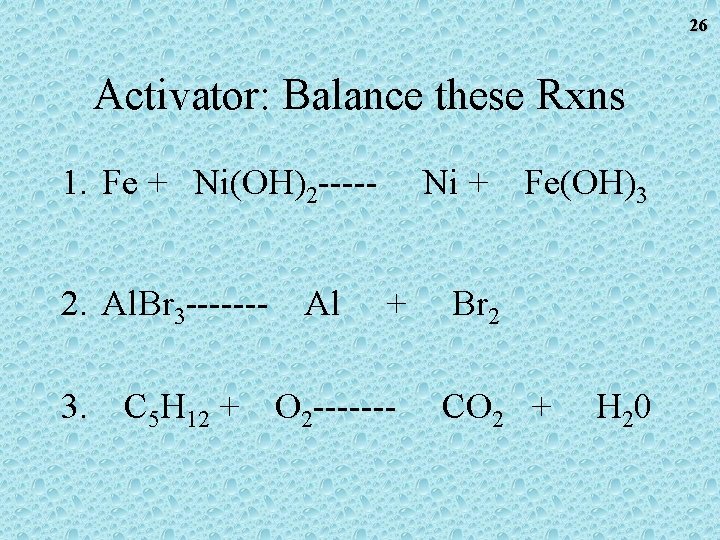
26 Activator: Balance these Rxns 1. Fe + Ni(OH)2 ----2. Al. Br 3 ------- Al 3. Ni + + C 5 H 12 + O 2 ------- Fe(OH)3 Br 2 CO 2 + H 20
27 ACTIVATOR • WHY MUST AN EQUATION BE BALANCED? • WHAT ARE USED TO BALANCE EQUATIONS?
28 ACTIVATOR WHAT 3 TYPES OF REACTIONS WILL WE BE DOING IN LAB TODAY?
29 EXTRA PRACTICE BALANCING • http: //chemistry. csudh. edu/lechelpcs/rxnbalancing csn 7. html ***I need to see when you are finished*** WATCH THE FOLLOWING VIDEO: http: //www. youtube. com/watch? v=i. HHvx 1 VC_8 What chemicals did he use for each of the reactions?
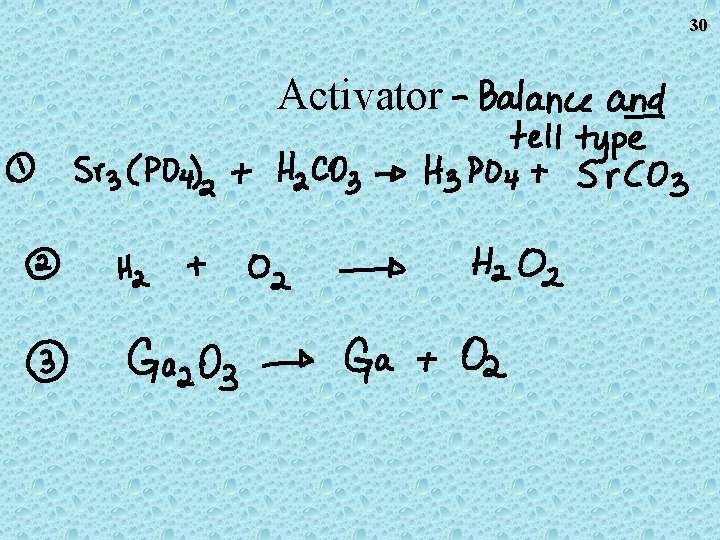
30 Activator
31 LAB: See purpose AND safety FILL IN OBSERVATIONS/DATA (before and after each reaction)
32 LAB ASSIGNMENT: Equations Section of Lab #1— 7 (BALANCE AND WRITE NAMES OF REACTANTS/PRODUCTS using your “best friend” chart) Conclusion Question #3 (BALANCE & TELL TYPE OF RXN)
33 ACTIVATOR QUICK WRITE: Describe 2 chemical reactions that are taking place or have taken place around you today.
34 BALANCING ACTIVITY You will be with a partner. You and your partner must EACH write down the problems. You are to BALANCE AND TELL TYPE OF RXN. When you think you’re finished, let me check. Then you’ll get your next card. The goal is to complete as many questions as you can before time is called.
35 Quiz-QUIZ A: TELL TYPE FOR 1— 20 (ALL) BALANCE 1— 10 ONLY –put final coefficient ratio QUIZ B: TELL TYPE FOR 1— 20 (ALL) BALANCE 11— 20 ONLY—put final coefficient ratio