
1 KNOWELDGE MANAGEMENT FRAMEWORK FOR IBDLP MENTOR SHRI
1 KNOWELDGE MANAGEMENT FRAMEWORK FOR IBDLP MENTOR: SHRI PANKAJ JAIN BY: NISHANT KUMAR IIM SHILLONG
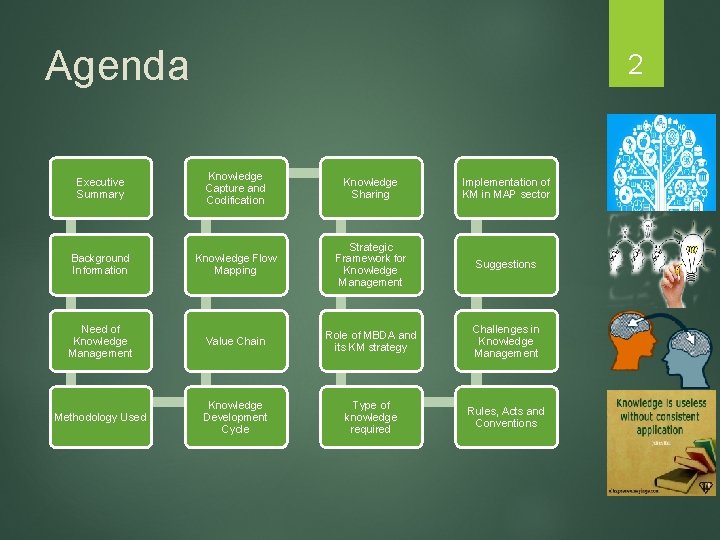
Agenda 2 Executive Summary Knowledge Capture and Codification Knowledge Sharing Implementation of KM in MAP sector Background Information Knowledge Flow Mapping Strategic Framework for Knowledge Management Suggestions Need of Knowledge Management Value Chain Role of MBDA and its KM strategy Challenges in Knowledge Management Methodology Used Knowledge Development Cycle Type of knowledge required Rules, Acts and Conventions
Executive Summary Biological resources are vital to humankind’s economic and social development Looking into the current scenario, there is requirement of balance between economic growth and conservation of natural resources Issues like rising population, increasing poverty, food insecurity and unsustainable resource utilization IBDLP Meghalaya, with the mission of promoting optimum and effective development and utilization of resources of Meghalaya “Knowledge management is a broad term encompassing social and technical processes that support communication and information management along with organisational innovation”– Dr Warwick Easdown, World Vegetable Centre, 2010 Three key ingredients which are required for sustainable management of natural resources are Knowledge, Commitment and Capacity 3
Executive Summary There is need of attention in new knowledge and in making better use of what we know already: 1. to help people, communities, businesses, industries and government make better decision at all level of management and policy; 2. to boost the innovative processes so that we can develop more sustainable management system; 3. to help communities and state to understand learn so that we can make best use of existing knowledge and past experience; and 4. to provide an accessible, participative, and inclusive regional platform for dialogue and exchange and making regional knowledge available globally PROPOSED AN INTEGRATED KNOWLEDGE MANAGEMENT FRAMEWORK This framework is supported by value chain analysis of mountain related product and services which helps in identification of the different stages and players in value chain, gaps and inefficiencies in between value chain, need of the specific form of knowledge to these players and how the appropriate knowledge can be shared to them. 4
Background Information Ø The National Knowledge Commission, Government of India has stated in its ‘Report to the Nation 2006 -09’ that “Knowledge has been recognized as the key driving force in the 21 st century and India’s ability to emerge as a globally competitive player will substantially depend on its knowledge resources” Ø The State’s rural population is heavily dependent upon the natural resources for livelihood support Ø Pressure on natural resources are continuously rising and there are other issues like rising population, increasing poverty, food insecurity and unsustainable resource utilization Ø The programme is concentrating on promoting optimum and effective development and utilization of resources of Meghalaya Ø IBDLP is standing on four pillars: Enterprise Facilitation, Good Governance, Natural Resource Management and Knowledge Management Ø This programme is trying to bring a paradigm shift as it veers away from the traditional ‘Beneficiary’ approach to ‘Entrepreneurs’ and ‘Development Partners’ approach 5

Need of KM Knowledge is the key element of effective growth. The generation, use, and application of knowledge by stakeholders contribute directly or indirectly to the design and outcomes of a development programme With changing socioeconomic and climate conditions, knowledge generation and management have gained in importance and also face complex challenges Whether they are farmers, women, disadvantage groups, or local, regional or national policymakers or some other organization, they all need complete knowledge to work effectively A mountain farmer can be helped by providing critical information about crop production, post-harvest technologies, technologies about water storage, or market information in the real time basis Similarly, providing policy makers and governments with critical data on effects of climate change, crop production (quantity) will help them make informed decisions on needs from the national to the community level 6
Methodology Used Literature Search (Secondary Research): Knowledge management is a concept which is still evolving There is no general framework available anywhere in the internet. Few organizations which are working on sustainable natural resource management have developed the framework for themselves but those are not available in public domain The most important part of the project was to study of the value chain especially for mountain related product ICIMOD helped a lot to gain knowledge in this field 7
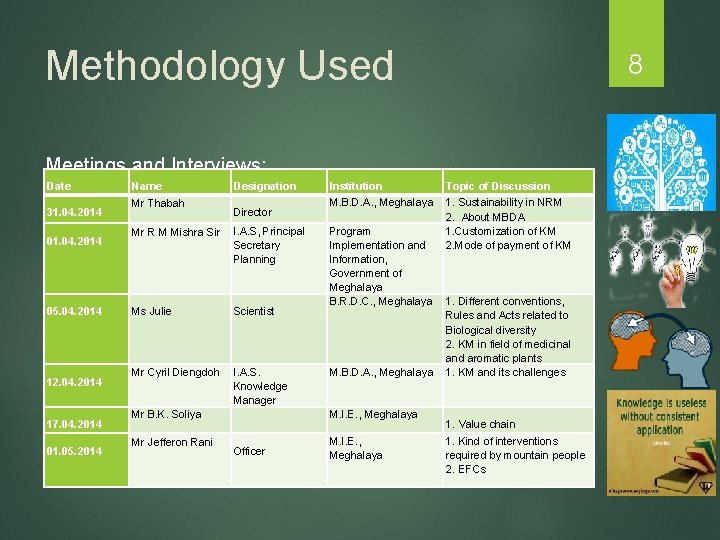
Methodology Used 8 Meetings and Interviews: Date 31. 04. 2014 05. 04. 2014 12. 04. 2014 17. 04. 2014 01. 05. 2014 Name Mr Thabah Designation Director Mr R M Mishra Sir I. A. S, Principal Secretary Planning Ms Julie Scientist Mr Cyril Diengdoh I. A. S. Knowledge Manager Mr B. K. Soliya Mr Jefferon Rani Institution M. B. D. A. , Meghalaya Program Implementation and Information, Government of Meghalaya B. R. D. C. , Meghalaya M. B. D. A. , Meghalaya M. I. E. , Meghalaya Officer M. I. E. , Meghalaya Topic of Discussion 1. Sustainability in NRM 2. About MBDA 1. Customization of KM 2. Mode of payment of KM 1. Different conventions, Rules and Acts related to Biological diversity 2. KM in field of medicinal and aromatic plants 1. KM and its challenges 1. Value chain 1. Kind of interventions required by mountain people 2. EFCs
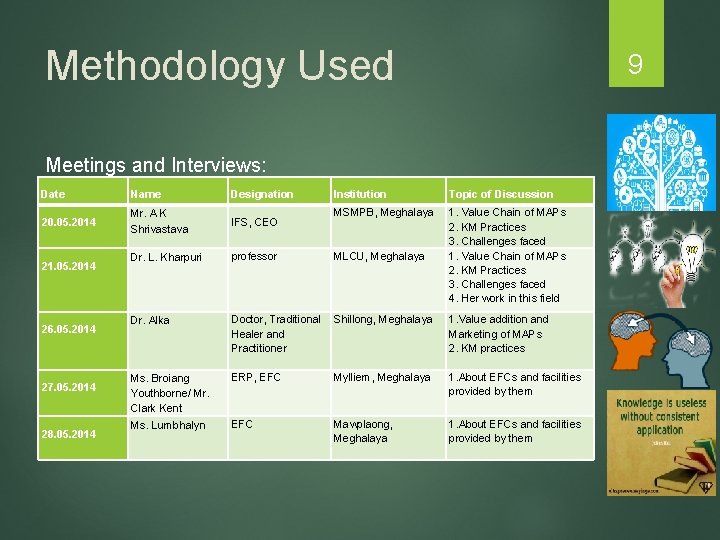
Methodology Used 9 Meetings and Interviews: Date Name Designation 20. 05. 2014 Mr. A K Shrivastava IFS, CEO Dr. L. Kharpuri professor MLCU, Meghalaya Dr. Alka Doctor, Traditional Healer and Practitioner Shillong, Meghalaya 1. Value addition and Marketing of MAPs 2. KM practices Ms. Broiang Youthborne/ Mr. Clark Kent Ms. Lumbhalyn ERP, EFC Mylliem, Meghalaya 1. About EFCs and facilities provided by them EFC Mawplaong, Meghalaya 1. About EFCs and facilities provided by them 21. 05. 2014 26. 05. 2014 27. 05. 2014 28. 05. 2014 Institution Topic of Discussion MSMPB, Meghalaya 1. Value Chain of MAPs 2. KM Practices 3. Challenges faced 4. Her work in this field
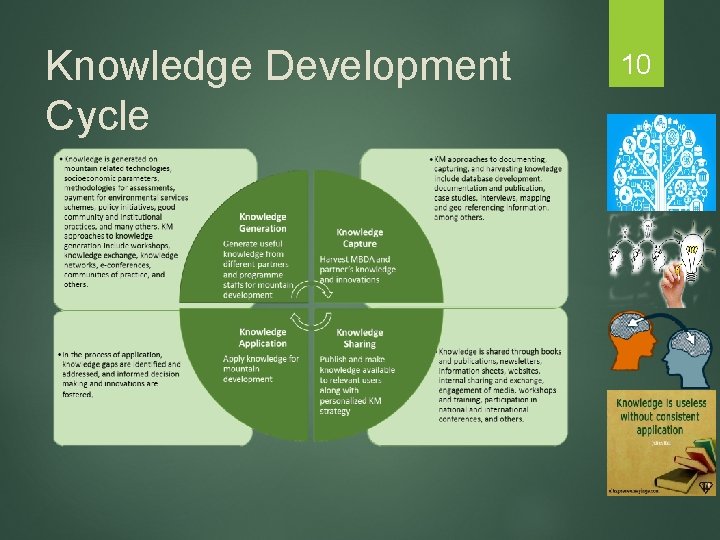
Knowledge Development Cycle 10
Value Chain VC approach is a powerful tool for identifying and analysing where and how value is added, from the producer to the end user VCs can be defined as “the full range of activities that are required to bring a product from its conception to its end use. The use of the terminology ‘chain’ suggests a focus on ‘vertical’ relationships between buyers and suppliers and the movement of a good or service from producer to consumer” After studying the value chain of various mountain related products and services, the common or generic value chain was developed. Those products are Potatoes, Indian bay leaf, Malta oranges, Medicinal herbs “Kuth” and “Kutki”, tourism There are different factors which affects the value chain along with supporting activities. We can classify them as micro and macro level factor but these are mountain specific. This means that these factors are only limited to mountain specification 11
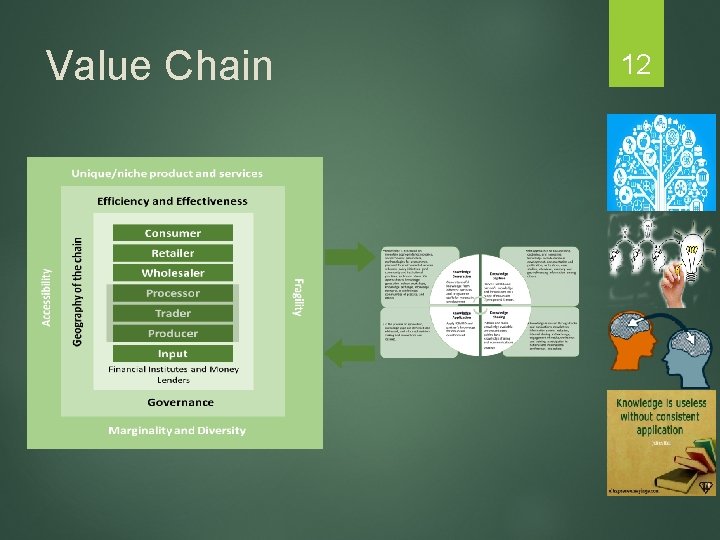
Value Chain 12
Knowledge Flow Mapping By studying the value chain of a product/sector we can identify the players in value chain and then segregate them in three basis groups, which will help further to map the flow of knowledge Government: “Government” includes the following stakeholders: • Meghalaya Government departments and agencies responsible for NRM policy development, regulation and research; • Department of Treasury and Finance • Local government authorities; and • Government departments, agencies and statutory authorities that have interests in NRM (including the Bureau of Meteorology, Department of Sustainability, Environment, Water, Population and Communities) Academia: Academia includes researchers, universities and research institutions 13
Knowledge Flow Mapping Private Sector : The private sector includes • Landholders and farmers; • Volunteers and community groups; • NRM sector organisations; • Industry; • Consultants; and • Traditional owner groups and other indigenous people 14
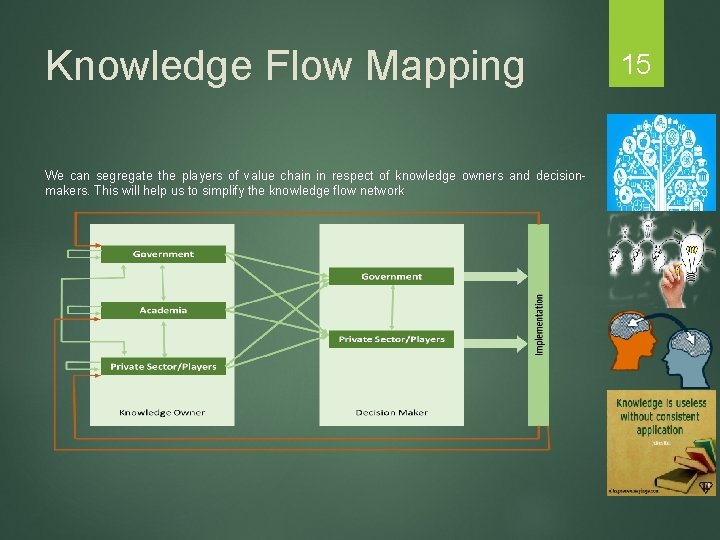
Knowledge Flow Mapping We can segregate the players of value chain in respect of knowledge owners and decisionmakers. This will help us to simplify the knowledge flow network 15
16 Knowledge Capture and Codification According to artificial intelligence researcher, Parsaye (1988), there are three major approaches to knowledge acquisition from individuals and groups: 1. Interviewing experts. a) Structured Interviews: The interviewer should outline specific goals and questions for the knowledge acquisition session b) Storytelling: Conveying information in a story provides a rich context, causing the story to remain in the conscious memory longer and creating more memory traces than is possible with information not in context 2. Learning by being told: The interviewee expresses and refines his or her knowledge, and at the same time, the knowledge manager clarifies and validates the knowledge artefact that renders this knowledge in explicit form 3. Learning by observation: The key is to use audio or video to record what the expert knows
Knowledge Capture and Codification A number of other techniques may be used to capture tacit knowledge from individuals and from groups, including: a) Knowledge Mapping: The knowledge map is a tool for showing which knowledge resides where (e. g. , people, media, organisational units, sources of knowledge outside the organisation); and what the patterns of knowledge flow are (access, distribution, learning). b) Yellow pages: The yellow pages facility is a structured collection of data and documents about people in an organisation. The purpose of the yellow pages is to facilitate communication and knowledge sharing between individuals and groups of people. c) Peer assist: A peer assist is a meeting or a workshop where people are invited from other teams to share their experience, insights, and knowledge with a team who have requested help. d) Focused Group Discussions: Discussion of a topic where participants are expert in that topic 17
Knowledge Sharing Few Knowledge Sharing Techniques are: a) Mentoring b) Knowledge Fairs and Trainings c) Communities of practice d) Intranets and Extranets e) Electronic conferences, discussion forums f) Audio Video Conferences g) Telecommunication h) Case Studies 18
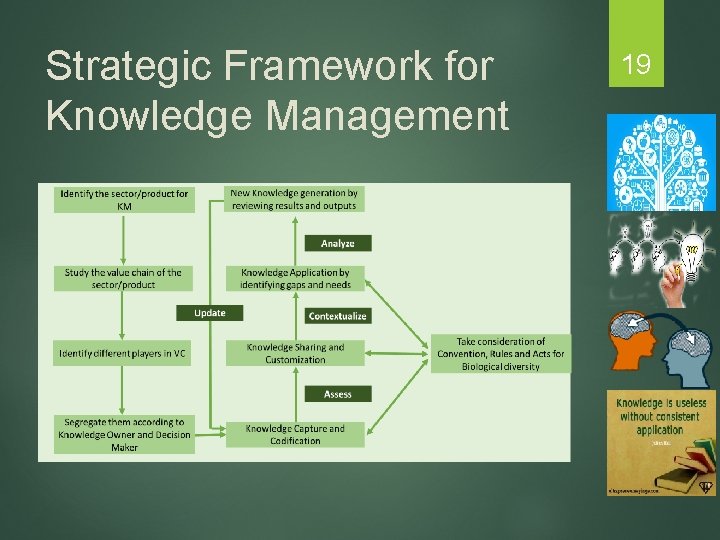
Strategic Framework for Knowledge Management 19
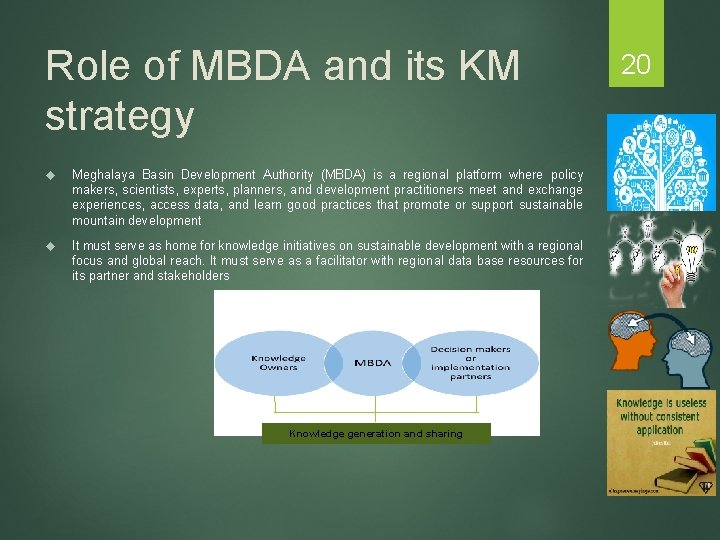
Role of MBDA and its KM strategy Meghalaya Basin Development Authority (MBDA) is a regional platform where policy makers, scientists, experts, planners, and development practitioners meet and exchange experiences, access data, and learn good practices that promote or support sustainable mountain development It must serve as home for knowledge initiatives on sustainable development with a regional focus and global reach. It must serve as a facilitator with regional data base resources for its partner and stakeholders Knowledge generation and sharing 20
21 Role of MBDA and its KM strategy The strategy of on knowledge management should be to: • Provide timely, accurate and relevant data or information to the partners and stake holders; • Captures, amalgamates, packages, and shares regional data and global experiences, technologies, good practices, policy initiatives, and others in the context of sustainable development of natural resources and distributes these along various pathways including the website and information centre; • Acts as data cleaning and storing centre for knowledge and geo-data available Meghalaya region; and • on the Applies lessons and replicates successes to achieve development results effectively and efficiently
22 Role of MBDA and its KM strategy These strategies can be achieved by following approaches: • Developing a platform for relevant socioeconomic and biodiversity data • Creating a consolidated knowledge base encompassing information relevant to interest of shareholder • Creating interactive platforms for dialogue and knowledge hub for regional communication and exchange • Sharing the results of research initiatives and application in strategic focus areas communication methods and channels • Integration of knowledge management in all Centre and programme activities supported by a common framework, thus developing a supportive knowledge sharing and learning culture using
Type of knowledge required • Conservation Technologies & Traditional Conservation System • Soil Testing & Soil Fertility Status Mapping • Multi – Cropping (Crop – Rotational set of Practices) • Integrated Farming System/Multi – Canopy System • Technology and Management Practices - agriculture, fishery, bee-keeping, sericulture, forestry & Plantation, Crops, animal husbandry • Integrated Pest Management • Seed production Technology & Seed Bank Promotion • Bio – technology & Tissue Culture • Technology for production of organic/bio-inputs • Organic Farming • Technological – intervention in rain water capturing/conservation/ harvesting/collection along natural drainage lines, natural, depressions on hill-top/slopes • Water Management/Saving Technologies • Technology for Water and other Natural resource Budgeting • Technology for reclaiming abandoned coal/limestone mined areas, etc • Technology for Water Quality Control 23
Type of knowledge required • Cost Effective Science and Technology for improving quality of life of rural population, particularly the rural– poor • Technology for Bio – fuel Plantation • Bio-Energy Technology for cooking & lighting • Cost Effective Technology for creation of micro-hydel project. • Technology for increased – productivity of crops, animal & livestock, aquatic and biodiversity • Present Level of Value Chain Development • Scope & Opportunity for Development of Value Chain up to the Final Product (Processing) • Post – Harvest Technology • Entrepreneurship Development • Enterprises Promotion • Agro – Business • Financial Access • Market Opportunities and Access, Cost – Discovery 24
Rules, Acts and Conventions a) Convention on Biological diversity (CBD): This multilateral treaty come into the force on Dec. 1993, with three main goals: conservation of biological diversity, sustainable use of its components, and fair and equitable sharing of benefits arising from the use of genetic resources and works on 12 principles b) Article 8 j of CBD: Requires parties to the CBD to respect, preserve and maintain the knowledge, innovations and practices of indigenous and local communities, promote their wider application with their holders’ approval and involvement, and encourage the equitable sharing of the benefits arising from their utilisation c) Article 15(5): Provides for access subject to prior informed consent which state “must inform the scope and purpose of any proposed activity and its impact on sacred sites, land, water and should take consent/approval and also involve them” d) Biological diversity act 2002 and Rules 2004: Covers conservation and use of biological resources and associated knowledge occurring in India for commercial and research purpose. It also provides framework for access to biological resources and sharing benefits arising 25
Challenges in Knowledge Management 1. Identification and capture of tacit knowledge (a framework is required) 2. No proper communication channels and modes of transfer of knowledge and information for different stakeholders, especially for those who lives in outskirts areas 3. A robust knowledge assessment framework (to assess knowledge is reliable, applicable, quality etc. ) 4. Many knowledge owners are reluctant to share the knowledge and seek some incentive out of it. 5. Identification of knowledge required (needed) or gaps between different stakeholders 6. Analysis of final result of the knowledge application 7. Communication gap 26
Suggestions a) PARTICIPATORY RURAL APPRAISAL • This methodology or concept was developed during the 1970 s and 80 s • Uses different methods which facilitate understanding of the problems and perspectives of local communities • Using a ‘village map’, the main resources and locations inside and outside the village are identified; a ‘historical time line’ charts the major changes and events that have occurred; and a ‘problem ranking matrix’ helps identify and understand the major problems faced • useful for policy makers, while also raising awareness in the local communities • Active participation and understanding of all in the community are the essence of PRA • Many organizations and NGOs are using tailored PRA frameworks and PRA toolkits to identify the problems 27
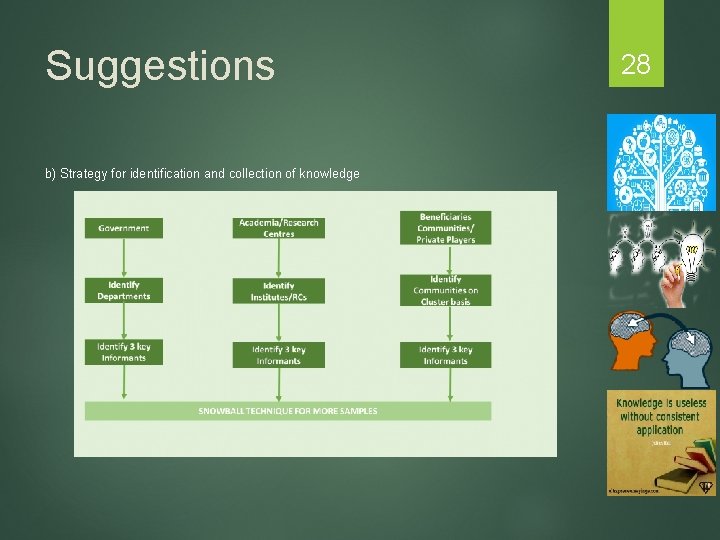
Suggestions b) Strategy for identification and collection of knowledge 28
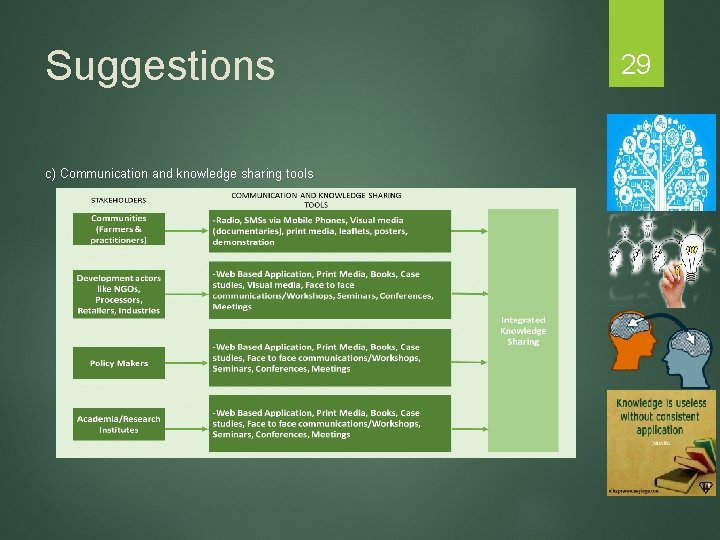
Suggestions c) Communication and knowledge sharing tools 29
Suggestions d) Collaboration with educational institutes/ research centres and set-up own research centres like BRDC which will help in research activity (knowledge generation) and assessing and testing the captured knowledge. e) Identify the interventions required by the local people and try to help them out so that a good relationship can be shaped between MBDA and local people. f) Development of a web portal for knowledge sharing Right now MBDA website is working as knowledge sharing portal Some suggestions for website: 1. The website is very good relative to other government website but in every page there is a lot of information and write-ups are there. Make it in hyperlink form where click and read facility should be there. 2. Information asymmetry is there. Data is available for only one district which is not giving a good impression. 4. Include other type of data in the website like data regarding rainfalls, temperature, climate change, GIS Mapping, Roadways etc. 5. Links for other portals and knowledge hubs should be there in the website (MIE, MIG and MINR, Metrology department etc. ) 30
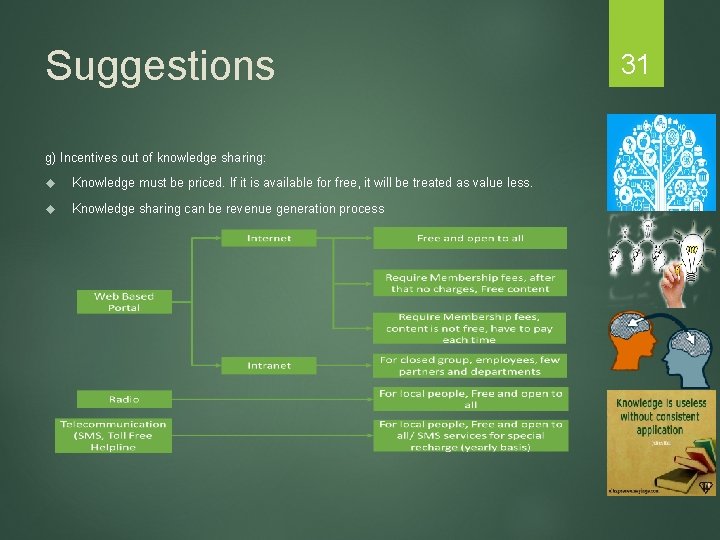
Suggestions g) Incentives out of knowledge sharing: Knowledge must be priced. If it is available for free, it will be treated as value less. Knowledge sharing can be revenue generation process 31
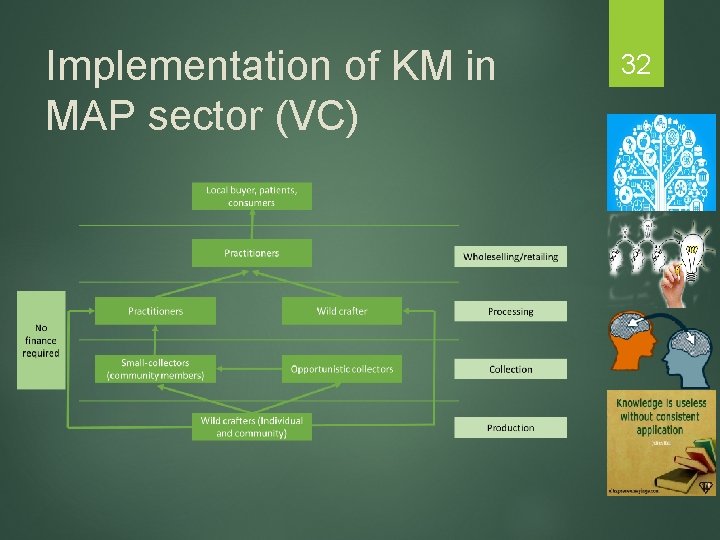
Implementation of KM in MAP sector (VC) 32
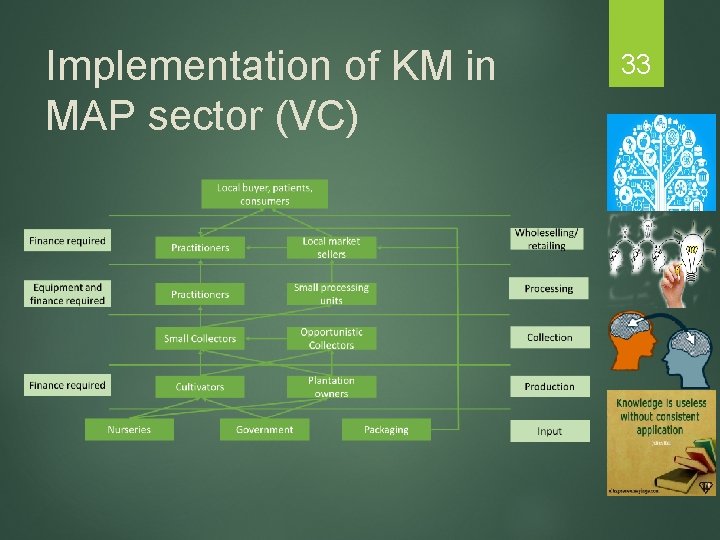
Implementation of KM in MAP sector (VC) 33
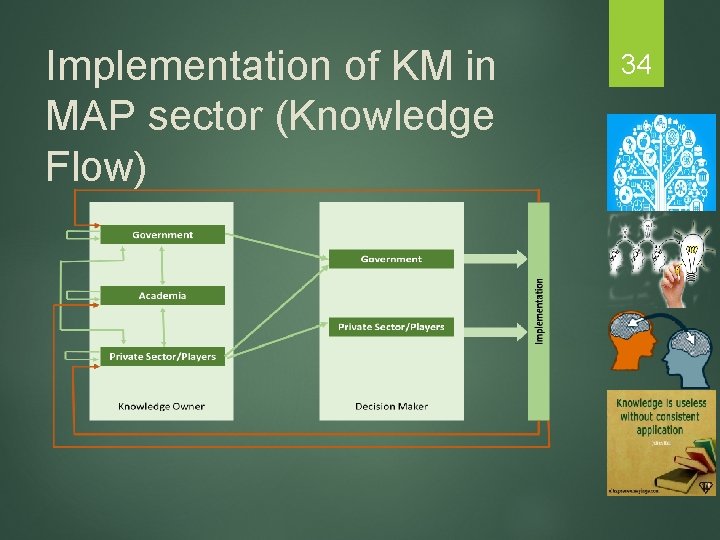
Implementation of KM in MAP sector (Knowledge Flow) 34
Implementation of KM in MAP sector (Type of Knowledge Rqd. ) • Cultivation of these MAPs • Processing of the MAPs • Knowledge related to seeds, manure, processing equipment etc. • Preservation methods • Lack of courses on traditional knowledge (Scientific methods and techniques for processing, storing and treating) • Market related knowledge including branding, packaging • Awareness on Climate changes and other activities affecting these MAPs • Identification and record of these plants • Integration of the traditional knowledge with the scientific researches for more effective and efficacy • Testing and verifying the results out of these plants 35
- Slides: 35