
1 Journal Behavior Genetics January 2018 common pathway

1
Journal Behavior Genetics. January 2018 common pathway model moderation model cross-lagged model

Genetic simplex model in the classical twin design & variations including G-E covariance Conor Dolan & Eveline de Zeeuw Boulder Workshop 2018 3
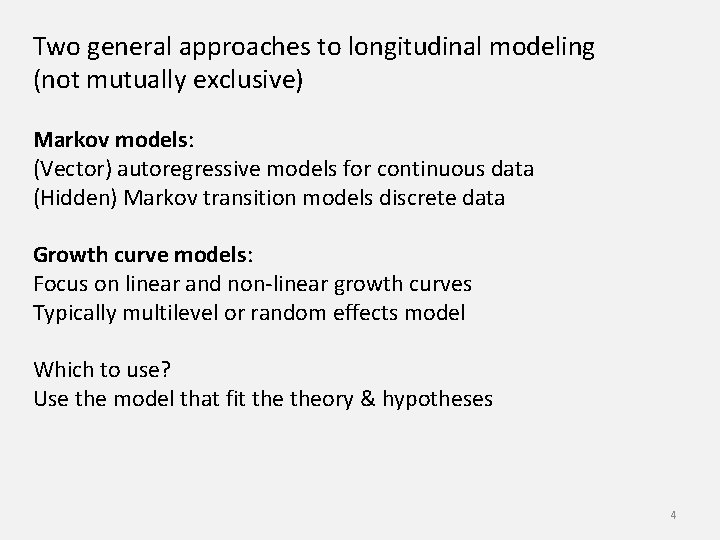
Two general approaches to longitudinal modeling (not mutually exclusive) Markov models: (Vector) autoregressive models for continuous data (Hidden) Markov transition models discrete data Growth curve models: Focus on linear and non-linear growth curves Typically multilevel or random effects model Which to use? Use the model that fit theory & hypotheses 4
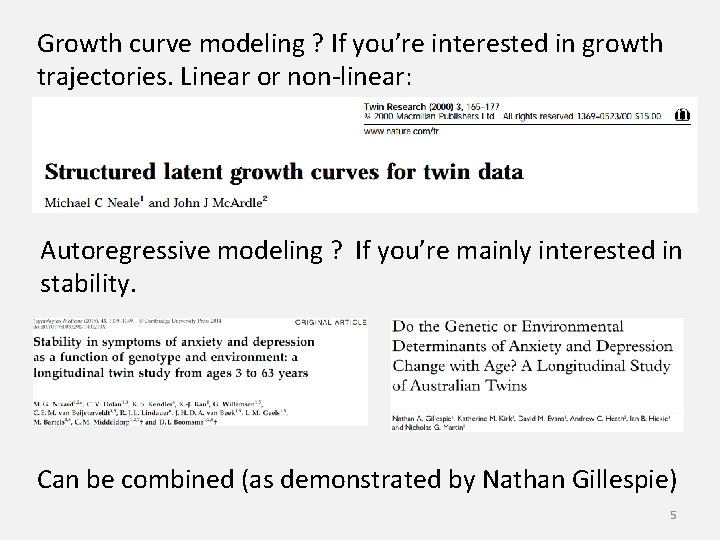
Growth curve modeling ? If you’re interested in growth trajectories. Linear or non-linear: Autoregressive modeling ? If you’re mainly interested in stability. Can be combined (as demonstrated by Nathan Gillespie) 5
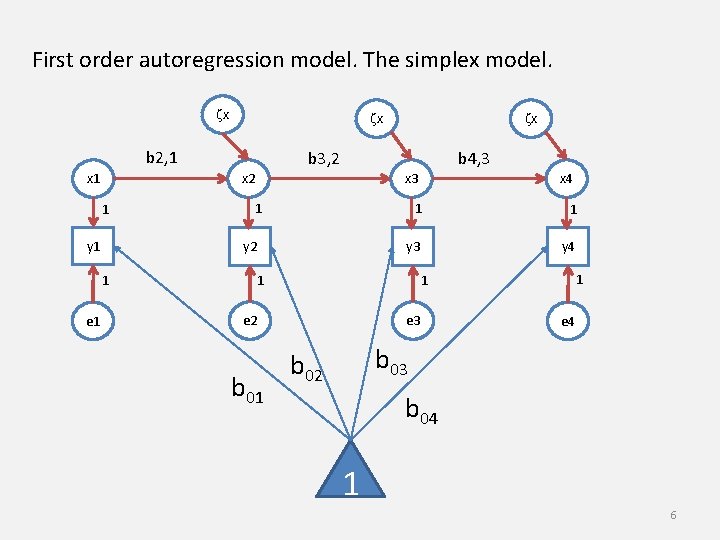
First order autoregression model. The simplex model. zx zx b 2, 1 x 1 y 1 b 4, 3 x 3 1 y 2 1 e 1 b 3, 2 x 2 1 zx 1 1 y 3 y 4 1 1 1 e 2 b 01 x 4 e 3 e 4 b 03 b 02 b 04 1 6
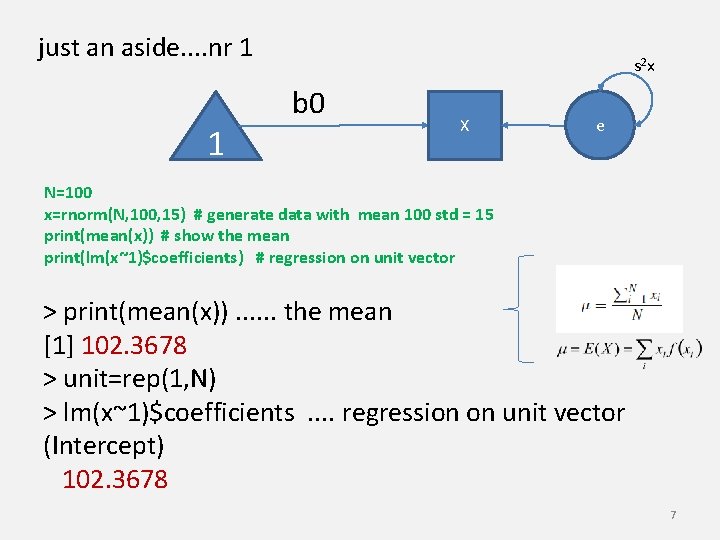
just an aside. . nr 1 1 s 2 x b 0 X e N=100 x=rnorm(N, 100, 15) # generate data with mean 100 std = 15 print(mean(x)) # show the mean print(lm(x~1)$coefficients) # regression on unit vector > print(mean(x)). . . the mean [1] 102. 3678 > unit=rep(1, N) > lm(x~1)$coefficients. . regression on unit vector (Intercept) 102. 3678 7
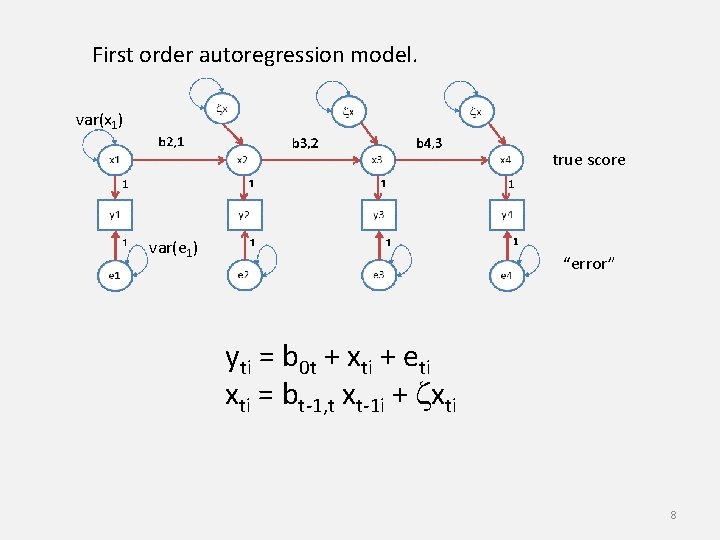
First order autoregression model. var(x 1) true score var(e 1) “error” yti = b 0 t + xti + eti xti = bt-1, t xt-1 i + zxti 8
just an aside. . nr 2 Identification: can we obtain unique estimates of the parameters in our model given the available information can we obtain unique estimates of the parameters in our ACDE model given the MZ and DZ 2 x 2 covariance matrices. NOPE. . . You can try, but different starting values will produce different estimates. Estimates not unique. . . useless 9
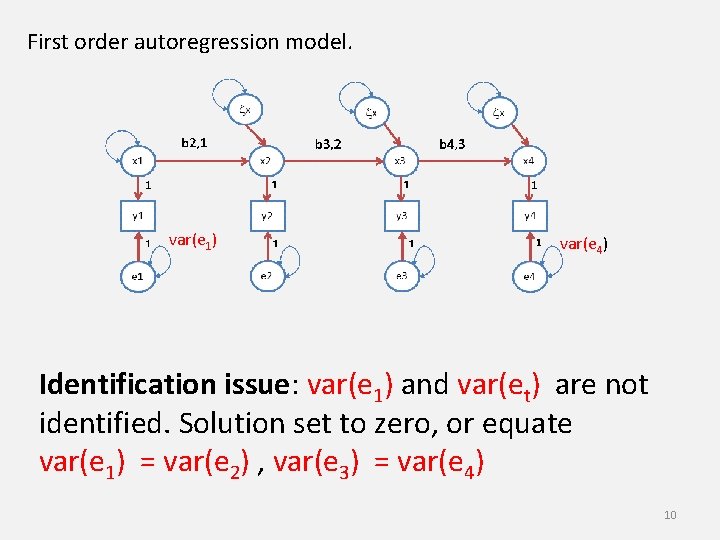
First order autoregression model. var(e 1) var(e 4) Identification issue: var(e 1) and var(et) are not identified. Solution set to zero, or equate var(e 1) = var(e 2) , var(e 3) = var(e 4) 10
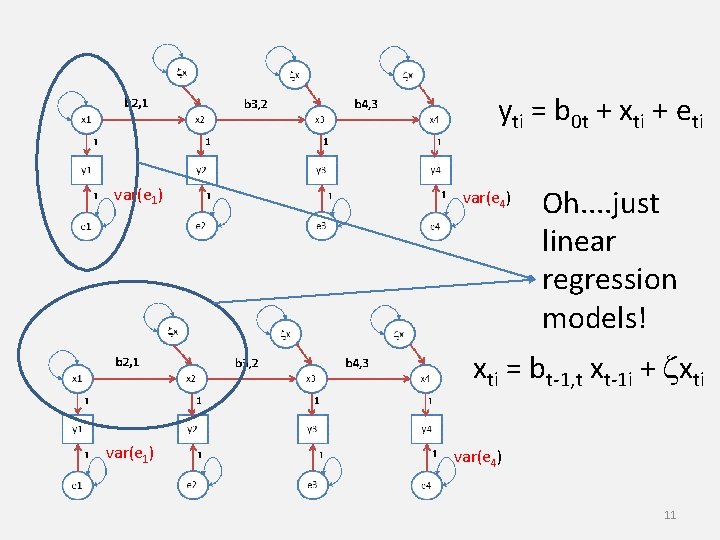
yti = b 0 t + xti + eti var(e 1) var(e 4) Oh. . just linear regression models! xti = bt-1, t xt-1 i + zxti var(e 1) var(e 4) 11
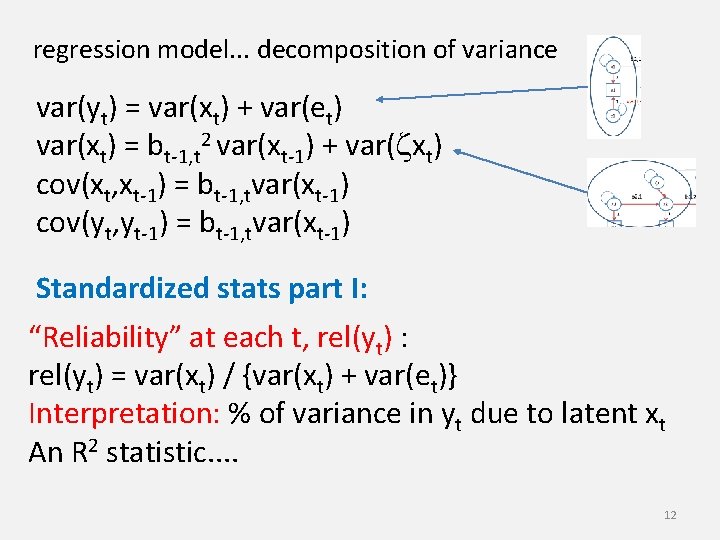
regression model. . . decomposition of variance var(yt) = var(xt) + var(et) var(xt) = bt-1, t 2 var(xt-1) + var(zxt) cov(xt, xt-1) = bt-1, tvar(xt-1) cov(yt, yt-1) = bt-1, tvar(xt-1) Standardized stats part I: “Reliability” at each t, rel(yt) : rel(yt) = var(xt) / {var(xt) + var(et)} Interpretation: % of variance in yt due to latent xt An R 2 statistic. . 12
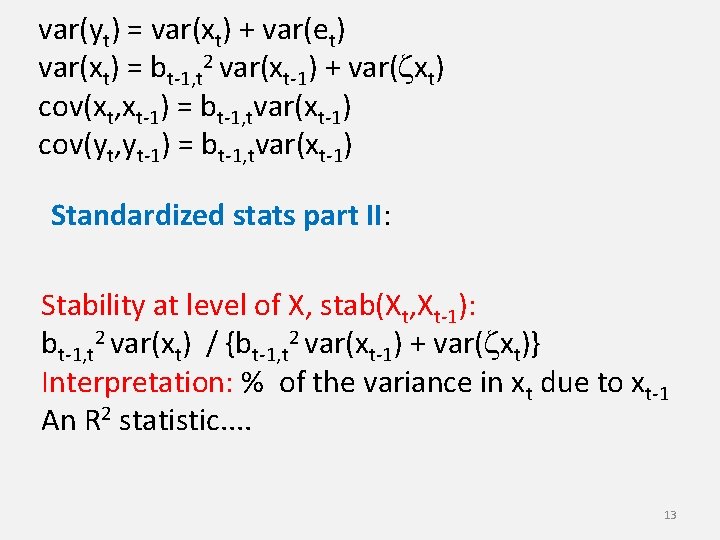
var(yt) = var(xt) + var(et) var(xt) = bt-1, t 2 var(xt-1) + var(zxt) cov(xt, xt-1) = bt-1, tvar(xt-1) cov(yt, yt-1) = bt-1, tvar(xt-1) Standardized stats part II: Stability at level of X, stab(Xt, Xt-1): bt-1, t 2 var(xt) / {bt-1, t 2 var(xt-1) + var(zxt)} Interpretation: % of the variance in xt due to xt-1 An R 2 statistic. . 13
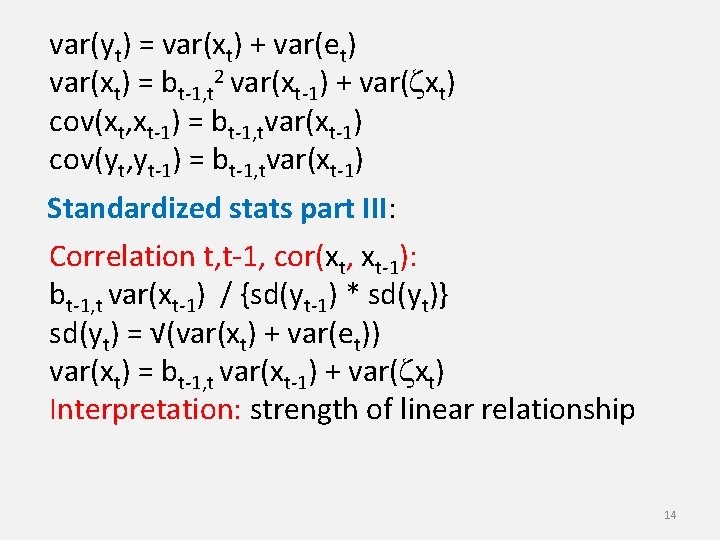
var(yt) = var(xt) + var(et) var(xt) = bt-1, t 2 var(xt-1) + var(zxt) cov(xt, xt-1) = bt-1, tvar(xt-1) cov(yt, yt-1) = bt-1, tvar(xt-1) Standardized stats part III: Correlation t, t-1, cor(xt, xt-1): bt-1, t var(xt-1) / {sd(yt-1) * sd(yt)} sd(yt) = √(var(xt) + var(et)) var(xt) = bt-1, t var(xt-1) + var(zxt) Interpretation: strength of linear relationship 14
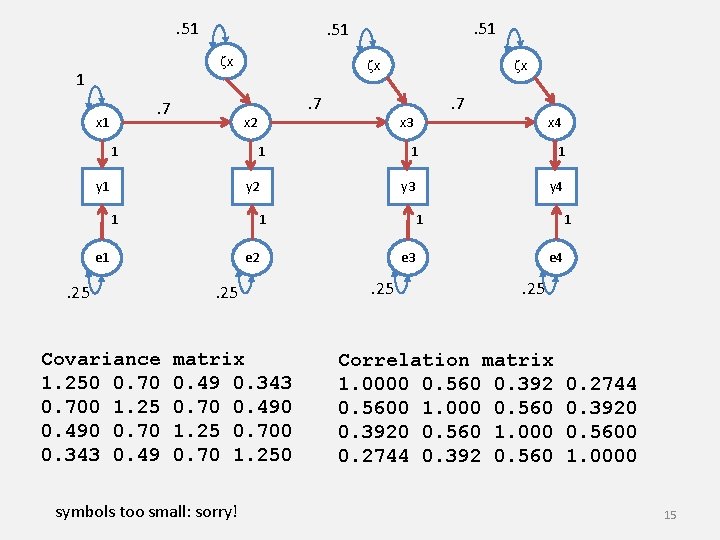
. 51 zx 1. 7 x 1 . 51 zx . 7 x 2 y 1 y 2 1 . 25 Covariance 1. 250 0. 700 1. 25 0. 490 0. 70 0. 343 0. 49 1 y 3 y 4 matrix 0. 49 0. 343 0. 70 0. 490 1. 25 0. 700 0. 70 1. 250 symbols too small: sorry! 1 1 e 2 . 25 x 4 1 1 e 1 . 7 x 3 1 1 zx e 3 . 25 e 4 . 25 Correlation matrix 1. 0000 0. 560 0. 392 0. 5600 1. 000 0. 560 0. 3920 0. 560 1. 000 0. 2744 0. 392 0. 560 0. 2744 0. 3920 0. 5600 1. 0000 15
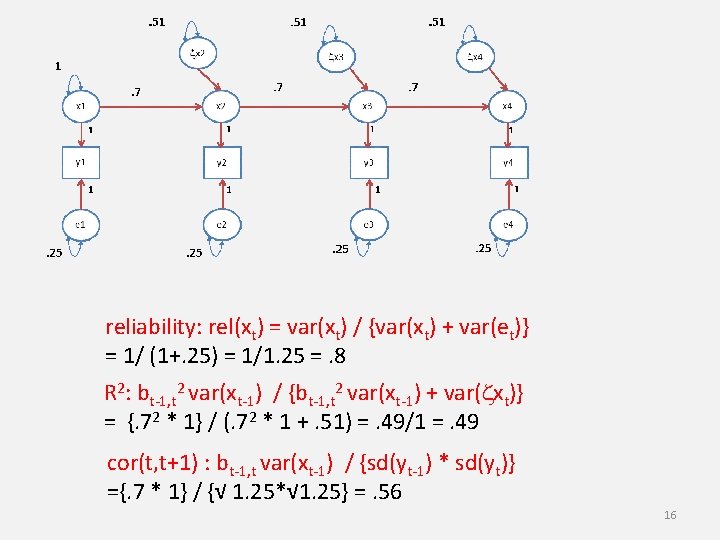
reliability: rel(xt) = var(xt) / {var(xt) + var(et)} = 1/ (1+. 25) = 1/1. 25 =. 8 R 2: bt-1, t 2 var(xt-1) / {bt-1, t 2 var(xt-1) + var(zxt)} = {. 72 * 1} / (. 72 * 1 +. 51) =. 49/1 =. 49 cor(t, t+1) : bt-1, t var(xt-1) / {sd(yt-1) * sd(yt)} ={. 7 * 1} / {√ 1. 25*√ 1. 25} =. 56 16
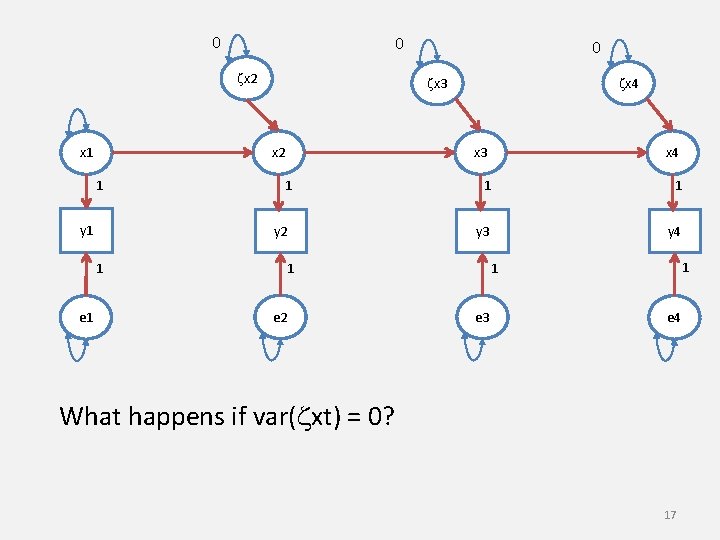
0 0 zx 2 x 1 y 1 1 y 2 1 e 1 zx 3 x 2 1 0 zx 4 x 3 x 4 1 1 y 3 y 4 1 e 2 1 1 e 3 e 4 What happens if var(zxt) = 0? 17
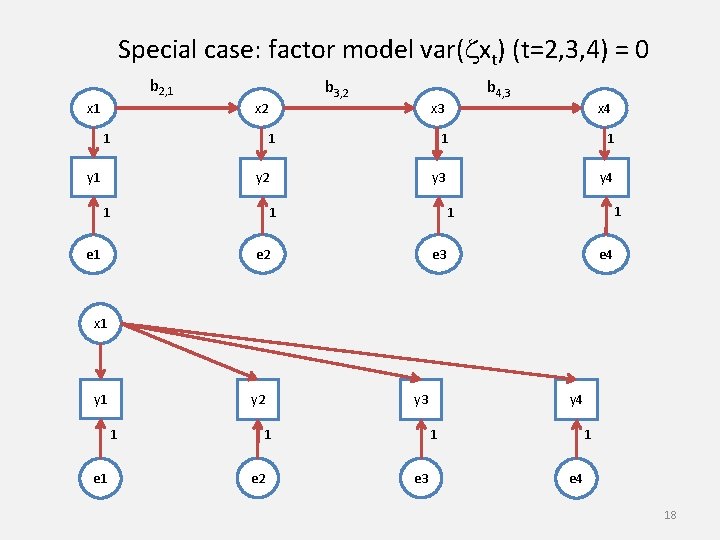
Special case: factor model var(zxt) (t=2, 3, 4) = 0 b 2, 1 x 1 b 3, 2 x 3 1 1 y 2 1 x 4 1 1 y 3 y 4 1 1 1 e 2 e 1 b 4, 3 e 4 x 1 y 2 1 e 1 y 3 1 e 2 y 4 1 1 e 3 e 4 18
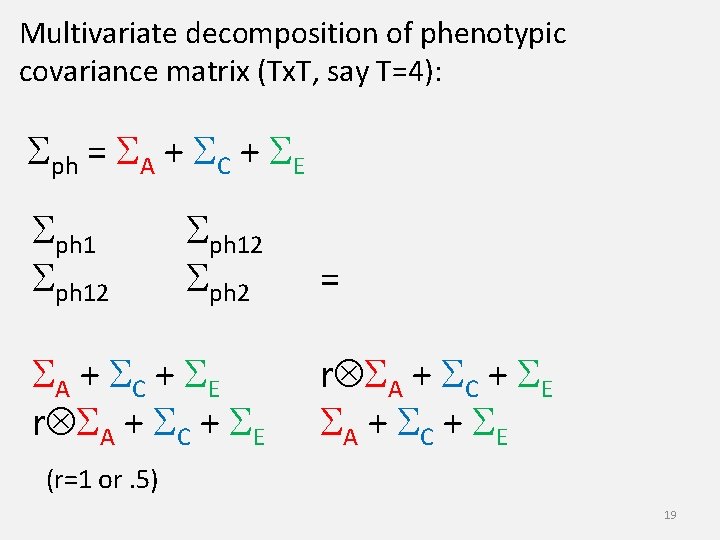
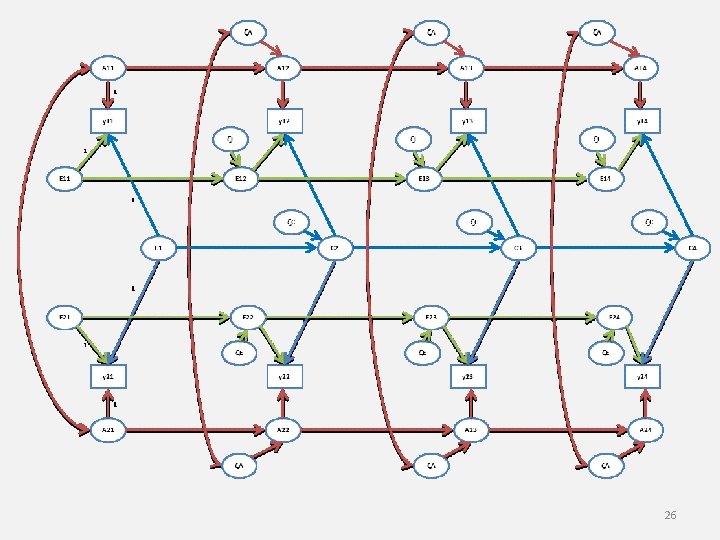
Multivariate decomposition of phenotypic covariance matrix (Tx. T, say T=4): Sph = SA + SC + SE Sph 12 Sph 2 SA + SC + SE r SA + SC + SE = r SA + SC + SE (r=1 or. 5) 19
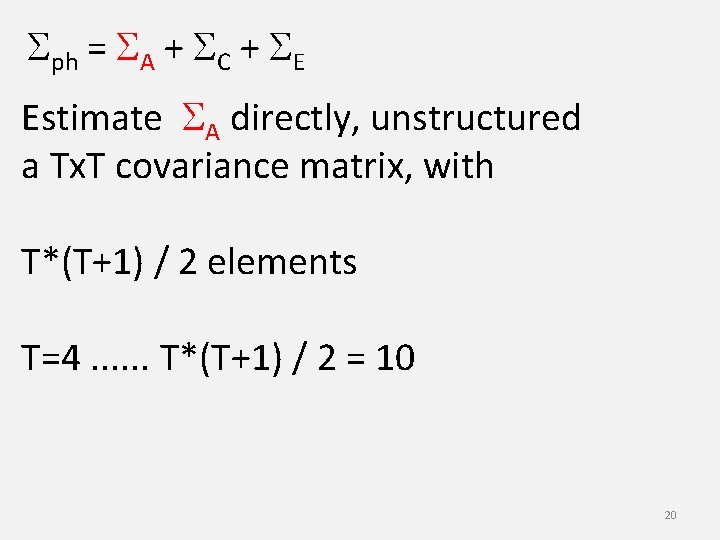
Sph = SA + SC + SE Estimate SA directly, unstructured a Tx. T covariance matrix, with T*(T+1) / 2 elements T=4. . . T*(T+1) / 2 = 10 20
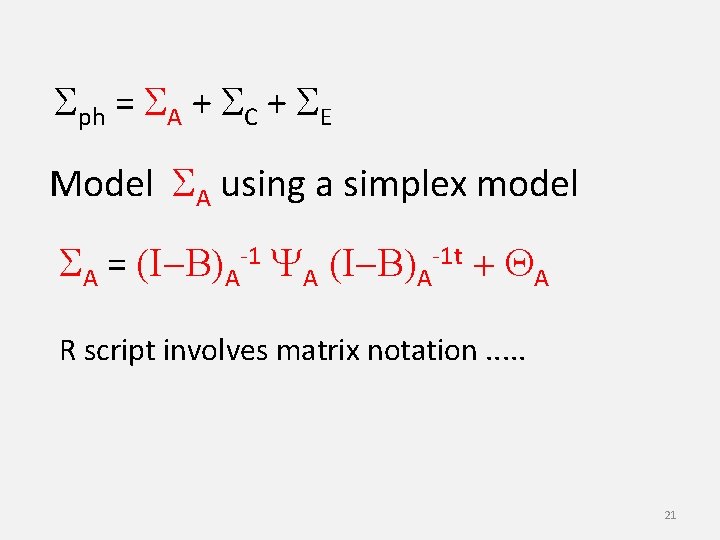
Sph = SA + SC + SE Model SA using a simplex model SA = (I-B)A-1 YA (I-B)A-1 t + QA R script involves matrix notation. . . 21
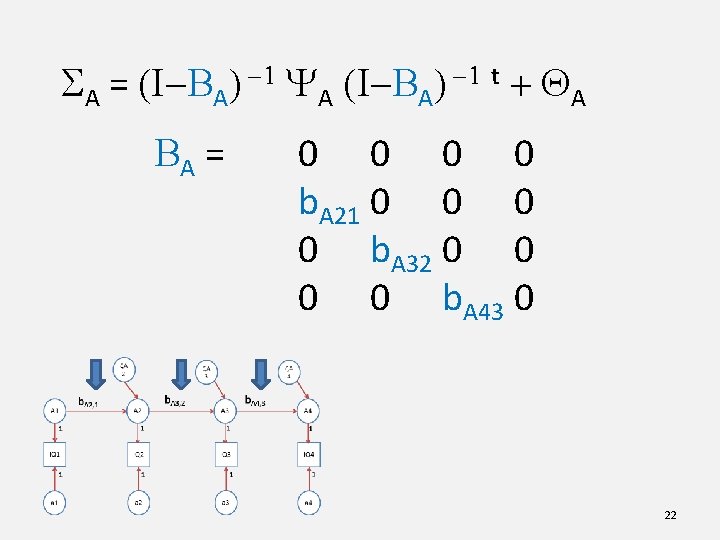
SA = (I-BA) -1 YA (I-BA) -1 t + QA BA = 0 0 b. A 21 0 0 b. A 32 0 0 b. A 43 0 22
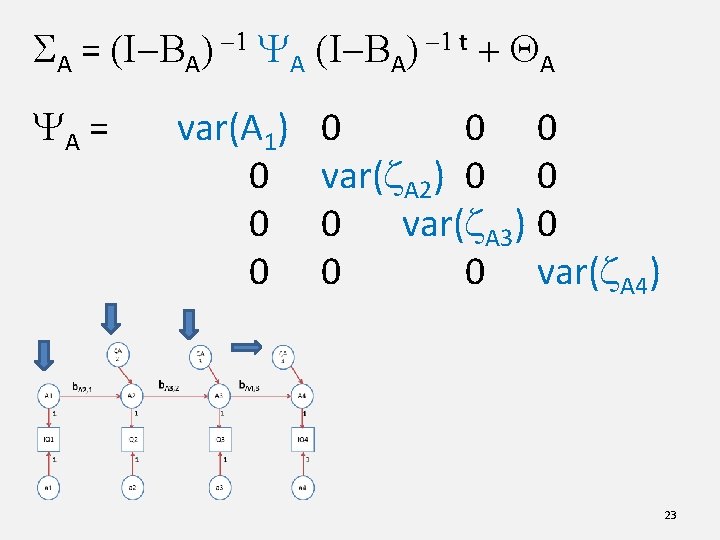
SA = (I-BA) -1 YA (I-BA) -1 t + QA YA = var(A 1) 0 0 0 var(z. A 2) 0 0 0 var(z. A 3) 0 0 0 var(z. A 4) 23
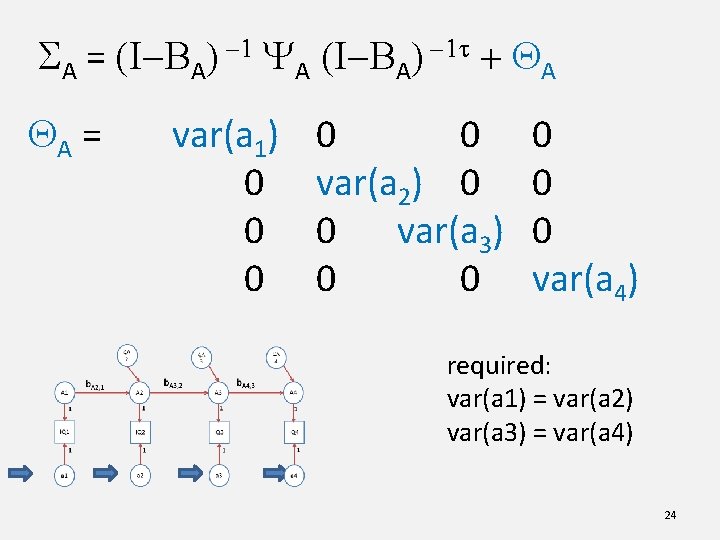
SA = (I-BA) -1 YA (I-BA) -1 t + QA QA = var(a 1) 0 0 0 var(a 2) 0 0 var(a 3) 0 0 0 var(a 4) required: var(a 1) = var(a 2) var(a 3) = var(a 4) 24
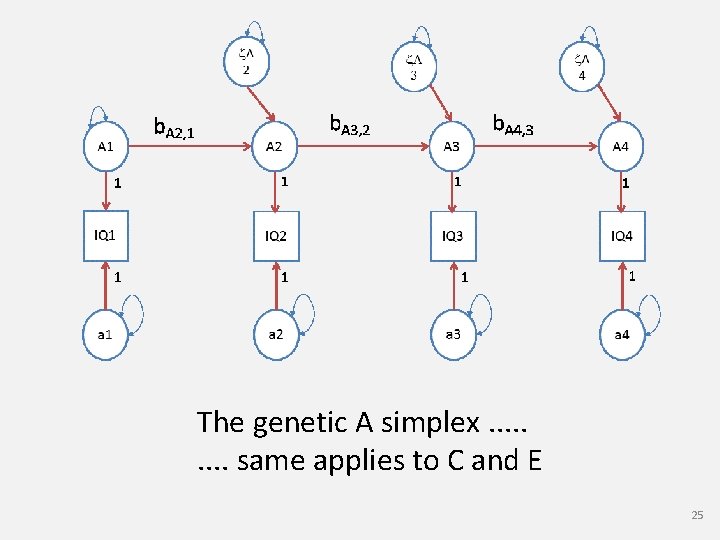
The genetic A simplex. . same applies to C and E 25
26
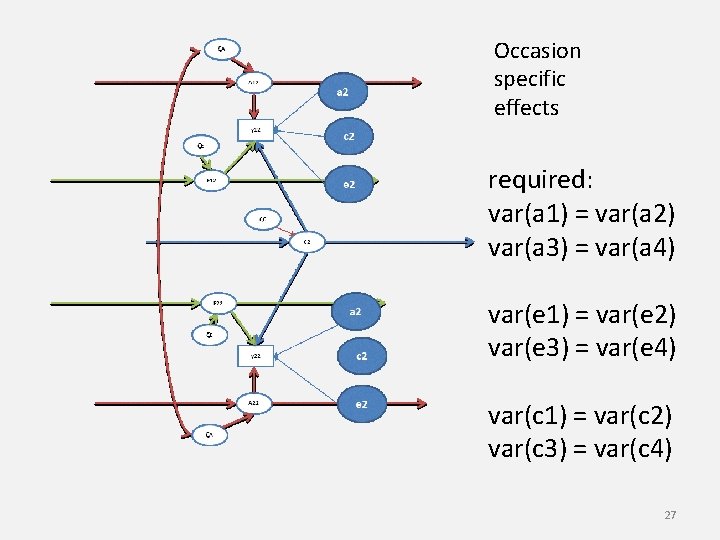
Occasion specific effects required: var(a 1) = var(a 2) var(a 3) = var(a 4) var(e 1) = var(e 2) var(e 3) = var(e 4) var(c 1) = var(c 2) var(c 3) = var(c 4) 27
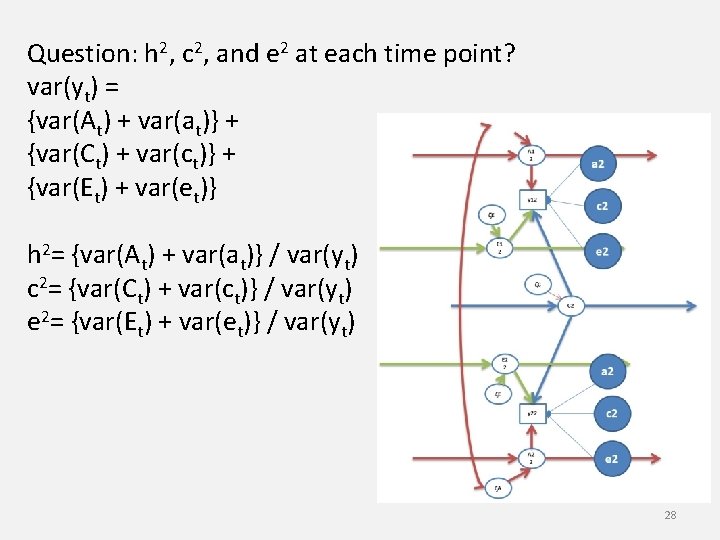
Question: h 2, c 2, and e 2 at each time point? var(yt) = {var(At) + var(at)} + {var(Ct) + var(ct)} + {var(Et) + var(et)} h 2= {var(At) + var(at)} / var(yt) c 2= {var(Ct) + var(ct)} / var(yt) e 2= {var(Et) + var(et)} / var(yt) 28
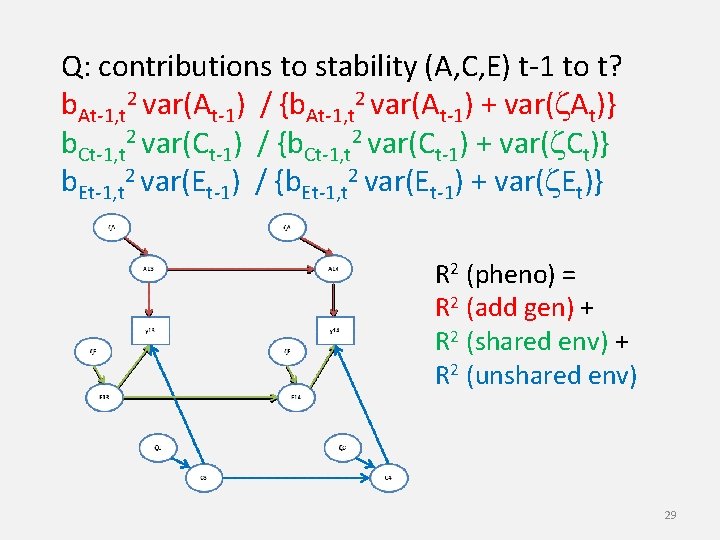
Q: contributions to stability (A, C, E) t-1 to t? b. At-1, t 2 var(At-1) / {b. At-1, t 2 var(At-1) + var(z. At)} b. Ct-1, t 2 var(Ct-1) / {b. Ct-1, t 2 var(Ct-1) + var(z. Ct)} b. Et-1, t 2 var(Et-1) / {b. Et-1, t 2 var(Et-1) + var(z. Et)} R 2 (pheno) = R 2 (add gen) + R 2 (shared env) + R 2 (unshared env) 29
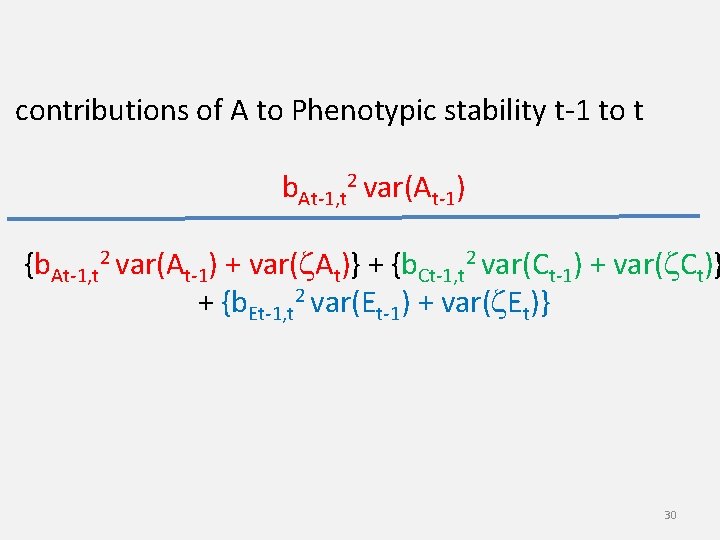
contributions of A to Phenotypic stability t-1 to t b. At-1, t 2 var(At-1) {b. At-1, t 2 var(At-1) + var(z. At)} + {b. Ct-1, t 2 var(Ct-1) + var(z. Ct)} + {b. Et-1, t 2 var(Et-1) + var(z. Et)} 30
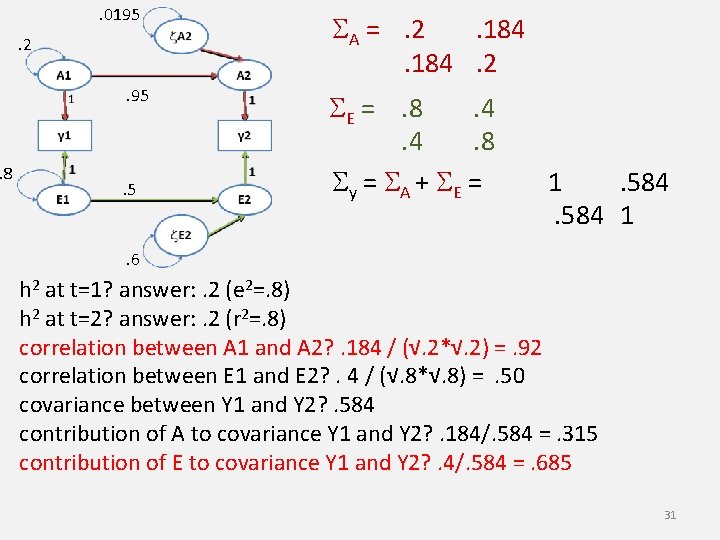
. 8 . 0195. 2. 95 . 5 SA =. 2. 184. 2 SE =. 8. 4. 4. 8 Sy = SA + SE = 1. 584 1 . 6 h 2 at t=1? answer: . 2 (e 2=. 8) h 2 at t=2? answer: . 2 (r 2=. 8) correlation between A 1 and A 2? . 184 / (√. 2*√. 2) =. 92 correlation between E 1 and E 2? . 4 / (√. 8*√. 8) =. 50 covariance between Y 1 and Y 2? . 584 contribution of A to covariance Y 1 and Y 2? . 184/. 584 =. 315 contribution of E to covariance Y 1 and Y 2? . 4/. 584 =. 685 31
32
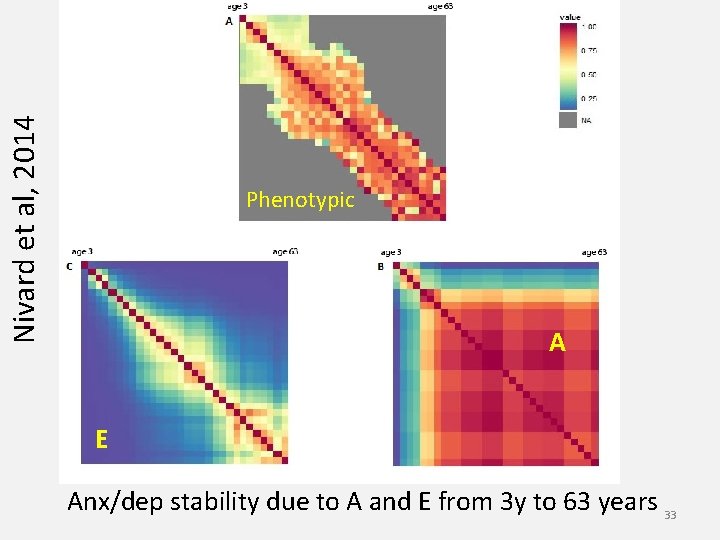
Nivard et al, 2014 Phenotypic A E Anx/dep stability due to A and E from 3 y to 63 years 33
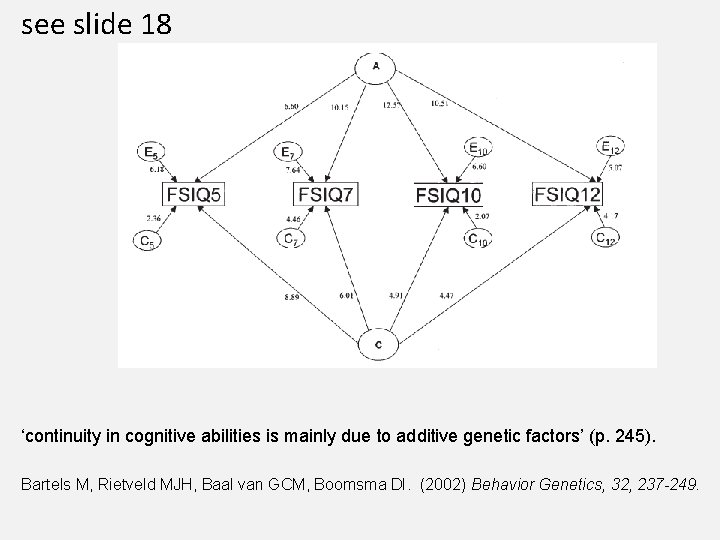
see slide 18 ‘continuity in cognitive abilities is mainly due to additive genetic factors’ (p. 245). Bartels M, Rietveld MJH, Baal van GCM, Boomsma DI. (2002) Behavior Genetics, 32, 237 -249.
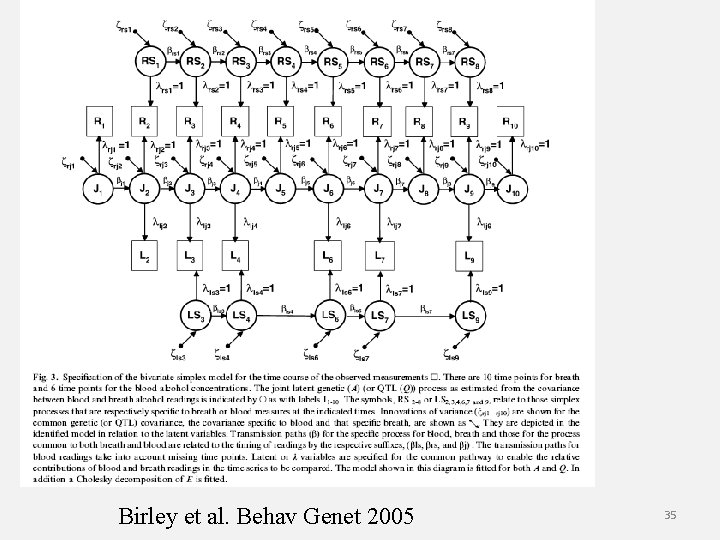
Birley et al. Behav Genet 2005 35
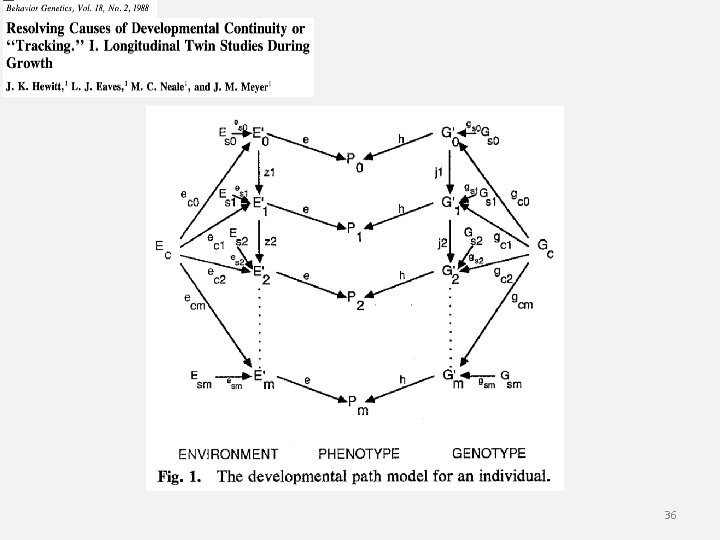
36
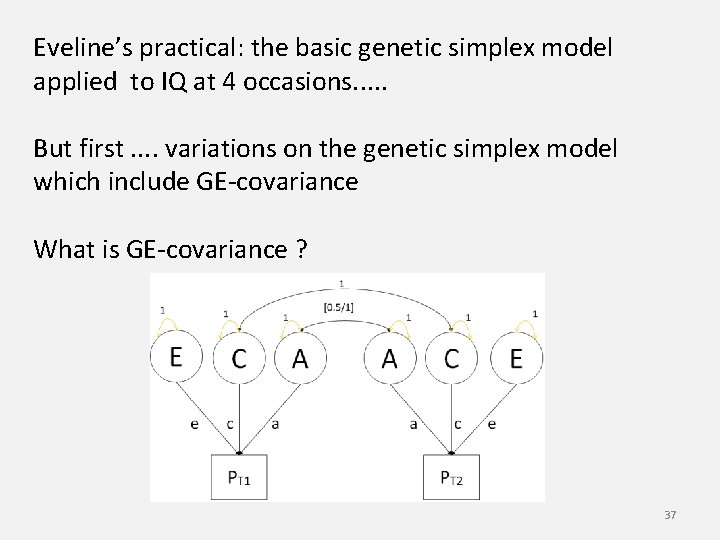
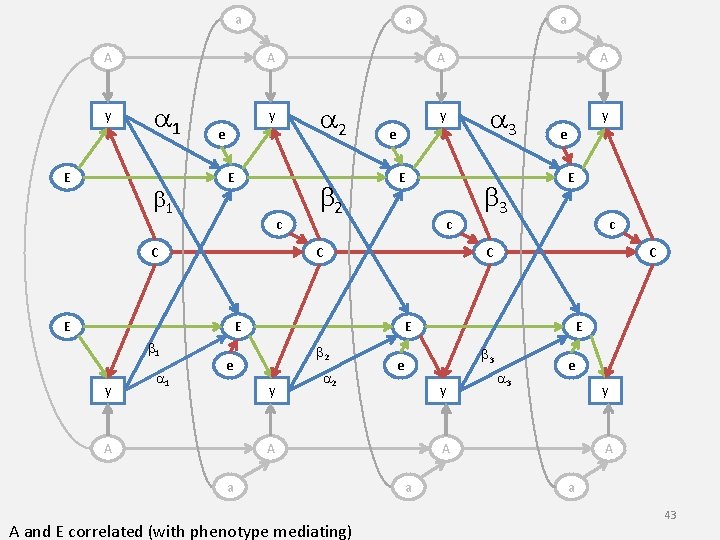
Eveline’s practical: the basic genetic simplex model applied to IQ at 4 occasions. . . But first. . variations on the genetic simplex model which include GE-covariance What is GE-covariance ? 37
https: //genepi. qimr. edu. au/staff/classicpapers/ “(. . . ), it is possible, …. . , to parameterize genotype environment covariance in a variety of ways consistent with meaningful biological and psychological theories. We may distinguish the following three kinds of Cov. GE which can be specified in terms of a theoretical model” (p. 8). Environments selected by genotypes (Scarr & Mc. Cartny, 1983; Plomin, De. Fries & Loehlin, 1977). Sibling effects (Carey, 1986, Behav Genet 16: 319– 341). Cultural transmission (Keller, et al, Twin Res & Hun Gen 2011).
Environments selected by genotypes (Scarr & Mc. Cartny, 1983; Plomin, De. Fries & Loehlin, 1977) – niche picking Sibling effects (Carey, 1986, Behav Genet 16: 319– 341) – mutual influences
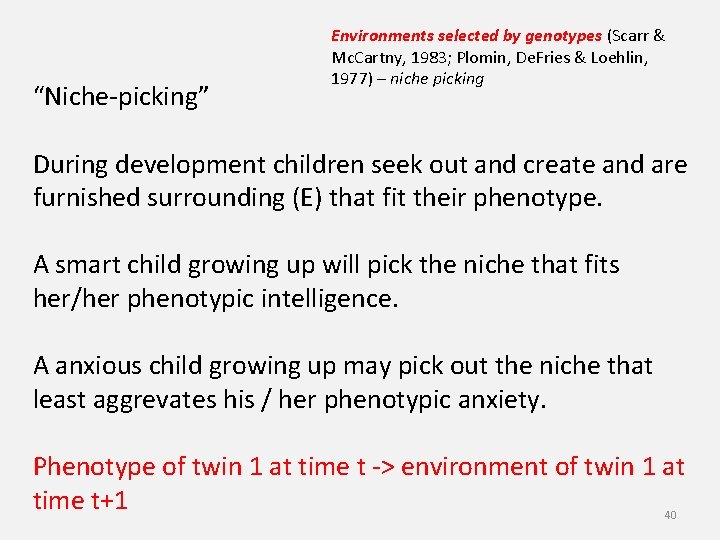
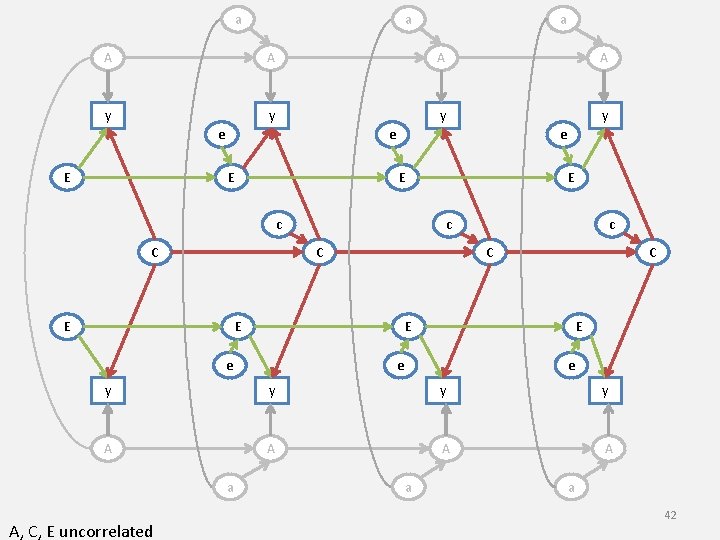
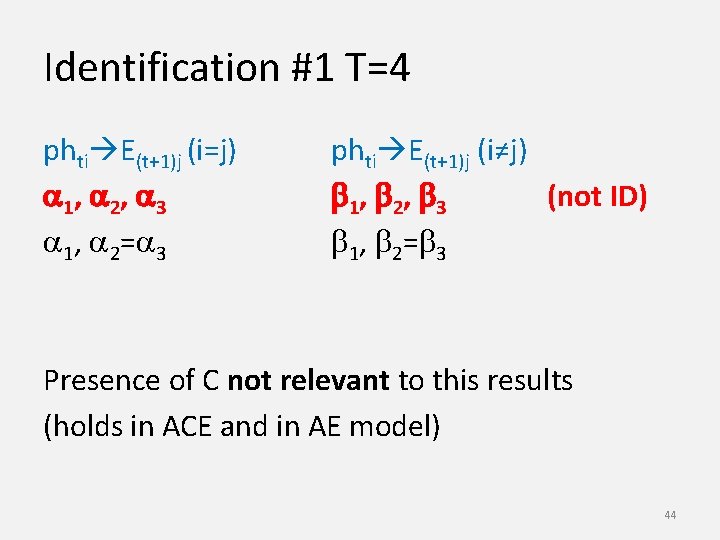
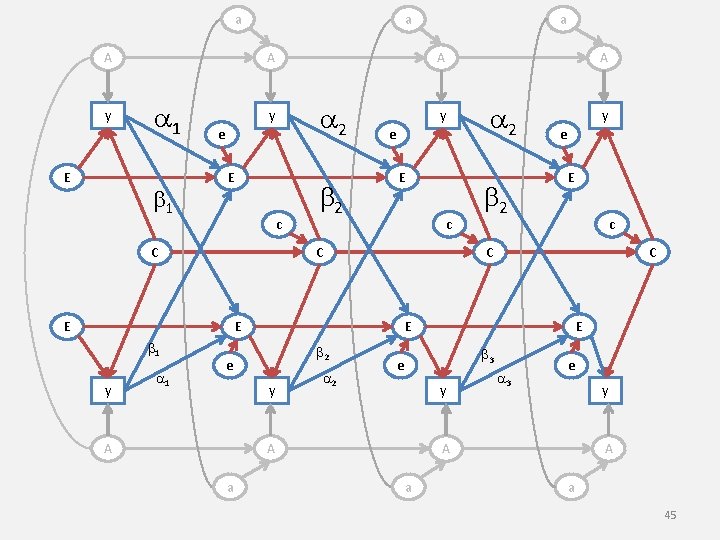
“Niche-picking” Environments selected by genotypes (Scarr & Mc. Cartny, 1983; Plomin, De. Fries & Loehlin, 1977) – niche picking During development children seek out and create and are furnished surrounding (E) that fit their phenotype. A smart child growing up will pick the niche that fits her/her phenotypic intelligence. A anxious child growing up may pick out the niche that least aggrevates his / her phenotypic anxiety. Phenotype of twin 1 at time t -> environment of twin 1 at time t+1 40
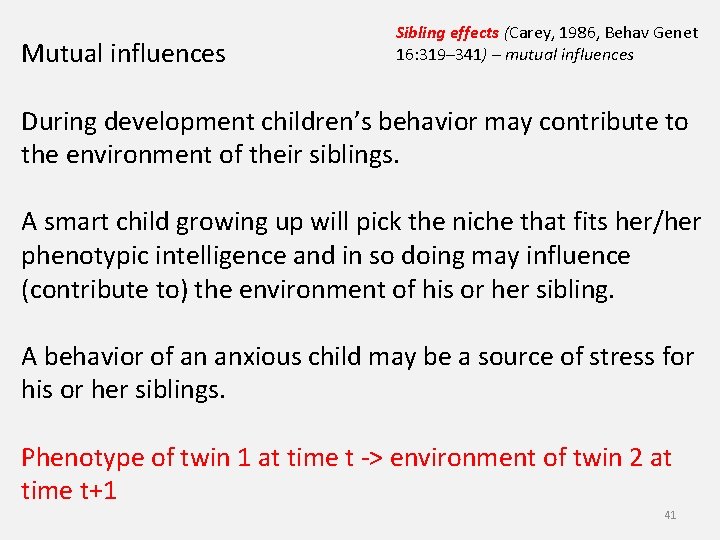
Mutual influences Sibling effects (Carey, 1986, Behav Genet 16: 319– 341) – mutual influences During development children’s behavior may contribute to the environment of their siblings. A smart child growing up will pick the niche that fits her/her phenotypic intelligence and in so doing may influence (contribute to) the environment of his or her sibling. A behavior of an anxious child may be a source of stress for his or her siblings. Phenotype of twin 1 at time t -> environment of twin 2 at time t+1 41
a a a A A y y e E e E E c C E e E e e y y A A a A, C, E uncorrelated a a 42
a A y E a A a 1 b 1 A a 2 y e E c C b 2 y a 3 y e E c C E b 2 e y A b 3 y C E a 1 A C E b 1 a a 2 b 3 e y A and E correlated (with phenotype mediating) E a 3 e y A a 43
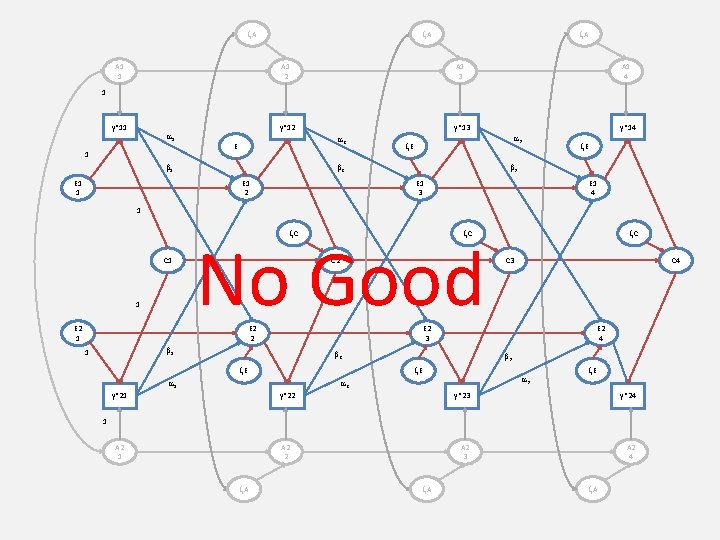
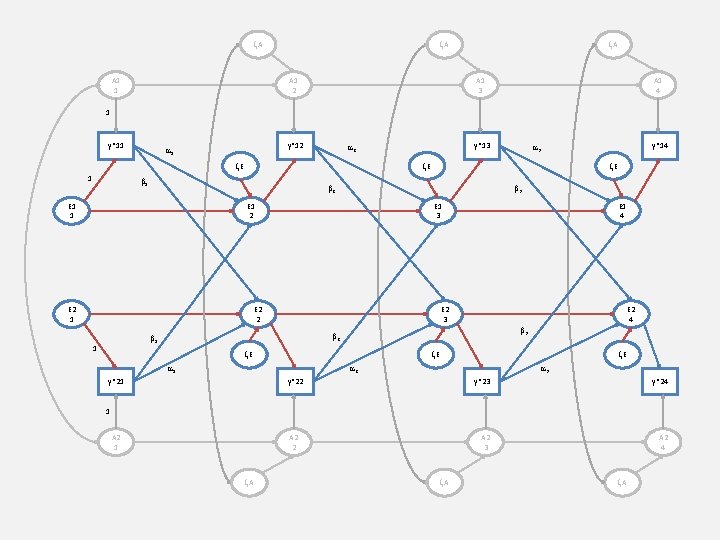
Identification #1 T=4 phti E(t+1)j (i=j) a 1, a 2, a 3 a 1, a 2=a 3 phti E(t+1)j (i≠j) b 1, b 2, b 3 (not ID) b 1, b 2=b 3 Presence of C not relevant to this results (holds in ACE and in AE model) 44
a A y E a A a 1 b 1 A a 2 y e E c C b 2 y a 2 y e E c b 2 y E c C a 2 E b 3 e y A a e E e A b 2 y C E a 1 A C E b 1 a a 3 e y A a 45
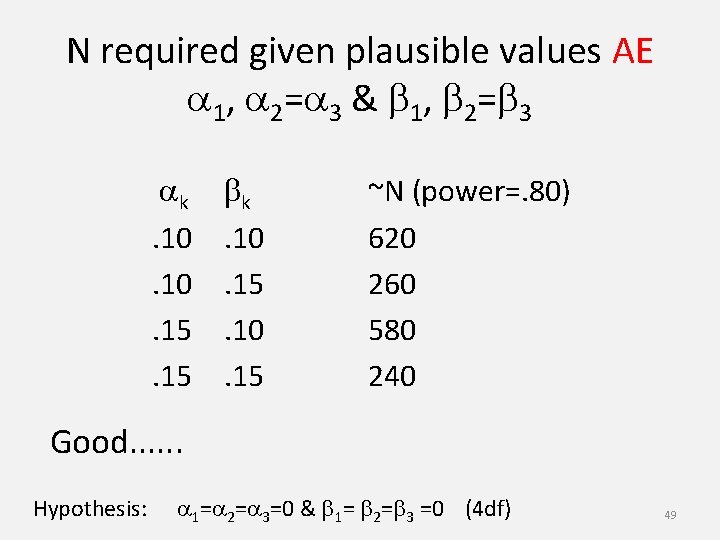
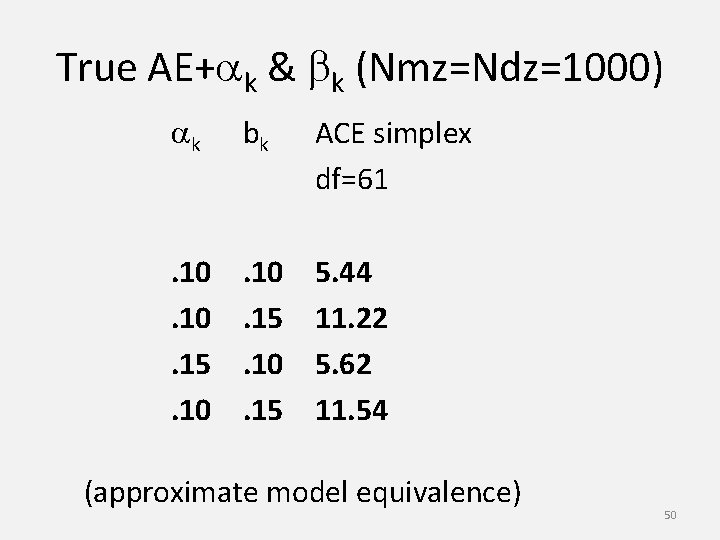
N required given plausible values ACE a 1, a 2=a 3 & b 1, b 2=b 3 Hypothesis: a 1=a 2=a 3=0 & b 1= b 2=b 3 =0 ak bk (power=. 80). 10. 10. 15. 15 (4 df) ~N 11700 4700 12100 4800 46
z. A A 1 1 z. A A 1 2 z. A A 1 3 A 1 4 1 y*11 a 1 1 y*12 E b 1 E 1 1 y*13 a 2 z. E b 2 E 1 2 y*14 a 3 z. E b 3 E 1 4 1 z. C C 1 1 E 2 1 z. C No Good C 2 E 2 2 C 3 C 4 E 2 3 b 1 1 z. C b 2 z. E b 3 z. E a 1 a 3 a 2 y*21 y*22 A 2 1 A 2 2 E 2 4 z. E y*23 y*24 A 2 3 A 2 4 1 z. A
z. A A 1 1 z. A A 1 2 z. A A 1 3 A 1 4 1 y*12 a 1 z. E 1 y*13 a 2 z. E b 1 z. E b 2 E 1 1 b 3 E 1 2 E 2 1 E 1 3 E 2 2 E 1 4 E 2 3 E 2 4 b 3 b 2 b 1 1 y*14 a 3 z. E a 1 z. E a 2 y*21 a 3 y*22 y*23 y*24 A 2 3 A 2 4 1 A 2 2 z. A
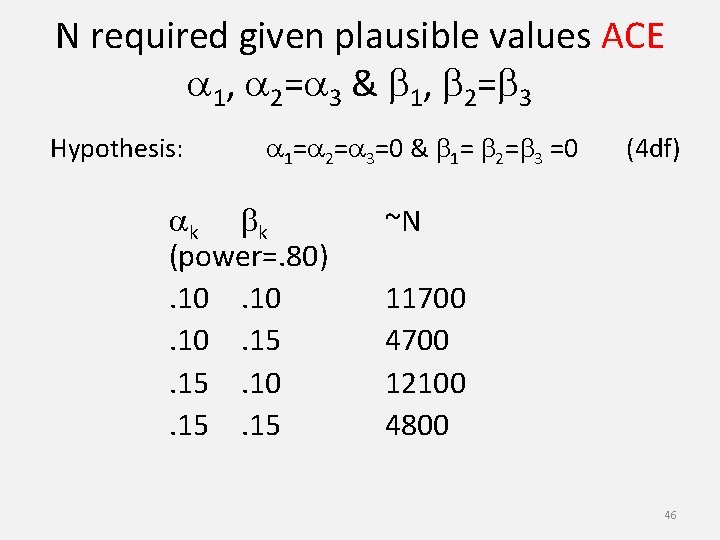
N required given plausible values AE a 1, a 2=a 3 & b 1, b 2=b 3 ak. 10. 15 bk. 10. 15 ~N (power=. 80) 620 260 580 240 Good. . . Hypothesis: a 1=a 2=a 3=0 & b 1= b 2=b 3 =0 (4 df) 49
True AE+ak & bk (Nmz=Ndz=1000) ak bk ACE simplex df=61 . 10. 15 5. 44 11. 22 5. 62 11. 54 (approximate model equivalence) 50
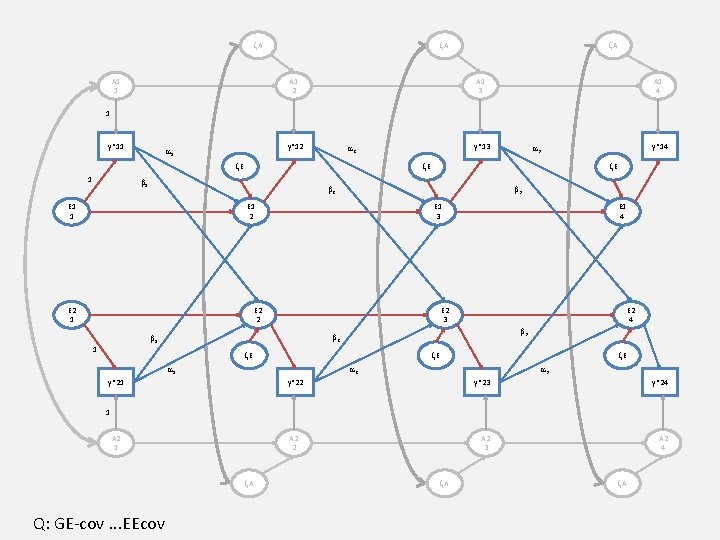
z. A A 1 1 z. A A 1 2 z. A A 1 3 A 1 4 1 y*12 a 1 z. E 1 y*13 a 2 z. E b 1 z. E b 2 E 1 1 b 3 E 1 2 E 2 1 E 1 3 E 2 2 E 1 4 E 2 3 E 2 4 b 3 b 2 b 1 1 y*14 a 3 z. E a 1 z. E a 2 y*21 a 3 y*22 y*23 y*24 A 2 3 A 2 4 1 A 2 2 z. A Q: GE-cov. . . EEcov z. A
Anxious depression • Twins aged 3, 7, 10, 12 Netherlands Twin Register (NTR), which includes the Young NTR (YNTR; van Beijsterveldt, Groen-Blokhuis, Hottenga, et al. , 2013) • ASEBA CBCL instruments (Achenbach), maternal ratings • Observed 89%, 54%, 45%, 37% (NMZ=3480) • Observed 89%, 50%, 39%, 32% (NDZ=3145) 52
Phenotypic correlations FIML phenotypic twin correlations MZ: . 71 (3), . 58 (7), . 58 (10), and. 63 (12). DZ: . 31 (3), . 36 (7), . 35 (10), and. 40 (12). From 7 y onwards looks like ACE model 53
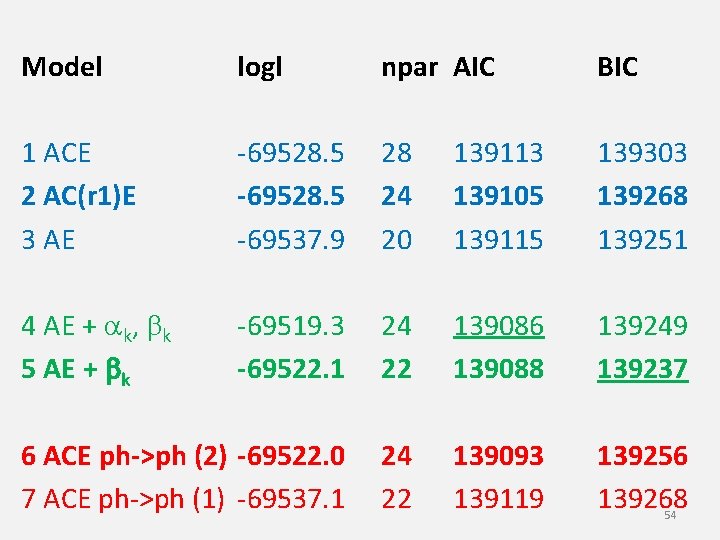
Model logl npar AIC BIC 1 ACE 2 AC(r 1)E 3 AE -69528. 5 -69537. 9 28 24 20 139113 139105 139115 139303 139268 139251 4 AE + ak, bk 5 AE + bk -69519. 3 -69522. 1 24 22 139086 139088 139249 139237 6 ACE ph->ph (2) -69522. 0 7 ACE ph->ph (1) -69537. 1 24 22 139093 139119 139256 139268 54
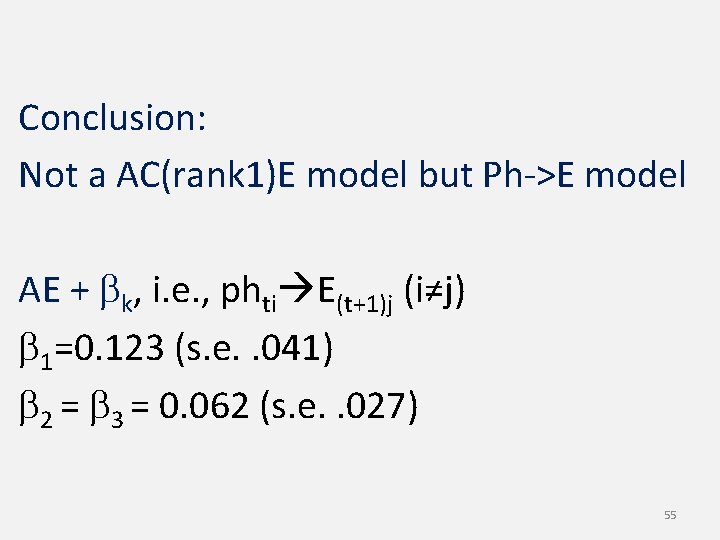
Conclusion: Not a AC(rank 1)E model but Ph->E model AE + bk, i. e. , phti E(t+1)j (i≠j) b 1=0. 123 (s. e. . 041) b 2 = b 3 = 0. 062 (s. e. . 027) 55
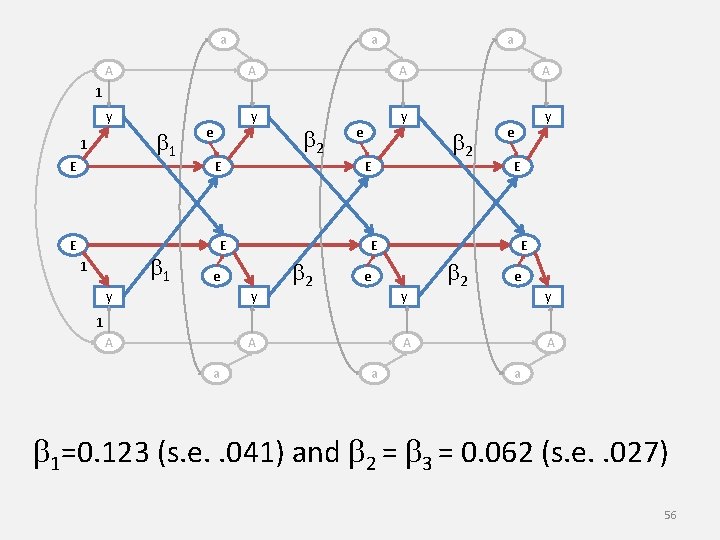
a a a A A y y 1 b 1 1 E E b 1 1 e E b 2 e b 2 E E e y y A A b 2 E e y b 2 e y 1 a A a b 1=0. 123 (s. e. . 041) and b 2 = b 3 = 0. 062 (s. e. . 027) 56
57
- Slides: 57