
1 JOINT SERVICE ADVENTUROUS TRAINING JSAT DIVING DEFENCE


- Slides: 46
1 JOINT SERVICE ADVENTUROUS TRAINING (JSAT) DIVING DEFENCE DIVING (Mil) CROSSOVER v 2
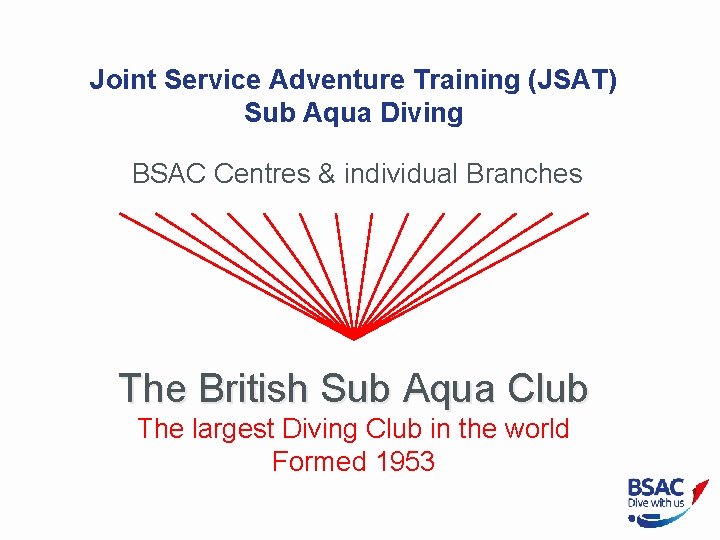
Joint Service Adventure Training (JSAT) Sub Aqua Diving BSAC Centres & individual Branches The British Sub Aqua Club The largest Diving Club in the world Formed 1953
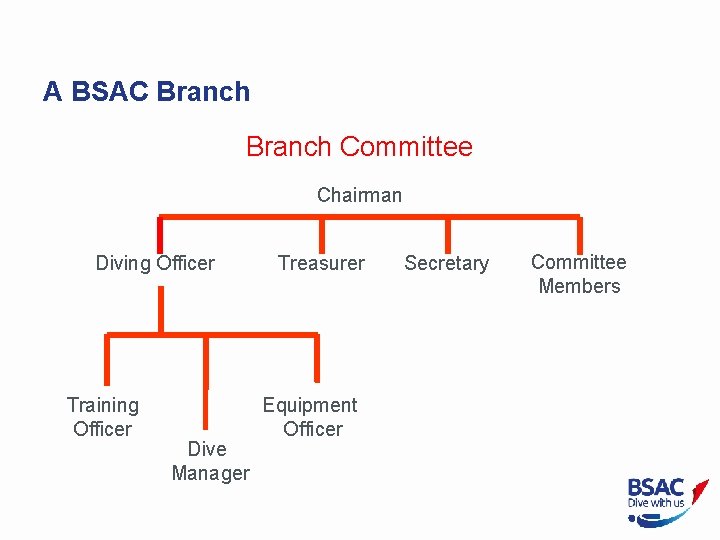
A BSAC Branch Committee Chairman Diving Officer Treasurer Training Officer Dive Manager Equipment Officer Secretary Committee Members
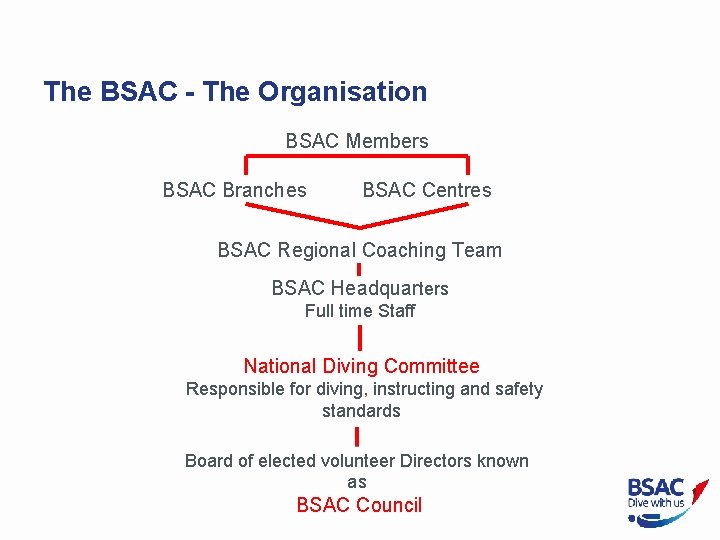
The BSAC - The Organisation BSAC Members BSAC Branches BSAC Centres BSAC Regional Coaching Team BSAC Headquarters Full time Staff National Diving Committee Responsible for diving, instructing and safety standards Board of elected volunteer Directors known as BSAC Council
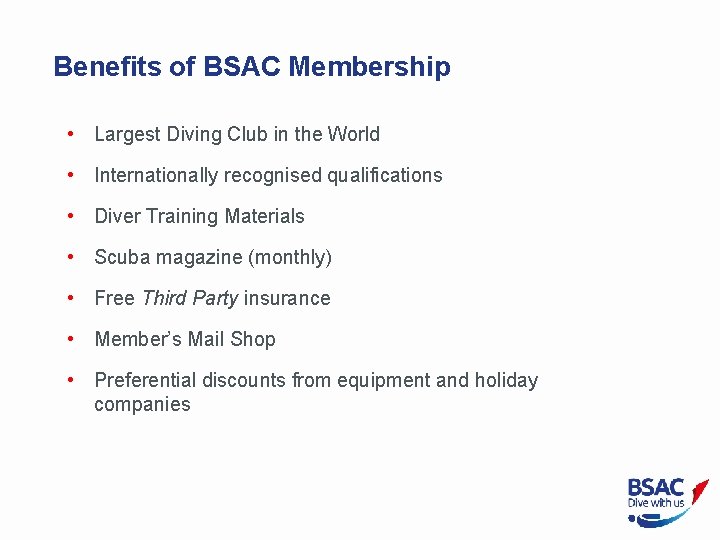
Benefits of BSAC Membership • Largest Diving Club in the World • Internationally recognised qualifications • Diver Training Materials • Scuba magazine (monthly) • Free Third Party insurance • Member’s Mail Shop • Preferential discounts from equipment and holiday companies
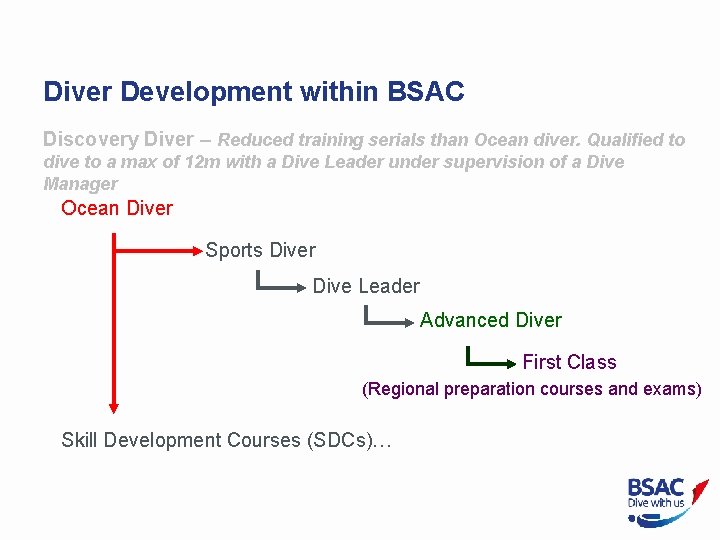
Diver Development within BSAC Discovery Diver – Reduced training serials than Ocean diver. Qualified to dive to a max of 12 m with a Dive Leader under supervision of a Dive Manager Ocean Diver Sports Diver Dive Leader Advanced Diver First Class (Regional preparation courses and exams) Skill Development Courses (SDCs)…
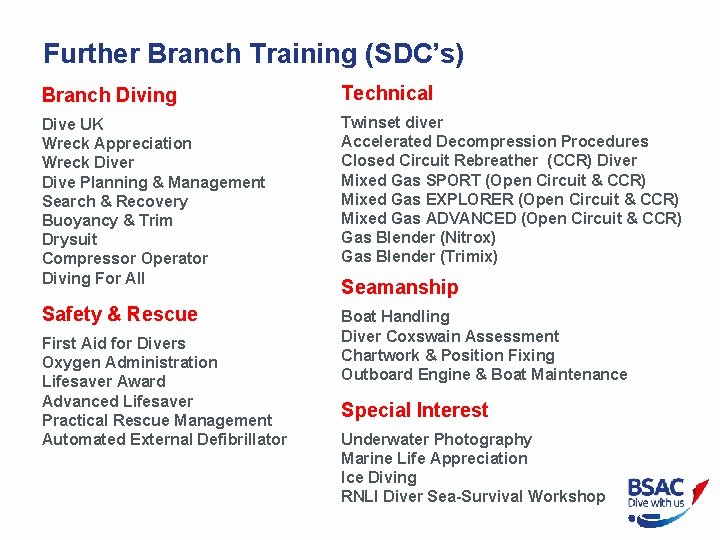
Further Branch Training (SDC’s) Branch Diving Technical Dive UK Wreck Appreciation Wreck Diver Dive Planning & Management Search & Recovery Buoyancy & Trim Drysuit Compressor Operator Diving For All Twinset diver Accelerated Decompression Procedures Closed Circuit Rebreather (CCR) Diver Mixed Gas SPORT (Open Circuit & CCR) Mixed Gas EXPLORER (Open Circuit & CCR) Mixed Gas ADVANCED (Open Circuit & CCR) Gas Blender (Nitrox) Gas Blender (Trimix) Safety & Rescue Boat Handling Diver Coxswain Assessment Chartwork & Position Fixing Outboard Engine & Boat Maintenance First Aid for Divers Oxygen Administration Lifesaver Award Advanced Lifesaver Practical Rescue Management Automated External Defibrillator Seamanship Special Interest Underwater Photography Marine Life Appreciation Ice Diving RNLI Diver Sea-Survival Workshop
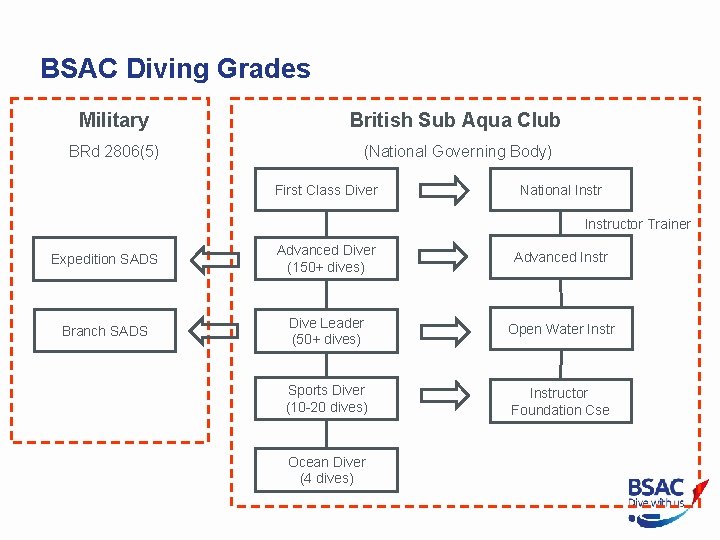
BSAC Diving Grades Military British Sub Aqua Club BRd 2806(5) (National Governing Body) First Class Diver National Instructor Trainer Expedition SADS Advanced Diver (150+ dives) Advanced Instr Branch SADS Dive Leader (50+ dives) Open Water Instr Sports Diver (10 -20 dives) Instructor Foundation Cse Ocean Diver (4 dives)
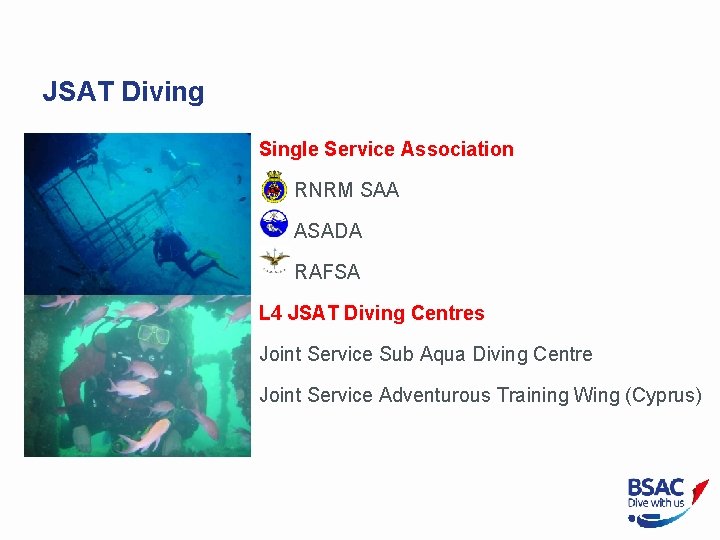
JSAT Diving Single Service Association RNRM SAA ASADA RAFSA L 4 JSAT Diving Centres Joint Service Sub Aqua Diving Centre Joint Service Adventurous Training Wing (Cyprus)
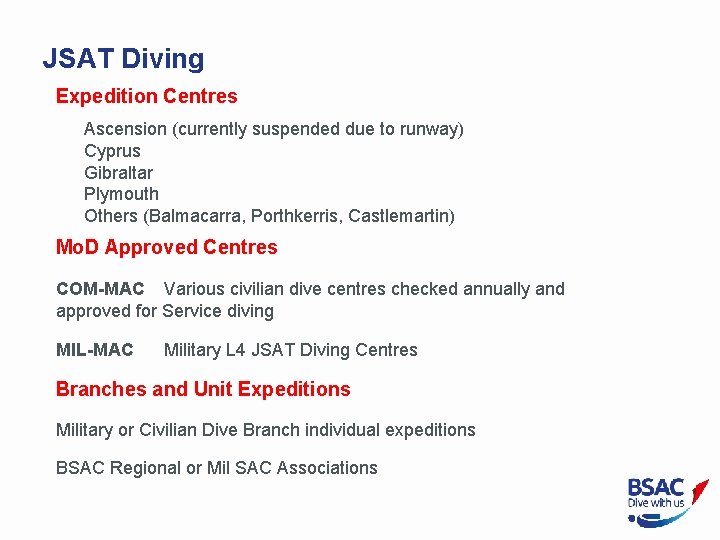
JSAT Diving Expedition Centres Ascension (currently suspended due to runway) Cyprus Gibraltar Plymouth Others (Balmacarra, Porthkerris, Castlemartin) Mo. D Approved Centres COM-MAC Various civilian dive centres checked annually and approved for Service diving MIL-MAC Military L 4 JSAT Diving Centres Branches and Unit Expeditions Military or Civilian Dive Branch individual expeditions BSAC Regional or Mil SAC Associations
OT 4 Ocean Diver Dive planning & Nitrox
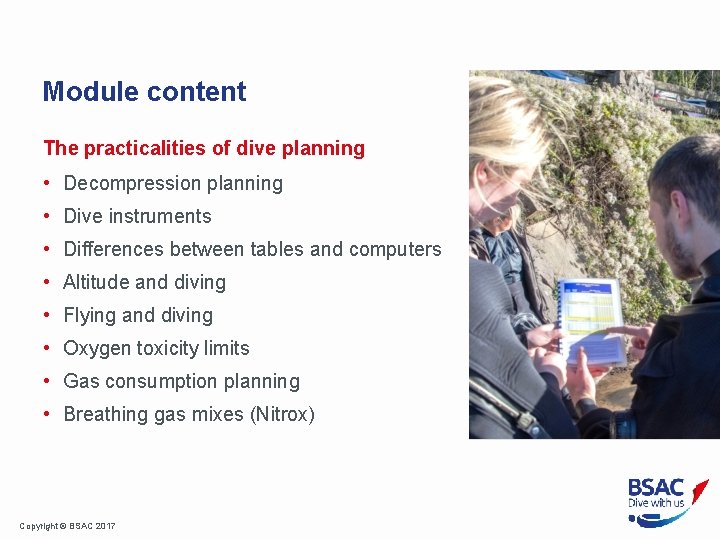
Module content The practicalities of dive planning • Decompression planning • Dive instruments • Differences between tables and computers • Altitude and diving • Flying and diving • Oxygen toxicity limits • Gas consumption planning • Breathing gas mixes (Nitrox) Copyright © BSAC 2017
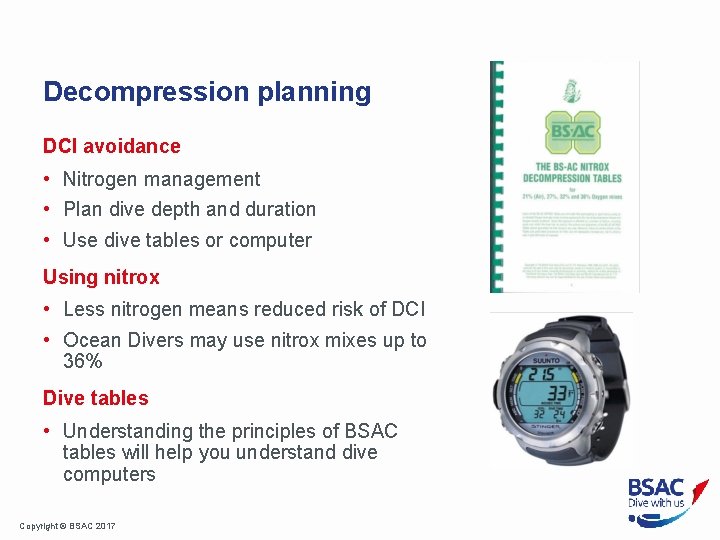
Decompression planning DCI avoidance • Nitrogen management • Plan dive depth and duration • Use dive tables or computer Using nitrox • Less nitrogen means reduced risk of DCI • Ocean Divers may use nitrox mixes up to 36% Dive tables • Understanding the principles of BSAC tables will help you understand dive computers Copyright © BSAC 2017
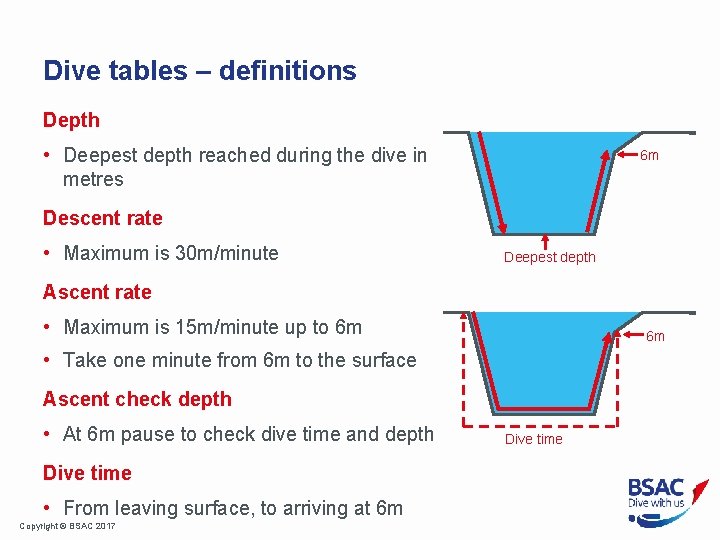
Dive tables – definitions Depth • Deepest depth reached during the dive in metres 6 m Descent rate • Maximum is 30 m/minute Deepest depth Ascent rate • Maximum is 15 m/minute up to 6 m 6 m • Take one minute from 6 m to the surface Ascent check depth • At 6 m pause to check dive time and depth Dive time • From leaving surface, to arriving at 6 m Copyright © BSAC 2017 Dive time
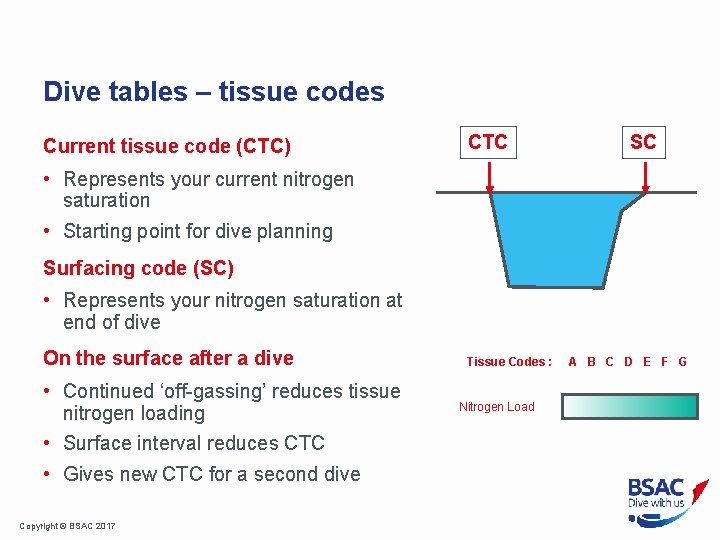
Dive tables – tissue codes Current tissue code (CTC) CTC SC • Represents your current nitrogen saturation • Starting point for dive planning Surfacing code (SC) • Represents your nitrogen saturation at end of dive On the surface after a dive • Continued ‘off-gassing’ reduces tissue nitrogen loading • Surface interval reduces CTC • Gives new CTC for a second dive Copyright © BSAC 2017 Tissue Codes : A B C D E F G Nitrogen Load
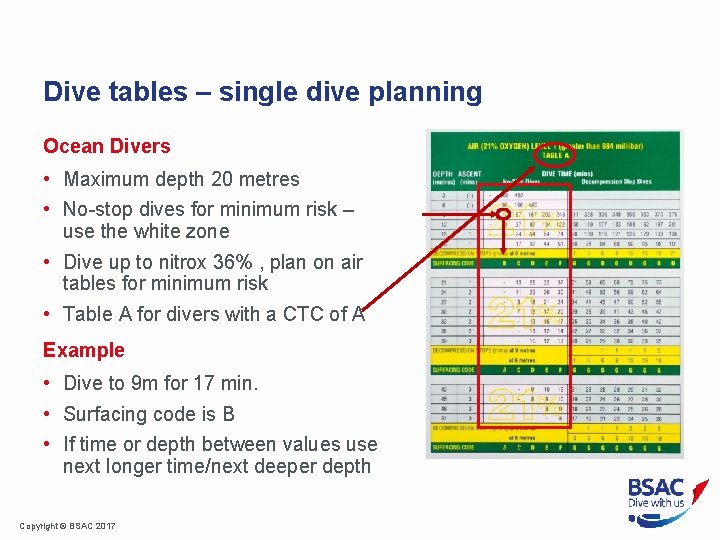
Dive tables – single dive planning Ocean Divers • Maximum depth 20 metres • No-stop dives for minimum risk – use the white zone • Dive up to nitrox 36% , plan on air tables for minimum risk • Table A for divers with a CTC of A Example • Dive to 9 m for 17 min. • Surfacing code is B • If time or depth between values use next longer time/next deeper depth Copyright © BSAC 2017
Quiz 1 What is dive time? • Time from leaving the surface, to arriving at 6 m What is your surfacing code after your first dive of the day to 20 m for 30 minutes? • E What is your surfacing code after a first dive to 12 m for 40 minutes? • D Copyright © BSAC 2017
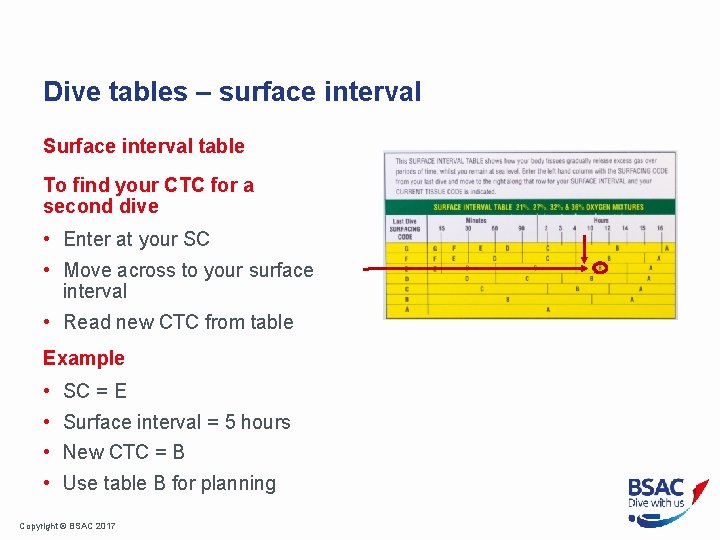
Dive tables – surface interval Surface interval table To find your CTC for a second dive • Enter at your SC • Move across to your surface interval • Read new CTC from table Example • • SC = E Surface interval = 5 hours New CTC = B Use table B for planning Copyright © BSAC 2017
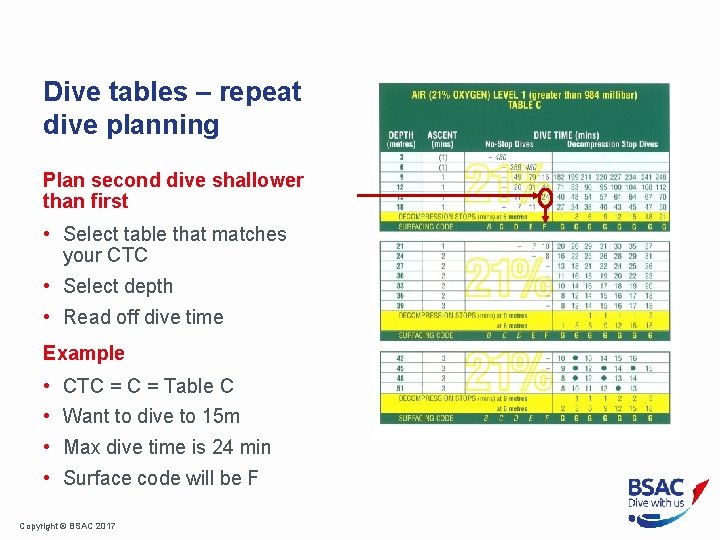
Dive tables – repeat dive planning Plan second dive shallower than first • Select table that matches your CTC • Select depth • Read off dive time Example • • CTC = Table C Want to dive to 15 m Max dive time is 24 min Surface code will be F Copyright © BSAC 2017
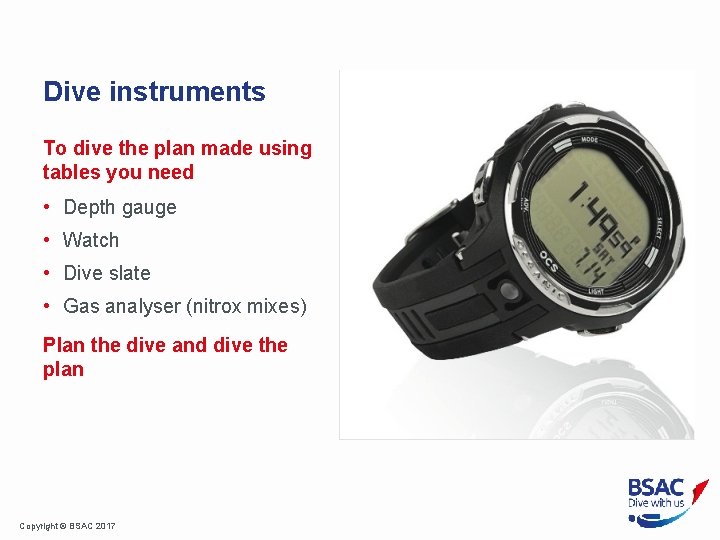
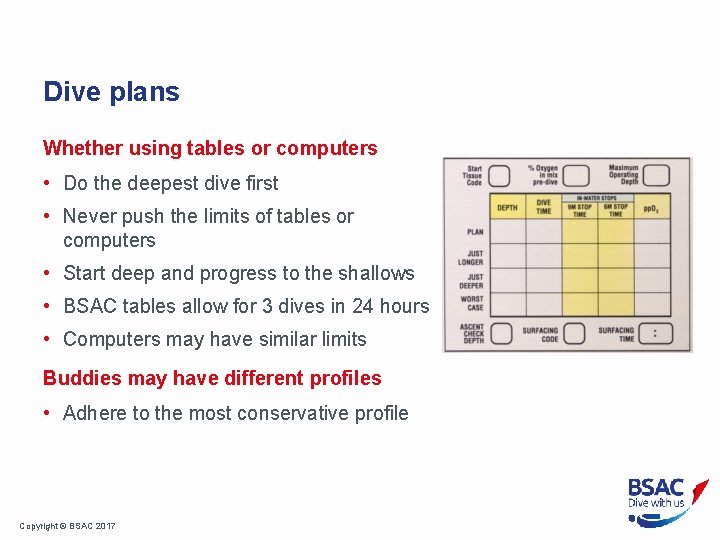
Dive instruments To dive the plan made using tables you need • Depth gauge • Watch • Dive slate • Gas analyser (nitrox mixes) Plan the dive and dive the plan Copyright © BSAC 2017
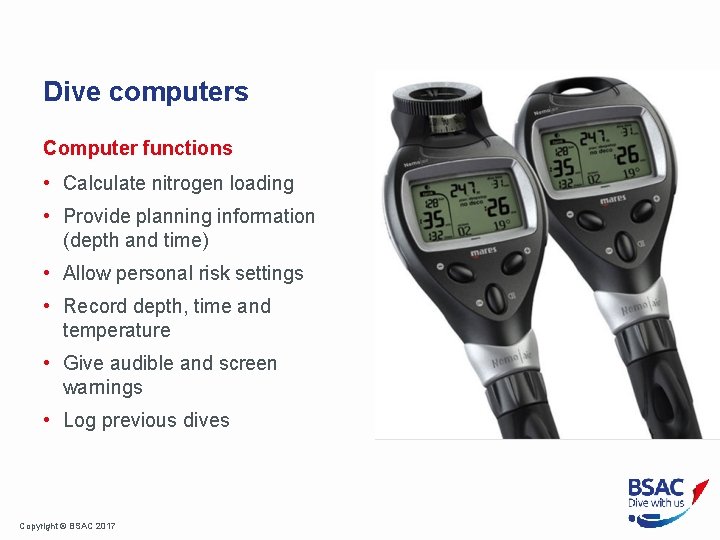
Dive computers Computer functions • Calculate nitrogen loading • Provide planning information (depth and time) • Allow personal risk settings • Record depth, time and temperature • Give audible and screen warnings • Log previous dives Copyright © BSAC 2017
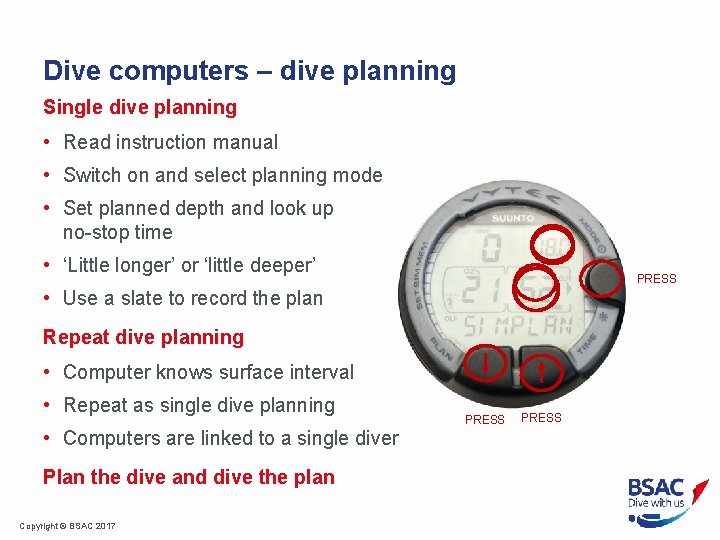
Dive computers – dive planning Single dive planning • Read instruction manual • Switch on and select planning mode • Set planned depth and look up no-stop time • ‘Little longer’ or ‘little deeper’ PRESS • Use a slate to record the plan Repeat dive planning • Computer knows surface interval • Repeat as single dive planning • Computers are linked to a single diver Plan the dive and dive the plan Copyright © BSAC 2017 PRESS
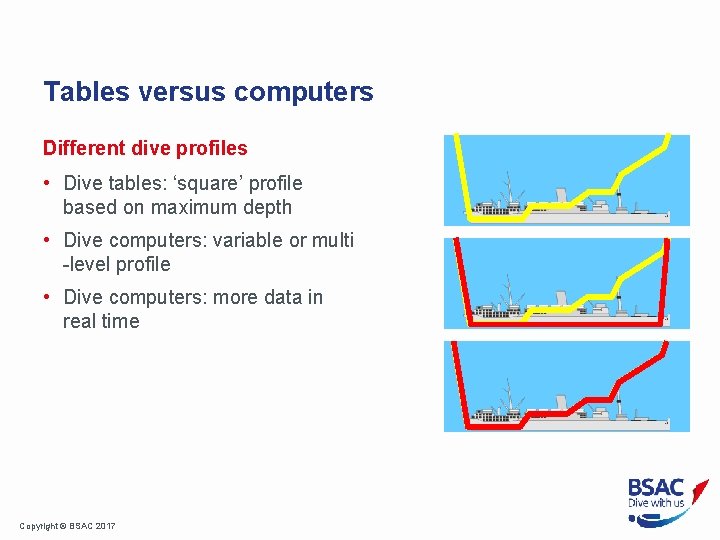
Tables versus computers Different dive profiles • Dive tables: ‘square’ profile based on maximum depth • Dive computers: variable or multi -level profile • Dive computers: more data in real time Copyright © BSAC 2017
Dive plans Whether using tables or computers • Do the deepest dive first • Never push the limits of tables or computers • Start deep and progress to the shallows • BSAC tables allow for 3 dives in 24 hours • Computers may have similar limits Buddies may have different profiles • Adhere to the most conservative profile Copyright © BSAC 2017
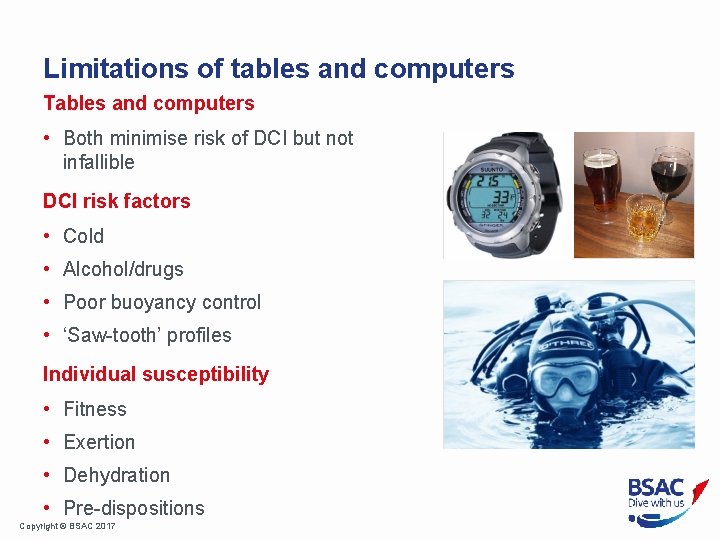
Limitations of tables and computers Tables and computers • Both minimise risk of DCI but not infallible DCI risk factors • Cold • Alcohol/drugs • Poor buoyancy control • ‘Saw-tooth’ profiles Individual susceptibility • Fitness • Exertion • Dehydration • Pre-dispositions Copyright © BSAC 2017
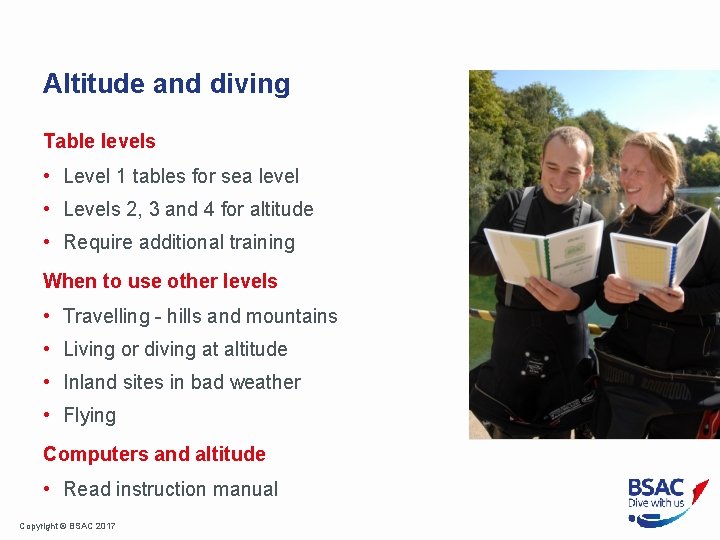
Altitude and diving Table levels • Level 1 tables for sea level • Levels 2, 3 and 4 for altitude • Require additional training When to use other levels • Travelling - hills and mountains • Living or diving at altitude • Inland sites in bad weather • Flying Computers and altitude • Read instruction manual Copyright © BSAC 2017
Flying and diving Flying before diving • Tissues off-gas • Stresses of flying • Recover before diving - 10 hours minimum Flying after diving • Increased level of off-gassing – DCI • Stresses of flying • Ensure long surface interval between last dive and flying • Tables require CTC of A or B • Computers – follow instructions Copyright © BSAC 2017
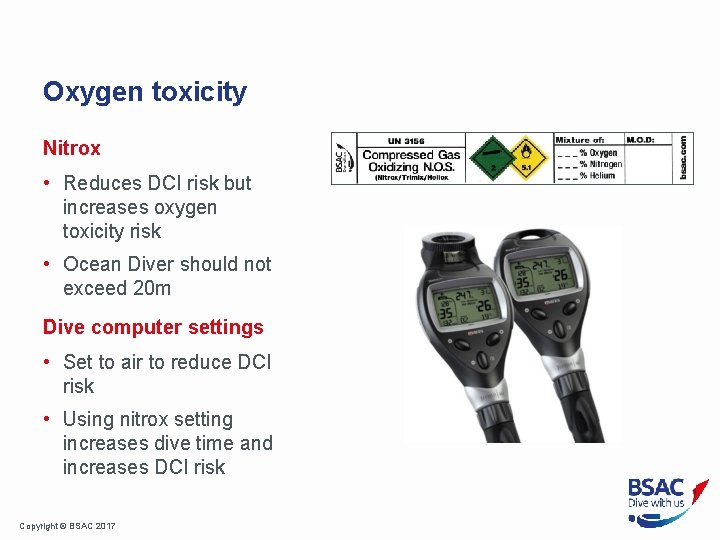
Oxygen toxicity Nitrox • Reduces DCI risk but increases oxygen toxicity risk • Ocean Diver should not exceed 20 m Dive computer settings • Set to air to reduce DCI risk • Using nitrox setting increases dive time and increases DCI risk Copyright © BSAC 2017
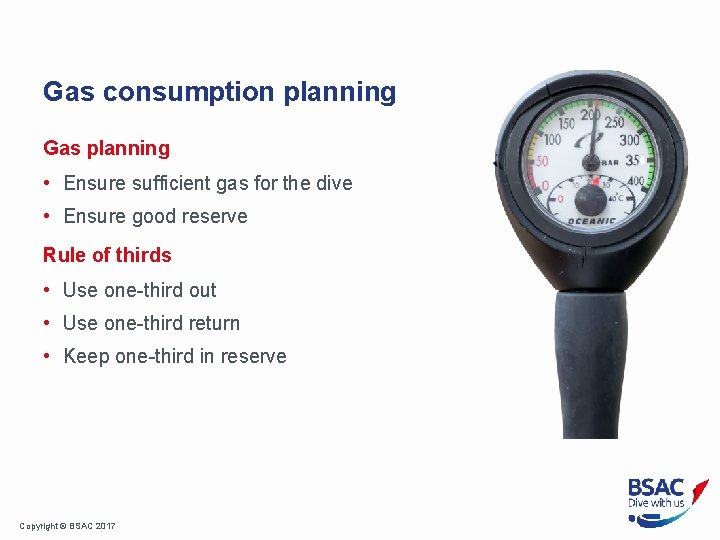
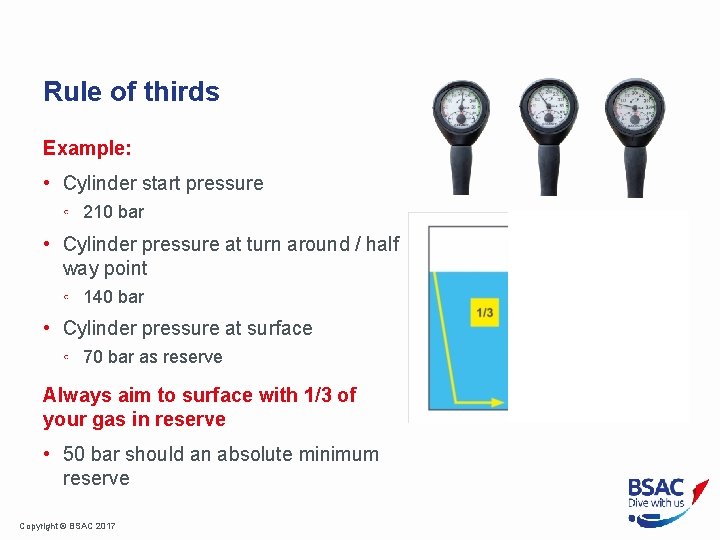
Gas consumption planning Gas planning • Ensure sufficient gas for the dive • Ensure good reserve Rule of thirds • Use one-third out • Use one-third return • Keep one-third in reserve Copyright © BSAC 2017
Rule of thirds Example: • Cylinder start pressure ◦ 210 bar • Cylinder pressure at turn around / half way point ◦ 140 bar • Cylinder pressure at surface ◦ 70 bar as reserve Always aim to surface with 1/3 of your gas in reserve • 50 bar should an absolute minimum reserve Copyright © BSAC 2017
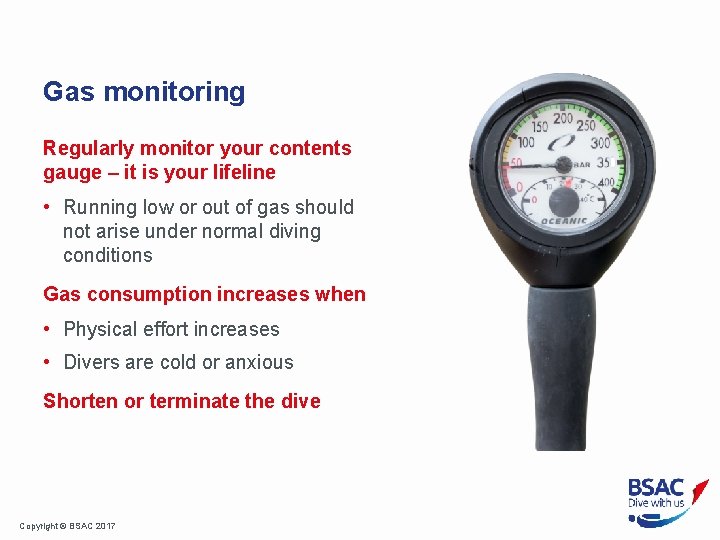
Gas monitoring Regularly monitor your contents gauge – it is your lifeline • Running low or out of gas should not arise under normal diving conditions Gas consumption increases when • Physical effort increases • Divers are cold or anxious Shorten or terminate the dive Copyright © BSAC 2017
Quiz 2 How deep can an Ocean Diver go on 32% nitrox? • 20 m How much gas should be held in reserve? • 1/3 but not less than 50 bar What are the risk factors for DCI? • Poor buoyancy control • Cold • Dehydration • Alcohol/drug consumption Copyright © BSAC 2017
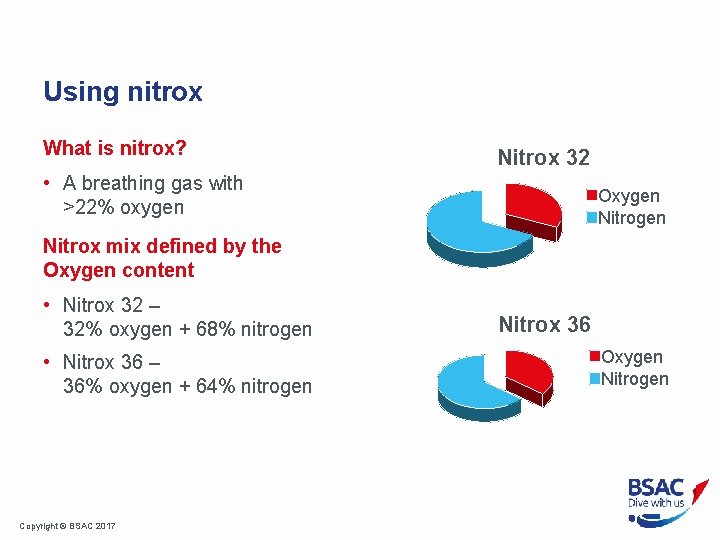
Using nitrox What is nitrox? Nitrox 32 • A breathing gas with >22% oxygen Oxygen Nitrox mix defined by the Oxygen content • Nitrox 32 – 32% oxygen + 68% nitrogen • Nitrox 36 – 36% oxygen + 64% nitrogen Copyright © BSAC 2017 Nitrox 36 Oxygen Nitrogen
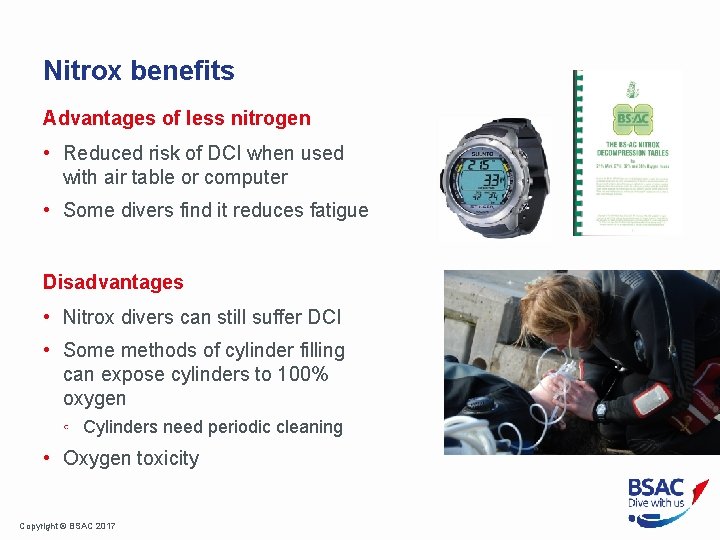
Nitrox benefits Advantages of less nitrogen • Reduced risk of DCI when used with air table or computer • Some divers find it reduces fatigue Disadvantages • Nitrox divers can still suffer DCI • Some methods of cylinder filling can expose cylinders to 100% oxygen ◦ Cylinders need periodic cleaning • Oxygen toxicity Copyright © BSAC 2017
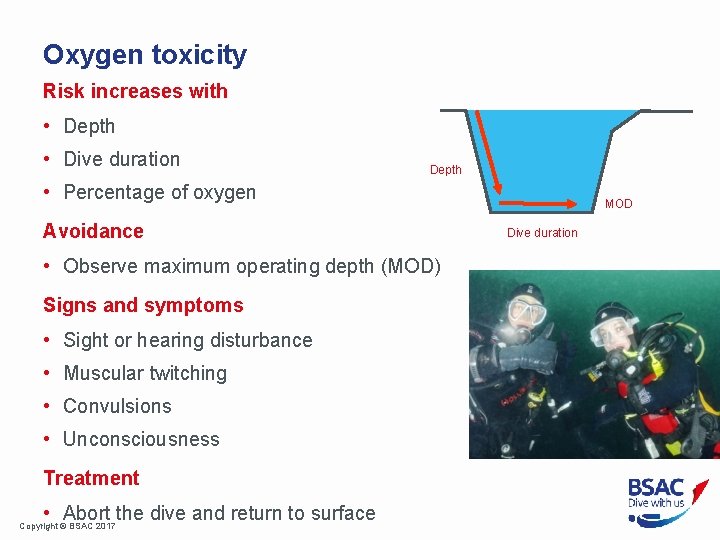
Oxygen toxicity Risk increases with • Depth • Dive duration Depth • Percentage of oxygen Avoidance • Observe maximum operating depth (MOD) Signs and symptoms • Sight or hearing disturbance • Muscular twitching • Convulsions • Unconsciousness Treatment • Abort the dive and return to surface Copyright © BSAC 2017 MOD Dive duration
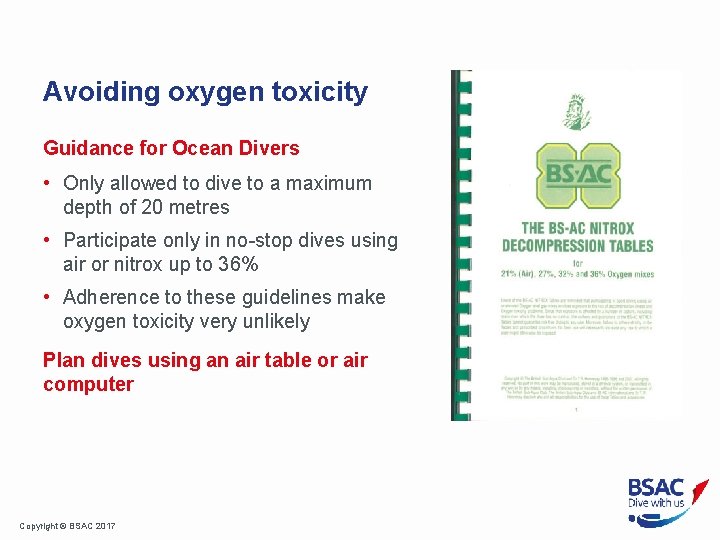
Avoiding oxygen toxicity Guidance for Ocean Divers • Only allowed to dive to a maximum depth of 20 metres • Participate only in no-stop dives using air or nitrox up to 36% • Adherence to these guidelines make oxygen toxicity very unlikely Plan dives using an air table or air computer Copyright © BSAC 2017
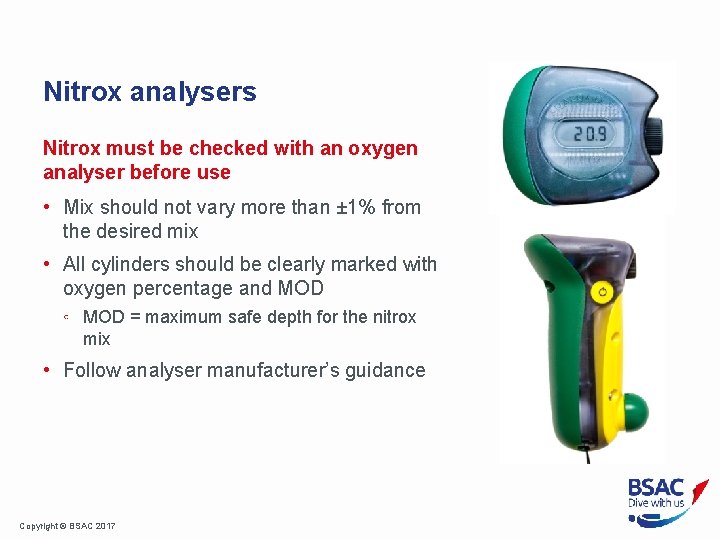
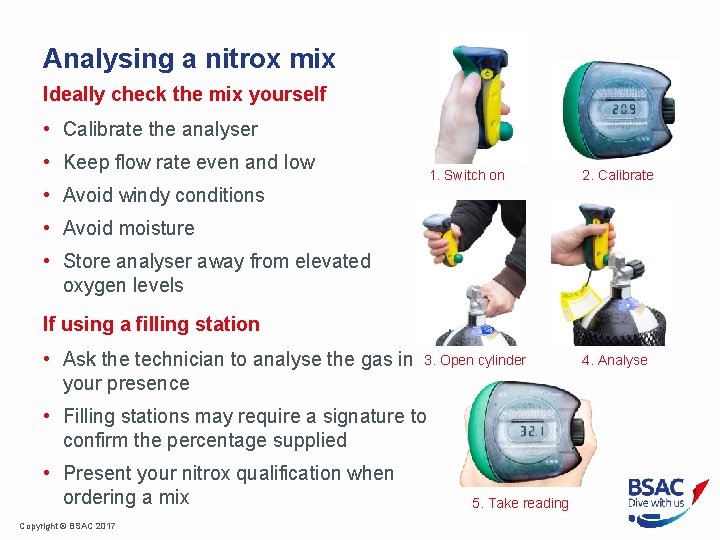
Nitrox analysers Nitrox must be checked with an oxygen analyser before use • Mix should not vary more than ± 1% from the desired mix • All cylinders should be clearly marked with oxygen percentage and MOD ◦ MOD = maximum safe depth for the nitrox mix • Follow analyser manufacturer’s guidance Copyright © BSAC 2017
Analysing a nitrox mix Ideally check the mix yourself • Calibrate the analyser • Keep flow rate even and low 1. Switch on 2. Calibrate • Avoid windy conditions • Avoid moisture • Store analyser away from elevated oxygen levels If using a filling station • Ask the technician to analyse the gas in 3. Open cylinder your presence • Filling stations may require a signature to confirm the percentage supplied • Present your nitrox qualification when ordering a mix Copyright © BSAC 2017 5. Take reading 4. Analyse
Quiz 2 What are the signs and symptoms of oxygen toxicity? • Sight or hearing disturbances • Muscular twitching • Convulsions • Unconsciousness What are the advantages of nitrox? • Reduced risk of DCI when used with air table or computer Copyright © BSAC 2017
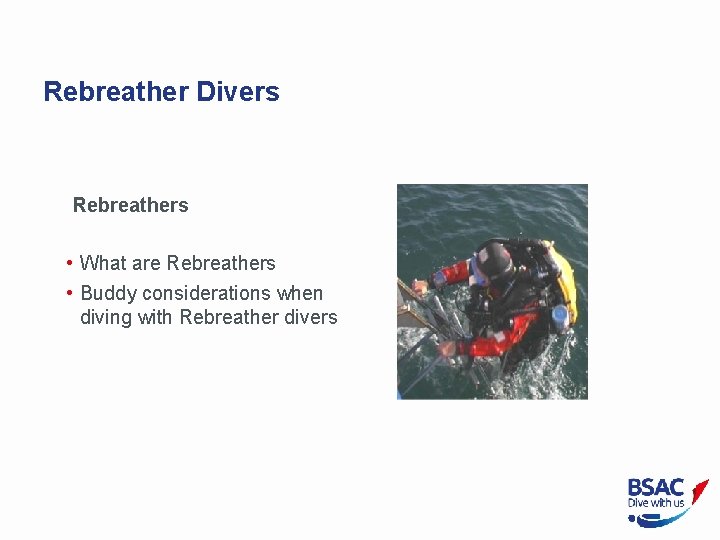
Rebreather Divers Rebreathers • What are Rebreathers • Buddy considerations when diving with Rebreather divers
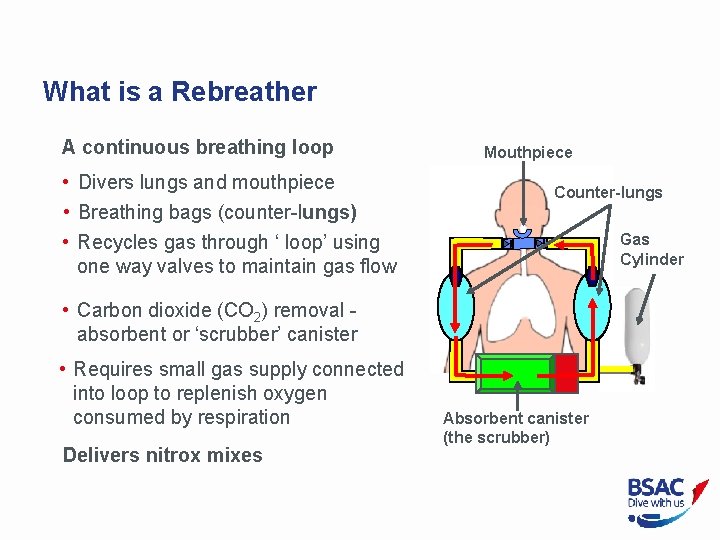
What is a Rebreather A continuous breathing loop • Divers lungs and mouthpiece • Breathing bags (counter-lungs) • Recycles gas through ‘ loop’ using one way valves to maintain gas flow Mouthpiece Counter-lungs Gas Cylinder • Carbon dioxide (CO 2) removal - absorbent or ‘scrubber’ canister • Requires small gas supply connected into loop to replenish oxygen consumed by respiration Delivers nitrox mixes Absorbent canister (the scrubber)
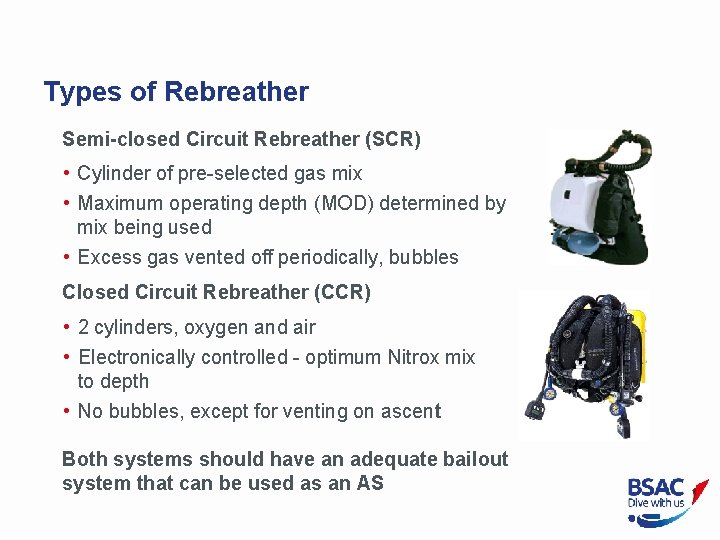
Types of Rebreather Semi-closed Circuit Rebreather (SCR) • Cylinder of pre-selected gas mix • Maximum operating depth (MOD) determined by mix being used • Excess gas vented off periodically, bubbles Closed Circuit Rebreather (CCR) • 2 cylinders, oxygen and air • Electronically controlled - optimum Nitrox mix to depth • No bubbles, except for venting on ascent Both systems should have an adequate bailout system that can be used as an AS
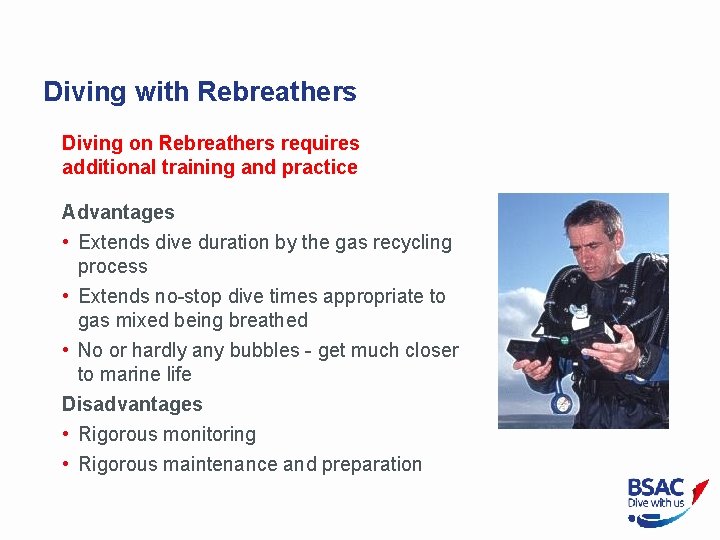
Diving with Rebreathers Diving on Rebreathers requires additional training and practice Advantages • Extends dive duration by the gas recycling process • Extends no-stop dive times appropriate to gas mixed being breathed • No or hardly any bubbles - get much closer to marine life Disadvantages • Rigorous monitoring • Rigorous maintenance and preparation
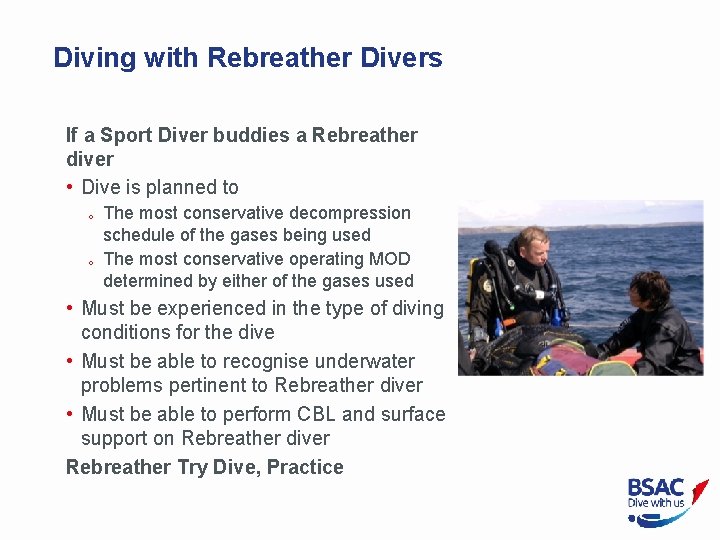
Diving with Rebreather Divers If a Sport Diver buddies a Rebreather diver • Dive is planned to o o The most conservative decompression schedule of the gases being used The most conservative operating MOD determined by either of the gases used • Must be experienced in the type of diving conditions for the dive • Must be able to recognise underwater problems pertinent to Rebreather diver • Must be able to perform CBL and surface support on Rebreather diver Rebreather Try Dive, Practice
Questions ?
Module OT 4 Summary • BSAC as an Organisation • BSAC Diver progression • JSAT Diving • Decompression planning • Oxygen toxicity limits • Gas consumption planning • Breathing gas mixes • Diving with Rebreathers Copyright © BSAC 2017