
1 ITRC Guidance Laboratory Processing of Incremental Samples
1 ITRC Guidance: Laboratory Processing of Incremental Samples Web-Based Document at: http: //www. itrcweb. org/ISM-1/ Presented by Mark Bruce, Ph. D. Test. America, North Canton, Ohio
2 ITRC Disclaimer u u u This material was sponsored by an agency of the United States Government. The views and opinions of authors expressed herein do not necessarily state or reflect those of the United States Government or any agency thereof and no official endorsement should be inferred. The information in ITRC Products was formulated to be reliable and accurate. However, the information is provided "as is" and use of this information is at the users’ own risk. Information in ITRC Products is for general reference only; it should not be construed as definitive guidance for any specific site and is not a substitute for consultation with qualified professional advisors. ITRC Product content may be revised or withdrawn at any time without prior notice. ITRC, ERIS, and ECOS make no representations or warranties with respect to information in its Products. ITRC, ERIS, and ECOS will not accept liability for damages of any kind that result from acting upon or using this information. ITRC, ERIS, and ECOS do not endorse or recommend the use of specific technology or technology provider through ITRC Products.
3 Laboratory Processing Learning Objectives Learn how to: u Match process options to analytes and data objectives u Manage sample moisture u Select/reduce particle size u Collect subsamples for analysis u Apply Quality Assurance u Examine options for lab certification
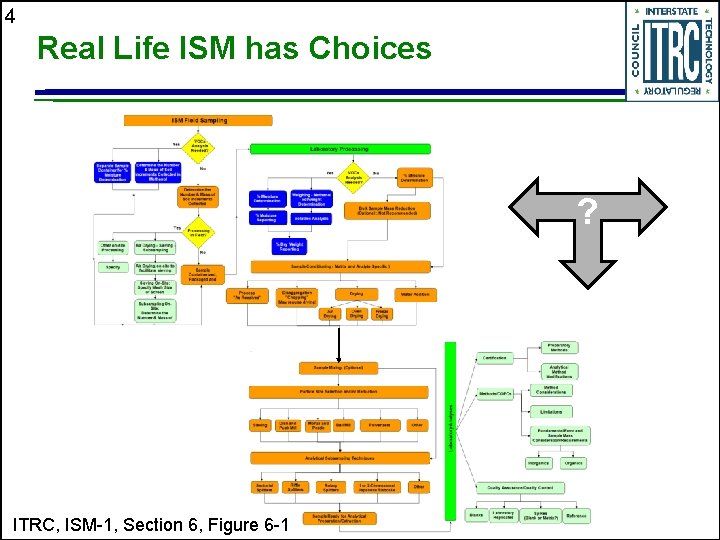
4 Real Life ISM has Choices ? ITRC, ISM-1, Section 6, Figure 6 -1
5 Analyte-Matrix Driven Options u Pick the right option • More representative subsamples • Better precision u Pick the wrong option • Poor and unknown bias
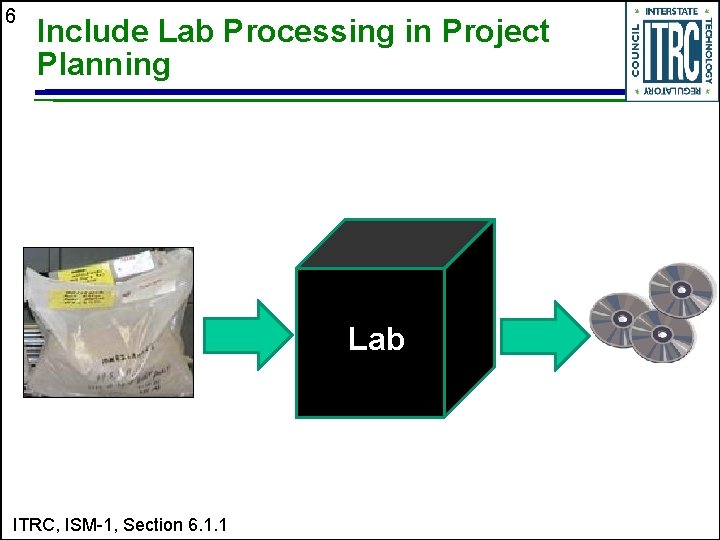
6 Include Lab Processing in Project Planning Lab ITRC, ISM-1, Section 6. 1. 1
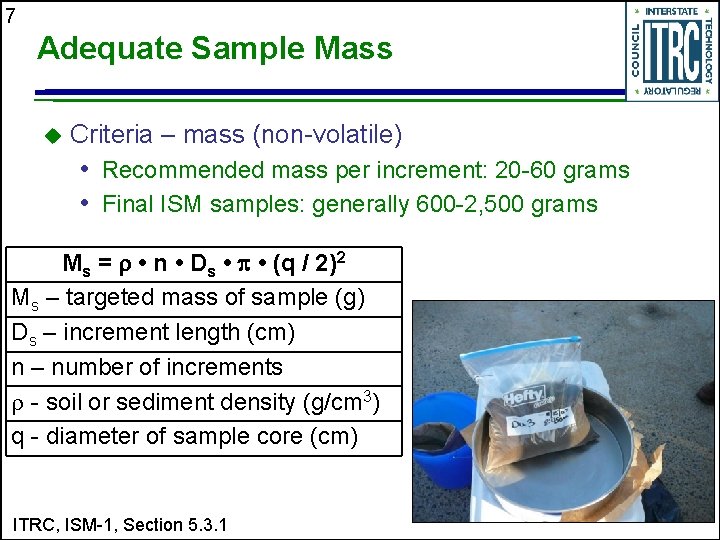
7 Adequate Sample Mass u Criteria – mass (non-volatile) • Recommended mass per increment: 20 -60 grams • Final ISM samples: generally 600 -2, 500 grams Ms = • n • Ds • • (q / 2)2 Ms – targeted mass of sample (g) Ds – increment length (cm) n – number of increments - soil or sediment density (g/cm 3) q - diameter of sample core (cm) ITRC, ISM-1, Section 5. 3. 1
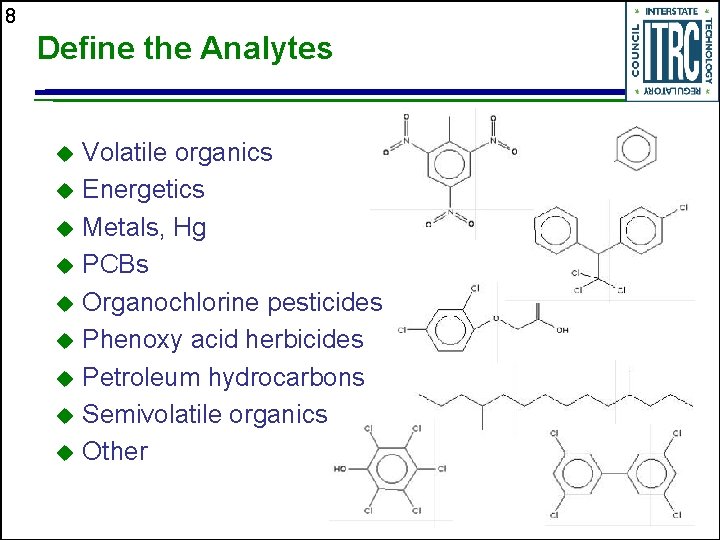
8 Define the Analytes Volatile organics u Energetics u Metals, Hg u PCBs u Organochlorine pesticides u Phenoxy acid herbicides u Petroleum hydrocarbons u Semivolatile organics u Other u
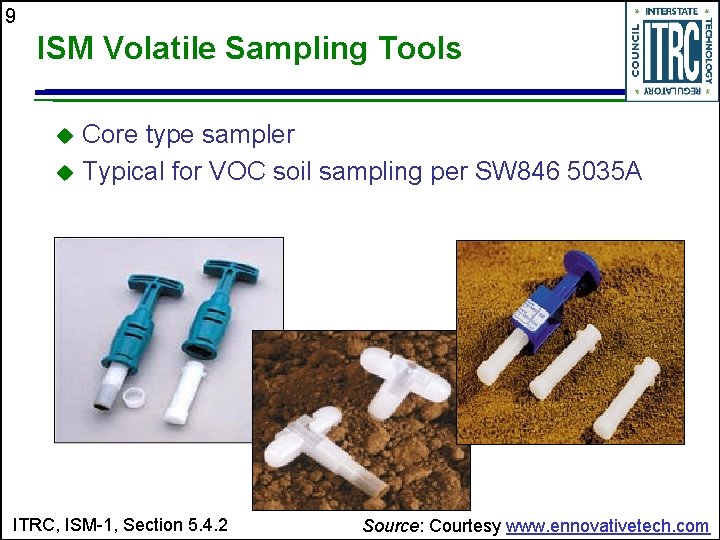
9 ISM Volatile Sampling Tools Core type sampler u Typical for VOC soil sampling per SW 846 5035 A u ITRC, ISM-1, Section 5. 4. 2 Source: Courtesy www. ennovativetech. com
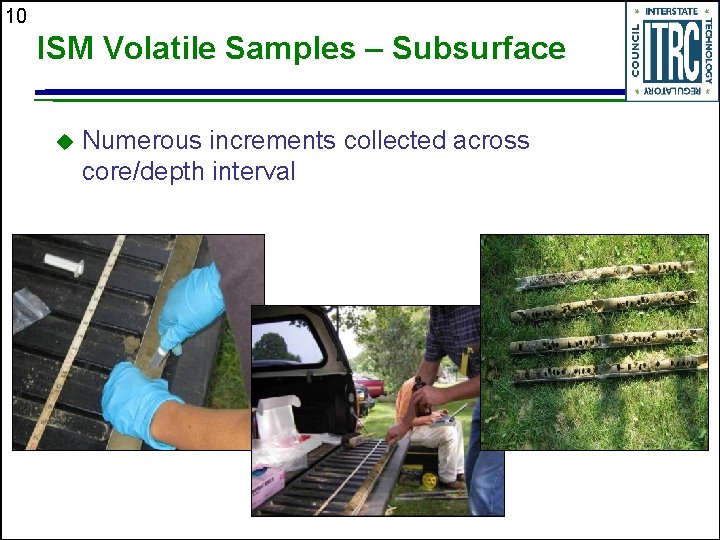
10 ISM Volatile Samples – Subsurface u Numerous increments collected across core/depth interval
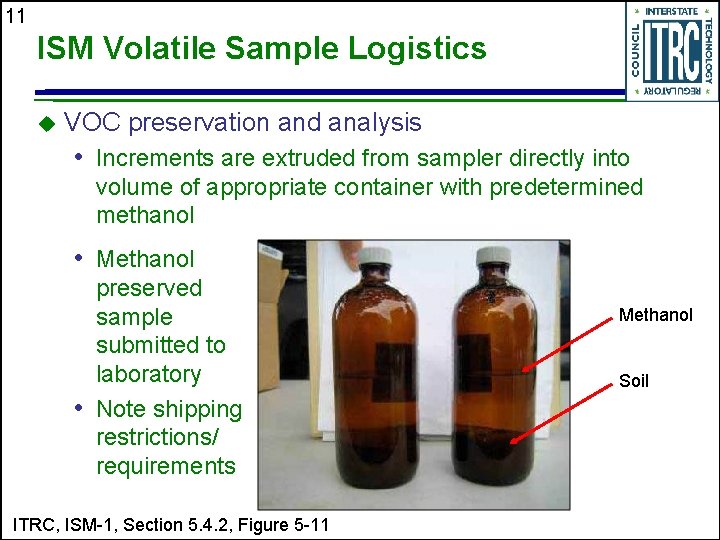
11 ISM Volatile Sample Logistics u VOC preservation and analysis • Increments are extruded from sampler directly into volume of appropriate container with predetermined methanol • Methanol preserved sample submitted to laboratory • Note shipping restrictions/ requirements ITRC, ISM-1, Section 5. 4. 2, Figure 5 -11 Methanol Soil
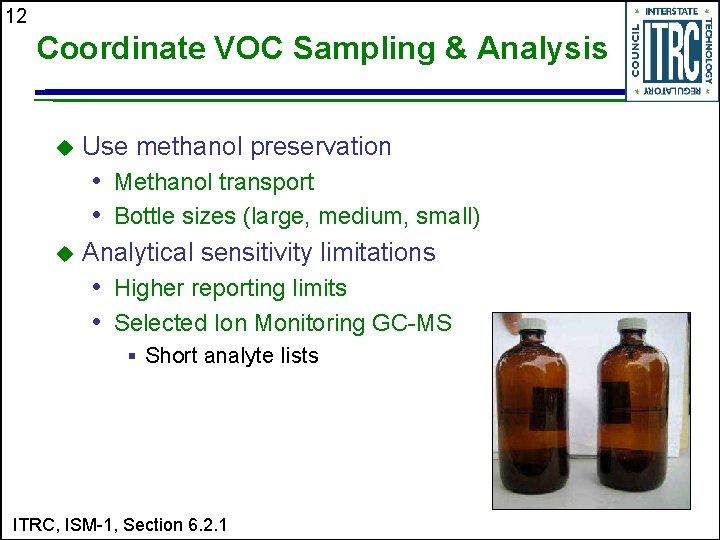
12 Coordinate VOC Sampling & Analysis u Use methanol preservation • Methanol transport • Bottle sizes (large, medium, small) u Analytical sensitivity limitations • Higher reporting limits • Selected Ion Monitoring GC-MS § Short analyte lists ITRC, ISM-1, Section 6. 2. 1
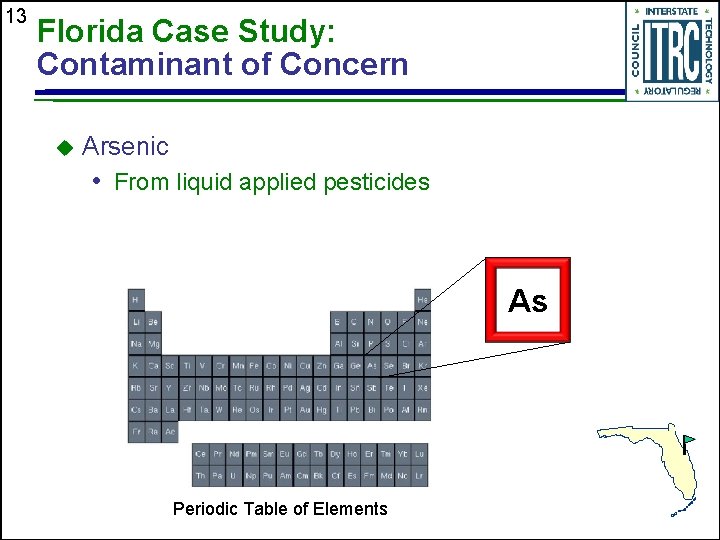
13 Florida Case Study: Contaminant of Concern u Arsenic • From liquid applied pesticides As Periodic Table of Elements
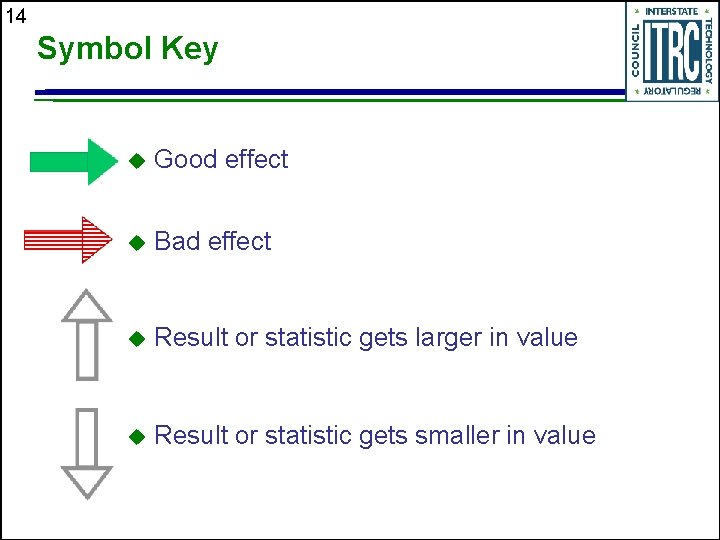
14 Symbol Key u Good effect u Bad effect u Result or statistic gets larger in value u Result or statistic gets smaller in value

15 Lab Processing Roadmap Sample Conditioning Lab Processing Particle Size Reduction Splitting and Subsampling

16 Condition the Sample u Air drying • • Room temperature – most common Ventilation hood Goal: Crushable agglomerates Consider volatilization losses § Boiling point § Binding to soil particles § Potential for Loss Table – Naphthalene – Acenaphthene – Benzo[a]pyrene u Use other options when drying not appropriate ITRC, ISM-1, Section 6. 2. 2. 3
17 Florida Case Study: Air Drying Samples u Arsenic • High boiling arsenic species • Volatilization loss not expected ITRC, ISM-1, Section 9, Appendix C
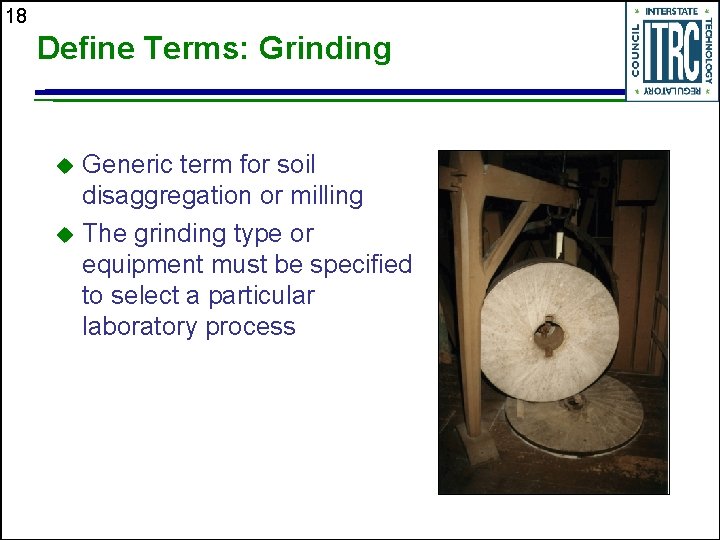
18 Define Terms: Grinding Generic term for soil disaggregation or milling u The grinding type or equipment must be specified to select a particular laboratory process u
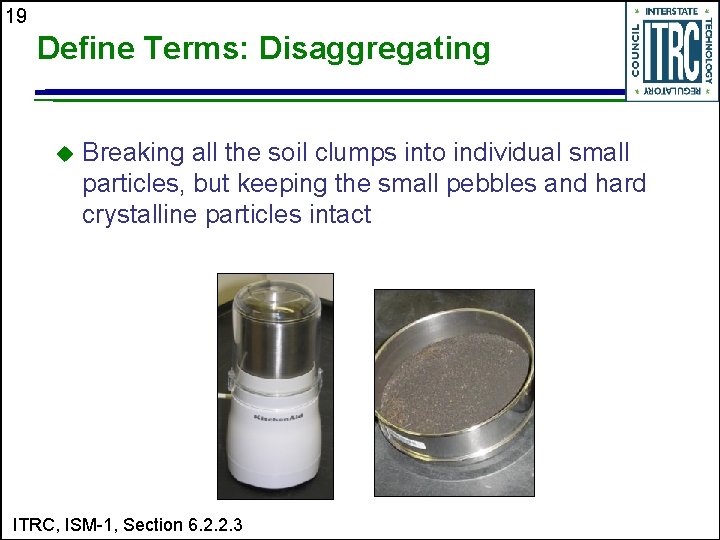
19 Define Terms: Disaggregating u Breaking all the soil clumps into individual small particles, but keeping the small pebbles and hard crystalline particles intact ITRC, ISM-1, Section 6. 2. 2. 3
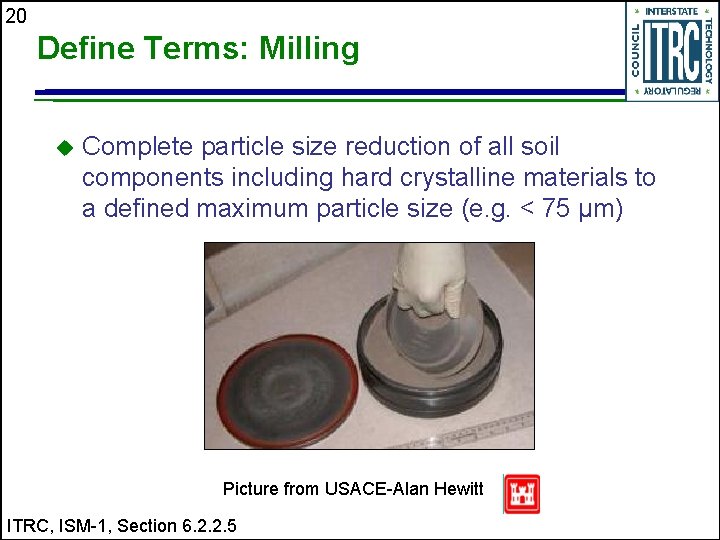
20 Define Terms: Milling u Complete particle size reduction of all soil components including hard crystalline materials to a defined maximum particle size (e. g. < 75 µm) Picture from USACE-Alan Hewitt ITRC, ISM-1, Section 6. 2. 2. 5
21 Florida Case Study: Particle Size Reduction u Disaggregation and sieving • Nugget effect expected to be small § Contaminant exposure sprayed as a liquid u Mill • Puck mill u Comparison study planned
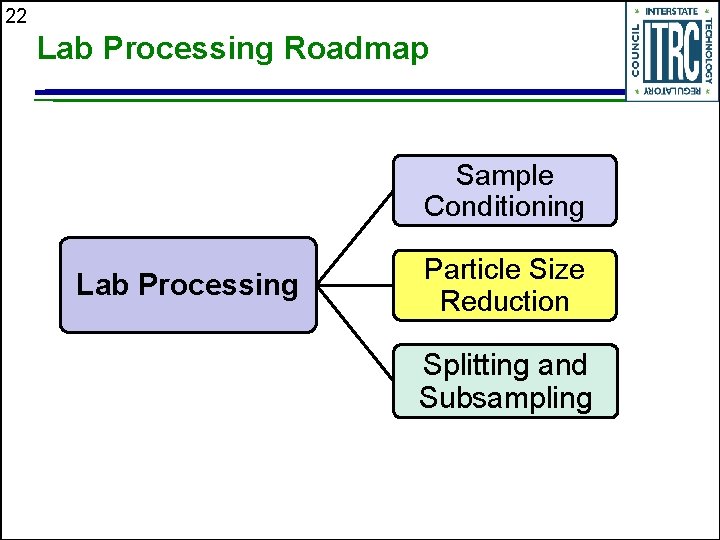
22 Lab Processing Roadmap Sample Conditioning Lab Processing Particle Size Reduction Splitting and Subsampling
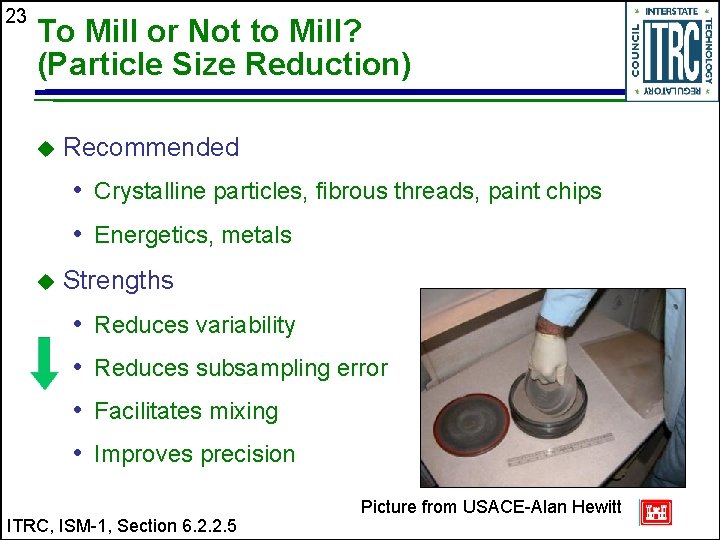
23 To Mill or Not to Mill? (Particle Size Reduction) u Recommended • Crystalline particles, fibrous threads, paint chips • Energetics, metals u Strengths • Reduces variability • Reduces subsampling error • Facilitates mixing • Improves precision ITRC, ISM-1, Section 6. 2. 2. 5 Picture from USACE-Alan Hewitt
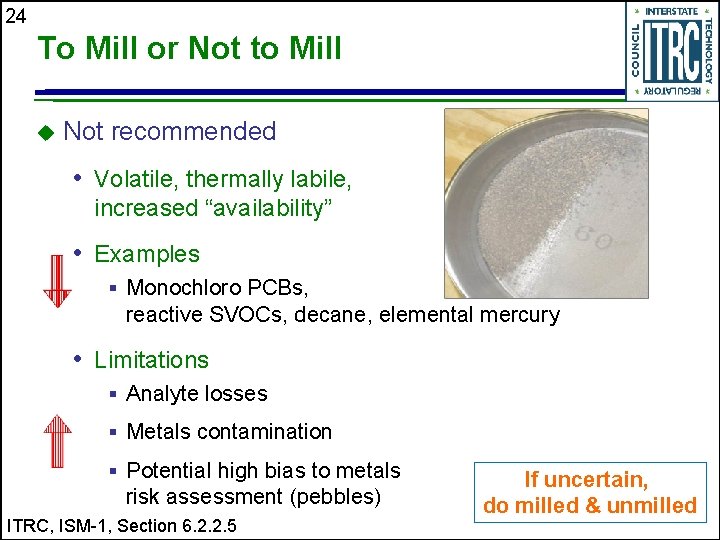
24 To Mill or Not to Mill u Not recommended • Volatile, thermally labile, increased “availability” • Examples § Monochloro PCBs, reactive SVOCs, decane, elemental mercury • Limitations § Analyte losses § Metals contamination § Potential high bias to metals risk assessment (pebbles) ITRC, ISM-1, Section 6. 2. 2. 5 If uncertain, do milled & unmilled
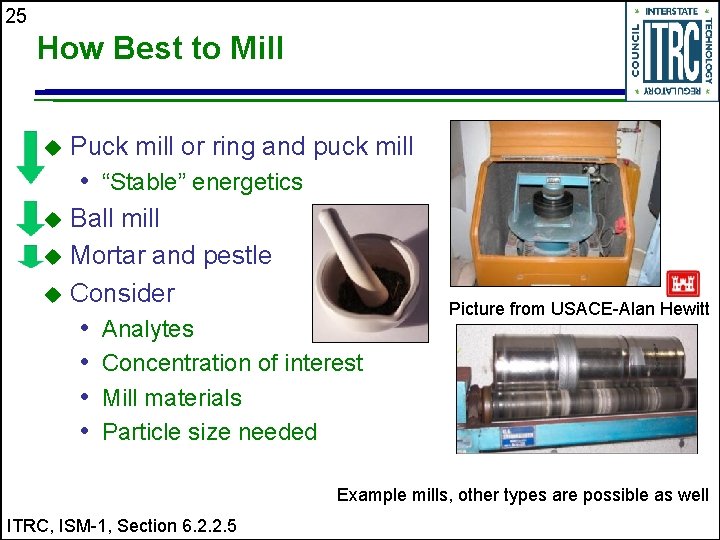
25 How Best to Mill u Puck mill or ring and puck mill • “Stable” energetics Ball mill u Mortar and pestle u Consider u • • Analytes Concentration of interest Mill materials Particle size needed Picture from USACE-Alan Hewitt Example mills, other types are possible as well ITRC, ISM-1, Section 6. 2. 2. 5
26 Florida Case Study: Results Confirm Milling Not Needed u Disaggregation and sieving • Nugget effect expected to be small § Contaminant exposure sprayed as a liquid u Mill • Puck mill u Results confirm milling not needed for this part of site • Small precision improvement with milling • No change in mean concentration
27 Lab Processing Roadmap Sample Conditioning Lab Processing Particle Size Reduction Splitting and Subsampling
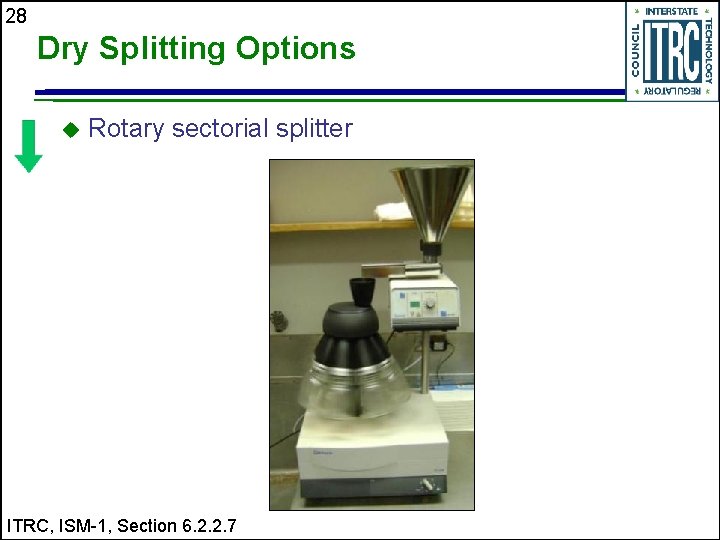
28 Dry Splitting Options u Rotary sectorial splitter ITRC, ISM-1, Section 6. 2. 2. 7
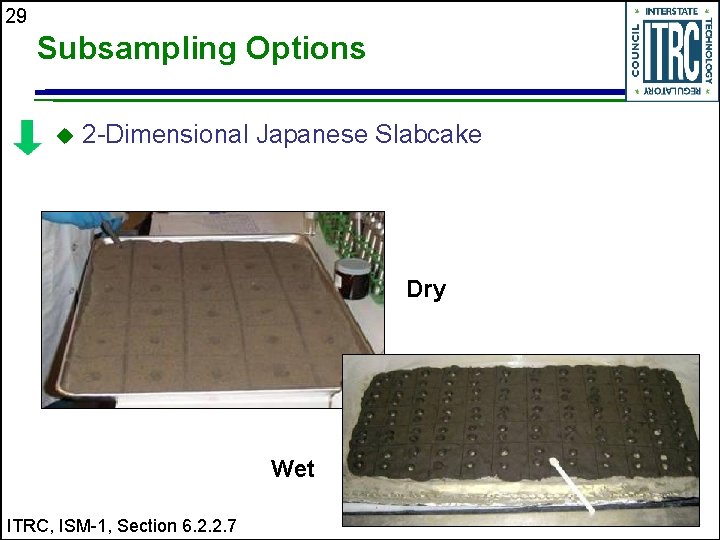
29 Subsampling Options u 2 -Dimensional Japanese Slabcake Dry Wet ITRC, ISM-1, Section 6. 2. 2. 7
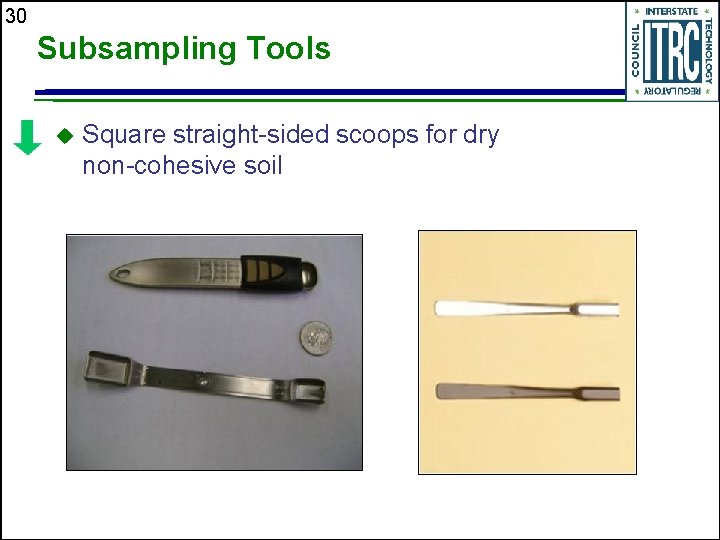
30 Subsampling Tools u Square straight-sided scoops for dry non-cohesive soil
31 Florida Case Study: Choose Subsampling Process u 2 -D Slabcake Subsampling • Lower cost than sectorial splitter • More representative than “dig a spot”

32 Why Use Large Subsamples? u Larger particles • Produce larger errors or require larger subsamples 200 %RSD 150 100 1 g 5 g 50 10 g 30 g 0 0 1 ITRC, ISM-1, Section 6. 3. 3 2 3 Particle size (mm) 4 5
33 Florida Case Study: Nugget Effect Minimal 2 g subsamples on disaggregated aliquots u 2 g subsamples on milled aliquots u u Low heterogeneity expected • Confirmed through replicates
34 Laboratory Quality Control Measures u Laboratory equipment blanks • Limited clean matrices u Laboratory control samples (LCS) and matrix spikes • Practicality of large scale spiking in kg samples § High cost § Limited availability • Introduced post ISM processing into subsample u Subsampling replicates
35 Florida Case Study: Challenges with “Blank” Samples u Ottawa sand method blank attempted for milling • Metals content of the sand was too variable u Standard preparation batch QC • No laboratory control sample or matrix spike through ISM processes
36 Verify Laboratory Certification u National Environmental Laboratory Accreditation Program (NELAP) u Non-NELAP state accreditation u Agency-specific accreditation • Do. D Environmental Laboratory Approval Program ITRC, ISM-1, Section 6. 4. 1
37 Cite Reference Methods u Collecting and Processing of Representative Samples For Energetic Residues in Solid Matrices from Military Training Ranges • USEPA SW-846 Method 8330 B, Appendix A http: //www. epa. gov/osw/hazard/testmethods/pdfs/8330 b. pdf u Metals in Solid Matrices • USACE research effort • Planned SW-846 Method 3050 - Update V? ITRC, ISM-1, Section 6. 4. 1
38 Use Alternate References u ASTM D 6323 Standard Guide for Laboratory Subsampling of Media Related to Waste Management Activities • ASTM 2003 u Guidance for Obtaining Representative Laboratory Analytical Subsamples from Particulate Laboratory Samples • Gerlach 2003 u Laboratory Standard Operating Procedure ITRC, ISM-1, Section 6. 4. 1
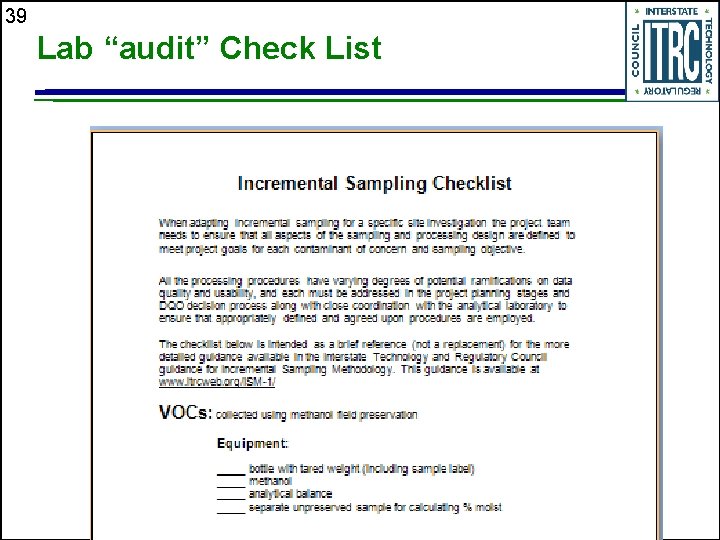
39 Lab “audit” Check List
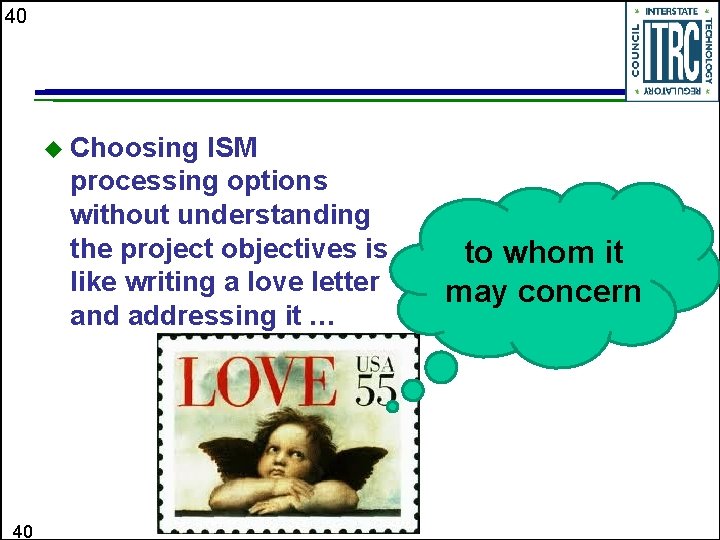
40 u Choosing ISM processing options without understanding the project objectives is like writing a love letter and addressing it … 40 to whom it may concern
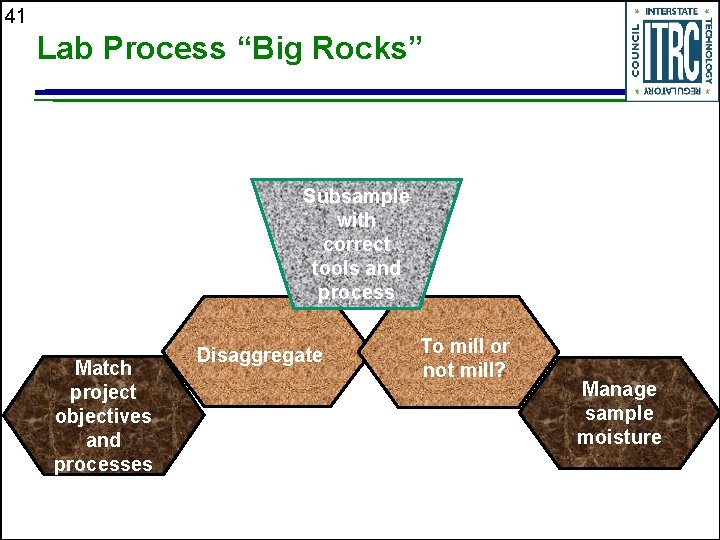
41 Lab Process “Big Rocks” Subsample with correct tools and process Match project objectives and processes Disaggregate To mill or not mill? Manage sample moisture
42 Contact Information Mark L. Bruce Ph. D. Technical Director Test. America 4101 Shuffel St. NW North Canton, OH 44720 Tel: 330 -966 -7267 Email: mark. bruce@testamericainc. com www. testamericainc. com 42
- Slides: 42