
1 INTRODUCTION TO WIOA COMMON PERFORMANCE MEASURES Measurement







- Slides: 54
1 INTRODUCTION TO WIOA COMMON PERFORMANCE MEASURES: Measurement and Data Collection Presented at: INA Multi-Regional Conference Miami, FL January 2017 Ron D’Amico Social Policy Research Associates Oakland, CA
WORKSHOP GOALS 2 üExplain the WIOA measures and how they differ from WIA üLegislative authority üTimeline üKey terms and how different from WIA üHow standards are to be set üObservations and implications for reporting 2
WHERE TO START? 3 3
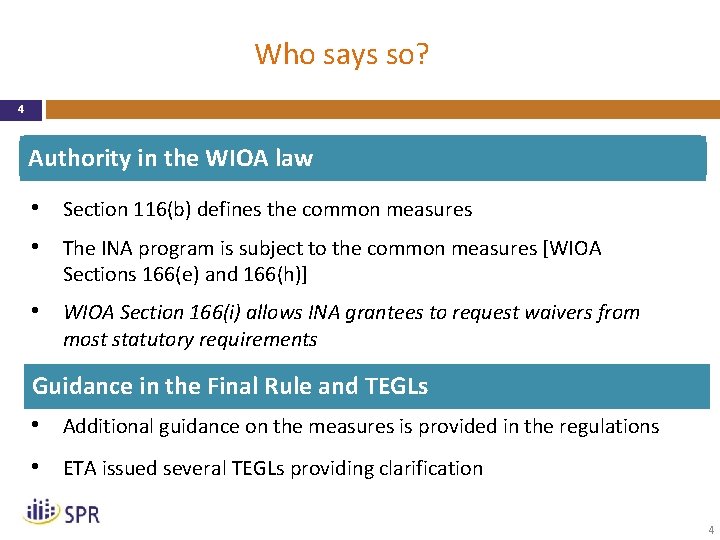
Who says so? 4 Authority in the WIOA law • Section 116(b) defines the common measures • The INA program is subject to the common measures [WIOA Sections 166(e) and 166(h)] • WIOA Section 166(i) allows INA grantees to request waivers from most statutory requirements Guidance in the Final Rule and TEGLs • Additional guidance on the measures is provided in the regulations • ETA issued several TEGLs providing clarification 4
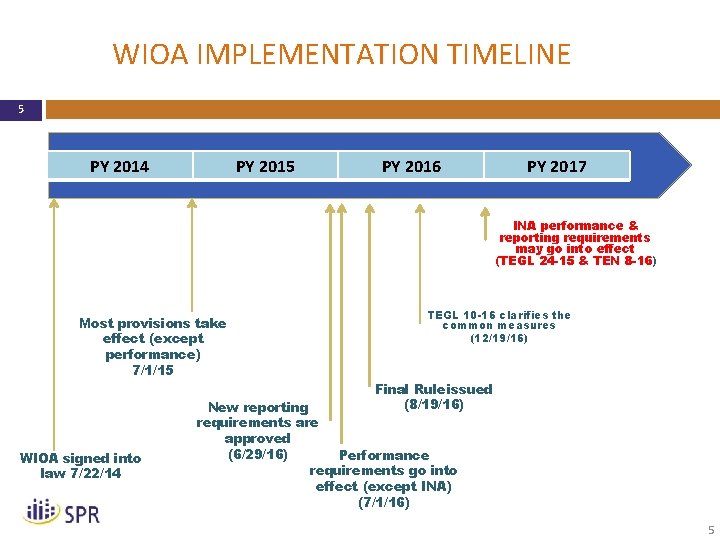
WIOA IMPLEMENTATION TIMELINE 5 PY 2014 PY 2015 PY 2016 PY 2017 INA performance & reporting requirements may go into effect (TEGL 24 -15 & TEN 8 -16) Most provisions take effect (except performance) 7/1/15 TEGL 10 -16 clarifies the common measures (12/19/16) Final Ruleissued (8/19/16) WIOA signed into law 7/22/14 New reporting requirements are approved (6/29/16) Performance requirements go into effect (except INA) (7/1/16) 5
IMPORTANT NOTE 6 Ø There may be further guidance specific to the INA program that is yet to come Ø WIOA common measures and reporting for the INA program take effect no sooner than PY 2017 6
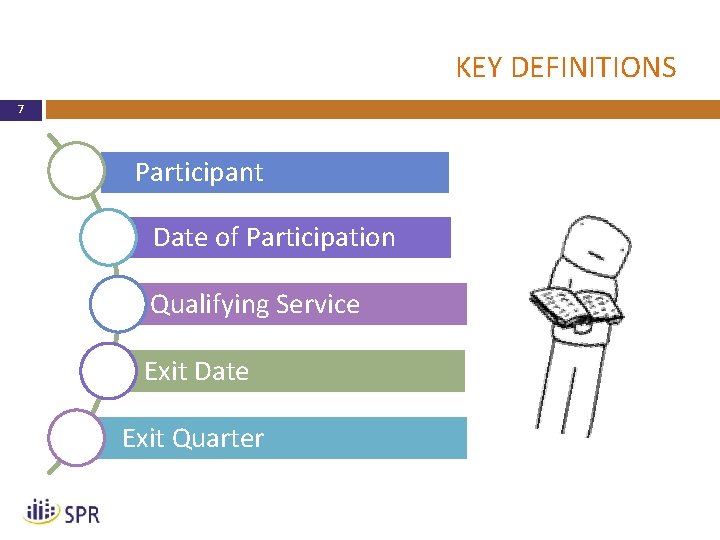
KEY DEFINITIONS 7 Participant Date of Participation Qualifying Service Exit Date Exit Quarter
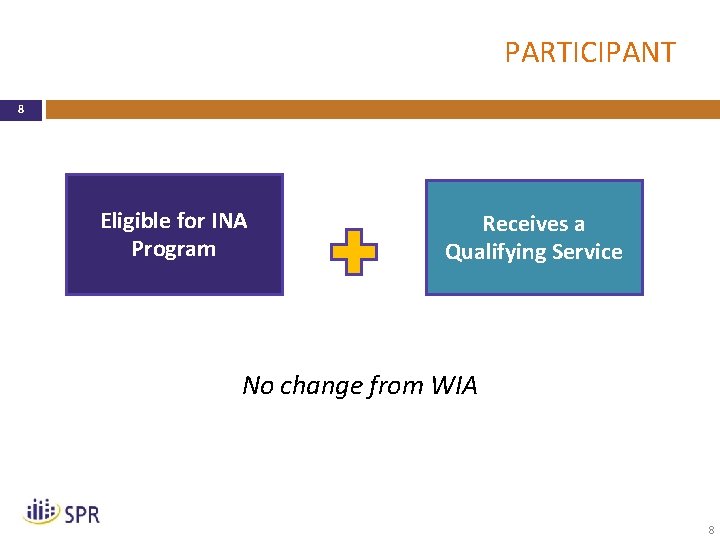
PARTICIPANT 8 Eligible for INA Program Receives a Qualifying Service No change from WIA 8
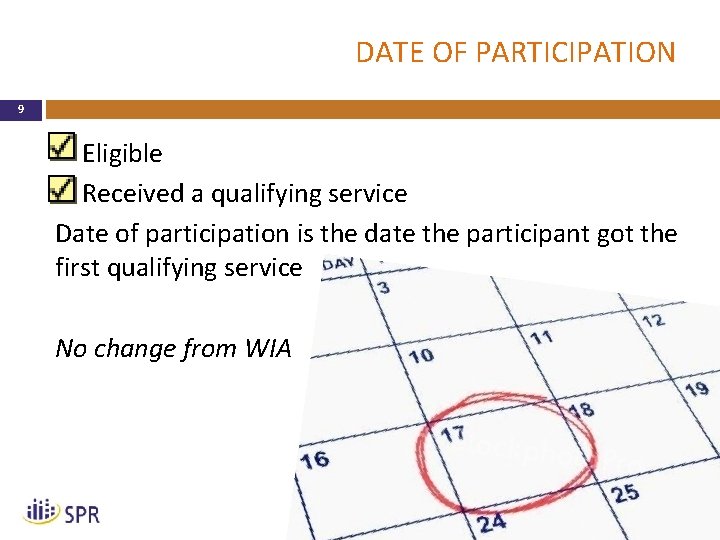
DATE OF PARTICIPATION 9 • Eligible • Received a qualifying service Date of participation is the date the participant got the first qualifying service No change from WIA 9
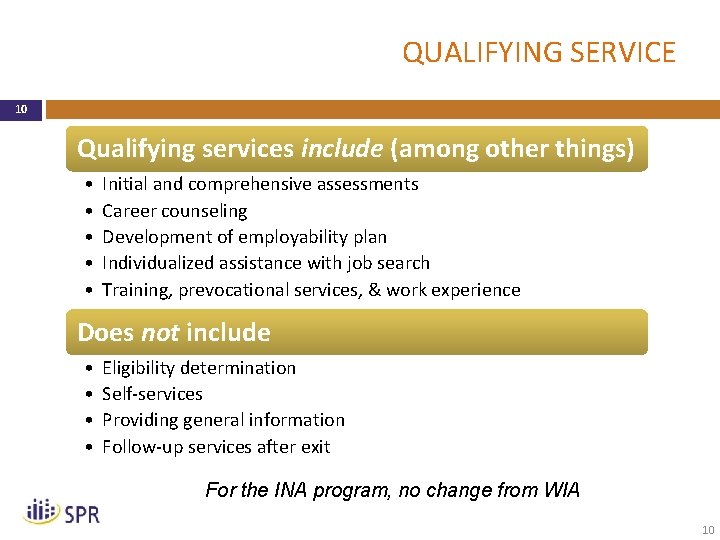
QUALIFYING SERVICE 10 Qualifying services include (among other things) • • • Initial and comprehensive assessments Career counseling Development of employability plan Individualized assistance with job search Training, prevocational services, & work experience Does not include • • Eligibility determination Self-services Providing general information Follow-up services after exit For the INA program, no change from WIA 10
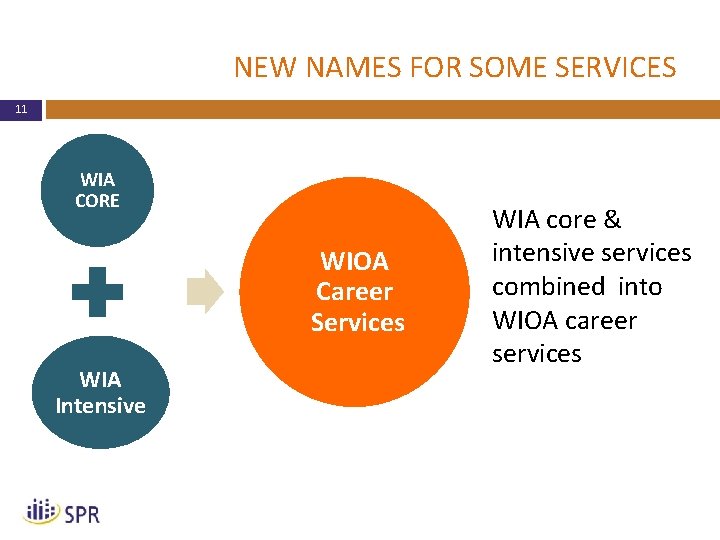
NEW NAMES FOR SOME SERVICES 11 WIA CORE WIOA Career Services WIA Intensive WIA core & intensive services combined into WIOA career services
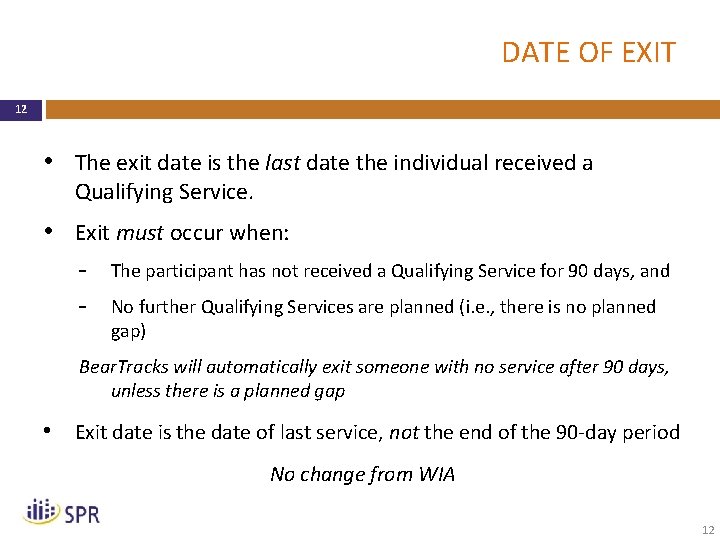
DATE OF EXIT 12 • The exit date is the last date the individual received a Qualifying Service. • Exit must occur when: - The participant has not received a Qualifying Service for 90 days, and - No further Qualifying Services are planned (i. e. , there is no planned gap) Bear. Tracks will automatically exit someone with no service after 90 days, unless there is a planned gap • Exit date is the date of last service, not the end of the 90 -day period No change from WIA 12
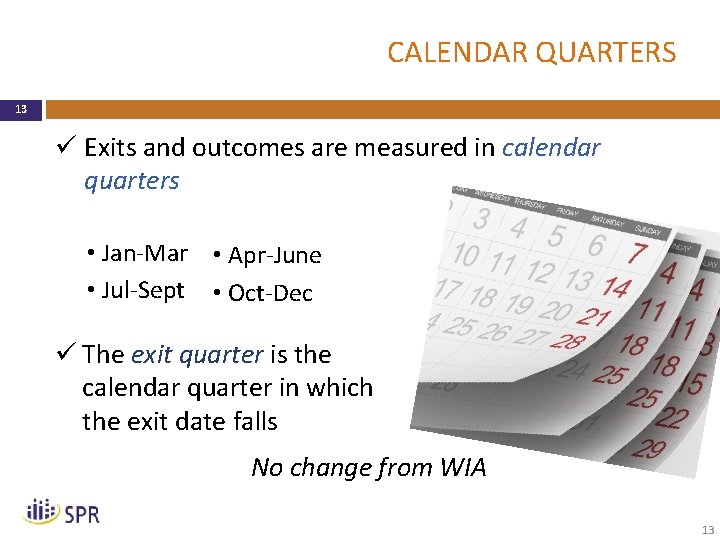
Quarters CALENDAR QUARTERS 13 ü Exits and outcomes are measured in calendar quarters • Jan-Mar • Apr-June • Jul-Sept • Oct-Dec ü The exit quarter is the calendar quarter in which the exit date falls No change from WIA 13
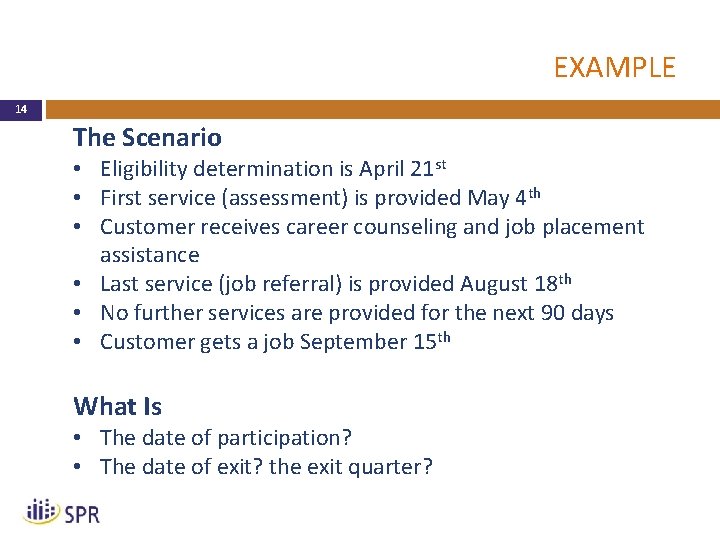
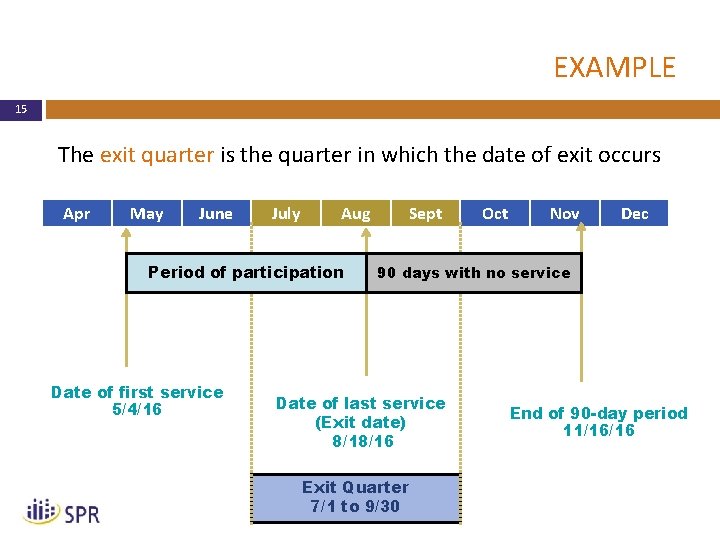
EXAMPLE 14 The Scenario • Eligibility determination is April 21 st • First service (assessment) is provided May 4 th • Customer receives career counseling and job placement assistance • Last service (job referral) is provided August 18 th • No further services are provided for the next 90 days • Customer gets a job September 15 th What Is • The date of participation? • The date of exit? the exit quarter?
EXAMPLE 15 The exit quarter is the quarter in which the date of exit occurs Apr May June July Aug Period of participation Date of first service 5/4/16 Sept Oct Nov Dec 90 days with no service Date of last service (Exit date) 8/18/16 Exit Quarter 7/1 to 9/30 End of 90 -day period 11/16/16
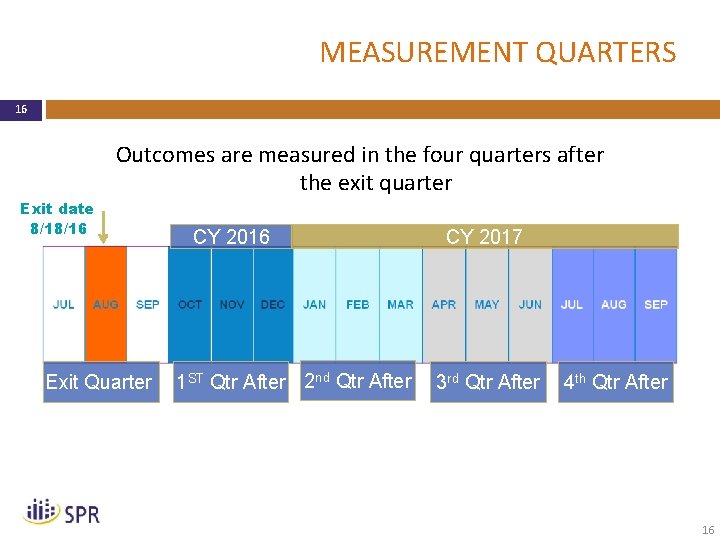
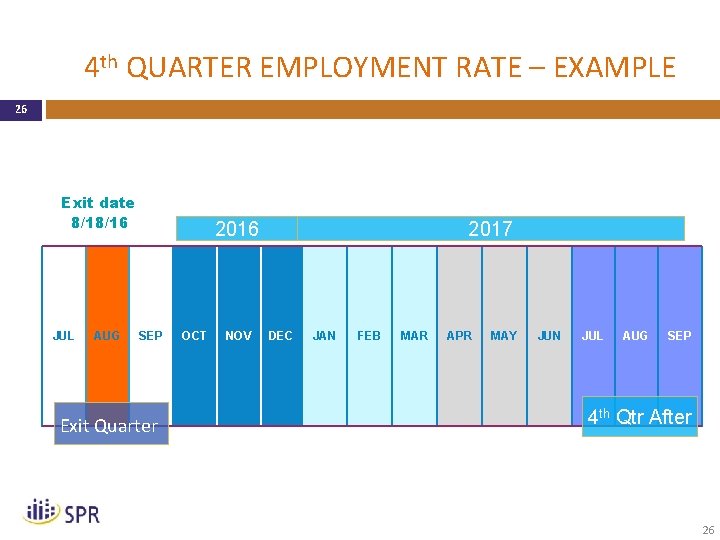
MEASUREMENT QUARTERS 16 Outcomes are measured in the four quarters after the exit quarter Exit date 8/18/16 Exit Quarter CY 2016 1 ST Qtr After 2 nd Qtr After CY 2017 3 rd Qtr After 4 th Qtr After 16
WHY USE CALENDAR QUARTERS? 17 Performance is measured using Unemployment Insurance (UI) wage records. UI records are reported quarterly, and include earnings for the quarter. They usually cannot identify the date of employment, hours of employment, or hourly wages Use of UI data implies a lag of 2 quarters before data become available 17
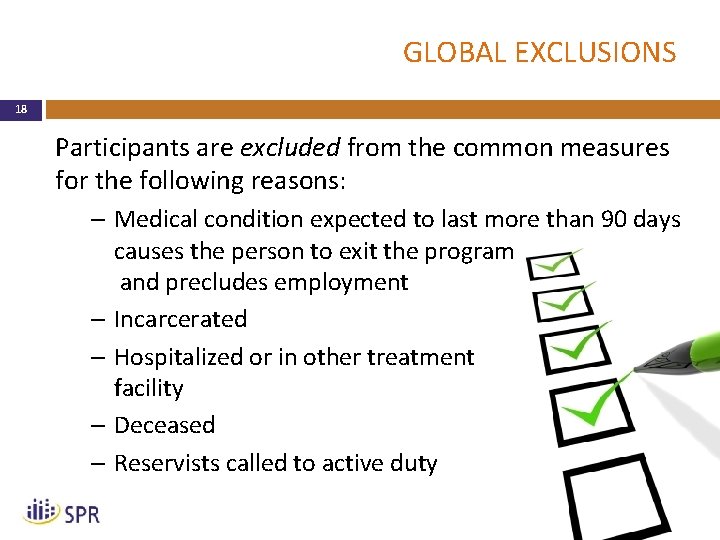
GLOBAL EXCLUSIONS 18 Participants are excluded from the common measures for the following reasons: – Medical condition expected to last more than 90 days causes the person to exit the program and precludes employment – Incarcerated – Hospitalized or in other treatment facility – Deceased – Reservists called to active duty 18
19 THE MEASURES
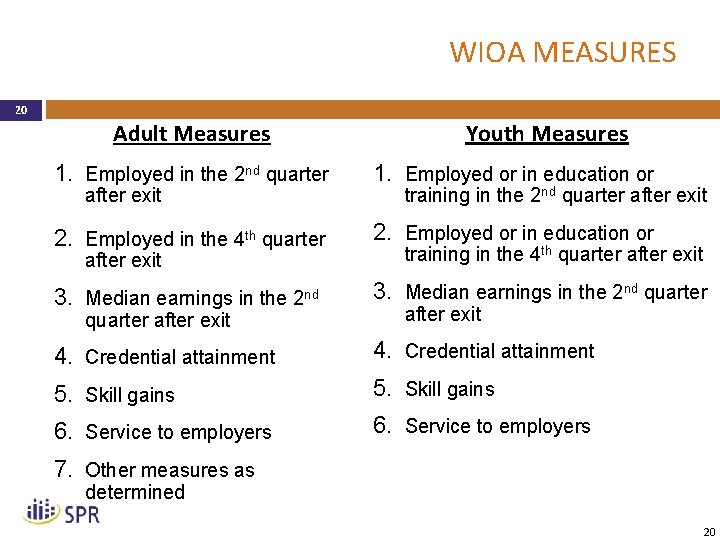
WIOA MEASURES 20 Adult Measures Youth Measures 1. Employed in the 2 nd quarter 1. Employed or in education or 2. Employed in the 4 th quarter 2. Employed or in education or 3. Median earnings in the 2 nd quarter 4. Credential attainment 5. Skill gains 6. Service to employers after exit quarter after exit training in the 2 nd quarter after exit training in the 4 th quarter after exit 7. Other measures as determined 20
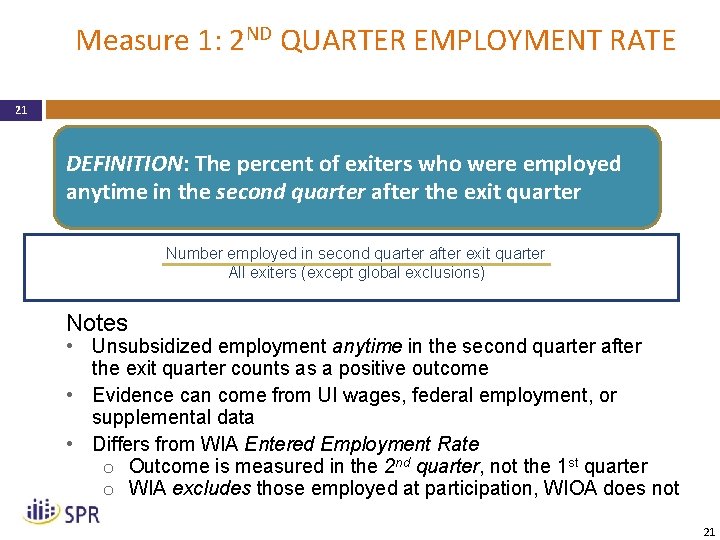
Measure 1: 2 ND QUARTER EMPLOYMENT RATE 21 DEFINITION: The percent of exiters who were employed anytime in the second quarter after the exit quarter Number employed in second quarter after exit quarter All exiters (except global exclusions) Notes • Unsubsidized employment anytime in the second quarter after the exit quarter counts as a positive outcome • Evidence can come from UI wages, federal employment, or supplemental data • Differs from WIA Entered Employment Rate o Outcome is measured in the 2 nd quarter, not the 1 st quarter o WIA excludes those employed at participation, WIOA does not 21
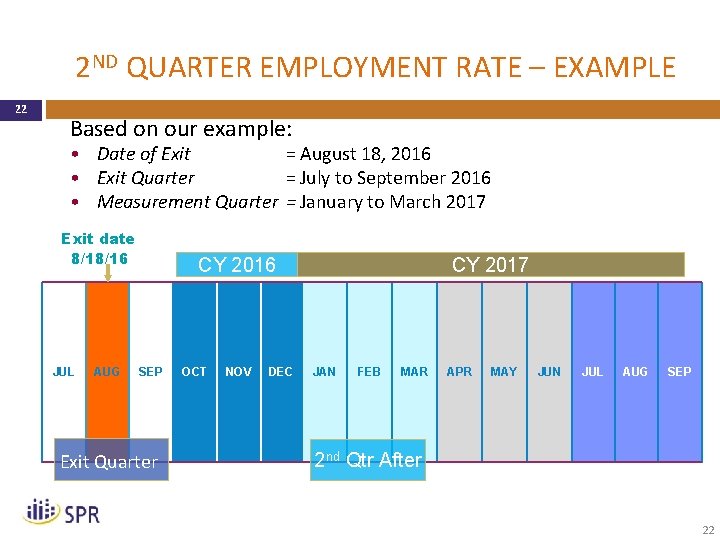
2 ND QUARTER EMPLOYMENT RATE – EXAMPLE 22 Based on our example: • Date of Exit = August 18, 2016 • Exit Quarter = July to September 2016 • Measurement Quarter = January to March 2017 Exit date 8/18/16 JUL AUG CY 2016 SEP Exit Quarter OCT NOV DEC CY 2017 JAN FEB MAR APR MAY JUN JUL AUG SEP 2 nd Qtr After 22
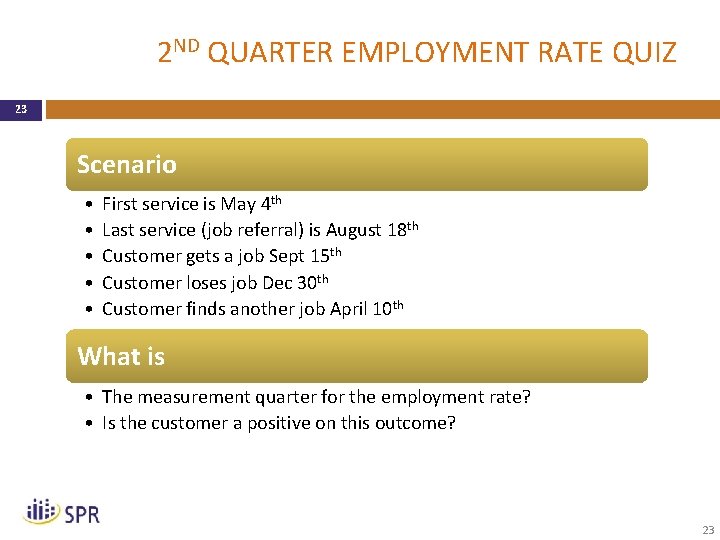
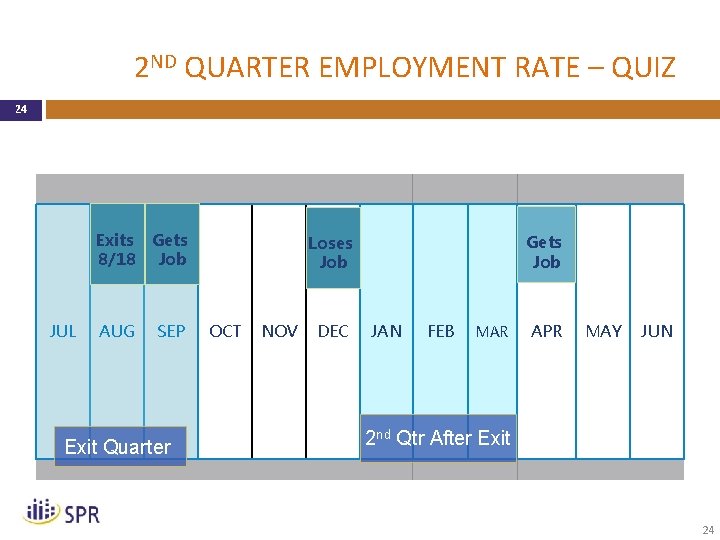
2 ND QUARTER EMPLOYMENT RATE QUIZ 23 Scenario • • • First service is May 4 th Last service (job referral) is August 18 th Customer gets a job Sept 15 th Customer loses job Dec 30 th Customer finds another job April 10 th What is • The measurement quarter for the employment rate? • Is the customer a positive on this outcome? 23
2 ND QUARTER EMPLOYMENT RATE – QUIZ 24 JUL Exits 8/18 Gets Job AUG SEP Exit Quarter Gets Job Loses Job OCT NOV DEC JAN FEB MAR APR MAY JUN 2 nd Qtr After Exit 24
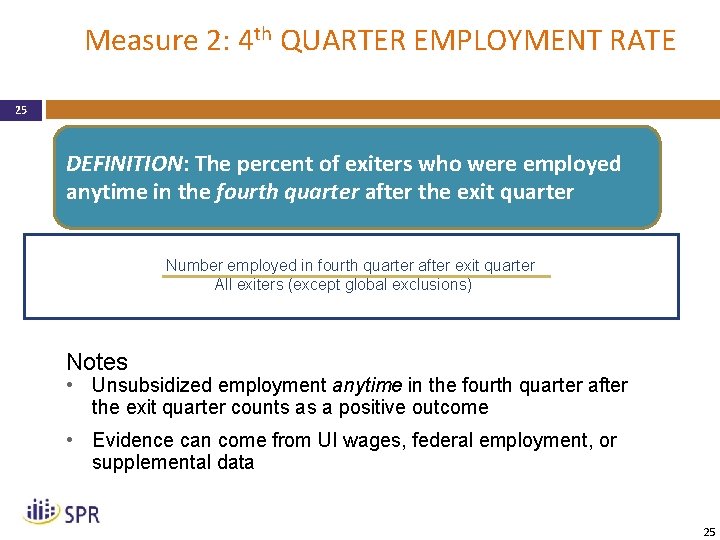
Measure 2: 4 th QUARTER EMPLOYMENT RATE 25 DEFINITION: The percent of exiters who were employed anytime in the fourth quarter after the exit quarter Number employed in fourth quarter after exit quarter All exiters (except global exclusions) Notes • Unsubsidized employment anytime in the fourth quarter after the exit quarter counts as a positive outcome • Evidence can come from UI wages, federal employment, or supplemental data 25
4 th QUARTER EMPLOYMENT RATE – EXAMPLE 26 Exit date 8/18/16 JUL AUG 2016 SEP Exit Quarter OCT NOV 2017 DEC JAN FEB MAR APR MAY JUN JUL AUG SEP 4 th Qtr After 26
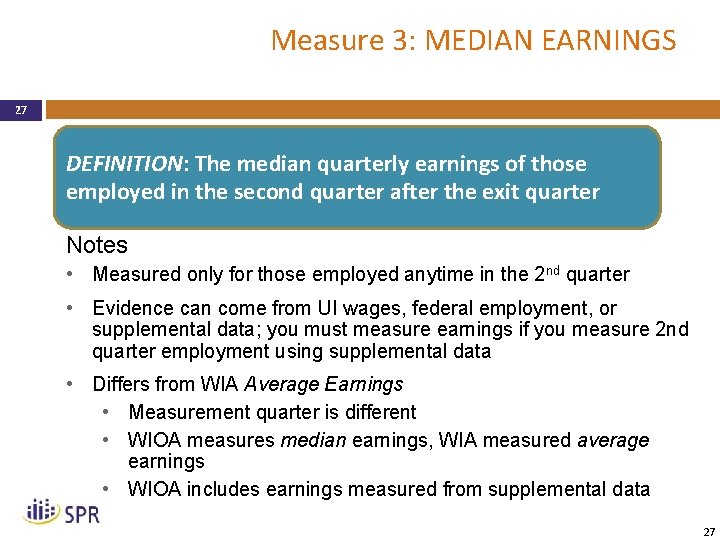
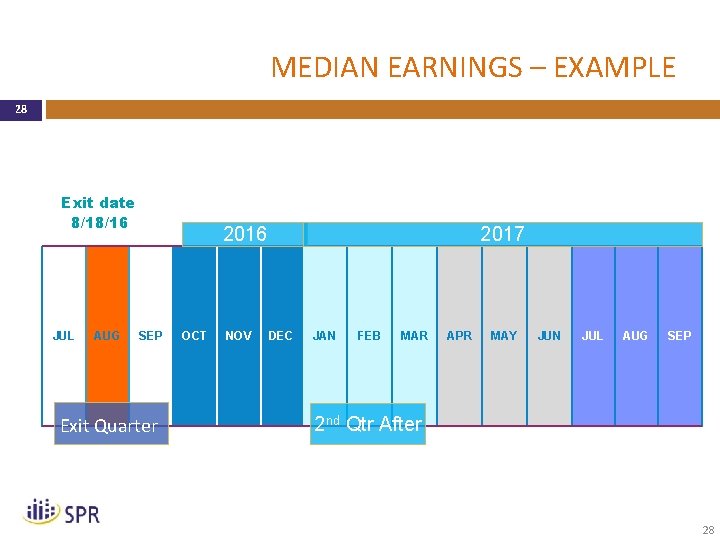
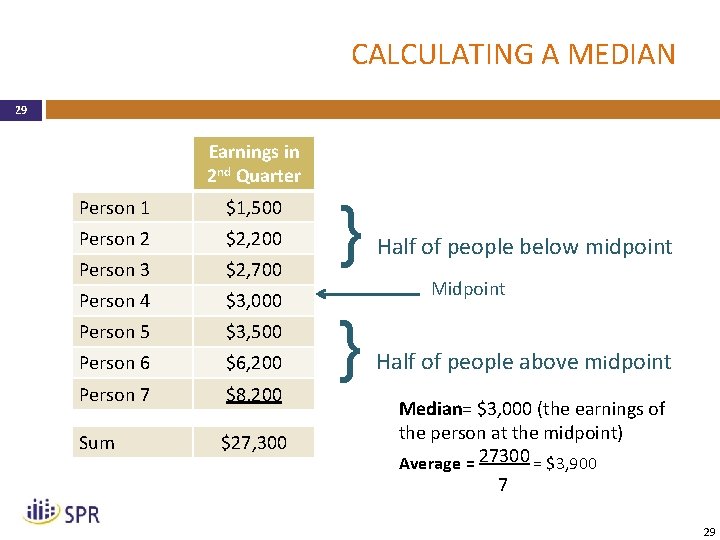
Measure 3: MEDIAN EARNINGS 27 DEFINITION: The median quarterly earnings of those employed in the second quarter after the exit quarter Notes • Measured only for those employed anytime in the 2 nd quarter • Evidence can come from UI wages, federal employment, or supplemental data; you must measure earnings if you measure 2 nd quarter employment using supplemental data • Differs from WIA Average Earnings • Measurement quarter is different • WIOA measures median earnings, WIA measured average earnings • WIOA includes earnings measured from supplemental data 27
MEDIAN EARNINGS – EXAMPLE 28 Exit date 8/18/16 JUL AUG 2016 SEP Exit Quarter OCT NOV 2017 DEC JAN FEB MAR APR MAY JUN JUL AUG SEP 2 nd Qtr After 28
CALCULATING A MEDIAN 29 Earnings in 2 nd Quarter Person 1 $1, 500 Person 2 $2, 200 Person 3 $2, 700 Person 4 $3, 000 Person 5 $3, 500 Person 6 $6, 200 Person 7 $8, 200 Sum $27, 300 } Half of people below midpoint Midpoint } Half of people above midpoint Median= $3, 000 (the earnings of the person at the midpoint) Average = 27300 = $3, 900 7 29
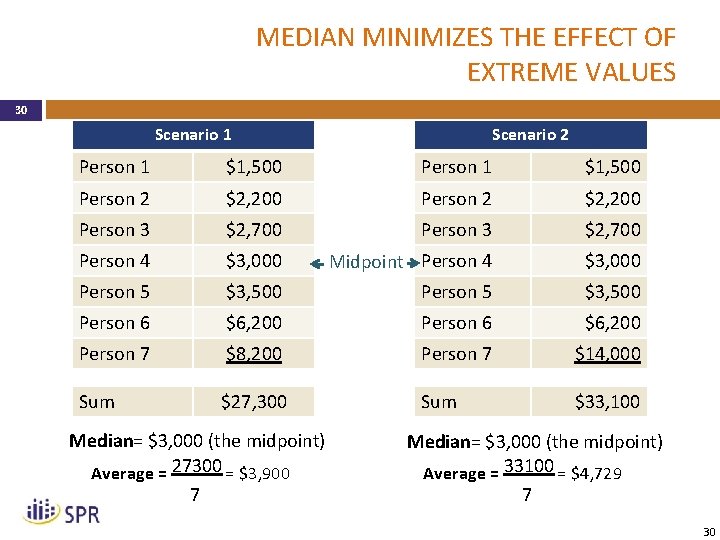
MEDIAN MINIMIZES THE EFFECT OF EXTREME VALUES 30 Scenario 1 Scenario 2 Person 1 $1, 500 Person 2 $2, 200 Person 3 $2, 700 Person 4 $3, 000 Person 5 $3, 500 Midpoint Person 4 Person 5 Person 6 $6, 200 Person 7 $8, 200 Person 7 $14, 000 Sum $27, 300 Sum $33, 100 Median= $3, 000 (the midpoint) Average = 27300 = $3, 900 7 $3, 500 Median= $3, 000 (the midpoint) Average = 33100 = $4, 729 7 30
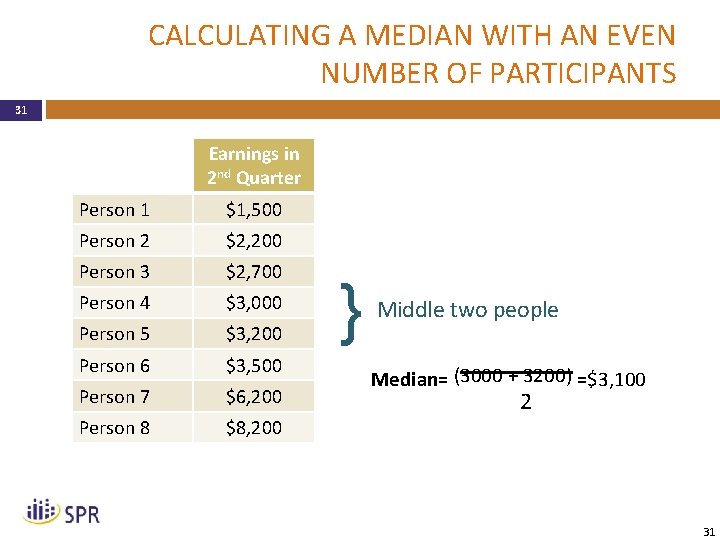
CALCULATING A MEDIAN WITH AN EVEN NUMBER OF PARTICIPANTS 31 Earnings in 2 nd Quarter Person 1 $1, 500 Person 2 $2, 200 Person 3 $2, 700 Person 4 $3, 000 Person 5 $3, 200 Person 6 $3, 500 Person 7 $6, 200 Person 8 $8, 200 } Middle two people Median= (3000 + 3200) =$3, 100 2 31
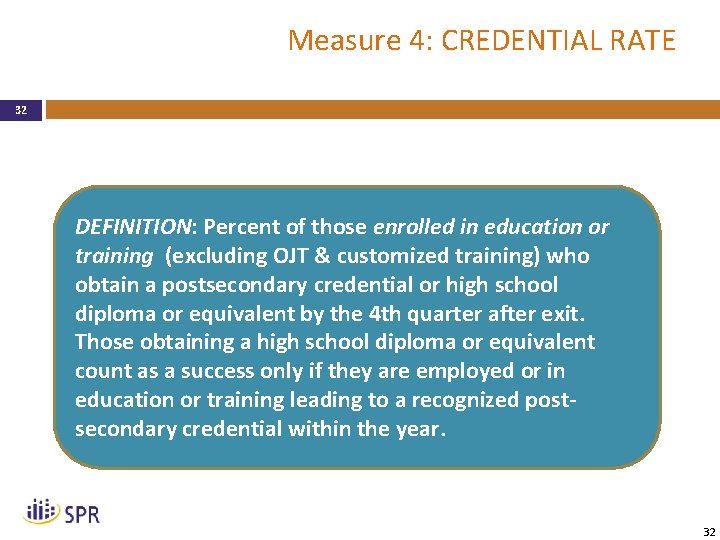
Measure 4: CREDENTIAL RATE 32 DEFINITION: Percent of those enrolled in education or training (excluding OJT & customized training) who obtain a postsecondary credential or high school diploma or equivalent by the 4 th quarter after exit. Those obtaining a high school diploma or equivalent count as a success only if they are employed or in education or training leading to a recognized postsecondary credential within the year. 32
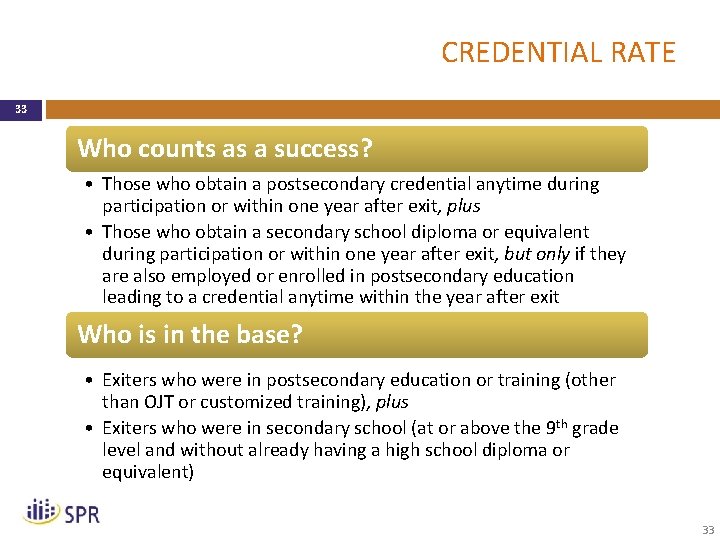
CREDENTIAL RATE 33 Who counts as a success? • Those who obtain a postsecondary credential anytime during participation or within one year after exit, plus • Those who obtain a secondary school diploma or equivalent during participation or within one year after exit, but only if they are also employed or enrolled in postsecondary education leading to a credential anytime within the year after exit Who is in the base? • Exiters who were in postsecondary education or training (other than OJT or customized training), plus • Exiters who were in secondary school (at or above the 9 th grade level and without already having a high school diploma or equivalent) 33
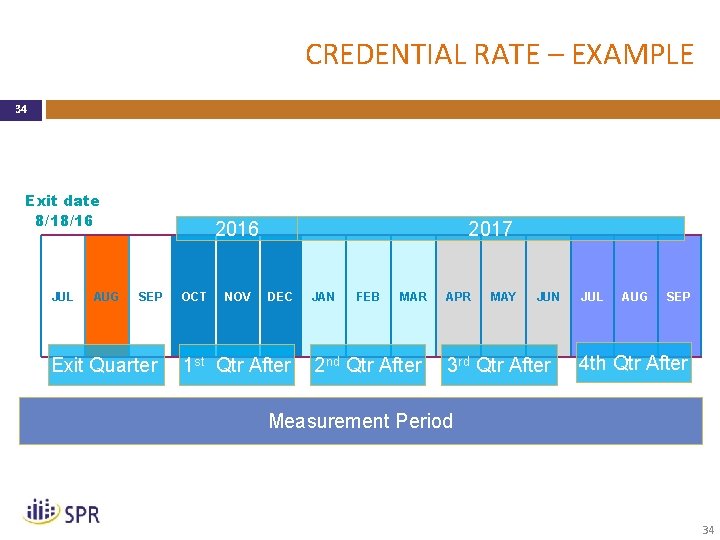
CREDENTIAL RATE – EXAMPLE 34 Exit date 8/18/16 JUL AUG 2016 SEP Exit Quarter OCT NOV 2017 DEC 1 st Qtr After JAN FEB MAR 2 nd Qtr After APR MAY JUN 3 rd Qtr After JUL AUG SEP 4 th Qtr After Measurement Period 34
CREDENTIAL RATE 35 What counts as a credential? Ø High school diploma or equivalent (but only if employed or in other training within the year after exit) Ø Recognized postsecondary credential, which includes: – an industry-recognized certificate awarded in recognition of attainment of technical/occupational skills, – a certificate of completion of an apprenticeship, – a license recognized by State or Federal government, or – an associate, baccalaureate, or graduate degree Work-readiness certificates do not count 35
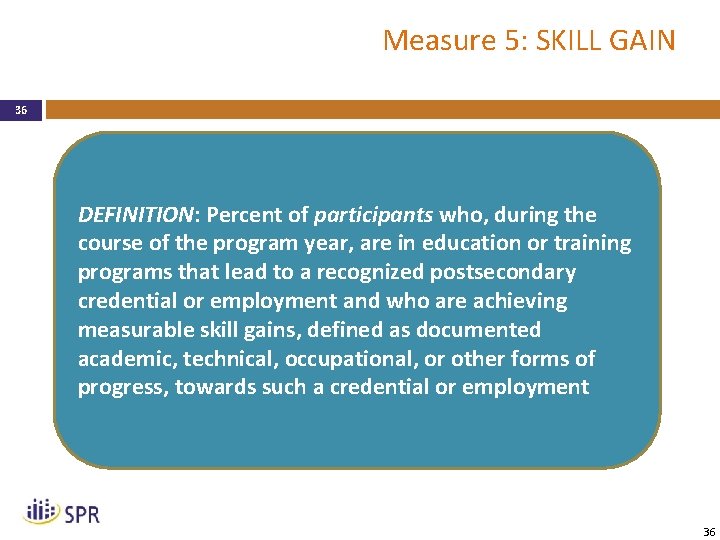
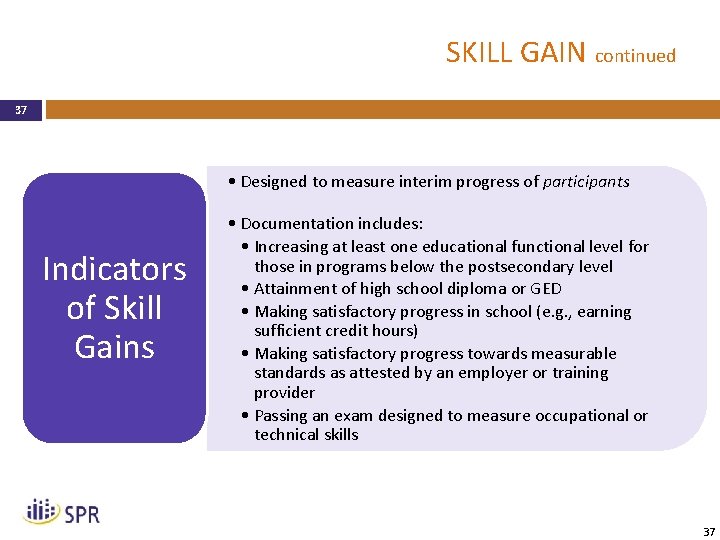
Measure 5: SKILL GAIN 36 DEFINITION: Percent of participants who, during the course of the program year, are in education or training programs that lead to a recognized postsecondary credential or employment and who are achieving measurable skill gains, defined as documented academic, technical, occupational, or other forms of progress, towards such a credential or employment 36
SKILL GAIN continued 37 • Designed to measure interim progress of participants Indicators of Skill Gains • Documentation includes: • Increasing at least one educational functional level for those in programs below the postsecondary level • Attainment of high school diploma or GED • Making satisfactory progress in school (e. g. , earning sufficient credit hours) • Making satisfactory progress towards measurable standards as attested by an employer or training provider • Passing an exam designed to measure occupational or technical skills 37
Measure 6: SERVING EMPLOYERS 38 Effectiveness in serving employers 38
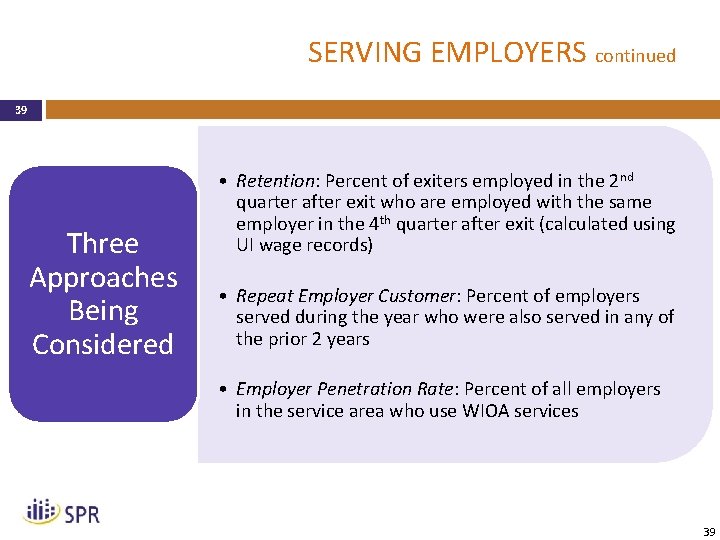
SERVING EMPLOYERS continued 39 Three Approaches Being Considered • Retention: Percent of exiters employed in the 2 nd quarter after exit who are employed with the same employer in the 4 th quarter after exit (calculated using UI wage records) • Repeat Employer Customer: Percent of employers served during the year who were also served in any of the prior 2 years • Employer Penetration Rate: Percent of all employers in the service area who use WIOA services 39
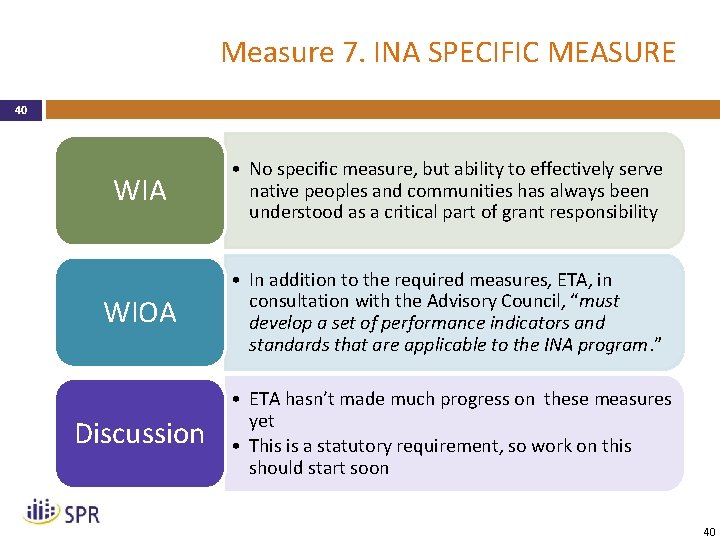
Measure 7. INA SPECIFIC MEASURE 40 WIA • No specific measure, but ability to effectively serve native peoples and communities has always been understood as a critical part of grant responsibility WIOA • In addition to the required measures, ETA, in consultation with the Advisory Council, “must develop a set of performance indicators and standards that are applicable to the INA program. ” Discussion • ETA hasn’t made much progress on these measures yet • This is a statutory requirement, so work on this should start soon 40
41 THE YOUTH MEASURES
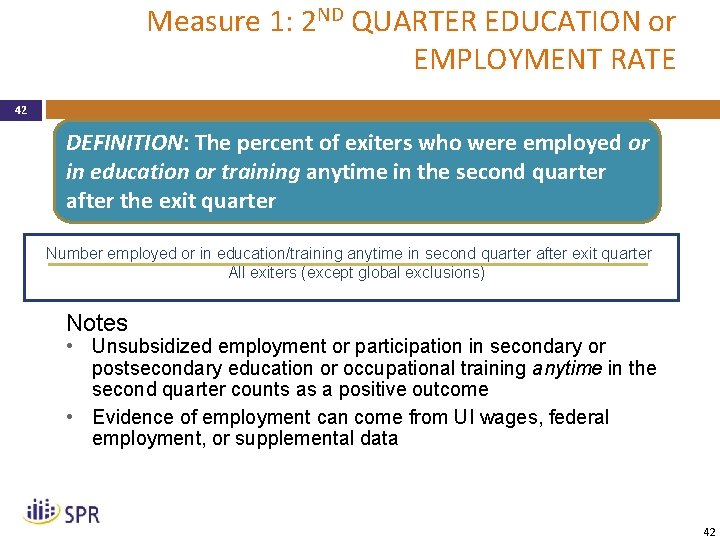
Measure 1: 2 ND QUARTER EDUCATION or EMPLOYMENT RATE 42 DEFINITION: The percent of exiters who were employed or in education or training anytime in the second quarter after the exit quarter Number employed or in education/training anytime in second quarter after exit quarter All exiters (except global exclusions) Notes • Unsubsidized employment or participation in secondary or postsecondary education or occupational training anytime in the second quarter counts as a positive outcome • Evidence of employment can come from UI wages, federal employment, or supplemental data 42
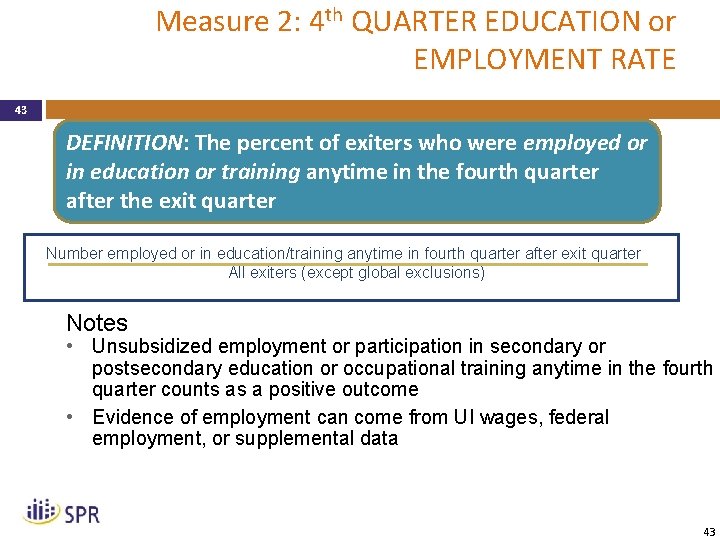
Measure 2: 4 th QUARTER EDUCATION or EMPLOYMENT RATE 43 DEFINITION: The percent of exiters who were employed or in education or training anytime in the fourth quarter after the exit quarter Number employed or in education/training anytime in fourth quarter after exit quarter All exiters (except global exclusions) Notes • Unsubsidized employment or participation in secondary or postsecondary education or occupational training anytime in the fourth quarter counts as a positive outcome • Evidence of employment can come from UI wages, federal employment, or supplemental data 43
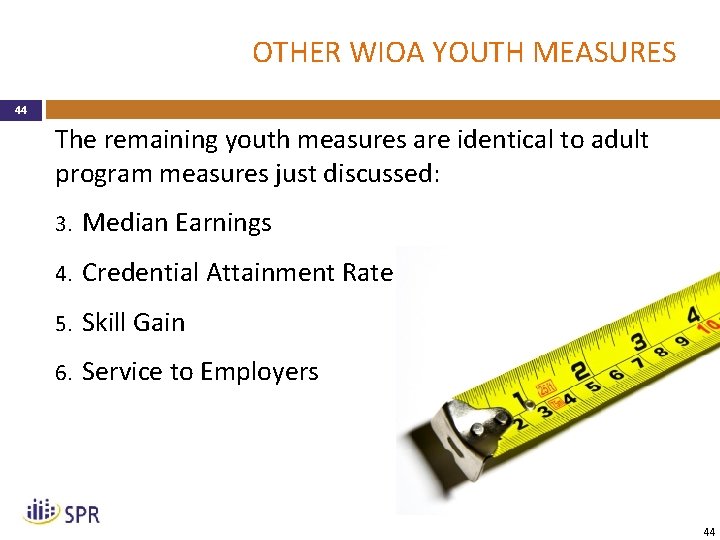
OTHER WIOA YOUTH MEASURES 44 The remaining youth measures are identical to adult program measures just discussed: 3. Median Earnings 4. Credential Attainment Rate 5. Skill Gain 6. Service to Employers 44
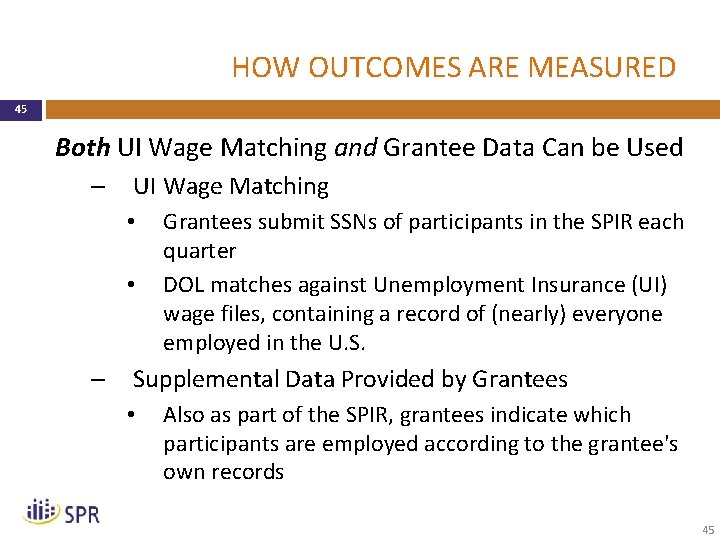
HOW OUTCOMES ARE MEASURED 45 Both UI Wage Matching and Grantee Data Can be Used – UI Wage Matching • • – Grantees submit SSNs of participants in the SPIR each quarter DOL matches against Unemployment Insurance (UI) wage files, containing a record of (nearly) everyone employed in the U. S. Supplemental Data Provided by Grantees • Also as part of the SPIR, grantees indicate which participants are employed according to the grantee's own records 45
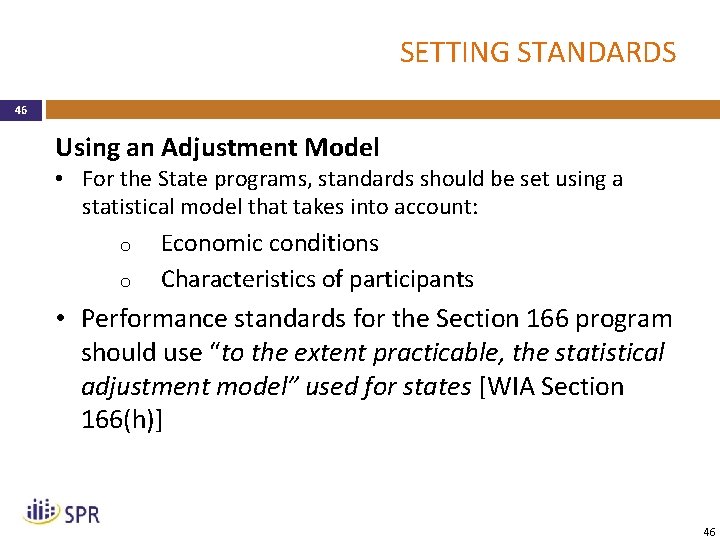
SETTING STANDARDS 46 Using an Adjustment Model • For the State programs, standards should be set using a statistical model that takes into account: o o Economic conditions Characteristics of participants • Performance standards for the Section 166 program should use “to the extent practicable, the statistical adjustment model” used for states [WIA Section 166(h)] 46
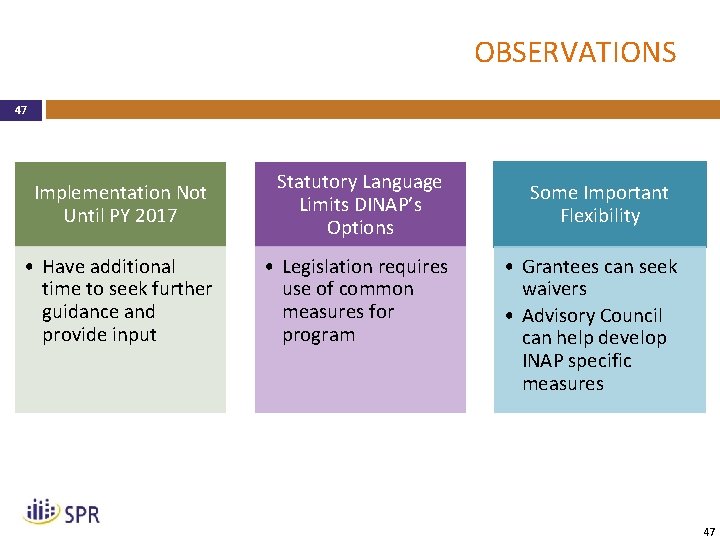
OBSERVATIONS 47 Implementation Not Until PY 2017 Statutory Language Limits DINAP’s Options • Have additional time to seek further guidance and provide input • Legislation requires use of common measures for program Some Important Flexibility • Grantees can seek waivers • Advisory Council can help develop INAP specific measures 47
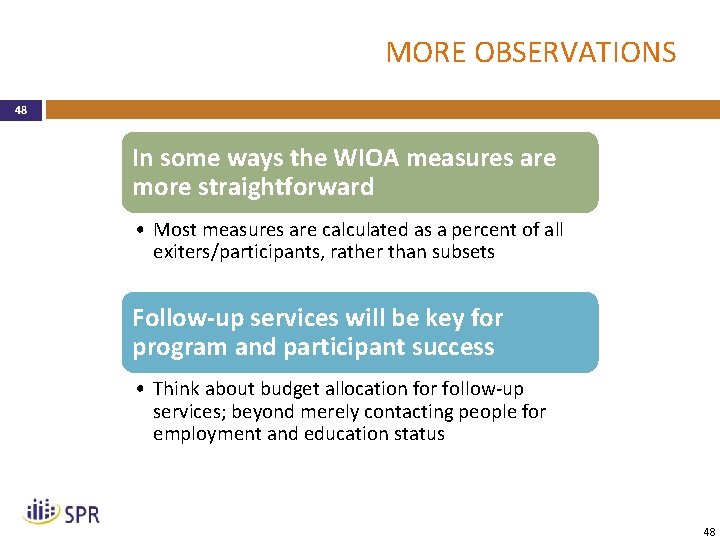
MORE OBSERVATIONS 48 In some ways the WIOA measures are more straightforward • Most measures are calculated as a percent of all exiters/participants, rather than subsets Follow-up services will be key for program and participant success • Think about budget allocation for follow-up services; beyond merely contacting people for employment and education status 48
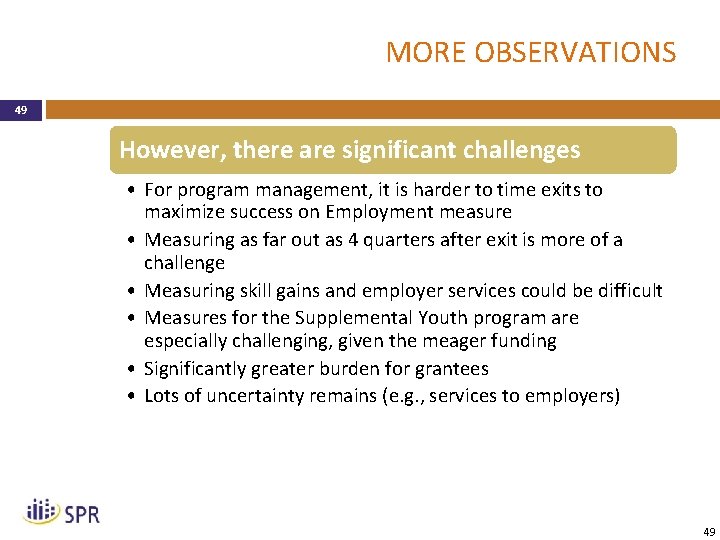
MORE OBSERVATIONS 49 However, there are significant challenges • For program management, it is harder to time exits to maximize success on Employment measure • Measuring as far out as 4 quarters after exit is more of a challenge • Measuring skill gains and employer services could be difficult • Measures for the Supplemental Youth program are especially challenging, given the meager funding • Significantly greater burden for grantees • Lots of uncertainty remains (e. g. , services to employers) 49
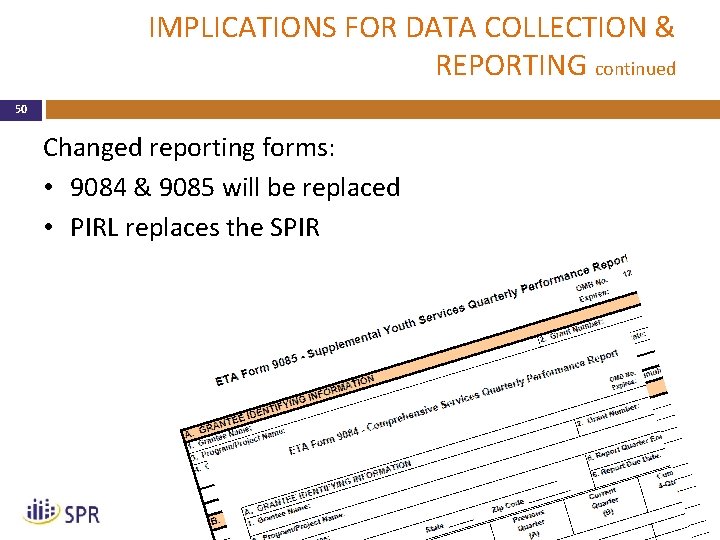
IMPLICATIONS FOR DATA COLLECTION & REPORTING continued 50 Changed reporting forms: • 9084 & 9085 will be replaced • PIRL replaces the SPIR
IMPLICATIONS FOR DATA COLLECTION & REPORTING 51 Bear Tracks will need to be modified or replaced o o Concepts of core and intensive services no longer apply New outcomes need to be reported Some changes to info on participant characteristics is required (but not many) May need to provide data on participants, not just exiters 51
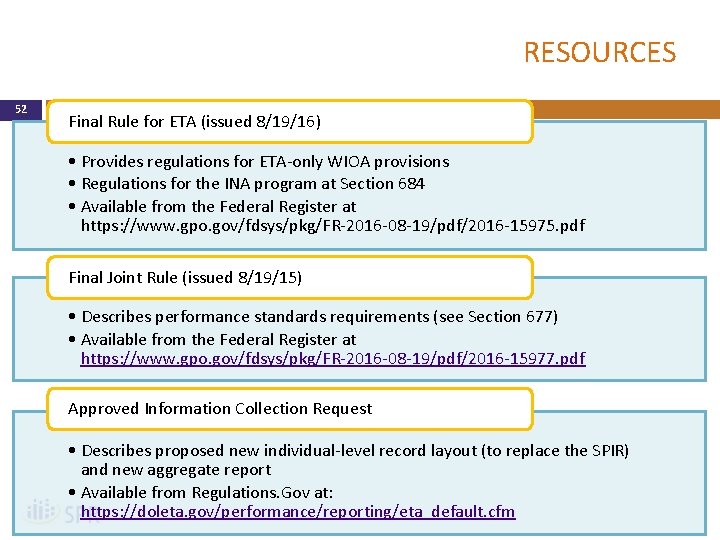
RESOURCES 52 Final Rule for ETA (issued 8/19/16) • Provides regulations for ETA-only WIOA provisions • Regulations for the INA program at Section 684 • Available from the Federal Register at https: //www. gpo. gov/fdsys/pkg/FR-2016 -08 -19/pdf/2016 -15975. pdf Final Joint Rule (issued 8/19/15) • Describes performance standards requirements (see Section 677) • Available from the Federal Register at https: //www. gpo. gov/fdsys/pkg/FR-2016 -08 -19/pdf/2016 -15977. pdf Approved Information Collection Request • Describes proposed new individual-level record layout (to replace the SPIR) and new aggregate report • Available from Regulations. Gov at: https: //doleta. gov/performance/reporting/eta_default. cfm
QUESTIONS 53
CONTACT INFORMATION 54 Ron D’Amico Principal Social Policy Research Associates 510 -788 -2484 Ron_damico@spra. com