
1 Introduction to Impact Assessment Social Return on

- Slides: 33
1 Introduction to Impact Assessment & Social Return on Investment (SROI) Shaikh Fattah, Ph. D. , SMIEEE, FIEB Education Committee Chair, IEEE HAC James Conrad, Ph. D. , Chair, IEEE HAC Events Committee www. nefconsulting. com
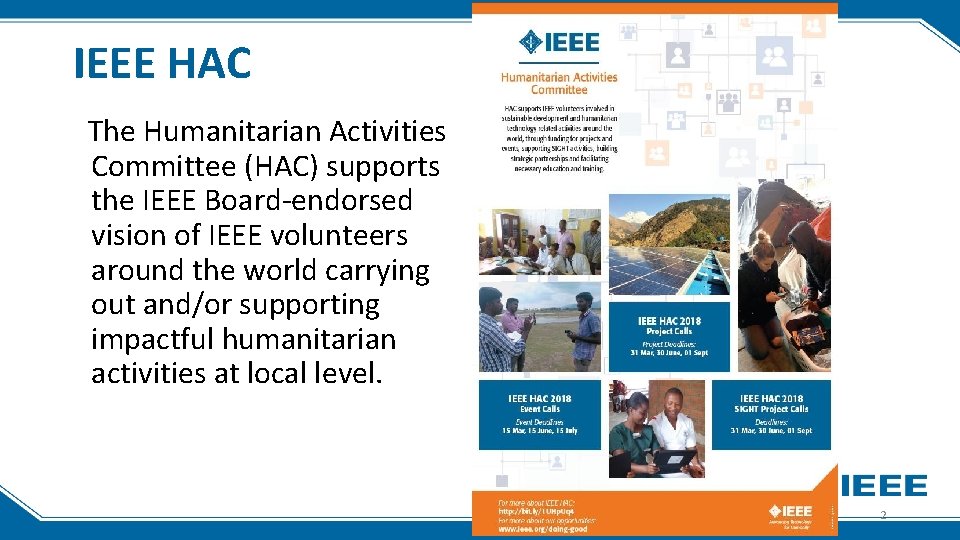
IEEE HAC The Humanitarian Activities Committee (HAC) supports the IEEE Board-endorsed vision of IEEE volunteers around the world carrying out and/or supporting impactful humanitarian activities at local level. 2
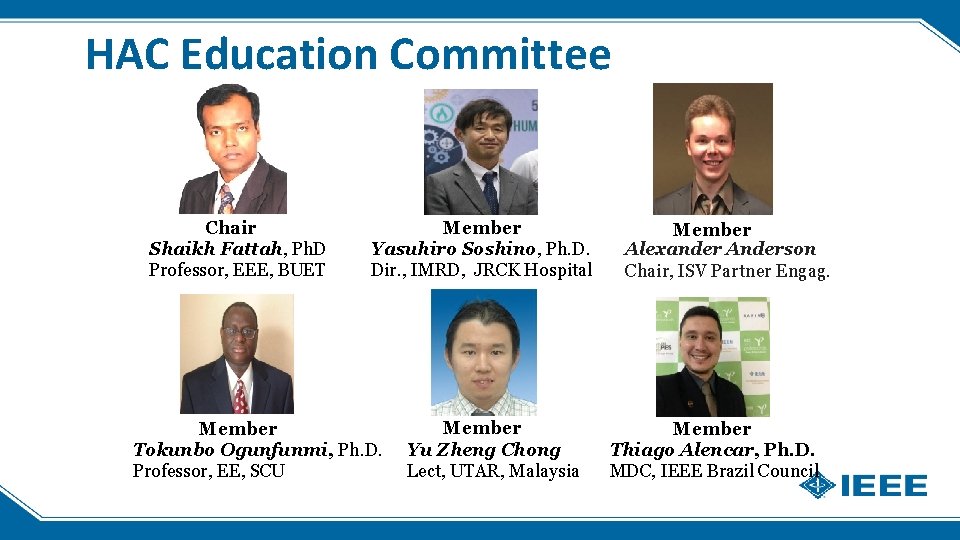
HAC Education Committee Chair Shaikh Fattah, Ph. D Professor, EEE, BUET Member Yasuhiro Soshino, Ph. D. Dir. , IMRD, JRCK Hospital Member Tokunbo Ogunfunmi, Ph. D. Professor, EE, SCU Member Yu Zheng Chong Lect, UTAR, Malaysia Member Alexander Anderson Chair, ISV Partner Engag. Member Thiago Alencar, Ph. D. MDC, IEEE Brazil Council
Objectives of HAC Education Committee • To offer necessary education materials and interactive training to professional engineers or engineering students who want to serve local community with the help of impactful humanitarian projects. • To cover fundamental knowledge and skills required to deal with humanitarian technology projects/events focusing on impact assessment in the sustainable development space. 4
Impact Assessment • HAC is prioritizing impact assessment in 2019. • Currently, HAC is piloting the Social Return on Investment (SROI) impact assessment methodology. • HAC will evaluate the feasibility of the SROI approach for humanitarian and sustainable development activities at IEEE by mid-year. • The following slides introduce the concept of SROI. • We welcome your feedback on how IEEE can best assess impact! 5
Social Return on Investment (SROI) Overview session 9 th February 2019 Alex Chapman www. nefconsulting. com
Big Picture Why are we interested in measuring social, economic and environmental impact? www. nefconsulting. com
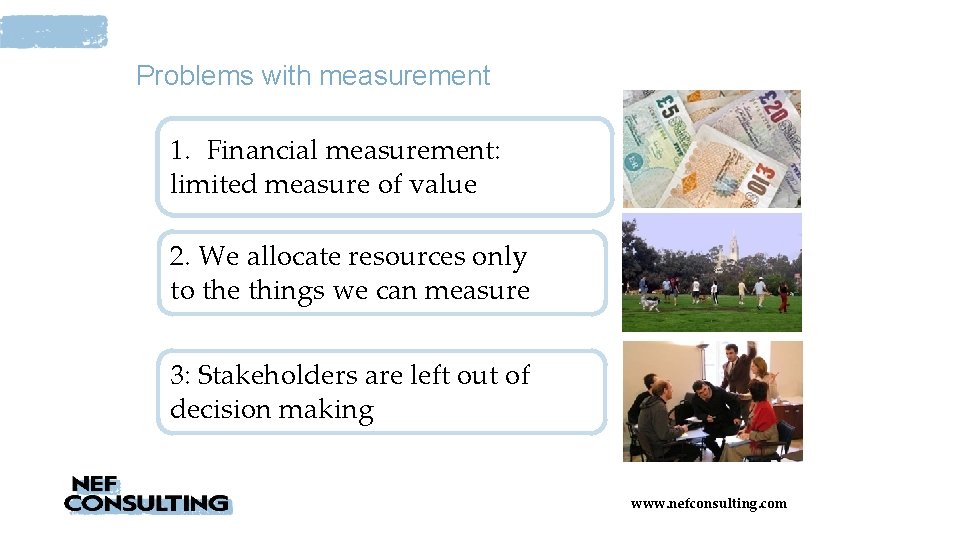
Problems with measurement 1. Financial measurement: limited measure of value 2. We allocate resources only to the things we can measure 3: Stakeholders are left out of decision making www. nefconsulting. com
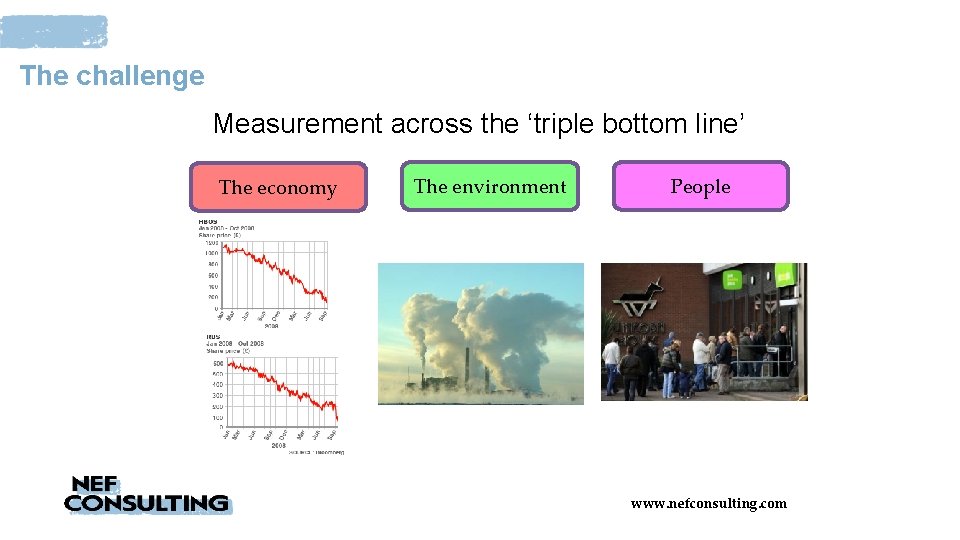
The challenge Measurement across the ‘triple bottom line’ The economy The environment People www. nefconsulting. com
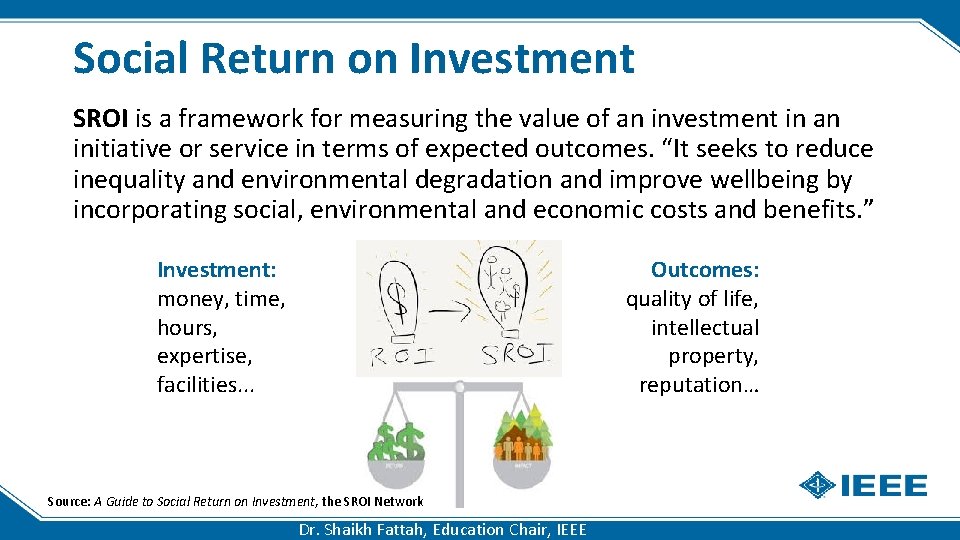
Social Return on Investment SROI is a framework for measuring the value of an investment in an initiative or service in terms of expected outcomes. “It seeks to reduce inequality and environmental degradation and improve wellbeing by incorporating social, environmental and economic costs and benefits. ” Outcomes: quality of life, intellectual property, reputation… Investment: money, time, hours, expertise, facilities. . . Source: A Guide to Social Return on Investment, the SROI Network Dr. Shaikh Fattah, Education Chair, IEEE
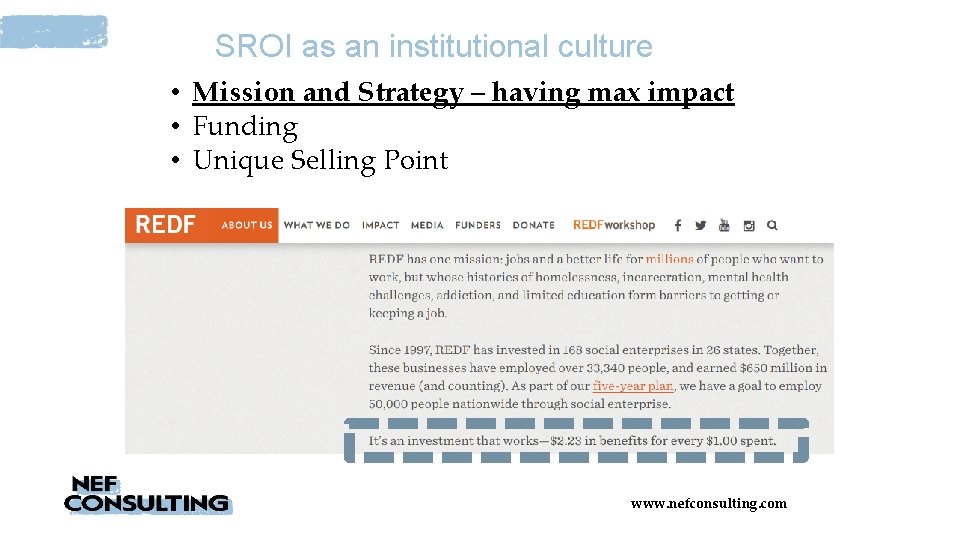
SROI as an institutional culture • Mission and Strategy – having max impact • Funding • Unique Selling Point www. nefconsulting. com
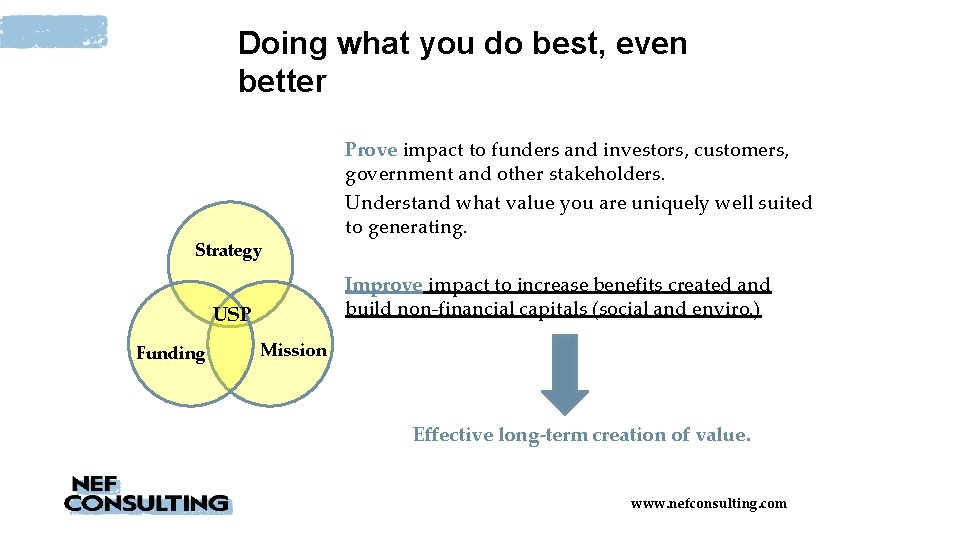
Doing what you do best, even better Strategy Improve impact to increase benefits created and build non-financial capitals (social and enviro. ) USP Funding Prove impact to funders and investors, customers, government and other stakeholders. Understand what value you are uniquely well suited to generating. Mission Effective long-term creation of value. www. nefconsulting. com
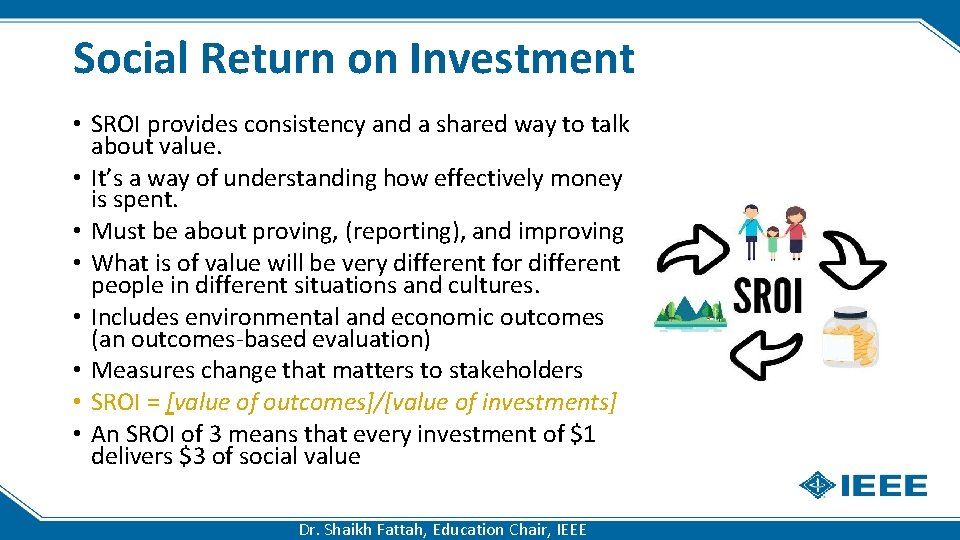
Social Return on Investment • SROI provides consistency and a shared way to talk about value. • It’s a way of understanding how effectively money is spent. • Must be about proving, (reporting), and improving • What is of value will be very different for different people in different situations and cultures. • Includes environmental and economic outcomes (an outcomes-based evaluation) • Measures change that matters to stakeholders • SROI = [value of outcomes]/[value of investments] • An SROI of 3 means that every investment of $1 delivers $3 of social value Dr. Shaikh Fattah, Education Chair, IEEE
Impact Assessment - SROI Pilot at IEEE • Better aggregate IEEE’s overall impact across social good programs • Achieve consistency although each program has different initiatives and metrics • HAC Projects Committee has revised its application form to incorporate more impact assessment • Focus on stakeholder involvement and incorporating their feedback into preand post-project implementation • Optional to conduct SROI analysis of the project – would create a stronger proposal Dr. Shaikh Fattah, Education Chair, IEEE
SROI: Forecast and Evaluative • Evaluative SROI: Evaluate the social value based on actual outcomes that have already taken place. • Forecasted SROI: Used to predict how much social value will be created if the activities meet their intended outcomes. • • • Useful in the planning stages of an activity Shows how investment can maximize impact Helps identify required data to be collected once the project has begun Dr. Shaikh Fattah, Education Chair, IEEE
Principles of SROI • • Involve stakeholders. Understand what changes. Value things that matter. Only include what is material. Do not over claim. Be transparent. Verify the result. Dr. Shaikh Fattah, Education Chair, IEEE
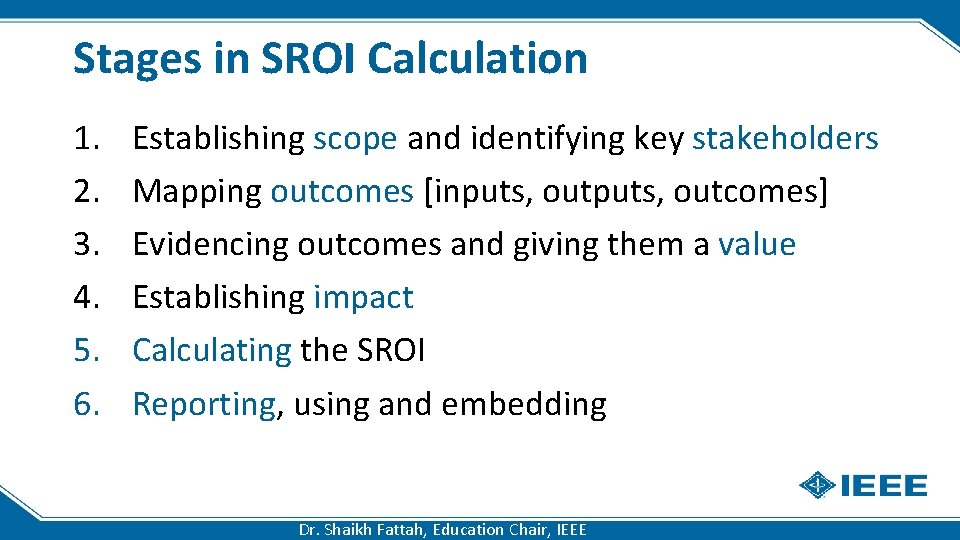
Stages in SROI Calculation 1. 2. 3. 4. 5. 6. Establishing scope and identifying key stakeholders Mapping outcomes [inputs, outcomes] Evidencing outcomes and giving them a value Establishing impact Calculating the SROI Reporting, using and embedding Dr. Shaikh Fattah, Education Chair, IEEE
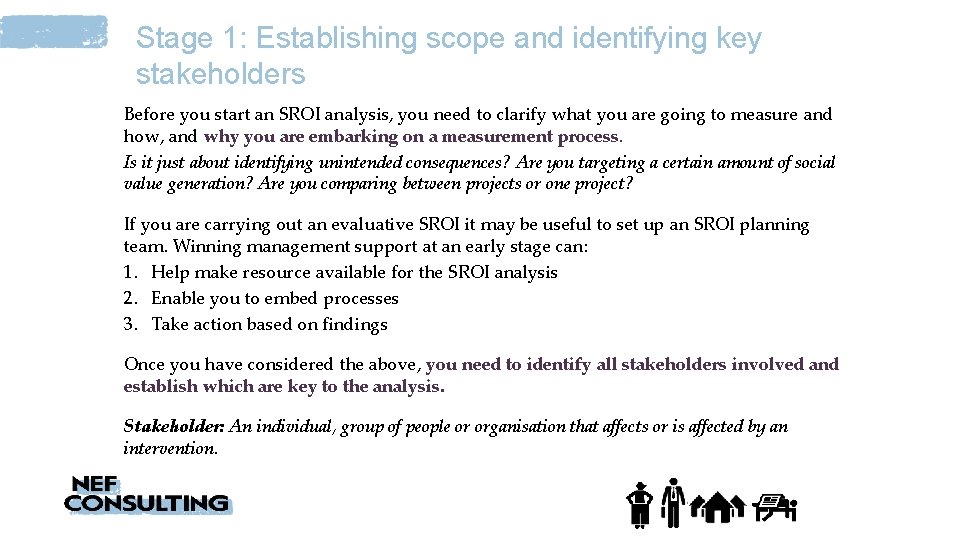
Stage 1: Establishing scope and identifying key stakeholders Before you start an SROI analysis, you need to clarify what you are going to measure and how, and why you are embarking on a measurement process. Is it just about identifying unintended consequences? Are you targeting a certain amount of social value generation? Are you comparing between projects or one project? If you are carrying out an evaluative SROI it may be useful to set up an SROI planning team. Winning management support at an early stage can: 1. Help make resource available for the SROI analysis 2. Enable you to embed processes 3. Take action based on findings Once you have considered the above, you need to identify all stakeholders involved and establish which are key to the analysis. Stakeholder: An individual, group of people or organisation that affects or is affected by an intervention. www. nefconsulting. com
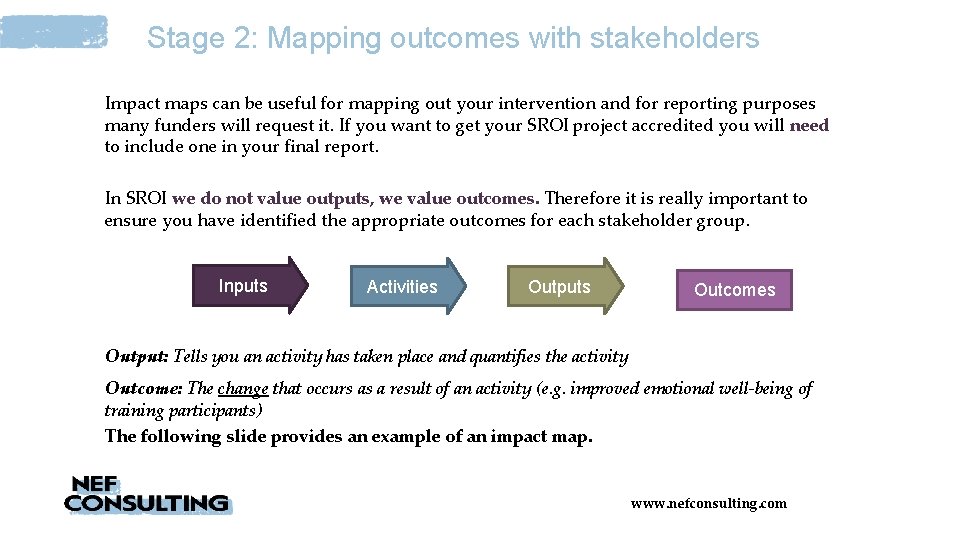
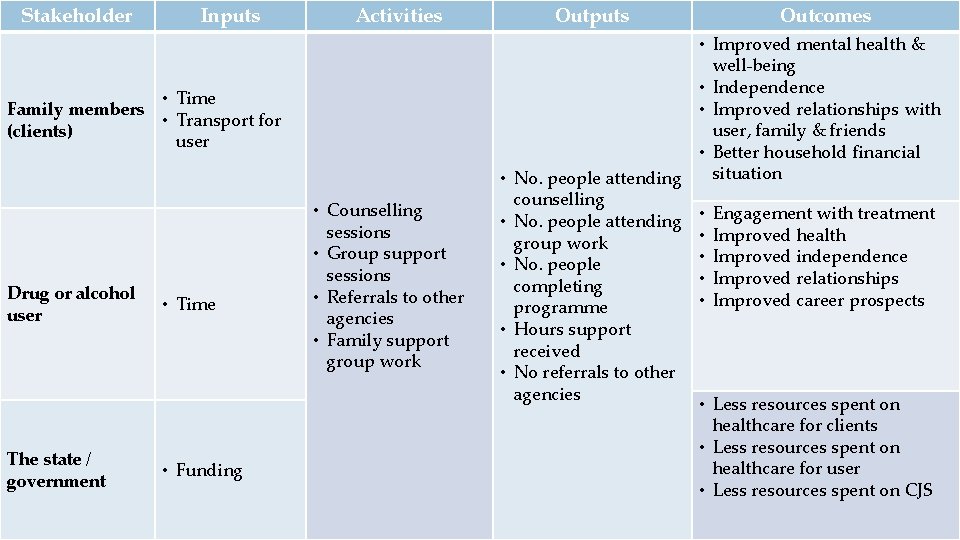
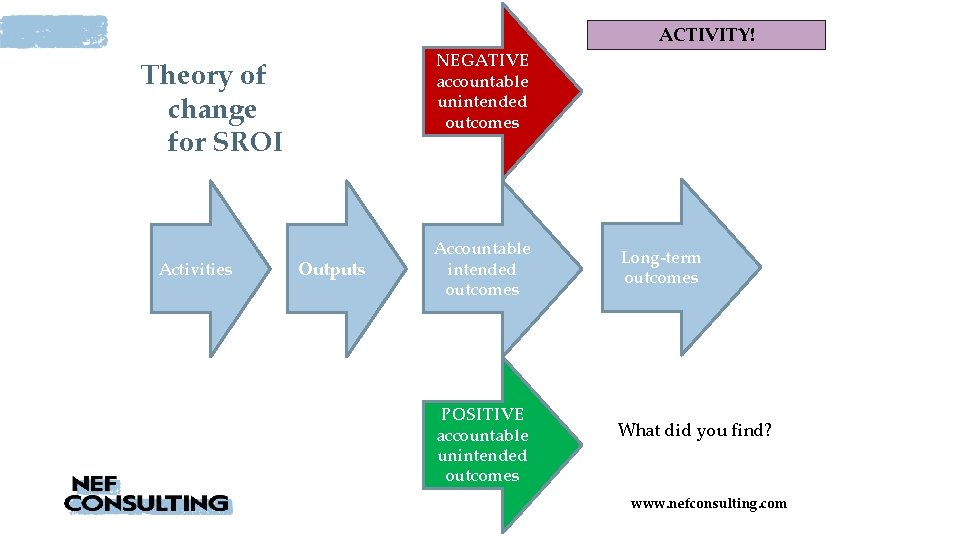
Stage 2: Mapping outcomes with stakeholders Impact maps can be useful for mapping out your intervention and for reporting purposes many funders will request it. If you want to get your SROI project accredited you will need to include one in your final report. In SROI we do not value outputs, we value outcomes. Therefore it is really important to ensure you have identified the appropriate outcomes for each stakeholder group. Inputs Activities Outputs Outcomes Output: Tells you an activity has taken place and quantifies the activity Outcome: The change that occurs as a result of an activity (e. g. improved emotional well-being of training participants) The following slide provides an example of an impact map. www. nefconsulting. com
Stakeholder Inputs Activities Outputs • Time Family members • Transport for (clients) user • Drug or alcohol user The state / government • Time • Funding • Counselling sessions • Group support sessions • Referrals to other agencies • Family support group work • • Outcomes • Improved mental health & well-being • Independence • Improved relationships with user, family & friends • Better household financial situation No. people attending counselling No. people attending • Engagement with treatment • Improved health group work • Improved independence No. people • Improved relationships completing • Improved career prospects programme Hours support received No referrals to other agencies • Less resources spent on healthcare for clients • Less resources spent on healthcare for user • Less resources spent on CJS www. nefconsulting. com
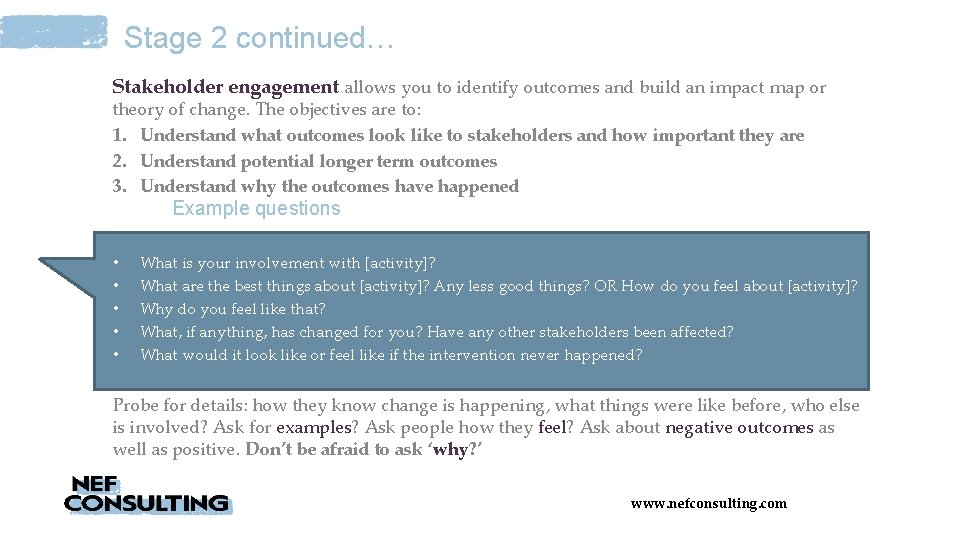
Stage 2 continued… Stakeholder engagement allows you to identify outcomes and build an impact map or theory of change. The objectives are to: 1. Understand what outcomes look like to stakeholders and how important they are 2. Understand potential longer term outcomes 3. Understand why the outcomes have happened Example questions • • • What is your involvement with [activity]? What are the best things about [activity]? Any less good things? OR How do you feel about [activity]? Why do you feel like that? What, if anything, has changed for you? Have any other stakeholders been affected? What would it look like or feel like if the intervention never happened? Probe for details: how they know change is happening, what things were like before, who else is involved? Ask for examples? Ask people how they feel? Ask about negative outcomes as well as positive. Don’t be afraid to ask ‘why? ’ www. nefconsulting. com
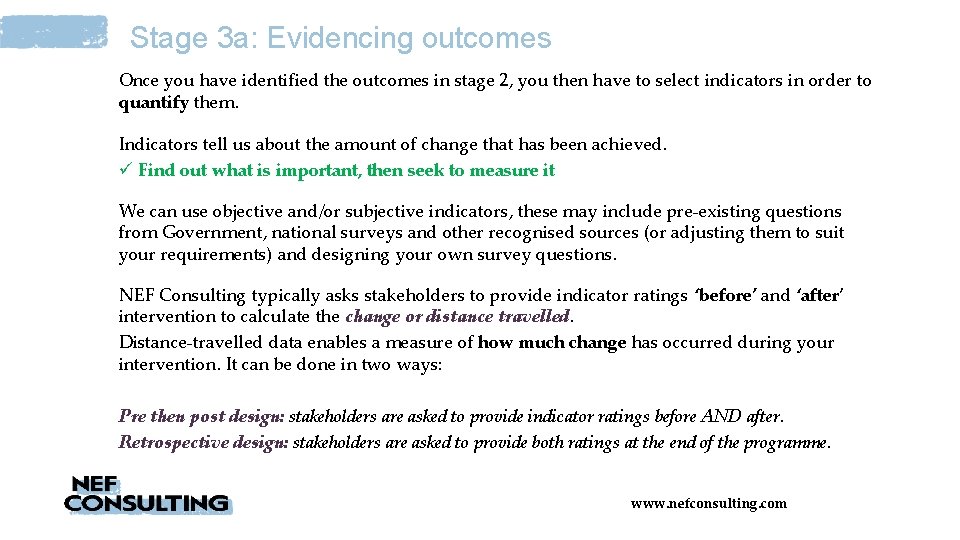
Stage 3 a: Evidencing outcomes Once you have identified the outcomes in stage 2, you then have to select indicators in order to quantify them. Indicators tell us about the amount of change that has been achieved. ü Find out what is important, then seek to measure it We can use objective and/or subjective indicators, these may include pre-existing questions from Government, national surveys and other recognised sources (or adjusting them to suit your requirements) and designing your own survey questions. NEF Consulting typically asks stakeholders to provide indicator ratings ‘before’ and ‘after’ intervention to calculate the change or distance travelled. Distance-travelled data enables a measure of how much change has occurred during your intervention. It can be done in two ways: Pre then post design: stakeholders are asked to provide indicator ratings before AND after. Retrospective design: stakeholders are asked to provide both ratings at the end of the programme. www. nefconsulting. com
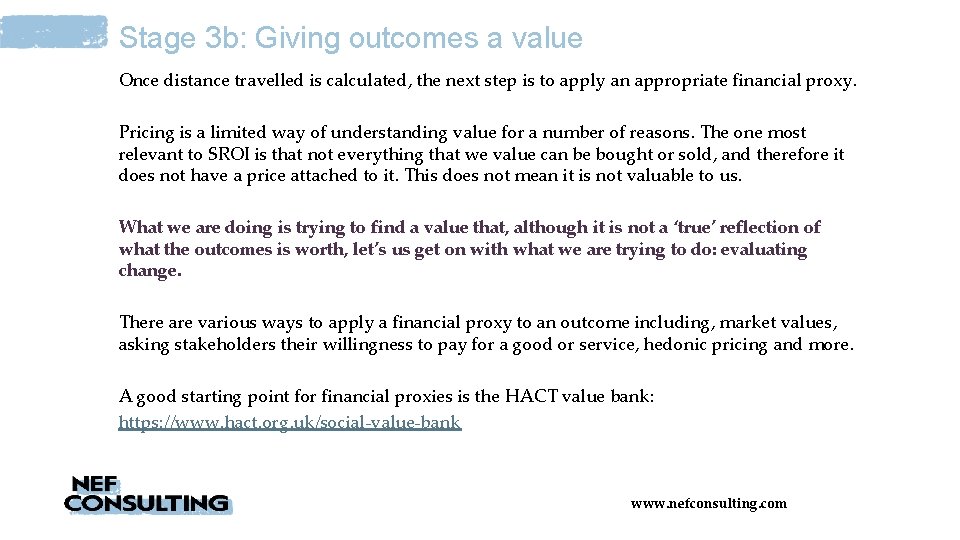
Stage 3 b: Giving outcomes a value Once distance travelled is calculated, the next step is to apply an appropriate financial proxy. Pricing is a limited way of understanding value for a number of reasons. The one most relevant to SROI is that not everything that we value can be bought or sold, and therefore it does not have a price attached to it. This does not mean it is not valuable to us. What we are doing is trying to find a value that, although it is not a ‘true’ reflection of what the outcomes is worth, let’s us get on with what we are trying to do: evaluating change. There are various ways to apply a financial proxy to an outcome including, market values, asking stakeholders their willingness to pay for a good or service, hedonic pricing and more. A good starting point for financial proxies is the HACT value bank: https: //www. hact. org. uk/social-value-bank www. nefconsulting. com
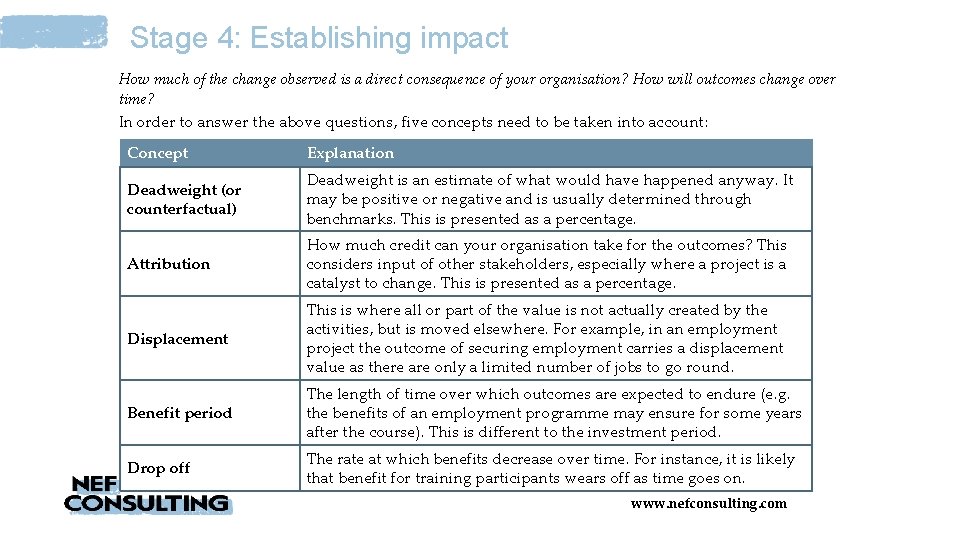
Stage 4: Establishing impact How much of the change observed is a direct consequence of your organisation? How will outcomes change over time? In order to answer the above questions, five concepts need to be taken into account: Concept Explanation Deadweight (or counterfactual) Deadweight is an estimate of what would have happened anyway. It may be positive or negative and is usually determined through benchmarks. This is presented as a percentage. Attribution How much credit can your organisation take for the outcomes? This considers input of other stakeholders, especially where a project is a catalyst to change. This is presented as a percentage. Displacement This is where all or part of the value is not actually created by the activities, but is moved elsewhere. For example, in an employment project the outcome of securing employment carries a displacement value as there are only a limited number of jobs to go round. Benefit period The length of time over which outcomes are expected to endure (e. g. the benefits of an employment programme may ensure for some years after the course). This is different to the investment period. Drop off The rate at which benefits decrease over time. For instance, it is likely that benefit for training participants wears off as time goes on. www. nefconsulting. com
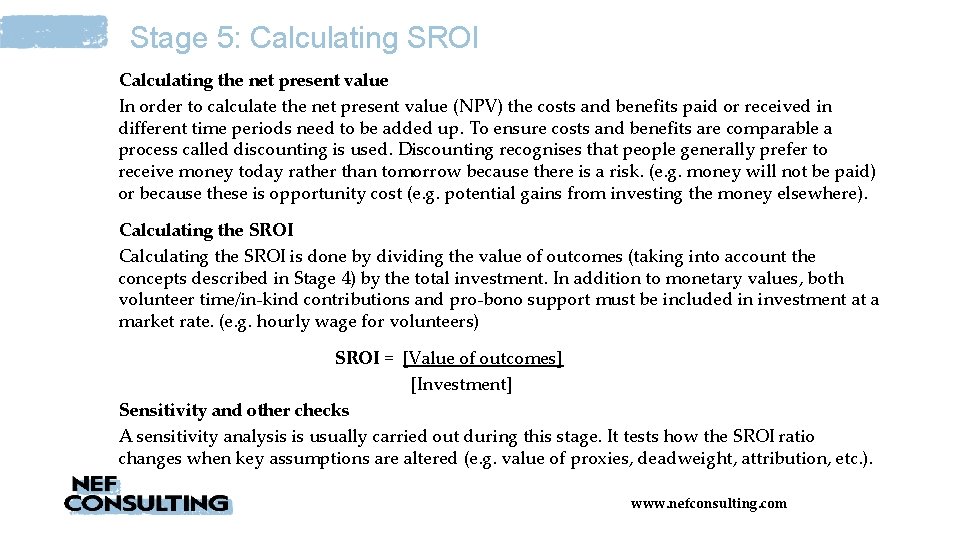
Stage 5: Calculating SROI Calculating the net present value In order to calculate the net present value (NPV) the costs and benefits paid or received in different time periods need to be added up. To ensure costs and benefits are comparable a process called discounting is used. Discounting recognises that people generally prefer to receive money today rather than tomorrow because there is a risk. (e. g. money will not be paid) or because these is opportunity cost (e. g. potential gains from investing the money elsewhere). Calculating the SROI is done by dividing the value of outcomes (taking into account the concepts described in Stage 4) by the total investment. In addition to monetary values, both volunteer time/in-kind contributions and pro-bono support must be included in investment at a market rate. (e. g. hourly wage for volunteers) SROI = [Value of outcomes] [Investment] Sensitivity and other checks A sensitivity analysis is usually carried out during this stage. It tests how the SROI ratio changes when key assumptions are altered (e. g. value of proxies, deadweight, attribution, etc. ). www. nefconsulting. com
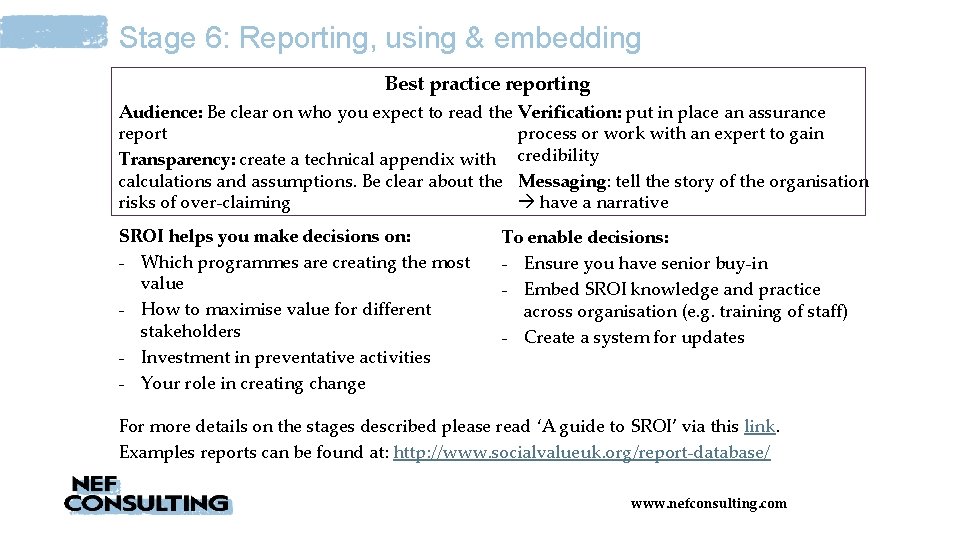
Stage 6: Reporting, using & embedding Best practice reporting Audience: Be clear on who you expect to read the Verification: put in place an assurance report process or work with an expert to gain Transparency: create a technical appendix with credibility calculations and assumptions. Be clear about the Messaging: tell the story of the organisation risks of over-claiming have a narrative SROI helps you make decisions on: - Which programmes are creating the most value - How to maximise value for different stakeholders - Investment in preventative activities - Your role in creating change To enable decisions: - Ensure you have senior buy-in - Embed SROI knowledge and practice across organisation (e. g. training of staff) - Create a system for updates For more details on the stages described please read ‘A guide to SROI’ via this link. Examples reports can be found at: http: //www. socialvalueuk. org/report-database/ www. nefconsulting. com
2 7 Discussion & Questions www. nefconsulting. com
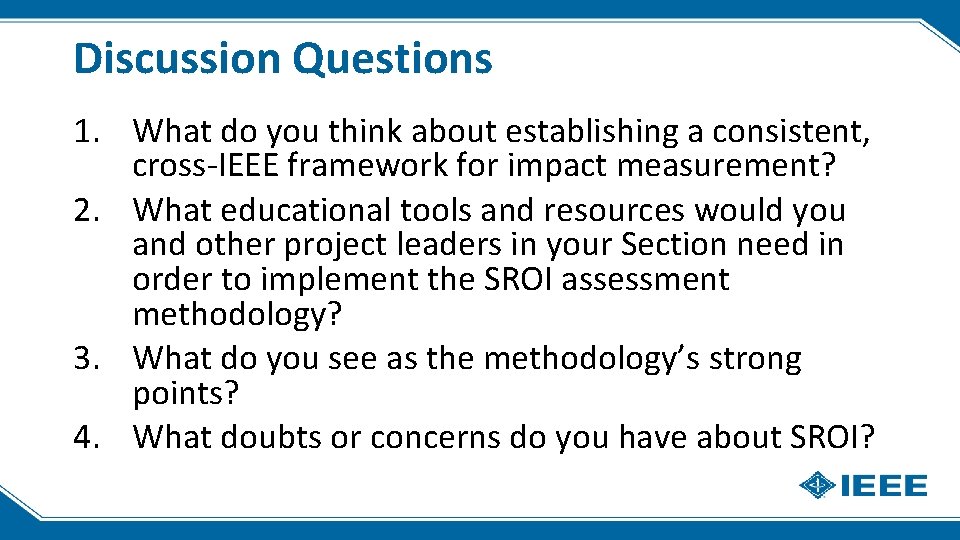
Discussion Questions 1. What do you think about establishing a consistent, cross-IEEE framework for impact measurement? 2. What educational tools and resources would you and other project leaders in your Section need in order to implement the SROI assessment methodology? 3. What do you see as the methodology’s strong points? 4. What doubts or concerns do you have about SROI?
Call to Action • Appoint someone in your section to find out more and stay up to date on developments in pilot program. • HAC is looking for volunteers across IEEE to help pilot the methodology – Is there a Project in your Section that could be a candidate?
Questions? Contact: Julianna Pichardo – sight@ieee. org, j. pichardo@ieee. org Holly Schneider Brown – h. s. brown@ieee. org
Thank You!
Appendix
ACTIVITY! NEGATIVE accountable unintended outcomes Theory of change for SROI Activities Outputs Accountable intended outcomes POSITIVE accountable unintended outcomes Long-term outcomes What did you find? www. nefconsulting. com