
1 Introduction to Human Development Chapter 1 Copyright




- Slides: 33
1 Introduction to Human Development Chapter 1 Copyright © 2010 Pearson Education, Inc. All rights reserved.
Introduction to Human Development • Introduction to Development • The Nature of Human Development • Theoretical Frameworks for Human Development • The Scientific Approach to the Study of Human Development Copyright © 2010 Pearson Education, Inc. All rights reserved.
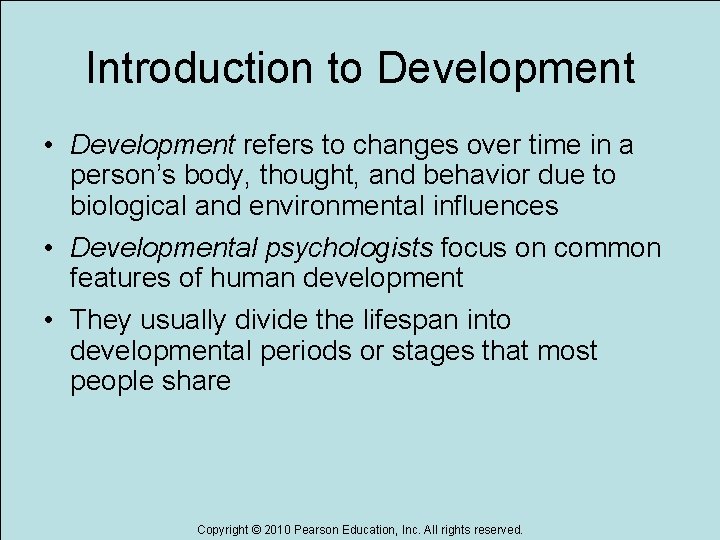
Introduction to Development • Development refers to changes over time in a person’s body, thought, and behavior due to biological and environmental influences • Developmental psychologists focus on common features of human development • They usually divide the lifespan into developmental periods or stages that most people share Copyright © 2010 Pearson Education, Inc. All rights reserved.
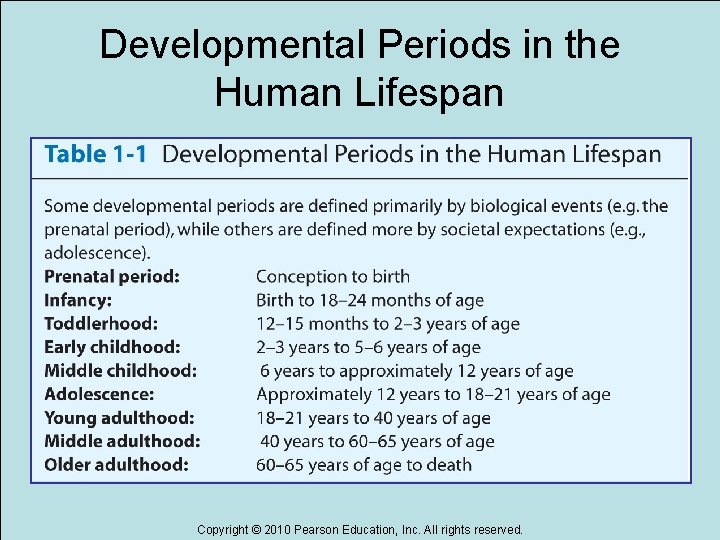
Developmental Periods in the Human Lifespan Copyright © 2010 Pearson Education, Inc. All rights reserved.
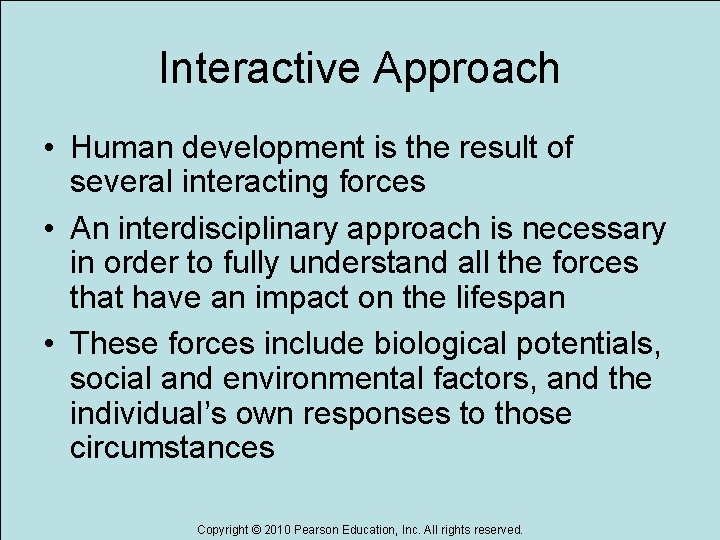
Interactive Approach • Human development is the result of several interacting forces • An interdisciplinary approach is necessary in order to fully understand all the forces that have an impact on the lifespan • These forces include biological potentials, social and environmental factors, and the individual’s own responses to those circumstances Copyright © 2010 Pearson Education, Inc. All rights reserved.
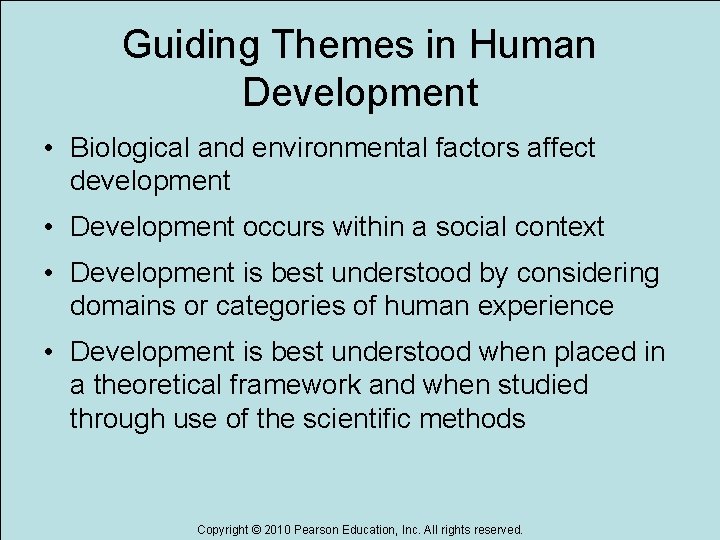
Guiding Themes in Human Development • Biological and environmental factors affect development • Development occurs within a social context • Development is best understood by considering domains or categories of human experience • Development is best understood when placed in a theoretical framework and when studied through use of the scientific methods Copyright © 2010 Pearson Education, Inc. All rights reserved.
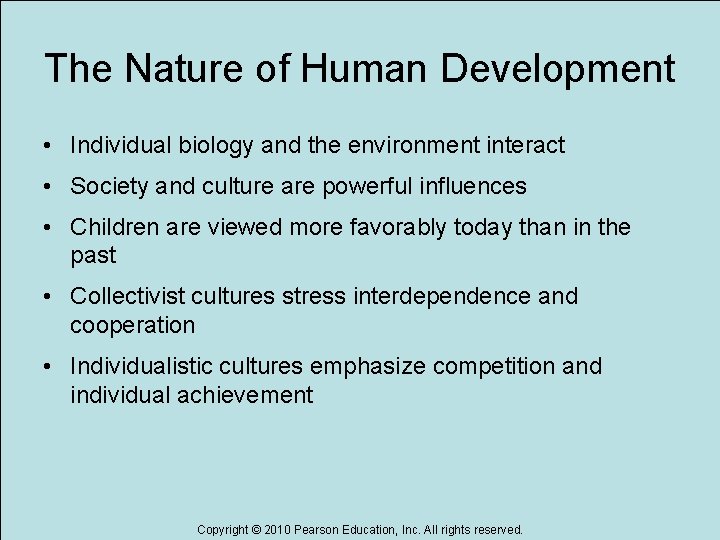
The Nature of Human Development • Individual biology and the environment interact • Society and culture are powerful influences • Children are viewed more favorably today than in the past • Collectivist cultures stress interdependence and cooperation • Individualistic cultures emphasize competition and individual achievement Copyright © 2010 Pearson Education, Inc. All rights reserved.
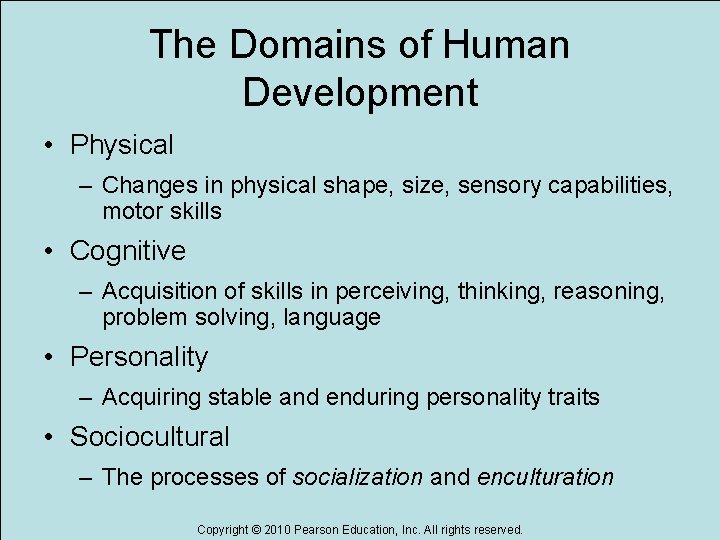
The Domains of Human Development • Physical – Changes in physical shape, size, sensory capabilities, motor skills • Cognitive – Acquisition of skills in perceiving, thinking, reasoning, problem solving, language • Personality – Acquiring stable and enduring personality traits • Sociocultural – The processes of socialization and enculturation Copyright © 2010 Pearson Education, Inc. All rights reserved.
Video clip Interview with UNICEF executive director about the effect of war on children in Gaza: http: //www. cnn. com/video/#/video/world/2009/0 1/16/curnow. gaza. children. veneman. intv. cnn Copyright © 2010 Pearson Education, Inc. All rights reserved.
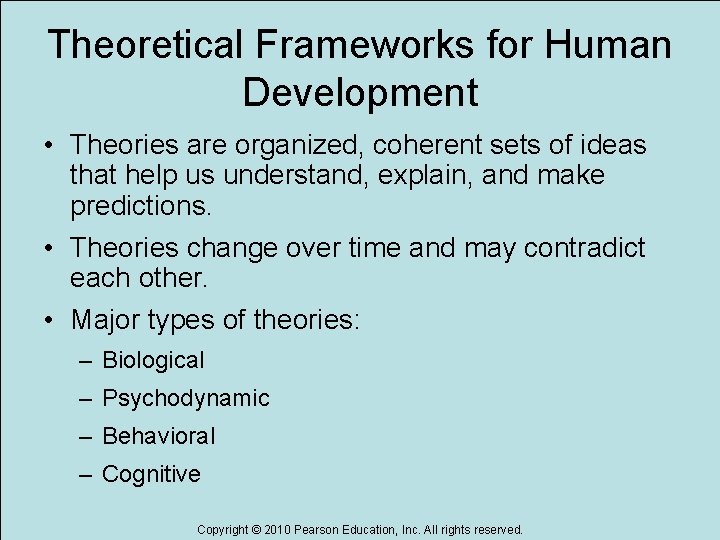
Theoretical Frameworks for Human Development • Theories are organized, coherent sets of ideas that help us understand, explain, and make predictions. • Theories change over time and may contradict each other. • Major types of theories: – Biological – Psychodynamic – Behavioral – Cognitive Copyright © 2010 Pearson Education, Inc. All rights reserved.
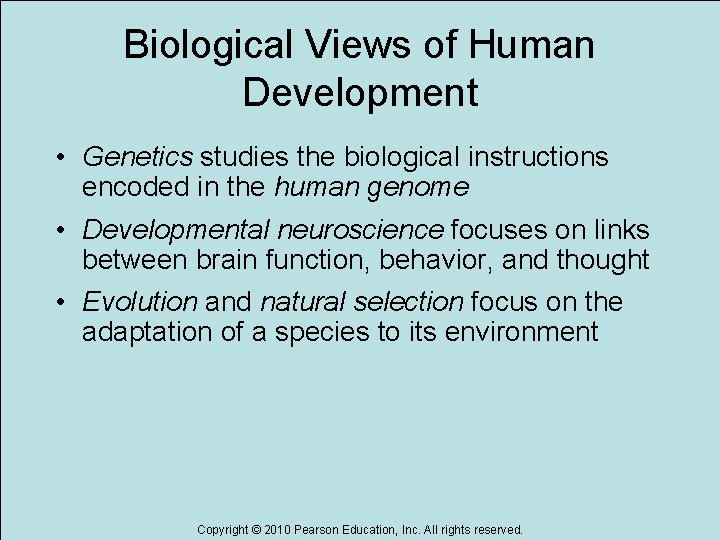
Biological Views of Human Development • Genetics studies the biological instructions encoded in the human genome • Developmental neuroscience focuses on links between brain function, behavior, and thought • Evolution and natural selection focus on the adaptation of a species to its environment Copyright © 2010 Pearson Education, Inc. All rights reserved.
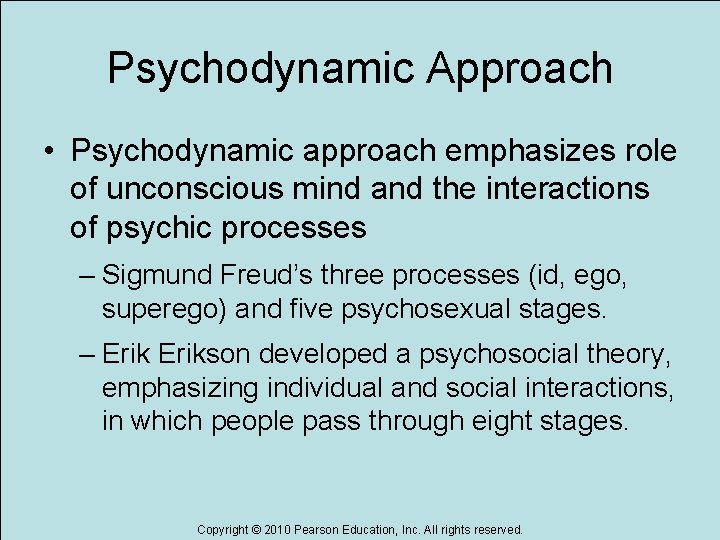
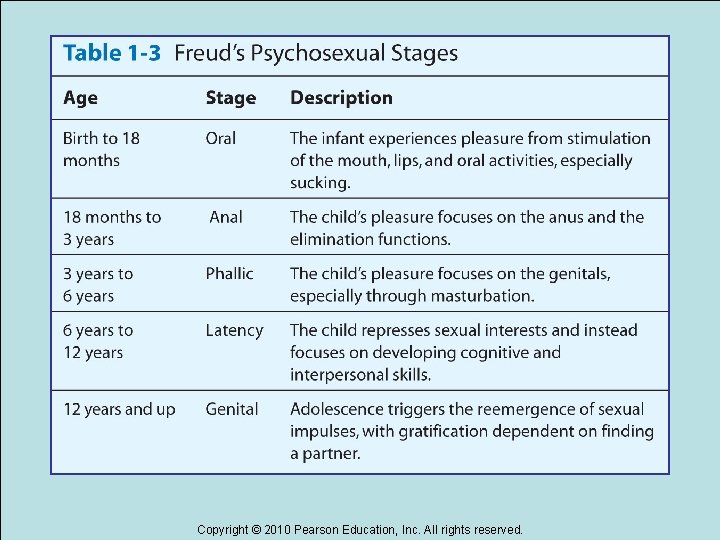
Psychodynamic Approach • Psychodynamic approach emphasizes role of unconscious mind and the interactions of psychic processes – Sigmund Freud’s three processes (id, ego, superego) and five psychosexual stages. – Erikson developed a psychosocial theory, emphasizing individual and social interactions, in which people pass through eight stages. Copyright © 2010 Pearson Education, Inc. All rights reserved.
Copyright © 2010 Pearson Education, Inc. All rights reserved.
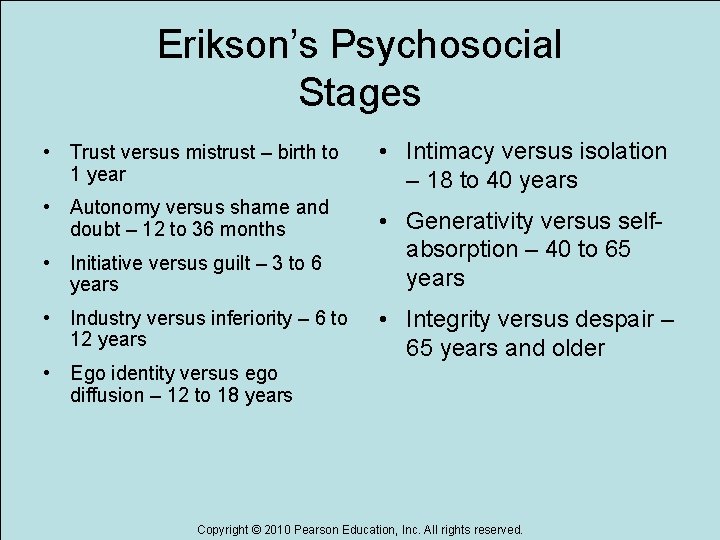
Erikson’s Psychosocial Stages • Trust versus mistrust – birth to 1 year • Autonomy versus shame and doubt – 12 to 36 months • Initiative versus guilt – 3 to 6 years • Industry versus inferiority – 6 to 12 years • Intimacy versus isolation – 18 to 40 years • Generativity versus selfabsorption – 40 to 65 years • Integrity versus despair – 65 years and older • Ego identity versus ego diffusion – 12 to 18 years Copyright © 2010 Pearson Education, Inc. All rights reserved.
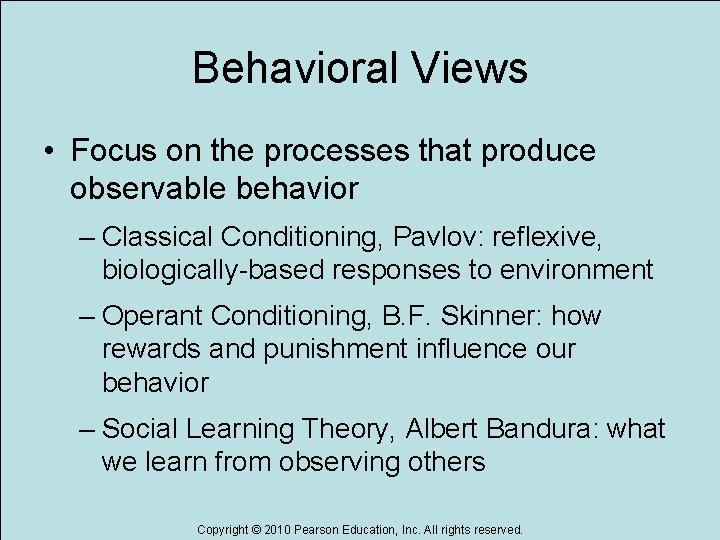
Behavioral Views • Focus on the processes that produce observable behavior – Classical Conditioning, Pavlov: reflexive, biologically-based responses to environment – Operant Conditioning, B. F. Skinner: how rewards and punishment influence our behavior – Social Learning Theory, Albert Bandura: what we learn from observing others Copyright © 2010 Pearson Education, Inc. All rights reserved.
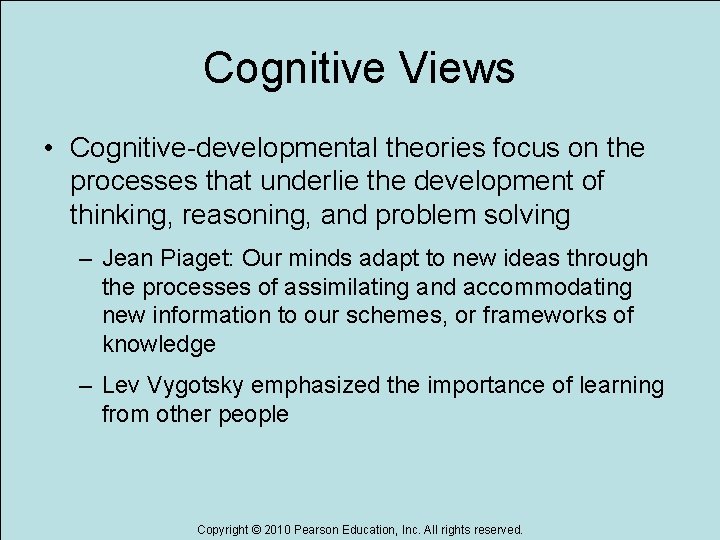
Cognitive Views • Cognitive-developmental theories focus on the processes that underlie the development of thinking, reasoning, and problem solving – Jean Piaget: Our minds adapt to new ideas through the processes of assimilating and accommodating new information to our schemes, or frameworks of knowledge – Lev Vygotsky emphasized the importance of learning from other people Copyright © 2010 Pearson Education, Inc. All rights reserved.
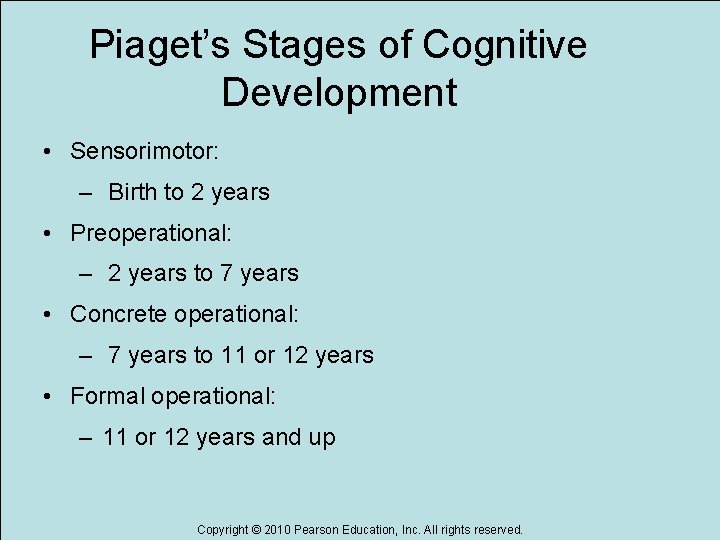
Piaget’s Stages of Cognitive Development • Sensorimotor: – Birth to 2 years • Preoperational: – 2 years to 7 years • Concrete operational: – 7 years to 11 or 12 years • Formal operational: – 11 or 12 years and up Copyright © 2010 Pearson Education, Inc. All rights reserved.
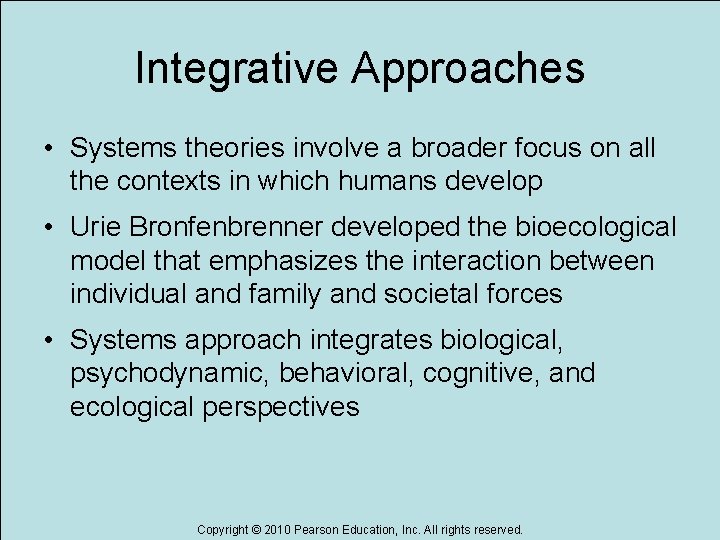
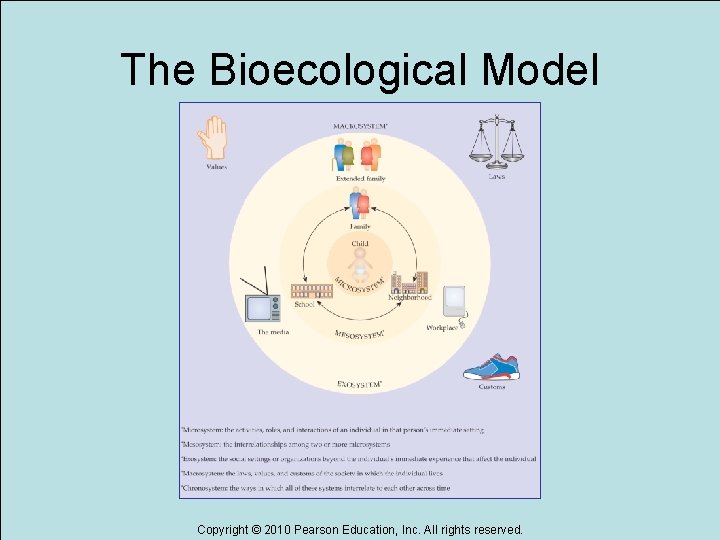
Integrative Approaches • Systems theories involve a broader focus on all the contexts in which humans develop • Urie Bronfenbrenner developed the bioecological model that emphasizes the interaction between individual and family and societal forces • Systems approach integrates biological, psychodynamic, behavioral, cognitive, and ecological perspectives Copyright © 2010 Pearson Education, Inc. All rights reserved.
The Bioecological Model Copyright © 2010 Pearson Education, Inc. All rights reserved.
Video Clip Description of Bronfenbrenner’s bioecological model: http: //www. youtube. com/watch? v=me 7103 o. IE-g Copyright © 2010 Pearson Education, Inc. All rights reserved.
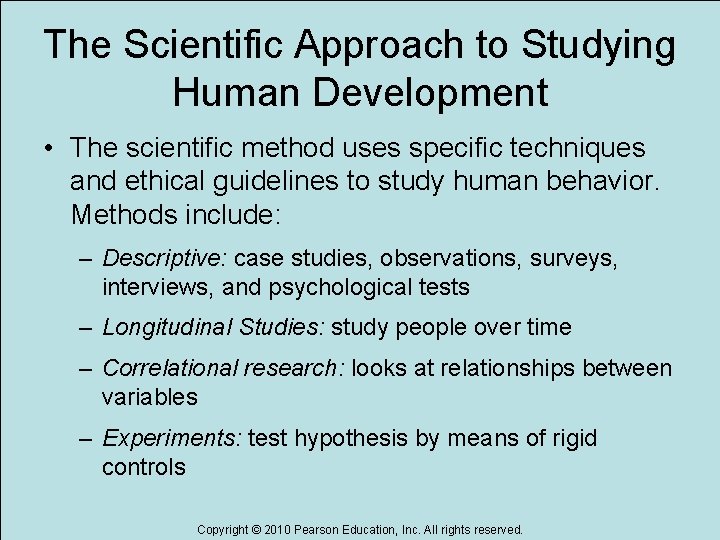
The Scientific Approach to Studying Human Development • The scientific method uses specific techniques and ethical guidelines to study human behavior. Methods include: – Descriptive: case studies, observations, surveys, interviews, and psychological tests – Longitudinal Studies: study people over time – Correlational research: looks at relationships between variables – Experiments: test hypothesis by means of rigid controls Copyright © 2010 Pearson Education, Inc. All rights reserved.
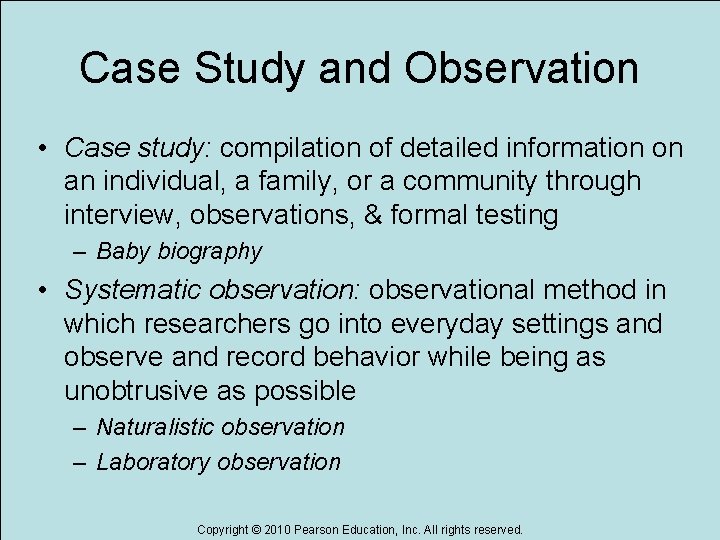
Case Study and Observation • Case study: compilation of detailed information on an individual, a family, or a community through interview, observations, & formal testing – Baby biography • Systematic observation: observational method in which researchers go into everyday settings and observe and record behavior while being as unobtrusive as possible – Naturalistic observation – Laboratory observation Copyright © 2010 Pearson Education, Inc. All rights reserved.
Questionnaires and Surveys • Questionnaire: a paper and pencil method that asks respondents to answer questions about past or present behavior, attitudes, preferences, opinions, feelings, and so forth • Survey: a questionnaire administered to a large group • Interview: a questionnaire that is administered verbally, usually in a one on one setting • Representative sampling: selecting a sample from a larger population so that the sample represents or mirrors the population in every important way Copyright © 2010 Pearson Education, Inc. All rights reserved.
Psychological Tests • Often involve the measurement of intelligence or personality traits • Must be carefully constructed and administered so that accurate results are obtained Copyright © 2010 Pearson Education, Inc. All rights reserved.
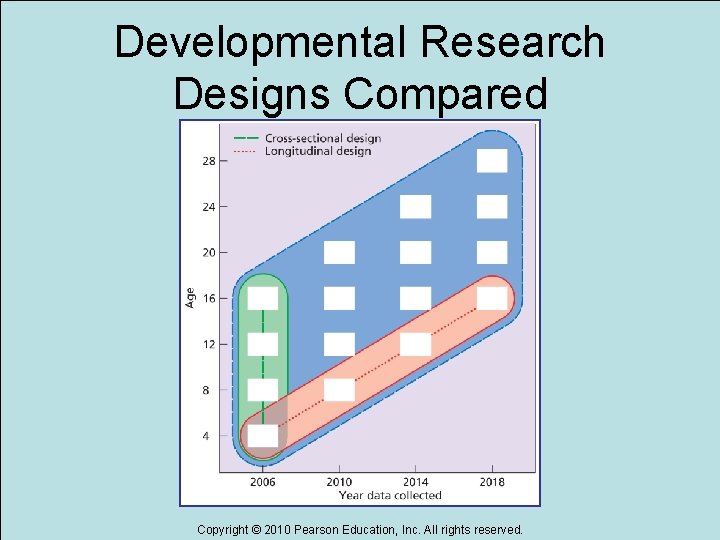
Studying Development Across Time • Longitudinal design – same participants are studied at various points in time to see how they change as they age • Cross-sectional design –compares individuals of different ages at one point in time – Confounding – Cohort effects • Sequential cohort design –several overlapping cohorts of different ages are studied longitudinally Copyright © 2010 Pearson Education, Inc. All rights reserved.
Developmental Research Designs Compared Copyright © 2010 Pearson Education, Inc. All rights reserved.
Correlation • Research technique that describes the relationship between two variables – The correlation coefficient • Correlation tells us nothing about causation Copyright © 2010 Pearson Education, Inc. All rights reserved.
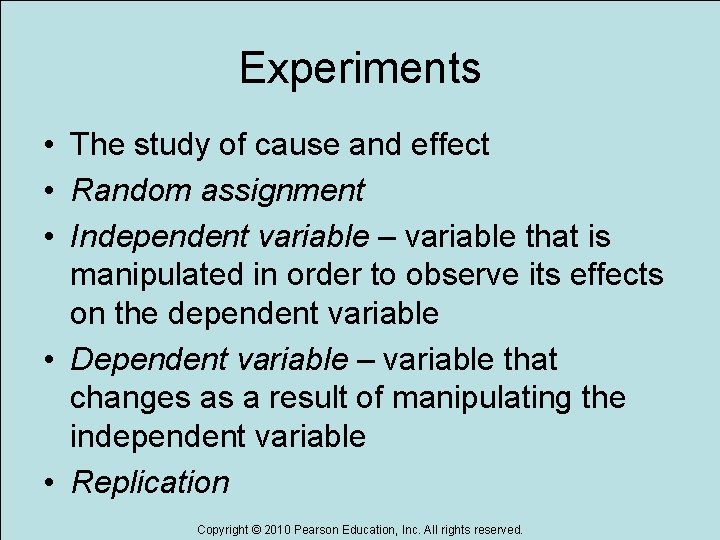
Experiments • The study of cause and effect • Random assignment • Independent variable – variable that is manipulated in order to observe its effects on the dependent variable • Dependent variable – variable that changes as a result of manipulating the independent variable • Replication Copyright © 2010 Pearson Education, Inc. All rights reserved.
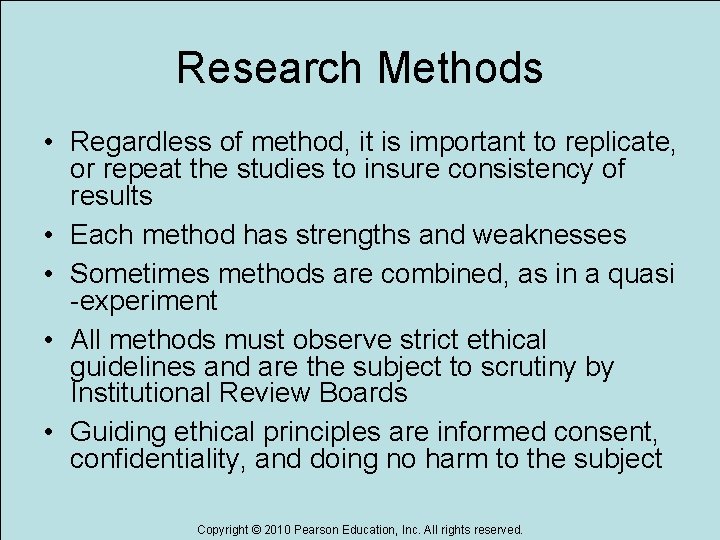
Research Methods • Regardless of method, it is important to replicate, or repeat the studies to insure consistency of results • Each method has strengths and weaknesses • Sometimes methods are combined, as in a quasi -experiment • All methods must observe strict ethical guidelines and are the subject to scrutiny by Institutional Review Boards • Guiding ethical principles are informed consent, confidentiality, and doing no harm to the subject Copyright © 2010 Pearson Education, Inc. All rights reserved.
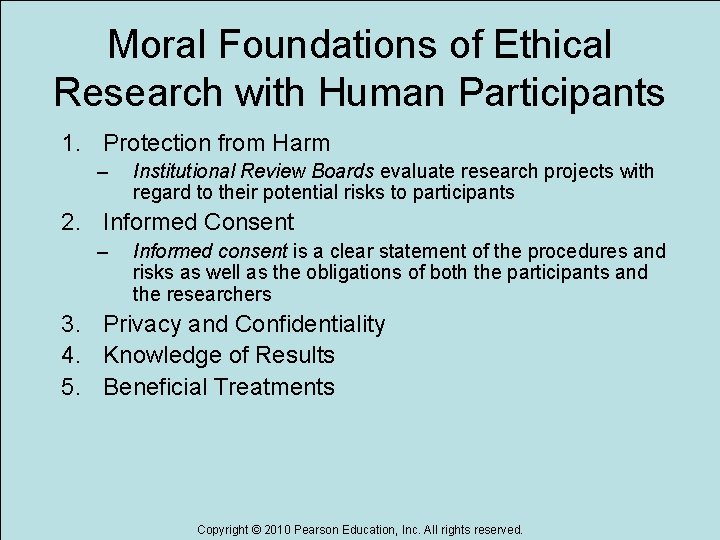
Moral Foundations of Ethical Research with Human Participants 1. Protection from Harm – Institutional Review Boards evaluate research projects with regard to their potential risks to participants 2. Informed Consent – Informed consent is a clear statement of the procedures and risks as well as the obligations of both the participants and the researchers 3. Privacy and Confidentiality 4. Knowledge of Results 5. Beneficial Treatments Copyright © 2010 Pearson Education, Inc. All rights reserved.
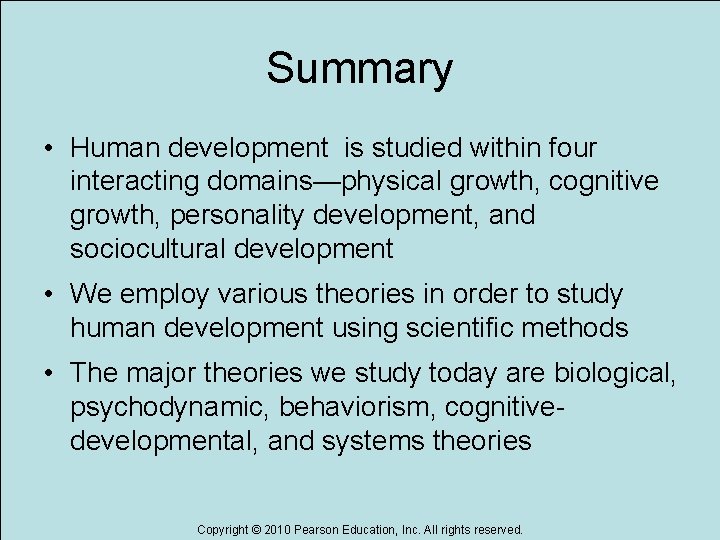
Summary • Human development is studied within four interacting domains—physical growth, cognitive growth, personality development, and sociocultural development • We employ various theories in order to study human development using scientific methods • The major theories we study today are biological, psychodynamic, behaviorism, cognitivedevelopmental, and systems theories Copyright © 2010 Pearson Education, Inc. All rights reserved.
Summary • The rules of science provide specific techniques and ethical guidelines for studying human development • These methods include: – case studies – observations – questionnaires, surveys, and interviews – longitudinal, cross-sectional and sequential-cohort designs – correlation studies – experiments • Ethical guidelines like informed consent, confidentiality and doing no harm to subjects must always be used Copyright © 2010 Pearson Education, Inc. All rights reserved.
Copyright © 2010 Pearson Education, Inc. All rights reserved.