
1 Introduction to Financial Management M Finance 4

- Slides: 38
1 Introduction to Financial Management M: Finance 4 th Edition Cornett, Adair, and Nofsinger © Mc. Graw-Hill Education. All rights reserved. Authorized only for instructor use in the classroom. No reproduction or further distribution permitted without the prior written consent of Mc. Graw-Hill Education.
What is Finance? • Finance applies specific value to • Things owned • Services used • Decisions made • Financial management • Organization’s approach to valuation ©Mc. Graw-Hill Education. 1 -2
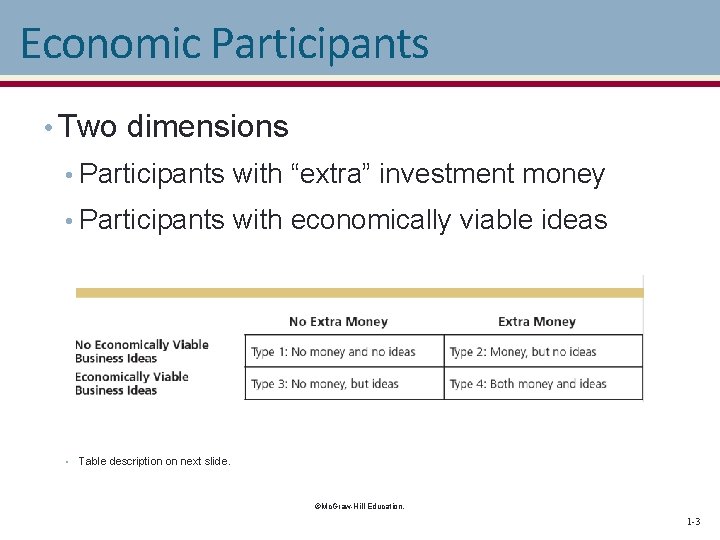
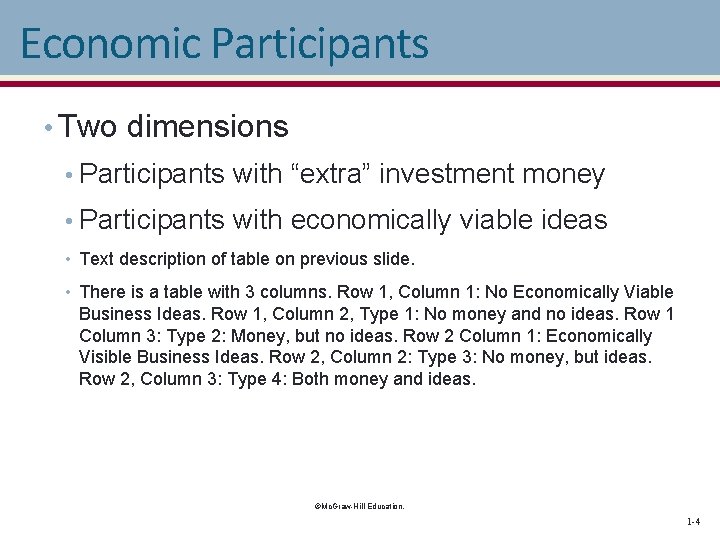
Economic Participants • Two dimensions • Participants with “extra” investment money • Participants with economically viable ideas • Table description on next slide. ©Mc. Graw-Hill Education. 1 -3
Economic Participants • Two dimensions • Participants with “extra” investment money • Participants with economically viable ideas • Text description of table on previous slide. • There is a table with 3 columns. Row 1, Column 1: No Economically Viable Business Ideas. Row 1, Column 2, Type 1: No money and no ideas. Row 1 Column 3: Type 2: Money, but no ideas. Row 2 Column 1: Economically Visible Business Ideas. Row 2, Column 2: Type 3: No money, but ideas. Row 2, Column 3: Type 4: Both money and ideas. ©Mc. Graw-Hill Education. 1 -4
Economic Participants – Type 1 • Type 1 Participants • Do not lend or spend in business context • No direct role in financial markets • Indirect role: to provide labor and consume products ©Mc. Graw-Hill Education. 1 -5
Economic Participants – Type 4 • Type 4 Participants • Use financial tools • Evaluate own businesses • Choose highest-potential ideas • Are self-funded, so no need for financial markets ©Mc. Graw-Hill Education. 1 -6
Economic Participants – Types 2 and 3 • Types 2 and 3 Participants • Use financial institutions and financial markets for mutually beneficial exchange • Type 2: makes temporary loans to Type 3 • Type 3: typically consists of companies engaging in R &D ©Mc. Graw-Hill Education. 1 -7
Where Does the Cash Go? • Economically successful projects repay money (plus profit) to investors • Friction occurs when not all cash is returned to investors • Retained Earnings • Taxes ©Mc. Graw-Hill Education. 1 -8
Subareas of Finance • Investments • Involve methods and techniques for making decisions about what kinds of securities to own • Assess opportunities based on needs vs. risk tolerance ©Mc. Graw-Hill Education. 1 -9
Subareas of Finance (continued) • Financial management • Decisions about acquiring and using cash • Examples include • Organizing and raising capital • Tax decisions • What projects to fund • What kind amount of capital to return to investors ©Mc. Graw-Hill Education. 1 -10
Subareas of Finance (concluded) • Financial institutions and markets • Facilitate flow of capital between investors and companies • International finance • Special risks and opportunities of moving cash flow in a global business environment ©Mc. Graw-Hill Education. 1 -11
Application and Theory • Risk • Uncertainty of future cash flows due to timing and size • Financial Asset • Ownership in cash flow represented by securities like stocks, bonds, and other assets ©Mc. Graw-Hill Education. 1 -12
Application and Theory (continued) • Real Assets • Physical property like gold, machinery, equipment, real estate • Real Markets • Places/processes that facilitate real asset trading • Time Value of Money (TVM) • Theory and application of valuing cash flows at various points in time ©Mc. Graw-Hill Education. 1 -13
Finance vs. Accounting • Tracks what happened to firm’s money in the past • Financial Management • Combines historical figures and current information • Determines what should happen with firm’s money now and in the future ©Mc. Graw-Hill Education. 1 -14
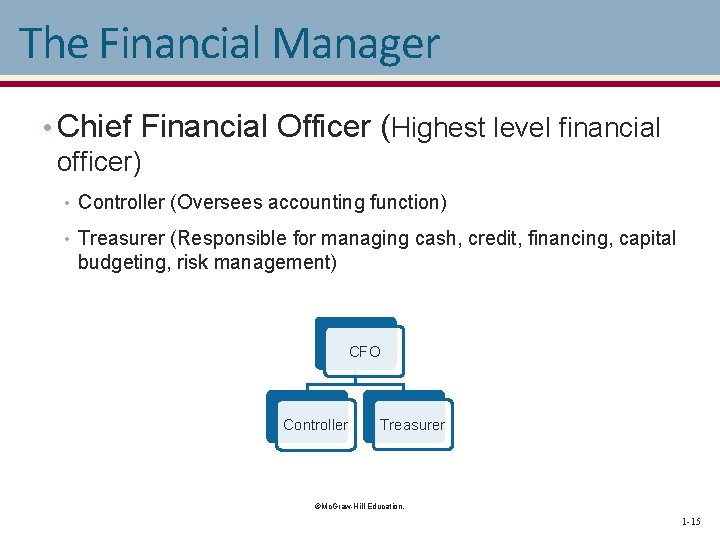
The Financial Manager • Chief Financial Officer (Highest level financial officer) • Controller (Oversees accounting function) • Treasurer (Responsible for managing cash, credit, financing, capital budgeting, risk management) CFO Controller Treasurer ©Mc. Graw-Hill Education. 1 -15
Finance in Other Business Functions • CFO and Treasurer • Most visible finance-related positions • Finance permeates the organization • Used to develop and manage strategy • Used in day-to-day business operations • Operations • Marketing • Human Resources ©Mc. Graw-Hill Education. 1 -16
Finance in Your Personal Life • Help you make good personal financial decisions • Borrowing money for a new car • Refinancing home mortgage at lower rate • Making credit card or student loan payments • Saving for retirement ©Mc. Graw-Hill Education. 1 -17
Business Organization • Single owners, partners, and corporations operate businesses • Advantages and disadvantages related to • Controls and ownership of firm • Owners’ risks • Access to capital and tax ramifications ©Mc. Graw-Hill Education. 1 -18
Organizational Forms of Business • Sole Proprietorships • General Partnerships • Corporations • Hybrids ©Mc. Graw-Hill Education. 1 -19
Sole Proprietorships • Not legally separate from the owner • Advantages • Easy to start • Light regulatory and paperwork burden • Single taxation at the personal tax rate • Disadvantages • Unlimited liability • Limited access to capital ©Mc. Graw-Hill Education. 1 -20
General Partnerships • Partners own the business together • Advantage • Relatively easy to start • Single taxation • Disadvantages • Partners jointly share unlimited liability • Personally liable for legal actions and debts of firm (Mutual Agency) • Difficult to raise large amounts of capital ©Mc. Graw-Hill Education. 1 -21
Public Corporations • Legally independent entity entirely separate from its owners • Advantages • Limited liability for owners • Can raise large amounts of capital • Easy to transfer ownership • Disadvantages • Double taxation (corporate level and personal level) ©Mc. Graw-Hill Education. 1 -22
Hybrid Organizations • Combine attributes of several forms • Advantages • Offer single taxation and limited liability to all owners • S Corporations • Limited Liability Partnerships (LLPs) • Limited Liability Companies (LLCs) ©Mc. Graw-Hill Education. 1 -23
Firm Goals • Owner seeks to maximize shareholder wealth and company’s value through • Maximizing present value of future cash flows • Maximizing owners’ equity • Decisions about • Attracting additional funds • Projects in which to invest • Returning profits to owners over time ©Mc. Graw-Hill Education. 1 -24
Corporate Goals • Maximize value of owners’ equity • Increase current value per share (stock price) of existing shares • Common methods • Maximize net income or profit • Minimize costs • Maximize market share ©Mc. Graw-Hill Education. 1 -25
Agency Problem • Problems arise when principal (shareholder) hires agent (manager) to operate firm but cannot monitor the agent’s actions • Manager’s interest may not be aligned with shareholder goals ©Mc. Graw-Hill Education. 1 -26
Agency Problem (continued) • Three approaches to minimizing this conflict of interest • Ignore if effect is minimal • Use accountants, debt holders to monitor managers • Provide incentives to managers • Equity stakes • Stock options • Employee Stock Option Plan (ESOP) ©Mc. Graw-Hill Education. 1 -27
Corporate Governance Defined • Set of laws, policies, incentives, and monitors designed to handle issues arising from the separation of ownership and control ©Mc. Graw-Hill Education. 1 -28
Corporate Governance – Inside • Inside monitors • Board of Directors • Hires the CEO • Evaluates management • Designs compensation plans ©Mc. Graw-Hill Education. 1 -29
Corporate Governance – Outside • Outside monitors • Auditors • Analysts • Banks • Credit rating agencies ©Mc. Graw-Hill Education. 1 -30
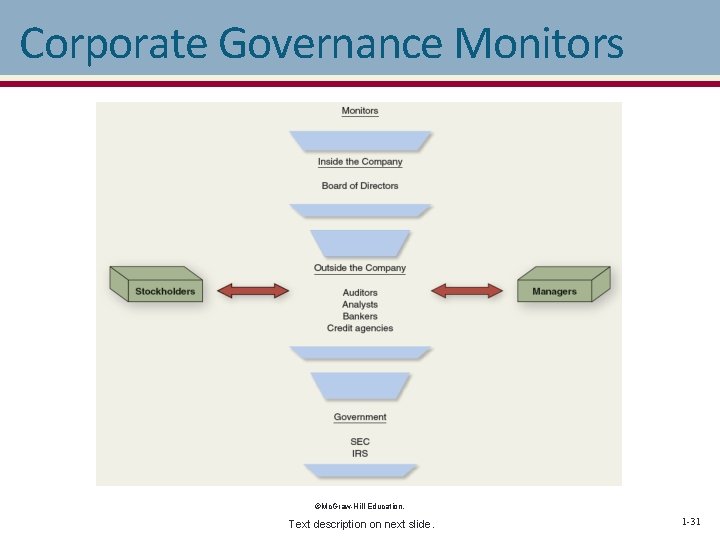
Corporate Governance Monitors ©Mc. Graw-Hill Education. Text description on next slide. 1 -31
Corporate Governance Monitors Text description of previous slide… • Monitors • Inside the Company • Board of Directors • Outside the company • Stockholders • Managers • Auditors, Analysts, Bankers, Credit Agencies • Government • SEC • IRS ©Mc. Graw-Hill Education. 1 -32
Ethics • Financial professionals manage other people’s money • Corporate managers • Bankers • Investment advisors • Ethical dilemmas of corporate agency relationship • Stealing from firms = stealing from shareholders ©Mc. Graw-Hill Education. 1 -33
Financial Markets and Intermediaries • Financial markets and financial intermediaries • Facilitate flow of capital from investors to firms and back to investors • Earn very high profits because of specialized expertise and assets ©Mc. Graw-Hill Education. 1 -34
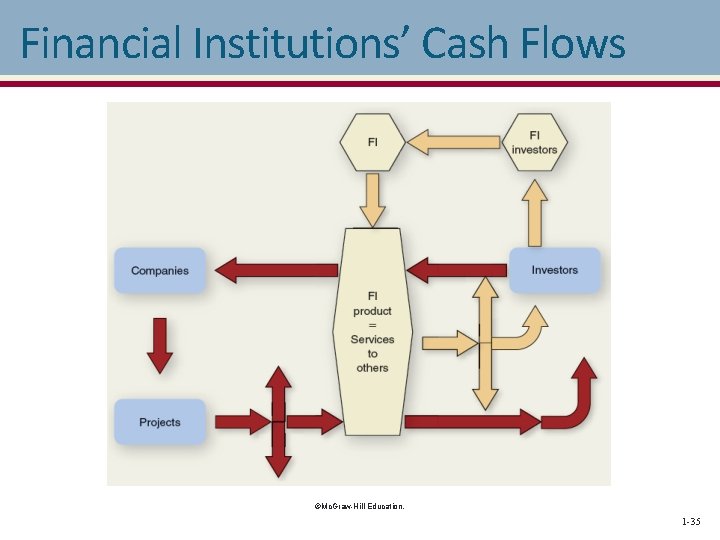
Financial Institutions’ Cash Flows ©Mc. Graw-Hill Education. 1 -35
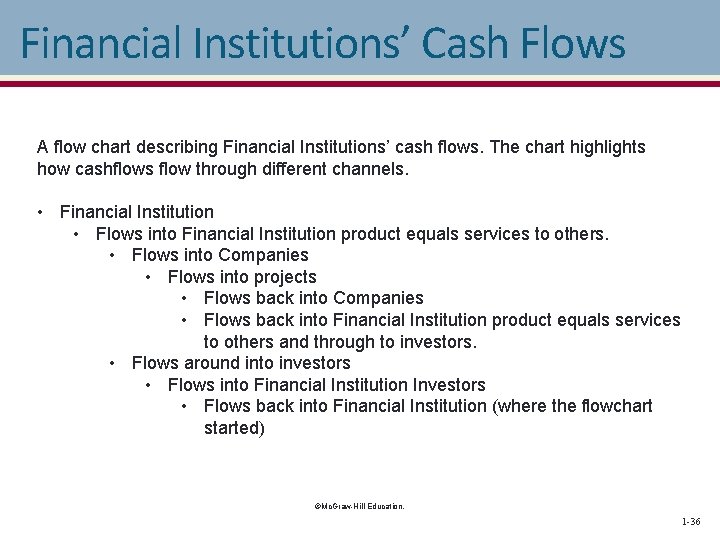
Financial Institutions’ Cash Flows A flow chart describing Financial Institutions’ cash flows. The chart highlights how cashflows flow through different channels. • Financial Institution • Flows into Financial Institution product equals services to others. • Flows into Companies • Flows into projects • Flows back into Companies • Flows back into Financial Institution product equals services to others and through to investors. • Flows around into investors • Flows into Financial Institution Investors • Flows back into Financial Institution (where the flowchart started) ©Mc. Graw-Hill Education. 1 -36
The Financial Crisis • Subprime Mortgage Borrowers • Higher-risk borrowers charged higher interest rates due to higher risk of default • Securitization • Loan originators sell the loan repayment rights to other financial institutions or investors ©Mc. Graw-Hill Education. 1 -37
The Financial Crisis (continued) • Sparked by collapse of U. S. home prices in late 2006 and 2007 • Spread to other financial institutions via affected mortgage-backed securities • Resulted in credit tightening by financial institutions; loss of confidence by consumers ©Mc. Graw-Hill Education. 1 -38