
1 Introduction How to program computers to learn
- Slides: 9
1. Introduction • How to program computers to learn? Learning: Improving automatically with experience • Example: Computers learning from medical records which treatments are most effective for new diseases • Added value: Better understanding of human learning abilities 1 er. Escuela Red Pro. TIC - Tandil, 18 -28 de Abril, 2006
1. Introduction 1. 1 Well-Posed Learning Problems – Definition: A computer program is said to learn from experience E with respect to some class of tasks T and performance measure P, if its performance at tasks in T, as measured by P, improves with experience E 1 er. Escuela Red Pro. TIC - Tandil, 18 -28 de Abril, 2006
1. Introduction • Example – Task T: Playing checkers – Training Experience E: Playing games against itself – Performance Measure P: Percentage of games won against opponents 1 er. Escuela Red Pro. TIC - Tandil, 18 -28 de Abril, 2006
1. Introduction 1. 2 Designing a Learning System – Choosing the training experience: • Direct (teacher) • Indirect (credit assignment) • Distribution of examples 1 er. Escuela Red Pro. TIC - Tandil, 18 -28 de Abril, 2006
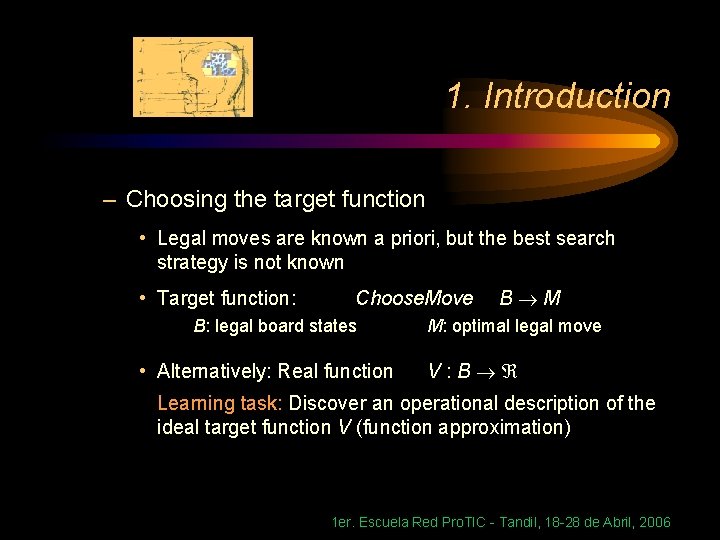
1. Introduction – Choosing the target function • Legal moves are known a priori, but the best search strategy is not known • Target function: Choose. Move B: legal board states • Alternatively: Real function B M M: optimal legal move V: B Learning task: Discover an operational description of the ideal target function V (function approximation) 1 er. Escuela Red Pro. TIC - Tandil, 18 -28 de Abril, 2006
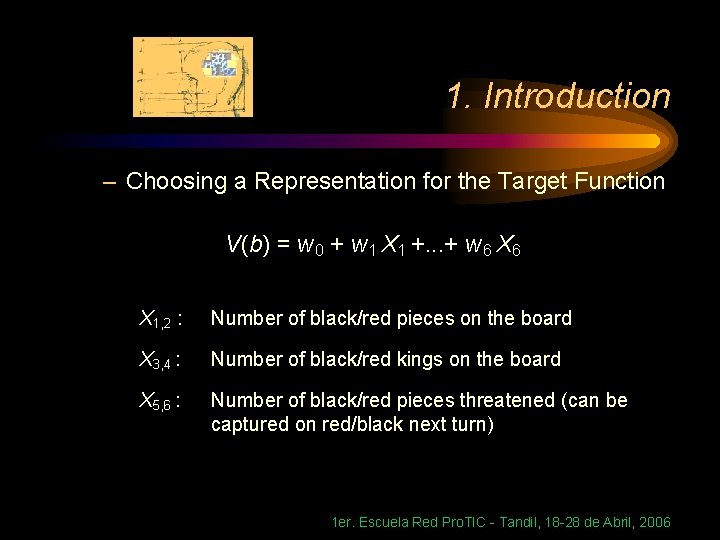
1. Introduction – Choosing a Representation for the Target Function V(b) = w 0 + w 1 X 1 +. . . + w 6 X 1, 2 : Number of black/red pieces on the board X 3, 4 : Number of black/red kings on the board X 5, 6 : Number of black/red pieces threatened (can be captured on red/black next turn) 1 er. Escuela Red Pro. TIC - Tandil, 18 -28 de Abril, 2006
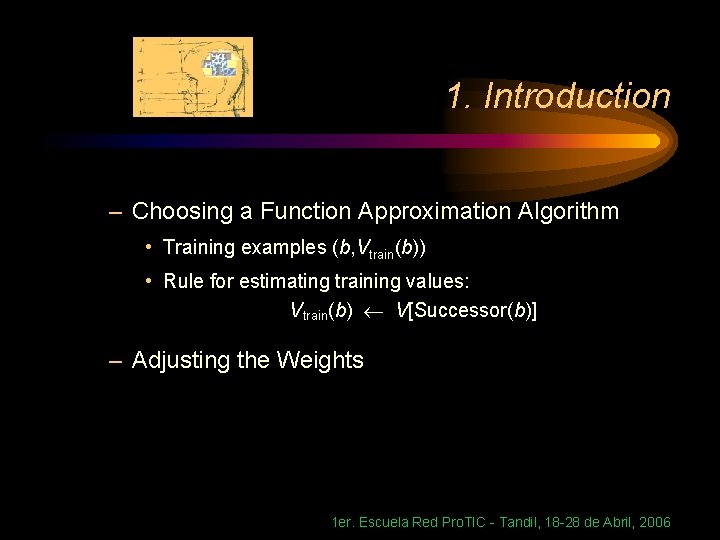
1. Introduction – Choosing a Function Approximation Algorithm • Training examples (b, Vtrain(b)) • Rule for estimating training values: Vtrain(b) V[Successor(b)] – Adjusting the Weights 1 er. Escuela Red Pro. TIC - Tandil, 18 -28 de Abril, 2006
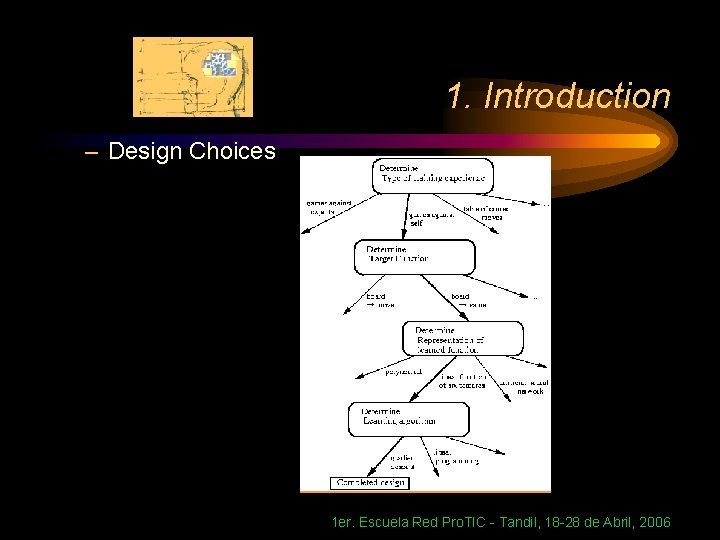
1. Introduction – Design Choices 1 er. Escuela Red Pro. TIC - Tandil, 18 -28 de Abril, 2006
1. Introduction 1. 3 Some Issues in Machine Learning – What algorithms can approximate functions well (and when)? – How does number of training examples influence accuracy? – How does complexity of hypothesis representation impact it? – How does noisy data influence accuracy? – What clues can we get from biological learning systems? 1 er. Escuela Red Pro. TIC - Tandil, 18 -28 de Abril, 2006