
1 Introduction 1 1 The Role of Operating

- Slides: 6
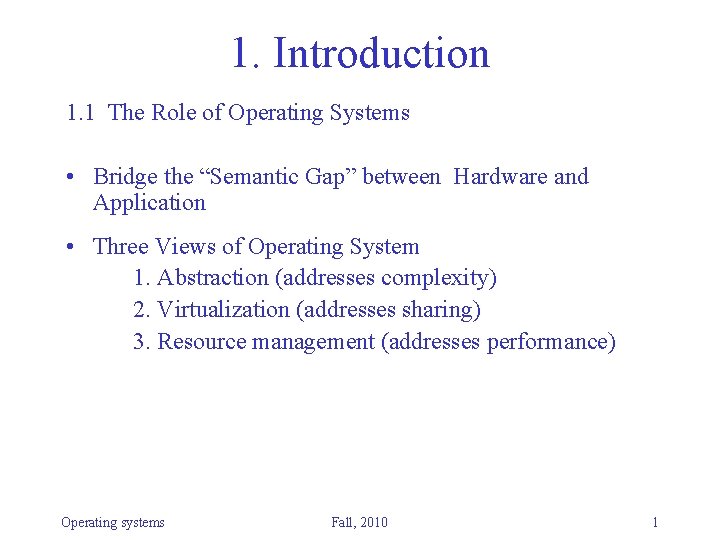
1. Introduction 1. 1 The Role of Operating Systems • Bridge the “Semantic Gap” between Hardware and Application • Three Views of Operating System 1. Abstraction (addresses complexity) 2. Virtualization (addresses sharing) 3. Resource management (addresses performance) Operating systems Fall, 2010 1
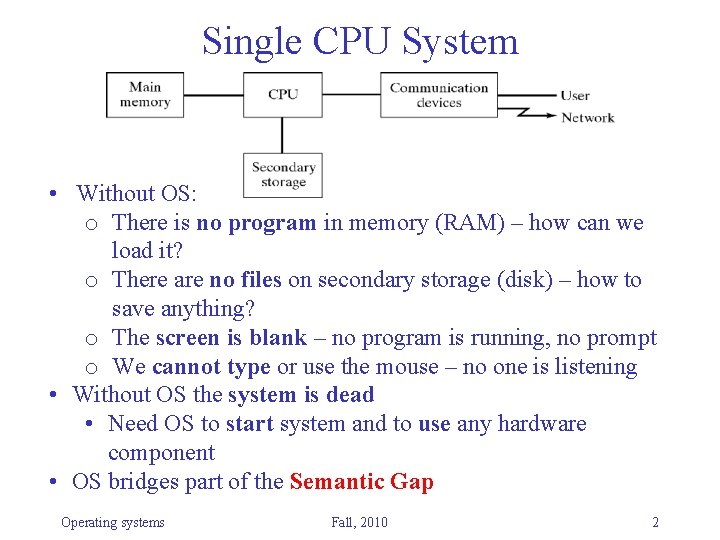
Single CPU System • Without OS: o There is no program in memory (RAM) – how can we load it? o There are no files on secondary storage (disk) – how to save anything? o The screen is blank – no program is running, no prompt o We cannot type or use the mouse – no one is listening • Without OS the system is dead • Need OS to start system and to use any hardware component • OS bridges part of the Semantic Gap Operating systems Fall, 2010 2
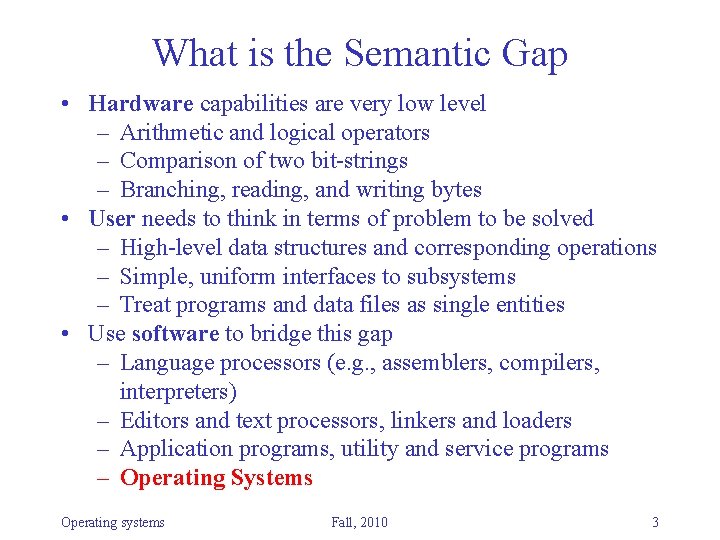
What is the Semantic Gap • Hardware capabilities are very low level – Arithmetic and logical operators – Comparison of two bit-strings – Branching, reading, and writing bytes • User needs to think in terms of problem to be solved – High-level data structures and corresponding operations – Simple, uniform interfaces to subsystems – Treat programs and data files as single entities • Use software to bridge this gap – Language processors (e. g. , assemblers, compilers, interpreters) – Editors and text processors, linkers and loaders – Application programs, utility and service programs – Operating Systems Operating systems Fall, 2010 3
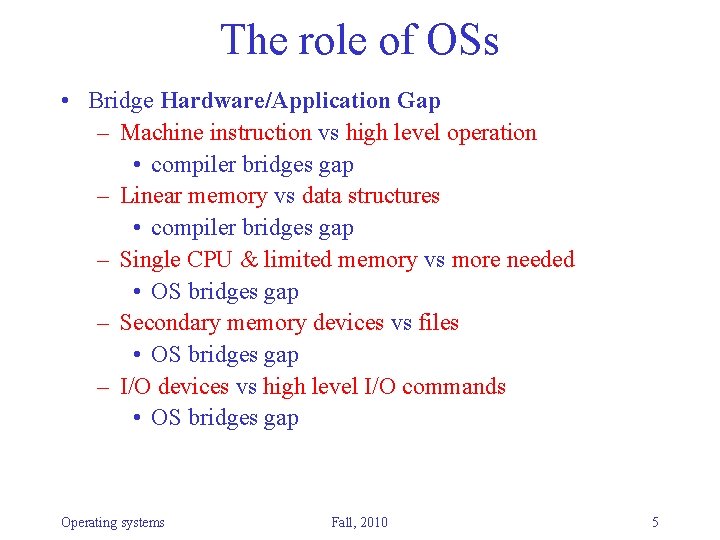
The role of OSs • Bridge Hardware/Application Gap – Machine instruction vs high level operation • compiler bridges gap – Linear memory vs data structures • compiler bridges gap – Single CPU & limited memory vs more needed • OS bridges gap – Secondary memory devices vs files • OS bridges gap – I/O devices vs high level I/O commands • OS bridges gap Operating systems Fall, 2010 5
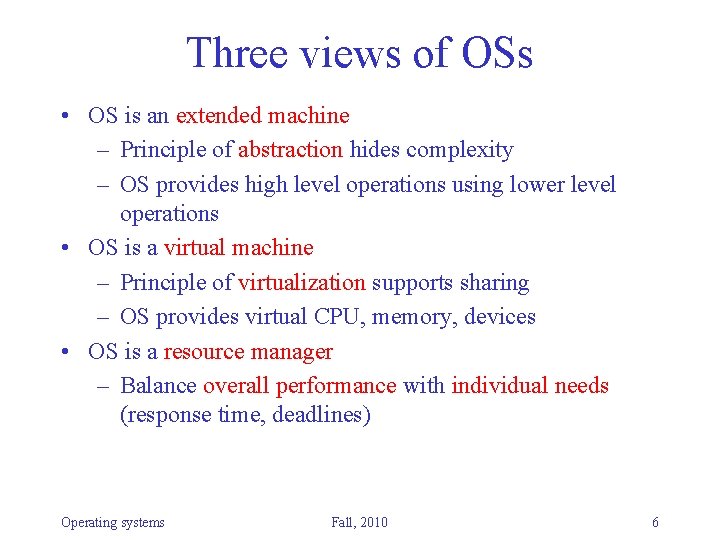
Three views of OSs • OS is an extended machine – Principle of abstraction hides complexity – OS provides high level operations using lower level operations • OS is a virtual machine – Principle of virtualization supports sharing – OS provides virtual CPU, memory, devices • OS is a resource manager – Balance overall performance with individual needs (response time, deadlines) Operating systems Fall, 2010 6
Some observations • In this course we study principles of OS – no specific system • Why? – Systems change, principle are permanent – E. g. : virtual memory, file organization, … • Course is problem-oriented: – Concrete problems with precise solutions – No memorization, only how-to knowledge and why Operating systems Fall, 2010 7