
1 Introduction 1 1 The Role of Operating
- Slides: 22
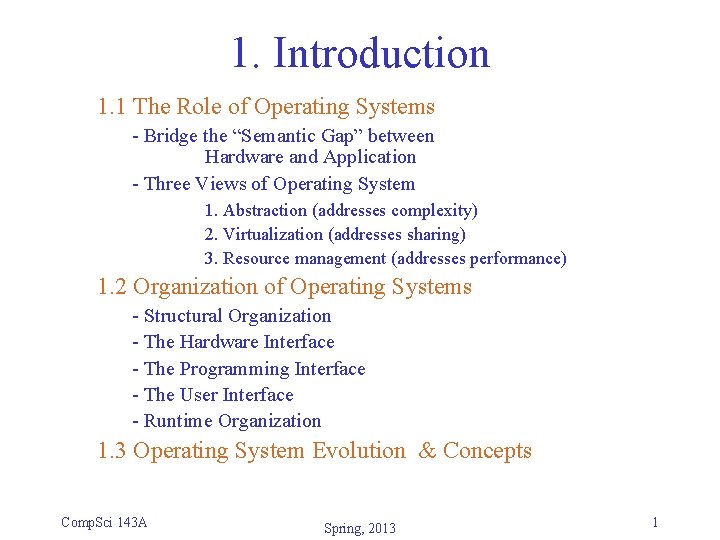
1. Introduction 1. 1 The Role of Operating Systems - Bridge the “Semantic Gap” between Hardware and Application - Three Views of Operating System 1. Abstraction (addresses complexity) 2. Virtualization (addresses sharing) 3. Resource management (addresses performance) 1. 2 Organization of Operating Systems - Structural Organization - The Hardware Interface - The Programming Interface - The User Interface - Runtime Organization 1. 3 Operating System Evolution & Concepts Comp. Sci 143 A Spring, 2013 1
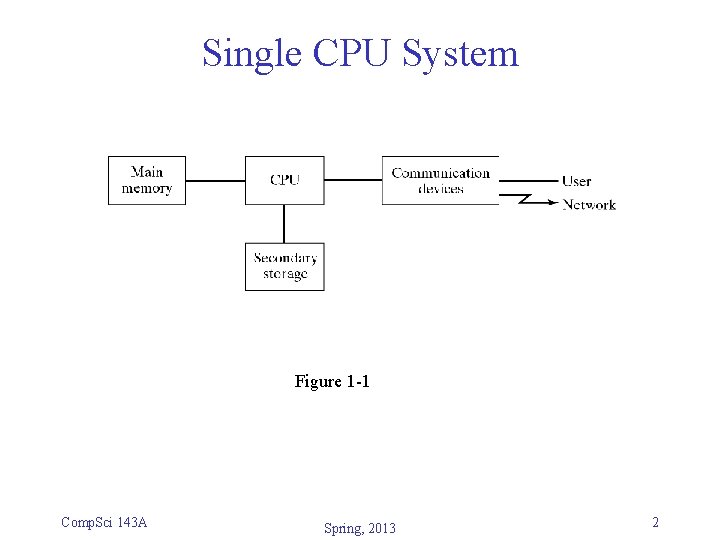
Single CPU System Figure 1 -1 Comp. Sci 143 A Spring, 2013 2
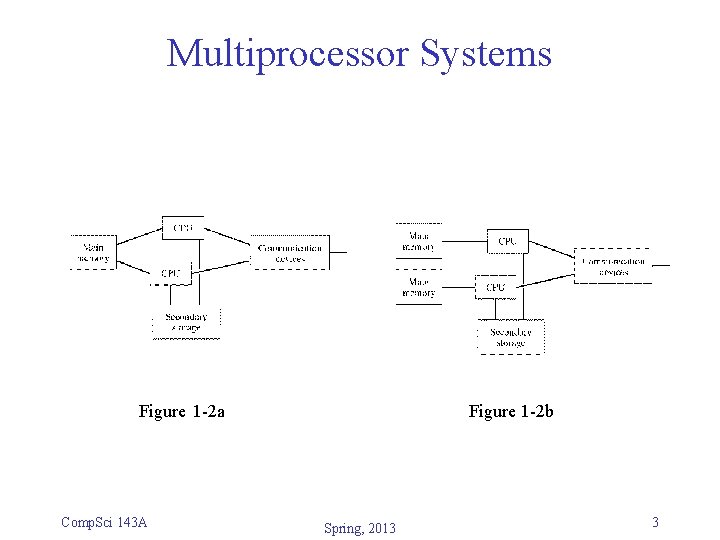
Multiprocessor Systems Figure 1 -2 b Figure 1 -2 a Comp. Sci 143 A Spring, 2013 3
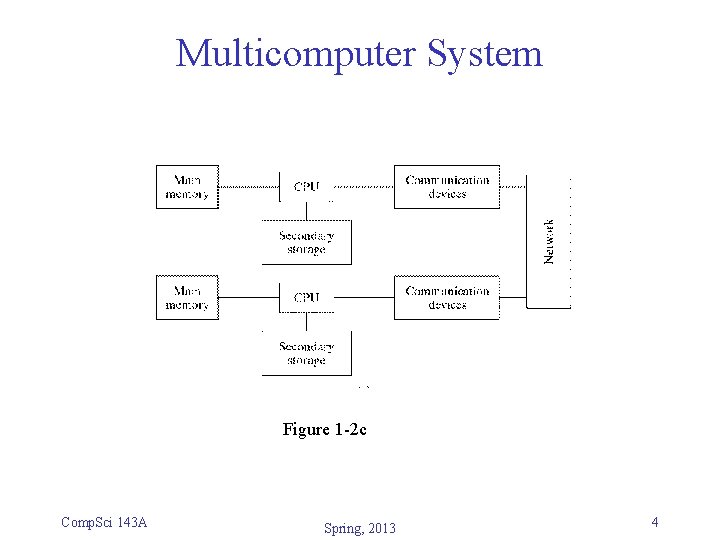
Multicomputer System Figure 1 -2 c Comp. Sci 143 A Spring, 2013 4
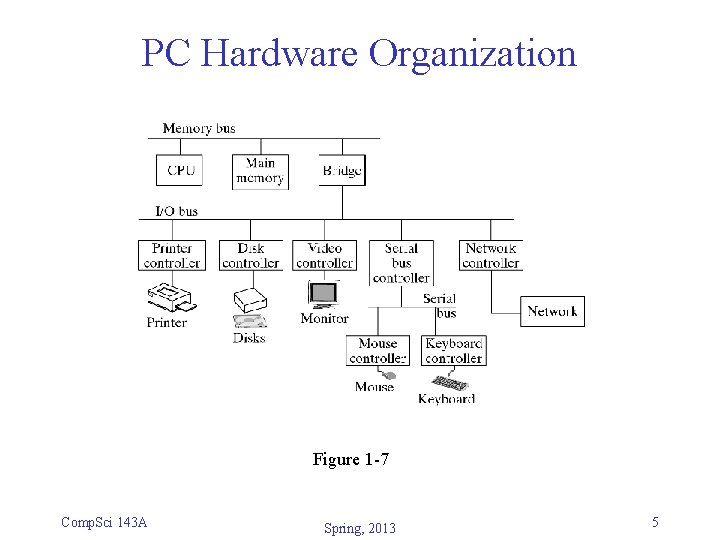
PC Hardware Organization Figure 1 -7 Comp. Sci 143 A Spring, 2013 5
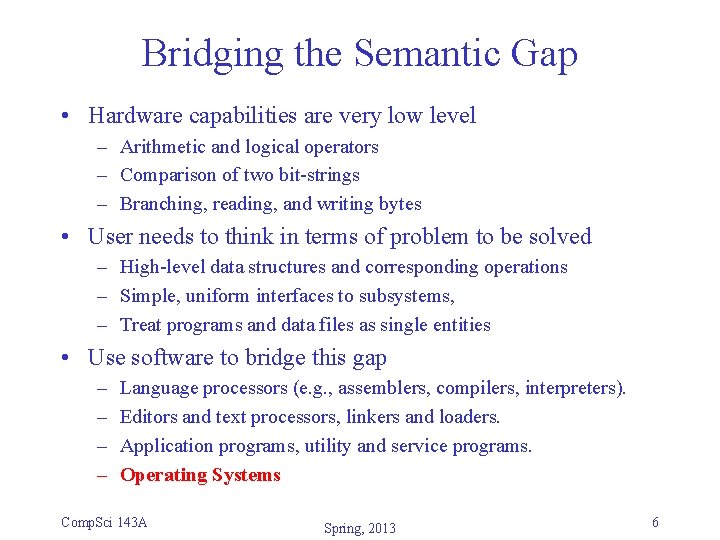
Bridging the Semantic Gap • Hardware capabilities are very low level – Arithmetic and logical operators – Comparison of two bit-strings – Branching, reading, and writing bytes • User needs to think in terms of problem to be solved – High-level data structures and corresponding operations – Simple, uniform interfaces to subsystems, – Treat programs and data files as single entities • Use software to bridge this gap – – Language processors (e. g. , assemblers, compilers, interpreters). Editors and text processors, linkers and loaders. Application programs, utility and service programs. Operating Systems Comp. Sci 143 A Spring, 2013 6
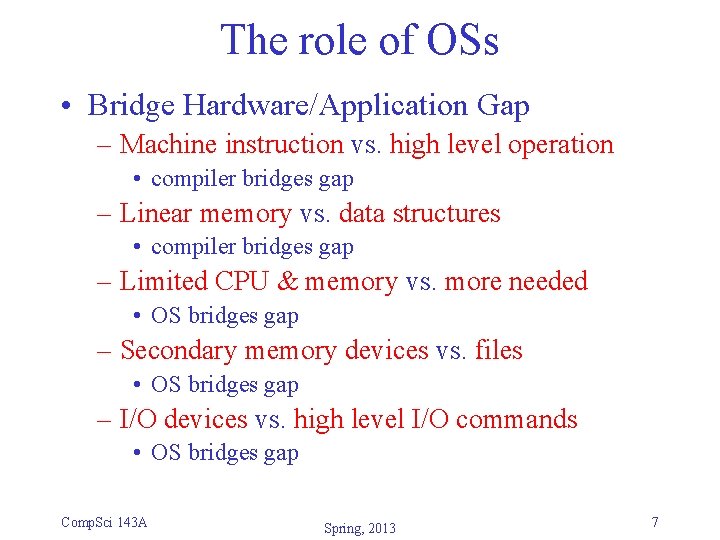
The role of OSs • Bridge Hardware/Application Gap – Machine instruction vs. high level operation • compiler bridges gap – Linear memory vs. data structures • compiler bridges gap – Limited CPU & memory vs. more needed • OS bridges gap – Secondary memory devices vs. files • OS bridges gap – I/O devices vs. high level I/O commands • OS bridges gap Comp. Sci 143 A Spring, 2013 7
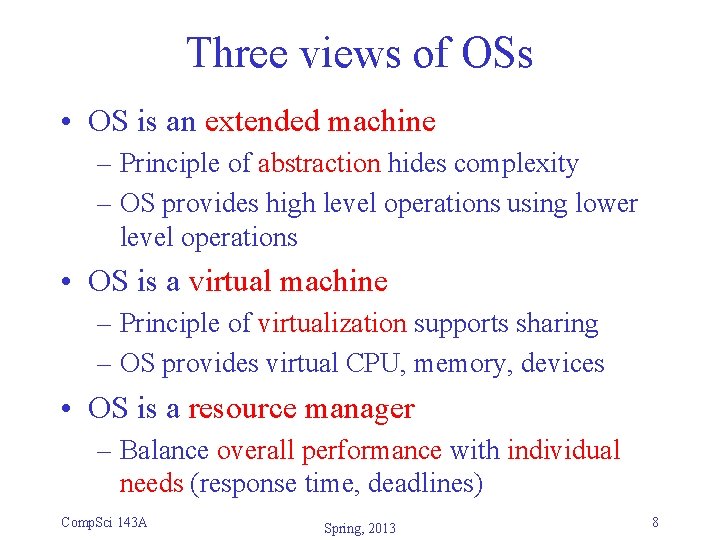
Three views of OSs • OS is an extended machine – Principle of abstraction hides complexity – OS provides high level operations using lower level operations • OS is a virtual machine – Principle of virtualization supports sharing – OS provides virtual CPU, memory, devices • OS is a resource manager – Balance overall performance with individual needs (response time, deadlines) Comp. Sci 143 A Spring, 2013 8
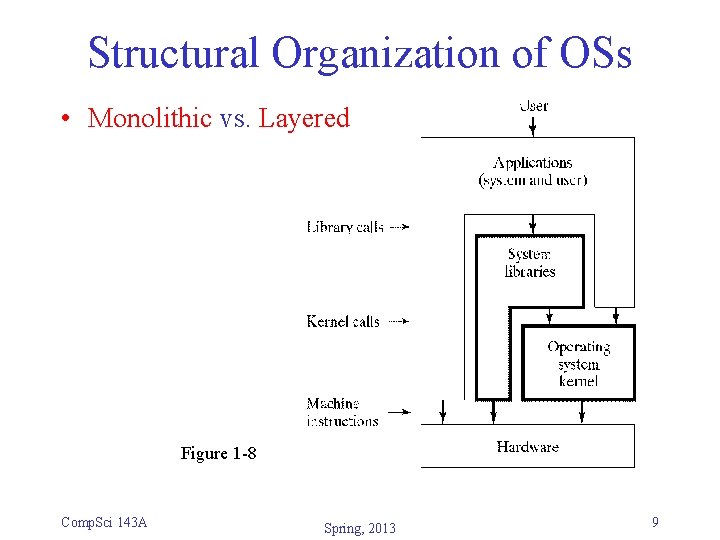
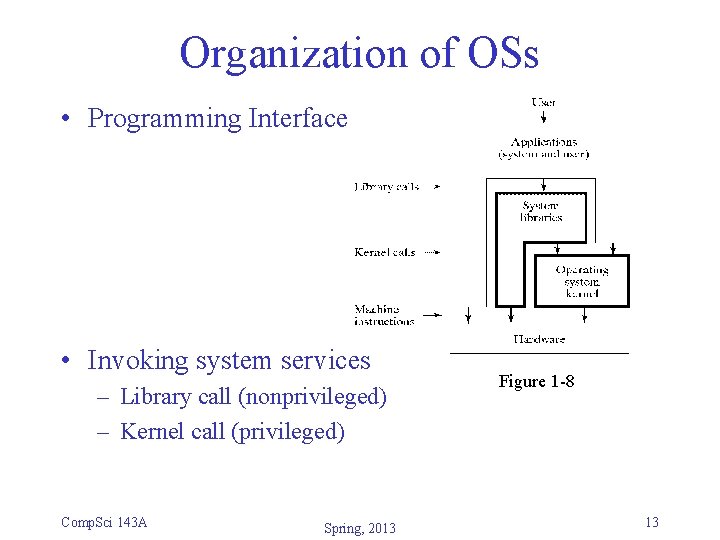
Structural Organization of OSs • Monolithic vs. Layered Figure 1 -8 Comp. Sci 143 A Spring, 2013 9
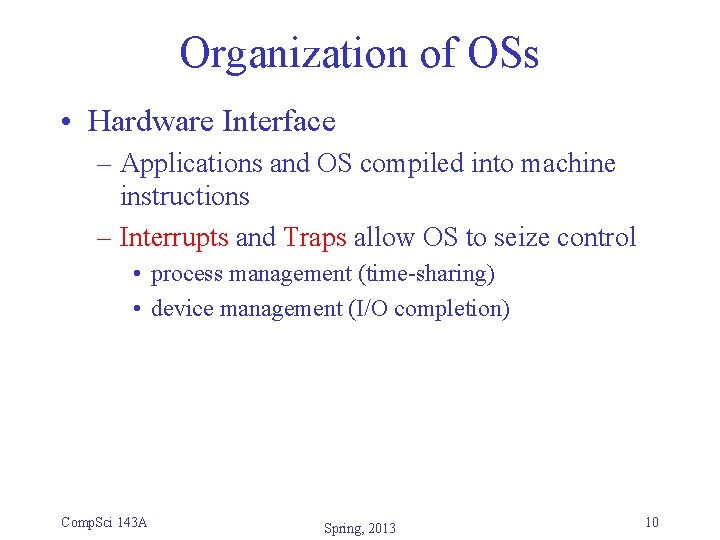
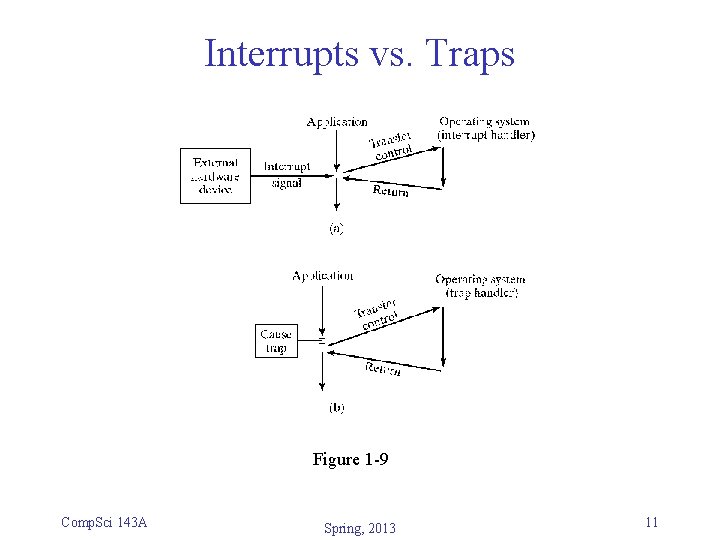
Organization of OSs • Hardware Interface – Applications and OS compiled into machine instructions – Interrupts and Traps allow OS to seize control • process management (time-sharing) • device management (I/O completion) Comp. Sci 143 A Spring, 2013 10
Interrupts vs. Traps Figure 1 -9 Comp. Sci 143 A Spring, 2013 11
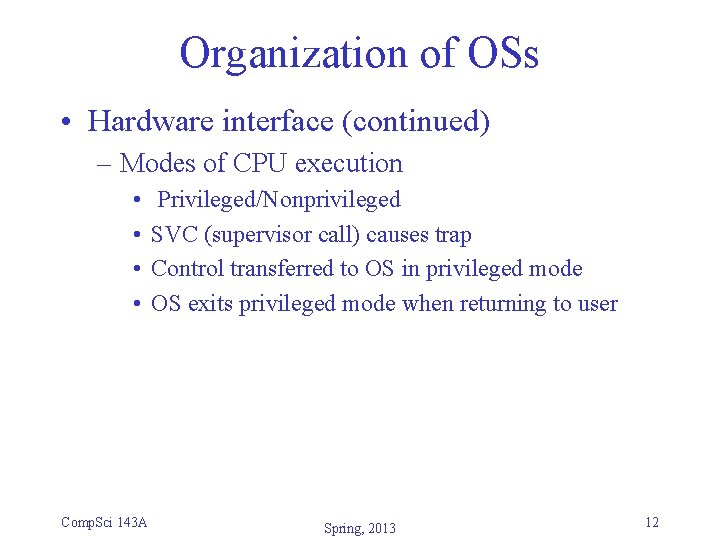
Organization of OSs • Hardware interface (continued) – Modes of CPU execution • • Comp. Sci 143 A Privileged/Nonprivileged SVC (supervisor call) causes trap Control transferred to OS in privileged mode OS exits privileged mode when returning to user Spring, 2013 12
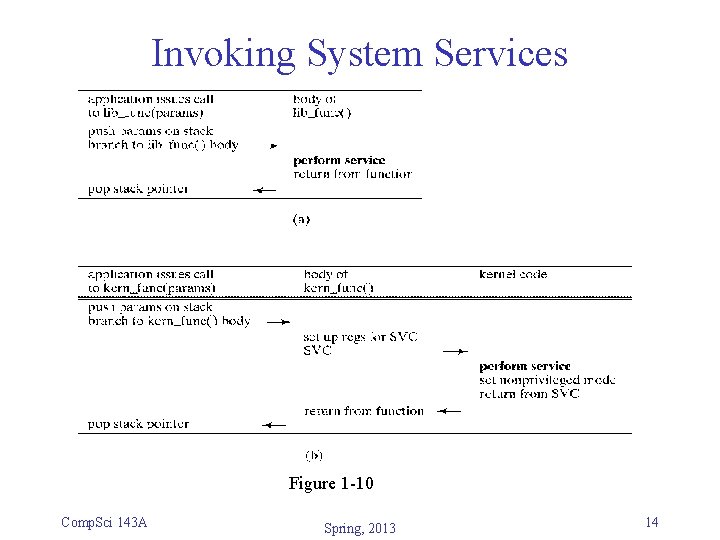
Organization of OSs • Programming Interface • Invoking system services – Library call (nonprivileged) – Kernel call (privileged) Comp. Sci 143 A Spring, 2013 Figure 1 -8 13
Invoking System Services Figure 1 -10 Comp. Sci 143 A Spring, 2013 14
Organization of OSs • User interface (cf. Fig. 1 -8) – Text-based shell (e. g. Unix) • command interpreter • shell scripts – Graphics-based GUI (e. g. Mac, MS Windows) • Windows • Icons • Menus • Pointer Comp. Sci 143 A Spring, 2013 15
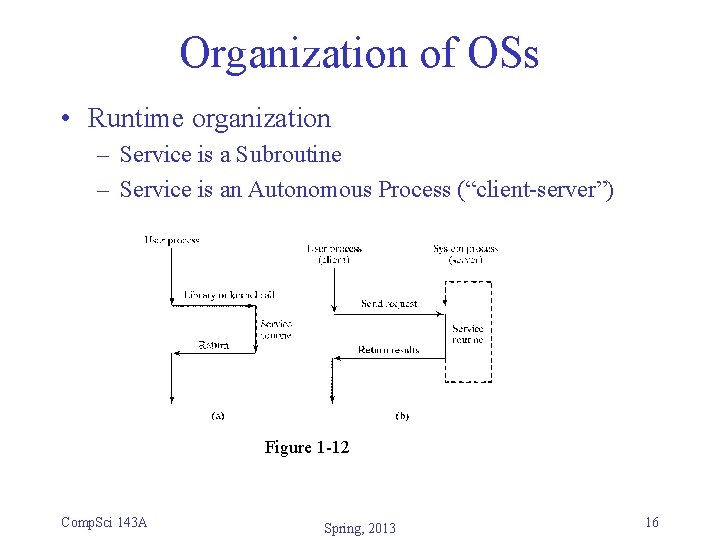
Organization of OSs • Runtime organization – Service is a Subroutine – Service is an Autonomous Process (“client-server”) Figure 1 -12 Comp. Sci 143 A Spring, 2013 16
OS Evolution and Concepts • Early systems – Bootstrapping • Batch OSs – I/O processors – Interrupts – Relocatable code (Allows separately compile programs to be combined without recompilation) • Multiprogramming Comp. Sci 143 A Spring, 2013 17
Multiprogramming • Basic problem: – Some programs are compute-bound, some I/O-bound – Even “balanced” programs are balance only over time – No one program can make full use of the system • Solution: Multiprogramming – Have more than one active (running) program in memory at any one time • Multiprogramming requires – Bridging the semantic gap – Sharing resources among different programs – Hiding from each program the fact of this sharing Comp. Sci 143 A Spring, 2013 18
OS Evolution and Concepts • Multiprogramming Systems – Overlap CPU and I/O – Protection – Synchronization and Communication – Dynamic Memory Management (swapping and paging) • Interactive OSs – Guaranteed response time – Time-sharing (quantum) Comp. Sci 143 A Spring, 2013 19
OS Evolution and Concepts • PC and workstation OSs – GUI • Real-time OSs – Deadlines (scheduling) • Distributed OSs – Loosely coupled/tightly coupled – Consistent timeline (logical clocks, time stamps) Comp. Sci 143 A Spring, 2013 20
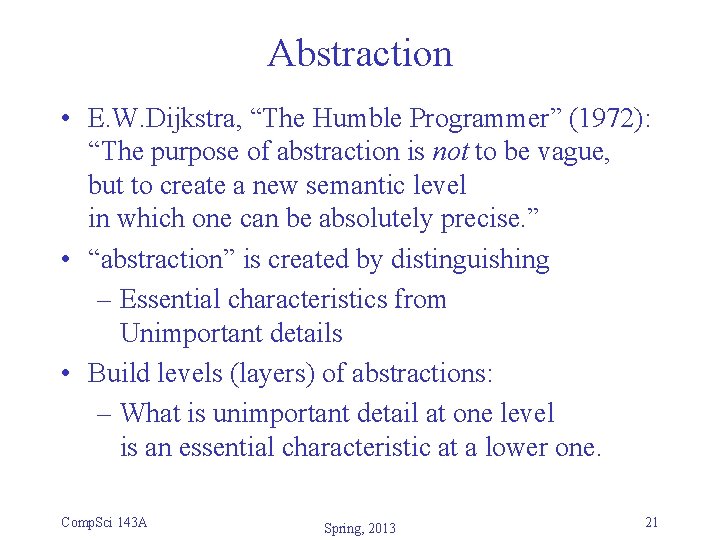
Abstraction • E. W. Dijkstra, “The Humble Programmer” (1972): “The purpose of abstraction is not to be vague, but to create a new semantic level in which one can be absolutely precise. ” • “abstraction” is created by distinguishing – Essential characteristics from Unimportant details • Build levels (layers) of abstractions: – What is unimportant detail at one level is an essential characteristic at a lower one. Comp. Sci 143 A Spring, 2013 21
History • Originally developed by Steve Franklin • Modified by Michael Dillencourt, Spring, 2009 • Modified by Michael Dillencourt, Summer 2012 Comp. Sci 143 A Spring, 2013 22