
1 IBL Experiments in the Math Circle at
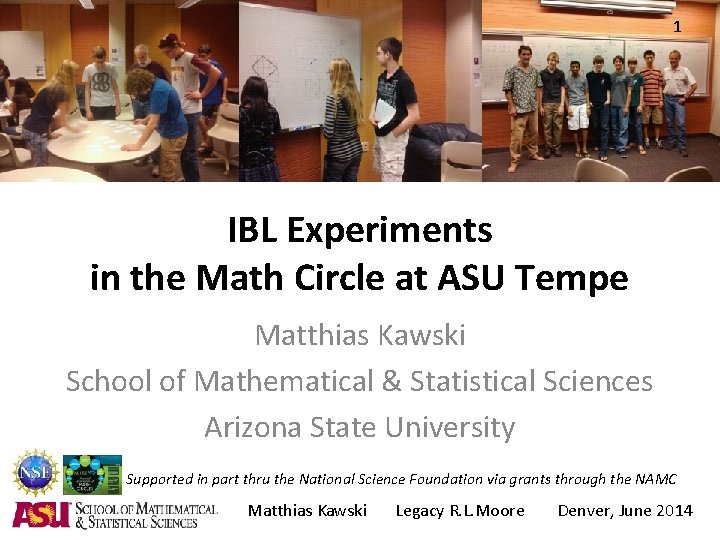
1 IBL Experiments in the Math Circle at ASU Tempe Matthias Kawski School of Mathematical & Statistical Sciences Arizona State University Supported in part thru the National Science Foundation via grants through the NAMC Matthias Kawski Legacy R. L. Moore Denver, June 2014
Outline • Brief personal introduction • Math Circles • history and heritage: Bulgaria, Russia • national umbrella: NAMC http: //www. mathcircles. org/ • Math Circle at ASU Tempe http: //math. la. asu. edu/~mathcircle • local demographics and our choices, our objectives • sample sessions & topics • Parting thoughts Matthias Kawski Legacy R. L. Moore Denver, June 2014
Personal background • • Differential geometric control theory (1986) 26 years at ASU, over 30 different courses taught calculus reform, CAS and dynamic visualization integrated curricula in engineering (1992 -2002) just-in-time, problem solving, inquiry, mini-lecture • travel worldwide as much to teaching/learning workshops & conferences as for control theory Matthias Kawski Legacy R. L. Moore Denver, June 2014
Teaching/learning: subscribe to • “intellectual need” (Guershon Harel) • “never prove a theorem that the students did not ask you to prove. ” (Jerry Uhl) [mine demand proof of Stokes ! ] • MAT 300: “Chapter Zero” (Carol Schumacher) • 9 th. Annual Legacy of R. L. Moore Conference (2006): “And where do the definitions and theorems come from? ” • but: experiment, observe, conjecture, make definitions are integral to math that all students must experience (adv calc stud’s: invent “compactness” natural definition!) • mathematics is a social enterprise: practice teamwork! • trying “modified Moore” in topology, complex, algebra Matthias Kawski Legacy R. L. Moore Denver, June 2014

Math Circles • 100 years plus in Bulgaria • Russia, Kolmogorov school • after-school tradition: ballet, swim, piano, soccer what about “math club” ? • math for fun - not for grades, no credit, no prizes • in US, first on coasts, since late 80 s, immigrants • recently: NMAC, MSRI, NSF, “circle on the road” Matthias Kawski Legacy R. L. Moore Denver, June 2014
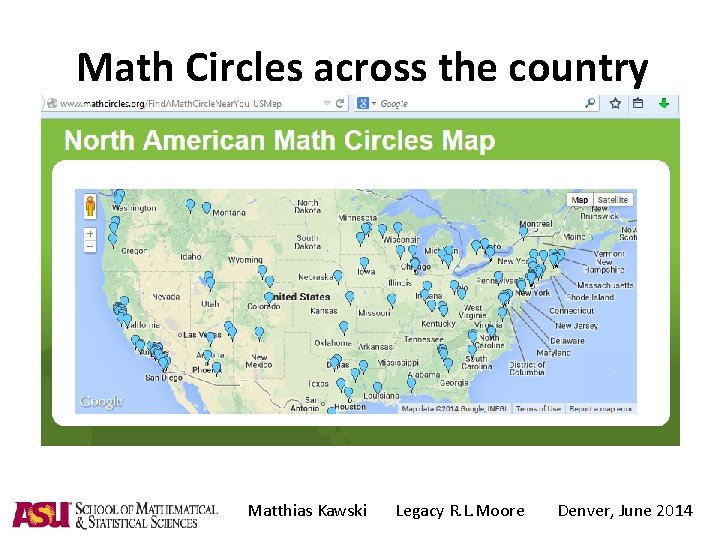
Math Circles across the country Matthias Kawski Legacy R. L. Moore Denver, June 2014
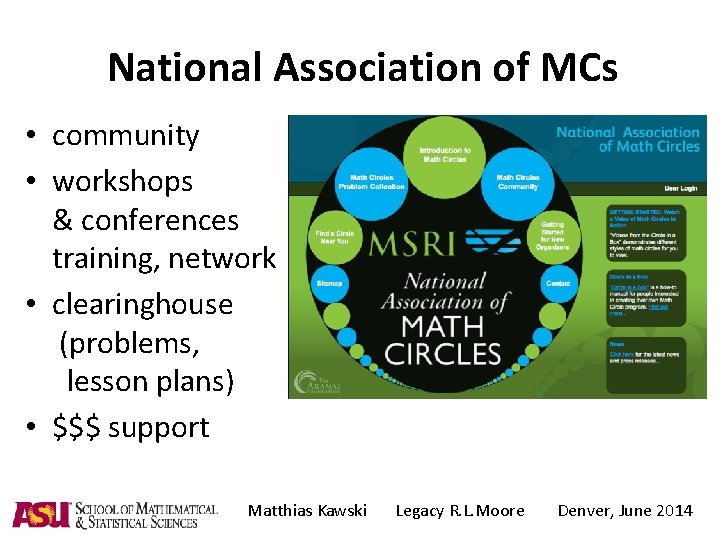
National Association of MCs • community • workshops & conferences training, network • clearinghouse (problems, lesson plans) • $$$ support Matthias Kawski Legacy R. L. Moore Denver, June 2014
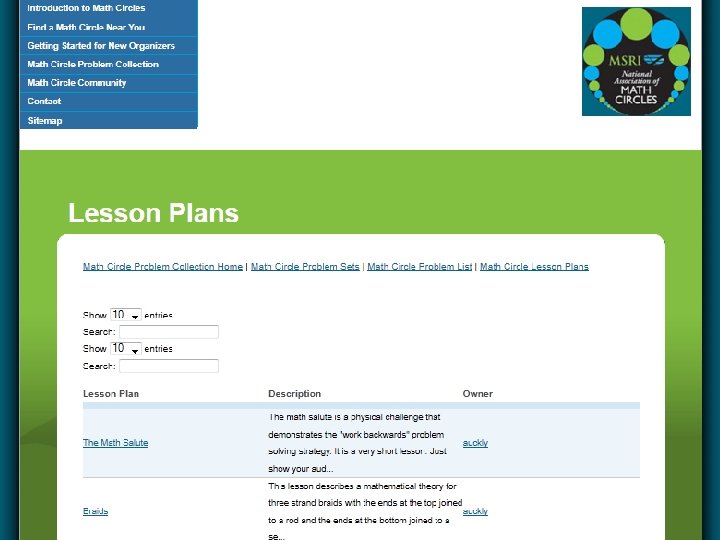
Matthias Kawski Legacy R. L. Moore Denver, June 2014
Math Circle at ASU Tempe • ASU: only R university in 4 M+ population metro area (expect about 50 future math Ph. Ds now in PHX HSs ) • need: many Math. Circles w/diverse themes, ages, goals • ours to make best use of unique resource: ASU R-fac (stud’s who cannot be served by others in community) • here: advanced topics for highly motivated students (e. g. Navajo. Circles different level, same engagement) Matthias Kawski Legacy R. L. Moore Denver, June 2014
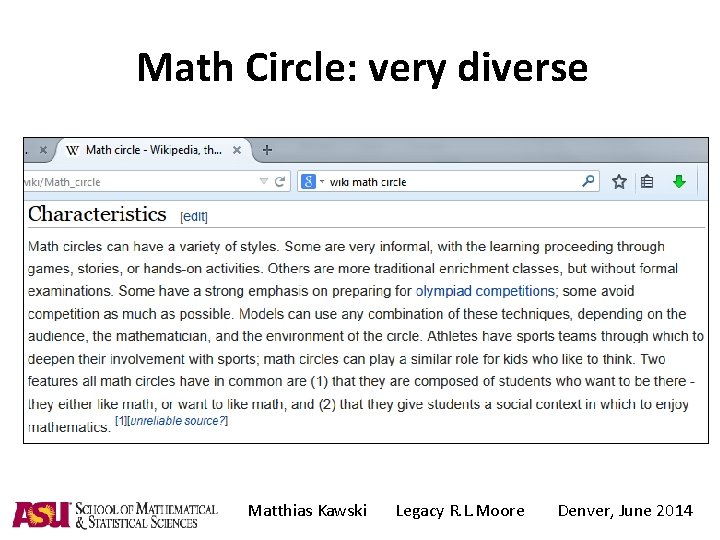
Math Circle: very diverse Matthias Kawski Legacy R. L. Moore Denver, June 2014
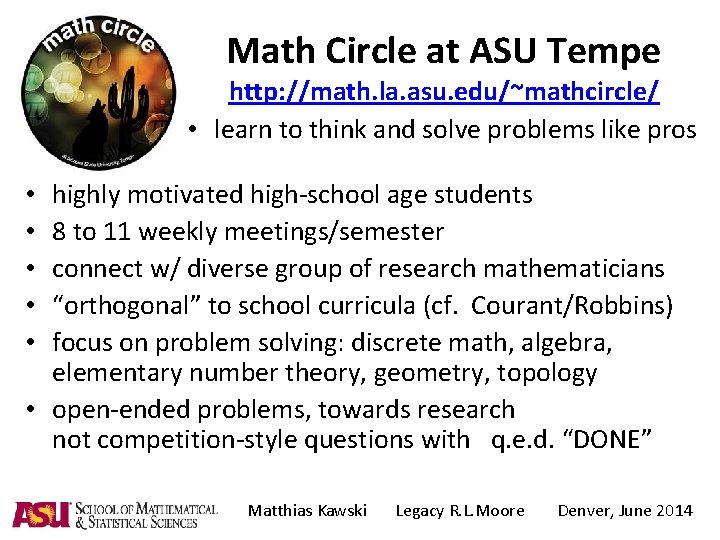
Math Circle at ASU Tempe http: //math. la. asu. edu/~mathcircle/ • learn to think and solve problems like pros highly motivated high-school age students 8 to 11 weekly meetings/semester connect w/ diverse group of research mathematicians “orthogonal” to school curricula (cf. Courant/Robbins) focus on problem solving: discrete math, algebra, elementary number theory, geometry, topology • open-ended problems, towards research not competition-style questions with q. e. d. “DONE” • • • Matthias Kawski Legacy R. L. Moore Denver, June 2014
Faculty and student roles: IBL ? • committed to bringing in diverse session leaders diverse math, sometimes outside “speakers”, but • but generally students do most of the work, and often suggest new direction of inquiry. asking new question is as valued as answering! • still themes/topics are initiated by faculty, who provide guidance which questions are likely worth pursuing, which are dead-ends Matthias Kawski Legacy R. L. Moore Denver, June 2014
Some criteria for topic selection • genuine math, engaging, accessible • open-ended, students ask new questions • preferably: opening to long lines of inquiry, ideally connected to current / recent active R • “orthogonal” to school curricula • a little “recreational math” or “historical math” • frequently: adapt NAMC resources to IBL format Matthias Kawski Legacy R. L. Moore Denver, June 2014
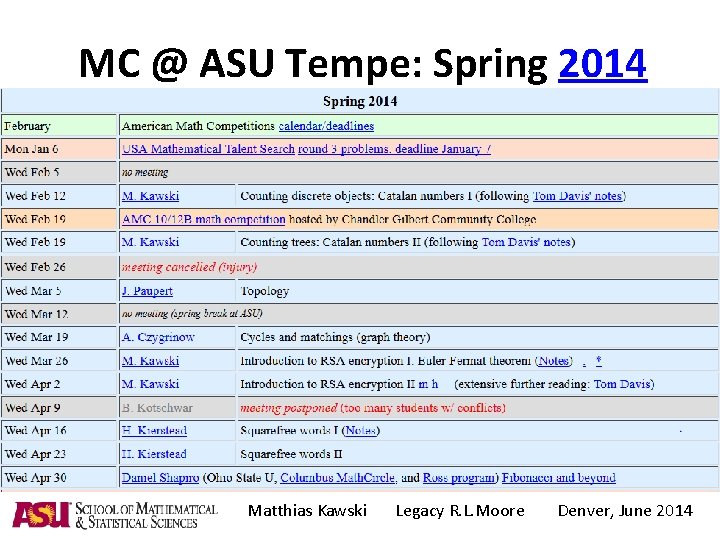
MC @ ASU Tempe: Spring 2014 Matthias Kawski Legacy R. L. Moore Denver, June 2014
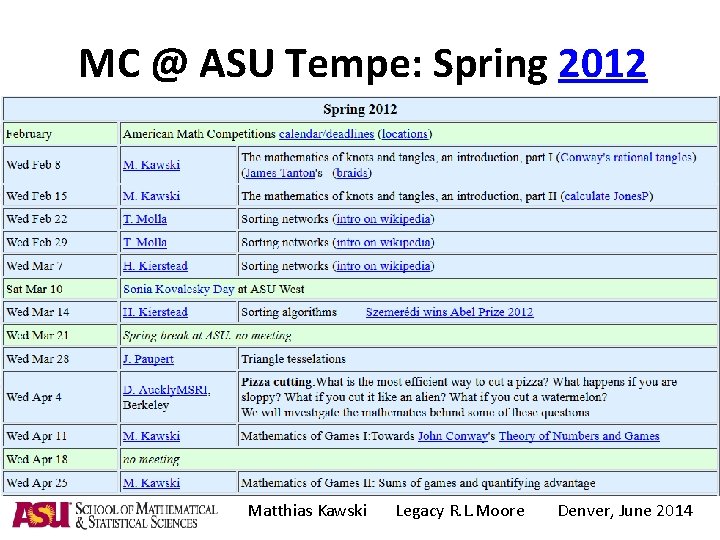
MC @ ASU Tempe: Spring 2012 Matthias Kawski Legacy R. L. Moore Denver, June 2014
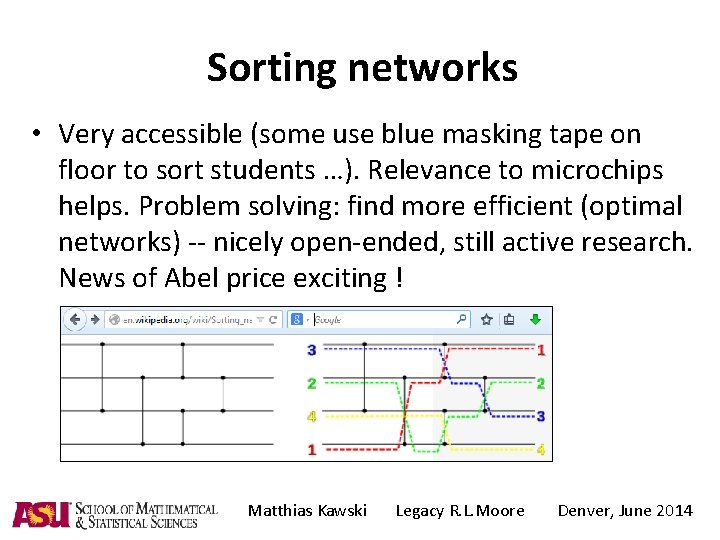
Sorting networks • Very accessible (some use blue masking tape on floor to sort students …). Relevance to microchips helps. Problem solving: find more efficient (optimal networks) -- nicely open-ended, still active research. News of Abel price exciting ! Matthias Kawski Legacy R. L. Moore Denver, June 2014
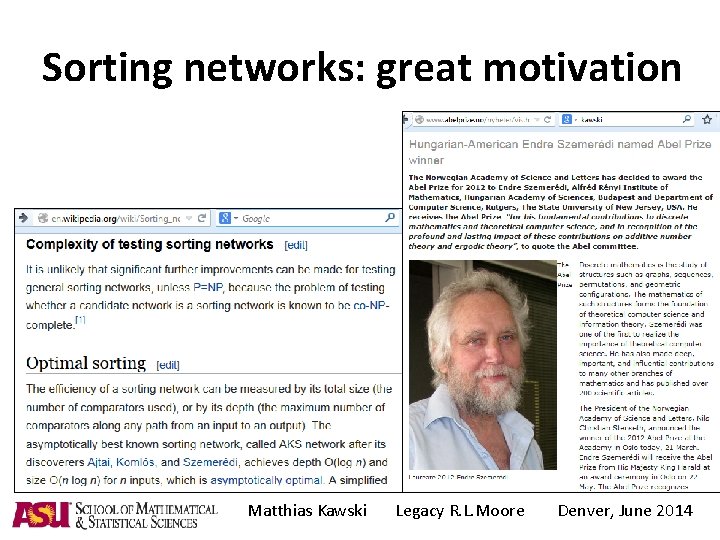
Sorting networks: great motivation Matthias Kawski Legacy R. L. Moore Denver, June 2014
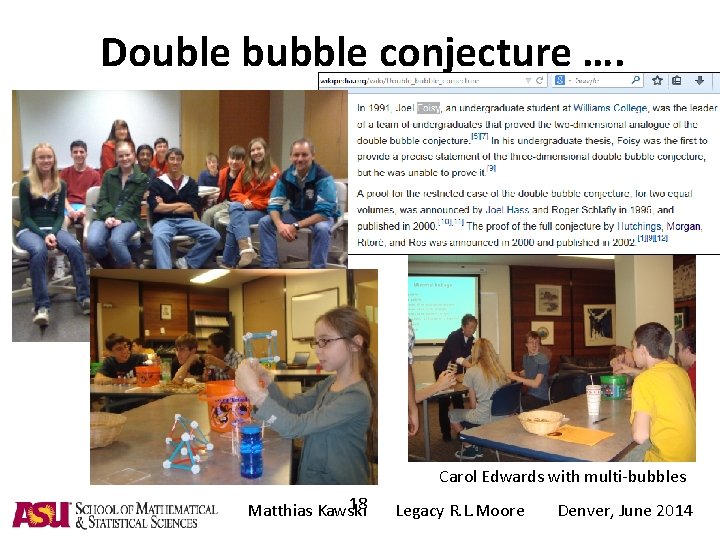
Double bubble conjecture …. Carol Edwards with multi-bubbles 18 Matthias Kawski Legacy R. L. Moore Denver, June 2014
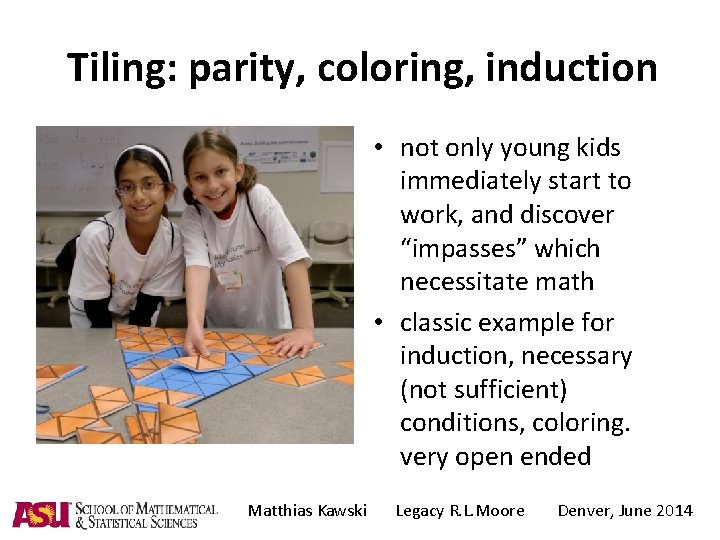
Tiling: parity, coloring, induction • not only young kids immediately start to work, and discover “impasses” which necessitate math • classic example for induction, necessary (not sufficient) conditions, coloring. very open ended Matthias Kawski Legacy R. L. Moore Denver, June 2014
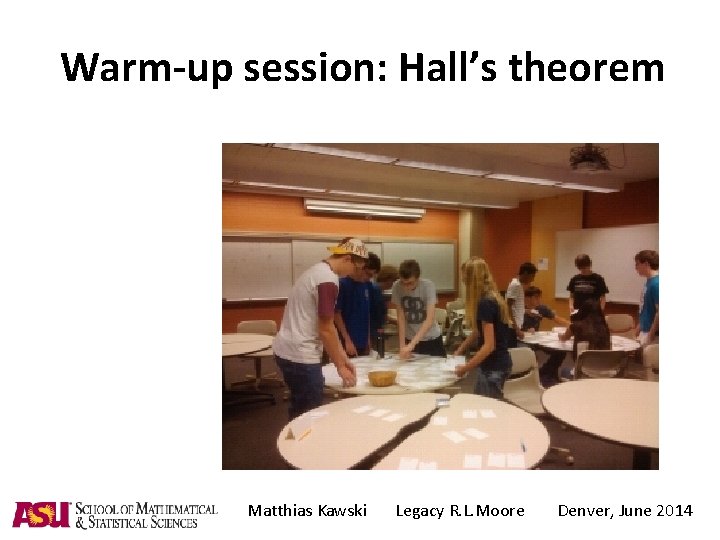
Warm-up session: Hall’s theorem Matthias Kawski Legacy R. L. Moore Denver, June 2014
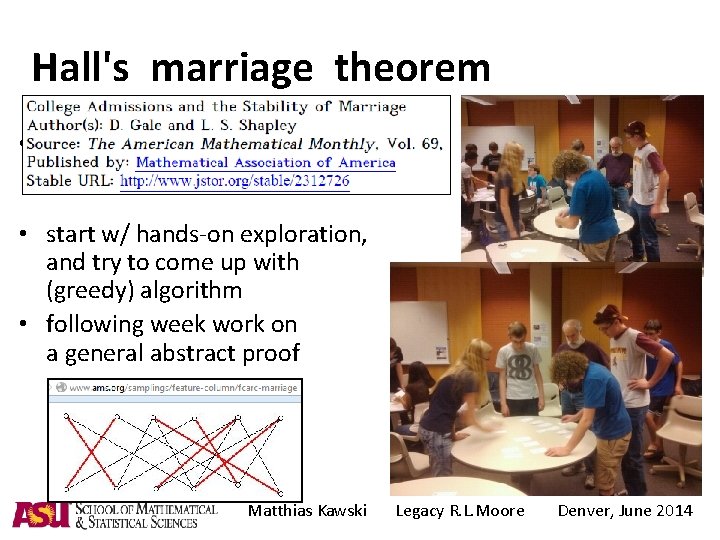
Hall's marriage theorem • • start w/ hands-on exploration, and try to come up with (greedy) algorithm • following week work on a general abstract proof Matthias Kawski Legacy R. L. Moore Denver, June 2014
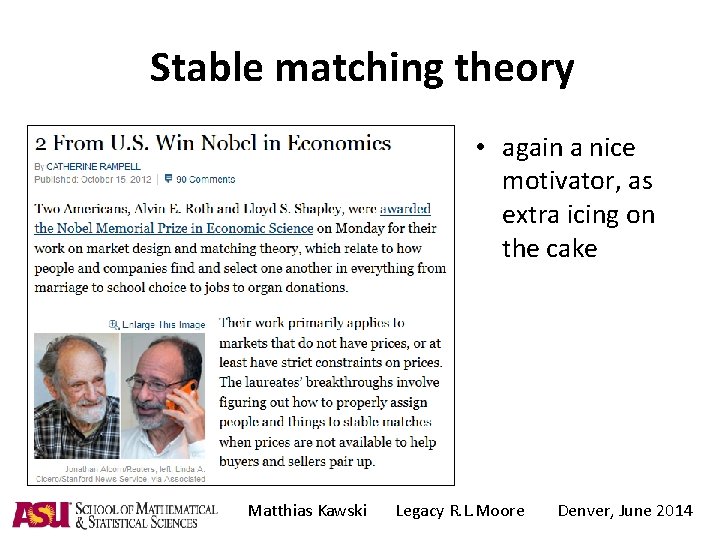
Stable matching theory • again a nice motivator, as extra icing on the cake Matthias Kawski Legacy R. L. Moore Denver, June 2014
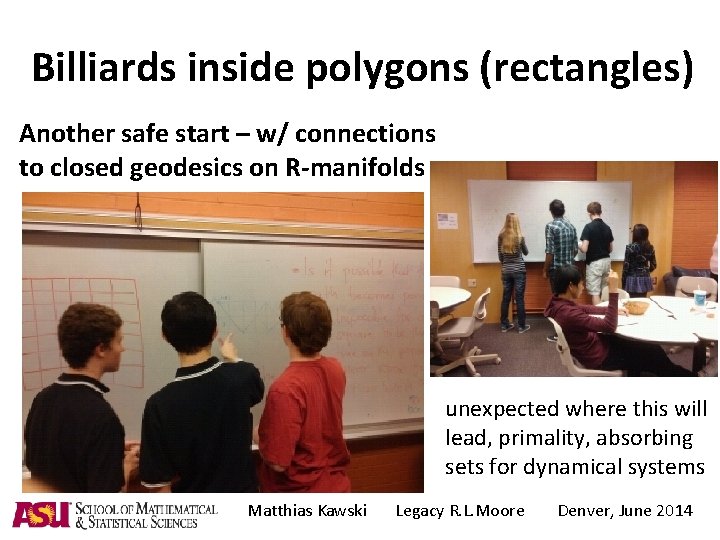
Billiards inside polygons (rectangles) Another safe start – w/ connections to closed geodesics on R-manifolds unexpected where this will lead, primality, absorbing sets for dynamical systems Matthias Kawski Legacy R. L. Moore Denver, June 2014
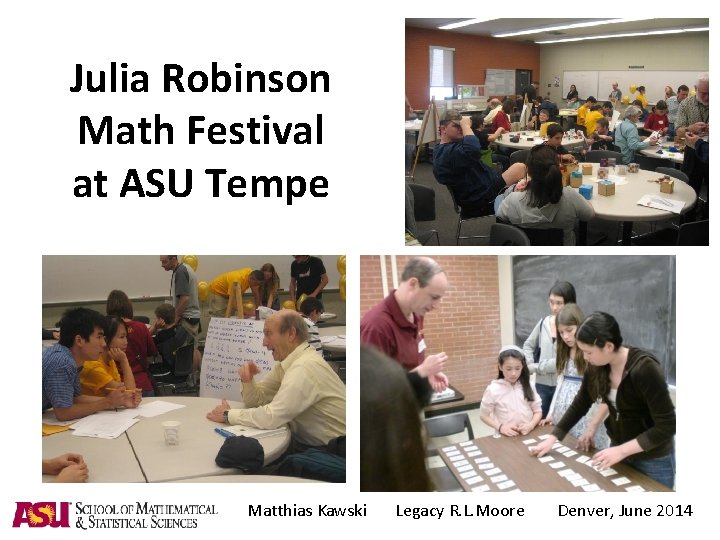
Julia Robinson Math Festival at ASU Tempe Matthias Kawski Legacy R. L. Moore Denver, June 2014
Parting comments • faculty use Math. Circle as a teaching laboratory experimenting with different ways to deliver, intention: take experience back to classrooms • students changed, adopted style of the pros: reflective, deliberate, open-ended R, new Qs • research/inquiry not bound by tight lesson plans • open ended questions, and new directions make it difficult to write a script (no worksheets) • often only a-posterior recollections what we did, reflections on what worked well (dissemination). Matthias Kawski Legacy R. L. Moore Denver, June 2014
- Slides: 25