
1 I can recognise numbers 1 20 written

1. I can recognise numbers 1 -20 (written and spoken) a) Look at the numbers below – read them through to yourself. 1 uno 11 once 2 dos 12 doce 3 tres 13 trece 4 cuatro 14 catorce 5 cinco 15 quince 6 seis 16 dieciseis 7 siete 17 diecisiete 8 ocho 18 dieciocho 9 nueve 19 diecinueve 10 diez 20 veinte b) Turn this sheet over – look at the numbers there and see if you know what they mean. If so, write them in. If not, do c) or d) or e) c) Log on and go to Euro. Talk – do the numbers activities d) Log on and Google ‘languages online’ – the web address should begin http: //atschool. eduweb. . – click on Espanol, then Caminos 1 Unidad 1 then do the 4 numbers activities 4, 5, 6, 7 from the list. e) Log on and go to: http: //oye. languageskills. co. uk – choose year 7 and then numbers 1 -31 section. Go right to the bottom and do the Vocab and Pronunciation activity. NB: if you are ready to see if you can recognise the numbers when spoken, tell your teacher and she will give the short test on this. You can write your answers below (fold the sheet in half so you cannot see the numbers above):

1. I can recognise numbers 1 -20 (written and spoken) NB: the numbers 1 -20 are not in order! catorce once dieciocho nueve tres trece cuatro uno veinte quince seis siete dieciseis diecisiete ocho dos doce diecinueve diez cinco a. f. b. g. c. h. d. i. e. j. Challenge 1 achieved – date __________ Signature of teacher: ___________ 20 10
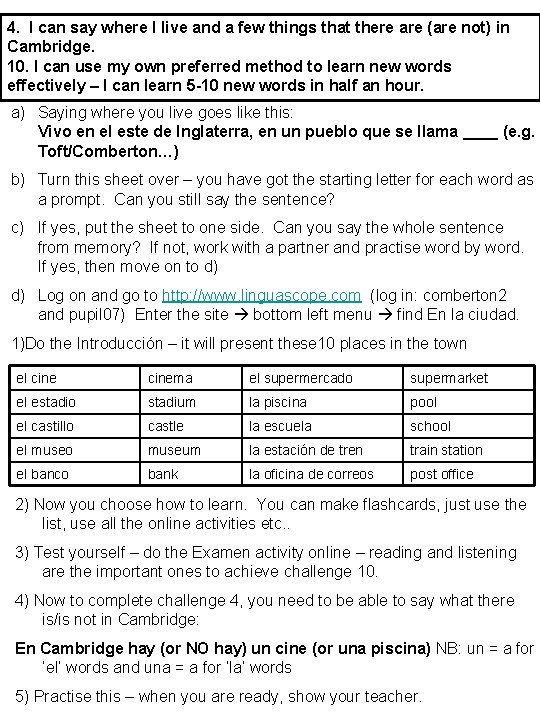
4. I can say where I live and a few things that there are (are not) in Cambridge. 10. I can use my own preferred method to learn new words effectively – I can learn 5 -10 new words in half an hour. a) Saying where you live goes like this: Vivo en el este de Inglaterra, en un pueblo que se llama ____ (e. g. Toft/Comberton…) b) Turn this sheet over – you have got the starting letter for each word as a prompt. Can you still say the sentence? c) If yes, put the sheet to one side. Can you say the whole sentence from memory? If not, work with a partner and practise word by word. If yes, then move on to d) d) Log on and go to http: //www. linguascope. com (log in: comberton 2 and pupil 07) Enter the site bottom left menu find En la ciudad. 1)Do the Introducción – it will present these 10 places in the town el cinema el supermercado supermarket el estadio stadium la piscina pool el castillo castle la escuela school el museo museum la estación de tren train station el banco bank la oficina de correos post office 2) Now you choose how to learn. You can make flashcards, just use the list, use all the online activities etc. . 3) Test yourself – do the Examen activity online – reading and listening are the important ones to achieve challenge 10. 4) Now to complete challenge 4, you need to be able to say what there is/is not in Cambridge: En Cambridge hay (or NO hay) un cine (or una piscina) NB: un = a for ‘el’ words and una = a for ‘la’ words 5) Practise this – when you are ready, show your teacher.
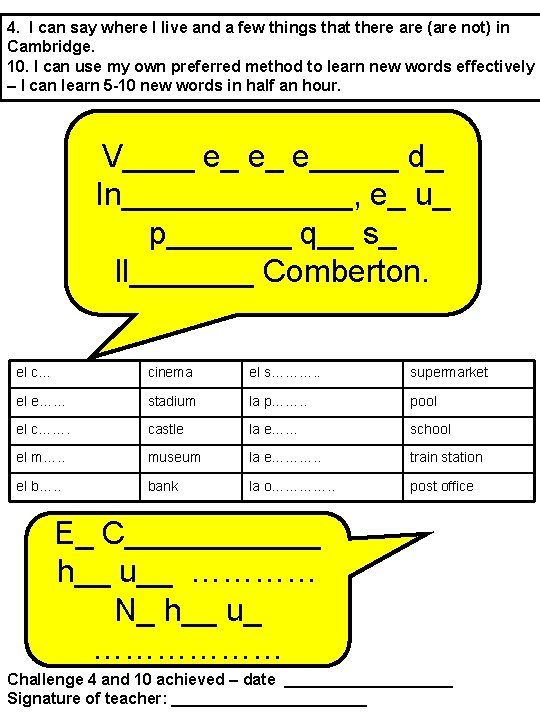
4. I can say where I live and a few things that there are (are not) in Cambridge. 10. I can use my own preferred method to learn new words effectively – I can learn 5 -10 new words in half an hour. V____ e_ e_ e_____ d_ In_______, e_ u_ p_______ q__ s_ ll_______ Comberton. el c… cinema el s………. . supermarket el e…… stadium la p……. . pool el c……. castle la e…… school el m…. . museum la e………. . train station el b…. . bank la o…………. . post office E_ C______ h__ u__ ………… N_ h__ u_ ……………… Challenge 4 and 10 achieved – date __________ Signature of teacher: ___________
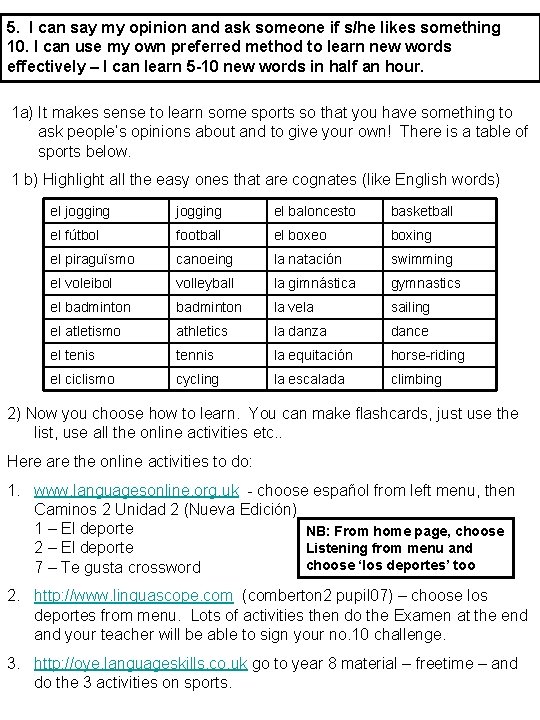
5. I can say my opinion and ask someone if s/he likes something 10. I can use my own preferred method to learn new words effectively – I can learn 5 -10 new words in half an hour. 1 a) It makes sense to learn some sports so that you have something to ask people’s opinions about and to give your own! There is a table of sports below. 1 b) Highlight all the easy ones that are cognates (like English words) el jogging el baloncesto basketball el fútbol football el boxeo boxing el piraguïsmo canoeing la natación swimming el voleibol volleyball la gimnástica gymnastics el badminton la vela sailing el atletismo athletics la danza dance el tenis tennis la equitación horse-riding el ciclismo cycling la escalada climbing 2) Now you choose how to learn. You can make flashcards, just use the list, use all the online activities etc. . Here are the online activities to do: 1. www. languagesonline. org. uk - choose español from left menu, then Caminos 2 Unidad 2 (Nueva Edición) 1 – El deporte NB: From home page, choose Listening from menu and 2 – El deporte choose ‘los deportes’ too 7 – Te gusta crossword 2. http: //www. linguascope. com (comberton 2 pupil 07) – choose los deportes from menu. Lots of activities then do the Examen at the end and your teacher will be able to sign your no. 10 challenge. 3. http: //oye. languageskills. co. uk go to year 8 material – freetime – and do the 3 activities on sports.
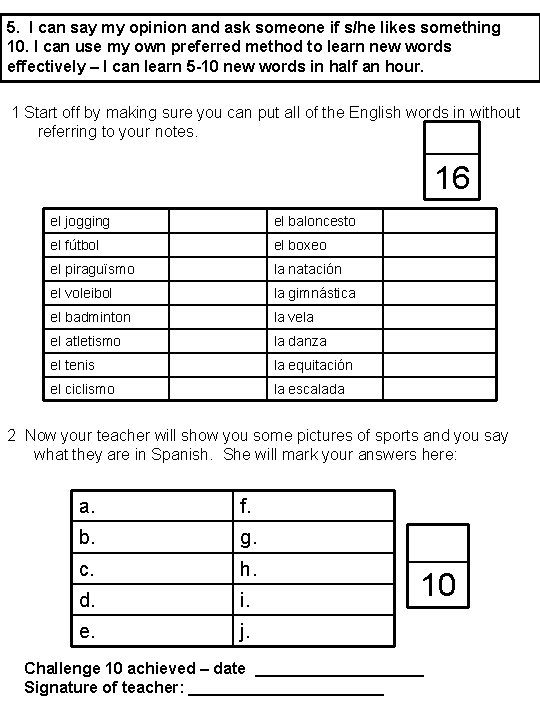
5. I can say my opinion and ask someone if s/he likes something 10. I can use my own preferred method to learn new words effectively – I can learn 5 -10 new words in half an hour. 1 Start off by making sure you can put all of the English words in without referring to your notes. 16 el jogging el baloncesto el fútbol el boxeo el piraguïsmo la natación el voleibol la gimnástica el badminton la vela el atletismo la danza el tenis la equitación el ciclismo la escalada 2 Now your teacher will show you some pictures of sports and you say what they are in Spanish. She will mark your answers here: a. f. b. g. c. h. d. i. e. j. 10 Challenge 10 achieved – date __________ Signature of teacher: ___________
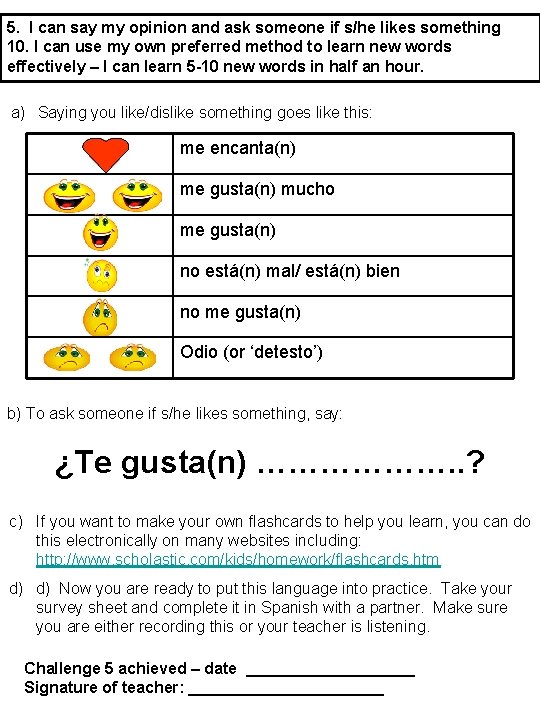
5. I can say my opinion and ask someone if s/he likes something 10. I can use my own preferred method to learn new words effectively – I can learn 5 -10 new words in half an hour. a) Saying you like/dislike something goes like this: me encanta(n) me gusta(n) mucho me gusta(n) no está(n) mal/ está(n) bien no me gusta(n) Odio (or ‘detesto’) b) To ask someone if s/he likes something, say: ¿Te gusta(n) ………………. . ? c) If you want to make your own flashcards to help you learn, you can do this electronically on many websites including: http: //www. scholastic. com/kids/homework/flashcards. htm d) d) Now you are ready to put this language into practice. Take your survey sheet and complete it in Spanish with a partner. Make sure you are either recording this or your teacher is listening. Challenge 5 achieved – date __________ Signature of teacher: ___________
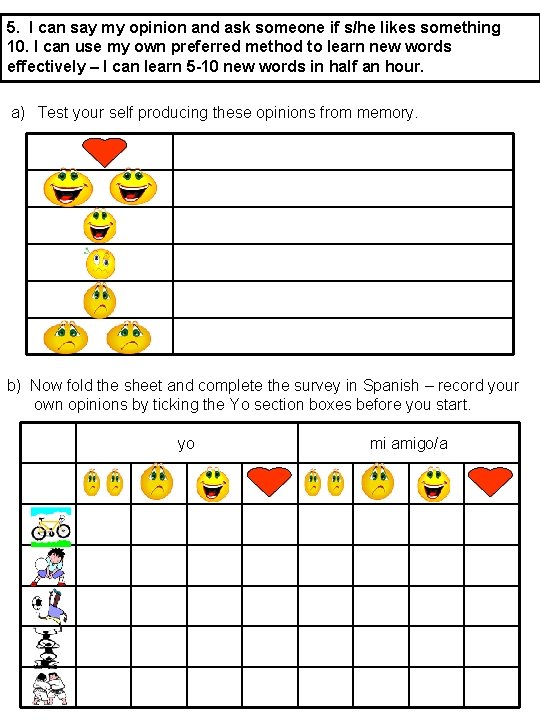
5. I can say my opinion and ask someone if s/he likes something 10. I can use my own preferred method to learn new words effectively – I can learn 5 -10 new words in half an hour. a) Test your self producing these opinions from memory. b) Now fold the sheet and complete the survey in Spanish – record your own opinions by ticking the Yo section boxes before you start. yo mi amigo/a
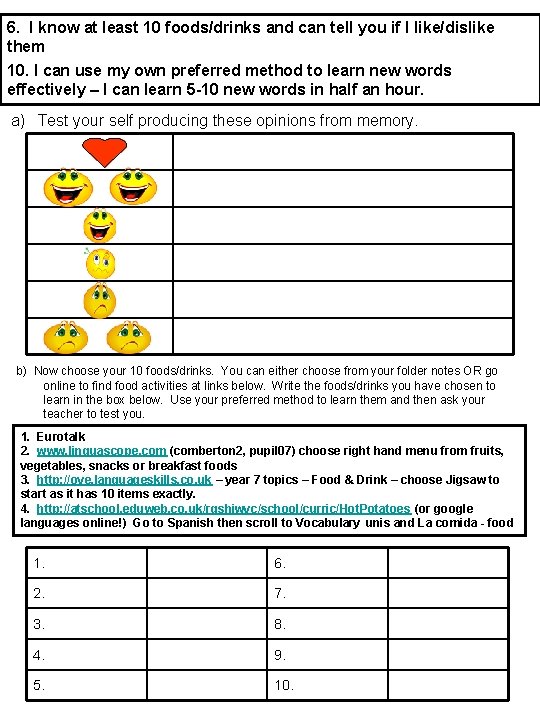
6. I know at least 10 foods/drinks and can tell you if I like/dislike them 10. I can use my own preferred method to learn new words effectively – I can learn 5 -10 new words in half an hour. a) Test your self producing these opinions from memory. b) Now choose your 10 foods/drinks. You can either choose from your folder notes OR go online to find food activities at links below. Write the foods/drinks you have chosen to learn in the box below. Use your preferred method to learn them and then ask your teacher to test you. 1. Eurotalk 2. www. linguascope. com (comberton 2, pupil 07) choose right hand menu from fruits, vegetables, snacks or breakfast foods 3. http: //oye. languageskills. co. uk – year 7 topics – Food & Drink – choose Jigsaw to start as it has 10 items exactly. 4. http: //atschool. eduweb. co. uk/rgshiwyc/school/curric/Hot. Potatoes (or google languages online!) Go to Spanish then scroll to Vocabulary unis and La comida - food 1. 6. 2. 7. 3. 8. 4. 9. 5. 10.
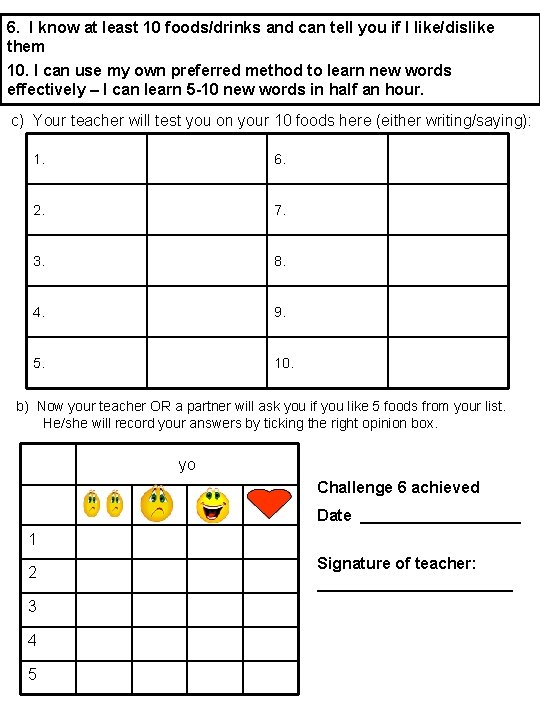
6. I know at least 10 foods/drinks and can tell you if I like/dislike them 10. I can use my own preferred method to learn new words effectively – I can learn 5 -10 new words in half an hour. c) Your teacher will test you on your 10 foods here (either writing/saying): 1. 6. 2. 7. 3. 8. 4. 9. 5. 10. b) Now your teacher OR a partner will ask you if you like 5 foods from your list. He/she will record your answers by ticking the right opinion box. yo Challenge 6 achieved Date _________ 1 2 3 4 5 Signature of teacher: ___________
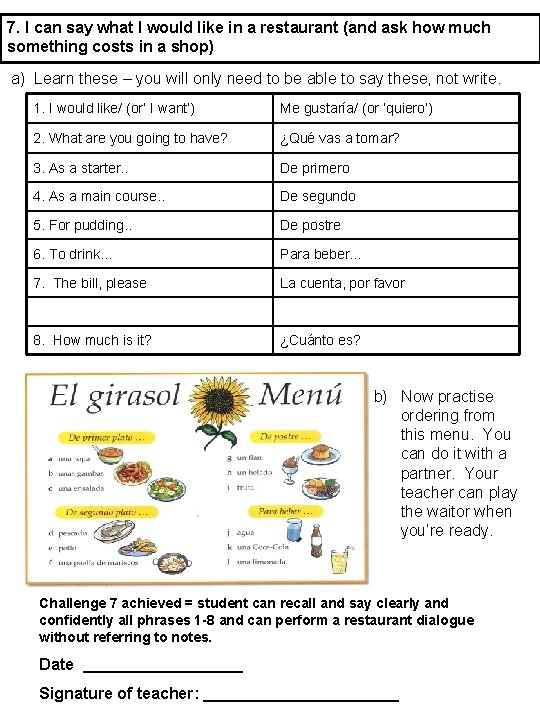
7. I can say what I would like in a restaurant (and ask how much something costs in a shop) a) Learn these – you will only need to be able to say these, not write. 1. I would like/ (or’ I want’) Me gustaría/ (or ‘quiero’) 2. What are you going to have? ¿Qué vas a tomar? 3. As a starter. . De primero 4. As a main course. . De segundo 5. For pudding. . De postre 6. To drink… Para beber… 7. The bill, please La cuenta, por favor 8. How much is it? ¿Cuánto es? b) Now practise ordering from this menu. You can do it with a partner. Your teacher can play the waitor when you’re ready. Challenge 7 achieved = student can recall and say clearly and confidently all phrases 1 -8 and can perform a restaurant dialogue without referring to notes. Date _________ Signature of teacher: ___________
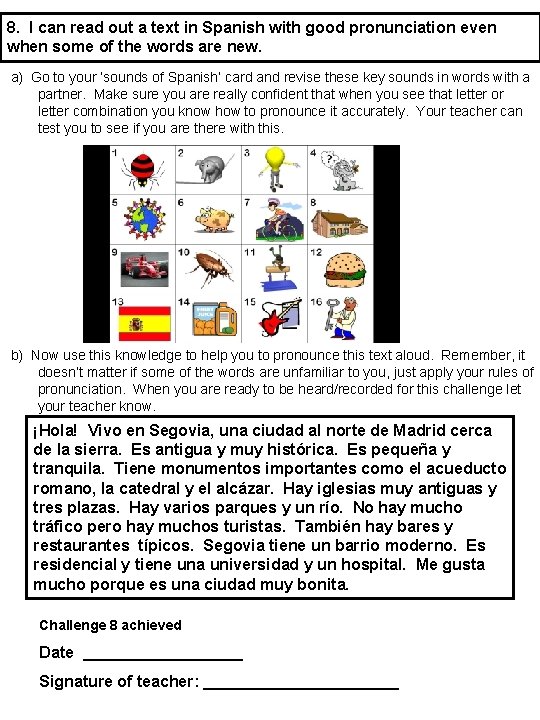
8. I can read out a text in Spanish with good pronunciation even when some of the words are new. a) Go to your ‘sounds of Spanish’ card and revise these key sounds in words with a partner. Make sure you are really confident that when you see that letter or letter combination you know how to pronounce it accurately. Your teacher can test you to see if you are there with this. b) Now use this knowledge to help you to pronounce this text aloud. Remember, it doesn’t matter if some of the words are unfamiliar to you, just apply your rules of pronunciation. When you are ready to be heard/recorded for this challenge let your teacher know. ¡Hola! Vivo en Segovia, una ciudad al norte de Madrid cerca de la sierra. Es antigua y muy histórica. Es pequeña y tranquila. Tiene monumentos importantes como el acueducto romano, la catedral y el alcázar. Hay iglesias muy antiguas y tres plazas. Hay varios parques y un río. No hay mucho tráfico pero hay muchos turistas. También hay bares y restaurantes típicos. Segovia tiene un barrio moderno. Es residencial y tiene una universidad y un hospital. Me gusta mucho porque es una ciudad muy bonita. Challenge 8 achieved Date _________ Signature of teacher: ___________
9. I can research new words by using a dictionary or online research tool (and use this knowledge to help me understand an unfamiliar text. ) a) First decide if you want to use a dictionary or online translator (http: //babelfish. altavista. com/) to look up 10 new words. Then decide on your 10 words and look them up. Write the answers down in the grid. Make sure you can identify the type of word you are looking up (i. e. noun, adjective, verb etc. . ) English word Type of word Spanish word
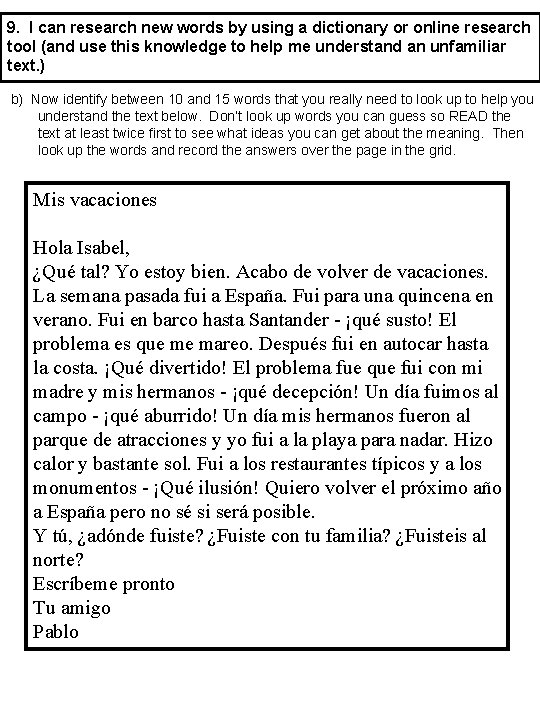
9. I can research new words by using a dictionary or online research tool (and use this knowledge to help me understand an unfamiliar text. ) b) Now identify between 10 and 15 words that you really need to look up to help you understand the text below. Don’t look up words you can guess so READ the text at least twice first to see what ideas you can get about the meaning. Then look up the words and record the answers over the page in the grid. Mis vacaciones Hola Isabel, ¿Qué tal? Yo estoy bien. Acabo de volver de vacaciones. La semana pasada fui a España. Fui para una quincena en verano. Fui en barco hasta Santander - ¡qué susto! El problema es que me mareo. Después fui en autocar hasta la costa. ¡Qué divertido! El problema fue que fui con mi madre y mis hermanos - ¡qué decepción! Un día fuimos al campo - ¡qué aburrido! Un día mis hermanos fueron al parque de atracciones y yo fui a la playa para nadar. Hizo calor y bastante sol. Fui a los restaurantes típicos y a los monumentos - ¡Qué ilusión! Quiero volver el próximo año a España pero no sé si será posible. Y tú, ¿adónde fuiste? ¿Fuiste con tu familia? ¿Fuisteis al norte? Escríbeme pronto Tu amigo Pablo
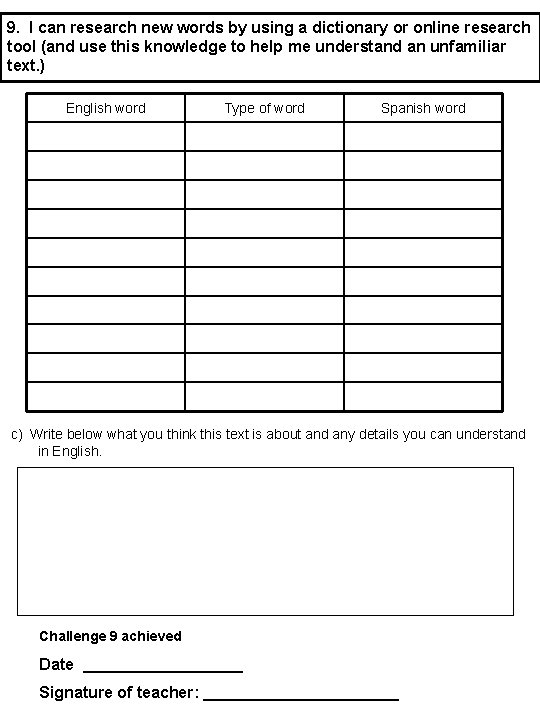
9. I can research new words by using a dictionary or online research tool (and use this knowledge to help me understand an unfamiliar text. ) English word Type of word Spanish word c) Write below what you think this text is about and any details you can understand in English. Challenge 9 achieved Date _________ Signature of teacher: ___________
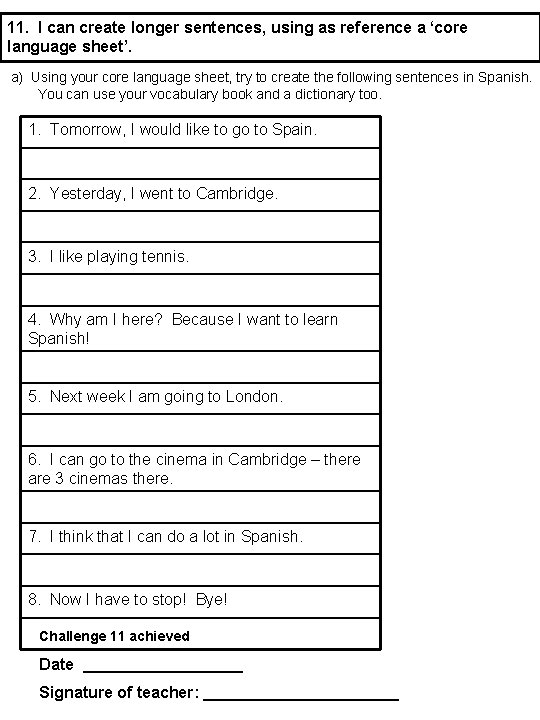
11. I can create longer sentences, using as reference a ‘core language sheet’. a) Using your core language sheet, try to create the following sentences in Spanish. You can use your vocabulary book and a dictionary too. 1. Tomorrow, I would like to go to Spain. 2. Yesterday, I went to Cambridge. 3. I like playing tennis. 4. Why am I here? Because I want to learn Spanish! 5. Next week I am going to London. 6. I can go to the cinema in Cambridge – there are 3 cinemas there. 7. I think that I can do a lot in Spanish. 8. Now I have to stop! Bye! Challenge 11 achieved Date _________ Signature of teacher: ___________
- Slides: 16