
1 hv spectrum correctedshifted CF 3 Br agust
1 hv spectrum corrected/shifted CF 3 Br agust, heima, . . CF 3 Br/Sept 10/PXP-291110 ks/Br 1 D-REMPIm. W-291110 ks-011210 ak. pxp agust, heima, . . CF 3 Br/Sept 10/PXP-291110 ks/Br 1 D-REMPIm. W-291110 ks-021210 ak. pxp agust, www, . . cf 3 br/PPT-011210 ak. ppt agust, heima, . . CF 3 Br/Sept 10/PXP-291110 ks/Leiðrétt-291110 ks-011210 ak. pxp agust, heima, . . CF 3 Br/Sept 10/PXP-291110 ks/Leiðrétt-291110 ks-021210 ak. pxp
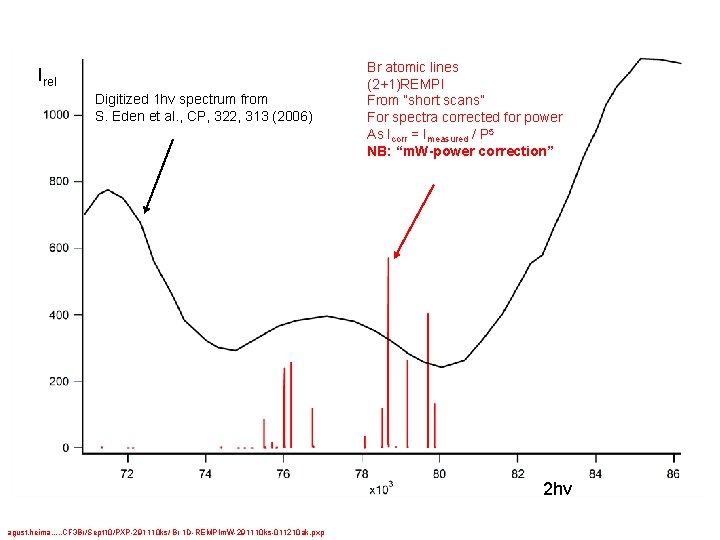
Irel Digitized 1 hv spectrum from S. Eden et al. , CP, 322, 313 (2006) Br atomic lines (2+1)REMPI From “short scans” For spectra corrected for power As Icorr = Imeasured / P 5 NB: “m. W-power correction” 2 hv agust, heima, . . CF 3 Br/Sept 10/PXP-291110 ks/ Br 1 D-REMPIm. W-291110 ks-011210 ak. pxp
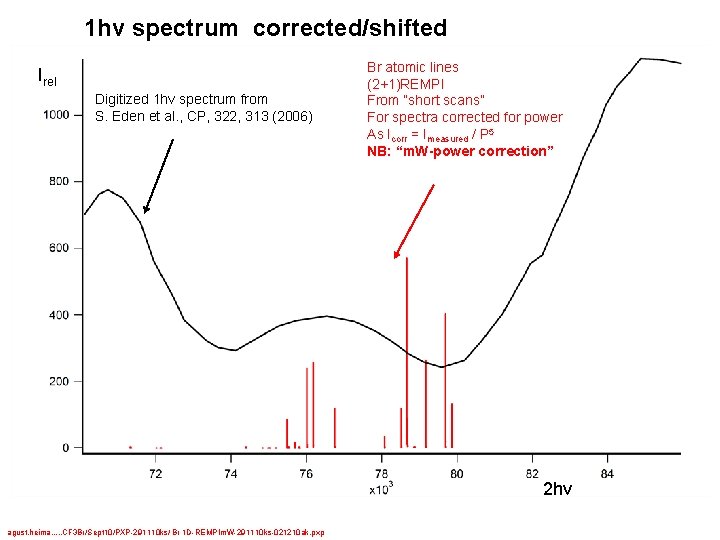
1 hv spectrum corrected/shifted Irel Digitized 1 hv spectrum from S. Eden et al. , CP, 322, 313 (2006) Br atomic lines (2+1)REMPI From “short scans” For spectra corrected for power As Icorr = Imeasured / P 5 NB: “m. W-power correction” 2 hv agust, heima, . . CF 3 Br/Sept 10/PXP-291110 ks/ Br 1 D-REMPIm. W-291110 ks-021210 ak. pxp
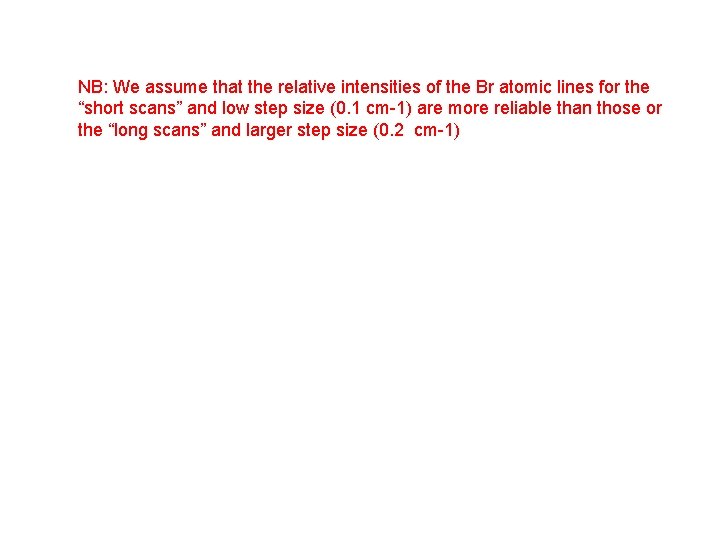
NB: We assume that the relative intensities of the Br atomic lines for the “short scans” and low step size (0. 1 cm-1) are more reliable than those or the “long scans” and larger step size (0. 2 cm-1)
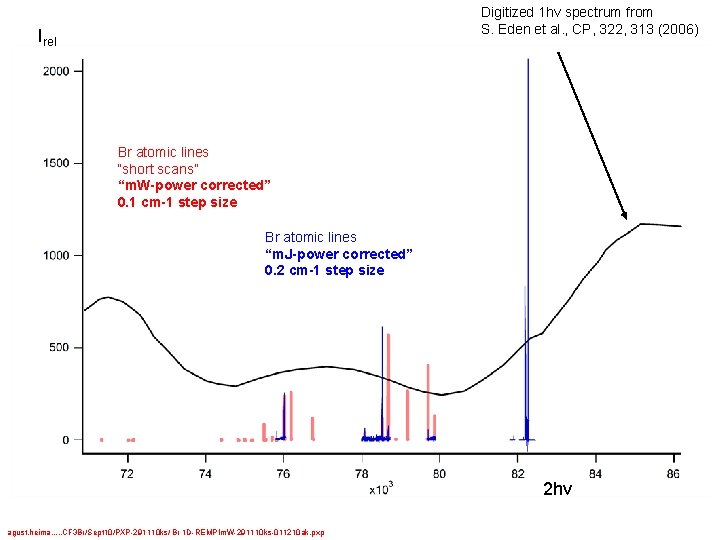
Digitized 1 hv spectrum from S. Eden et al. , CP, 322, 313 (2006) Irel Br atomic lines “short scans” “m. W-power corrected” 0. 1 cm-1 step size Br atomic lines “m. J-power corrected” 0. 2 cm-1 step size 2 hv agust, heima, . . CF 3 Br/Sept 10/PXP-291110 ks/ Br 1 D-REMPIm. W-291110 ks-011210 ak. pxp
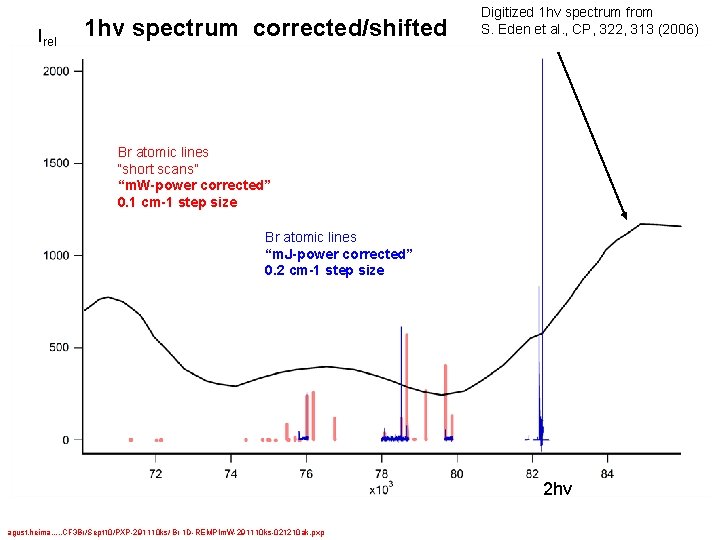
Irel 1 hv spectrum corrected/shifted Digitized 1 hv spectrum from S. Eden et al. , CP, 322, 313 (2006) Br atomic lines “short scans” “m. W-power corrected” 0. 1 cm-1 step size Br atomic lines “m. J-power corrected” 0. 2 cm-1 step size 2 hv agust, heima, . . CF 3 Br/Sept 10/PXP-291110 ks/ Br 1 D-REMPIm. W-291110 ks-021210 ak. pxp
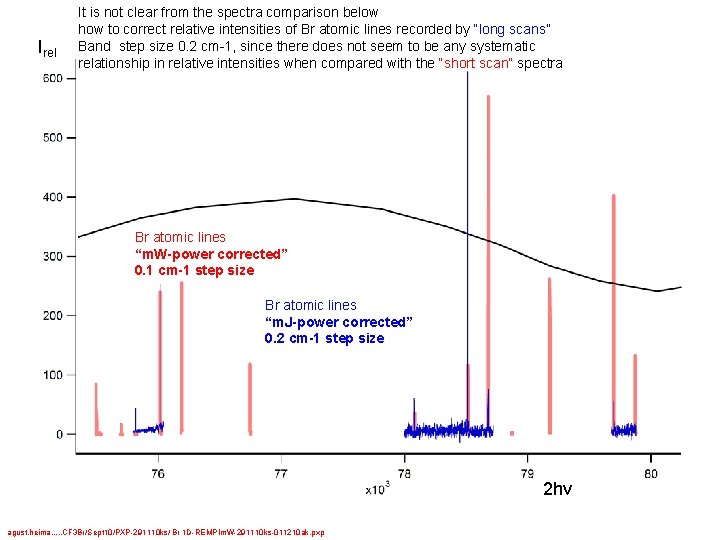
Irel It is not clear from the spectra comparison below how to correct relative intensities of Br atomic lines recorded by “long scans” Band step size 0. 2 cm-1, since there does not seem to be any systematic relationship in relative intensities when compared with the “short scan” spectra Br atomic lines “m. W-power corrected” 0. 1 cm-1 step size Br atomic lines “m. J-power corrected” 0. 2 cm-1 step size 2 hv agust, heima, . . CF 3 Br/Sept 10/PXP-291110 ks/ Br 1 D-REMPIm. W-291110 ks-011210 ak. pxp
• The conclusion is that Br atomic lines in the high wavenumber range (> 80000 cm-1) need to be rescanned by short scans and small step sizes (0. 1 cm-1) in order to obtain more relyable picture of the relative intensities of The bands in that region. • Based on the data presented in slide 2, abowe, for Br atomic lines recorded in the range 71000 – 80000 cm-1 (“short scans”, small step sizes) the largest signals are observed for the region of excitation to the [CF 3 Br+, 2 E]c ; 5 p Rydberg state whereas atomic lines corresponding to excitations to the region to the [CF 3 Br+, 2 E]c ; 5 s Rydberg state are very weak. This suggests that the major channel For formation of Br is via excitation to the [CF 3 Br+, 2 E]c ; 5 p Rydberg state. This fits nicely with the results of the CF 3+ formation analaysis: See: http: //www 3. hi. is/~agust/rannsoknir/rempi/cf 3 br/PPT-201110 ak. ppt and below
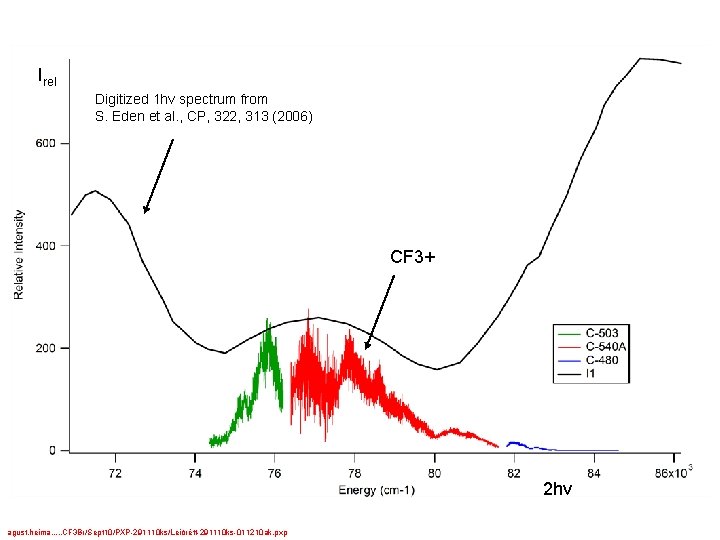
Irel Digitized 1 hv spectrum from S. Eden et al. , CP, 322, 313 (2006) CF 3+ 2 hv agust, heima, . . CF 3 Br/Sept 10/PXP-291110 ks/Leiðrétt-291110 ks-011210 ak. pxp
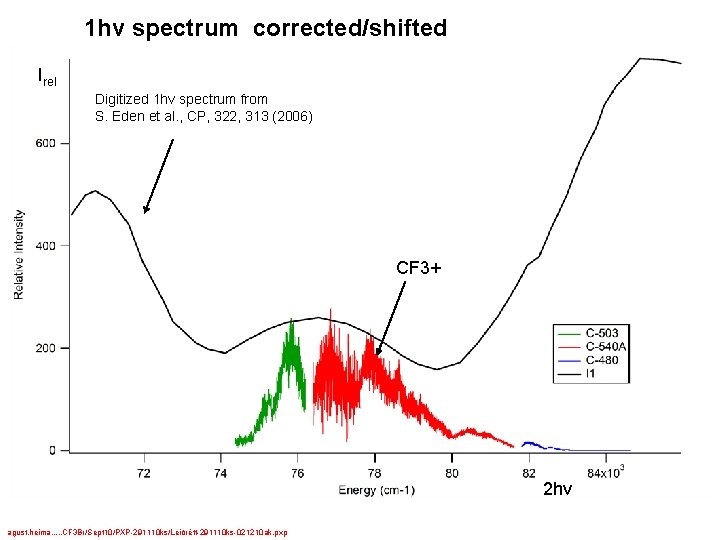
1 hv spectrum corrected/shifted Irel Digitized 1 hv spectrum from S. Eden et al. , CP, 322, 313 (2006) CF 3+ 2 hv agust, heima, . . CF 3 Br/Sept 10/PXP-291110 ks/Leiðrétt-291110 ks-021210 ak. pxp
- Slides: 10